Meet Me in the Park — Norman Bluhm and Frank O’Hara

“Why I Am Not a Painter” — Frank O’Hara

“Why I Am Not a Painter” by Frank O’Hara

I am not a painter, I am a poet.
Why? I think I would rather be
a painter, but I am not. Well,

for instance, Mike Goldberg
is starting a painting. I drop in.
“Sit down and have a drink” he
says. I drink; we drink. I look
up. “You have SARDINES in it.”
“Yes, it needed something there.”
“Oh.” I go and the days go by
and I drop in again. The painting
is going on, and I go, and the days
go by. I drop in. The painting is
finished. “Where’s SARDINES?”
All that’s left is just
letters, “It was too much,” Mike says.

But me? One day I am thinking of
a color: orange. I write a line
about orange. Pretty soon it is a
whole page of words, not lines.
Then another page. There should be
so much more, not of orange, of
words, of how terrible orange is
and life. Days go by. It is even in
prose, I am a real poet. My poem
is finished and I haven’t mentioned
orange yet. It’s twelve poems, I call
it ORANGES. And one day in a gallery
I see Mike’s painting, called SARDINES.


Sardines — Mike Goldberg

sardines

“Bernhard is an architect of consciousness” — Ben Marcus on Thomas Bernhard

Bernhard is an architect of consciousness more than a narrative storyteller. His project is not to reference the known world, stuffing it with fully rounded characters who commence to discover their conflicts with one another, but to erect complex states of mind-usually self-loathing, obsessive ones-and then set about destroying them. Bernhard’s characters are thorough accomplices in their own destruction, and they are bestowed with a language that is dementedly repetitive and besotted with the appurtenances of logical thinking. The devious rationality of Bernhard’s language strives for a severe authority, and it tends to make his characters seem believable, no matter how unhinged their claims. Phrases don’t get repeated so much as needled until they yield graver meanings, with incremental changes introduced as though a deranged scientist were adding and removing substances in the performance of an experiment. “You wake up, and you feel molested,” Strauch says:

In fact: the hideous thing. You open your chest of drawers :a further molestation. Washing and dressing are molestations. Having to get dressed! Having to eat breakfast! When you go out on the street you are subject to the gravest possible molestations. You are unable to shield yourself. You lay about yourself, but it’s no use. The blows you dole out are returned a hundred fold. What are streets, anyway? Wendings of molestation, up and down. Squares? Bundled together molestations.

Without a story to drive it, Frost builds not through unfolding events but by telemarking around Strauch’s bitter cosmology while the narrator follows him through the woods, fattening himself on the rage of his new mentor. A chart of Strauch’s worldview would produce a splotchy Rorschach of points and counterpoints, contradictions, reversals, and the occasional backflip, none of which could really hold up to a logician’s scrutiny, which adds to his mystery. Strauch, a failed artist who only painted in total darkness, is opposed to nearly everything, and lest you think he’s a humanist at the core, with a fondness for the arts (that classic virtue of the misanthrope), he claims that “artists are the sons and daughters of loathsomeness, of paradisiac shamelessness, the original sons and daughters of lewdness; artists, painters, writers and musicians are the compulsive masturbators on the planet.”

From Ben Marcus’s 2011 essay “Misery Loves Nothing,” first published in Harper’s and available in full for free at Marcus’s site. I’m about halfway through Bernhard’s early novel Frost, a book that is very dark, bitter, intriguing, and funny. Very very funny.

The Artist’s Granddaughter at the Table — Max Liebermann

Expectation — Richard Oelze

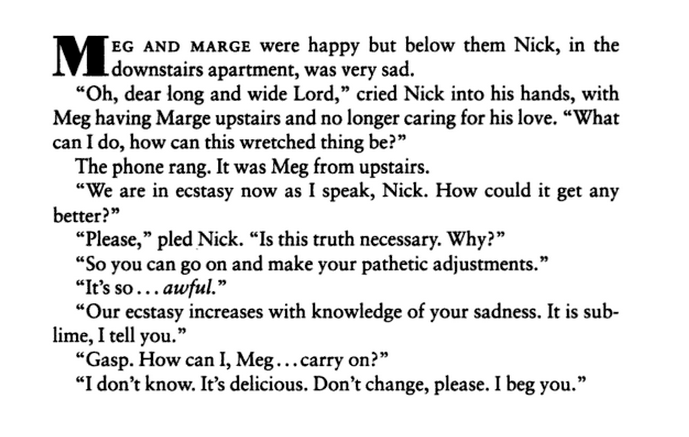
“Dear Awful Diary” — Barry Hannah

dadbh

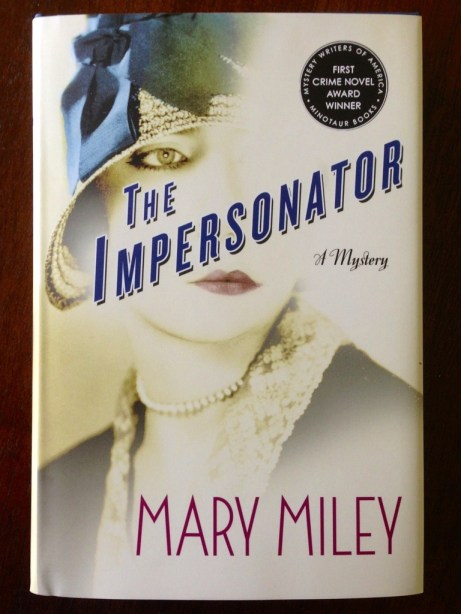
The Impersonator (Book Acquired, 8.26.2013)

20130830-074003.jpg

The Impersonator, a mystery by Mary Miley. Publisher Macmillan/Minotaur’s blurb:

In 1917, Jessie Carr, fourteen years old and sole heiress to her family’s vast fortune, disappeared without a trace. Now, years later, her uncle Oliver Beckett thinks he’s found her: a young actress in a vaudeville playhouse is a dead ringer for his missing niece. But when Oliver confronts the girl, he learns he’s wrong. Orphaned young, Leah’s been acting since she was a toddler.

Oliver, never one to miss an opportunity, makes a proposition—with his coaching, Leah can impersonate Jessie, claim the fortune, and split it with him. The role of a lifetime, he says. A one-way ticket to Sing Sing, she hears. But when she’s let go from her job, Oliver’s offer looks a lot more appealing. Leah agrees to the con, but secretly promises herself to try and find out what happened to the real Jessie. There’s only one problem: Leah’s act won’t fool the one person who knows the truth about Jessie’s disappearance.

Set against a Prohibition-era backdrop of speakeasies and vaudeville houses, Mary Miley’s Minotaur Books/Mystery Writers of America First Crime Novel Competition winner The Impersonator will delight readers with its elaborate mystery and lively prose.

Walt Kelly’s NO!

WaltKelly_NO-1_cover_100

Read all of Walt Kelly’s NO! at Whirled of Kelly.

“Perhaps the universe is suspended on the tooth of some monster” (Thoughts from Anton Chekhov’s Note-Books)

* * * * *

A scholar, without talent, a blockhead, worked for twenty-four years and produced nothing good, gave the world only scholars as untalented and as narrow-minded as himself. At night he secretly bound books—that was his true vocation: in that he was an artist and felt the joy of it. There came to him a bookbinder, who loved learning and studied secretly at night.

* * * * *

But perhaps the universe is suspended on the tooth of some monster.

* * * * *

Keep to the right, you of the yellow eye!

* * * * *

Do you want to eat? No, on the contrary.

* * * * *

A pregnant woman with short arms and a long neck, like a kangaroo.

* * * * *

How pleasant it is to respect people! When I see books, I am not concerned with how the authors loved or played cards; I see only their marvelous works.

* * * * *

To demand that the woman one loves should be pure is egotistical: to look for that in a woman which I have not got myself is not love, but worship, since one ought to love one’s equals.

* * * * *

The so-called pure childlike joy of life is animal joy.

* * * * *

—From Anton Chekhov’s Note-Books.

Portrait of Y.E. Kustodieva — Boris Kustodiev

Last Year at Marienbad — Alain Resnais (Full Film)

Sharks — Utagawa Kuniyoshi

The Mystery at the Middle of Ordinary Life — Don DeLillo

The Mystery at the Middle of Ordinary Life, a one-act play by Don DeLillo

A MAN and a WOMAN in a room.

WOMAN: I was thinking how strange it is.

MAN: What?

WOMAN: That people are able to live together. Days and nights and years. Five years go by. How do they do it? Ten, eleven, twelve years. Two people making one life. Sharing ten thousand meals. Talking to each other face to face, open face, like hot sandwiches. All the words that fill the house. What do people say over a lifetime? Trapped in each other’s syntax. The same voice. The droning tonal repetition. I’ll tell you something.

MAN: You’ll tell me something.

WOMAN: There’s a mystery here. The people behind the walls of the brown house next door. What do they say and how do they survive it? All that idle dialogue. The nasality. The banality. I was thinking how strange it is. How do they do it, night after night, all those nights, those words, those few who do it and survive?

MAN: They make love. They make salads.

WOMAN: But sooner or later they have to speak. This is what shatters the world. I mean isn’t it gradually shattering to sit and listen to the same person all the time, without reason or rhyme. Words that trail away. The pauses. The clauses. How many thousands of times can you look at the same drained face and watch the mouth begin to open? Everything’s been fine up to now. It is when they open their mouths. It is when they speak.

[Pause.]

MAN: I’m still not over this cold of mine.

WOMAN: Take those things you take.

MAN: The tablets.

WOMAN: The caplets.

[Pause.]

MAN: Long day.

WOMAN: Long day.

MAN: A good night’s sleep.

WOMAN: Long slow day.

[Lights slowly down.]

CURTAIN
On the Beach — Felix Vallotton

Workers – David Burliuk

“The Unknown Citizen” — W.H. Auden

“The Unknown Citizen” by W.H. Auden—

(To JS/07 M 378
This Marble Monument
Is Erected by the State)

He was found by the Bureau of Statistics to be
One against whom there was no official complaint,
And all the reports on his conduct agree
That, in the modern sense of an old-fashioned word, he was a
saint,
For in everything he did he served the Greater Community.
Except for the War till the day he retired
He worked in a factory and never got fired,
But satisfied his employers, Fudge Motors Inc.
Yet he wasn’t a scab or odd in his views,
For his Union reports that he paid his dues,
(Our report on his Union shows it was sound)
And our Social Psychology workers found
That he was popular with his mates and liked a drink.
The Press are convinced that he bought a paper every day
And that his reactions to advertisements were normal in every way.
Policies taken out in his name prove that he was fully insured,
And his Health-card shows he was once in a hospital but left it cured.
Both Producers Research and High-Grade Living declare
He was fully sensible to the advantages of the Instalment Plan
And had everything necessary to the Modern Man,
A phonograph, a radio, a car and a frigidaire.
Our researchers into Public Opinion are content
That he held the proper opinions for the time of year;
When there was peace, he was for peace: when there was war, he went.
He was married and added five children to the population,
Which our Eugenist says was the right number for a parent of his
generation.
And our teachers report that he never interfered with their
education.
Was he free? Was he happy? The question is absurd:
Had anything been wrong, we should certainly have heard.