Lesender Knabe — Frans Hals

“Game” – Octavio Paz

I’ll plunder seasons.
I’ll play with months and years.
Winter days with the red faces of summer.

And down the gray road,
in the silent parade
of hard, unmoving days,
I’ll organize the blues and gymnastics.

A rippling morning
of painted lips,
cool, as though just bathed,
with an autumn dawn.

And I’ll catch the clouds–
red, blue, purple–
and throw them against the inexpressive paper
of the black and blue sky,
so that they’ll write a letter
in the universal language
to their good friend the wind.

To help the shopkeepers,
I’ll make luminous billboards,
with spotlights of stars.

Maybe I’ll assassinate a dawn
so that, bleeding,
it will stain a white cloud purple.

In the shop of the seasons,
I’ll sell ripe autumn apples
wrapped in the paper of winter mists.

I’ll kidnap Spring,
to have her in my house,
like a ballerina.

The wind will change its schedule.
Unpredictable crossings of the clouds.

And down the highway of the Future, I’ll rush toward Winter,
for the surprise of meeting it later,
mixed with Summer.

On the green felt of space,
I’ll bet on days
that will roll like dice.

I’ll play with months and years.


Octavio Paz’s first unpublished poem, 1931. Translated by Eliot Weinberger.

Watch Rembrandt’s J’Accuse, Peter Greenaway’s Film-Essay on Visual Illiteracy


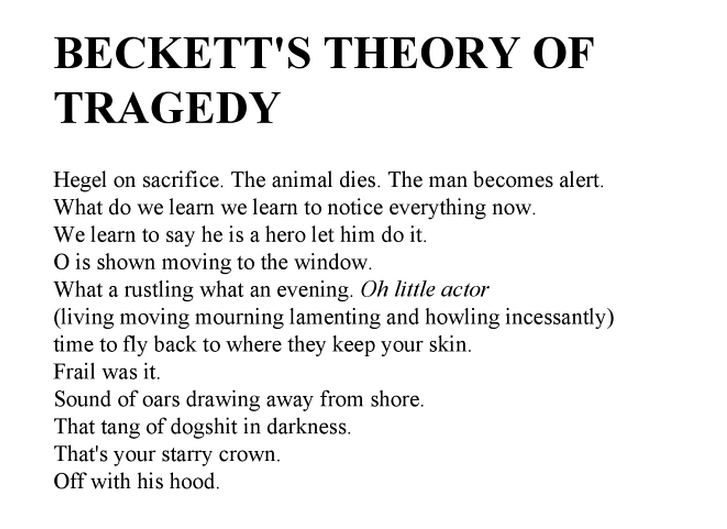
“Beckett’s Theory of Tragedy” — Anne Carson

Capture

Scheveningen Women and Other People Under Umbrellas — Vincent van Gogh

List with No Name #38

  1. John Barth’s beret
  2. Zora Neale Hurston’s fedora
  3. Mark Twain’s bowtie
  4. David Foster Wallace’s bandanna
  5. Tom Wolfe’s white suit
  6. Carson McCuller’s cigarettes
  7. Wiillaim Faulkner’s pipe
  8. Jonathan Franzen’s spectacles
  9. Flannery O’Connor’s crutches
  10. Walt Whitman’s hat (cocked, natch)
  11. Oscar Wilde’s fur coat
  12. Thomas Pynchon’s paper bag

Waterproof Mascara — Marlene Dumas

World of Pains and Troubles (John Keats)

—The common cognomen of this world among the misguided and superstitious is ‘a vale of tears’ from which we are to be redeemed by a certain arbitrary interposition of God and taken to Heaven–What a little circumscribed straightened notion! call the world if you Please ‘The vale of Soul-making’ Then you will find out the use of the world (I am speaking now in the highest terms for human nature admitting it to be immortal which I will here take for granted for the purpose of showing a thought which has struck me concerning it) I say “Soul making” Soul as distinguished from an Intelligence– There may be intelligences or sparks of the divinity in millions–but they are not Souls till they acquire identities, till each one is personally itself. Intelligences are atoms of perception–they know and they see and they are pure, in short they are God–how then are Souls to be made? How then are these sparks which are God to have identity given them–so as ever to possess a bliss peculiar to each ones individual existence? How, but by the medium of a world like this? This point I sincerely wish to consider because I think it a grander system of salvation than the chrystain religion–or rather it is a system of Spirit-creation–This is effected by three grand materials acting the one upon the other for a series of years–These Materials are the Intelligence–the human heart (as distinguished from intelligence or Mind) and the World or Elemental space suited for the proper action of Mind and Heart on each other for the purpose of forming the Soul or Intelligence destined to possess the sense of Identity. I can scarcely express what I but dimly perceive–and yet I think I perceive it–that you may judge the more clearly I will put it in the most homely form possible–I will call the world a School instituted for the purpose of teaching little children to read–I will call the Child able to read, the Soul made from that school and its hornbook. Do you not see how necessary a World of Pains and troubles is to school an Intelligence and make it a soul? A Place where the heart must feel and suffer in a thousand diverse ways! Not merely is the Heart a Hornbook, it is the Minds Bible, it is the Minds experience, it is the teat from which the Mind or intelligence sucks its identity–As various as the Lives of Men are–so various become their Souls, and thus does God make individual beings, Souls, Identical Souls of the sparks of his own essence–“

—From a letter John Keats wrote to his brother George, dated April 21, 1810. (More excerpts from Keats’s letters with commentary).

Woman Reading — Utagawa Kuniyoshi

Kuniyoshi_Utagawa_Woman_reading

Susan Sontag’s List of Novels with Cinematic Structure

Novels with cinematic structure:

Hemingway, In Our Time

Faulkner,

[Horace] McCoy, They Shoot Horses, Don’t They?

Robbe-Grillet, Les Gommes [The Erasers]

[Georges] Bernanos, M. Ouine

I[vy] Compton-Burnett,

V Woolf, Between the Acts

Philip Toynbee, Tea with Mrs. Goodman

des Forêts, Les Mendiants

his first novel—multiple pov [points of view]

[Barnes,] Nightwood

Reverzy, Le Passage

Burroughs,

[John] Dos Passos

Firbank, CapriceVainglory; and [Inclinations] (trilogy)

Jap[anese] writer [Yasunari Kawabata] (N.B. visual sense, suppleness of changing scenes)—Snow Country, etc.

Dickens (cf. Eisenstein)—

There are people who thought with camera eye (a unified p-o-v that displaces itself) before the camera

N[athaniel] West,

Blechman

“new novelists”: Claude Simon, Le Palace

Claude Ollier, La Mis-en-Scène

(all based on organization of a decor (N[orth] Africa)

–From an entry dated 6/26/66 Paris in Susan Sontag’s notebook, published as part of As Consciousness Is Harnessed to Flesh. (I’ve maintained the bracketed editorial intrusions of the published text, even with they did not seem necessary).

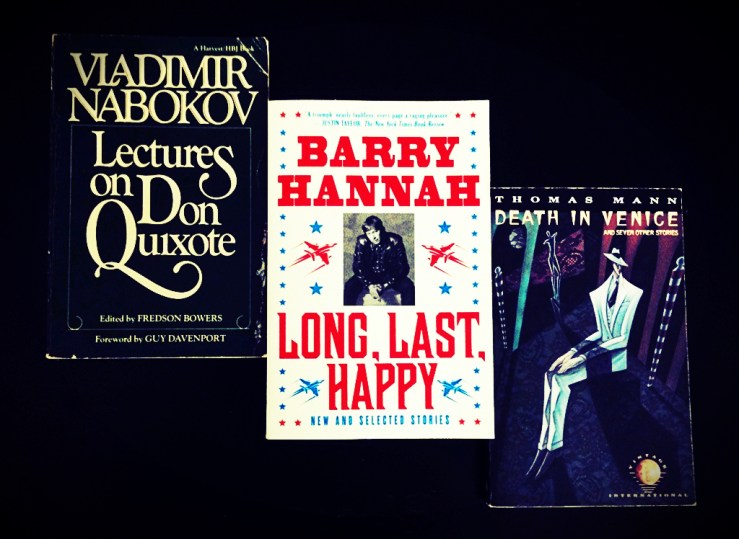
Hannah/Nabokov/Mann (Books Acquired, 8.30.2013)

20130905-153520

Psychopathic Ward — Robert Riggs

A Short Documentary About Vincent Van Gogh by Alain Resnais

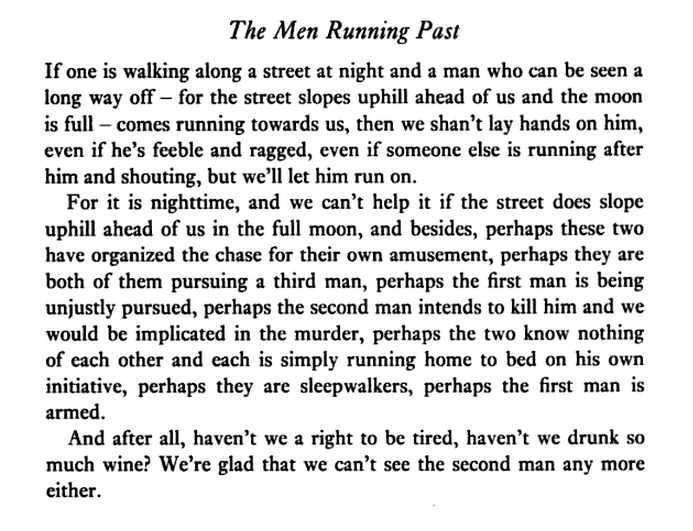
“The Men Running Past” — Franz Kafka

kafka

Two Arabs Reading — Edwin Lord Weeks

Plagiarism

Art and cultural property crime—which includes theft, fraud, looting, and trafficking across state and international lines—is a looming criminal enterprise with estimated losses in the billions of dollars annually.

Jan van Eyck: The Just Judges.

Early to mid-1800s: Burkel paints After the Hunt (c. 1830), Amalfi Cave (c. 1845), and The Horse Round-up (c.1861-1863).

In October 1969, two thieves entered the Oratory of San Lorenzo in Palermo, Italy and removed the Caravaggio Nativity from its frame. Experts estimate its value at $20 million.

Vincent van Gogh: View of the Sea at Scheveningen(1882).

1925: All three Burkel paintings are acquired and subsequently exhibited by the Pirmasens Museum in Germany.

On December 31, 1999, during the fireworks that accompanied the celebration of the millennium, a thief broke into the Ashmolean Museum in Oxford, England and stole Cezanne’s landscape painting View of Auvers-sur-Oise. Valued at £3 million, the painting has been described as an important work illustrating the transition from early to mature Cezanne painting.

Johannes Vermeer: The Concert (c.1658–1660).

On September 8, 2011, Madeleine Leaning on Her Elbow with Flowers in Her Hair by Pierre Auguste Renoir was stolen during an armed robbery in a Houston home. The masked robber is described as a white male, 18 to 26 years old, who weighs about 160 pounds and is approximately 5’10” tall. He was armed with a large-caliber, semi-automatic handgun. A private insurer is offering up to $50,000 for information leading to the recovery of the painting.

Rembrandt: The Storm on the Sea of Galilee (1633).

May 13, 1942: To avoid Allied bombings, the Burkel paintings were taken to a local air-raid shelter outside of Pirmasens.

Approximately 100 paintings stolen from a Florida family’s art collection in a fine art storage facility. This collection included works by Picasso, Rothko, Matisse and others that were recovered from Chicago, New York and Tokyo.

Vincent van Gogh: Congregation Leaving the Reformed Church in Nuenen (1884).

Radu Dogaru’s mother, hoping to free her son from prosecution, told the police that on a freezing night in February, 2013, she placed seven stolen paintings — which included Monet’s 1901 Waterloo Bridge, London; Gauguin’s 1898 Girl in Front of Open Window” and Picasso’s 1971 Harlequin Head — in a wood-burning stove used to heat saunas and incinerated them.

September 19, 1945: The Pirmasens Museum reports that “about 50 paintings which had been stored in the air-raid shelter at Husterhoh School during the war have been lost during the arrival of the American troops on March 22, 1945.” The works were later smuggled to the U.S. by unknown individuals.

Jean-Baptiste Oudry: The White Duck (1753).

Mid-1960s: A New Jersey man purchases the Burkel paintings.

How Picassos, Matisses, Monets and other precious masterpieces may have met a fiery fate in a remote Romanian village, population 3,400, is something the police are still trying to understand.

Amadeo Modigliani: La Femme à l’éventail (Modigliani) (1919).

Late 1980s: The Burkel paintings are handed down to the New Jersey man’s daughter.

Caspar David Friedrich: Landschaft mit Regenbogen (c. 1810).

October 25, 2005: The William H. Bunch Auction and Appraisal Company in Pennsylvania advertises the sale of the Burkel paintings on the Internet and through the print media. Heike Wittmer, Pirmasens Museum Director and Archivist, spots the paintings for sale and alerts German authorities. U.S. Embassy officials contact the FBI, which halts the sale and takes custody of the paintings from the consignor, who voluntarily agrees to their return to Germany.

Rembrandt’s Self Portrait (1630): Recovered in a sting operation in Copenhagen carried out in cooperation with ICE and law enforcement agencies in Sweden and Denmark. The FBI had previously recovered Renoir’s The Young Parisian. Both paintings had been stolen from the Swedish National Museum in Stockholm in 2000.

February 10, 2006: The Burkel paintings are repatriated to Germany by the U.S.

Pablo Picasso: Le pigeon aux petits pois(1911).

In December 2002, two thieves used a ladder to climb to the roof and break in to the Vincent Van Gogh Museum, Amsterdam, The Netherlands. In just a few minutes the thieves stole two paintings: Van Gogh’s View of the Sea at Scheveningen and Congregation Leaving the Reformed Church in Nuenen, valued at $30 million. Dutch police convicted two men in December 2003, but did not recover the paintings.

Forensic analysis of ash found in Mrs. Dogaru’s stove, conducted by Romania’s National History Museum, found nails and tacks that indicated that at least three had been burned.

Franz Marc: The Tower of Blue Horses 1913 (missing since 1945).

Carl Spitzweg: Der Liebesbrief 1845-1846 (missing since 1989).

IF YOU HAVE ANY INFORMATION CONCERNING THESE WORKS OF ART OR CIRCUMSTANCES OF THESE CRIMES, PLEASE CONTACT YOUR LOCAL FIELD OFFICE OR THE NEAREST U.S. EMBASSY OR CONSULATE.
Watch This Terrible Book Trailer for Thomas Pynchon’s New Novel Bleeding Edge (Or Don’t)

I don’t know, I’m guessing this is intentionally awful. I mean, book trailers are supposed to be awful, right?