A Constellation of Vital Phenomena (Book Acquired Some Time Last Week)

20130502-112630.jpg

A Constellation of Vital Phenomena by Anthony Marra. Publisher Random House’s blurb:

In his brilliant, haunting novel, Stegner Fellow and Whiting Award winner Anthony Marra transports us to a snow-covered village in Chechnya, where eight-year-old Havaa watches from the woods as Russian soldiers abduct her father in the middle of the night, accusing him of aiding Chechen rebels. Across the road their lifelong neighbor and family friend Akhmed has also been watching, fearing the worst when the soldiers set fire to Havaa’s house. But when he finds her hiding in the forest with a strange blue suitcase, he makes a decision that will forever change their lives. He will seek refuge at the abandoned hospital where the sole remaining doctor, Sonja Rabina, treats the wounded.
For the talented, tough-minded Sonja, the arrival of Akhmed and Havaa is an unwelcome surprise. Weary and overburdened, she has no desire to take on additional risk and responsibility. And she has a deeply personal reason for caution: harboring these refugees could easily jeopardize the return of her missing sister. But over the course of five extraordinary days, Sonja’s world will shift on its axis and reveal the intricate pattern of connections that weave together the pasts of these three unlikely companions and unexpectedly decides their fate. A story of the transcendent power of love in wartime, A Constellation of Vital Phenomenais a work of sweeping breadth, profound compassion, and lasting significance.
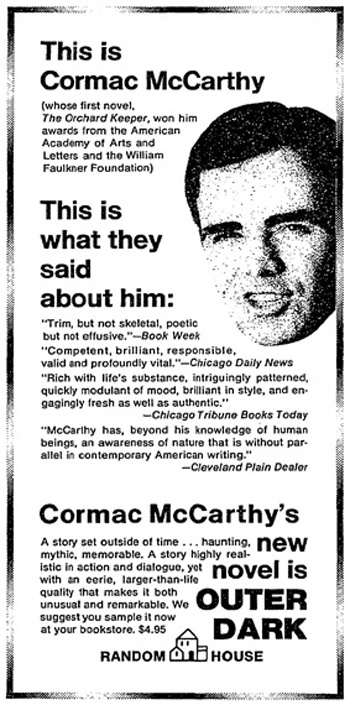
 

1968 Ad for Cormac McCarthy’s Outer Dark

d05fb40e5ddc4b3a068ca6a01aebc9a3

(Via/more; my review of Outer Dark).

“Life of Ma Parker” — Katherine Mansfield

“Life of Ma Parker” by Katherine Mansfield

When the literary gentleman, whose flat old Ma Parker cleaned every Tuesday, opened the door to her that morning, he asked after her grandson. Ma Parker stood on the doormat inside the dark little hall, and she stretched out her hand to help her gentleman shut the door before she replied. “We buried ‘im yesterday, sir,” she said quietly.

“Oh, dear me! I’m sorry to hear that,” said the literary gentleman in a shocked tone. He was in the middle of his breakfast. He wore a very shabby dressing-gown and carried a crumpled newspaper in one hand. But he felt awkward. He could hardly go back to the warm sitting-room without saying something—something more. Then because these people set such store by funerals he said kindly, “I hope the funeral went off all right.”

“Beg parding, sir?” said old Ma Parker huskily.

Poor old bird! She did look dashed. “I hope the funeral was a—a—success,” said he. Ma Parker gave no answer. She bent her head and hobbled off to the kitchen, clasping the old fish bag that held her cleaning things and an apron and a pair of felt shoes. The literary gentleman raised his eyebrows and went back to his breakfast.

“Overcome, I suppose,” he said aloud, helping himself to the marmalade.

Ma Parker drew the two jetty spears out of her toque and hung it behind the door. She unhooked her worn jacket and hung that up too. Then she tied her apron and sat down to take off her boots. To take off her boots or to put them on was an agony to her, but it had been an agony for years. In fact, she was so accustomed to the pain that her face was drawn and screwed up ready for the twinge before she’d so much as untied the laces. That over, she sat back with a sigh and softly rubbed her knees…

“Gran! Gran!” Her little grandson stood on her lap in his button boots. He’d just come in from playing in the street.

“Look what a state you’ve made your gran’s skirt into—you wicked boy!”

But he put his arms round her neck and rubbed his cheek against hers. Continue reading ““Life of Ma Parker” — Katherine Mansfield”

At the Garden Table — August Macke

Dark Star — John Carpenter (Full Film)

Little Women (The Far Side)

lw

Some content on this page was disabled on June 29, 2021 as a result of a DMCA takedown notice from Andrews McMeel Universal. You can learn more about the DMCA here:

https://wordpress.com/support/copyright-and-the-dmca/

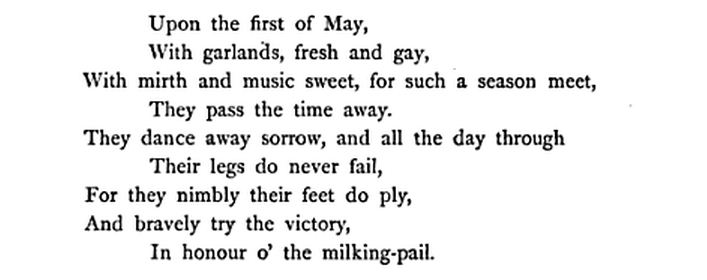
“Upon the first of May” (The Milkmaid)

md

Maypole — Luc Tuymans

Maypole Scene from The Wicker Man

May Day, Central Park — Maurice Prendergast

“May-Day” — Ralph Waldo Emerson

“May-Day” by Ralph Waldo Emerson

Daughter of Heaven and Earth, coy Spring,
With sudden passion languishing,
Maketh all things softly smile,
Painteth pictures mile on mile,
Holds a cup with cowslip-wreaths,
Whence a smokeless incense breathes.
Girls are peeling the sweet willow,
Poplar white, and Gilead-tree,
And troops of boys
Shouting with whoop and hilloa,
And hip, hip three times three.
The air is full of whistlings bland;
What was that I heard
Out of the hazy land?
Harp of the wind, or song of bird,
Or clapping of shepherd’s hands,
Or vagrant booming of the air,
Voice of a meteor lost in day?
Such tidings of the starry sphere
Can this elastic air convey.
Or haply ‘t was the cannonade
Of the pent and darkened lake,
Cooled by the pendent mountain’s shade,
Whose deeps, till beams of noonday break,
Afflicted moan, and latest hold
Even unto May the iceberg cold.
Was it a squirrel’s pettish bark,
Or clarionet of jay? or hark,
Where yon wedged line the Nestor leads,
Steering north with raucous cry
Through tracts and provinces of sky,
Every night alighting down
In new landscapes of romance,
Where darkling feed the clamorous clans
By lonely lakes to men unknown.
Come the tumult whence it will,
Voice of sport, or rush of wings,
It is a sound, it is a token
That the marble sleep is broken,
And a change has passed on things.
Continue reading ““May-Day” — Ralph Waldo Emerson”

Reading in the Cismigiu Garden — Theodor Aman

Hell — Hans Memling

Heavy Dreams (Sigizmund Krzhizhanovsky)

Quantin followed the procession for a few minutes out of morbid curiosity. The choice of narrower side streets, where it was easier to enlist the wall’s support, was probably deliberate, he thought, but then a long notice stuck to the stone exactly at eye level arrested his attention and, with it, his progress. The notice—in the manner of a proper, not overly pushy advertisement—listed the advantages ofso-called heavy dreams. Having come across the subject once before, Quantin read the fine print carefully, line by line: “The main advantage of the heavy industry of nightmares over the light industry of golden threads plunged into brain fibrils, over the production of so-called sweet dreams, is that in marketing our nightmares we can guarantee that they will come true, we can hand our customers ‘turnkey dreams.’ Sweet dreams cannot withstand reality, sleepy reveries wear out faster than socks; whereas a heavy dream, a simple but well-made nightmare, is easily assimilated by life. Where dreams unburdened by anything disappear like drops of water in the sand, dreams containing a certain harshness will, as they evaporate in the sun, leave a hard kernel on the roof of Plato’s famous cave: these dposits will collect and accrue, eventually forming a swordlike stalactite.

“Speaking in more modern terms,” the fine print went on, “our nightmares, weighing as they do on the brain, gradually form a sort of moral ceiling that is always about to come crashing down on one’s head: some of our customer’s call this ‘world history.’ But that’s not the point. The point is the durability, unwakeability, high depressiveness, and wide availability of our nightmares: mass-market products good for all eras and classes, nighttime and daytime, moonlight and sunlight, closed eyes and open.”

From Sigizmund Krzhizhanovsky’s short story “The Branch Line,” collected in NYRB’s Memories of the Future (translation by Joanne Turnbull).

Henry Miller/Georg Büchner (Books Acquired, 4.30.2013)

20130430-165618.jpg

Needing another book the same way I need another hole in the head, I nevertheless dropped by my local used bookstore to browse—the place is huge, and a day of grading term papers made me feel zapped and perhaps depressed. Anyway. Spotted a beautiful Penguin edition of Henry Miller’s The Colossus of Maroussi and had to have it. Here’s a passage some soul saw fit to dogear:

20130430-165623

I had never heard of Georg Büchner or his novella fragment Lenz, but it was shelved next to Blake Butler’s Scorch Atlas and both stood out because of their odd shapes.

20130430-165633.jpg

Here are the blurbs for Lenz, which more or less sold me:

20130430-165639.jpg

Finally, I did not buy yet another edition of Moby-Dick, despite this midcentury Rinheart cover—but I had to snap it to share:

20130430-165646.jpg


“Can’t Go Wrong Without You” — His Name Is Alive/Brothers Quay

“I dreamt that the Earth was finished” — Roberto Bolaño

31. I dreamt that Earth was finished. And the only
human being to contemplate the end was Franz
Kafka. In heaven, the Titans were fighting to the
death. From a wrought-iron seat in Central Park,
Kafka was watching the world burn.

32. I dreamt I was dreaming and I came home
too late. In my bed I found Mário de Sá-Carneiro
sleeping with my first love. When I uncovered them
I found they were dead and, biting my lips till they
bled, I went back to the streets.

33. I dreamt that Anacreon was building his castle
on the top of a barren hill and then destroying it.

34. I dreamt I was a really old Latin American
detective. I lived in New York and Mark Twain
was hiring me to save the life of someone without
a face. “It’s going to be a damn tough case, Mr.
Twain,” I told him.

35. I dreamt I was falling in love with Alice Sheldon.
She didn’t want me. So I tried getting myself killed
on three continents. Years passed. Finally, when I
was really old, she appeared on the other end of the
promenade in New York and with signals (like the
ones they use on aircraft carriers to help the pilots
land) she told me she’d always loved me.

36. I dreamt I was 69ing with Anaïs Nin on an
enormous basaltic flagstone.

Read more short poems from Roberto Bolaño’s Tres (New Directions) in translation by Laura Healy.