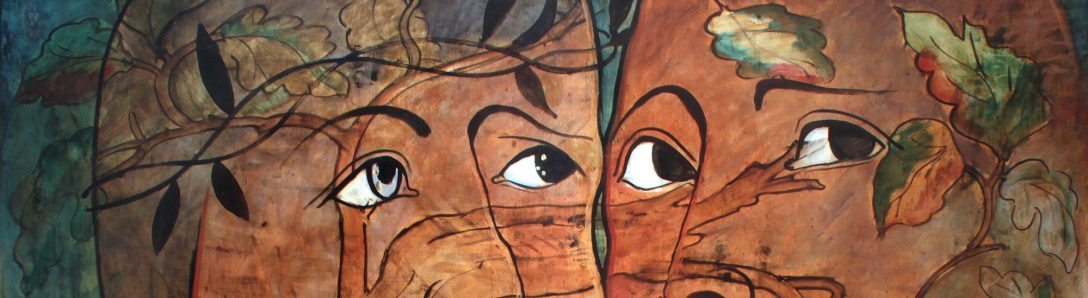
“New Year’s Eve” / “New Year’s Night” — D.H.Lawrence

Two poems by D.H. Lawrence:

“New Year’s Eve”—

There are only two things now,
The great black night scooped out
And this fire-glow.

This fire-glow, the core,
And we the two ripe pips
That are held in store.

Listen, the darkness rings
As it circulates round our fire.
Take off your things.

Your shoulders, your bruised throat!
Your breasts, your nakedness!
This fiery coat!

As the darkness flickers and dips,
As the firelight falls and leaps
From your feet to your lips!

“New Year’s Night”—

Now you are mine, to-night at last I say it;
You’re a dove I have bought for sacrifice,
And to-night I slay it.

Here in my arms my naked sacrifice!
Death, do you hear, in my arms I am bringing
My offering, bought at great price.

She’s a silvery dove worth more than all I’ve got.
Now I offer her up to the ancient, inexorable God,
Who knows me not.

Look, she’s a wonderful dove, without blemish or spot!
I sacrifice all in her, my last of the world,
Pride, strength, all the lot.

All, all on the altar! And death swooping down
Like a falcon. ’Tis God has taken the victim;
I have won my renown.


Book Shelves #53, 12.30.2012 (Final Entry)

Book shelves series #53, fifty-third—and final!—Sunday of 2012: In which I take a few photos at random.

I somehow managed to squeeze 52 weeks of shots out of all the book-bearing surfaces of my home (—oh—I did one week from my office).

For the last in this series (yay!) I simply walked through the rooms of the house, took a few shots, and then put them in digital frames.

For the most part, my method was thoughtless, although I did grab a pic of a bookcase new to our house (second pic, top left) that dominates my son’s room.

I also took a pic of Perec’s essay collection because one of his essays inspired this (awful, awful) project.

From that essay, “The Art and Manner of Arranging One’s Books”:

We should first of all distinguish stable classifications from provisional ones. Stable classifications are those which, in principle, you continue to respect; provisional classifications are those supposed to last only a few days, the time it takes for a book to discover, or rediscover, its definitive place. This may be a book recently acquired and not read yet, or else a book recently read that you don’t quite know where to place and which you have promised to yourself you will put away on the occasion of a forthcoming ‘great arranging’, or else a book whose reading has been interrupted and that you don’t to classify before taking it up again and finishing it, or else a book you have used constantly over a given period, or else a book you have taken down to look up a piece of information or a reference and which you haven’t yet put back in its place, or else a book that you can’t put back in its place, or else a book that you can’t put back in its rightful place because it doesn’t belong to you and you’ve several times promised to give it back, etc.

20121230-103829.jpg

20121230-103740.jpg

20121230-103752.jpg

20121230-103804.jpg

So, what did I get out of doing this project?

1. Photographing books is difficult—I mean physically. They all reflect light differently.

2. Doing a regularly-scheduled project is difficult.

3. I have too many books.

Okay. That’s it. Finis.

Garden Hose — Edith Vonnegut

“The Whale Tooth” — Jack London

“The Whale Tooth” by Jack London

It was in the early days in Fiji, when John Starhurst arose in the mission house at Rewa Village and announced his intention of carrying the gospel throughout all Viti Levu. Now Viti Levu means the “Great Land,” it being the largest island in a group composed of many large islands, to say nothing of hundreds of small ones. Here and there on the coasts, living by most precarious tenure, was a sprinkling of missionaries, traders, bêche-de-mer fishers, and whaleship deserters. The smoke of the hot ovens arose under their windows, and the bodies of the slain were dragged by their doors on the way to the feasting.

The Lotu, or the Worship, was progressing slowly, and, often, in crablike fashion. Chiefs, who announced themselves Christians and were welcomed into the body of the chapel, had a distressing habit of backsliding in order to partake of the flesh of some favorite enemy. Eat or be eaten had been the law of the land; and eat or be eaten promised to remain the law of the land for a long time to come. There were chiefs, such as Tanoa, Tuiveikoso, and Tuikilakila, who had literally eaten hundreds of their fellow men. But among these gluttons Ra Undreundre ranked highest. Ra Undreundre lived at Takiraki. He kept a register of his gustatory exploits. A row of stones outside his house marked the bodies he had eaten. This row was two hundred and thirty paces long, and the stones in it numbered eight hundred and seventy-two. Each stone represented a body. The row of stones might have been longer, had not Ra Undreundre unfortunately received a spear in the small of his back in a bush skirmish on Somo Somo and been served up on the table of Naungavuli, whose mediocre string of stones numbered only forty-eight.

The hard-worked, fever-stricken missionaries stuck doggedly to their task, at times despairing, and looking forward for some special manifestation, some outburst of Pentecostal fire that would bring a glorious harvest of souls. But cannibal Fiji had remained obdurate. The frizzle-headed man-eaters were loath to leave their fleshpots so long as the harvest of human carcases was plentiful. Sometimes, when the harvest was too plentiful, they imposed on the missionaries by letting the word slip out that on such a day there would be a killing and a barbecue. Promptly the missionaries would buy the lives of the victims with stick tobacco, fathoms of calico, and quarts of trade beads. Natheless the chiefs drove a handsome trade in thus disposing of their surplus live meat. Also, they could always go out and catch more. Continue reading ““The Whale Tooth” — Jack London”

Duke of Alba — Francisco Goya

Watch Charlie Chaplin’s Overlooked Masterpiece, Monsieur Verdoux (Full Film)

(I wrote about the film here).

Wind Fallen Trees — Ivan Shishkin

“Joyce” — Ezra Pound

“Joyce” by Ezra Pound

Despite the War, despite the paper shortage, and despite those old-established publishers whose god is their belly and whose god-father was the late F.T. Palgrave, there is a new edition of James Joyce’s “A Portrait of the Artist as a Young Man.”

It is extremely gratifying that this book should have “reached its fourth thousand,” and the fact is significant in just so far as it marks the beginning of a new phase of English publishing, a phase comparable to that started in France some years ago by the Mercure.

The old houses, even those, or even more those, which once had a literary tradition, or at least literary pretensions, having ceased to care a damn about literature, the lovers of good writing have “struck”; have sufficiently banded themselves together to get a few good books into print, and even into circulation. The actual output is small in bulk, a few brochures of translations, Eliot’s “Prufrock,” Joyce’s “A Portrait,” and Wyndham Lewis’ “Tarr,” but I have it on good authority that at least one other periodical will start publishing its authors after the War, so there are new rods in pickle for the old fat-stomached contingent and for the cardboard generation.

Joyce’s “A Portrait” is literature; it has become almost the prose bible of a few people, and I think I have encountered at least three hundred admirers of the book, certainly that number of people who, whether they “like” it or not, are wholly convinced of its merits. Continue reading ““Joyce” — Ezra Pound”

“Blood! Real Blood!”

Thomas Pynchon Reviews Oakley Hall’s Novel Warlock

Tombstone, Arizona, during the 1880’s is, in ways, our national Camelot: a never-never land where American virtues are embodied in the Earps, and the opposite evils in the Clanton gang; where the confrontation at the OK corral takes on some of the dry purity of the Arthurian joust. Oakley Hall, in his very fine novel Warlock (Viking) has restored to the myth of Tombstone its full, mortal, blooded humanity. Wyatt Earp is transmogrified into a gunfighter named Blaisdell who, partly because of his blown-up image in the Wild West magazines of the day, believes he is a hero. He is summoned to the embattled town of Warlock by a committee of nervous citizens expressly to be a hero, but finds that he cannot, at last, live up to his image; that there is a flaw not only in him, but also, we feel, in the entire set of assumptions that have allowed the image to exist. It is Blaisdell’s private abyss, and not too different from the town’s public one. Before the agonized epic of Warlock is over with — the rebellion of the proto-Wobblies working in the mines, the struggling for political control of the area, the gunfighting, mob violence, the personal crises of those in power — the collective awareness that is Warlock must face its own inescapable Horror: that what is called society, with its law and order, is as frail, as precarious, as flesh and can be snuffed out and assimilated back into the desert as easily as a corpse can. It is the deep sensitivity to abysses that makesWarlock one of our best American novels. For we are a nation that can, many of us, toss with all aplomb our candy wrapper into the Grand Canyon itself, snap a color shot and drive away; and we need voices like Oakley Hall’s to remind us how far that piece of paper, still fluttering brightly behind us, has to fall.

Thomas Pynchon’s 1965 review of Oakley Hall’s novel Warlock. Via/more.


Charlie Kaufman Interview

Ridiculous Dream — Francisco Goya

“Wakefield” — Nathaniel Hawthorne

“Wakefield” by Nathaniel Hawthorne

In some old magazine or newspaper, I recollect a story, told as truth, of a man – let us call him Wakefield – who absented himself for a long time, from his wife. The fact, thus abstractedly is not very uncommon, nor – without a proper distinction of circumstances – to be condemned either as naughty or nonsensical. Howbeit, this, though far from the most aggravated, is perhaps the strangest instance, on record, of marital delinquency; and, moreover, as remarkable a freak as may be found in the whole list of human oddities. The wedded couple lived in London. The man, under presence of going a journey, took lodgings in the next street to his own house, and there, unheard of by his wife or friends, and without the shadow of a reason for such self-banishment, dwelt upwards of twenty years. During that period, he beheld his home every day, and frequently the forlorn Mrs. Wakefield. And after so great a gap in his matrimonial felicity – when his death was reckoned certain, his estate settled, his name dismissed from memory, and his wife, long, long ago, resigned to her autumnal widowhood – he entered the door one evening, quietly, as from a day’s absence, and became a loving spouse till death.

This outline is all that I remember. But the incident, though of the purest originality, unexampled, and probably never to be repeated, is one, I think, which appeals to the general sympathies of mankind. We know, each for himself, that none of us would perpetrate such a folly, yet feel as if some other might. To my own contemplations, at least, it has often recurred, always wonder, but with a sense that the story must be true, and a conception of its hero’s character. Whenever any subject so forcibly affects the mind, time is well spent in thinking of it. If the reader choose, let him do his own meditation; or if he prefer to ramble with me through the twenty years of Wakefield’s vagary, I bid him welcome; trusting that there will be a pervading spirit and a moral, even should we fail to find them, done up neatly, and condensed into the final sentence. Thought has always its efficacy, and every striking incident its moral. Continue reading ““Wakefield” — Nathaniel Hawthorne”

A Girl Reading a Letter — Joseph Wright

Octopus, Red Fish — Utagawa Kuniyoshi

“The Tuft of Kelp” — Herman Melville

“The Tuft of Kelp” by Herman Melville—

All dripping in tangles green,
Cast up by a lonely sea
If purer for that, O Weed,
Bitterer, too, are ye?

The Noise — King Crimson (Full Filmed Concert, 1982)