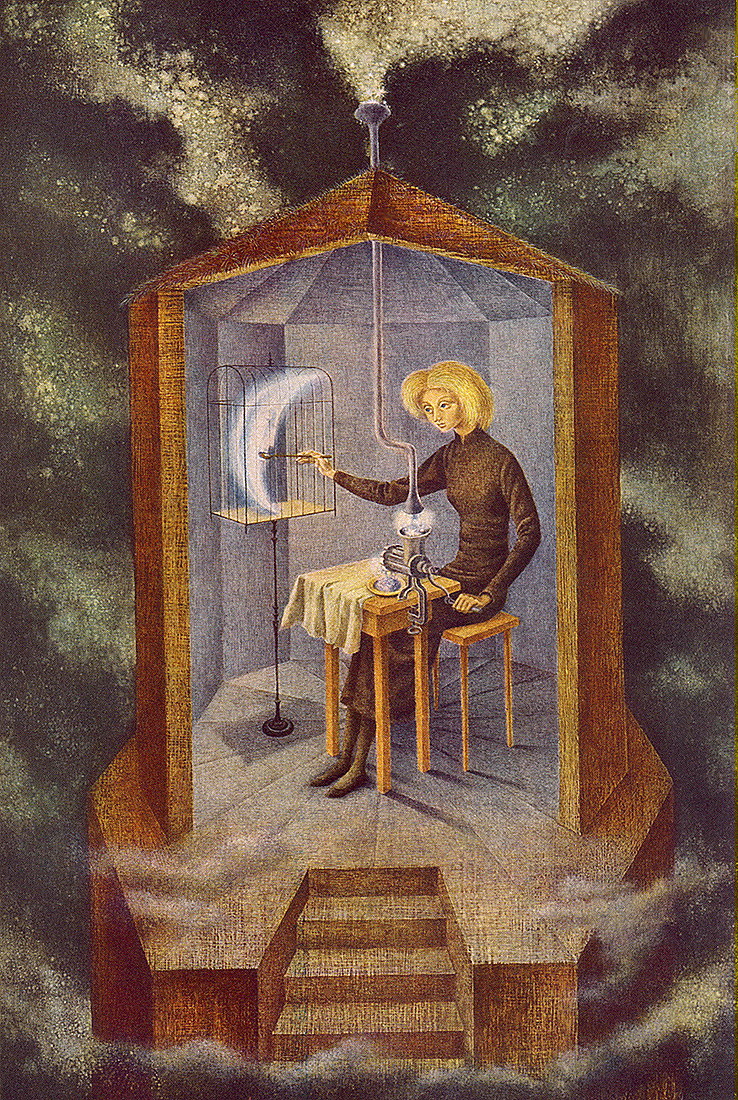
Star Maker — Remedios Varo

star-maker

“The Lagoon” — Joseph Conrad

“The Lagoon” by Joseph Conrad

The white man, leaning with both arms over the roof of the little house in the stern of the boat, said to the steersman–

‘We will pass the night in Arsat’s clearing. It is late.’

The Malay only grunted, and went on looking fixedly at the river. The white man rested his chin on his crossed arms and gazed at the wake of the boat. At the end of the straight avenue of forests cut by the intense glitter of the river, the sun appeared unclouded and dazzling, poised low over the water that shone smoothly like a band of metal. The forests, somber and dull, stood motionless and silent on each side of the broad stream. At the foot of big, towering trees, trunkless nipa palms rose from the mud of the bank, in bunches of leaves enormous and heavy, that hung unstirring over the brown swirl of eddies. In the stillness of the air every tree, every leaf, every bough, every tendril of creeper and every petal of minute blossoms seemed to have been bewitched into an immobility perfect and final. Nothing moved on the river but the eight paddles that rose flashing regularly, dipped together with a single splash; while the steersman swept right and left with a periodic and sudden flourish of his blade describing a glinting semicircle above his head. The churnedup water frothed alongside with a confused murmur. And the white man’s canoe, advancing up stream in the short-lived disturbance of its own making, seemed to enter the portals of a land from which the very memory of motion had for ever departed.

The white man, turning his back upon the setting sun, looked along the empty and broad expanse of the sea-reach. For the last three miles of its course the wandering, hesitating river, as if enticed irresistibly by the freedom of an open horizon, flows straight into the sea, flows straight to the east – to the east that harbors both light and darkness. Astern of the boat the repeated call of some bird, a cry discordant and feeble, skipped along over the smooth water and lost itself, before it could reach the other shore, in the breathless silence of the world.

     The steersman dug his paddle into the stream, and held hard with stiffened arms, his body thrown forward. The water gurgled aloud; and suddenly the long straight reach seemed to pivot on its center, the forests swung in a semicircle, and the slanting beams of sunset touched the broadside of the canoe with a fiery glow, throwing the slender and distorted shadows of its crew upon the streaked glitter of the river. The white man turned to look ahead. The course of the boat had been altered at right-angles to the stream, and the carved dragon-head of its prow was pointing now at a gap in the fringing bushes of the bank. It glided through, brushing the overhanging twigs, and disappeared from the river like some slim and amphibious creature leaving the water for its lair in the forests. Continue reading ““The Lagoon” — Joseph Conrad”

Against the Common Good — Francisco Goya

R1-7-goya_against_the_common_good

Andrei Tarkovsky’s Advice to Young Directors

“Literary Indecencies” — H.L. Mencken

The low, graceless humor of names! On my shelf of poetry, arranged by the alphabet, Coleridge and J. Gordon Cooglar are next-door neighbors! Mrs. Hemans is beside Laurence Hope! Walt Whitman rubs elbows with Ella Wheeler Wilcox; Robert Browning with Richard Burton; Rossetti with Cale Young Rice; Shelly with Clinton Scollard; Wordsworth with George E. Woodberry; John Keats with Herbert Kaufman!

Ibsen, on the shelf of dramatists, is between Victor Hugo and Jerome K. Jerome. Sudermann follows Harriet Beecher Stowe. Maeterlinck shoulders Percy Mackaye. Shakespeare is between Sardou and Shaw. Euripides and Clyde Fitch! Upton Sinclair and Sophocles! Aeschylus and F. Anstey! D’Annunzio and Richard Harding Davis! Augustus Thomas and Tolstoi!

More alphabetical humor. Gerhart Hauptmann and Robert Hichens; Voltaire and Henry Van Dyke; Flaubert and John Fox, Jr.; Balzac and John Kendrick Bangs; Ostrovsky and E. Phillips Oppenheim; Elinor Glyn and Théophile Gautier; Joseph Conrad and Robert W. Chambers; Zola and Zangwill!…

Midway on my scant shelf of novels, between George Moore and Frank Norris, there is just room enough for the two volumes of “Derringforth,” by Frank A. Munsey.

“Literary Indecencies,” a chapter from H.L. Mencken’s collection Damn!


William S. Burroughs Shoots at William S. Burroughs T-Shirts

Portrait of a One-Eyed Man — Vincent van Gogh

“Jenny Ondioline” — Stereolab

“Desiree’s Baby” — Kate Chopin

“Desiree’s Baby” by Kate Chopin

As the day was pleasant, Madame Valmonde drove over to L’Abri to see Desiree and the baby.

It made her laugh to think of Desiree with a baby. Why, it seemed but yesterday that Desiree was little more than a baby herself; when Monsieur in riding through the gateway of Valmonde had found her lying asleep in the shadow of the big stone pillar.

The little one awoke in his arms and began to cry for “Dada.” That was as much as she could do or say. Some people thought she might have strayed there of her own accord, for she was of the toddling age. The prevailing belief was that she had been purposely left by a party of Texans, whose canvas-covered wagon, late in the day, had crossed the ferry that Coton Mais kept, just below the plantation. In time Madame Valmonde abandoned every speculation but the one that Desiree had been sent to her by a beneficent Providence to be the child of her affection, seeing that she was without child of the flesh. For the girl grew to be beautiful and gentle, affectionate and sincere – the idol of Valmonde.

It was no wonder, when she stood one day against the stone pillar in whose shadow she had lain asleep, eighteen years before, that Armand Aubigny riding by and seeing her there, had fallen in love with her. That was the way all the Aubignys fell in love, as if struck by a pistol shot. The wonder was that he had not loved her before; for he had known her since his father brought him home from Paris, a boy of eight, after his mother died there. The passion that awoke in him that day, when he saw her at the gate, swept along like an avalanche, or like a prairie fire, or like anything that drives headlong over all obstacles.

Monsieur Valmonde grew practical and wanted things well considered: that is, the girl’s obscure origin. Armand looked into her eyes and did not care. He was reminded that she was nameless. What did it matter about a name when he could give her one of the oldest and proudest in Louisiana? He ordered the corbeille from Paris, and contained himself with what patience he could until it arrived; then they were married. Continue reading ““Desiree’s Baby” — Kate Chopin”

Reading Man in Park — August Macke

“Pity would be no more / If we did not make somebody Poor”

The Evening Star — Camille Corot

Krapp’s Last Tape — Samuel Beckett (Full Performance)

1985 Robert Fripp Documentary

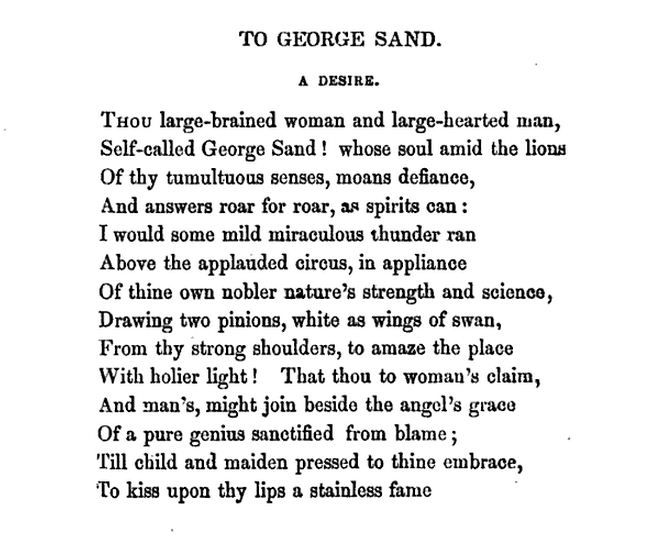
“To George Sand (A Desire)” — Elizabeth Barrett Browning

ebb

Map of the Moon — Johannes Hevelius

Trepanning Instruments of the American Civil War

(More/via).