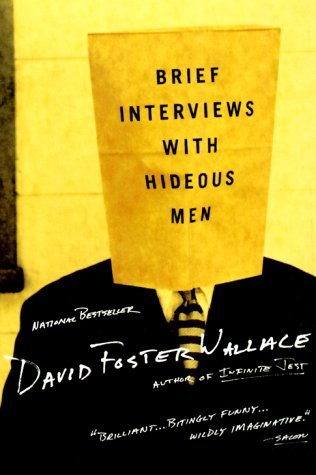
Essential Short Story Collections: Brief Interviews with Hideous Men

brief-interviews-wit_79fe25.jpg

Properly describing David Foster Wallace’s Brief Interviews with Hideous Men involves using all of those words that I hate to see in any book review: “radiates,” “pathos,” “poignancy,” “gut-busting laughs,” “existential crises of identity in the post-modern world,” and so on. Now that I have them out of the way, let me tell you why you should read this book: it will make you laugh, it will make you cry. Out loud. After you read it, you will want to press it on other people, who will say, “Yeah, sure, okay”; only their eyes’ will be slightly-slanted, their mouths just a bit crooked, even their nose will appear askew at your demand. They will hurriedly change the subject–you’ve already foisted so many unwanted books on them, and who even has time to read now?–but you will persevere! “Here,” you’ll say, “Read “A Radically Condensed History of Postindustrial Life”–it’s only two paragraphs! You can read the whole thing in under a minute!”:

When they were introduced, he made a witticism, hoping to be liked. She laughed extremely hard, hoping to be liked. Then each drove home alone, staring straight ahead, with the very same twist to their faces.

The man who’d introduced them didn’t much like either of them, though he acted as if did, anxious as he was to preserve good relations at all times. One never knew, after all, now did one now did one now did one.

And, as they finish reading, you’ll beam at them and nod your head knowingly. They’ll look a little confused, perhaps bored. “It’s like an overture, see? It’s like, about loss, the inability to connect, the masks we wear to hide our hideousnessnesses.” Your victim will nod politely and begin to bring up an interesting thing he saw on the local news concerning pet ownership, but you’ll cut him off before he can get out of this. “Check out the “Brief Interviews with Hideous Men” sections that permeate the book–they’re like little vignettes, interviews where you only get the interviewee’s responses. They’re funny, shocking sad–they’re really good! Also, check out my favorites– “Adult World (I)” and “Adult World (II)”–these stories are about a wife who it turns out doesn’t really know her husband at all. Just read the beginning– ”

For the first three years, the young wife worried that their lovemaking together was somehow hard on his thingie. The rawness and tenderness and spanked pink of the head of his thingie. The slight wince when he’d enter her down there. The vague hot-penny taste of rawness when she took his thingie in her mouth–she seldom took him in her mouth, however; there was something about it that she felt he did not quite like.

“See?” you’ll demand uncaringly of your now-obviously exasperated detainee, “See? Sex! It’s got sex in it! Everyone loves to read about sex, especially weird awkward sex!” Your victim will now stand up, feigning the need to visit the restroom. But you won’t let him go that easily! “There’s another series of running vignettes that unify the book’s structure, making its sum more than just a collection of previously-published stories–check out a selection from one of the “Yet Another Example of the Porousness of Certain Borders” series”–

“Don’t love you no more.”

“Right back at you.”

“Divorce your ass.”

“Suits me.”

“Except now what about the doublewide.”

“I get the truck is all I know.”

“You’re saying I get the doublewide you get the truck.”

“All I’m saying is that truck out there’s mine.”

“Then what about the boy.”

“For the truck you mean?”

Your poor visitor is now literally walking away from you, ignoring the book in your hands, yet still somehow politely smiling–though only with his mouth–his hard eyes show how much he hates you right now. As he retreats to the toilet, your feelings hurt, you comfort yourself by declaring that he doesn’t read anyway; besides, he wouldn’t be able to figure out that “Tri-Stan: I Sold Sissee Nar to Ecko” was a retelling of both the Tristan and Isolde and Narcissus and Echo stories, set in Hollywood; he wouldn’t appreciate the book’s themes of child-abuse, repressed (false?) memories, and lost love. Philistine.

When he comes out of the bathroom you chit-chat a little more and then he’s ready to go. He holds his hand out toward the book. He wants to borrow the book. He wants to take your book. Oh shit. What have you done?

_____________________________________________________________________

Believe it or not, that dude who plays “Jim” from The Office is directing a movie version of Brief Interviews with Hideous Men, scheduled to come out later this year.

You can read the first part of this series here.
A Few Thoughts on (Not Teaching) The Canon

Today I attended the first day of a two-day College Board workshop meant to provide additional training to teachers of Advanced Placement English Language and Composition. I’ve been to a number of these over the years, and College Board’s trainers tend to be better than the average presenters we get in education. The workshops also provide an opportunity to see what teachers at other schools are doing with their students.

Anyway, the only reason I bother to write about this is because of an interesting conversation/confrontation that happened almost immediately at the beginning of the session. As per usual with these things, we were to introduce ourselves–how long we’d been teaching, where we teach, the grade levels we teach, etc. The presenter also asked us to identify the book we most enjoyed “teaching.” That was the verb used–“teaching.” We were in a circle; I was one of the last people to have to introduce myself, and I heard repeatedly “I like to teach Gatsby” or “I like to teach Night” or “I like to teach To Kill a Mockingbird” or “I teach Faulkner.” I was getting a little antsy. Here’s why: 1) I don’t teach books–I don’t even know what it means to teach a book, 2) I rarely have my students read a complete book as part of their curriculum–I abridge almost everything, and 3) I’d been in this same situation more than once, and I knew that saying this was going to rub some of these English teachers the wrong way. And of course it did rub wrong, in particular two musty hags of the old school, one of whom cut me off condescendingly in mid-sentence: “So you’re saying that your kids never read a whole book?”

As pleasantly as possible, I tried to explain that I aim to expose my students to a multiplicity of voices and themes and rhetorical styles and methods, and that I didn’t see my primary job as fostering a love of literature; rather, I believe that the main duty of the English teacher is to facilitate the development of reading, composition, and thinking. I tried to explain that, even in my AP classes, most of my students are not avid readers and most of my students do not read at their grade level, and therefore struggling through 4 or 5 novels or plays over the course of one year didn’t seem as valuable to me as working through over a hundred different writers writing in a variety of styles for a variety of purposes. I tried to explain that reading a selection on slavery from 1789 by Olaudah Equiano in conjunction with a 2005 UN report on human trafficking, and then responding to these text was a far more valuable skill than wading through a dusty “classic” hunting down “universal” themes (whatever those are…).

The response, predictably was: “You mean, your 11th graders don’t read The Scarlet Letter? They don’t read Gatsby? That’s terrible!”

Why? Why should The Scarlett Letter or The Great Gatsby be so reverently “taught” to sixteen and seventeen year olds in this country? I like both of these books–I really do (although I think Gatsby is possibly the most overrated and over-read book ever published, and I’d take Hawthorne’s fabulous short stories any day over dreary Dimsdale and Hester Prynne)–but what purpose is there in making kids read them? Are they truly that relevant, or important?

I should be clear here that I am in no way at all against students reading these books; I wish that they would read these books, in fact. Only, I wish that they would love reading so much that they would be inspired to read books that they’ve heard are great or classic. But here’s the thing: I don’t think that telling a student they must read a book and that that book is a great work of literature and that they should enjoy or be inspired by that book is in any way a fair proposition. It leads only to anxiety, frustration, boredom, and then defeat.

Instead, English teachers should recognize that literature is just one part of reading and writing, and that most of our students are not going to go on to be English teachers or fiction writers. We should focus on a heteroglossic range of voices, styles, and purposes in introducing texts into the classroom. Students should be taught to respond to a variety of texts across a variety of disciplines, not to a few canonical authors. What happens more often than not in English classrooms is something like this: students are forced to read a work too complex for them to comprehend; they rely on the teacher’s interpretation to guide them through the novel (never having been taught a close-reading method that might give them access to the text); the student then writes a meaningless recapitulation of the teacher’s own “universalist” interpretation of the literary work, to the egotistical delight of the teacher who is enthralled that the student has “got it.” What’s lost is the opportunity to engage in relevant, “real-life” writing, writing that enters into an ongoing conversation in a meaningful way.

This is has been a straight-up rant–I’m sorry. I think that the following scene from Freaks and Geeks says it all better than I just did. Kim Kelly (Busy Phillips) critiques On the Road:

In Defense of Pressed Vegetation

Our pal Bobby Tomorrowland recently posted a blog that lamented the passing of a time “when brainy little monographs flew off the shelves at independent bookstores, when information was shared and consumed en masse via organic materials, pressed vegetation, before we turned our economy over to the pixel and set fire to the past.” I know that Bob is a bibliophile: we’ve swapped (and stolen) books from each other for years (Bob lately moved north with my unread copy of The Wind-up Bird Chronicles, exchanging a book of anthropo-mythological film criticism in its place). Still, I was nonetheless a little perturbed by Tomorrowguy’s use of the past-tense verb “was.” Bob clarified his point in the comments thread, writing that “there’s a bittersweet realization that the ledgers, tracts and statements of the future will likely emerge in virtual — not vegetable — form.” Now, sure, “will likely” is still conditional, but it also translates to “probably.” Does Bob really believe that paper books are to be consumed by the “fire of the past”? And where does he locate the sweetness ratio of of this “bittersweet realization”?

Websites and blogs give people the ability to communicate a message to a wide audience without the annoying mediation of an editor or the complications of distributing a physical product. Just as 7″ records, once the currency of underground music, have been displaced by mp3s, zines and “little magazines” are giving way to blogs. American newspapers, in competition with both TV and the internet, increasingly find themselves in economic trouble. Writers of every stripe scramble to praise Amazon’s new e-book reader, the Kindle. Clearly, a new type of literacy based on interfacing with screen media, will certainly be a necessary skill for those seeking “professional” or “white collar” jobs in the West, in the now, and in the future (Greg Ulmer, one of my former professors at the University of Florida has dubbed this skill “electracy“). I will grant Tom Orrowland this much. But his line of logic is specifically teleological, presuming a technologically progressive future, a future shared by everyone. What are the limits of this kind of tomorrowland? Does its horizon extend indefinitely into a promised land, where everyone–that is to say, all members of all cultures, of any imposed tier or hierarchy–share access to this future? Is it not possible to imagine a future of social and technological collapse, where hand-cranked presses must serve where pixels have failed? Or, to be less dramatically eschatological–and to return to Bobby’s original vegetation metaphor –are not handbills and fliers and pamphlets the vital stuff of grassroots movements? To be sure, the internet exists as a profoundly important coeval to the print medium, but is access and exposure to such movements to be only available to those with screen media?Is it so inconceivable people without access to machines could exist fifty or a hundred or two hundred years from now? A thousand? Is electracy in fact an evolutionary threat to literacy? Will hypertext cannibalize pressed vegetation?

Maybe I react this way because I truly love books–not just their contents, but the physical objects themselves, and the thought of a future without books is ugly to me. I love my local independent book store, and I visit it at least twice a month. I love the dizzying smell of a library, the sweet slow-rot of millions of pages. I also have a fondness for several independent presses out there today, publishers who understand that their audiences are genuine bibliophiles. Earlier this month, I gave props to Ursula LeGuin for her insightful recent essay “Staying Awake” in Harper’s. She wrote, and I quoted, and here requote:

The book itself is a curious artifact, not showy in its technology but complex and extremely efficient: a really neat little device, compact, often very pleasant to look at and handle, that can last decades, even centuries. It doesn’t have to be plugged in, activated, or performed by a machine; all it needs is light, a human eye, and a human mind. It is not one of a kind, and it is not ephemeral. It lasts. It is reliable. If a book told you something when you were fifteen, it will tell it to you again when you are fifty, though you may understand it so differently that it seems you’re reading a whole new book.

I couldn’t agree more. Her argument is both simple and profound. To underscore its simplicity, would you be willing to take your laptop or Kindle into the bath with you? How about a sandy beach? Could you imagine poring over a digital version of your favorite Eric Carle book with your young child? What about all the brilliant annotations and ephemeral marginalia doodlers such as myself impose on the text? Again, I’m not presuming that there won’t be water-resistant, beach-friendly, child-friendly, doodler-savvy media interfaces in the future. I can conceive of such a thing. Only I’m dubious. With any number of futuristic fibers available, people still wear organic materials like cotton and leather. We still frame our homes with wood. Many of us prefer to eat real food instead of the edible food-like substances that abound in grocery stores and convenience marts. In short, I think that humans have an affinity and comfort with “naturalistic” products, and I’m not sure if an e-book reader or computer screen will ever be able to replicate the feeling of curling up the couch with a well-loved book stolen from a friend.

Maybe I’m just a Luddite (for the record, I still think my Sony Walkman sounds ten times better than my portable mp3 player). Maybe I’ll be proven wrong, maybe even in just a few short months. Who knows? But I’d rather be cranky and old-fashioned than accept a future without books.

Cannibalism and the Economy of Sacrifice in Olaudah Equiano’s Interesting Narrative

equiano.jpeg

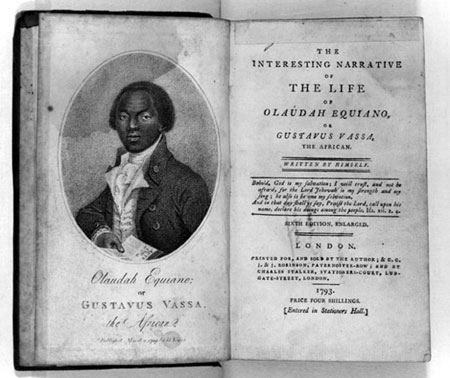
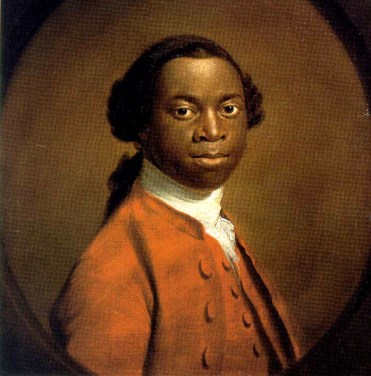
I’ve been re-reading Olaudah Equiano’s Interesting Narrative, a fascinating autobiography/travel book detailing Equiano’s experiences being kidnapped from West Africa at a young age and sold into slavery. During this time, Equiano migrates all around the world, earns and loses and earns again his freedom, and eventually comes to identify himself as an Englishman, replete with English values. Today, the book is widely regarded as a key abolitionist text; it remains a fascinating document of the cruelty and inhumanity of slavery. It’s also a pretty interesting adventure story.

The early part of the book is chock full of images of consumption and sacrifice. Prominent among these images, the threat of cannibalism looms as the ultimate horror at stake in an alien encounter between two different cultures. The first image of cannibalism, however, becomes a sort of baseline of the rhetoric of cannibalism. Equiano relates the following Ibo proverb concerning villagers with bitter tempers: “if they were to be eaten, they were to be eaten with bitter herbs,” noting that many Ibo “offerings [sacrifices] are eaten with bitter herbs.” This seemingly light-hearted proverb locates the consumption of the human body as a site of holy sacrifice, acknowledging that the cost of existence always figures as a displacement of one person’s access to resources in favor of another’s. Equiano later expresses a wish to sacrifice himself to gain his sister’s freedom—“happy should I have ever esteemed myself to encounter every misery for you, and to procure your freedom by the sacrifice of my own,” here echoing the Ibo proverb’s realization of a sacrificial economy. This sacrificial economy plummets into the taboo horror of cannibalism, as a terrified Equiano, kidnapped and dragged to the West African coast, first encounters Europeans. He asks his fellow Africans “if [he] were not to be eaten by those white men with horrible looks, red faces, and loose hair.” The terror of this alien-encounter is not abated when the Africans assure Equiano that he is not to be eaten; “I expected they would sacrifice me,” he writes.

equiano_frontispiece.jpg

As the horror of his sea voyage increases, so does his belief that he is to be voraciously consumed by his captors. While “all pent up together like so many sheep in a fold,” Equiano avers that “We thought […] we should be eaten by these ugly men.” Equiano here figures as a sacrificial lamb, consumed by brutal barbarians. The slave-traders tap into and exploit this fear, using it to manipulate the behavior of Equiano: “the captain and people told me in jest they would kill and eat me, but I thought them in earnest.” Equiano puts his horror even more bluntly: “I very much feared they would kill and eat me.” Equiano’s horror at the threat of cannibalism contrasts greatly with the captain’s playful attitude about the eating of human flesh. The captain “jocularly” threatens to “kill” and “eat” Equiano, and also threatens to eat his young friend as well. The captain then inquires about the cannibalistic practices of West Africans, jokingly averring that “black people were not good to eat,” thus implying he had tasted their flesh before. The captain’s rhetorical technique further destabilizes Equiano’s sense of safety as well as confounding any attempt to systematize knowledge of the ethics, morality, and diet of his new captors; in short, the captain further alienates Equiano’s experience. However, a future Equiano, reflective and knowledgeable, assesses these structures of consumption and sacrifice in terms of economy. “Must every tender feeling be likewise sacrificed to your avarice?” Equiano demands of the “nominal Christians” who participate in the slave trade. Equiano thus translates the literal consumption of enslaved labor into the spiritual, emotional consumption that occurs when people cannibalize each other. The captain’s humor—and indeed, the slight and humorous tone of the Ibo proverb—both serve as defense mechanisms to psychologically mask the taboo terror of cannibalism that figuratively underscores the enslavement of human beings.

SM and Pavement: Album Cover Retrospective

With the new Stephen Malkmus & Jicks album set to drop any day now, we thought we’d take a look at the history of SM’s ouvre via his past album covers.

slanted.jpg

Slanted and Enchanted (1992): Pavement’s first full length defines the so-called lo-fi indie rock sound: scrawling guitars that went to school on Sonic Youth’s Sister, ramshackle percussion (courtesy of original crazy-ass Gary Young), cryptic lyrics, and toneless melodies. The first album also sets the template for the Pavement aesthetic: notebook graffiti, polysemous symbols, postpunk DIY collage work, and lots of scribbling. Key tracks: “Summer Babe,” “In the Mouth a Desert,” “Trigger Cut.”

westing.jpg

Westing by Musket and Sextant (1993): The first Pavement record I bought. On tape! From Camelot Music. Because they didn’t have Slanted and Enchanted. The DIY cover is riddled with seemingly cryptic messages that are actually references to songs and albums that Pavement liked (e.g. “Maps and Legends” by REM). Westing takes the DIY look of Slanted to the next level, and helps to inform not just the way Pavement albums and singles will look for the next few years, but also seems to codify the indie rock look in general (see also: Sebadoh). Key tracks: “Box Elder,” “Forklift,” “Debris Slide.”

crooked.jpg

Crooked Rain, Crooked Rain (1994): This is the first album I remember anticipating coming out. “Luck on every finger”–more cryptology. Was the second song called “Ell Ess Two” or “Elevate Me Later,” or maybe it was “LS2”? Is that SM’s handwriting? An album about rock music. It didn’t leave my CD player for the next three years, and that is no exaggeration. Key tracks: The whole album is perfect. “Gold Soundz” works on any mixtape if you’re in a pinch though. My favorite track might be “Stop Breathin’,” which I think is about the Civil War. For years I thought that Pavement included the only bad track on Crooked Rain, “Hit the Plane Down,” as a kind of purposeful marring, like ancient artisans who included a flaw in their art so as not to displease the gods. Later I just realized that that was the Spiral Staircase track.
Continue reading “SM and Pavement: Album Cover Retrospective”

50 Great Guitarists, All Better Than Slash (In No Particular Order)–Part VII

31. Kevin Shields

Kevin Shields claims that a “new” My Bloody Valentine record will come out this year. Hold your breath. Anyway. Kevin Shields. Loveless. Yeah, that was really good. “If They Move, Kill ‘Em (MBV Arkestra),” I like that too. MBV–never really made a good video.


32. Peter Hook

Don’t start with me. I know Peter Hook played bass. Bass is a guitar, right? I love New Order. Who can deny Peter Hook’s iconic bass leads. Sure, Bernard Sumner had that jangly thing down, but, c’mon, “Ceremony”? “Disorder”? “Temptation”? “Blue Monday”? “Perfect Kiss”? “Love Vigilantes”? Give me a break, those are perfect songs, and you know it’s because of Hook’s sweet lines. Shit, even “Regret” is awesome. Peter Hook is too good. Sumner looks kind of like Thomas Lennon playing Lt. Dangle in this vid:

33. Ash Bowie & 34. Dave Brylawski

Polvo never got their due. Maybe they’ll get a renaissance one day. They were the loudest band I’ve ever seen (they permanently damaged my hearing). They were one of the first bands I listened to where I said “What the fuck is this?” Great stuff, bendy electric. Chewy churny. I saw them cover “Fly Like an Eagle” at Merge Record’s fifth anniversary party. Ash Bowie played what looked like a little SK1. He kicked a stool at the girls from Tsunami, who were filming the show.

35. Joey Santiago

Joey Santiago was in this band called the Pixies who were pretty good.

Shilling for DFW, Special Babies, Ursula K. LeGuin, Sunshine, and (Moby)Dick Jokes

This month’s issue of Harper’s has some great stuff, including a selection called “The Compliance Branch” from David Foster Wallace’s current work in progress. In the short piece, an unidentified narrator is overcome by a “fierce” infant:

The infant’s face, as I experienced it, was mostly eyes and lower lip, its nose a mere pinch, its forehead milky and domed, its pale red hair wispy, no eyebrows or lashes or even eyelids I could see. I never saw it blink. Its features seemed suggestions only. It had roughly as much face as a whale does. I did not like it at all.

Doesn’t this guy know that all babies are special? Evidence of special babies:

baby-sumo.jpg

You can read DFW’s last piece for Harper’s, “Tense Present,” an essay about grammar and usage and democracy, here. Or, alternately, you could treat yourself to the entirety of Consider the Lobster, where said essay is collected. Or, if you’re spectacularly lazy, hear DFW read unpublished work here and here.

Harper’s also has a great essay by ‘klept fave Ursula K. LeGuin. In “Staying Awake,” LeGuin takes on the relationship between reading, capitalism, literature in art. Good stuff. Bibliophile’s will appreciate LeGuin on the physiognomy of books:

The book itself is a curious artifact, not showy in its technology but complex and extremely efficient: a really neat little device, compact, often very pleasant to look at and handle, that can last decades, even centuries. It doesn’t have to be plugged in, activated, or performed by a machine; all it needs is light, a human eye, and a human mind. It is not one of a kind, and it is not ephemeral. It lasts. It is reliable. If a book told you something when you were fifteen, it will tell it to you again when you are fifty, though you may understand it so differently that it seems you’re reading a whole new book.

If you haven’t read LeGuin, I highly recommend The Left Hand of Darkness, a book that scrutinizes gender roles with more interesting results than, say, Eugenides’s Middlesex or Woolf’s Orlando.

Abrupt transition: Sunshine, the latest movie from director Danny Boyle, the mastermind behind Trainspotting, Millions, and 28 Days Later, is out on DVD. Sunshine, scripted by long-time Boyle collaborator Alex Garland (The Beach, 28 Days Later, 28 Weeks Later), was eaten alive last summer by a host of tertiary blockbuster sequels. I liked Sunshine; in addition to being a shiny, beautiful movie, it also raised some interesting questions about the cost of existence, individual worth, and the merits of self-sacrifice. Although the end unravels a bit, the movie is well worth seeing. Recommended.

Finally, lit nerds and Melville fans such as myself might have a laugh at Teddy Wayne’s take on Ishmael as comedian. Sample joke:

What’s the deal with the biscuits? Do they really expect this to suffice for a six months’ imperialistic voyage for exotic spices? And the servings they give you—is this for, like, a baby sailor? Did I accidentally request the infant meal?

Ishmael’s a hack–get it? Is there anything funnier than whaling humor?

whale.jpg

Essential Short Story Collections: Jesus’ Son

Welcome to a new feature at the Biblioklept, “Essential Short Story Collections,” in which we take a look at some, uh, short story collections that are essential (how’s that for a tautology?). Because we here at Biblioklept Headquarters USA always put Jesus first, and because his latest novel Tree of Smoke was so dang good, why not start with Denis Johnson’s 1992 collection Jesus’ Son?

jesusson.jpg

Jesus’ Son is almost a novel in short story form. The unnamed narrator of the stories is an alcoholic drug addict who manages to survive through a mix of petty thievery, odd odd jobs, and straight-up bumming it. The collection opens with “Car Crash While Hitchhiking.” The title of this story is in no way misleading. And although the first story winds up with the narrator hospitalized and blacking out (initiating a motif in Jesus’ Son), the next story, “Two Men” finds him reasonably healthy and up to no good. “Two Men” is a meditation on the bonds of friendship and an outstanding example of Johnson’s tight prose:

I was being taken out of the dance by my two good friends. I had forgotten my friends had come with me, but there they were. Once again I hated the two of them. The three of us had formed a group based on something erroneous, some basic misunderstanding that hadn’t yet come to light, and so we kept on in one another’s company, going to bars and having conversations. Generally one of these false coalitions died after a day or a day and a half, but this one had lasted more than a year. Later on one of them got hurt when we were burglarizing a pharmacy, and the other two of us dropped him bleeding at the back entrance of the hospital and he was arrested and all the bonds were dissolved.

Friends! Good stuff. Other stand-outs in the collection include “Work,” a story about stealing copper wire, and “Emergency,” a tale involving copping pills from an emergency room job. Reminiscent of Hunter S. Thompson, “Emergency” perfectly captures drug-addled paranoia overflowing into petty existential questing. An encounter with some normals:

A family in a big Dodge, the only car we’d seen in a long time, slowed down and gawked out the windows as they passed by. The father said, “What is it, a snake?”

“No, it’s not a snake,” Georgie said, It’s a rabbit with babies inside it.”

“Babies!” the mother said, and the father sped the car forward, over the protests of several little kids in the back.

Georgie came back to my side of the truck with his shirtfront stretched out in front of him as if he were carrying apples in it, or some such, but they were, in fact, slimy miniature bunnies. “No way I’m eating those things, ” I told him.

The last story in Jesus’ Son, “Beverly Home,” finds our narrator in a somewhat more stable position, working in a retirement home and attending NA and AA meetings. His one vice and indulgence is voyeurism; he takes to watching a Mennonite couple through their windows at night, progressing from deviant sex-obsession to pining for their mundane life:

I got so I enjoyed seeing them sitting in their living room talking, almost not talking at all, reading the Bible, saying grace, eating their supper in the kitchen alcove, as much as I liked watching her naked in the shower.

At the end of the book, moved by the strange spectacle of a man washing his wife’s feet, the narrator finds a kind of hope and redemption for the future:

All these weirdos, and me getting a little better every day right in the midst of them. I had never known, never even imagined for a heartbeat, that there might be a place for people like us.

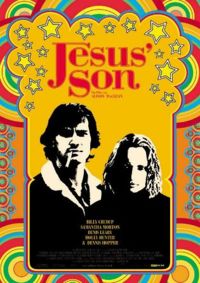
200px-jesus_son_ver5.jpg

I mentioned above that Jesus’ Son can almost be read as a novel, but make no mistake–it is a collection of short stories, character sketches, vignettes that add up to something greater. The 2000 film adaptation of the movie makes this quite clear. Although the film, starring Billy Crudup as the unnamed narrator, is not half bad, the disconnected and fragmentary nature of the book–which reinforced the book’s themes of existential alienation and minor redemption–comes across as episodic and even whimsical in the movie.

I highly recommend Jesus’ Son, and I hope that people who “don’t have time to read” will make a little space in their day for this slim but substantial book. Most of the stories can be read in under half an hour, so why not pick up a copy?

What I Liked About that Zodiac Movie

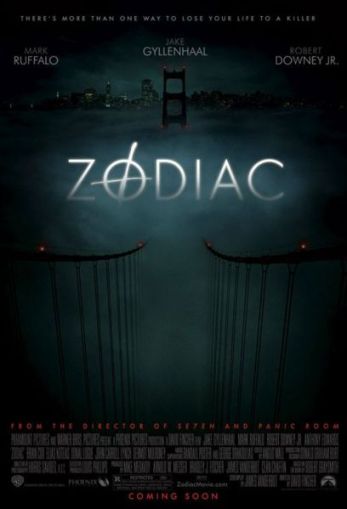
This weekend, I watched and thoroughly enjoyed David Fincher’s Zodiac, a film I initially had no interest in seeing, but nonetheless dutifully queued up when it wound up on numerous critics’ year-end top ten lists. When Zodiac came out last year, I prejudicially–and wrongly–assumed that the film, the tale of the infamous Zodiac killer who menaced California in the late sixties and early seventies, would be a moody character study, all ominous texture, smoggy chase scenes, and desperate anger à la Fincher’s 1995 thriller, Se7en (that movie where Gwyneth Paltrow’s head gets chopped off), or even worse, Fincher’s awful 1997 effort The Game. Most Hollywood suspense films–Fincher’s included–propel themselves on chase sequences, meaningless yelling, and overstated light and music queues that seem to scream “this is the part where you feel tense.” Zodiac, however, eschews all of these often vacuous tropes in favor of simply telling a story.

zodiacfincher.jpg

In today’s issue of Slate, Elbert Ventura points out in his write-up of the director’s cut DVD of Zodiac that the film is “a cop epic without a single shootout, a serial-killer flick in which all the blood is shed in the first act, and a taut procedural in which the case is never solved. In fact, it’s one of the most unsatisfying thrillers you’ll ever see—which is precisely how Fincher intended it.” Ventura’s review is fantastic, and I highly recommend reading it. He discusses the underlying politics of Zodiac, arguing that the film champions due process over vigilante “justice,” an important position to reaffirm in an age of Jack Bauerisms and actual debates over what constitutes torture.

What I really enjoyed about the film wasn’t so much its sense of values (something I honestly only realized after Ventura’s review), but the fact that the story was told without the intrusions of the personal lives of the principals involved as some kind of dramatic back story. Too often, Hollywood feels the need to muddy a perfectly good story with an unnecessary secondary plot about the personal conflict that the dramatic action in the main plot creates for its protagonists. Zodiac seems to understand that the obsessive hunt for the Zodiac killer is a source of personal conflict for the characters. To be sure, wives are annoyed with husbands, family duties are overlooked, and characters have substance abuse problems. However, Fincher is never tempted to exploit these “issues” for dramatic fodder. Instead, what might’ve served as a dramatic back drop in a standard Hollywood movie becomes little more than a character tic.

zodiac.jpg

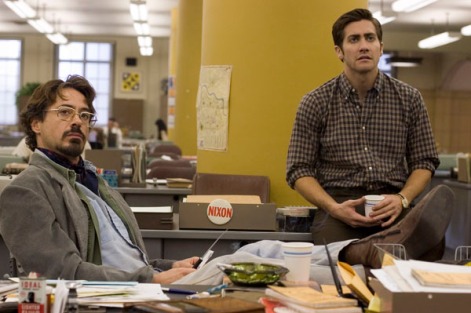
This is not to say that the film is not character-driven. Zodiac is anchored by stellar performances by that guy from Donnie Darko, that guy from Less Than Zero, and that guy from Eternal Sunshine of the Spotless Mind, and also features great supporting parts from that chick from Gummo, that guy from Revenge of the Nerds, and that guy who was in everything. Hell, even that guy from Mr. Show has a bit part.

Too bad that Zodiac was a flop. There should be more Hollywood thrillers like this, films unafraid to simply tell a great story, even if that story doesn’t have gunslinging heroes or damsels in distress, even if the bad guy gets away. Check it out on DVD.

zodiacbuttonnote.gif

(Very) Early 2008

So. Yes. Well. OK. With holiday rehab served and “exhaustion” surmounted, Biblioklept is now back in production for the ’08. A few things:

2008, you might’ve heard, is an election year. Biblioklept’s official position is that all career politicians are scoundrels in the pocket of corporations. But. We do love Ralph Nader, and he’s come out in support of South Carolina pretty boy John Edwards. So maybe there’s something to that.

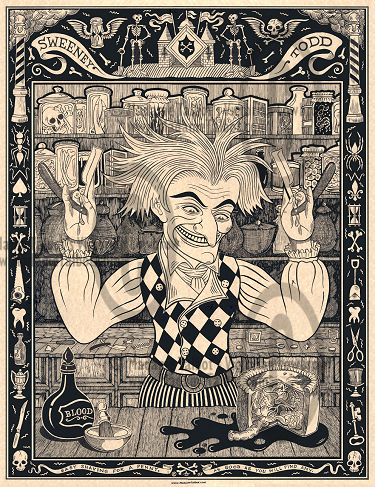
sweeneyposter.jpg

By our reckoning, Tim Burton hasn’t made a good movie since 1999’s Sleepy Hollow or a great movie since 1994’s Ed Wood. Finally though, his adaptation of Stephen Sondheim’s Sweeney Todd: The Demon Barber of Fleet Street marks a return to excellence. Why aren’t there more musical horror films? Go see this film in the theater.

distortion_large.jpg

Speaking of musical Stephens, Stephin Merritt’s Magnetic Fields will unleash their new album Distortion on January 15th. We weren’t crazy about 2004’s i, but Distortion marks a return to a more straightforward pop sound with plenty of (surprise) distortion. We’re really digging this album. Check out a few of the tracks for yourself.

And yes, this is still a blog about books. Look out for upcoming reviews of R. Crumb’s Kafka biography, Eggers’s What is the What, stuff from Chris Ware, a few short story collections, and a collection of William Blake’s work. Also, we haven’t abandoned our 50 Guitarists series or the Alphabet Soup project. So there’s that. Anyway. Biblioklept will be back in full-scale, proper review mode next week. In the meantime, check out Bibliokid for random daily Internet detritus.

Happy Hogmanay

From the OED:

hogmanay

Sc. and north. Eng. ({sm}h{rfa}gm{schwa}{sm}ne{shti})
Forms: 7 hogmynae, 8 hagmane, -menai, 8-9 hagmena, -menay, (hagman heigh), hogmanay, (9 hogmena, -menay, -maney, hanganay). [Of obscure history, noted only from 17th c. App. of French origin: see note below.]
The name given in Scotland (and some parts of the north of England) to the last day of the year, also called ‘Cake-day’; the gift of an oatmeal cake, or the like, which children expect, and in some parts systematically solicit, on that day; the word shouted by children calling at friends’ houses and soliciting this customary gift.
c1680 [see b]. 1693 Scotch Presbyt. Eloq. (1738) 120 It is ordinary among some Plebeians in the South of Scotland, to go about from Door to Door upon New-Year’s Eve, crying Hagmane. 1790 Gentl. Mag. LX. I. 499/1 Concerning the origin of the expression ‘Hagman Heigh’. Ibid., In..Scotland, and in the North of England, till very lately, it was customary for every body to make and receive presents amongst their friends on the eve of the new year, which present was called an Hagmenay. Ibid. II. 616/2 On the last night of the old year (peculiarly called Hagmenai). 1792 Caledonian Mercury 2 Jan. (Jam.), The cry of Hogmanay Trololay is of usage immemorial in this country. 1805 J. NICOL Poems I. 27 (Jam.) The cottar weanies, glad an’ gay..Sing at the doors for hogmanay. 1825 BROCKETT s.v. Hagmena, The poor children in Newcastle, in expectation of their hogmena, go about from house to house knocking at the doors, singing their carols, and [saying] ‘Please will you give us wor hogmena’. 1826-41 R. CHAMBERS Pop. Rhymes Scot. (1858) 295 The children on coming to the door, cry ‘Hogmanay!’ which is in itself a sufficient announcement of their demands. Ibid. 296 Cries appropriate to the morning of Hogmanay..‘Get up, goodwife, and shake your feathers, And dinna think that we are beggars; For we are bairns come out to play, Get up and gie’s our hogmanay.’ 1827 HONE Table-Bk. I. 7 The Hagman Heigh is an old custom observed in Yorkshire on new year’s eve. 1830 SCOTT Jrnl. II. 360 We spent our Hogmanay pleasantly enough. 1884 St. James’s Gaz. 27 Dec. 6/1 Seasonable mummery..was reserved for Hogmanay. 1890 Scott. Antiq. June 40 This is the sort of thing they used to sing as their ‘Hagmena Song’ in Yorkshire. 1893 HESLOP Northumb. Gloss. s.v., In North Northumberland the hogmanay is a small cake given to children on Old Year’s Day; or the spice bread and cheese, with liquor, given away on the same day. 1897 E. W. B. NICHOLSON Golspie 100-108.

b. attrib. and Comb., as hogmanay cake, day, night, concert, song, etc.

c1680 in Law Mem. 191 note [Protest of the Gibbites] They solemnly renounce..Pasch-Sunday, Hallow-even, Hogmynae-night, Valentine’s even [etc.]. 1826-41 R. CHAMBERS Pop. Rhymes Scot. (1858) 295 A particular individual..has frequently resolved two bolls of [oat]meal into hogmanay cakes. 1864 BURTON Scot Abr. I. v. 297 The eve that ushers in the new year is called in Scotland Hogmanay Night. 1897 Westm. Gaz. 21 Dec. 6/3 On New Year’s Eve there is to be a grand Hogmanay concert for the special benefit of patriotic Scots in London.”
Watch the fireworks:

Tumblr, Supper’s Ready, Bibliokid, Unrelated Owl

Thanks to Bobby Tomorrowland for hipping me to Tumblr. This is probably the simplest, cleanest way to blog; it’s actually kind of addictive. Check out Bob’s new blog Supper’s Ready, and my new blog, Bibliokid, and then say, “Jeez, I can do better than that,” and make your own damn blog.

Unrelated owl:

wildlife_barn_owl.jpg

Omega the Unknown

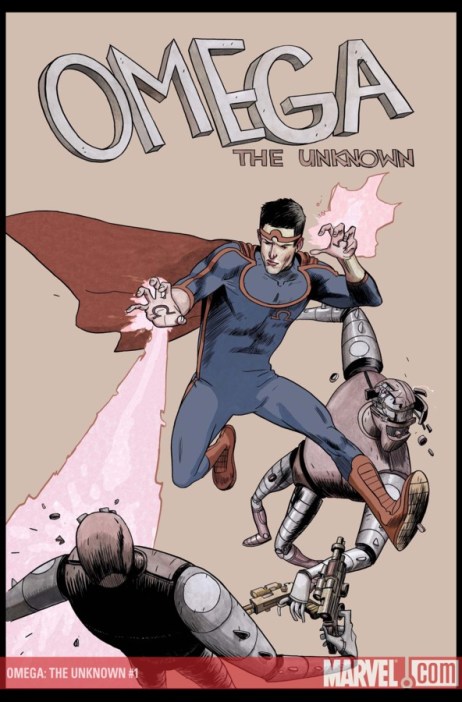
omegatu1.jpg

Earlier this year, in an interview with the AV Club, Jonathan Lethem briefly mentioned that he was working on “kind of an emo comic book” for Marvel Comics. The first issue of that comic–part one of a ten issue run–came out back in October, prompting me to go to a comic book store–something that I haven’t done in years. Lethem’s Omega the Unknown is essentially an update of the original Omega the Unknown series, written by Steve Gerber and Mary Skrenes with art by Jim Mooney. The original ten issue run was published by Marvel Comics twenty years ago.

Lethem’s Omega the Unknown centers on robotically erudite teenager Alex Island and his new life after the bizarre death of his parents (who turn out to be–gasp!–robots). Alex has a strange (and still unexplained in the first three issues) relationship with a superhero who doesn’t speak, but who seems to be watching over him, protecting him from alien androids who are out to get him. Also watching over him after his parents’ deaths are a callow young nurse and a cynical social worker. All the while, local Brooklyn “superhero” The Mink tries to figure out how he can turn this new superhero and his robot villains into an opportunity for more publicity.

I haven’t read Marvel comics in over 15 years, but Omega the Unknown is quite a bit better than even the best comics I remember reading in the late eighties/early nineties (um, Chris Claremont’s X-books). Still, despite its introspection, lack of huge splash pages or silly, purposeless fights, Omega is deeply entrenched in superhero terrain: this isn’t an indie comic. Also, I was able to wait a week between reading issues two and three, even though I had both of them in my possession–compare this to a “superhero” comics like Alan Moore’s Watchmen, which I had to read in one sitting.

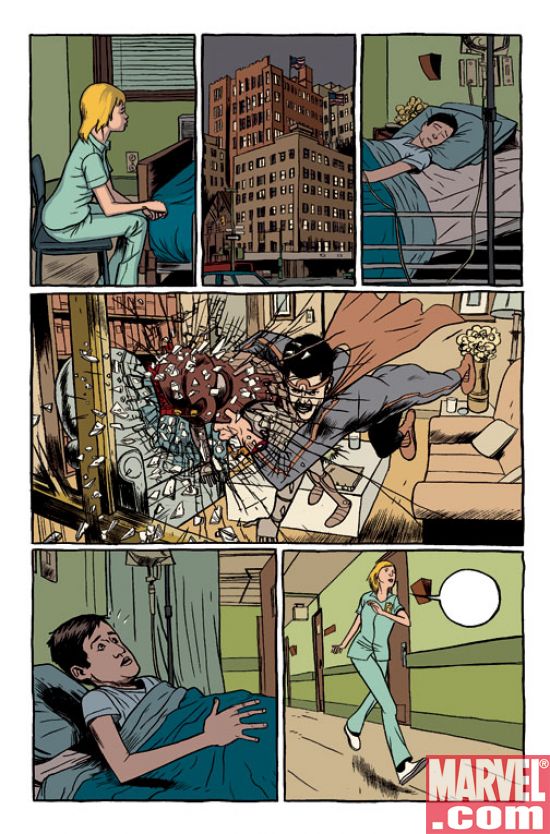
omega03.jpg

Farel Dalrymple’s art is fantastic, especially given Marvel’s current penchant for anime-inspired overly-muscled cartooning. Dalrymple’s figures recall many of my favorite artists, capturing the quintessential stark simplicity of Jack Kirby’s squarish hulks and the wild energy of early John Romita Jr. coupled with the attention and detail to line Art Adams always puts into his illustrations.

I’ll continue to pick up the issues of Omega the Unknown, but so far, it’s hardly essential Lethem, or, for that matter, essential comic reading. Still, for now, I’ll give it the benefit of the doubt.

Pessimus Populus: The Worst People of 2007

Time to round up all the awful people of 2007. This list is in no way definitive, and it’s barely in hierarchal order, but I think it’s sound enough. Just like last year’s list (for the record, everyone on that list was also horrible in 2007), the miscreants represented are limited to Americans only–there are simply too many assholes out there to take on the whole world.

10. Michael Vick:

Organizing the killing of dogs for sport and entertainment–and to make money–makes you a complete asshole.

rt_vick_dog_fighting_070718_ms.jpg

9. The multitude of vacuous, soulless, slutty “celebrities,” whose malfeasance and just plain general dumbness passes for “culture” these days:

We’re not going to name them, because we’re sick of them and so are you. Still, coverage of their worthless exploits continues to metastasize like cancer. Perhaps we should blame the American people? Nah…this blog is pro-America! Which brings us to an attack on–

8. The Democratic Party:

The Democratic Party has spent this entire decade as impotent mugwumps, a collection of scaredy-cat politicians who fell into every trap the well-organized Republicans set for them. Even with the Congressional and Senate majority, they still couldn’t manage to do anything to stop the steady growing institutionalizing of a stark divide between the haves and the have-nots.

donkey.jpg

7. The Republican Party and every fool who still supports them:

I’m still amazed to run into Bush supporters. I got over my liberal outrage a few years ago (it became unsustainable in the face of the sheer ludicrous evil perpetuated by the Neocons in the name of “security”), and my liquid rage has now gelled into detached cynicism. Still, when I encounter any “Republicans” who defend the Bush administration, I love to ask them why they support a monster who has so dramatically increased government spending, as well as the role of the federal government in the lives of Americans. The average Republican seems to respond only in hypothetical rhetorical questions–“You think Gore would’ve done a better job?” or worse, points out that Bush was the “moral” candidate (uh…Katrina?). Still, I get the sad feeling that these chumps were fooled by one of the most organized political efforts in American history to consolidate power and revoke civil liberties.

6. OJ Simpson:

Speaking of hypothetical rhetoric, before he was roughing up sports memorabilia dealers in Las Vegas, OJ Simpson was hard at work getting If I Did It: Confessions of the Murderer published. According to a Fox press release (there was going to be a tell-all interview aired; for once moral outrage trumped poor taste): “O.J. Simpson, in his own words, tells for the first time how he would have committed the murders if he were the one responsible for the crimes. In the two-part event, Simpson describes how he would have carried out the murders he has vehemently denied committing for over a decade.”

Wow. What a fucking asshole.

if_i_did_it_2.png

5. Alberto Gonzales:

Gonzales was either lying when he repeatedly said he didn’t or couldn’t recall any details about the 2006 firing of eight US attorneys for their political persuasions (um, they weren’t “loyal Bushies“), or he was just grossly incompetent in his position as US Attorney General. It took him months to resign, and even then, the Bush administration continued to support him.

4. Nancy Grace, Bill O’Reilly, and every other douchebag who perpetuates sensationalist, divisive nonsense under the guise of “journalism”:

This brand of yellow journalism has been around forever, but in recent years its proliferation has become unbearable. Even worse, it’s starting to infect mainstream journalism, which increasingly tells “stories,” instead of simply reporting the news. Plus, Nancy Grace is an awful bitch.

3. Dick Cheney:

Make no mistake, Dick Cheney’s evil hasn’t fallen off any–sure he came in at #2 last year, but, as I said at the beginning of this list, the rankings are somewhat arbitrary. I suppose he got a little bit of cred this year for not shooting any old men in the face (at least none that we know of). Evil and secretive, Cheney believes that Americans are idiots, sheep who need to be sheparded.

Check out clips from The Daily Show‘s series “You Don’t Know Dick.”

2. The perpetrator of the Virginia Tech Massacre, and every other asshole who feels like mass murder will make them famous and heal their sick spirit:

I won’t publish his name or even link to it, for that matter. These people want fame and recognition, a glory after death, to be remembered and recognized, and I don’t wish to be part of that. But still. This guy was clearly one of the worst–if not the worst–persons of 2007. These types of killings keep happening again and again, and I am in no way discounting or ignoring the other slayings this year–some as recent as last week–but this particular massacre is the worst school shooting in American history. I am still shocked that this tragedy never sparked a full-scale debate leading to gun control reform. Hell, gun control isn’t even a major issue in the 2008 presidential election.

Here are the names of the victims (for a detailed list, go here): Ryan Clark (22), Emily Hilscher (19), Liviu Librescu (76), Minal Panchal (26), G. V. Loganathan (53), Jarrett Lane (22), Brian Bluhm (25), Matthew Gwaltney (24), Jeremy Herbstritt (27), Partahi Lumbantoruan (34), Daniel O’Neil (22), Juan Ortiz (26), Julia Pryde (23), Waleed Shaalan (32), Christopher James Bishop (35), Lauren McCain (20), Michael Pohle Jr. (23), Maxine Turner (22), Nicole White (20), Jocelyne Couture-Nowak (49), Ross Alameddine (20), Austin Cloyd (18), Daniel Perez Cueva (21), Caitlin Hammaren (19), Rachael Hill (18), Matthew La Porte (20), Henry Lee (20), Erin Peterson (18), Mary Read (19), Reema Samaha (18), Leslie Sherman (20), Kevin Granata (45).

1. George W. Bush:

I may now anticipate a response on the order of: “OK, Biblioklept–Bush is awful, but he didn’t murder 33 people in cold blood–what makes him #1 on your list?” Here’s the deal: although Bush hasn’t technically murdered anyone, his war has led to the deaths of thousands and thousands of people, and his radically conservative policies on everything from environmental protection to child health care will have long term detrimental effects on American society for decades to come. He claims that history will judge his presidency, and I believe him: Bush will go down in history as the worst president since Richard Nixon, and will no doubt be judged even more harshly.

Hard at work:

Other People’s Lists: The Best Books of 2007

quad.jpg

Since we’ve already had our say about the best books of ’07, here’s what some other clowns thought:

The New York Times agreed with us that Denis Johnson’s Tree of Smoke was fantastic. They also give props to Roberto Bolaño’s The Savage Detectives, the reading of which is high on our “to do” list. In their non-fiction superlatives, they highlight music critic Alex Ross’s The Rest is Noise, as do the a couple of the folks over at Slate–although Slate‘s list fails to recognize Tree of Smoke (the book is seriously seriously good good good). The editors of Publisher’s Weekly also cite Johnson’s novel as one of ’07’s best, and they’re one of the few sites out there to mention Don DeLillo’s Falling Man. I’ve just started listening to the audiobook version of Falling Man, and I should be able to weigh in before ’07 is kaput. There’s a better-than-you-would-think-it-would-be write-up at Time of the top-ten graphic novels of 2007. The School Library Journal effectively organizes its list by grade level, a boon to teachers and parents everywhere. That bastion of literary criticism, The Economist, seems to think that Michael Chabon’s The Yiddish Policemen’s Union was something special, although we know better. The writers over at the Village Voice are sensible enough to append the adjective “favorite” instead of “best,” perhaps excusing them from also giving a nod to Chabon’s book (although their mistaking Miranda July for an author cannot be forgiven). When you get sick of reading other people’s list, head over to Book Covers and check out the Best Book Shelves of 2007 (the images in this post are from said list).

bookinist.jpg

Oh, I see? Oh, I see

My wife works at a children’s museum. Sometimes people send her “ideas” that they think the museum might be able to put to good use. Like this guy:

what-do-you-think.jpg

Superlatives 2007

pig1.jpg

Not only does the end of each year bring ugly barefaced consumerism, nightmare traffic, and hellish stress, it invariably leads up to oodles of lists, hierarchies, rankings, and tabulations. We here at Biblioklept are not above marshaling the cultural detritus of the year into our own list, as follows. But before we even get to all that, I have to say that The Year of the Golden Pig (whether it was really a Golden Pig year or not) was a wonderful and special year for me, thanks to the birth of my lovely little girl. So: very good year.
Best Fiction Book I read in 2007

childrenshospital.jpg

This is really tough, because I read so many great books this year. Cormac McCarthy’s The Road really stuck with me, and although I thought the end was a cop-out, I found myself thinking about the book constantly and rereading it in bits and pieces. For sheer entertainment, I also really enjoyed Chris Bachelder’s US! I also read or reread most of James Joyce’s oeuvre, and I really did enjoy Ulysses, despite the torture it put me through, and I can’t leave it out of this group. Still, I have to give the award to a book published last year, Chris Adrian’s astounding and astonishing The Children’s Hospital, a book so good that I actually had to stand up to read it at times.

Best Nonfiction Book I read in 2007

consider.jpg

Although Consider the Lobster, David Foster Wallace’s “sequel” to his hilarious collection of essays A Supposedly Fun Thing I’ll Never Do Again, isn’t quite as funny as that earlier book of essays, it shows a maturation of scope and a control of language that I would’ve thought impossible ten years ago, simply because DFW has been such a master of words from the outset of his writing career. Great book.

Best Book Published in 2007 that I Read in 2007

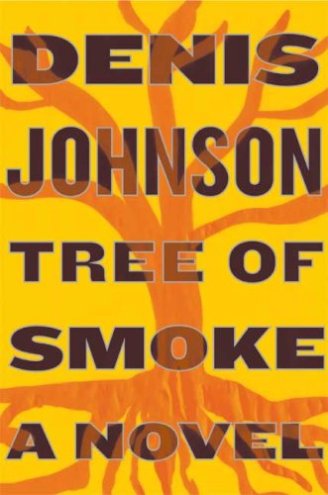
tree-of-smoke.jpg

Denis Johnson’s Tree of Smoke was the best book I read all year, although it’s only fair to point out that I listened to the audiobook–maybe I should put quotation marks around read, or just use the verb listen instead. In fact almost all of the books published in 2007 that I…uh…”read” were audiobooks, including two of the bigger releases this year, Michael Chabon’s The Yiddish Policemen’s Union and Jonathan Lethem’s You Don’t Love Me Yet. Which brings us to…

Most Disappointing Book of 2007

Jonathan Lethem’s You Don’t Love Me Yet was pretty awful.

Best Movie I Saw in the Theater in 2007

childrenofmen.jpg

Tie: Children of Men (yeah, I know it came out in 2006–I saw it in 2007 though) and Superbad. If you were to make a graph of emotional matrices, these two films would probably fit quite comfortably at ends opposite of each other. Still, they have plenty in common–great stories, emotional impact, and most importantly, they meet the ultimate criterion for an excellent movie: they start out great and only get better.

superbad.jpg

Best Movie I Saw on DVD in 2007

David Lynch’s INLAND EMPIRE. Watch it at night in the dark, preferably alone, preferably in the cold.

Most Disappointing Movie of 2007

Although it was by no means bad, I was disappointed in the Coen’s adaptation of Cormac McCarthy’s No Country for Old Men. It was a good movie–Javier Badem was fantastic, great pacing and tone–but still it didn’t blow me away like, say, Fargo or Blood Simple or Miller’s Crossing did. Ditto Werner Herzog’s Rescue Dawn. Chalk it up to hyperbolic expectations, I guess. Maybe I need to watch these films again on DVD and reconsider.

Best Album of 2007

This is always a tough one, and there were plenty of great albums that came out this year. Late in the year I found myself unexpectedly in love with The National’s Boxer, a serious album that’s still growing on me like a weird moss. Battles’s Mirrored was superb; I found myself listening to James Blackshaw’s The Cloud of Unknowing whenever I wanted my mind to mush out; Menomena’s Friend and Foe was the perfect soundtrack for a long drive; the psychedelic progrock of Frog Eyes’s Tears of the Valedictorian made me itch in a good way; and with Strawberry Jam, Animal Collective finally let us know what they were singing. Fiery Furnaces, my favorite band, put out Widow City, their most “rock” album to date, a great collection of songs about widows and hieroglyphics and mysticism and bored Spanish royals and automatic husbands and perverts in Japanese slippers. But if I had to pick just one album of the year, it would have to be Panda Bear’s Person Pitch, a gorgeous pastiche of loveliness that I consistently put on repeat. Bring your own harmonies and sing along.

Best Single of 2007

Just when I’d given up on Outkast–what with Big Boi doing that awful Caddyshack ripoff and Andre busy with his silly cartoon–they show up on UGK’s “International Players Anthem,” easily the best track of the year. From Andre’s opening meditation on the virtues of commitment to the final verse’s warnings about Paul McCartney’s messy divorce, this song is pure magic. The death of Pimp C earlier this week adds a darker shade to the poignancy and sweet nostalgia of “International Players Anthem.”

…and of course, I can’t leave this out.

Most Disappointing Album of 2007

I haven’t been interested in Blonde Redhead in years, really–chalk it up to a sense of propriety stemming from following them since their earliest (and best) albums (and 7″s!)–but 23 was a dreadful bore. Ditto the Sea and Cake’s Everybody: even the addition of a few fuzzy edges couldn’t muddle the Chicago quartet’s vanilla smoothiness. But it was Smokey Rolls Down Thunder Canyon, Devendra Banhart’s follow up to 2005’s Cripple Crow that stood out as the biggest disappointment. Banhart’s unfocused, overblown, tossed-off collection of songs copped riffs left and right without adding anything new or inventive. My wife reviewed the album best while riding in the car with me: “Why are you listening to The Doors?”

Best Network TV Show of 2007

I love NBC’s 30 Rock so much that I wanna take it out behind the middle school and get it pregnant.

Best Cable TV Show of 2007

It’s Always Sunny in Philadelphia: bad awful people doing rotten awful things. Charlie is a personal hero of mine.

Best New TV Show of 2007

Flight of the Conchords is hilarious. That’s lousy writing/reviewing, but it’s true: the show is just really really funny. You should watch it. You’ll like it a lot (unless there’s a yawning abyss where your soul should be…)

Best Out of Control Local News Appearance of 2007

Two way tie: Tracy Morgan–

vs. Tracy Morgan–

Best Abs of 2007

With a body like that, Putin can curtail my civil liberties any time!

shirtlessputin3.jpg

Best Makeover of 2007

When he’s not terrorizing bands in the studio, making awesome Christmas albums, or just having a few tequila drinks with a lady friend, Phil Spector takes time out to make sure that he’s looking fine and dandy like cotton candy.

phil.jpg

Most Enjoyable Blog of 2007

I’ve looked forward to and greatly enjoyed each entry in Nathan Rabin’s ambitious project My Year of Flops over at the Onion AV Club. Is it too much to ask him to do this again in 2008?

Most Addictive WordPress Blog of 2007

I Can Has Cheezburger. Our lives were so empty before Lolcatz.

lolcat.jpg

Single Greatest/Worst Moment of 2007