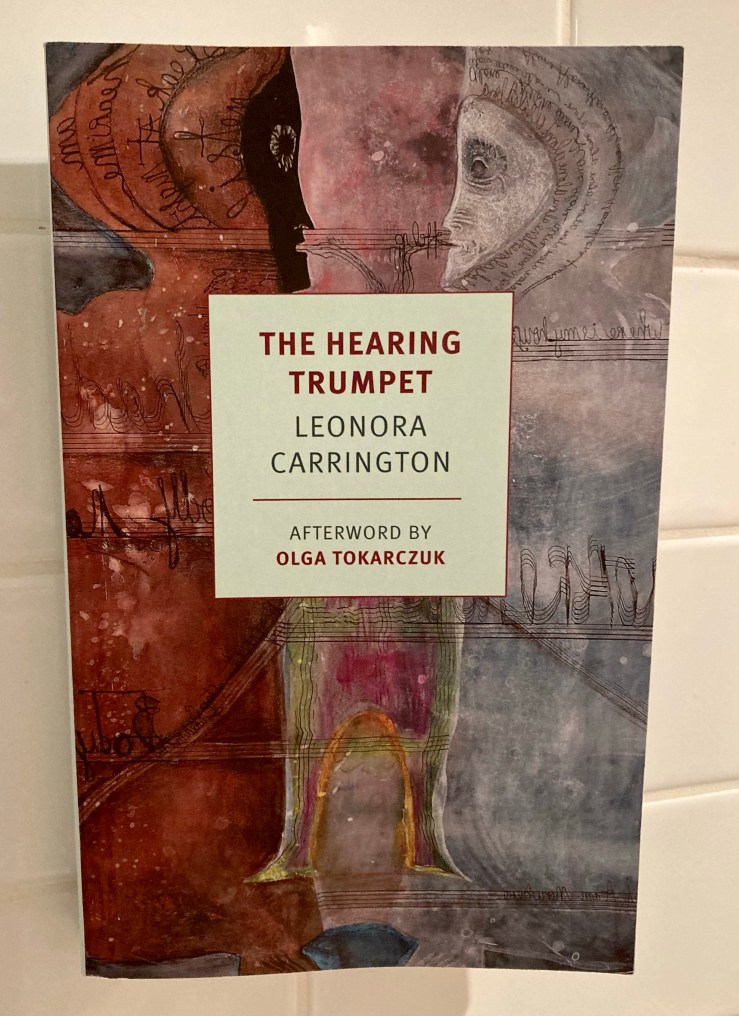
Leonora Carrington’s The Hearing Trumpet (Book acquired, 1 Dec. 2020)

NYRB will have a new edition of surrealist painter Leonora Carrington’s 1976 novel The Hearing Trumpet out in early January of 2021. I started it this afternoon, and the first 20 or so pages seem to divert in style from the short stories I’ve read by her—definitely chock full of quirky imagery, but also relatively straightforward in their execution. At around the 20 page mark, though, the narrative dips into demented dreamland. Ali Smith’s blurb promises there’s more under the surface:

The Hearing Trumpet . . . reads on its parodic surface like an Agatha Christie domestic mystery, but one melted, dissolved by extreme heat into something unthinkably other, and reconstructed as the casebook of an alchemist. . . . It asks its readers to allow the dark, allow the wild and rethink how power works. It is a work of massive optimism. . . . One of the most original, joyful, satisfying, and quietly visionary novels of the twentieth century.

I also love the blurb from Luis Buñuel:

Reading The Hearing Trumpet liberates us from the miserable reality of our days.

Here’s NYRB’s blurb:

Leonora Carrington, painter, playwright, and novelist, was a surrealist trickster par excellence, and The Hearing Trumpet is the witty, celebratory key to her anarchic and allusive body of work. The novel begins in the bourgeois comfort of a residential corner of a Mexican city and ends with a man-made apocalypse that promises to usher in the earth’s rebirth. In between we are swept off to a most curious old-age home run by a self-improvement cult and drawn several centuries back in time with a cross-dressing Abbess who is on a quest to restore the Holy Grail to its rightful owner, the Goddess Venus. Guiding us is one of the most unexpected heroines in twentieth-century literature, a nonagenarian vegetarian named Marian Leatherby, who, as Olga Tokarczuk writes in her afterword, is “hard of hearing” but “full of life.”

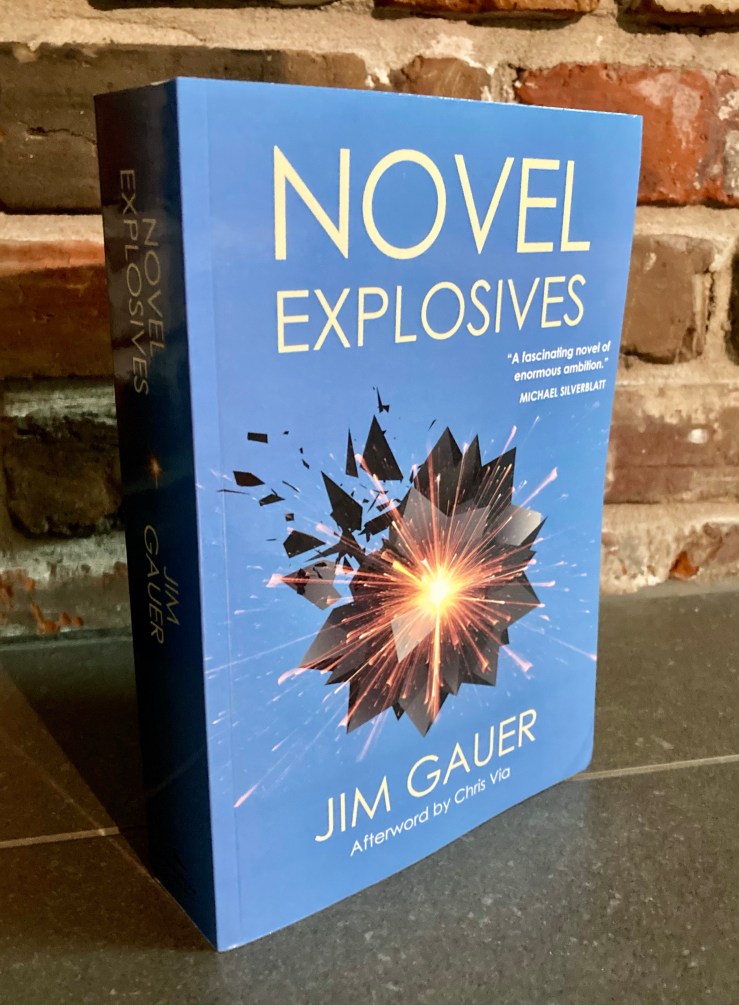
Jim Gauer’s Novel Explosives (Book acquired, 30 Nov. 2020)

Oof she’s a big boy. Jim Gauer’s 2016 novel Novel Explosives showed up at Biblioklept World Headquarters on Sunday (a rare day for acquisitions). The novel has been praised by folks like Michael Silverblatt, Steven Moore, and Matt Bucher, and has been compared to the work of Pynchon, Bolaño, and Gaddis. It’s also pretty damn long. Anyway, Novel Explosives is being reprinted by indie Zerogram; their blurb:

IT’S THE WEEK AFTER EASTER, APRIL 13-20, AN OTHERWISE ORDINARY WEEK IN 2009… LATE in the week, a man wakes up in Guanajuato, Mexico, with his knowledge intact, but with no sense of who he is, or how he came to Guanajuato. EARLY in the week, a venture capital investor sits at his desk in Santa Monica, California, attempting to complete his business memoirs, but troubled by the fact that a recent deal appears to be some sort of money-laundering scheme. IN THE MIDDLE of the week, two gunmen for the Juárez Drug Cartel arrive at a small motel in El Paso, assigned to retrieve a suitcase full of currency, and eliminate the man who brought it to El Paso. THUS BEGINS the three-stranded narrative of Novel Explosives, a search for identity that travels through the worlds of venture capital finance, high-tech money-laundering methods, and the Juárez drug wars, a joyride of a novel with only one catch: the deeper into the book you go, the more dangerous it gets.

Ge Fei’s Peach Blossom Paradise (Book acquired, 12 Nov. 2020)

Ge Fei’s novel Peach Blossom Paradise, translated from the Chinese by Canaan Morse, is forthcoming from. Their blurb:

In 1898 reformist intellectuals in China persuaded the young emperor that it was time to transform his sclerotic empire into a prosperous modern state. The Hundred Days’ Reform that followed was a moment of unprecedented change and extraordinary hope—brought to an abrupt end by a bloody military coup. Dashed expectations would contribute to the revolutionary turn that Chinese history would soon take, leading in time to the deaths of millions.

Peach Blossom Paradise, set at the time of the reform, is the story of Xiumi, the daughter of a wealthy landowner and former government official who falls prey to insanity and disappears. Days later, a man with a gold cicada in his pocket turns up at his estate and is inexplicably welcomed as a relative. This mysterious man has a great vision of reforging China as an egalitarian utopia, and he will stop at nothing to make it real. It is his own plans, however, which come to nothing, and his “little sister” Xiumi is left to take up arms against a Confucian world in which women are chattel. Her campaign for change and her struggle to seize control over her own body are continually threatened by the violent whims of men who claim to be building paradise.

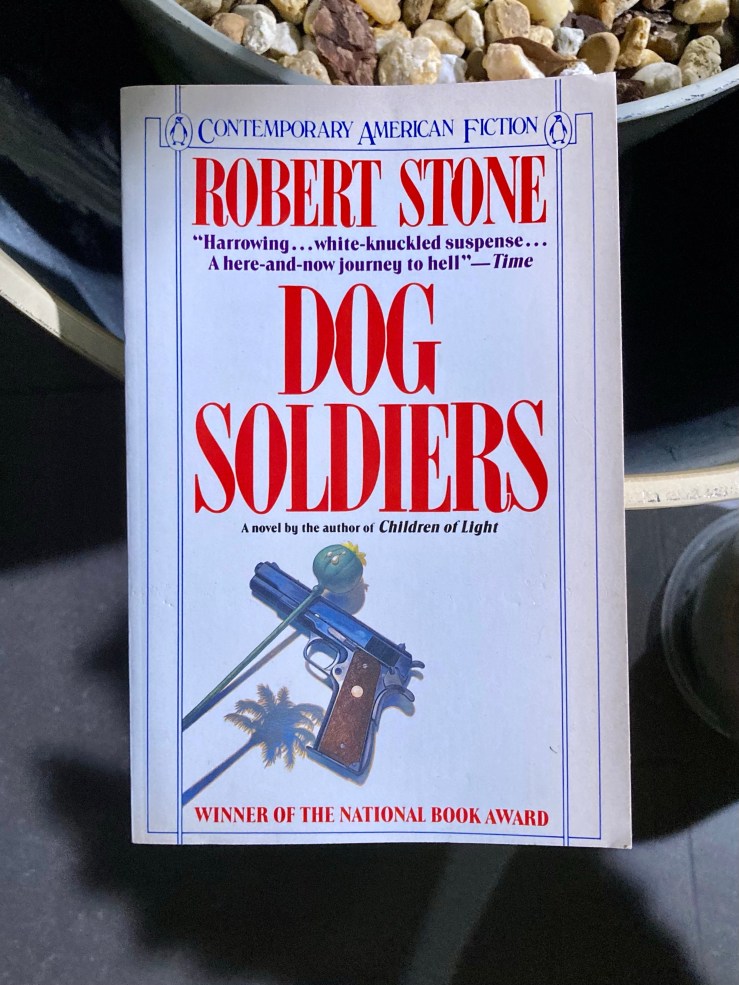
Robert Stone’s Dog Soldiers (Book acquired, 17 Nov. 2020)

I’ve been looking for a copy of Robert Stone’s 1974 novel Dog Soldiers for a little over a year now. By looking I mean scanning over the Robert Stone section (dude has his own little placard) of my beloved used bookshop, seeing literally dozens of copies for pretty much every Stone book except Dog Soldiers.

My interest in the novel I owe to the late great freight date David Berman, who reportedly repeatedly said it was his favorite novel. The guitarist William Tyler–whom I did not get to see play with Steven Gunn earlier this year, way back in March, way back in early COVID days—attests that Berman “told me his favorite novel was Dog Soldiers by Robert Stone.” I think I also heard that Dog Soldiers was Berman’s fave from the writer John Lingan, probably on twitter, although the detail is not included in his fantastic 2019 profile of Berman. And Berman mentioned the book in his Reddit AMA as part of his answer to book recommendations for someone starting college:

Poetics of Space by Gaston Bachelard

Dog Soldiers by Robert Stone

Anatomy of Melancholy by Robert Burton

Complete Emily Dickinson

Anyway…I found Dog Soldiers, finally, today. I stopped in quickly to pick up two novels for my son, whose reading virility is through the roof now—dude reads like 600 pages a week—and I had a few minutes before I needed to attend my carpool duties and, finally, today, I read Dog Soldiers. I think I’ll read it next, and maybe write something about it here—something not about Berman, but who knows.

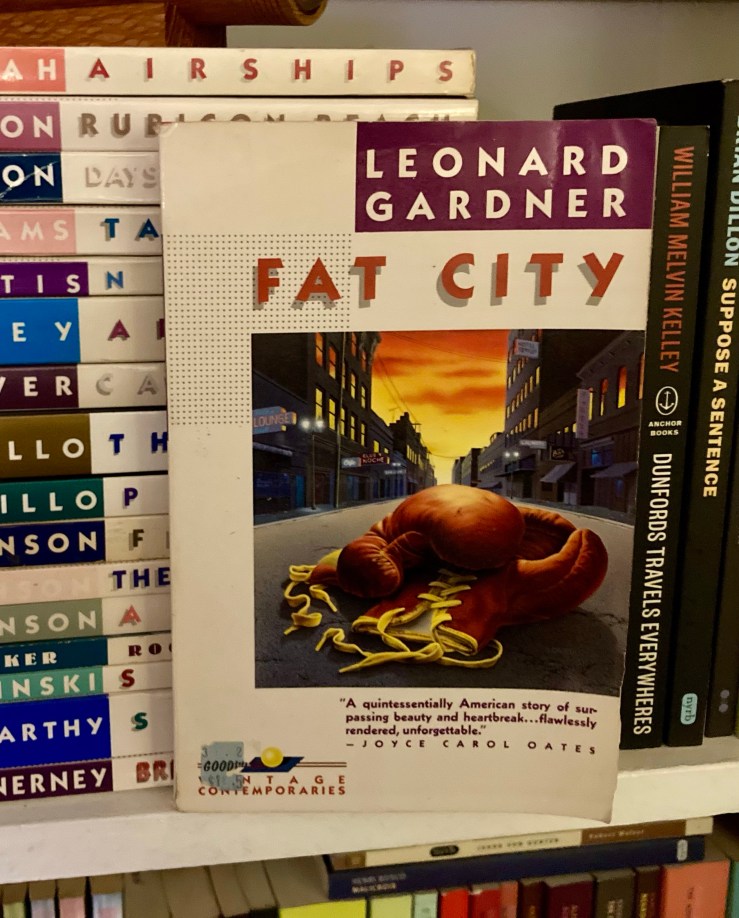
Leonard Gardner’s Fat City (Book acquired, 12 Nov. 2020)

I’ve been wanting to read Leonard Gardner’s Fat City for a while, and how could I pass up this Vintage Contemporaries edition?

I think I first heard of the book years ago in conjunction with its influence on Denis Johnson. In Salon, in 1996, Johnson wrote, or gushed, really–

Exactly which year of the 1960s the book came out, I can’t remember, but I remember well which year of my lifetime it was — I was discovering that it wasn’t a joke anymore, I was actually going to have to become a writer, I was too emotionally crippled for real work, there wasn’t anything else I could do — I was 18 or 19. Newsweek reviewed “Fat City,” a first novel by Leonard Gardner, in a tone that seemed to drop the usual hype — “It’s good. It really is.” I wanted to get a review like that.

I got the book and read about two Stockton, California boxers who live far outside the boxing myth and deep in the sorrow and beauty of human life, a book so precisely written and giving such value to its words that I felt I could almost read it with my fingers, like Braille.

The stories of Ernie Munger, a young fighter with frail but nevertheless burning hopes, and Billy Tully, an older pug with bad luck in and out of the ring, parallel one another through the book. Though the two men hardly meet, the tale blends the perspective on them until they seem to chart a single life of missteps and baffled love, Ernie its youth and Tully its future. I wanted to write a book like that.

My neighbor across the road, also a young literary hopeful, felt the same. We talked about every paragraph of “Fat City” one by one and over and over, the way couples sometimes reminisce about each moment of their falling in love.

And like most youngsters in the throes, I assumed I was among the very few humans who’d ever felt this way. In the next few years, studying at the Writer’s Workshop in Iowa City, I was astonished every time I met a young writer who could quote esctatically line after line of dialogue from the down-and-out souls of “Fat City,” the men and women seeking love, a bit of comfort, even glory — but never forgiveness — in the heat and dust of central California. Admirers were everywhere.

My friend across the road saw Gardner in a drugstore in California once, recognized him from his jacket photo. He was looking at a boxing magazine. “Are you Leonard Gardner?” my friend asked. “You must be a writer,” Gardner said, and went back to the magazine. I made him tell the story a thousand times.

Between the ages of 19 and 25 I studied Leonard Gardner’s book so closely that I began to fear I’d never be able to write anything but imitations of it, so I swore it off.

I haven’t owned a copy of “Fat City” in over 20 years, but I recently learned that the University of California Press is bringing out an edition this November, and I’ve ordered one.

When I was about 34 (the same age Gardner was when he published his), my first novel came out. About a year later I borrowed “Fat City” from the library and read it. I could see immediately that 10 years’ exile hadn’t saved me from the influence of its perfection — I’d taught myself to write in Gardner’s style, though not as well. And now, many years later, it’s still true: Leonard Gardner has something to say in every word I write.

I just finished John Brunner’s big baggy shaggy dog of a sci-fi novel, Stand on Zanzibar (reading David Ohle’s spare abject wild dystopian prose-poem Motorman, in between Zanzibar chunks)—I think Fat City might be a nice reset.

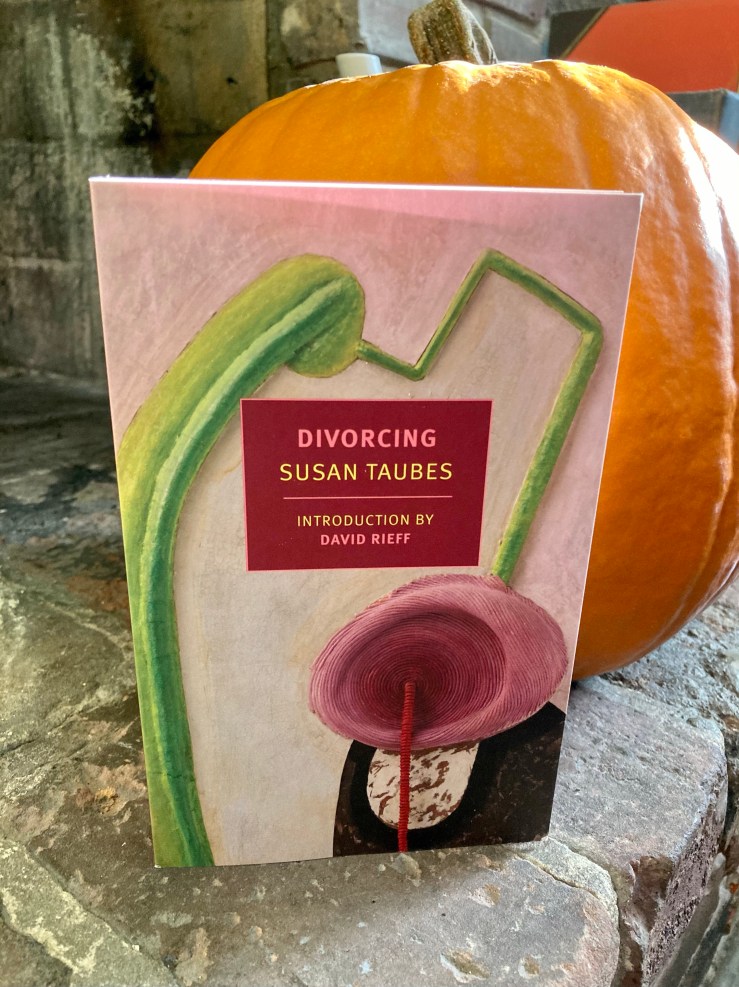
Susan Taubes’s Divorcing (Book acquired, 14 Oct. 2020)

Susan Taubes’s forgotten semi-autobiographical novel Divorcing is being republished by NRYB.

I had never heard of Taubes until Divorcing showed up at Biblioklept World Headquarters yesterday. Divorce was Taubes’s first, and only (to my knowledge) novel. It was first published in 1969 and received a mixed (and somewhat sexist) review in The New York Times by Hugh Kenner. A few days after the review was published, Taubes committed suicide by walking into the Atlantic Ocean. Her body was identified by her friend and contemporary Susan Sontag.

Here’s NYRB’s blurb for Divorcing:

Dream and reality overlap in Divorcing, a book in which divorce is not just a question of a broken marriage but names a rift that runs right through the inner and outer worlds of Sophie Blind, its brilliant but desperate protagonist. Can the rift be mended? Perhaps in the form of a novel, one that goes back from present-day New York to Sophie’s childhood in pre–World War II Budapest, that revisits the divorce between her Freudian father and her fickle mother, and finds a place for a host of further tensions and contradictions in her present life. The question that haunts Divorcing, however, is whether any novel can be fleet and bitter and true and light enough to gather up all the darkness of a given life.

Susan Taubes’s startlingly original novel was published in 1969 but largely ignored at the time; after the author’s tragic early death, it was forgotten. Its republication presents a chance to discover a splintered, glancing, caustic, and lyrical work by a dazzlingly intense and inventive writer.

Here’s a note on Taubes from one of Sontag’s 1965 journal entries. Sontag’s son edited the journals collected in As Consciousness is Harnessed to Flesh: Journals and Notebooks 1964-1980, and provides the note that Sontag identified Taubes’s body:

Lady Macbeth of Mtsensk: Selected Stories of Nikolai Leskov (Book acquired, 19 Sept. 2020)

NRYB has a forthcoming collection of Nikolai Leskov stories (novellas, really) called Lady Macbeth of Mtsensk. The collection features new translations from Donald Rayfield, Robert Chandler, and William Edgerton. NYRB’s blurb:

Nikolai Leskov is the strangest of the great Russian writers of the nineteenth century. His work is closer to the oral traditions of narrative than that of his contemporaries, and served as the inspiration for Walter Benjamin’s great essay “The Storyteller,” in which Benjamin contrasts the plotty machinations of the modern novel with the strange, melancholy, but also worldly-wise yarns of an older, slower era that Leskov remained in touch with. The title story is a tale of illicit love and multiple murder that could easily find its way into a Scottish ballad and did go on to become the most popular of Dmitri Shostakovich’s operas. The other stories, all but one newly translated, present the most focused and finely rendered collection of this indispensable writer currently available in English.

The collection includes six novellas: Lady Macbeth of Mtsensk, The Sealed Angel, The Enchanted Wanderer, The Steel Flea, The Unmercenary Engineers, and The Innocent Prudentius.

I read a few of these stories some years back in a Borzoi collection of Leskov stories called The Enchanted Wanderer and Other Stories; those translations were by Richard Pevear and Larissa Volokhonsky (and included some much shorter tales).

I also highly highly recommend Lady Macbeth, director William Oldroyd and writer Alice Birch’s 2016 film adaptation of Leskov’s Lady Macbeth of Mtsensk, which I reviewed on this blog a few years ago.

Walker Percy’s The Moviegoer (Book acquired, 18 Sept. 2020)

I ended up reading Walker Percy’s postmodern Gothic novel Lancelot earlier this month. I’m a big fan of Southern literature—Faulkner and O’Connor, Barry Hannah and Charles Portis, etc.—but Percy has been a blind spot up until now. I got copies of Lancelot and The Second Coming when my college’s library removed a ton of books last year. They’d been in my office for months, and when I went back at the beginning of the fall semester to grab some textbooks—I’m teaching online only now—I grabbed the Percys (Percies?). I picked up Lancelot and then never really put it down. Something about its comedic grotesquerie, its insane monologuing just…clicked for me right now.

I figured I should read Percy’s first and most famous novel The Moviegoer next, so I picked up a used copy last week. I was stoked to find a 1971 Noonday edition with a cover design by Milton Glaser. I read the first fifty pages this weekend, and have enjoyed it so far, but maybe Lancelot spoiled me a bit. Percy’s first novel seems far more restrained and measured—subtler, really, although Lancelot is, to be clear, out there. While Lancelot reminded me of Barry Hannah’s zany, mean-spirited stuff, so far The Moviegoer strikes me as soaked in existentialist ennui. The main character and narrator, Binx Bolling, echoes Camus’ hero of The Stranger, Mersault so far. I do enjoy Percy’s evocation of New Orleans in the late fifties very much, but I was hoping for a little more humor. Still, I’ll stick with it.

William Melvin Kelley’s Dunfords Travels Everywhere (Book acquired, 9 Sept. 2020)

Earlier this summer, I “discovered” the long-neglected novels of William Melvin Kelley, first through an essay on postmodern fiction by Black American authors (I can’t find the essay now, but I think it was by Bernard Bell), and then in a more-widely circulated article at The New Yorker. I then read Kelley’s first novel A Different Drummer and his fourth novel, demWhat I really wanted to read though was Kelley’s final novel, Dunfords Travels Everywheres, which is generally described as his most postmodern and Joycean. 

Dunfords was, at that point, not in print. I had no success finding it at my local used bookshop, so I looked on Abebooks, where I discovered that the cheapest copies were going for a hundred bucks.

Fortunately, Anchor Books has reissued Dunfords Travels Everywheres—it’s out later this month. Even better, they’ve included the many pen-and-ink illustrations for the book that Kelley commissioned from his wife Aiki. These illustrations were not included in the novel’s first edition in 1970. Here is one of her illustrations:

Proper review in the works; for now, here’s publisher Anchor’s blurb:

William Melvin Kelley’s final work, a Joycean, Rabelaisian romp in which he brings back some of his most memorable characters in a novel of three intertwining stories.

Ride on out with Rab and Turt, two o’New Afriqueque’s toughfast, ruefast Texnosass Arangers, as they battle Chief Pugmichillo and ricecure Mr. Charcarl Walker-Rider. Cut in on Carlyle Bedlowe, wrecker of marriage, saver of souls.

Or just along with Chig Dunford, product of Harlem and private schools, on the circular voyage of self-discovery that takes him from Europe’s Café of One Hand to Harlem’s Jack O’Gee’s Golden Grouse Bar & Restaurant.

Beginning on an August Sunday in one of Europe’s strangest cities, Dunfords Travels Everywheres but always returns back to the same point—the “Begending”—where Mr. Charcarl’s dream becomes Chig Dunford’s reality (the “Ivy League Negro” in the world outside the Ivory Tower).

Pierre Senges takes on Kafka’s fragments in Studies of Silhouettes (Book acquired, 2 Aug. 2020)

I’ve enjoyed digging into Pierre Senges’s Studies of Silhouettes since its arrival last week. The book is forthcoming from Sublunary Editions thanks to a translation by Jacob Siefring. Here’s Siefring’s blurb, which explains Senges’s project here:

Each of the texts in this work proceed from the fragments and cryptic beginnings found scattered throughout the notebooks Max Brod took possession of after Kafka’s death. The results tend to be as variable as they are unexpected: outlines of tales, madcap soliloquies, fairy tale inversions, strange parables, comedic monologues. In some instances a single fragment of Kafka’s is reprised multiple times, yielding parallel but divergent texts. Other times, a unique fragment is driven to its logical extreme, or gives way to a dizzying cascade of ab absurdum speculation, and one marvels how the development could have been otherwise. As one might expect, all of Kafka’s familiar obsessions—the night and its terrors, the law, justice and its lack, bureaucracy, animals, et cetera—are here in force. Each passage begins in boldface to indicate the hand of the Prague lawyer, before giving way to Senges’s liberties.

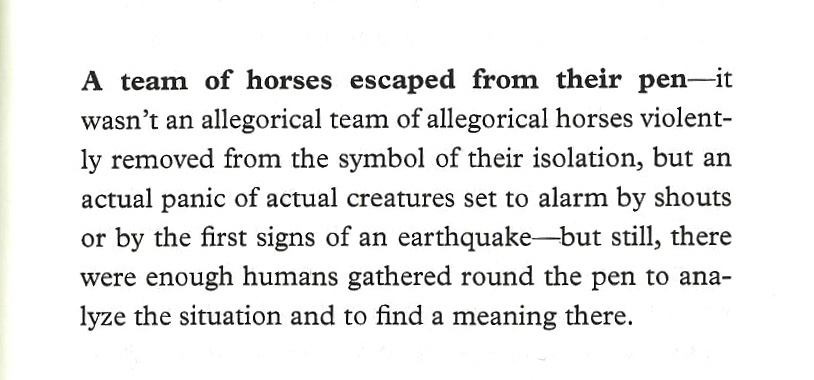
I’ve been dipping in at random, between the other few books I’ve been reading, and it’s good stuff. Here’s a sample:

Read my review of Pierre Senges’s Geometry in the Dust here.

John Brunner’s Stand on Zanzibar (Book acquired, 28 Aug. 2020)

I usually allow myself to peruse my favorite used bookstore every other Friday, poking around for weird finds and etc. I had no luck this week—nothing like a Vintage Contemporaries Barry Hannah—but they did have a copy of John Brunner’s 1968 novel Stand on Zanzibar, which I’d been searching (not-too-hard) for for a few years now. The thing is much longer than I expected (I knew it was long…but it’s long…650 pages). Not sure when I’ll even get to it. It’s supposed to be a cult classic right? Here’s the blurb from my edition:

There are seven billion-plus humans crowding the surface of 21st century Earth. It is an age of intelligent computers, mass-market psychedelic drugs, politics conducted by assassination, scientists who burn incense to appease volcanoes … all the hysteria of a dangerously overcrowded world, portrayed in a dazzlingly inventive style. Employing a dazzling range of literary techniques, John Brunner has created a future world as real as this morning’s newspaper – moving, sensory, impressionistic, as jagged as the times it portrays, this book is a real mind stretcher – and yet beautifully orchestrated to give a vivid picture of the whole.

And here’s an excerpt, via Macmillan’s site:


context (1)

SCANALYZE MY NAME

Stock cue SOUND: “Presenting SCANALYZER, Engrelay Satelserv’s unique thrice-per-day study of the big big scene, the INdepth INdependent INmediate INterface between you and your world!”
Stock cue VISUAL: cliptage, splitscreen, cut in bridge-melder, Mr. & Mrs. Everywhere depthunder (today MAMP, Mid-Atlantic Mining Project), spaceover (today freefly-suiting), transiting (today Simplon Acceleratube), digging (today as every day homimage with autoshout).
Autoshout cue: “It’s happening it’s happening! SCANALYZER SCANALYZER SCANALYZER SCANALYZER SCANALYZER SCANALYZER—”
Stock cue VISUAL: cliptage, wholescreen, planet Earth turning jerk-jerk-jerk and holding meridians for GMT, EST, PCT, Pacific Conflict Zone Time.
Live cue SOUND: “And it’s six poppa-momma for the happening people keeping it straight and steady on that old Greenwich Mean Time—how mean can time get, you tell me, hm? Zee for zero, bee for base, counting down to one after ess ee eks—sorree—ess EYE eks! We know what’s happening happening HAPPENING but that piece of the big big scene is strictly up to you, Mr. and Mrs. Everywhere—or Mr. and Miss, or Miss and Miss, or Mister and Mister, take your pick, hah-hah! Counting down to one after one poppa-momma for that good old Eastern Standard tie-yum, one after ten anti-matter for the Pacific Coast, and for all of you fighting the good fight in lonely midocean one after seven anti-matter—PIPS!”
Clock cue: 5 × 1-sec. countdown pips on G in alt, minute signal on C in alt.
Plug cue: “No time like the present for things to happen in, no better way to keep time straight and steady than by the signal from General Technics’ critonium clock, so accuright it serves to judge the stars.”
Script cue VISUAL: cliptage, splitscreen, excerpts from day’s news.
Live cue SOUND: “And no better way to keep abreast—pardon—than with SCANALYZER!”
Cut autoshout cue. (If they haven’t made it by this time they’ve switched off.)
Plug cue: “SCANALYZER is the one single, the ONLY study of the news in depth that’s processed by General Technics’ famed computer Shalmaneser, who sees all, hears all, knows all save only that which YOU, Mr. and Mrs. Everywhere, wish to keep to yourselves.”
Script cue: the happening world.
the happening world (1)

Continue reading “John Brunner’s Stand on Zanzibar (Book acquired, 28 Aug. 2020)”

Brian Dillon’s Suppose a Sentence (Book acquired, 14 Aug. 2020)

Brian Dillon’s Suppose a Sentence is a collection of 27 essays that each take a single sentence as their starting point. Organized chronologically by author dates, the collection begins with Shakespeare and Donne and works its way to Anne Carson and Anne Boyer (with Eliot, Stein, Beckett, Bowen et al along the way). When it showed up at Biblioklept World Headquarters last week I was intrigued, and admittedly jumped to the end to read the pieces on Carson and Boyer. In subsequent days I read the pieces on Shakespeare (Dillon takes his sentence “O, o, o, o” from Hamlet, but finds the vowels reputation throughout the playwright’s oeuvre) and Robert Smithson (in the middle of the book). I’ve decided to settle down and read in order at a leisurely pace—a chapter a day?

In the meantime, NYRB’s blurb

In Suppose a Sentence, Brian Dillon, whom John Banville has called “a literary flâneur in the tradition of Baudelaire and Walter Benjamin,” has written a sequel of sorts to Essayism, his roaming love letter to literature. In this new book Dillon turns his attention to the oblique and complex pleasures of the sentence. A series of essays prompted by a single sentence—from Shakespeare to Janet Malcolm, John Ruskin to Joan Didion—the book explores style, voice, and language, along with the subjectivity of reading. Both an exercise in practical criticism and a set of experiments or challenges, Suppose a Sentence is a polemical and personal reflection on the art of the sentence in literature. Whether the sentence in question is a rigorous expression of a state of vulnerability, extremity, even madness, or a carefully calibrated arrangement, Dillon examines not only how it works and why but also, in the course of the book, what the sentence once was, what it is today, and what it might become tomorrow.

Blog about William Melvin Kelley’s satire Dem (book acquired 12 Aug. 2020)

2020-08-13_184241

I managed to snag a cheap used copy of William Melvin Kelley’s fourth novel Dem (or, more properly, dem) yesterday. I usually just snap a pic when I do these book acquired posts, but the cover for this 1969 Collier mass-market, by Leo and Diane Dillon, was simply too good not to scan.

I read not-quite-half of dem today, and the Dillons’ cover captures Kelley’s hypercolor satire of white upper-middle-class America: the infantalized businessman, attended by a black domestic, his bored wife not-quite-off-scene; and hey—look in that mirror.

I’ll admit that the book was hard to break into for the first few moments, until a wild moment around page 20 or so, that I’m still waiting on the novel to deliver upon (or, as it seems at this point, to depart from entirely). Kelley’s style in dem is choppier, sharper, more cartoonish than his Faulknerian debut A Different Drummer and if dem skews towards absurd irony where Drummer was heroic-tragic, both novels are rooted in intense anger tempered by strange empathy.

As its subheading attests, dem is, like Drummer, a take on white people viewing black people, and over a half-century after its publication, many of the tropes Kelley employs here still ring painfully true. His “hero,” Mitchell Pierce is a lazy advertising executive, bored with his wife, a misogynist who occasionally longs to return to the “wars in Asia.” He’s also deeply, profoundly racist; structurally racist; the kind of racist who does not think of his racism as racism. At the same time, Kelley seems to extend little parcels of sympathy to Pierce, even as he reveals the dude to be a piece of shit, as if to say, What else could he end up being in this system but a piece of shit?

The novel I’m most interested in reading by Kelley is his last, 1970’s Dunfords Travels Everywheres, long out of print and hard (read: expensive on the internet) to find. It is, apparently, his most postmodern novel, his most polyglossic, and, if the stuff I’ve read on it is accurate, it represents his most profound satirical break/engagement with reality. Fortunately, it’s getting a reprint this fall. Looking forward to it.

Chester Himes’ A Rage in Harlem (Book acquired, 5 Aug. 2020 and read this past weekend)

img_5907

I’d been meaning to read Chester Himes for a while now (on the recommendation of Ishmael Reed, who cites Himes as a major influence), so I picked up a copy of A Rage in Harlem, the first of his Coffin Ed and Grave Digger detective stories. I was expecting hardboiled crime fiction—and sure, there are elements of it here—but Himes’ 1957 novel was far zanier and more ecstatic than I expected. A Rage in Harlem pops along with wild energy, spinning out into strange directions, donning artful disguises, always on the run. Absolutely loved it. Here’s the blurb:

For love of fine, wily Imabelle, hapless Jackson surrenders his life savings to a con man who knows the secret of turning ten-dollar bills into hundreds—and then he steals from his boss, only to lose the stolen money at a craps table. Luckily for him, he can turn to his savvy twin brother, Goldy, who earns a living—disguised as a Sister of Mercy—by selling tickets to Heaven in Harlem. With Goldy on his side, Jackson is ready for payback.

Sigizmund Krzhizhanovsky’s Unwitting Street (Book acquired, 29 July 2020)

img_5815

Sigizmund Krzhizhanovsky’s Unwitting Street is new in English translation by Joanne Turnbull from NYRB. I loved the first collection of Krzhizhanovsky’s stories that I read, Memories of the Future (also translated by Joanne Turnbull) and wrote about it here, comparing  his weird fables to Kafka, Borges, and Philip K. Dick, among others. (I also really enjoyed the collection Autobiography of a Corpse (another Turnbull translation).

There are eighteen tales in Unwitting Street, most of them rather short. A few of the pieces are fragments or sketches. I read the opener this morning, “Comrade Punt,” which was a bit wacky and unexpectedly whimsical.

Here’s NYRB’s blurb for Unwitting Street, which is out in August:

When Comrade Punt does not wake up one Moscow morning—he has died—his pants dash off to work without him. The ambitious pants soon have their own office and secretary. So begins the first of eighteen superb examples of Sigizmund Krzhizhanovsky’s philosophical and phantasmagorical stories. Where the stories included in two earlier NYRB collections (Memories of the Future and Autobiography of a Corpse) are denser and darker, the creations in Unwitting Street are on the lighter side: an ancient goblet brimful of self-replenishing wine drives its owner into the drink; a hypnotist’s attempt to turn a fly into an elephant backfires; a philosopher’s free-floating thought struggles against being “enlettered” in type and entombed in a book; the soul of a politician turned chess master winds up in one of his pawns; an unsentimental parrot journeys from prewar Austria to Soviet Russia.

Manchette’s No Room at the Morgue (Book acquired, 22 July 2020)

img_5805

Jean-Patrick Manchette’s detective noir novel No Room at the Morgue (translated by Alyson Waters) is forthcoming in August from NYRB.

Their blurb:

No Room at the Morgue came out after Jean-Patrick Manchette had transformed French crime fiction with such brilliantly plotted, politically charged, unrelentingly violent tales as Nada and The Mad and the Bad. Here, inspired by his love of Dashiell Hammett, Manchette introduces Eugene Tarpon, private eye, a sometime cop who has set up shop after being kicked off the force for accidentally killing a political demonstrator. Months have passed, and Tarpon desultorily tries to keep in shape while drinking all the time. No one has shown up at the door of his office in the midst of the market district of Les Halles. Then the bell rings and a beautiful woman bursts in, her hands dripping blood. It’s Memphis Charles, her roommate’s throat has been cut, and Memphis can’t go to the police because they’ll only suspect her. Can Tarpon help?

Well, somehow he can’t help trying. Soon bodies mount, and the craziness only grows.

Under the Sign of the Labyrinth (Book acquired, 7 July 2020)

img_5756

Christina Tudor-Sideri’s Under the Sign of the Labyrinth adds to Sublunary Editions‘ growing catalog of odd and engaging short volumes.

Their blurb:

There is no need to place your hand on a wound to feel it throbbing in pain. There is no need to see its root to know that a tree is dying. I am renouncing history. A film frame has lost its meaning. Vain and cruel, I have become a self that contains all negations to come, I have escaped the universe of time and space—page after page, touch after touch, train after train. I have become the idea of a sea beast moving in the deep. I have become the labyrinth. I am entombed in poetry. In the first stanza, in the last, in the blueness of thirsting ink—in the bruising of eternity. I have become alone. I am alone.”