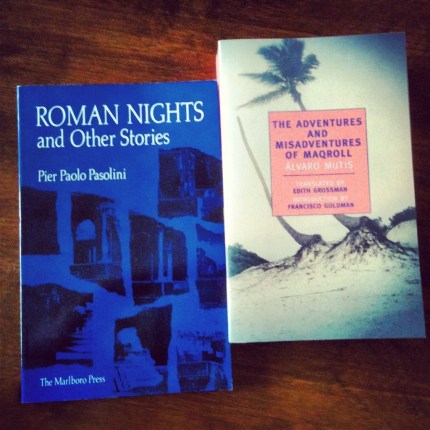
The edition I had of Mutis’s Maqroll only holds the first three novellas, so I ordered the NYRB seven-story volume. It’s like 700 pages and very attractive.
I also found this collection of Pier Paolo Pasolini short stories.
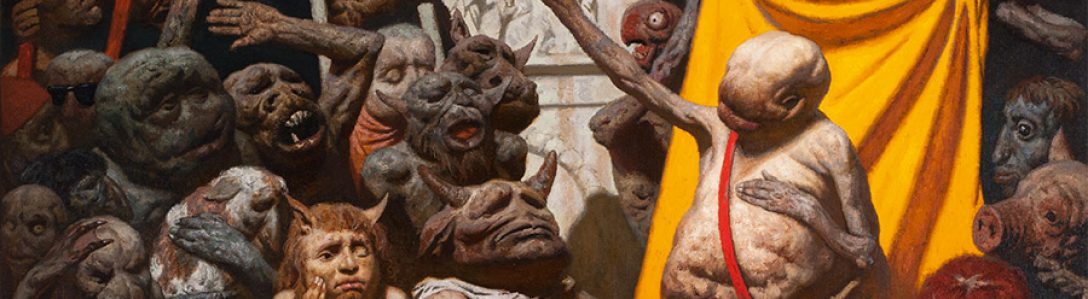
The edition I had of Mutis’s Maqroll only holds the first three novellas, so I ordered the NYRB seven-story volume. It’s like 700 pages and very attractive.
I also found this collection of Pier Paolo Pasolini short stories.

I just read the first few chapters of The President in Her Towers, Tom Whalen’s satire of academia—good stuff: short, punchy chapters that illustrate the reality of academia in all its paranoid surreality. Here’s publisher Ellipsis Press’s blurb:
Through the corridors of the university’s Humanities and Sciences Towers, rumors are swirling about the President: her bizarre decrees, her midnight meetings, her strange projects (the Head-in-Progress, the Activated Eye, the Gestation Chamber). The President’s dedicated personal assistant, Thomas (a.k.a. Herr Abjectus), is charged with investigating and reporting on these and other matters, but it won’t be easy—especially since the President has disappeared. And now there is a new rumor: that she has been marked for assassination
 The stories Peter Tieryas Liu’s Watering Heaven move at a sharp clip, propelled by realistic dialogue set against a surreal backdrop. “Every time I have sex, I lay an egg,” one character tells another in the opening scene of “Chronology of an Egg.” The strange romance culminates in a fantastic punchline to this magical set-up. The protagonist of “The Wolf’s Choice,” facing an existential crisis, transforms his outward appearance by extensive plastic surgery. And in “Rodenticide”—well, let me just share a paragraph of Liu’s prose:
He dreamed of rats. One named Zhucheng lost her tail—a pink, gnarled tube with a texture like a gizzard. She was crying a shrill homily and there were flags with emblems of rat ears. He realized all rats were psychics with more understanding of humans than humans themselves—a homeopathic conglomeration of half-defunct diseases. Telepathy is my disease, Zhucheng screamed, I know you’re planning our mass extermination!
“Rodenticide” is just one example of Liu’s strange mix of absurdity, realism, and magic. The stories of Watering Heaven suggest a world where comedy and romance might tip over dramatically into horror or despair at any moment. Good stuff.
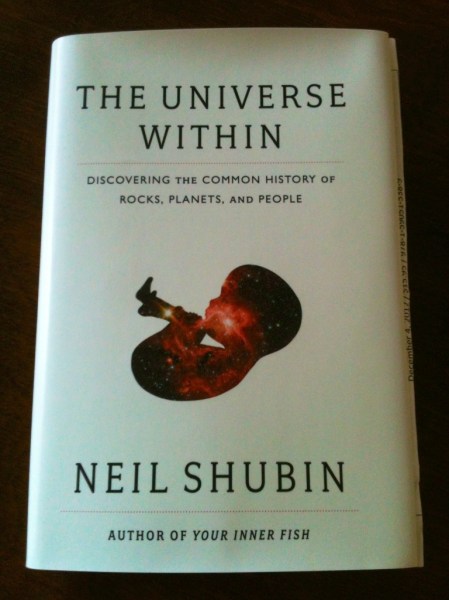 The Universe Within is new from Pantheon early next year. Their blurb:
From one of our finest and most popular science writers, and the best-selling author of Your Inner Fish, comes the answer to a scientific mystery as big as the world itself: How are the events that formed our solar system billions of years ago embedded inside each of us?
In Your Inner Fish, Neil Shubin delved into the amazing connections between human bodies—our hands, heads, and jaws—and the structures in fish and worms that lived hundreds of millions of years ago. In The Universe Within, with his trademark clarity and exuberance, Shubin takes an even more expansive approach to the question of why we look the way we do. Starting once again with fossils, he turns his gaze skyward, showing us how the entirety of the universe’s fourteen-billion-year history can be seen in our bodies. As he moves from our very molecular composition (a result of stellar events at the origin of our solar system) through the workings of our eyes, Shubin makes clear how the evolution of the cosmos has profoundly marked our own bodies.
University of Chicago paleontologist Shubin wrote about the fishy origins of humanity in 2009’s Your Inner Fish. In his new book, he goes farther back and further out, explaining how humans bear the markings of cosmic phenomena; as he puts it, “Written inside us is the birth of the stars.” Here, the author surveys everything from glints in “Greenlandic rocks” to the spreading signs of supernovae to reveal “deep ties to the forces that shaped our bodies.” He demonstrates how mammals owe their “high-energy lifestyle[s]” to oxygen released hundreds of millions of years ago as continents spread apart, and how color vision arose after continental drift cooled the planet, diversified flora, and resulted in biological competition that favored those organisms who could identify nutritious plants according to hue (“Every time you admire a richly colorful view, you can thank India for slamming into Asia”). Shubin is a leading proponent of the fusion of paleontology, developmental genetics, and genomics, and the result of his efforts is a volume of truly inspired science writing. Appropriately vast in scope, Shubin deftly balances breadth and depth in his search for a “sublimely beautiful truth.”

This one looks pretty cool—André Maurois’s 1928 novel Climates. Here’s publisher Other Press’s blurb:
Written in 1928 by French biographer and novelist Andre Maurois, Climates became a best seller in France and all over Europe. The first 100,000 copies printed of its Russian translation sold out the day they appeared in Moscow bookstores. This magnificently written novel about a double conjugal failure is imbued with subtle yet profound psychological insights of a caliber that arguably rivals Tolstoy’s. Here Phillipe Marcenat, an erudite yet conventional industrialist from central France, falls madly in love with and marries the beautiful but unreliable Odile despite his family’s disapproval. Soon, Phillipe’s possessiveness and jealousy drive her away. Brokenhearted, Phillipe then marries the devoted and sincere Isabelle and promptly inflicts on his new wife the very same woes he endured at the hands of Odile. But Isabelle’s integrity and determination to save her marriage adds yet another dimension to this extraordinary work on the dynamics and vicissitudes of love.
I haven’t had time to dip into Climates yet, but it got a compelling write-up in The New Yorker last month. Excerpt:
At first sight, “Climates” is a simple fable. It tells of Philippe Marcenat, the heir to a provincial paper-mill business, who falls in love with the woman of his dreams, Odile Malet. He loses her, but is later loved in turn by Isabelle de Cheverny, a woman not of his dreams at all, although he tries (“Vertigo”-ishly) to make her so. We follow first Philippe and then Isabelle as they reflect on their love. There is a happy ending of sorts, though not for Philippe. Maurois has summarized his first vision of the story, in its bare-bones form, as:
Part 1. I love, and am not loved.
Part 2. I am loved, and do not love.
Put that way, it sounds like a perfectly balanced diptych. In fact, it is neither balanced nor anywhere near simple. Each of these four “love” and “non-love” elements conceals some complication, something moving at cross-purposes to it. Beneath what seems to be love, there lurks tyranny or submission, or a mixture of both. Beneath what seems to be non-love, there is… it’s hard to say what, but something indefinable that looks very much like love.

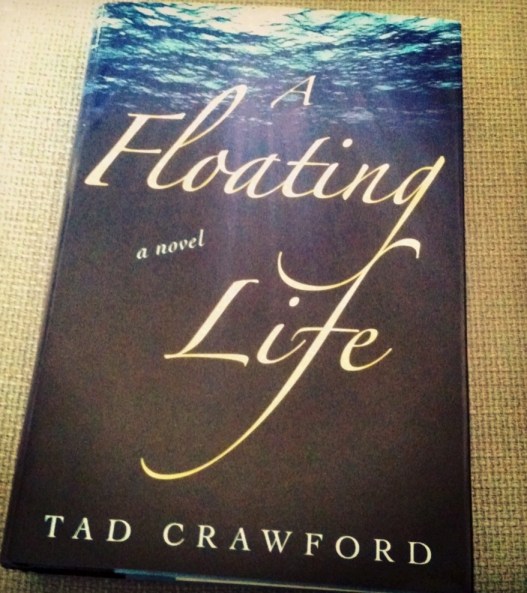
A Floating Life by Tad Crawford. Here’s PW‘s review, which is a bit-too-unkind in my estimation:
A nameless narrator bumbles through a series of bewildering nightmares linked only by the flimsiest narrative thread in Crawford’s disjointed debut. The protagonist ricochets between two realities: in one, he is addled by mundane afflictions (e.g., erectile dysfunction) and finds work as an assistant in a shop called the Floating World, which specializes in model boats and miniature canal systems. The store’s owner, Pecheur, dreams of using these models to harness the destructive power of the ocean for the good of humanity. The narrator’s other reality is a shifting landscape wherein he awakes time and again from horrifying fantasies—from a cage suspended above a bottomless pit to a ravenous family of talking bears. This is Crawford’s approximation of the floating world, “the Buddhist concept of a world filled with pain [that] came to mean the transient and unreliable nature of our world, how fleetingly it floats in the illusion of time,” but the execution is buoyed more by concept than plot. It is an experiment in storytelling, but without motivated characters and dramatic tension, it fails to tell a story at all.
I think it’s more likely that Crawford fails to tell the story that the editors of PW want (or rather, expect) to read. Crawford’s got an ear for dialogue, and much of the book is propelled by conversations—dialogue that sometimes carries on for pages at a time. Kirkus seems to better understand what Crawford is attempting in their review:
In Crawford’s world, boundaries, especially those between people, are semipermeable membranes with tenuous connections to reality.
At times, Crawford seems to be channeling Kafka or Borges, a feeling reinforced when, at a party his unnamed narrator engages a vaguely familiar woman in conversation. She informs her interlocutor that she’s written a letter to her husband, outlining his deficiencies and the hopelessness of their marriage. The narrator finally figures out whom he’s talking to—his wife. Equally dreamlike sequences emerge from this one. The couple decides to live in separate bedrooms in their apartment, but when this turns out to be unfeasible, the narrator goes to look for a new place to live. The real estate agent he talks to firmly rejects some of the narrator’s choices and eventually tells him he’d be happy in a small efficiency, but the building is being constructed under this apartment, deep in the ground, so in a surreal way, the apartment is actually a penthouse. One of the most important connections the narrator makes is to The Floating World, a weird and elusive shop where one can buy model ships, something the narrator starts to develop an intense interest in. The shop is located in a brownstone with no identifying marks, and its proprietor is a Dutchman who goes by the nautical name of Pecheur. Over time, the narrator and the shopkeeper become quite close, the latter taking on the narrator as an assistant. In addition to the death of Pecheur, the narrator ultimately must also confront his erectile dysfunction as well as the dilemma of waking up in an infirmary where he breastfeeds an infant, rather unusual since the narrator is a man.
Odd, offbeat and strangely shimmering.
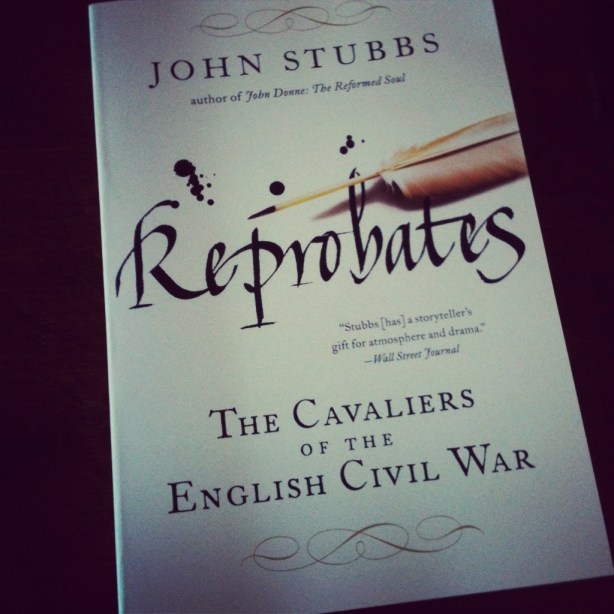
This one looks pretty cool—Reprobates, John Stubbs’s history of the English Civil War. A cursory flip through the book suggests that the subtitle is perhaps a little misleading—Reprobates seems to be more of a survey of the shifts in English culture in the 17th century than a dry study of the actual war between Roundheads and Royalists. In his insightful review at Literary Review, Adrian Tinniswood points out that,
. . . the real focus of Stubbs’s book is the cavalier poets, that motley collection of royalist writers who gathered around the aging and irascible Ben Jonson in the late 1620s and 1630s and went on to seek their fortunes at court, simultaneously memorialising and mythologising its decline. The self-styled ‘Tribe of Ben’ – William Davenant, Thomas Carew, Sir John Suckling and the rest – remain resolutely minor figures, both in literature and in history. Most are remembered for a single poem, like Sir John Denham and ‘Cooper’s Hill’, or even a single line, like Richard Lovelace’s ‘Stone walls do not a prison make’ or Robert Herrick’s ‘Gather ye rosebuds while ye may’. Some aren’t even remembered for that. Can you recall anything Suckling wrote? . . . Under Stubbs’s affectionate but forensic gaze these reprobates seem like figures of fun in a Restoration comedy rather than the heroes they so clearly believed themselves to be.
At The Guardian, Christopher Bray finds even more comedy in these reprobates, suggesting that,
If Ben Elton ever writes another series of Blackadder, Reprobates ought to be top of his research list. Not because John Stubbs offers a daringly revisionist take on the English civil war. The book’s subtitle notwithstanding, the war occupies rather fewer than a quarter of its nearly 500 pages. What we do get, though, is a colourful braiding of poetry criticism, literary biography and social and political history – the whole lot knotted together by characters of such effervescent high spirits the sitcom form might have been invented for them.
Looks like good stuff.
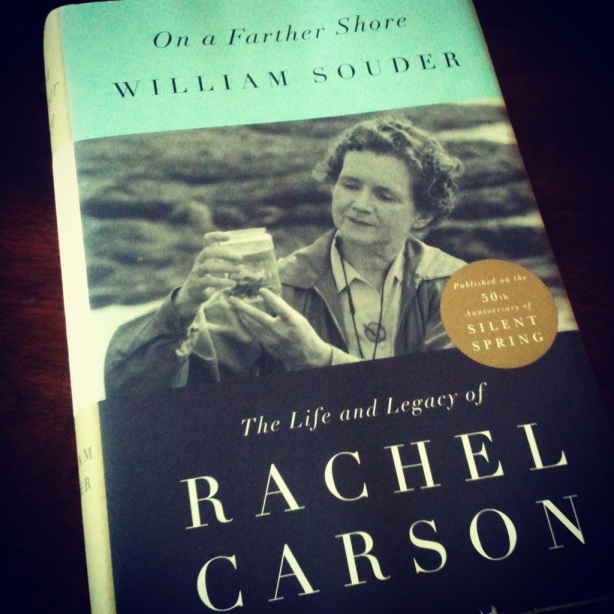
On a Farther Shore is William Souder’s big, bold biography of Rachel Carson, whose long (and often poetic) essay Silent Spring changed the way many people thought about humanity’s changing relationship with the environment. Here’s publisher Crown/Random House’s blurb:
She loved the ocean and wrote three books about its mysteries, including the international bestseller The Sea Around Us. But it was with her fourth book, Silent Spring, that this unassuming biologist transformed our relationship with the natural world.
Rachel Carson began work on Silent Spring in the late 1950s, when a dizzying array of synthetic pesticides had come into use. Leading this chemical onslaught was the insecticide DDT, whose inventor had won a Nobel Prize for its discovery. Effective against crop pests as well as insects that transmitted human diseases such as typhus and malaria, DDT had at first appeared safe. But as its use expanded, alarming reports surfaced of collateral damage to fish, birds, and other wildlife. Silent Spring was a chilling indictment of DDT and its effects, which were lasting, widespread, and lethal.
Published in 1962, Silent Spring shocked the public and forced the government to take action-despite a withering attack on Carson from the chemicals industry. The book awakened the world to the heedless contamination of the environment and eventually led to the establishment of the EPA and to the banning of DDT and a host of related pesticides. By drawing frightening parallels between dangerous chemicals and the then-pervasive fallout from nuclear testing, Carson opened a fault line between the gentle ideal of conservation and the more urgent new concept of environmentalism.
Elegantly written and meticulously researched, On a Farther Shore reveals a shy yet passionate woman more at home in the natural world than in the literary one that embraced her. William Souder also writes sensitively of Carson’s romantic friendship with Dorothy Freeman, and of her death from cancer in 1964. This extraordinary new biography captures the essence of one of the great reformers of the twentieth century.
Elizabeth Royte gave Shore a good review in The New York Times; excerpt:
Souder is at his best when he places Carson’s intellectual development in context with the nascent environmental movement. The storm over “Silent Spring,” he notes, was a “cleaving point” in history when the “gentle, optimistic proposition called ‘conservation’ began its transformation into the bitterly divisive idea that would come to be known as ‘environmentalism.’” (Souder isn’t shy about expressing his own disappointment with what he views as a permanent wall between partisans, with nature and science pitted against an “unbreakable coalition of government and industry, the massed might of the establishment.”)
I’ll let Lucy have the last word:


The kind people of Paris Press were good enough to send me a reader copy of their 10th anniversary edition of Virginia Woolf’s essay “On Being Ill,” which they’ve collected with “Notes from Sick Rooms,” an essay by Julia Stephen—Woolf’s mother. Paris Press’s blurb:
Published together for the first time, Woolf and Stephen create a literary conversation between parent and child, patient and care giver, from the vantage points each experience in the world of illness. Originally published by Paris Press in 2002, this new edition doubles the length of the original book and includes a new introduction to Notes from Sick Rooms by eminent Woolf scholar Mark Hussey, and a new afterword by Rita Charon, founder and director of the Narrative Medicine program at Columbia University, along with the original introduction to On Being Ill by Hermione Lee, Woolf’s biographer.
Lee’s introduction seems to be an expansion of a piece she wrote for The Guardian in 2004; in that piece she wrote:
The story of the body’s life, and the part the body has to play in our lives, is one of Virginia Woolf’s great subjects. Far from being an ethereal, chill, disembodied writer, she is always transforming thoughts and feelings and ideas into bodily metaphors. She writes with acute – often extremely troubling – precision about how the body mediates and controls our life stories. Body parts are strewn all over her pages. Rage and embarrassment are felt in the thighs; a headache can turn into a whole autobiography; dressing up the body is an epic ordeal; and a clenched fist, feet in a pair of boots, the flash of a dress or the fingertip feel of a creature in a salt-water pool, can speak volumes.
Nowhere is her attention to body parts more eloquent and intense than in the essay “On Being Ill”. It is one of Woolf’s most daring, strange and original short pieces of writing, and it has more subjects than its title suggests. Like the clouds that its sick watcher, “lying recumbent”, sees changing shapes and ringing curtains up and down, this is a shape-changing essay.
Woolf announces her theme in a long, winding opening sentence that showcases some of the “shape-shifting” Lee alludes to:
Considering how common illness is, how tremendous the spiritual change that it brings, how astonishing, when the lights of health go down, the undiscovered countries that are then disclosed, what wastes and deserts of the soul a slight attack of influenza brings to view, what precipices and lawns sprinkled with bright flowers a little rise of temperature reveals, what ancient and obdurate oaks are uprooted in us by the act of sickness, how we go down in the pit of death and feel the waters of annihilation close above our heads and wake thinking to find ourselves in the presence of the angels and the harpers when we have a tooth out and come to the surface in the dentist’s arm-chair and confuse his “Rinse the mouth-rinse the mouth” with the greeting of the Deity stooping from the floor of Heaven to welcome us – when we think of this, as we are so frequently forced to think of it, it becomes strange indeed that illness has not taken its place with love and battle and jealousy among the prime themes of literature.

And what of Stephen’s essay? It’s a practical, concrete, and mostly pragmatic approach to caring for sick people. Some parts compel more than others, as when Stephen discusses the absurd flights of fancy that might afflict the ill. In his introduction to “Notes from Sick Rooms,” Mark Hussey tries to amplify connections between the two texts that are either obvious (the texts share a common subject) or speculative (Stephen’s essay “foreshadows the wit and sharp observation that is characteristic of her famous daughter’s style”). Hussey’s comments are best when they provide basic context and don’t try to force the reader into making connections. There’s also an afterward by Rita Charon, an internist, who again tries to synthesize the two texts. I suppose context is important, but there’s a sense of inflation here that I’m not entirely sure either essay (Woolf’s or Stephen’s) necessarily merits.
I took my kids to the book store today and let them run like heathen.

They had fun. I usually take them separately (and usually they go to the library), but their mother is at work and we needed to get out of the house.
My daughter picked out a few books for her little brother (and then read them to him, sort of).
She also picked out a book of antique paper dolls (Dolly Dingle) and an Anne of Green Gables pop up cottage book to let the dolls live in.
Here’s what I picked out, maybe more for me than them:
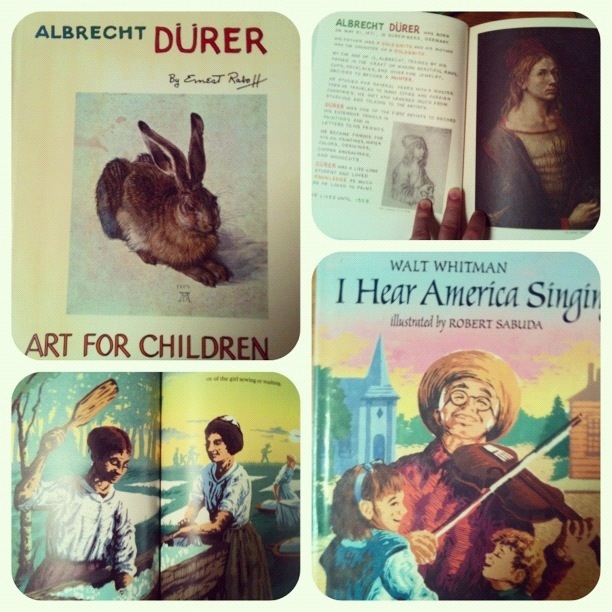
A beautiful illustrated Durer biography that’s written more or less like a comic book, and an illustrated edition of Whitman’s “I Hear America Singing.”
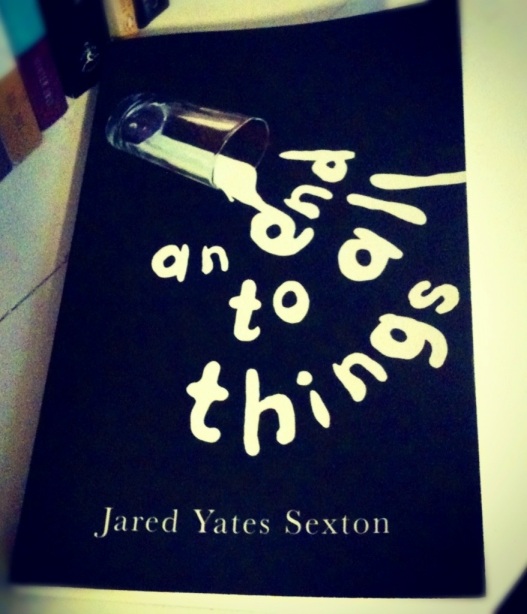
Jared Yates Sexton’s An End to All Things immediately appealed to me when it arrived last month. This collection is stocked with short, precise, unpretentious stories. Great sentences—shades of Hannah, Carver, Pancake. I’ve read about half a dozen so far, parceling them out over spare afternoon minutes and it’s good stuff—feels real without the strains of literary realism. You can read a story at publisher Atticus Books’ site, “You Never Ask Me About My Dreams” (great title). The first few paragraphs:
At that point things had been rough for a couple of months and I would’ve done anything to ease the tension. I set an alarm for half an hour earlier than usual. I thought if I had some breakfast going when Cathy got up she’d have to see that I cared.
After all, cooking wasn’t the easiest thing to do in our house. Both of us hated dishes so the kitchen was always a mess. There were pots and pans stacked on the counters and plates in the sink. Some still had clumps of food stuck to them. I even had to rinse out a bowl to use. Somehow there were a couple of clean forks and knives in the drawer. I got some eggs from the fridge and went to work scrambling the yolks.
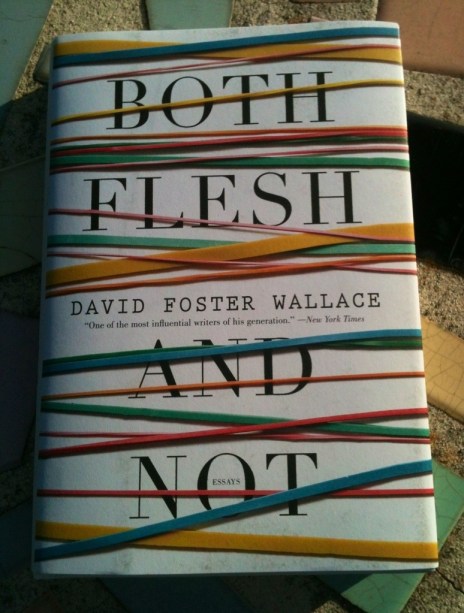
1. Today, I picked up Both Flesh and Not, a collection of David Foster Wallace essays and short pieces. I specifically ordered this book from my local bookstore (I didn’t get a review copy), and I bought it in hardback (I generally dislike hardbacks).
2. I should be reading it now—I’d like to be reading it—but I’m flicking between the five or six channels I have, usually stopping on PBS, and then scanning Twitter and other online media, because, hey, it’s Election Day in America.
3. I’ve already read several of the pieces in Both Flesh. You might have too. Here’s the table of contents:
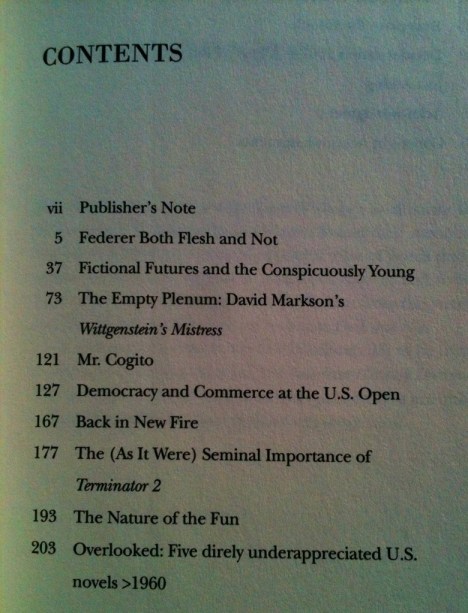
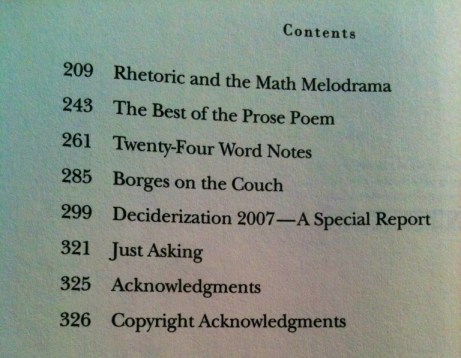
4. But a lot of it I haven’t read. I’m eager to dig into the piece on David Markson, and the piece on Brat Pack writers, “Fictional Futures,” which was later repurposed in “E Unibus Pluram.”
5. I spent most of the afternoon riffling through it, trying not to think about the election results that would be coming in the next few years. I played outside with my kids, building a strange hut out of giant elephant leaves and then a small nest out of pine straw. I photographed the planes that daily fly over our neighborhood, slow, heavy supply planes that drift in lazy routine arcs from the nearby naval base, not loud as jets, but bulky. Elephant mothers, pregnant.

6. I remembered that Wallace killed himself in an election year, in September. I remember how I felt.
7. (Please don’t think this riff is really about anything. I’m distracted. I’ve imbibed some wine. Some Xanax might be involved).
8. Speaking of posts in 2008—
I went back just now, and riffled through the site’s archives from November of 2008. (Back when I’d post like three, maybe four times a week. Once a day at most).
A lot of vitriol there. A lot of vitriol for Palin, and a lot of vitriol for the emerging sentiment that would galvanize in what would become the Tea Party movement.
I wrote about the Election Night too. About Jesse Jackson’s tears. I even wrote about finding some respite from cynicism in Obama’s election. (Don’t worry, I’m as cynical as ever. Moreso—
9. —but
I remember watching the inauguration in 2009. I was still teaching high school. I had third period planning and I watched the whole shebang in an empty lab on the school’s third floor with my friend Derek, a black Muslim who taught history in the classroom next to mine. It was cold up there and empty. I remember he asked me if the election poem was good and I asked him what he thought (I thought it was good). I remember we cried a little in spite of ourselves and clutched at each other. The world seemed so much more possible. I’m clutching to this memory now, which is deep and rich and I hope to keep forever. It presents through pinot and Xanax).
10. Is this a bait and switch? I apologize. Look, I love you reader. Really, I do. I do.
11. So, another detail from the Wallace collection:
The selections are intercut with definitions from his vocabulary list for The American Heritage Dictionary. Like so:

12. What was I doing here? I don’t know. Let me just wrap it up. I should be writing about DFW and the book but I can’t. Distracted. I’ll schedule the post. Let it stand. Let it roll at 11:11am tomorrow? (To clarify–it’s 9:55pm on 11/06/2012).
Okay, I’ll do that. Finish the rest in the comments? Sure. And some more, of course, about the book.

For some reason—some reason founded on no reason at all but rather superstitious suspicion—I didn’t believe Charles Burns would follow up X’ed Out, the first chapter of a proposed trilogy. I suppose X’ed Out had unresolved cult classic written all over it (written metaphorically, of course).
X’ed Out was one of my favorite books of 2010. From my review:
In Black Hole, Burns established himself as a master illustrator and a gifted storyteller, using severe black and white contrast to evoke that tale’s terrible pain and pathos. X’ed Out appropriately brings rich, complex color to Burns’s method, and the book’s oversized dimensions showcase the art beautifully. This is a gorgeous book, both attractive and repulsive (much like Freud’s concept of “the uncanny,” which is very much at work in Burns’s plot). Like I said at the top, fans of Burns’s comix likely already know they want to read X’ed Out; weirdos who love Burroughs and Ballard and other great ghastly fiction will also wish to take note. Highly recommended.

So, of course I was stoked when Burns’s sequel The Hive showed up a few weeks ago—in fact, the only thing that got in the way of me reading it immediately was that it showed up in a package along with Chris Ware’s Building Stories (this is, without question, the best package I’ve received in six years of doing the blog).

Anyway, I’ll be revisiting X’ed Out and then reviewing The Hive in the next week or so. For now, a few pics. Two from the interior above. And our hero Doug, in his alter-ego/costume Nitnit (inverse Tintin):

I dig this panel in particular: A take on Roy Lichtenstein via Raymond Pettibon via the romance comics those pop artists were riffing on:

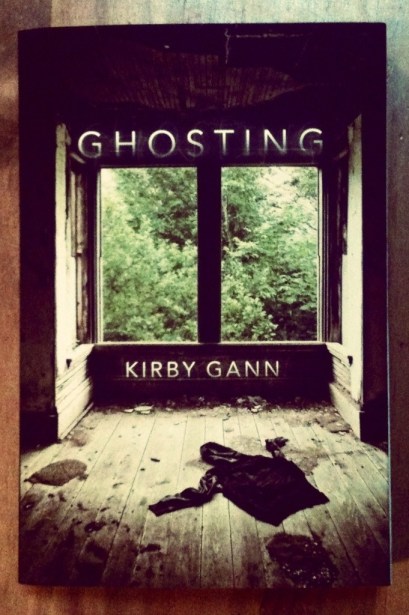
I got a copy of Kirby Gann’s novel Ghosting a few week or so ago, and finally have had time to dip into the first three chapters this morning. Gann’s prose—and perhaps the framing of his characters—reminds me a bit of Russell Banks or Thomas McGuane—that combination of the rough and the refined, that rawness that actually comes from meticulous reworking. Sample of that prose (context not important):
The first cop to show nods at Dwayne Hardesty and stands beside him at the feet of four kids who lie spread-eagled face-down on the muddy portico steps leading to the graffiti-strewn boards that shield the seminary entrance. The wash of the cruiser’s spot frescoes their captive forms in hard outline, three underfed and thin and the fourth a fat block squeezed into a Kentucky basketball sweatshirt that strains to withstand his heavy nervous breathing, the grommets in their jeans and an occasional earring flashing agleam in the white light; four pairs of white sneakers, expensive and rain-wet, shine stark and severe and unworldly.
Ghosting is a thriller, and Gann propels the narrative forward with these cinematic images (and realistic dialogue), engaging the reader to keep turning the pages.
Here’s the jacket copy:
A dying drug kingpin enslaved to the memory of his dead wife; a young woman torn between her promising future and the hardscrabble world she grew up in; a mother willing to do anything to fuel her addiction to pills; and her youngest son, searching for an answer behind his brother’s disappearance—these are just some of the unforgettable characters that populate Ghosting, Kirby Gann’s lush and lyrical novel of family, community, and the ties that can both bond and betray.
Fleece Skaggs has disappeared along with Lawrence Gruel’s reefer harvest. Convinced that the best way to discover the fate of his older brother is to take his place as a drug runner for Greuel, James Cole plunges into a dark underworld of drugs, violence, and long hidden family secrets, where discovering what happened to his brother could cost him his life.
A genre-subverting literary thriller explored through the alternating viewpoints of different characters, Ghosting is both a simple quest for the solution to a mystery, and a complex consideration of human frailty and equivocation.
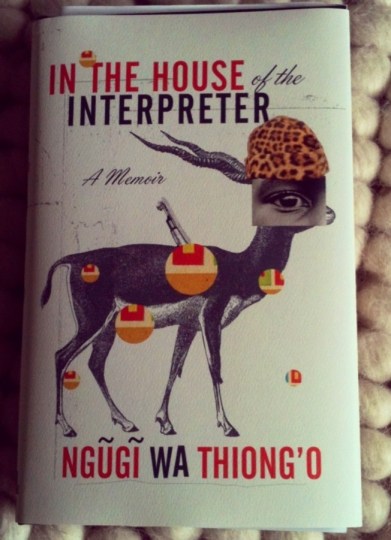
In the House of the Interpreter is a memoir from Ngugi wa Thiong’o. It’s new next month in hardback from Pantheon (lovely cover/design, on this one, Pantheon people. Seriously). Their blurb:
World-renowned Kenyan novelist, poet, playwright, and literary critic Ng˜ug˜ý wa Thiong’o gives us the second volume of his memoirs in the wake of his critically acclaimed Dreams in a Time of War.
In the House of the Interpreter richly and poignantly evokes the author’s life and times at boarding school—the first secondary educational institution in British-ruled Kenya—in the 1950s, against the backdrop of the tumultuous Mau Mau Uprising for independence and Kenyan sovereignty. While Ng˜ug˜ý has been enjoying scouting trips, chess tournaments, and reading about the fictional RAF pilot adventurer Biggles at the prestigious Alliance High School near Nairobi, things have been changing rapidly at home. Poised as he is between two worlds, Ng˜ug˜ý returns home for his first visit since starting school to find his house razed and the entire village moved up the road, closer to a guard checkpoint. Later, his brother Good Wallace, a member of the insurgency, is captured by the British and taken to a concentration camp. As for Ng˜ug˜ý himself, he falls victim to the forces of colonialism in the person of a police officer encountered on a bus journey, and he is thrown into jail for six days. In his second year at Alliance High School, the boarding school that was his haven in a heartless world is shattered by investigations, charges of disloyalty, and the politics of civil unrest.
In the House of the Interpreter hauntingly describes the formative experiences of a young man who would become a world-class writer and, as a political dissident, a moral compass to us all. It is a winning celebration of the implacable determination of youth and the power of hope.
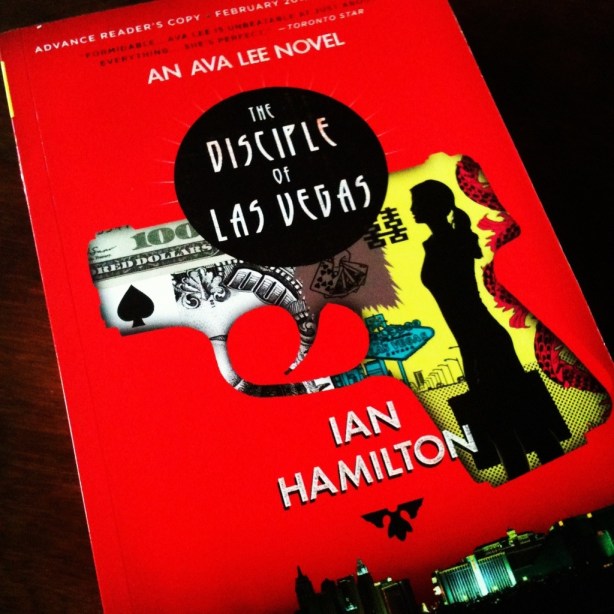
I guess these books are already big in the UK, or maybe they will be big, or something. This one’s an ARC and it doesn’t come out until early next year. Here’s the UK pub copy:
Hired by Tommy Ordonez, the richest man in the Philippines, to recover $50 million in a land swindle, Ava has her work cut out. Tommy’s brother has messed up and the Filipino billionaire’s reputation is on the line.
Tracking the money, Ava uncovers an illegal online gambling ring, and follows the trail to Las Vegas. Once there, she turns her gaze to David Douglas, one of the greatest poker players in the world – and someone who knows more about the missing money than he’s letting on.
Meanwhile, Jackie Leung, an old target of Ava’s, has made it rich. He wants revenge, and he’s going after Ava.

