Book Shelves #45, 11.04.2012

20121103-171422.jpg

Book shelves series #45, forty-fifth Sunday of 2012

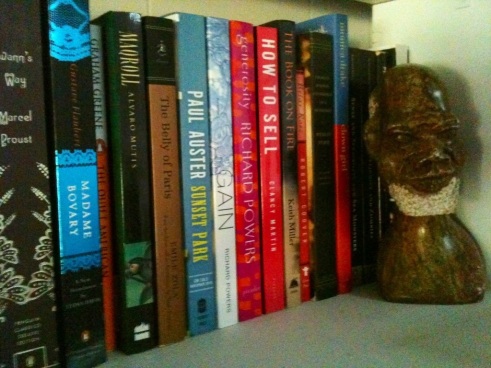
Yon shelf, murky, dim:

20121103-171436.jpg

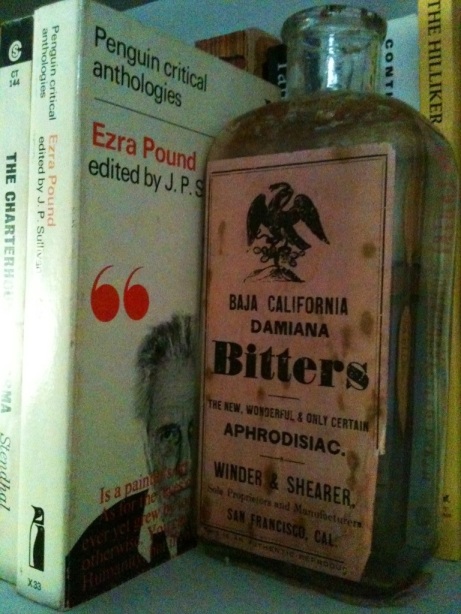
Homeboy on the end, once my parents’,  tschotchke of time in ’80s South Africa, used to work as a bookend, now he just hangs out on this double-booked shelf.

20121103-171448.jpg

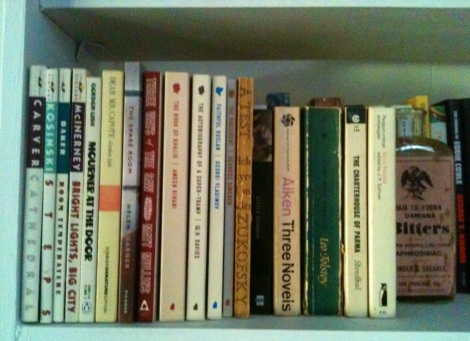
Front layer:

20121103-171458.jpg

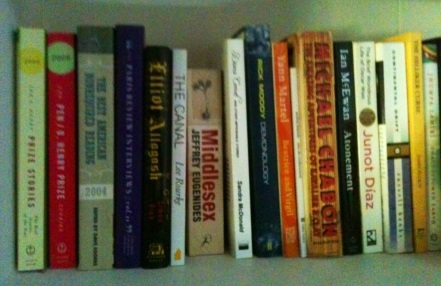
Back layer, including a number of volumes (to be clear: Chabon, Martel, Diaz, Eugenides) I should just trade in.

20121103-171526.jpg

(Also: I hate this project and wish I’d never started it).

Woman Reading — Mary Cassatt

D.T. Max Talks About His David Foster Wallace Biography

Reading — Henri Fantin-Latour

The Reader — Felicien Rops

The Maid with the Yellow Hair — Frederic Leighton

Adoration of the Moon — Max Weber

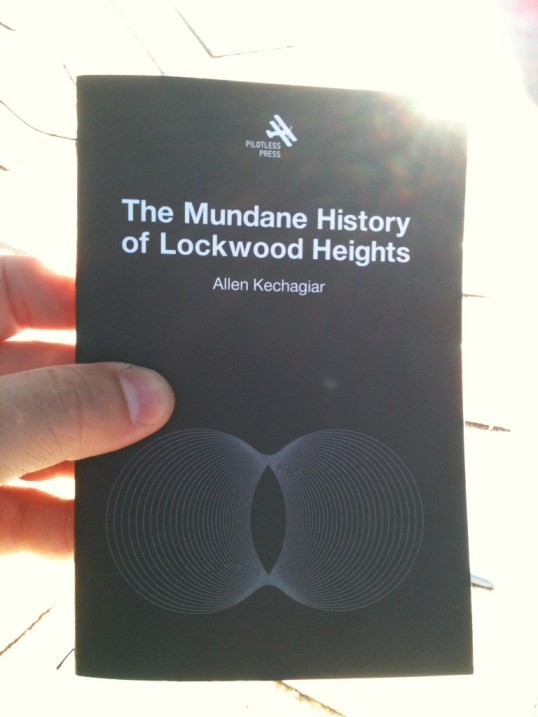
I Review The Mundane History of Lockwood Heights, a Chapbook by Allen Kechagiar

20121029-143421.jpg

“The Mundane History of Lockwood Heights” is a lovely little chapbook, new from Pilotless Press, an Athenian  outfit (uh, Greek, not Georgian) that  knows how to put together an aesthetically-pleasing text. “Lockwood Heights” is their first release. It’s by Allen Kechagiar, who, full disclosure, I’ve been email-friendly with for a several years now.

What’s “Lockwood Heights” about?

An unnamed narrator, a young man, returns to his hometown in California, the titular Lockwood Heights, “another far station, another dead end valley prone to fire, another far suburb with no other cause than the profit it would generate for its contractors.” With little going for it in a depressed economy, the citizens of Lockwood Heights allow porn production to become their town’s raison d’etre. Studios move in and the girls of Lockwood Heights soon find they can essentially auction off their virginity on camera:

They struggle to keep their virginity intact (or at any rate their parents struggle to keep it so) and hope that they will be chosen as the royal heir’s queen consort. Here, at Lockwood Heights, we had our very own race: at its finish line there was no prince to greet the winners, but a whole menagerie, or more accurately a bestiary, comprising of artificially tanned Californian would-have-beens, barely legal girls with gigantic strap-ons, transvestites and hermaphrodites, midgets and giants, obese, anorexic, effeminate, silicon-enhanced or not, all of them with a ticket to her body, standing in a metaphorical queue. A body that wasn’t hers to control anymore. The studio owned it from then on, through the unwritten contracts of promised fame that is rarely delivered.

They were also called the Treasurers or The Knights Who Say No. Their motto was non numquam. Their herald was a locked gate.

The various histories of these girls fill most of “The Mundane History of Lockwood Heights,” and as the narrator often uses the first-person plural “we” (that is, the high school boys), the story sometimes takes on a melancholy and wistful tone similar to Eugenides’s The Virgin Suicides. These are the finest moments of “Heights,” compact and precise narratives that relate the sad (and sometimes not-so-sad) lives of these girls who make porn (or, in some cases, refuse to).

It’s not just the girls of Lockwood Heights who sell their bodies on film—our protagonist comes home to sell all he has left, his “twin virginity” to be lost for a director who is sometimes called the Stanley Kubrick of porn. Scenes of the narrator meeting the casting director, his costar, and other workers on the film’s production are interspersed with the girl stories, as well as the backdrop of the narrator’s homecoming. His father has died, his mother is absent, and a strange little ersatz closet has been constructed in one of the house’s corridors. The interrelationship between these three elements is not as fully developed as it could be; I found myself wanting more. I also wanted more of the strange, aphoristic asides the narrator occasionally offers, like this one:

When we sleep we do not live in the full sense of the word. We rehearse death. Our dreams, the fallout of our daily lives, can only be remembered. They cannot be lived.

When they happen, we do not exist.

In its best moments (and there are plenty of those), “Heights” commands the reader’s attention with its bizarre mix of pathos and the pathetic, with sharp humor that threatens to tip into something more sinister. The southern California exurb Kechagiar crafts recalls the slightly off dystopias of George Saunders—the kind of place we wish were more removed from our immediate reality. “The Mundane History of Lockwood Heights” feels like the starting point of something bigger, more expansive, more detailed—and I’d want to read that something. Recommended.

Girl Reading — Pierre-Auguste Renoir

A Scholar — Rembrandt

Watch Nosferatu, F.W. Murnau’s Chilling 1922 Film Adaptation of Dracula

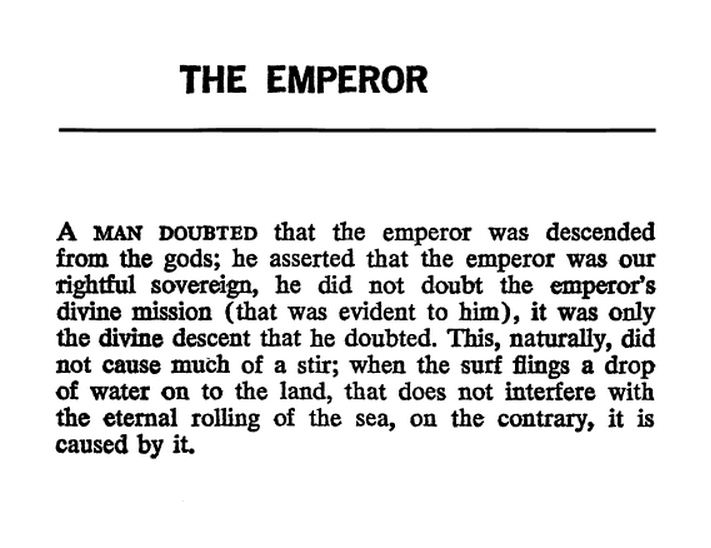
“The Emperor” — Kafka

Reading Girl — Ilya Repin

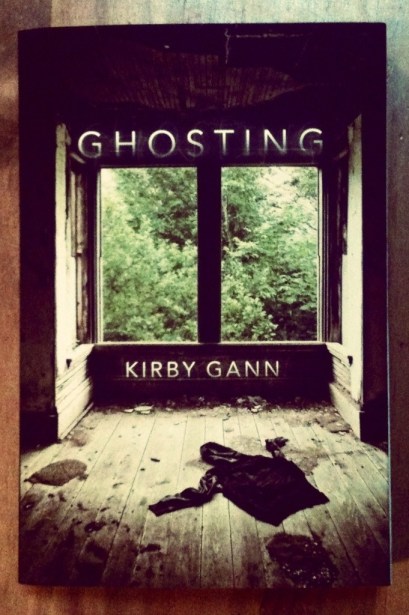
Ghosting (Book Acquired, 10.18.2012)

20121018-174628.jpg

I got a copy of Kirby Gann’s novel Ghosting a few week or so ago, and finally have had time to dip into the first three chapters this morning. Gann’s prose—and perhaps the framing of his characters—reminds me a bit of Russell Banks or Thomas McGuane—that combination of the rough and the refined, that rawness that actually comes from meticulous reworking. Sample of that prose (context not important):

The first cop to show nods at Dwayne Hardesty and stands beside him at the feet of four kids who lie spread-eagled face-down on the muddy portico steps leading to the graffiti-strewn boards that shield the seminary entrance. The wash of the cruiser’s spot frescoes their captive forms in hard outline, three underfed and thin and the fourth a fat block squeezed into a Kentucky basketball sweatshirt that strains to withstand his heavy nervous breathing, the grommets in their jeans and an occasional earring flashing agleam in the white light; four pairs of white sneakers, expensive and rain-wet, shine stark and severe and unworldly.

Ghosting is a thriller, and Gann propels the narrative forward with these cinematic images (and realistic dialogue), engaging the reader to keep turning the pages.

Here’s the jacket copy:

A dying drug kingpin enslaved to the memory of his dead wife; a young woman torn between her promising future and the hardscrabble world she grew up in; a mother willing to do anything to fuel her addiction to pills; and her youngest son, searching for an answer behind his brother’s disappearance—these are just some of the unforgettable characters that populate Ghosting, Kirby Gann’s lush and lyrical novel of family, community, and the ties that can both bond and betray.

Fleece Skaggs has disappeared along with Lawrence Gruel’s reefer harvest. Convinced that the best way to discover the fate of his older brother is to take his place as a drug runner for Greuel, James Cole plunges into a dark underworld of drugs, violence, and long hidden family secrets, where discovering what happened to his brother could cost him his life.

A genre-subverting literary thriller explored through the alternating viewpoints of different characters, Ghosting is both a simple quest for the solution to a mystery, and a complex consideration of human frailty and equivocation.


Italian Monk Reading — Camille Corot

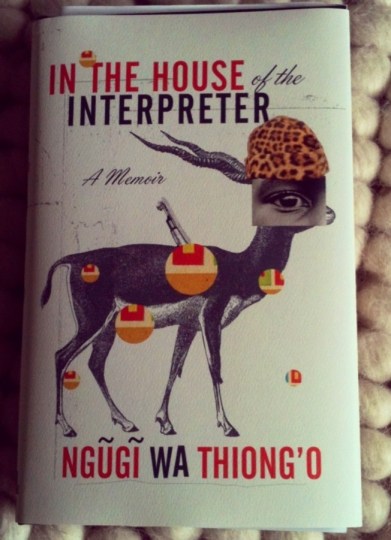
Ngugi wa Thiong’o’s Memoir — In the House of the Interpreter (Book Acquired, 10.24.2012)

20121025-161753.jpg

In the House of the Interpreter is a memoir from Ngugi wa Thiong’o. It’s new next month in hardback from Pantheon (lovely cover/design, on this one, Pantheon people. Seriously). Their blurb:

World-renowned Kenyan novelist, poet, playwright, and literary critic Ng˜ug˜ý wa Thiong’o gives us the second volume of his memoirs in the wake of his critically acclaimed Dreams in a Time of War.

In the House of the Interpreter richly and poignantly evokes the author’s life and times at boarding school—the first secondary educational institution in British-ruled Kenya—in the 1950s, against the backdrop of the tumultuous Mau Mau Uprising for independence and Kenyan sovereignty. While Ng˜ug˜ý has been enjoying scouting trips, chess tournaments, and reading about the fictional RAF pilot adventurer Biggles at the prestigious Alliance High School near Nairobi, things have been changing rapidly at home. Poised as he is between two worlds, Ng˜ug˜ý returns home for his first visit since starting school to find his house razed and the entire village moved up the road, closer to a guard checkpoint. Later, his brother Good Wallace, a member of the insurgency, is captured by the British and taken to a concentration camp. As for Ng˜ug˜ý himself, he falls victim to the forces of colonialism in the person of a police officer encountered on a bus journey, and he is thrown into jail for six days. In his second year at Alliance High School, the boarding school that was his haven in a heartless world is shattered by investigations, charges of disloyalty, and the politics of civil unrest.

In the House of the Interpreter hauntingly describes the formative experiences of a young man who would become a world-class writer and, as a political dissident, a moral compass to us all. It is a winning celebration of the implacable determination of youth and the power of hope.


The Reader — Pierre-Auguste Renoir