“Sybil, You Were Raped by Santa Claus” (Ellison’s Invisible Man)

From Ralph Ellison’s Invisible Man, a shocking, weird, gross, Christmasy reference near the end of the book. The context is that, in 1950s America, Sibyl, a white woman, wants the narrator, a black man, to fulfill her rape fantasy. Page 522 of my edition–

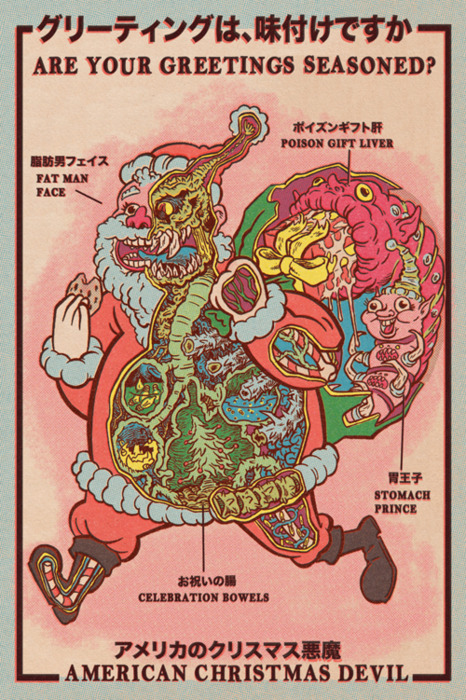
American Christmas Devil: Celebration Bowels, Fat Man Face, Poison Gift Liver, and Stomach Prince

A Blood Meridian Christmas

Cormac McCarthy’s seminal anti-Western Blood Meridian isn’t exactly known for visions of peace on earth and good will to man. Still, there’s a strange scene in the book’s final third that subtly recalls (and somehow inverts) the Christmas story. The scene takes place at the end of Chapter 15. The kid, erstwhile protagonist of Blood Meridian, has just reunited with the rampaging Glanton gang after getting lost in the desert and, in a vision-quest of sorts, has witnessed “a lone tree burning on the desert” (a scene I have argued is the novel’s moral core).

Glanton’s marauders, tired and hungry, find temporary refuge from the winter cold in the town of Santa Cruz where they are fed by Mexicans and then permitted to stay the night in a barn. McCarthy offers a date at the beginning of the chapter — December 5th — and it’s reasonable to assume, based on the narrative action, that the night the gang spends in the manger is probably Christmas Eve. Here is the scene, which picks up as the gang — “they” — are led into the manger by a boy–

The shed held a mare with a suckling colt and the boy would would have put her out but they called to him to leave her. They carried straw from a stall and pitched it down and he held the lamp for them while they spread their bedding. The barn smelled of clay and straw and manure and in the soiled yellow light of the lamp their breath rolled smoking through the cold. When they had arranged their blankets the boy lowered the lamp and stepped into the yard and pulled the door shut behind, leaving them in profound and absolute darkness.

No one moved. In that cold stable the shutting of the door may have evoked in some hearts other hostels and not of their choosing. The mare sniffed uneasily and the young colt stepped about. Then one by one they began to divest themselves of their outer clothes, the hide slickers and raw wool serapes and vests, and one by one they propagated about themselves a great crackling of sparks and each man was seen to wear a shroud of palest fire. Their arms aloft pulling at their clothes were luminous and each obscure soul was enveloped in audible shapes of light as if it had always been so. The mare at the far end of the stable snorted and shied at this luminosity in beings so endarkened and the little horse turned and hid his face in the web of his dam’s flank.

The “shroud of palest fire” made of sparks is a strange image that seems almost supernatural upon first reading. The phenomena that McCarthy is describing is simply visible static electricity, which is not uncommon in a cold, dry atmosphere–particularly if one is removing wool clothing. Still, the imagery invests the men with a kind of profound, bizarre significance that is not easily explainable. It is almost as if these savage men, naked in the dark, are forced to wear something of their soul on the outside. Tellingly, this spectacle upsets both the mare and her colt, substitutions for Mary and Christ child, which makes sense. After all, these brutes are not wise men.

[Ed. note — Yes, this post is recycled (regifted?) from last year].

Read “The Fir-Tree,” Hans Christian Andersen’s Depressing Story About the Existential Fate of a Christmas Tree

Hans Christian Andersen’s “The Fir-Tree,” a depressing story about a Christmas tree—

Far down in the forest, where the warm sun and the fresh air made a sweet resting-place, grew a pretty little fir-tree; and yet it was not happy, it wished so much to be tall like its companions— the pines and firs which grew around it. The sun shone, and the soft air fluttered its leaves, and the little peasant children passed by, prattling merrily, but the fir-tree heeded them not. Sometimes the children would bring a large basket of raspberries or strawberries, wreathed on a straw, and seat themselves near the fir-tree, and say, “Is it not a pretty little tree?” which made it feel more unhappy than before. And yet all this while the tree grew a notch or joint taller every year; for by the number of joints in the stem of a fir-tree we can discover its age. Still, as it grew, it complained, “Oh! how I wish I were as tall as the other trees, then I would spread out my branches on every side, and my top would over-look the wide world. I should have the birds building their nests on my boughs, and when the wind blew, I should bow with stately dignity like my tall companions.” The tree was so discontented, that it took no pleasure in the warm sunshine, the birds, or the rosy clouds that floated over it morning and evening. Sometimes, in winter, when the snow lay white and glittering on the ground, a hare would come springing along, and jump right over the little tree; and then how mortified it would feel! Two winters passed, and when the third arrived, the tree had grown so tall that the hare was obliged to run round it. Yet it remained unsatisfied, and would exclaim, “Oh, if I could but keep on growing tall and old! There is nothing else worth caring for in the world!” In the autumn, as usual, the wood-cutters came and cut down several of the tallest trees, and the young fir-tree, which was now grown to its full height, shuddered as the noble trees fell to the earth with a crash. After the branches were lopped off, the trunks looked so slender and bare, that they could scarcely be recognized. Then they were placed upon wagons, and drawn by horses out of the forest. “Where were they going? What would become of them?” The young fir-tree wished very much to know; so in the spring, when the swallows and the storks came, it asked, “Do you know where those trees were taken? Did you meet them?”

Continue reading “Read “The Fir-Tree,” Hans Christian Andersen’s Depressing Story About the Existential Fate of a Christmas Tree”

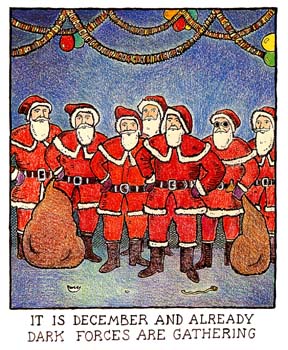
It Is December and Already Dark Forces Are Gathering — Glen Baxter

The Price of Reindeer Meat, How Fast A Fake Christmas Tree Burns, and Other Fun Facts from Harper’s Index

The following citations are culled from a search of Harper’s Index that used the term “Christmas.” (If it’s not obvious, the numbers before each datum are the month and year that Harper’s originally published the datum in its Index)–

12/84   Number of robots FAO Schwarz expects to sell this Christmas season: 10,000

12/84   Total number of recordings of “White Christmas” that have been sold: 150,431,669

12/84   Chance of a white Christmas in New York: 23%

In Minneapolis: 73%

12/85   Percentage of Jewish households in the United States that had Christmas trees in 1984: 12

12/85   Rank of “Grandma Got Run Over by a Reindeer,” among all Christmas singles, in sales last year: 1

12/87   Price of a pound of reindeer meat at Lobel’s Prime Meats in New York City: $14.98

12/88   Estimated cost of a partridge in a pear tree, retail: $39.95

12/89   Percentage of Americans who say they didn’t get what they wanted for Christmas last year: 6

12/89   Percentage of Americans who say they ate plum pudding last Christmas: 1

12/89   Ratio of U. S. households that have real Christmas trees to those that have artificial Christmas trees: 1:1

12/90   Average number of Christmas cards received by an American household each December: 26

12/91   Estimated number of cookies that will be left out for Santa Claus this Christmas Eve: 84,000,000

12/92   Price paid at auction in October for a 1942 Christmas card signed by Adolf Hitler: $3,025

12/93   Maximum speed at which the seeds of the dwarf mistletoe are expelled when ripe, in miles per hour: 60

12/93   Price of a life-sized computer-controlled triceratops, from the Neiman Marcus Christmas catalogue: $93,000

12/93   Percentage of Americans who say they enjoy Christmas shopping “a great deal”: 28

12/93   Pages of forms an applicant must fill out to be considered for the position of elf at Macy’s: 10

12/95   Fee charged by a California design firm to place a string of lights on an outdoor Christmas tree, lights not included: $75

12/96   Estimated number of Americans hospitalized last year for injuries involving the ingestion of Christmas ornaments: 687

12/97   Chance that an American adult can name all of Santa’s reindeer: 1 in 4

12/98   Year in which Christmas celebrations, plum pudding, and mince pie were outlawed in England: 1647

12/00   Minutes required to take in “the true story of Christmas ” at Little Rock’s Living Nativity drive-through: 2

12/01   Number of Montreal stores vandalized last year for mounting Christmas displays in November: 14

12/02   Chances of getting a hotel room in Bethlehem on Christmas in 2000 and 2001, respectively: 0, 9 in 10

Chance that a Bethlehem hotel expects to be open this Christmas: 1 in 5

12/02   Rank of a burning Yule-log video loop among the top-rated 8-10 a.m. TV shows in New York City last Christmas: 1

12/03    Estimated number of artificial Christmas trees displayed in U.S. homes each year for every real one: 2.6

12/05   Miles per hour of two low-flying Danish fighter jets in February when they startled a reindeer named Rudolph to death: 450

Amount his owner, a professional Santa, was paid by the Air Force in September to buy a new Rudolph: $5,000

12/06   Number of worldwide incidents last Christmas of “Santarchy,” which involves roving mobs of unruly Santas: 29

Number of fruitcakes that drunken Santas catapulted into the air at the event in Portland, Oregon: 6

1/07   Percentage change since 1970 in the height of the National Christmas Tree: +63

12/07   Number of golf clubs a Phoenix tourism group is sending to troops overseas as part of its “Operation White Christmas”: 14,000

12/07   Number of Christmas trees FedExed last year to U.S. troops: 11,854

12/07   Number of seconds it takes a synthetic Christmas tree to burn: 32

12/08   Percentage of U.S. Christmas trees purchased in 2001 and 2007, respectively, that were artificial: 21, 36

“A Prayer for Baby Jesus” — Ricky Bobby

“The Junky’s Christmas” — William Burroughs

Granddad’s Eggnog

Hopefully everyone is happy and with loved ones and friends during these holidays–and what better way to show love and fellowship than sharing a draught of delicious eggnog (alternately, the sad and solitary can drown their lonely sorrows in this high-alcohol, high-calorie treat). This is an old recipe; I remember my cousin and I stealing sips of this nog during my grandparents’ Christmas parties.

You will need:

A bottle of fine bourbon

A bottle of fine rum

A liqueur of your choice (this is optional; coffee, cream, or amaretto all add a nice touch)

A gallon of vanilla ice cream (substitute frozen yoghurt if you’re concerned about calories)

A carton of store-bought eggnog (alternately, you can make your own eggnog from eggs, milk, and sugar, although it’s a genuine pain in the ass and no one will ever know the difference, unless you go around pointing it out to them, which will make you look like an asshole, and you don’t want to look like an asshole, do you?)

Nutmeg, cinnamon, mace, clove (Use whole spices! Any of your favorite holiday spices will do, but I consider these four essential)

To make a one gallon pitcher of eggnog:

Put about 6 cups of ice cream in the pitcher. Add some cinnamon sticks and cloves; grate some nutmeg and mace into the pitcher. Add 4 cups of the store-bought eggnog, stir mixture. Add about 3 and 1/2 cups of bourbon, 1 1/2 cups of rum, and liqueur (about 1/2 a cup will do) to taste; add more spices. Stir vigorously; cover and allow to set in the freezer for at least 12 hours before serving. Stir vigorously before serving.

To make your guests happy, I suggest serving the nog with both liquor and ice cream at hand; this way those inclined may add either as their taste dictates. (Note for heavy drinkers: if your intention is to get smashed, stop drinking the eggnog after two cups and begin drinking the bourbon straight! The high levels of cream and sugar in this nog will almost guarantee a hangover–don’t overdo it!)


“Christmas Trees” — Robert Frost

“Christmas Trees” by Robert Frost–

A Christmas Circular Letter

The city had withdrawn into itself
And left at last the country to the country;
When between whirls of snow not come to lie
And whirls of foliage not yet laid, there drove
A stranger to our yard, who looked the city,
Yet did in country fashion in that there
He sat and waited till he drew us out
A-buttoning coats to ask him who he was.
He proved to be the city come again
To look for something it had left behind
And could not do without and keep its Christmas.
He asked if I would sell my Christmas trees;
My woods—the young fir balsams like a place
Where houses all are churches and have spires.
I hadn’t thought of them as Christmas Trees.
I doubt if I was tempted for a moment
To sell them off their feet to go in cars
And leave the slope behind the house all bare,
Where the sun shines now no warmer than the moon.
I’d hate to have them know it if I was.
Yet more I’d hate to hold my trees except
As others hold theirs or refuse for them,
Beyond the time of profitable growth,
The trial by market everything must come to.
I dallied so much with the thought of selling.
Then whether from mistaken courtesy
And fear of seeming short of speech, or whether
From hope of hearing good of what was mine,
I said, “There aren’t enough to be worth while.”
“I could soon tell how many they would cut,
You let me look them over.”

“You could look.
But don’t expect I’m going to let you have them.”
Pasture they spring in, some in clumps too close
That lop each other of boughs, but not a few
Quite solitary and having equal boughs
All round and round. The latter he nodded “Yes” to,
Or paused to say beneath some lovelier one,
With a buyer’s moderation, “That would do.”
I thought so too, but wasn’t there to say so.
We climbed the pasture on the south, crossed over,
And came down on the north.
He said, “A thousand.”

“A thousand Christmas trees!—at what apiece?”

He felt some need of softening that to me:
“A thousand trees would come to thirty dollars.”

Then I was certain I had never meant
To let him have them. Never show surprise!
But thirty dollars seemed so small beside
The extent of pasture I should strip, three cents
(For that was all they figured out apiece),
Three cents so small beside the dollar friends
I should be writing to within the hour
Would pay in cities for good trees like those,
Regular vestry-trees whole Sunday Schools
Could hang enough on to pick off enough.
A thousand Christmas trees I didn’t know I had!
Worth three cents more to give away than sell,
As may be shown by a simple calculation.
Too bad I couldn’t lay one in a letter.
I can’t help wishing I could send you one,
In wishing you herewith a Merry Christmas.


“A Christmas Greeting” — Walt Whitman

“A Christmas Greeting” by Walt Whitman

Welcome, Brazilian brother–thy ample place is ready;
A loving hand–a smile from the north–a sunny instant hall!
(Let the future care for itself, where it reveals its troubles,
impedimentas,
Ours, ours the present throe, the democratic aim, the acceptance and
the faith;)
To thee to-day our reaching arm, our turning neck–to thee from us
the expectant eye,
Thou cluster free! thou brilliant lustrous one! thou, learning well,
The true lesson of a nation’s light in the sky,
(More shining than the Cross, more than the Crown,)
The height to be superb humanity.

A Blood Meridian Christmas

Cormac McCarthy’s seminal anti-Western Blood Meridian isn’t exactly known for visions of peace on earth and good will to man. Still, there’s a strange scene in the book’s final third that subtly recalls (and somehow inverts) the Christmas story. The scene takes place at the end of Chapter 15. The Kid, erstwhile protagonist of Blood Meridian, has just reunited with the rampaging Glanton gang after getting lost in the desert and, in a vision-quest of sorts, has witnessed “a lone tree burning on the desert” (a scene I argued earlier this year was the novel’s moral core).

Glanton’s marauders, tired and hungry, find temporary refuge from the winter cold in the town of Santa Cruz where they are fed by Mexicans and then permitted to stay the night in a barn. McCarthy offers a date at the beginning of the chapter — December 5th — and it’s reasonable to assume, based on the narrative action, that the night the gang spends in the manger is probably Christmas Eve. Here is the scene, which picks up as the gang — “they” — are led into the manger by a boy–

The shed held a mare with a suckling colt and the boy would would have put her out but they called to him to leave her. They carried straw from a stall and pitched it down and he held the lamp for them while they spread their bedding. The barn smelled of clay and straw and manure and in the soiled yellow light of the lamp their breath rolled smoking through the cold. When they had arranged their blankets the boy lowered the lamp and stepped into the yard and pulled the door shut behind, leaving them in profound and absolute darkness.

No one moved. In that cold stable the shutting of the door may have evoked in some hearts other hostels and not of their choosing. The mare sniffed uneasily and the young colt stepped about. Then one by one they began to divest themselves of their outer clothes, the hide slickers and raw wool serapes and vests, and one by one they propagated about themselves a great crackling of sparks and each man was seen to wear a shroud of palest fire. Their arms aloft pulling at their clothes were luminous and each obscure soul was enveloped in audible shapes of light as if it had always been so. The mare at the far end of the stable snorted and shied at this luminosity in beings so endarkened and the little horse turned and hid his face in the web of his dam’s flank.

The “shroud of palest fire” made of sparks is a strange image that seems almost supernatural upon first reading. The phenomena that McCarthy is describing is simply visible static electricity, which is not uncommon in a cold, dry atmosphere–particularly if one is removing wool clothing. Still, the imagery invests the men with a kind of profound, bizarre significance that is not easily explainable. It is almost as if these savage men, naked in the dark, are forced to wear something of their soul on the outside. Tellingly, this spectacle upsets both the mare and her colt, substitutions for Mary and Christ child, which makes sense. After all, these brutes are not wise men.

Santa Claus Rape in Ellison’s Invisible Man

I’m finishing up Ralph Ellison’s Invisible Man, and I came to this shocking, weird, gross, Christmasy reference near the end of the book. The context is that, in 1950s America, Sibyl, a white woman, wants the narrator, a black man, to fulfill her rape fantasy. Page 522 of my edition–

George Orwell’s Recipes for Plum Cake and Christmas Pudding

(Via).

“Peace on Earth/Little Drummer Boy” — Will Ferrell & John C. Reilly

Vodpod videos no longer available.

Happy Xmas

black_santa

“And there were shepherds living out in the fields nearby, keeping watch of their flocks at night. An angel of the Lord appeared to them, and the glory of the Lord shone around them, and they were terrified. But the angel said to them, ‘Do not be afraid. I bring you good news of great joy that will for all the people. Today in the town of David a Savior has been born to you; he is Christ the Lord'” — Luke 2:8-11

William Burroughs — “The Junky’s Christmas”

Part One:

Part Two: