Man is born to trouble as the sparks fly upward (Peanuts)

pe140914

Roman Muradov’s Enigmatic Graphic Novella (In a Sense) Lost and Found Reviewed

If you regularly read The New York Times or The New Yorker, you’ve probably already seen Roman Muradov’s compelling illustrations. If you’re a fan, you also know about his strange and wonderful Yellow Zine comics (and if you don’t know them, check out his adaptation of Italo Calvino).

Muradov’s début graphic novella (In a Sense) Lost and Found was released recently by Nobrow Press, and it’s a beauty—rich, imaginative, playful, and rewarding. And it smells good.

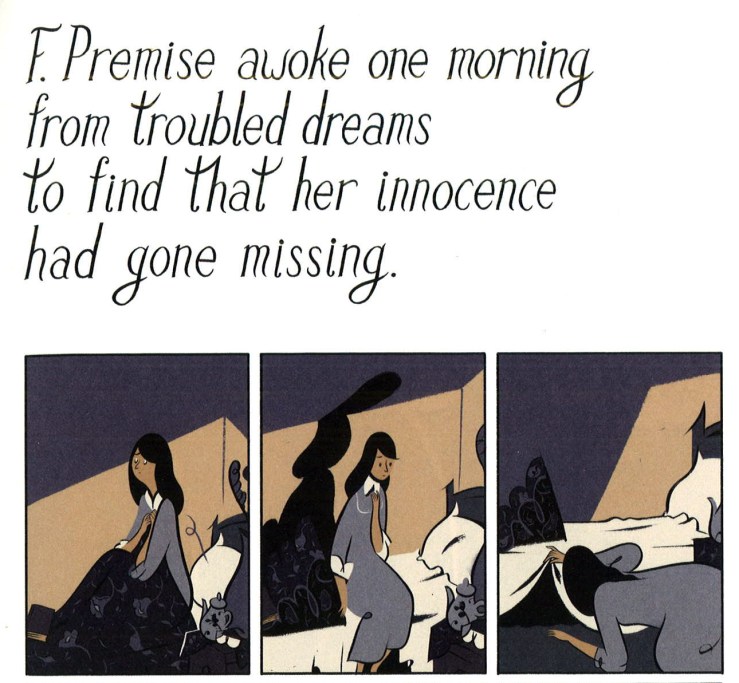
(In a Sense) Lost and Found begins with a nod to Kafka’s Metamorphosis:
8

Although we’re told by the narrative script that our heroine F. Premise (faulty premise?) “awoke,” the surreal world Muradov creates in Lost and Found suggests that those “troubled dreams” continue far into waking hours. The story runs on its own internal dream-logic, shifting into amorphous spaces without any kind of exposition to guide the reader who is, in a sense, as lost as the protagonist becomes at times on her Kafkaesque quest.

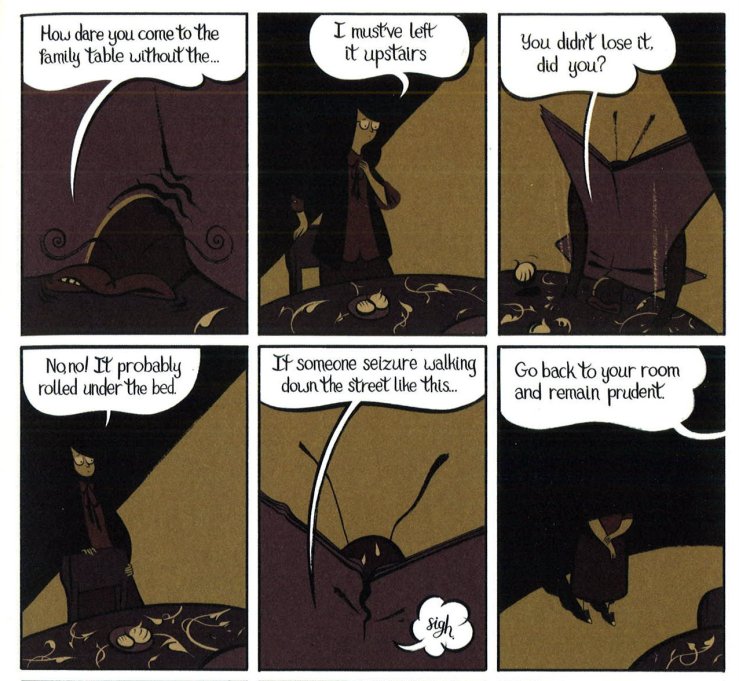
What is F. Premise’s mission? To regain her innocence, perhaps, although only the initial narrative script and the punning title allude to “innocence.” The characters seem unable or unwilling to name this object; each time they mention it, their speech trails off elliptically, as we see when Premise’s father (?) confronts her at the breakfast table:
6

Muradov’s imagery suggests Kafka’s bug again—the father’s antennae poke over the broadsheet he’s reading (the book is larded with readers), his strange mouth sagging out under it. Even more Kafkaesque though is Muradov’s refusal to reveal the father’s face, the face of authority, who sends his daughter back up to her room where she must remain locked away.

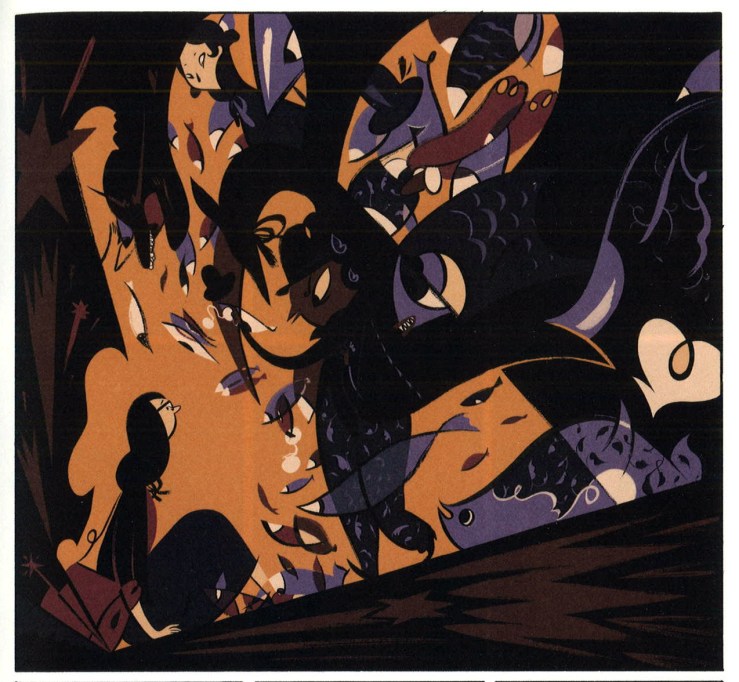
She sneaks out of course—would there be an adventure otherwise?—and it turns out that faceless father is right: F. Premise falls (literally) under the intense gaze of the community. F. Premise is startlingly present to others now by virtue of her absent virtue.
5

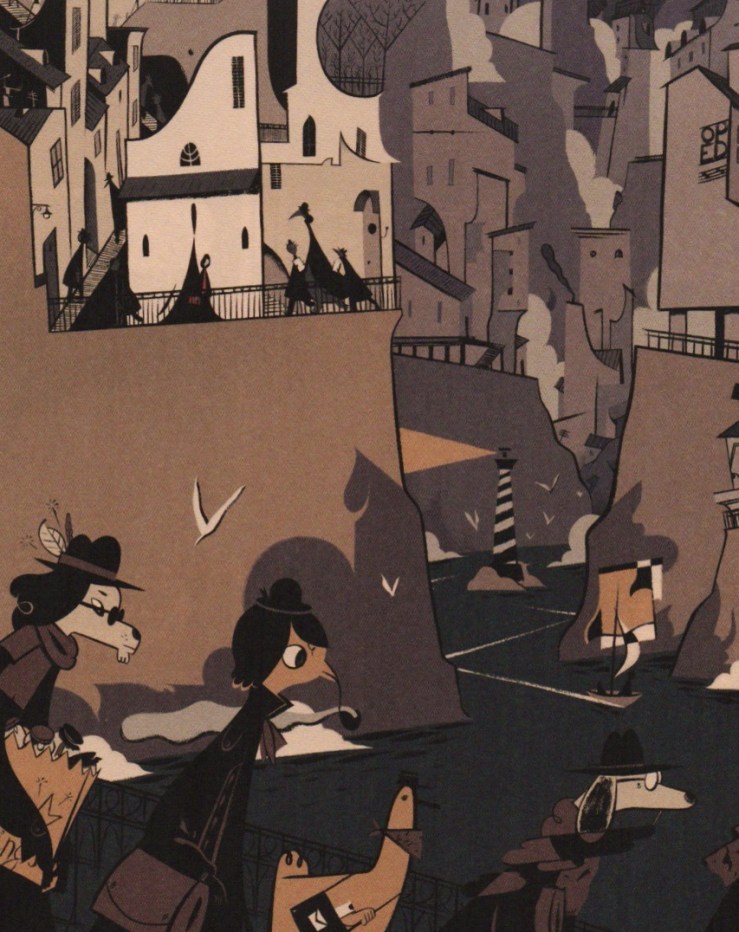
Muradov uses traditional nine-panel grids to tell his story, utilizing large splashes sparingly to convey the intensity of key moments in the narrative. The book brims with beautiful, weird energy, rendered in intense color and deep shadow. Muradov’s abstractions—pure shapes—cohere into representative objects only to fragment again into abstraction. (Perhaps I should switch “cohere” and “fragment” here—I may have the verbs backwards).

The art here seems as grounded in a kind of post-cubism as it does in the work of Muradov’s cartooning forebears. In the remarkable passage below, for example, our heroine moves from one world to another, her form nearly disappearing into complete abstraction by the fifth panel (an image that recalls Miró), before stabilizing again (if momentarily) in the sixth panel.

2

It’s in that last panel that F. Premise returns to her adopted home (of sorts)—a bookstore, of course. Earlier, the kindly owner of the bookstore loans her a pair of old plus-fours, and all of a sudden her identity shifts—or rather, the community shifts her identity, their penetrating gaze no longer trying to screw her to a particular preconception. Identity in Lost and Found is as fluid and changeable as the objects in Muradov’s haunting illustrations.

I have probably already belabored too much of the plot. Suffice to say that our heroine’s quest takes strange turns, makes radical shifts, she descends up and down and into other worlds. Embedded in the journey is a critique of nostalgia, of the commodification of memory (or, more accurately, the memory of memory). Is our innocence what we thought it was? Can we buy it back like some mass-produced object?
IMG_3292

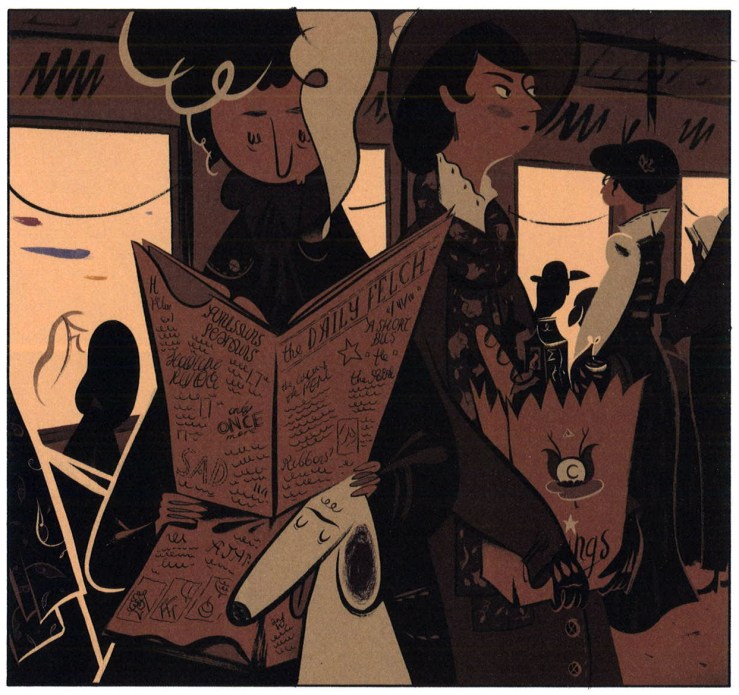
As I noted before, Lost and Found is stuffed with images of readers. There’s something almost Borgesian in the gesture, as if each background character might be on the threshold (if not right in the middle of) their own adventures.
3

It’s in the book’s final moments though that we see a move from reading to writing: Our heroine F. Premise picks up the pen and claims agency, writes her own life. She is indeed the narrative voice after all, the imposing script that, like some all-knowing hand, guided us into the narrative in the first place, only to disappear until the end.
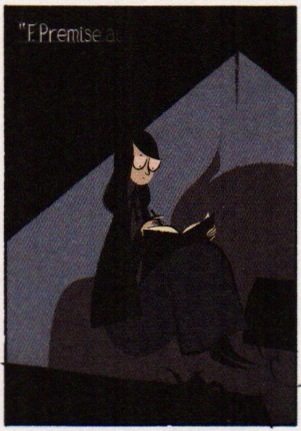
IMG_3293

I loved Lost and Found, finding more in its details, shadowy corners, and the spaces between the panels with each new reading. My only complaint is that I wish it were longer. The book is probably not for everyone—readers looking for a simple comic with an expository voice that will guide them through a traditional plot should probably look elsewhere. But readers willing to engage in Muradov’s ludic text will be rewarded—and even folks left scratching their heads will have to admit that the book is gorgeous, an aesthetic experience unto itself. And it smells good. Highly recommended.


Portrait of Charles Burns in the Style of Nitnit

burns

Charles Schulz is the only writer I’ve continually been reading since I was a kid (Chris Ware)

It was the Peanuts collections in my grandfather’s basement office that really stayed with me through childhood and into college. Charlie Brown, Linus, Snoopy, and Lucy all felt like real people to me. I even felt so sorry for Charlie Brown at one point that I wrote him a valentine and sent it to the newspaper, hoping he’d get it. I’ve said it many times before, but Charles Schulz is the only writer I’ve continually been reading since I was a kid. And I know I’m not alone. He touched millions of people and introduced empathy to comics, an important step in their transition from a mass medium to an artistic and literary one.

From Chris Ware’s new interview with The Paris Review.

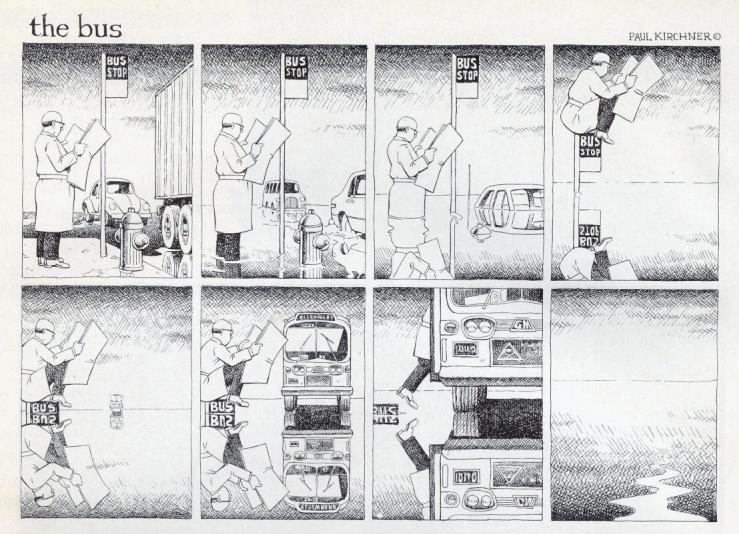
The Bus — Paul Kirchner

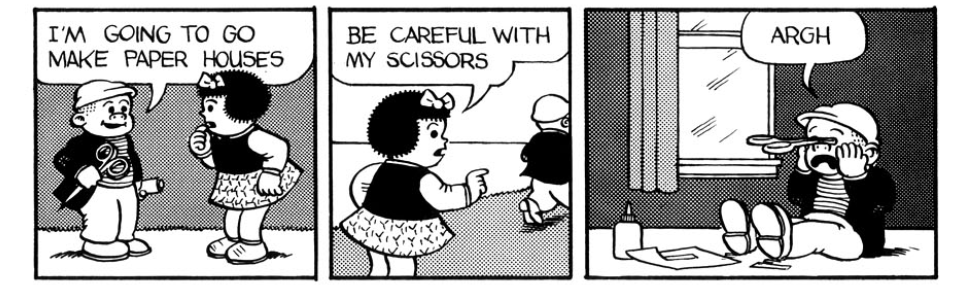
A Nancy strip by Chris Ware

IMG_0103.PNG

From Acme Novelty Library #3

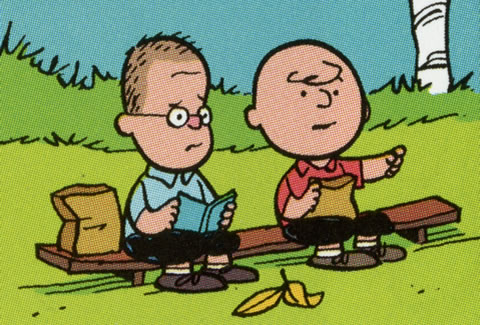
Who cares? (Peanuts)

who cares

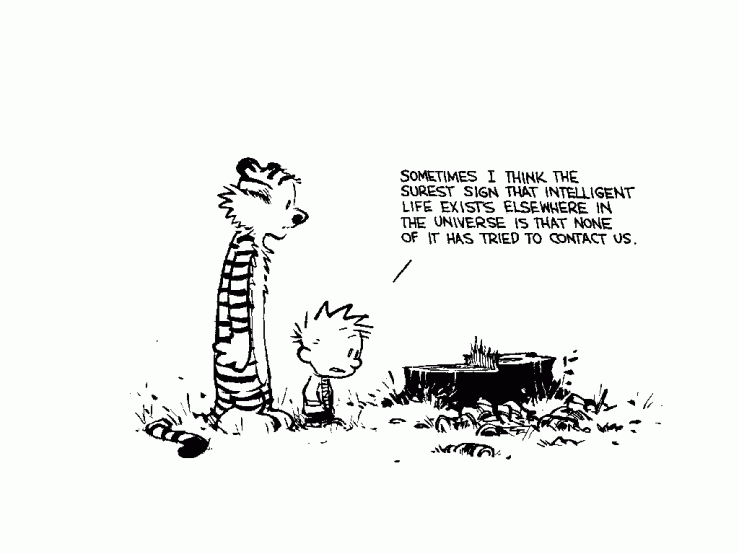
Surest sign (Calvin and Hobbes)

CalvinHobbes

The Bus — Paul Kirchner

bus

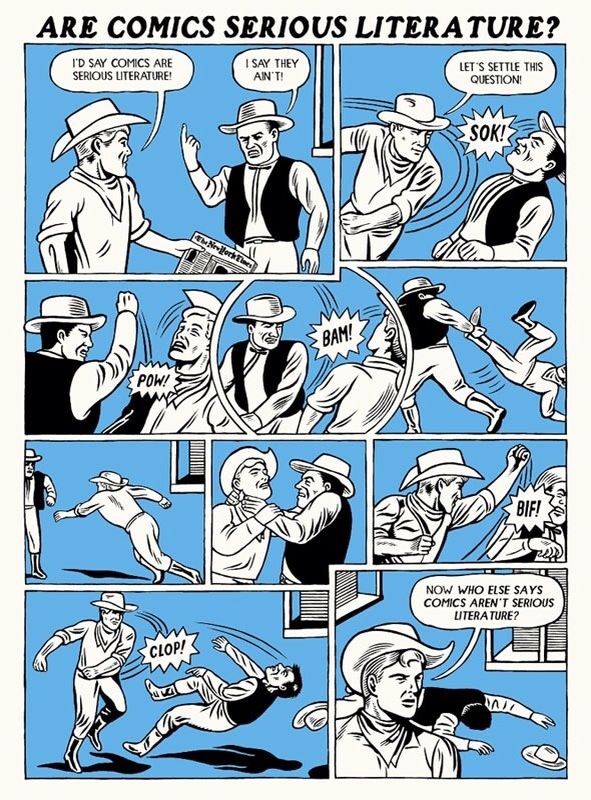
Are Comics Serious Literature? — Michael Kupperman

IMG_3057.JPG

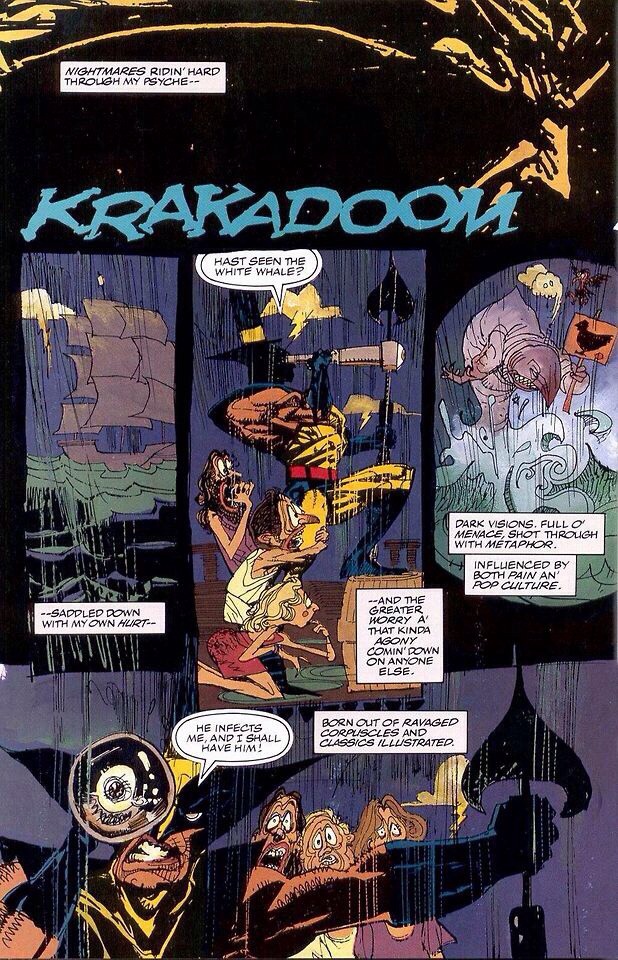
Wolverine/Moby-Dick (Bill Sienkiewicz)

IMG_0085.JPG

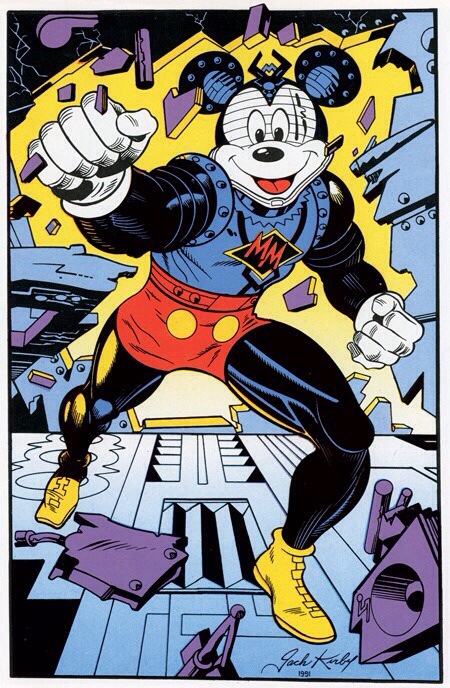
Mickey Mouse — Jack Kirby

IMG_0084.JPG

Technically (Glen Baxter)

20140627-095605-35765119.jpg

Not bad, but (The Far Side)

20140801-165913-61153383.jpg

Some content on this page was disabled on May 26, 2021 as a result of a DMCA takedown notice from Gary Larson. You can learn more about the DMCA here:

https://wordpress.com/support/copyright-and-the-dmca/

Bob Schofield Discusses The Inevitable June and His Sad-Cartoon-Apocalypse Aesthetic

Bob Schofield is a writer and artist. He first showed up on my radar when theNewerYork sent me a digital file of his book The Inevitable June, which I described as “the kind of thing that we need more of; not a gimmick or a hybrid, but something new.” I’m still not sure what the book is, but I dig it. Bob was kind enough to talk to me over a series of emails about his work. Read some of Bob’s work at his website. Read my review of The Inevitable June here. Read our discussion below.

Biblioklept: What is The Inevitable June?

Bob Schofield: The Inevitable June is a collection of 30 surreal short prose pieces, one for every day in June, intercut with black and white illustrations. The drawings don’t always correspond to the text, and there isn’t really much of a coherent “story” per se, but there is certainly momentum and direction. The book definitely goes somewhere, though I’m not sure where exactly that “somewhere” is.

I kind of just wanted to build a little world that mirrored my imagination. A kind of scale-model. So I wanted it to be a little cold and sad and spooky and, hopefully, also fun. Like some kind of weird, floppy theme park made of bound paper squares.

Biblioklept: How did you compose that “scale-model”? Did you have an outline from the outset?

Schofield: There were a few structural “rules” I came up with, and the rest I sort of made up as I went. Like I knew I’d have thirty pieces total, and they’d all be titled for successive days in June. It’s funny, a lot of the momentum in the book just comes from that progression of calendar days. I guess we’re just culturally wired to feel like we’re going somewhere when we see those days slide by. But in the book it’s all relatively arbitrary, and if you were to take the days away as titles, things would feel a lot more meandering.

Photograph of Bob Schofield by Alex Broadwell

My other big structural decision was to start every piece with “This morning,” which would become a kind of refrain throughout the book. I kind of thought of it a bit like a dinner bell, indicating one course of the meal was over, and we were moving on to the next.

Then as I was writing all the individual pieces, I’d cherry pick certain images and phrases I liked, and then be sure to repeat them later on. That way the reader’s brain would kind of light up as they recognized parts of a pattern, even though the pattern wasn’t really saying anything specific. I think that kind of thing is important when you don’t have a more familiar storytelling structure to rely on. You need to give the reader something to hold on to.

And for myself as writer, all these patterns and rules gave me just as much of an anchor. It meant I wasn’t just spinning off into some sort of insane, incomprehensible word soup. I’d always be aware that I’d have to wrap things up at some point, and move on to the next “day.”

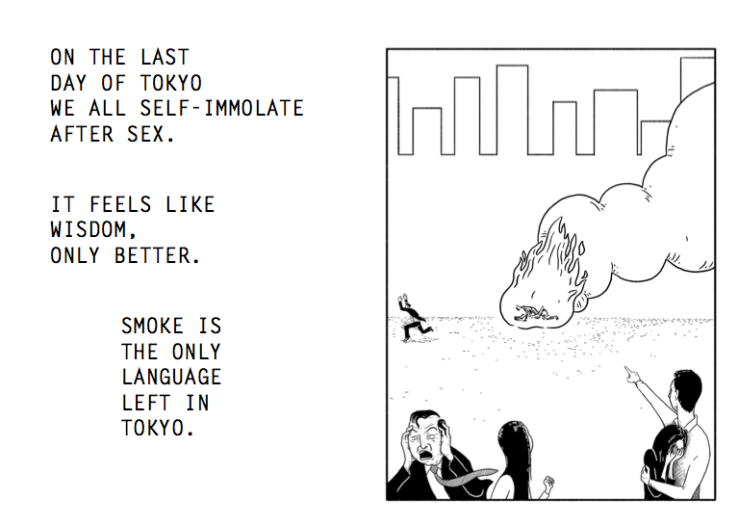
Biblioklept: Your book The Last Days of Tokyo shares some of the anchoring features you mention—beginning each page with the phrase “On the last day of Tokyo,” for example, and the image of a salaryman fleeing in horror, his face an echo of Munch’s The Scream.

1 Continue reading “Bob Schofield Discusses The Inevitable June and His Sad-Cartoon-Apocalypse Aesthetic” →

Kevin Thomas Discusses His Illustrated Book Reviews with Biblioklept

Kevin Thomas’s new book Horn! (from OR Books) collects the book reviews he’s been doing for the past few years at the Rumpus. Kevin reviews new books (and occasionally reissues) in comic strip form. Over a series of emails, Kevin talked with me about his process, how he got started, the books that have stuck with him the most over the years, and his theory that The Life Aquatic with Steve Zissou is a secret remake of Three Amigos!  Find Kevin on Goodreads,Twitter, and Tumblr.

Biblioklept: You’ve been reviewing books at The Rumpus for a couple of years now in your strip Horn! How did the strip start? Did it start with The Rumpus, or before?

Kevin Thomas: I had been making these primitive autobiographical webcomics under the “Horn!” moniker for about a year when The Rumpus Book Club started. One of the selling points of the book club was that if you reviewed a book and the editors liked it, they’d publish it on the site. So I dedicated one comic a month to reviewing these books, and after the third submission was accepted, The Rumpus asked me if I wanted to make it a regular strip.

Biblioklept: What other kinds of comics did you make before that? Did you have any training or background in cartooning?

KT: No, I was trained, to put it generously, to be a composer. Before that I wanted to be a poet. I had great teachers in both of those fields, but never even thought about taking a studio art class. Maybe the fact that I hadn’t yet tried and failed at comics was what drew me to it. Continue reading “Kevin Thomas Discusses His Illustrated Book Reviews with Biblioklept” →

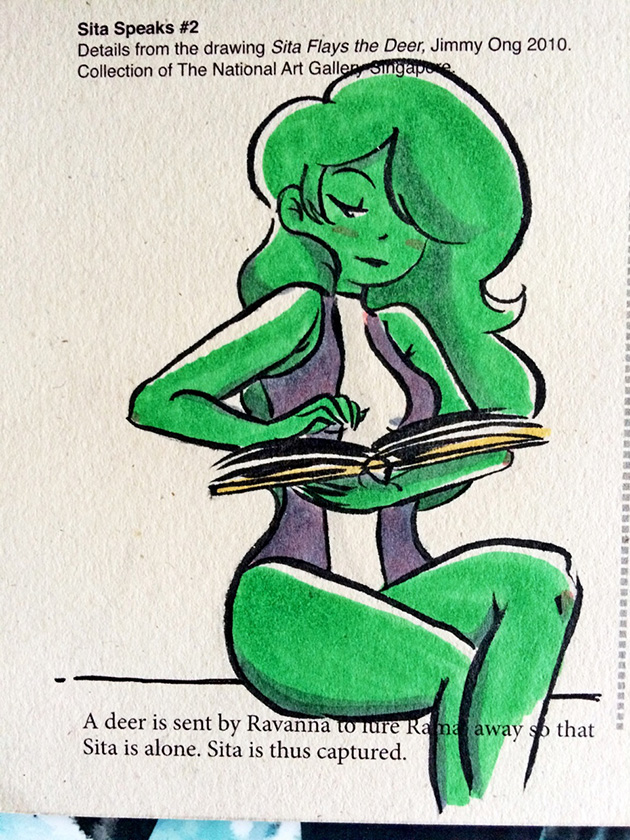
She-Hulk Reading — Regina Bautista

shehulk