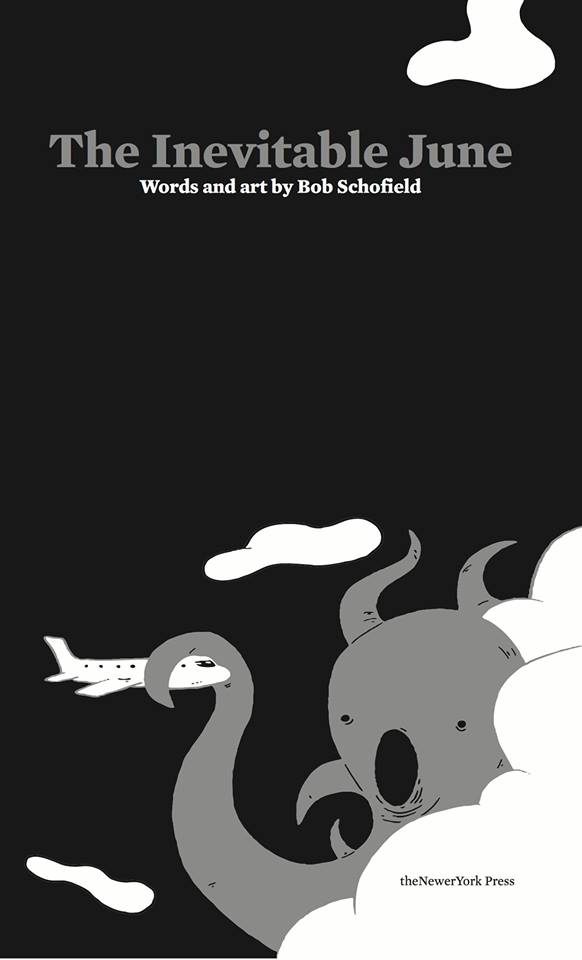
Bob Schofield’s The Inevitable June continues theNewerYork Press’s dedication to beautiful weirdness. They’ve billed The Inevitable June as “words and art,” which is truth in advertising, yes, but is also a way of avoiding putting a label on this strange little book.
Is it a comic? A novella? A thought experiment? A prose-poem? A flip-book? Something entirely new? Yes.
But entirely new is wrong too, because, as the billing states, what we’ve got here are those ancient raw elements of storytelling, words and pictures, resynthesized into something that, in its strangeness, evokes newness and surpasses novelty.

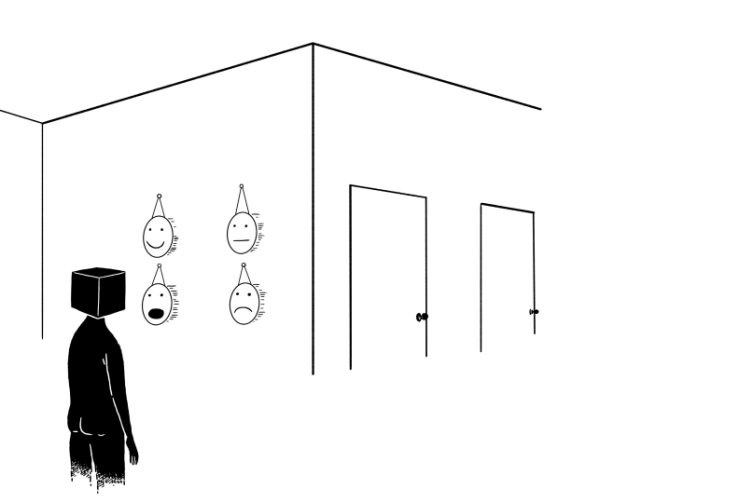
An initial simplicity of form, both in written and drawn line, allows the reader’s consciousness to slip into the strangeness of June. We begin with a simple black-on-white square (emblem of a page or a screen? (or hey man it’s just a square?)) which turns into a cube, or a box rather, one side open (a door; a window) its interior obscured. Should the reader stick his head in? Yes. The book seems to take place in this box, an imaginative dream-machine that we might recall from a childhood or two.
What follows is an almanac of tragicomic weirdness, each entry logging the events of a new morning in an eternal June.
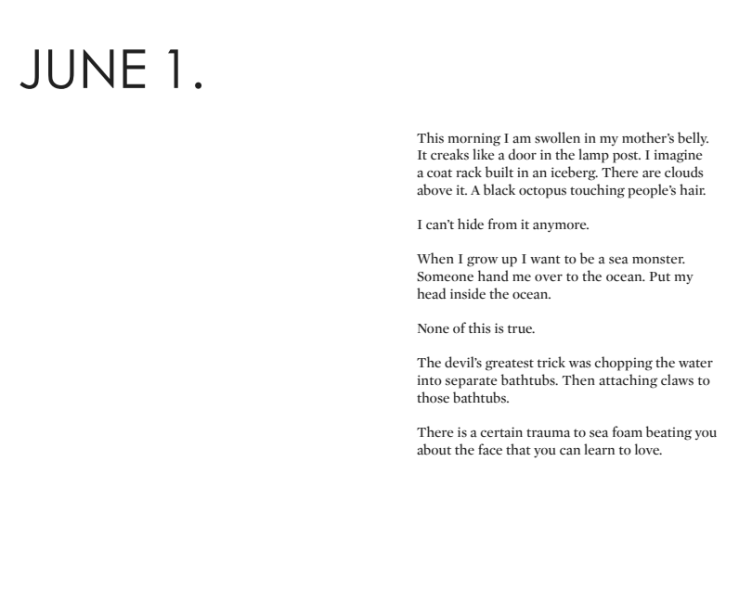
The clarity and concreteness of Schofield’s prose jars against its symantic expression, evoking a dream-nightmare world of continual creation and destruction. Every morning the world begins—and ends—anew, complete with new metaphors which crumble or dissolve or give way under the strain of the next morning’s creation.
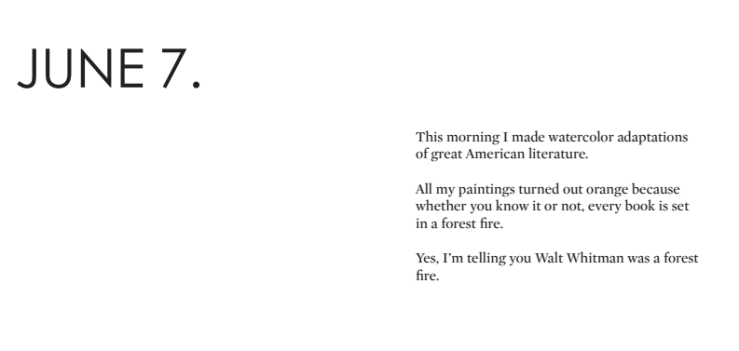
The Inevitable June echoes with images of oceans and fires, glass airplanes and invisible pilots, octopuses and yetis, angels and demons. Its transmutations both challenge and invite the reader to play a game where the rules have not been, cannot be, verbalized.
Is the game consciousness?
A version of consciousness anyway, a metaphor for consciousness—a collection of words and art, black and white lines, inky abysses and blank fields of possibility. If The Inevitable June attests that imaginative power can transform, it also underscores the costs and conditions of that transformation—the edges, the borders, the limits—the constraints of time, the days on a calendar. Interposed, our protagonist travels, falls, rises, dreams, and performs his various identities.
I read Schofield’s book a few times (it’s short) in different formats—on a laptop, a tablet, and then the physical book. Oh, and on my iPhone. I reread that thing on an iPhone waiting in my car to pick up my son from school. It was a different read each time, offering new strangenesses, new pathways, pratfalls, and pitfalls. The Inevitable June is not for all readers, obviously, but it gave me some joy in its puzzles and prose. Recommended.






 Biblioklept