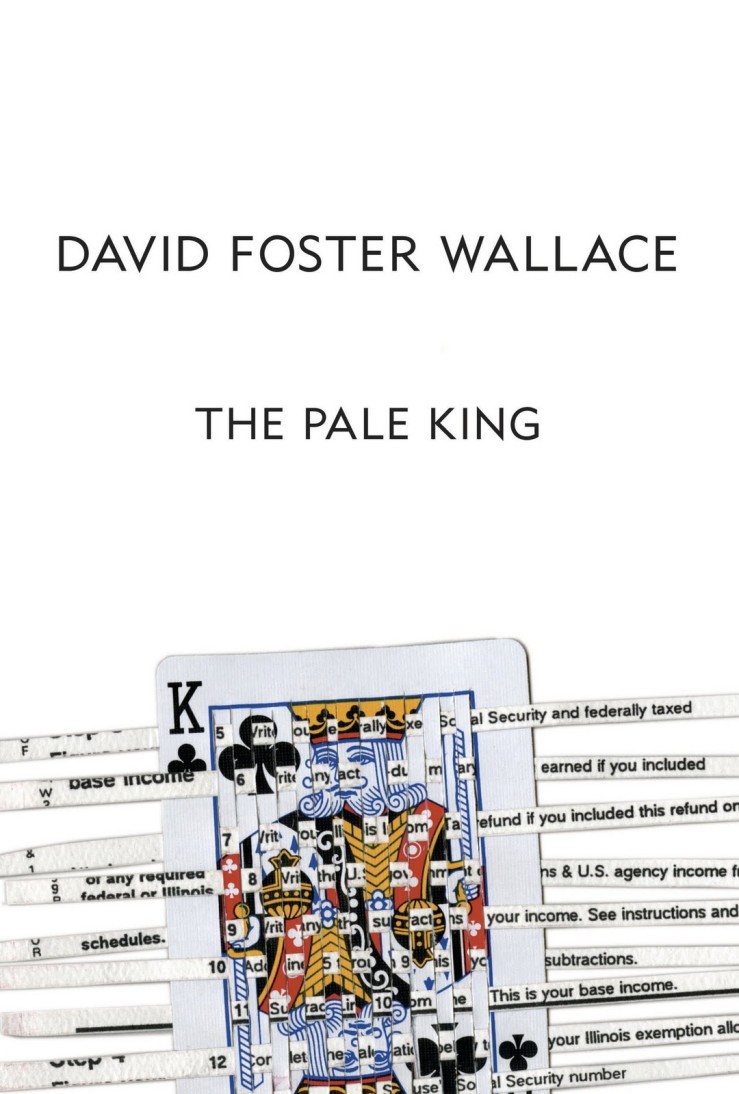
“Corporations Are Getting Better and Better at Seducing Us into Thinking the Way They Think” — David Foster Wallace

From  §19 of David Foster Wallace’s The Pale King:

‘I have no idea what we do. As citizens we cede more and more of our autonomy, but if we the government take away citizens’ freedom to cede their autonomy we’re now taking away their autonomy. It’s a paradox. Citizens are constitutionally empowered to choose to default and leave the decisions to corporations and a government we expect to control them. Corporations are getting better and better at seducing us into thinking the way they think—of profits as the telos and responsibility as something to be enshrined in symbol and evaded in reality. Cleverness as opposed to wisdom. Wanting and having instead of thinking and making. We cannot stop it. I suspect what’ll happen is that there will be some sort of disaster—depression, hyperinflation—and then it’ll be showtime: We’ll either wake up and retake our freedom or we’ll fall apart utterly. Like Rome—conqueror of its own people.’

(This is the second paragraph; read the first here (or, like, buy the book)).

I want to write about this chapter against the backdrop of America’s current political/social/cultural climate—the so-called “debate” about government’s role, individual responsibility, our corporate welfare state, etc. What I want to write I am having a hard time writing. For one, the issue seems so big, so slippery, so oily, so recent, so indigestible. For another, I feel like Wallace’s chapter is so smart and engaging on its own that I shouldn’t be messing with it when I really don’t have anything smart or engaging to say about it.

I guess what I really want is for people to read it, or at least parts of it, so I’ll be posting bits of it over the next week or two, with occasional comments.

If I can’t be analytic about  §19 of The Pale King, perhaps I can at least offer a rough description:

The chapter is one of the longer ones in the novel at 20 pages, although it’s hardly the longest.

The chapter is probably set in early 1980 (or possible late 1979).

The chapter is probably set in a stuck elevator, probably as the result of a power failure, as the lights seem to be off.

The chapter is written entirely as a dialogue, mainly (solely?) between three IRS agents: Glendenning, DeWitt, and someone referred to as ‘X.’

The chapter references The Excorist, which might have been intended to be (or maybe is?) a motif in The Pale King.

The chapter discusses the cultural upheaval of the 1960s and early ’70s, and links this upheaval to the dawning conservatism of the Reagan years (which obviously have not yet happened in terms of the chapter’s timeline, but which one of the interlocutors nevertheless perspicaciously anticipates).

The dialogue (Socratic, if I’m feeling analytic) traces the tension between individual freedom, individual liberty, and the role of the government as an arbiter of civic life.

I’ll end with the somewhat generic definition of “civics” the chapter offers—

‘Civics is the branch of political science that quote concerns itself with citizenship and the rights and duties of US citizens.’

And there we go—that conflict between rights and duties.

“Americans Are in a Way Crazy” — David Foster Wallace

Chapter 19 David Foster Wallace’s The Pale King (or, §19, if you prefer the book’s conceit) begins with this paragraph—

‘There’s something very interesting about civics and selfishness, and we get to ride the crest of it. Here in the US, we expect government and law to be our conscience. Our superego, you could say. It has something to do with liberal individualism, and something to do with capitalism, but I don’t understand much of the theoretical aspect—what I see is what I live in. Americans are in a way crazy. We infantilize ourselves. We don’t think of ourselves as citizens—parts of something larger to which we have profound responsibilities. We think of ourselves as citizens when it comes to our rights and privileges, but not our responsibilities. We abdicate our civic responsibilities to the government and expect the government, in effect, to legislate morality. I’m talking mostly about economics and business, because that’s my area.’

‘What do we do to stop the decline?’

I plan to write more about this later — Tea Party, Real America, all that slang — but I’m tapped out right now. Back to school, syllabi to stick in the toaster oven, too much red tonight, all that jazz.

“Very Few of the Things That I Start I Finish” — David Foster Wallace

David Foster Wallace on the Economy of Comfort

The Pale King — David Foster Wallace

In one of the notes at the end of David Foster Wallace’s incomplete novel The Pale King, the author writes, “Plot a series of set-ups for stuff happening, but nothing actually happens.” This is a fairly precise summary of The Pale King—if you take “nothing actually happens” to mean an absence of recognizable character arcs defined through readily identifiable conflicts progressing along a linear narrative. The Pale King is not a traditional novel. Hell, it’s not even really a novel, unless you decide to really stretch your definition of what a novel is. Which is all fine and good and dandy. Infinite Jest is not a traditional novel either, but it is, I believe, clearly identifiable as a novel: it coheres; it completes; it concludes—which The Pale King does not.

You know the context of The Pale King, and if you don’t you can look it up—there’s a glut of hand-wringing and buzz and backlash out there (out there=internet) that I’ve spent the past three or four months doing my best to ignore. And while I haven’t read a review of The Pale King yet (I’ll read Tom McCarthy’ s write up in The New York Times as soon as I finish my piece), I would have to be deaf dumb blind not to have missed all the headlines, the links, the tweets, the weight people have sought to attach to this book. Anyway, I’m approaching hand-wringing here myself, which is not my aim. I want to try to review the book. But, like I said, there’s all that context. It’s unfinished. Incomplete. Posthumous.

We know the context. You know it’s incomplete, I know it’s incomplete, we know that going in. Which is why it’s a far more satisfying read, I believe, to treat The Pale King as a fragmentary piece, a novel-in-stories, a collection of themes, riffs, dialogues and monologues, vignettes, bits and pieces. It’s closer in many ways to Brief Interviews with Hideous Men or Oblivion than it is to Infinite Jest, although there are plenty of novelly-novel elements. There’s a setting: mostly a sweaty Peoria, Illinois in the mid 1980s, and although much of the novel centers around an IRS regional center there, there are also bits in Chicago, various college classrooms, suburban homes, sad motels, crowded highways, fringe communities, surveillance vans, bars, psych wards, etc. There are recurring characters, all of them IRS employees.

Perhaps a bit on those characters: Some of the best moments of the book center on the bizarre mind of Claude Sylvanshine, a fact psychic who can’t control the flow of data that surges into his mind. Sylvanshine works with his partner and sometime rival Reynolds to help lay the groundwork for the arrival of Merrill Errol Lehrl in Peoria, where Lehrl will continue to machinize the IRS or something like that. There’s Toni Ware, easily the coolest character in the book. There’s not enough Toni Ware in The Pale King. There’s Leonard Stecyk, a person so impossibly good that he drives everyone to despair. There’s Lane Dean, a Christian who may or may not be slowly losing faith. There’s Chris Fogle, who tells us basically his life story in a 100 page novella that may or may not be the center of the book (there is no center though). There’s David Wallace, who claims to be writing a memoir, who claims to be, like, the David Foster Wallace, the author, who claims that he worked for the IRS for a few years between other gigs. As if to prove he’s the real David Wallace, his sections are crammed with diverting, annoying footnotes that repeatedly interrupt any rhythm the reader (or this reader anyway) could get going. It’s difficult to summarize or even describe the relations between the characters, who are defined repeatedly not just through their own telling, but through each others’ eyes, which makes it even more difficult to unpack the plot of The Pale King.

The conflict of the book, or at least the surface conflict, the plot-level conflict, seems to be (or seems to have intended to have been) about a movement within the IRS to essentially change its mission from one of service, of doing a job that no one wants to do that nevertheless has to be done for the greater good of democracy, to a more nefarious and machine-like agency bent on generating revenue—like a corporation. Thus humanity vs. bureaucracy, religious-type calling vs. mercenary machinery, selfless duty vs. selfish will, etc. etc. etc. Chapter 19 (§19, in the book’s terms) lays out these themes beautifully in a civics lesson (the chapter is set in a stuck elevator, I think). The civics lesson has even more resonance in these times of rampant Teabaggery. Here’s a taste—-

Corporations aren’t citizens or neighbors or parents. They can’t vote or serve in combat. They don’t learn the Pledge of Allegiance. They don’t have souls. They’re revenue machines. I don’t have any problem with that. I think it’s absurd to lay moral or civic obligations on them. Their only obligations are strategic, and while they can get very complex, at root they’re not civic entities. With corporations, I have no problem with the government enforcement of statutes and regulatory policy serving a conscience function. What my problem is is the way it seems that we as individual citizens have adopted a corporate attitude. That our ultimate obligation is to ourselves. That unless it’s illegal or there are direct practical consequences for ourselves, any activity is okay.

The IRS gives Wallace a perfect backdrop to explore the tension between civic virtue and the American right to be a selfish asshole, but it’s the book’s themes of boredom and attention that have been remarked upon the most. Simply put, the theme is pervasive, perhaps overdetermined within the narrative, and at once both obvious and complex. Infinite Jest explored the consequences and existential fallout of a society conditioned to believe that it had to be entertained at all times; The Pale King seems to respond to the same existential problem in kind, only from a different angle. There’s so much of this theme of boredom and attention throughout the book that I’ll lazily go to Wallace’s end notes again, where he concisely lays it bare for us (or not for us really but probably for himself)—

It turns out that bliss—a second-by-second joy + gratitude at the gift of being alive, conscious—lies on the other side of crushing, crushing boredom. Pay close attention to the most tedious thing you can find (tax returns, televised golf), and, in waves, a boredom like you’ve never known will wash over you and just about kill you. Ride these out and it’s like stepping from black and white into color. Like water after days in the desert. Constant bliss in every atom.

Wallace finds a kind of transcendental out in the ability to concentrate attention on tasks of despair-invoking boredom. This type of attention obviously recalls the intensity of fervent, even monastic prayer (indeed, the IRS agents are often implicitly compared to monks), yet the Midwest America of The Pale King is deeply desacralized. Although Lane Dean provides a figure of religion in crisis (underexplored for the perhaps obvious reason that the book is unfinished), for the most part The Pale King  presents a post-Nietzschean world without an authorizing center. Wallace’s work then is to find some kind of metaphysical solace in a world where God seems absent at best, and he finds it in paying close attention to the tedium of life. For me, it’s The Pale King’s strange metaphysical moments that are the most intriguing (and frustrating) then. We have the aforementioned Sylvanshine, a fact psychic who can parse data, but cannot glean real meaning from it—

The fact psychic lives part-time in the world of fractious, boiling minutiae that no one knows or could be bothered to know even if they had the chance to know. The population of Brunei. The difference between mucus and sputum. How long a piece of gum has resided on the underside of the third-row fourth-from-left-seat of the Virginia Theater, Cranston, RI, but not who put it there or why. Impossible to predict what facts will intrude. Constant headaches.

In a world of information-overload, attending deeply and meaningfully to data becomes prohibitively difficult, if not impossible. Sylvanshine’s blessing/curse dramatizes the paralyzing post-20th century crisis of too much information (and therefore too many choices). The Pale King’s metaphysical elements manifest again in the ghosts Garrity and Blumquist, who kinda-sorta haunt the IRS center in Peoria; one of them shows up to explain the etymology of the word “boring” to Lane Dean. There’s a boy whose devotion to kissing every square inch of his body (clearly an impossible feat) takes on a spiritual dimension. There’s Chris Fogle, who experiences a religious-type epiphany in an accounting class. There’s also a “fierce infant” who seems to have some metaphysical powers, although I don’t know why I’m lumping him in here. Like I said, (didn’t I say?) I don’t really know how to review this book (I’ve also had a few beers at this point). The infant is one of those threads that goes nowhere, that fails to cohere, that might have a missing piece somewhere else, somewhere unwritten. A more complete picture of the transcendental bliss that prolonged attention might hold comes late in the book, in a longish piece (§46) that details a tête-à-tête between Meredith Rand, who is too-pretty, a little crazy, and ultimately both boring and alienating to almost any guy she actually talks to, and Drinion, an asexual man I take to be autistic. Drinion pays absolute, intense, true, human attention to Meredith Rand’s story of being admitted to a psychiatric hospital in her teens for cutting herself; there she meets her future husband. During their conversation, Drinion begins to levitate—via his attention, he literally transcends gravity. And yet the catch of it all is that Drinion’s autism and aesexuality somehow make it easier for him to attend others, to truly connect to this beautiful woman who simultaneously bores and alienates most of the men she bothers to speak with.

Still, Wallace posits in Drinion—and elsewhere in the book, but hey, let’s face it, this is getting pretty long for a blog review—Wallace posits some kind of answer to existential despair and boredom, an answer that goes beyond a trite commonplace like “empathy,” in that empathy is ultimately about self-identification: the answer in The Pale King seems to be selfless identification, in the most literal sense. There’s no cheat here—the narrative bits with Toni Ware especially dramatize the brutal ugliness of life, its essential Darwinian unfairness, the random cruelty that might be there. This is a book about death and taxes, and Wallace works to sanctify these costs of life, to make them count in a in a world that has largely abandoned the sacred, in a society where many people are incapable or unwilling to think empathetically about their relation to (via taxes and social institutions) other humans whom they do not personally know.

The Pale King is not as rich or funny or sad as Infinite Jest; it has nothing to match Don Gately nor does it have a Prince Hal Incandenza. But why hold that against it? It is, after all, an unfinished thing, but as incomplete as it may be, its ends not just loose but frayed, it is still a marvel of heart and intellect. Highly recommended.
The Pale King’s Opening Lines Vs. Hadji Murad’s Opening Lines

Putting together a review of David Foster Wallace’s The Pale King right now, I realize I have no place to put , nor anything intelligent or even thoughtful to say, about an observation I made about its opening lines (you know, that sentence you halfway paid attention to on some dude’s tumblr), which seem to echo the opening of Leo Tolstoy’s Hadji Murad, which said observation I only observed because I read the books at the same time, and in fact read the opening chapters on the same day. Anyway.

First lines of The Pale King

Past the flannel plains and blacktop graphs and skylines of canted rust, and past the tobacco-​brown river overhung with weeping trees and coins of sunlight through them on the water downriver, to the place beyond the windbreak, where untilled fields simmer shrilly in the a.m. heat: shattercane, lamb’s‑quarter, cutgrass, sawbrier, nutgrass, jimsonweed, wild mint, dandelion, foxtail, muscadine, spinecabbage, goldenrod, creeping charlie, butter-​print, nightshade, ragweed, wild oat, vetch, butcher grass, invaginate volunteer beans, all heads gently nodding in a morning breeze like a mother’s soft hand on your cheek.

First lines of Hadji Murad—-

I was returning home by the fields. It was midsummer, the hay harvest was over and they were just beginning to reap the rye. At that season of the year there is a delightful variety of flowers —red, white, and pink scented tufty clover; milk-white ox-eye daisies with their bright yellow centers and pleasant spicy smell; yellow honey-scented rape blossoms; tall campanulas with white and lilac bells, tulip-shaped; creeping vetch; yellow, red, and pink scabious; faintly scented, neatly arranged purple plaintains with blossoms slightly tinged with pink; cornflowers, the newly opened blossoms bright blue in the sunshine but growing paler and redder towards evening or when growing old; and delicate almond-scented dodder flowers that withered quickly.

I’m not suggesting that Wallace is consciously following Tolstoy here, although the structures of the openings are remarkably similar, and in each case, the flora imagery is ultimately ironized by the narrative that follows.

Seven Fragmentary Novels That Aren’t The Pale King

I finished David Foster Wallace’s The Pale King the other night (don’t worry—I know that there’s been a terrible shortage of coverage for this obscure book, so I’ll post a review pretty soon review here). The Pale King unfolds as a series of fragments, some short as one page, many the length of long short stories, and one novella length piece. Characters recur, but themes, images, and motifs hold these pieces together rather than any linear plot. The better pieces can stand on their own as short stories, yet are much richer when read with/against the rest of the novel. The Pale King remained unfinished at the time of Wallace’s death, but his notes on the manuscript (published at the end of the book) suggest that fragmentation was always his intentional method.

The fragmentary novel is nothing new, but its particular powers have gained resonance against the backdrop of a world where authority, information, and communication are increasingly decentralized, scattered, and, well, fragmented. Fragmentary novels might have roots in the picaresque (those one-damn-thing-after-the-next novels like Don QuixoteCandide, Huckleberry FinnInvisible Man, Orlando, Blood Meridian . . .), but picaresque novels tend to have a shape, a trajectory, even if they seem to lack traditional plot arcs or characterization. What I’m talking about here are novels made of pieces, segments, or chapters that work fine on their own, and  may even seem self-contained, but when synthesized help reveal the novel’s greater project. So, seven fragmentary novels that aren’t The Pale King—

Steps, Jerzy Kosinski

There’s force and vitality and horror in Steps, all compressed into lucid, compact little scenes. In terms of plot, some scenes connect to others, while most don’t. The book is unified by its themes of repression and alienation, its economy of rhythm, and, most especially, the consistent tone of its narrator. In the end, it doesn’t matter if it’s the same man relating all of these strange experiences because the way he relates them links them and enlarges them. At a remove, Steps is probably about a Polish man’s difficulties under the harsh Soviet regime at home played against his experiences as a new immigrant to the United States and its bizarre codes of capitalism. But this summary is pale against the sinister light of Kosinski’s prose. Here’s David Foster Wallace: “Steps gets called a novel but it is really a collection of unbelievably creepy little allegorical tableaux done in a terse elegant voice that’s like nothing else anywhere ever. Only Kafka’s fragments get anywhere close to where Kosinski goes in this book, which is better than everything else he ever did combined.”

Speedboat, Renata Adler

Telegraphed in bristling, angular prose, Speedboat unwinds as a series of seemingly unrelated vignettes, japes, and jokes all filtered through the narrator’s ironic, faux-journalist sensibility. Adler’s novel eschews plot, conventional characters, and resolution—its contours are its center. Speedboat was published in the early 1970s, but it would seem ahead of its time even if it were published tomorrow.  Adler captures the deep existential alienation of modern life, converting dread into verve and despair into marvel.

2666, Roberto Bolaño

Bolaño’s opus bears considerable superficial comparison to Wallace’s The Pale King: both were published posthumously, both have endured a process of buzz and backlash, both are unfinished, and both are purposefully fragmented. 2666 comprises (at least five) parts, some connected explicitly, others tied loosely together, but all interwoven with themes of violence, darkness, art, and love. The book’s most notorious section, “The Part About the Crimes,” is itself a fragmented beast, a procession of murders and rapes, dead-end investigations, bizarre TV appearances, and other sinister doings. Prominent characters disappear into the violence of Santa Teresa never to return again; the great mystery of the book seems unsolved. But like Ariadne, Bolaño offers his readers a thread through the labyrinth, a layering of motifs, as words and images repeat throughout shifts in space and time.

Naked Lunch, William S. Burroughs

Naked Lunch’s cut-up origins are well-known and probably greatly exaggerated: the book is far more coherent than its reputation insists. Still, Burroughs’s infamous novel is all over the place (quite literally), moving through time and space and even to Interzone. Comic, rambling, lusty, and perverse, Naked Lunch’s satire is often overshadowed by its seedier, more sensational side. Burroughs claimed his novels were part of an antique literary pedigree: “I myself am in a very old tradition, namely, that of the picaresque novel. People complain that my novels have no plot. Well, a picaresque novel has no plot. It is simply a series of incidents.”

Vertigo, W. G.  Sebald

Vertigo blurs the lines between fiction, history, autobiography, and biography. The book comprises four sections. The first section tells the story of the romantic novelist Stendhal (or, more to the point, a version of Stendhal); the second section details two trips Sebald made to Italy, one in 1980, and one in 1987; the third section describes a trip Kakfa took to Italy near the end of his life; the final section describes the narrator hiking from Austria to visit the village where he was born in Bavaria. Underwriting and uniting these separate episodes is the narrator’s attempt to find a common thread between past and present, to find a unity in a Europe fractured by time and war. There’s also a deep, throbbing melancholy mixed with beauty and wisdom here.

Cloud Atlas, David Mitchell

Mitchell constructs Cloud Atlas like a doubled matryoshka doll, nesting narratives inside narratives that work their way to an apocalyptic future; once Cloud Atlas hits its middle mark, it works outward to the past, back to its own edges. With the exception of the middle piece, a nod to Russell Hoban’s Riddley Walker, Mitchell fragments each piece of Cloud Atlas at a key turning point, an old literary trick really, but one that pays off. The tales likely hold up on their own, but their intertextual play is the real delight of the novel, as Mitchell showcases a variety of styles and genres and forms that reflect the content and era of each tale. At its core,  Cloud Atlas explores Nietzschean themes of eternal recurrence and the will to power; its clever fragmented structure emphasizes the loops of history humanity finds itself caught in again and again, even as brave souls seek a new way of seeing, living, doing.

Go Down, Moses, William Faulkner

Faulkner always insisted that Go Down, Moses was a novel, although in its initial publication it was presented as a collection of short stories.  And granted, any of the stories can be read on their own. “Was” is hilarious homosocial hijinks, but read against the sorrow and anger in “The Fire and the Hearth” and “Pantaloon in Black,” or the prolonged majesty of “The Bear,” Faulkner’s project becomes much clearer—he is taking on a century in the lives of the Mississippi McCaslins. Go Down, Moses is strange and sad and funny and truly an achievement, a book that works as a sort of time machine, an attempt to undo or recover the racial and familial (and in Faulkner, these are the same) divides of the past.

Is American Psycho Profound, Artistic Nihilism or Stupid, Shallow Nihilism? — Bret Easton Ellis vs David Foster Wallace

Bret Easton Ellis’s controversial novel American Psycho turns 20 this year. The folks at Vintage were kind enough to send me a copy of the book to promote the anniversary, and despite a mounding stack of review copies, I took a few hours to re-read parts of Ellis’s third novel.

I’ve only read two Ellis books and I remember the reading of them distinctly, precisely; I remember how I picked them up and where I was and what I was doing and all that jazz. The first was Ellis’s début Less Than Zero, a slim, ugly little novel that I read in one night. I was fifteen, spending a summer with my aunt and uncle, living in my cousin’s old bedroom. Less Than Zero was part of a cache of books that included Hunter S. Thompson’s Fear and Loathing in Las Vegas, Anthony Scaduto’s Bob Dylan biography, some Hemingway and Fitzgerald novels, One Flew Over the Cuckoo’s Nest, and a Kurt Vonnegut starter kit. In short, a life changing library, and most of it went home with me in my Jansport (somewhat surreptitiously, although I’m sure if I had asked I would have received). Only I didn’t take Less Than Zero, despite reading it all in one sick night, and then reading it again in pieces over the summer. The book hurt my stomach. The drugs were not the Looney Tunes business in HST’s book—they were the symptom of a blank nihilism I simply couldn’t identify with. The scene where the kids casually watch a snuff film horrified me. And the rape scene. Well. It was the first time I read something that genuinely disturbed me in a non-child, non-Grimm’s way — in a way where I felt moral outrage from an adult-psyche-type-position (whatever that means). The book genuinely concerned me; I was afraid such people existed.

I read American Psycho in 2002. I was traveling through Thailand for a month, trading books at guest houses and shops as I went, and the only book I remember being more ubiquitous than American Psycho was Alex Garland’s The Beach (which, yes, I also read there). I had seen and quite enjoyed Mary Harron’s 2000 film adaptation of American Psycho, which had the good sense to treat the whole matter as a piece of cartoonish black comedy. In Harron’s hands, the hyperbolic exploits of Patrick Bateman are considerably less ambiguous than the book’s depiction; Harron  clearly marks the narrative violence as Bateman’s internal fantasies. Of course, one of literature’s greatest tools is ambiguity, and Ellis’s American Psycho revels in it. In a sense, this is the book’s defining nihilism: its total unwillingness to make a definitive judgment about its protagonist’s violence. Instead, American Psycho’s claims to satire rely on the implicit force of the reader’s sense of humanity and morality; like Less Than Zero before it, we have a flat narrative, an utter lack of self-reflection or internal psychology. Ellis gives us only concrete contours, cocaine, hydrochloric acid, chainsaws, and a laundry list of brand names. These are novels without interiors.

American Psycho, utterly concrete, deeply ironic, and occasionally funny, is a strange beach read, but a beach read nonetheless (although all that gristle and blood (and oh the rat!) won’t go down easy for many folks). When I read it in 2002 I found it neither shocking or enlightening, just precise and ugly and grotesque, a numbing progression of concrete descriptions of clothes and restaurants punctuated by ridiculous violence. Its one-note satire would find a better home in a short story. A short short story. I’ve spent the past few days reading through its sections again, trying to reassess it against the backdrop of my current literary estimations of Bret Easton Ellis, which I hate to admit are largely informed not only by his own acerbic personality, but also by (or perhaps more accurately against) his agon with David Foster Wallace.

BEE vs. DFW is not exactly news. Ellis (b. 1964) and Wallace (b. 1962) both published their first novels in the mid-eighties. Less Than Zero made 21-year-old Ellis a star, a likely “voice of his generation.” The Broom of the System didn’t exactly go gangbusters for Wallace, but its voluminous scope, Pynchonian silliness, and its willingness to pick up the postmodern games that Ellis and the other new minimalists seemed to reject announced a major new talent who was willing to both think and feel—to go beyond the surfaces. Indeed, Wallace’s entire project might be defined as setting himself apart from the cool, detached irony that characterizes Ellis’s ethos. In a 1993 interview with Larry McCaffery,Wallace decries fiction that devotes
“a lot of energy to creating expectations and then taking pleasure in disappointing them. You can see this clearly in something like Ellis’s American Psycho: it panders shamelessly to the audience’s sadism for a while, but by the end it’s clear that the sadism’s real object is the reader herself.” I think this is an apt criticism. American Psycho is torture porn encased in a thin veneer of social satire with no interior substance. Here’s Wallace at length—

 I think it’s a kind of black cynicism about today’s world that Ellis and certain others depend on for their readership. Look, if the contemporary condition is hopelessly shitty, insipid, materialistic, emotionally retarded, sadomasochistic, and stupid, then I (or any writer) can get away with slapping together stories with characters who are stupid, vapid, emotionally retarded, which is easy, because these sorts of characters require no development. With descriptions that are simply lists of brand-name consumer products. Where stupid people say insipid stuff to each other. If what’s always distinguished bad writing—flat characters, a narrative world that’s cliched and not recognizably human, etc.—is also a description of today’s world, then bad writing becomes an ingenious mimesis of a bad world. If readers simply believe the world is stupid and shallow and mean, then Ellis can write a mean shallow stupid novel that becomes a mordant deadpan commentary on the badness of everything. Look man, we’d probably most of us agree that these are dark times, and stupid ones, but do we need fiction that does nothing but dramatize how dark and stupid everything is? In dark times, the definition of good art would seem to be art that locates and applies CPR to those elements of what’s human and magical that still live and glow despite the times’ darkness. Really good fiction could have as dark a worldview as it wished, but it’d find a way both to depict this world and to illuminate the possibilities for being alive and human in it. You can defend Psycho as being a sort of performative digest of late-eighties social problems, but it’s no more than that.

Four years before the interview—and two years before the publication of American Psycho—Wallace mocked Ellis’s void, vacuous characters in “Girl with Curious Hair,” a story about a yuppie on LSD at a Keith Jarrett concert.  With no affective life, Sick Puppy (as his low life punk rock friends call him) feels nothing. He cannot enjoy his wealth, his position—not even his acid trip. He can’t even enjoy sex unless he can burn his partner as he’s being fellated. As Marshall Boswell points out in his study Understanding David Foster Wallace, “the story eerily forecasts . . . American Psycho . . . in a grisly and hilarious pastiche of Ellis’ preposterously benumbed prose.”

Perhaps Wallace’s greatest critique of nihilism — greatest in that it escapes the confines of Ellis and his ilk’s literary purview — is Don Gately, erstwhile hero of Infinite Jest, a recovering Demerol addict and small time thief whose painful day-to-day existence figures as the existential struggle against bleak, overwhelming nothingness. Gately is the heart and spirit of IJ, a big sad throbbing heart that, to quote Wallace out of context (from above), is the writer’s way “to depict this [dark] world and to illuminate the possibilities for being alive and human in it.”

Ellis perhaps perceives a character like Gately and his illuminating possibilities as simply too affected. Last summer, at a reading in Hackney, England, Easton offered the following—

Question: David Foster Wallace – as an American writer, what is your opinion now that he has died?

Answer: Is it too soon? It’s too soon right? Well I don’t rate him. The journalism is pedestrian, the stories scattered and full of that Midwestern faux-sentimentality, and Infinite Jest is unreadable. His life story and his battle with depression however is really quite touching . . .

Then there was this cryptic tweet a few months ago—

I’m not sure what Ellis’s tweet meant, and attendees of the Hackney reading claim that he was more considered and measured in his tone than the actual words of his response seem to entail. His end of the agon with Wallace is also rife with its own set of problems—his contemporary is dead, horribly dead, a suicide, (the kind of death that makes an essay like this one, an essay that claims to find affirmation of life in DFW and empty nihilism BEE, particularly hard to swallow, I suppose)—making it all the harder to respond. I read his “too soon” remark from the Hackney reading to be in earnest.

But Ellis’s tweets are not part of his literary corpus (even though they can be entertaining), and Wallace’s suicide is not part of his text. So, I return to those texts—

Wallace’s last effort, The Pale King, contrasts strongly with American Psycho. Wallace’s novel is fractured, heteroglossic, crammed with ideas, and at times purposefully taxing on its reader’s attention. American Psycho is concise (even if its plot is messy and episodic), imagistic, lacks even the pretense of allowing a controlling voice other than Bateman’s into the narrative, and, in its fetishistic, sexualized violence, is a work designed to lock its reader’s attention in a sensationalized vice grip. It’s id-bait par excellence, seductive and stylish. Its greatest achievement may be to fool some readers into believing that its violence is simply part and parcel of its intention of being a scathing satire. The book then relies heavily — too heavily — on an exterior morality system to weigh its flat, static characters, characters who face incredible trauma and yet never process it (or even attempt to process it). And I am not just speaking of Bateman. Consider the dry cleaner who repeatedly removes bloodstains, or the maid  who mops up brain bits without a single question. Then there are the faceless, indistinguishable alpha males who populate Bateman’s yuppie corporate world, and their requisite fiancées and mistresses, weak watery women the narrative repeatedly condemns. These characters lack meaning or depth; they are essentially probable replicants of Bateman, the implication being that psychopathic tendencies lurk everywhere, that the modern condition preempts empathy or human understanding or plain old common decency. The savvy reader is supposed to admire Ellis’s satire of capitalist vacuity, and admittedly, there are some very funny riffs (Bateman’s bits on popular music like Huey Lewis and the News and Whitney Houston, replicated in the film version, still hold up well). But I think Wallace is correct when he asserts that the real violence is ultimately inflicted on the reader. Ellis’s violence is not the same as Flannery O’Connor’s, who used the shock of murder in her stories to explore the possibility of awe, transcendence, and revelation in a desacralized world. Wallace’s The Pale King tries to sanctify the costs of life (death and taxes and the deep existential crisis these costs entail) in a world that has largely abandoned the sacred, in a society where many people are incapable or unwilling to think empathetically about their relation to (via taxes and social institutions) other humans whom they do not personally know. Ellis’s American Psycho is a cartoonish, lopsided distortion of a descralized world. Its affective power is purely externalized, generated from the reader’s moral core. It replaces feeling with violence; it replaces ideas with the illusion of ideas. Its closest claim to art is its satirical power, which is ultimately puddle-shallow (did we really need Ellis to tell us that yuppies are uncaring, shallow and materialistic?) Writers need not be morally instructive, but good books are guided by a vision. Ellis’s vision is pure, bleak nihilism, abyssal and unreflecting, asking little from its reader other than to play voyeur to murder and giving back nothing in return.

Six (More) Stoner Novels (And a Bonus Short Story)

One year ago, to celebrate 4/20, Sam Munson at the Daily Beast wrote an article praising “The Best Stoner Novels.” Not a bad list—Wonder Boys, sure, Invisible Man, a bit of a stretch, The Savage Detectives, a very big stretch, but sure, why not. Anyway, six more stoner novels (not that we advocate the smoking of the weed)—

Junkie, William Burroughs

Burroughs’s (surprisingly lucid) early novel Junkie may take its name from heroin, but it’s full of weed smoking. Lesson: weed smoking leads to heroin. And the inevitable search for yage.

Inherent Vice, Thomas Pynchon

Doc Sportello, the wonky PI at the off-center of Pynchon’s California noir, is always in the process of lighting another joint, if not burning his fingers on the edges of a roach. A fuzzy mystery with smoky corners.

Infinite Jest, David Foster Wallace

Hal Incandenza, protagonist of Wallace’s opus, spends much of his time hiding in the tunnels of Enfield Tennis Academy, feeding his bizarre marijuana addiction, which is, in many ways, more of an addiction to a secret ritual than to a substance. Hal’s hardly the only character in IJ who likes his Mary Jane; there’s a difficult section near the novel’s beginning that features a minor character preparing to go on a major weed binge. His pre-smoking anxiety works as a challenge to any reader seeking to enter the world of Infinite Jest.

The Lord of the Rings, J.R.R. Tolkien

I’m pretty sure “pipe-weed” isn’t tobacco.

Chronic City, Jonathan Lethem

I kind of hated Chronic City, a novel where characters seem to light up joints on every other page. It seems to have been written in an ambling, rambling fog, absent of any sense of immediacy, urgency, or, uh, plot. Bloodless stuff, but, again, very smoky.

Stoner, John Williams

Okay. Stoner has nothing to do with marijuana. But, hey, it’s called Stoner, right?

Bonus short story: Raymond Carver’s “Cathedral”

Carver’s classic story features a myopic narrator who comes up against his own shortcomings when he meets an old friend of his wife, a blind man who ironically sees deeper than he does. After drinking too much booze, they spark up, share a doob, and take in a documentary about European cathedrals. Great stuff.


“Good Luck Editing This” — Outtakes from David Foster Wallace’s ZDF Interview

David Foster Wallace, Slavoj Žižek, and Scatological Ideology

I came across this clip of Slavoj Žižek discussing the different types of toilets that one finds across Europe the other day, and his riff immediately reminded me of David Foster Wallace’s novella The Suffering Channel (or “The Suffering Channel,” if you prefer to think of it as a long short story). Here’s a version of the riff in English, which seems to approach a stand-up comedy routine at times—

“You go to the toilet and you sit on ideology,” says Žižek, arguing that “Disgust . . . is not necessarily, immediately characterized by its object” — disgust is when you confront something from your inside on your outside (Žižek is likely working in part from Julia Kristeva’s theory of the abject here). His inventory and analysis of the differences between French, English, and German toilets immediately recalled this passage from The Suffering Channel

She had also at some point spent a trimester at Cambridge, and still spoke with a slight British accent, and asked generally now whether anyone else who traveled abroad much had noticed that in German toilets  the hole into which the poop is supposed to disappear when you flush is positioned way in front, so that the poop just sort of lies there in full view and there’s almost no way you can avoid looking at it when you get up and turn around to flush. Which she observed was so almost stereotypically German, almost as if you were supposed to study and analyze your poop and make sure it passed muster before you flushed it down

Of course, pretty much every page of The Suffering Channel concerns the scatological: it is literally about a man who shits out art. Wallace seems to be exploring the ways in which we are unable to reconcile what is inside us — that is, what makes us us — with its final form. For Kristeva, the ultimate abject is the corpse. Žižek, less mordant perhaps, seems to be signalling (in the short clip anyway) the relatively straightforward idea that ideology is always operating, always a force conditioning our identity.

Near the end of the clip (around 5:25 or so), Žižek brings up the example of saliva, pointing out that we are constantly swallowing it, producing it and absorbing it back into ourselves, yet to fill a glass with it and then try to drink it would be revolting, horrific. Compare this with another passage from The Suffering Channel

‘Your own saliva,’ said Laurel Manderley. ‘You’re swallowing it all the time. Is it disgusting to you? No. But now imagine gradually filling up a juice glass or something with your own saliva, and then drinking it all down.’

‘That really is disgusting,’ the editorial intern admitted.

‘But why? When it’s in your mouth it’s not gross, but the minute it’s outside of your mouth and you consider putting it back in, it becomes gross.’

‘Are you suggesting it’s somehow the same thing with poo?’

‘I don’t know. I don’t think so. I think with poo, it’s more like as long as it’s inside us we don’t think about it. In a way, poo only becomes poo when it’s excreted. Until then, it’s more like a part of you, like your inner organs.’

‘It’s maybe the same way we don’t think about our organs, our livers and intestines. They’re inside all of us —‘

‘They are us. Who can live without intestines?’

‘But we still don’t want to see them. If we see them, they’re automatically disgusting.’

Wallce lards his novella with example after example of this kind, of the ways in which abject encounters with the borders of self — shit, saliva, menstrual blood, farts — confer identity through a kind of ritual shame. I doubt that Wallace is following, overtly anyway, any post-Lacanian figures in The Suffering Channel, and the concordance of examples used by Wallace and Žižek is probably ultimately not that remarkable. What I do find worth remarking upon, I suppose, are the ways in which Wallace and Žižek were/are so adept at discussing those areas of humanity we’re often happy to overlook.

On the Feeling of Being In-between Books

Like most bibliophiles, I have a big ole stack of books — multiple stacks, really — lying around the house; that is, I have unshelved books in little intermediary piles that I am either always reading or planning to read “next,” which is to say, sometime in the near future. I’ve written before about books I’m always reading (and re-reading), so I’ll set that aside for the moment; also, there are those books of a somewhat fragmentary nature that I like to read slowly (fodder for a future post, perhaps) — but let’s set those aside as well, because they are not what I’m speaking of here.

I found a few years ago that the best way to finish a book, especially a challenging book, but really any novel worth reading, is to simply give it as much undivided attention as you can — to do your best to not let all those other books jump the queue. And for the most part, I’m pretty good at doing this.

So well anyway.

I finished Roberto Bolaño’s Amulet the night before last. I’ve had the book for a while, and though I had desired to read it, I hadn’t had the feeling of wanting to commit to this particular book; so, what I’m doing now, gentle reader, is distinguishing between these two things. We, that is bibliophiles, we all desire to read certain books (lots of certain books, no doubt), but that’s not the same as the feeling of wanting to commit to the particular book. Because generally a bibliophile knows that a great book, or at least a book worth reading, requires a certain level of commitment.

I picked Amulet out of the stack after reading Malcolm Lowry’s Under the Volcano. I don’t know why. There was no intellectual impulse in the choice, although a connection might easily be made between the two novels, both set in Mexico; indeed, Bolaño opens The Savage Detectives with a quote from Under the Volcano, and the heroine of Amulet shows up in The Savage Detectives — so there is some connection. But again, the decision to read Amulet next, instead of, say, Giuseppe Tomasi di Lampedusa’s The Leopard or Heinrich Böll’s The Train Was on Time or any of the other dozens of books cluttering up Biblioklept International Headquarters, was, or at least I believe was, more a matter of intuition and feeling than intellect.

So, as I mentioned, I finished Amulet the other night, and, during the course of reading that novel, another dead literary darling’s novel came out, David Foster Wallace’s The Pale King. Which I’ve been greatly anticipating. Which I’ve been very much desiring to read. Which I have absolutely no desire to commit to reading now, which is to say in that moment between books. Which is strange, I suppose, but perhaps easy to account for on several fronts. First, every day seems to bring some new, fully realized review of The Pale King to the internet, or some piece about Wallace’s “legacy” and The Pale King, or, even worse, some coverage about coverage of The Pale King (which, yes, I realize this post is now threatening to become). Another reason that might account for the fact that I have no feeling to commit to reading The Pale King now may be that it is Wallace’s last novel; maybe I want to wait a bit, give myself a bit of distance from the internet buzz, let anticipation build again. Divorce myself from the idea of having to read the book — especially in the context of Biblioklept, a maybe-literary blog.

To go back to my earlier point, the point of all of this (if this rambling can be said to have a point) is that I realize that I rarely choose to read the “next” book in an intellectual way — that is, the choice is almost always intuitive, born from some feeling that I don’t know how to name, except to say that it’s the feeling that I have when I’m in-between books. It’s a wonderful feeling, exhilarating and freeing and full of possibility, as corny as that sounds, but also a kind of anxiety, a feeling paradoxically tempered by the temporal messiness of being a reader, which is to say being a human, as if the limited time we have to read dampens — and thus defines — the edges of this particular exhilaration. I love the feeling because it opens a seemingly illimitable range of possibilities — the possibilities of new books, new narratives — even as the choice forecloses the possibility of another choice. Etymologically, the word “decide” means “to cut off.” But enough dithering. Time to riffle through the stack.

A Few Thoughts on “Wiggle Room,” an Excerpt from David Foster Wallace’s Novel The Pale King

[Editorial note: Biblioklept originally published this post on March 3rd, 2009. We run it again today in anticipation of  the publication of David Foster Wallace’s posthumous novel, The Pale King, which is like, right around the corner].

The New Critics’ biggest contribution to literary criticism was the dictum that analysis was to be applied strictly to the text itself, without the muddying impurities of biography or any other outside knowledge influencing the reader. A context-free reading is pretty hard to come by, though, isn’t it? School syllabi are arranged around era or genre, or both; our teachers preface each novel or poem or story or essay with a nod to its relevance; a friend hands us a book because it’s “good.” We furtively flip through Tropic of Capricorn, knowing its rep; we look down our noses at abstinence vampire novels. In short, it’s hard to get to that pure reading the New Critics favor. Still, I’ve always thought it’s a pretty good strategy to put aside biographical/author psychology, and just stick to a good close reading of the text. Today, reading David Foster Wallace’s “Wiggle Room,” I was completely unable to do that.The context of Wallace’s recentish suicide hung over each page, each sentence. It was a distraction that led to a (necessary) rereading, a distraction that colored the reading–and then the rereading. A strange little voice popped into Wallace’s dense narration that kept whispering, “posthumous, unfinished novel.” But now that I’ve complicated and contextualized and complained, perhaps I should simply comment a bit on the story now.

In dense, thick sentences, Wallace relates a work morning for Lane Dean, an IRS rote examiner who detests his Sisyphean job. Like many cubicle-dwellers, Lane spends much of his day trying not to look at the clock. He also tries to use an inspirational photo of his son sparingly, so that the effect might be more intense. However, the boredom on this particular day overwhelms Lane and he “had the sensation of a great type of hole or emptiness falling through him and continuing to fall and never hitting the floor. Never before in his life up to now had he once thought of suicide.” Trying to truck through it is no good: “Lane Dean summoned all his will and bore down and did three returns in a row, and began imagining different high places to jump off of.” These thoughts of suicide are mixed with a strange humor. As Lane’s depression becomes frantic, Wallace writes, “Unbidden came ways to kill himself with Jell-O.” As Lane becomes more and more anxious, it becomes apparent that–paradoxically–his boredom literally excites him. He gets all worked up about it, about the thought of having to devote a whole lifetime to such meaningless, boring work. The scene culminates in an horrific image:

When he started to see the baby’s photo face melting and lengthening and growing a long cleft jaw and aging years in just seconds and finally caving in from old age and falling away from the grinning yellow skull underneath, he knew he was half asleep and dreaming but did not know his own face was in his hands until he heard a human voice and opened his eyes but couldn’t see who it went with and then smelled the pinkie’s rubber right under his nose.

The “human voice” that wakes up Lane is a strange cyclopean figure, an older man who delivers a weird lecture on the origins of the word “bore.” The scene is pure Wallacian, filled with plenty of erudite references and jostling with a love for etymology. It literally zaps life-force back into the text, and punctuates Lane’s boring day–which Wallace has so expertly made the reader suffer as well–with some strange, frightening fun. Wallace’s narration makes clear that the appearance of this strange man is not simply Lane going crazy from his boredom–Lane clearly cannot understand half of what the man refers to. Instead, we are given this nugget: “The phantom of the hallucination of repetitive concentration held for too long a time, like saying a word over and over until it kind of melted and got foreign.” After philosophical reflection on why the need for a word for a condition like boredom might have arisen, the episode ends with the phantom leaving and Lane looking up to see that “no time had passed at all, again.”

The emphasis on the ways a person’s soul might be bored into, how one might become bored, and what that might mean, proliferates the short text, and perhaps evokes some of the themes we’ll find in the whole of The Pale King. As the quotes I pulled suggest, the idea that boredom might feed a suicidal impulse resonates strongly in light of Wallace’s unfortunate death. But there I go again, letting context color my analysis. But if we’re only left fragments, isn’t it natural to want to pull them together, to frame them–to give them order–context? It’s hard to say and probably not worth guessing if Lane Dean and the phantom will be major parts of The Pale King or not, but as the text progressed, I found myself more and more interested. Apparently, The Pale King will be published with notes and outlines–some bits of context–perhaps giving readers a clue as to how the text was meant to progress. Who knows. A lot of readers felt thatInfinite Jest didn’t have a proper ending (not me, though). While I think that the “Wiggle Room” episode stands well on its own, I’d certainly be happy to read more about the phantom. Still, Infinite Jest was larded with lots of little vignettes that added to the whole, but it’s important to point out that there was a whole to be added to–not just a series of vignettes. I’m really hoping that, even unfinished, Wallace has left us something of substance and depth, something that narrativizes—contextualizes—its themes into a meaningful work of art.

“Backbone” — David Foster Wallace

The New Yorker has published an excerpt from David Foster Wallace’s The Pale King under the title “Backbone.” Many fans might have already heard the piece — and in Wallace’s own voice even — as it was part of the Lannan recordings and has been transcribed at least twice (although it appears one of those transcriptions has been taken down). (There’s also this fragment, by the way). Anyway, a taste–

Every whole person has ambitions, objectives, initiatives, goals. This one particular boy’s goal was to be able to press his lips to every square inch of his own body.

His arms to the shoulders and most of his legs beneath the knee were child’s play. After these areas of his body, however, the difficulty increased with the abruptness of a coastal shelf. The boy came to understand that unimaginable challenges lay ahead of him. He was six.

There is little to say about the original animus or “motive cause” of the boy’s desire to press his lips to every square inch of his own body. He had been housebound one day with asthma, on a rainy and distended morning, apparently looking through some of his father’s promotional materials. Some of these survived the eventual fire. The boy’s asthma was thought to be congenital.

Is Infinite Jest Just David Foster Wallace’s Way of Imposing His Phallus on the Consciousness of the World?

From David Foster Wallace’s 1997 interview with Charlie Rose. I love Rose’s response–

DFW: Feminists are always saying this. Feminists are saying white males say, “Okay, I’m going to sit down and write this enormous book and impose my phallus on the consciousness of the world.”

ROSE: And you say?

DFW: I — I — if that was going on, it was going on on a level of awareness I do not want to have access to.

ROSE: Do you still play tennis?

“Part of the Fun for Me Was Being Part of Some Kind of Exchange Between Consciousnesses” — David Foster Wallace on the Pleasures of Writing

“It Was this Truly Epiphantic Experience” — David Foster Wallace Describes the First Time He Saw Blue Velvet

From his 1997 interview with Charlie Rose (which Jesus yeah I know you’ve seen before, but hey, it’s worth reading this anecdote from the transcript), David Foster Wallace describes seeing David Lynch’s Blue Velvet

The screen gets all fuzzy now as the viewer’s invited to imagine this. Coming out of an avant garde tradition, I get to this grad school and at the grad school, turns out all the teachers are realists. They’re not at all interested in post-modern avant garde stuff. Now, there’s an interesting delusion going on here — so they don’t like my stuff. I believe that it’s not because my stuff isn’t good, but because they just don’t happen to like this kind of esthetic.

In fact, known to them but unknown to me, the stuff was bad, was indeed bad. So in the middle of all this, hating the teachers, but hating them for exactly the wrong reason — this was spring of 1986 — I remember — I remember who I went to see the movie with — “Blue Velvet” comes out. “Blue Velvet” comes out.

“Blue Velvet” is a type of surrealism — it may have some — it may have debts. There’s a debt to Hitchcock somewhere. But it is an entirely new and original kind of surrealism. It no more comes out of a previous tradition or the post-modern thing. It is completely David Lynch. And I don’t know how well you or your viewers would remember the film, but there are some very odd — there’s a moment when a guy named “the yellow man” is shot in an apartment and then Jeffrey, the main character, runs into the apartment and the guy’s dead, but he’s still standing there. And there’s no explanation. You know, he’s just standing there. And it is — it’s almost classically French — Francophilistically surreal, and yet it seems absolutely true and absolutely appropriate.

And there was this — I know I’m taking a long time to answer your question. There was this way in which I all of a sudden realized that the point of being post-modern or being avant garde or whatever wasn’t to follow in a certain kind of tradition, that all that stuff is B.S. imposed by critics and camp followers afterwards, that what the really great artists do — and it sounds very trite to say it out loud, but what the really great artists do is they’re entirely themselves. They’re entirely themselves. They’ve got their own vision, their own way of fracturing reality, and that if it’s authentic and true, you will feel it in your nerve endings. And this is what “Blue Velvet” did for me.

I’m not suggesting it would do it for any other viewer, but I — Lynch very much helped snap me out of a kind of adolescent delusion that I was in about what sort of avant garde art could be. And it’s very odd because film and books are very different media. But I remember — I remember going with two poets and one other student fiction writer to go see this and then all of us going to the coffee shop afterwards and just, you know, slapping ourselves on the forehead. And it was this truly epiphantic experience.