Blog about some recent reading, books acquired, a mini-review of The Hard Quartet live, etc.

I’ve been lucky over the last decade or so that my little college’s spring break almost always coincides with my children’s spring break. We aimed again this year at Georgia, spending a few days in a cabin outside the unfortunately named Whitesburg. Spring had not yet really sprung there yet. There was very little green about, but the hikes along and around Snake Creek through 20th century ruins were pleasant enough, and the kids enjoyed ziplining and aerial obstacle courses. In one of their sessions, I sneaked away to Harvey’s House of Books.

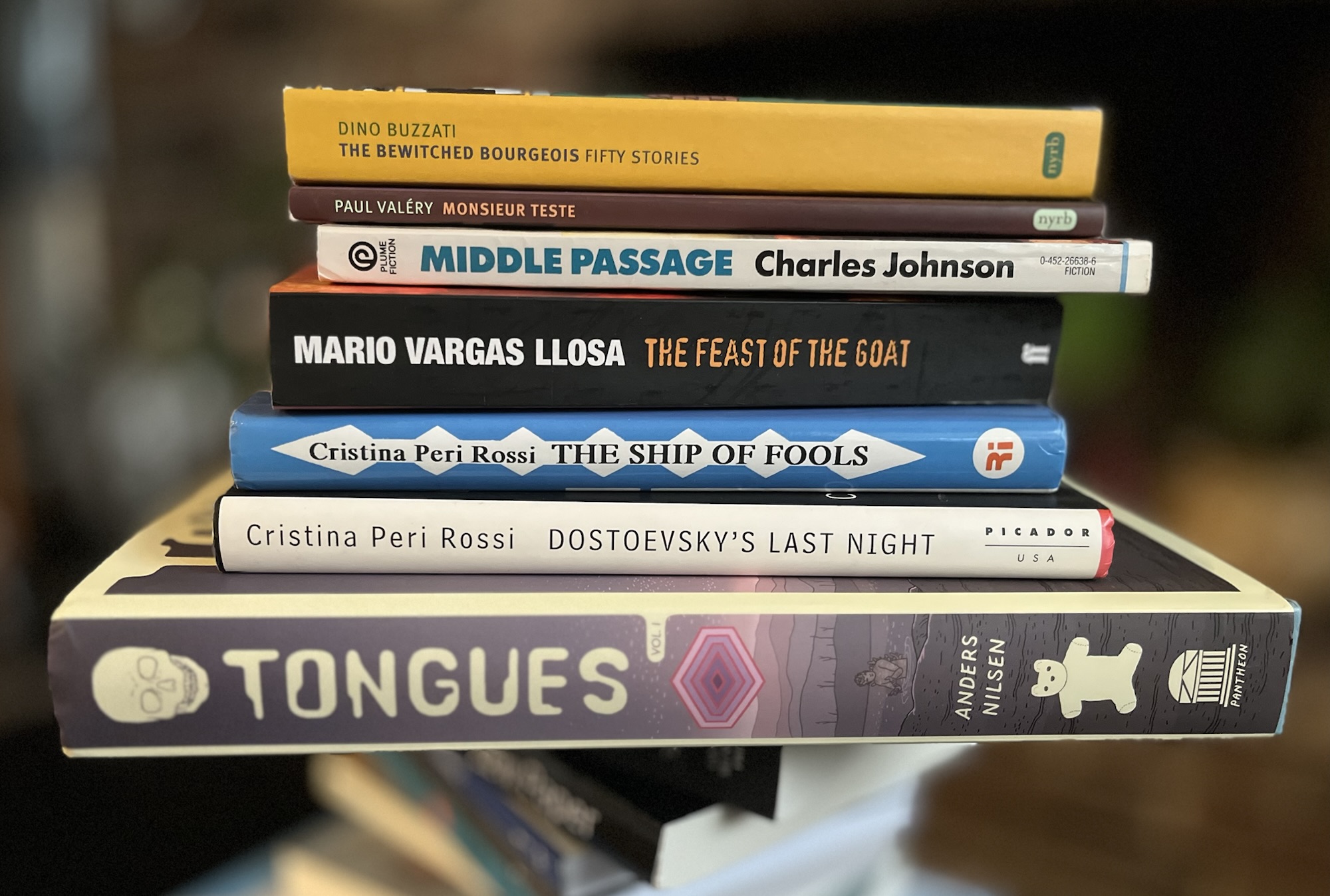
Harvey’s is, as far as I can tell, a Friends of the Library venture run by volunteers. I didn’t expect much, but the fiction section was surprisingly well populated. For around five bucks I picked up Charles Johnson’s Middle Passage, Mario Vargas Llosa’s The Feast of the Goat, and two by Cristina Peri Rossi — The Ship of Fools and Dostoevsky’s Last Night.

I was happy and surprised to find Rossi’s The Ship of Fools (in translation by Psiche Hughes); I’ve had it on a mental list for a few months now. I started it that night and it’s really odd–reminds me a bit of Ann Quin’s stuff, very odd but fun. More thoughts to come.

The Ship of Fools proved a nice antidote to the books I’d brought with me, Paul Valéry’s Monsieur Teste, (in translation by Charlotte Mandell) and a Dino Buzzati collection translated by Lawrence Venuti, called The Bewitched Bourgeois. I’ve enjoyed the Buzzati stories, but piled up there’s a sameness here that cries for interruption. I love Borgesian riffs on “Before the Law” as much as the next nerd, but too many in a row (six, in my case this week) feels, I dunno, like, I get it. But to be clear, I’ve really liked most of The Bewitched Bourgeois. I think it’s better parceled out though. Monsieur Teste on the other hand…look, I don’t know, maybe I misunderstood the book entirely, but I really kinda sorta hated it. Was I supposed to hate the central persona, Mister Teste, who aims for precision in language but comes off as a bore? At least it was short.

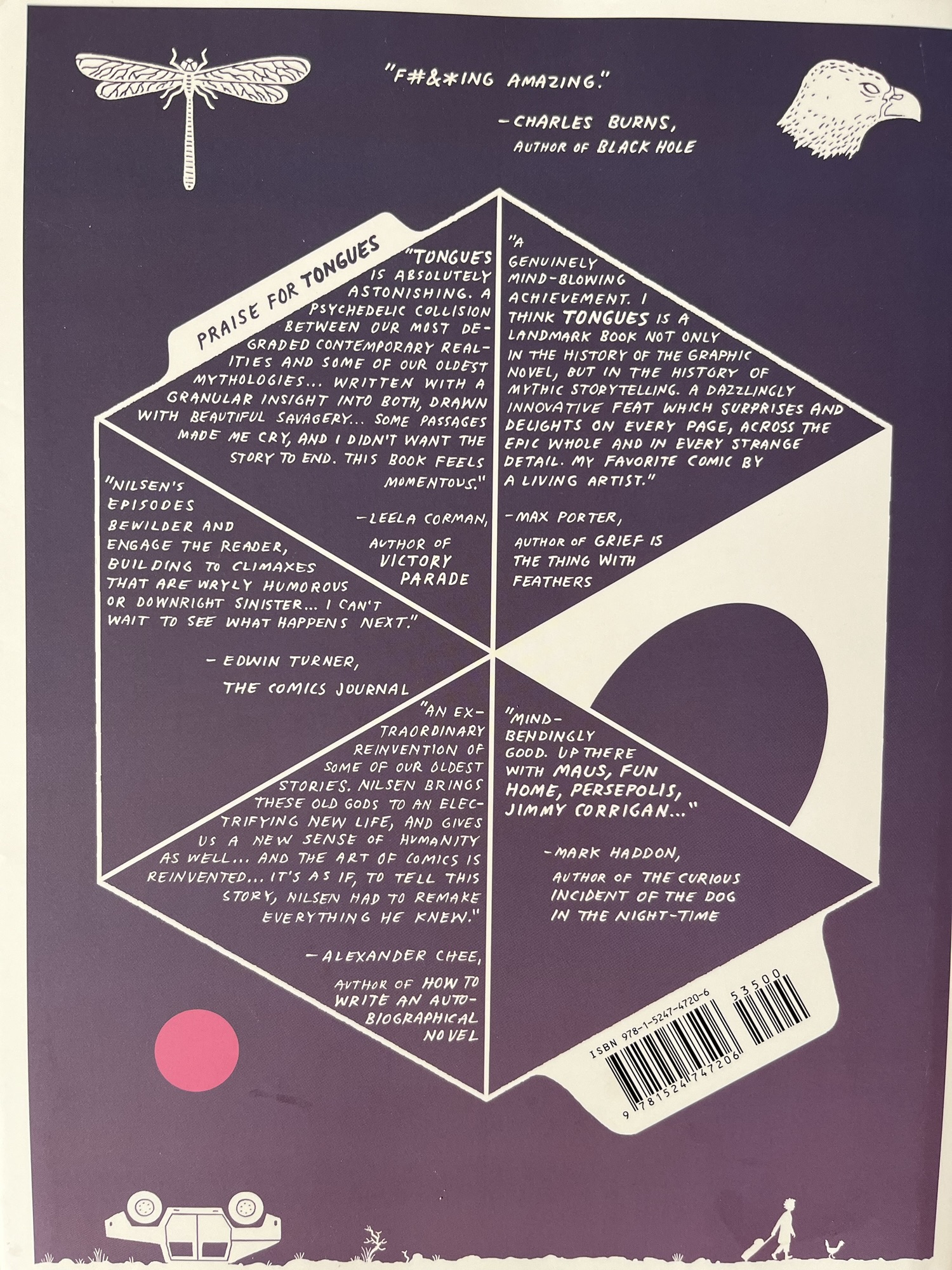
While I didn’t have the time in Atlanta to hit multiple bookstores (like in past trips), I made a point to hit up A Capella Books, a well stocked indie joint with a great used collection. I didn’t score anything there, although I was thrilled to see Anders Nilsen’s Tongues prominently featured in the graphic novel section. The book is great — I got a review copy right before we left. Some asshole named Edwin Turner landed a blurb on the back under his hero Charles Burns’s much shorter, pithier, better blurb:
Our spring break culminated Saturday night at the Variety Playhouse in Little Five Points, where we saw the so-called indie supergroup The Hard Quartet play all of their songs. I really dig The Hard Quartet’s self-titled debut, and dragged my wife and son along. (My daughter declined but played taxi driver.) Some interesting looking children were exiting the theater (really more of a club, let’s be honest) as we were entering, assuring the concerned security guard that they’d be right back, they just needed to get some Gatorade at a corner store. These were Sharp Pins, or The Sharp Pins, or Thee Sharp Pins, a Chicago power pop trio fronted by a kid named Kai Slater. They played a tight thirty minute set (including a Byrds cover); young Slater knows how to tuck away middle eight. The band’s youth invigorated the crowd of indie oldheads, and if Sharp Pins were occasionally a little out of tune or a step behind on the count, what came through was a true joy for the pop song. My son went bananas from them, saying something like, I know that they aren’t as good at playing their instruments as the Hard Quartet guys, but I liked their songs more. He bought their album and their t-shirt.

I liked The Hard Quartet’s live show very much — these are some old, or let’s just say older guys — look, pretty much everyone at the show was old, older, etc., except the Sharp Pins, my son, and some other teens there with their folks — these guys, the HQ, are veterans of disorder, coming up in club shows and theaters and big stages and big big stages and so on. They seemed very comfortable in the quasi-theater club. It was a joy to watch and listen to them.

They are, as I mentioned before, a so-called “supergroup.” Stephen Malkmus was the sideman for David Berman in The Silver Jews; Matt Sweeney, a popular YouTube influencer, was a member of another infamous supergroup — David Pajo’s short-lived side project Zwan; Emmett Kelly is a former gang member and circus performer; Jim White is the best drummer I’ve ever seen live (I have no stupid joke here; he is amazing and I listened to Ocean Songs every night for two years in a row when I was 22 and that’s not an exaggeration.)

The Hard Quartet are clearly a “real” band and not anyone’s side project. Sonics live were richer, fuller, more expansive than on disc. Emmett Kelly sang his new song, which, as far as I can tell, is the only update to their setlist in the past year — basically the record played straight through — but they seemed to never remember who was playing bass on which song when. No one used a pick, ever, as far as I could tell. Sweeney broke a string and then claimed he’d never broken a string on stage, ever. (Dubious.) Malkmus said he was thinking about “The Devil Went Down to Georgia,” but, what if it was, like, “The Devil Went Down on George.” Sweeney jokingly referred to Charlie Daniels as Chuck Daniels and at least two Atlanta audience members hissed foolish rejoinders. (Could’ve been those big beers, bald boys!) Jim White is both a gentle percussionist and a rawk gawd drummer. Malkmus’s, Kelly’s, and Sweeney’s singing in unison were some of the finest moments of the night, as in “Rio’s Song” and “Heel Highway.” The band’s weathered implementation of silence and space was also delicious and judicious in numbers like “Six Deaf Rats,” “Action for the Military Boys,” and “Hey.” Skronk and noodling were measured but never mannered. (Or the manners were there but they weren’t bad, unless they were meant to be bad.) Matt Sweeney’s left foot was the boss of the band, the bandleader, the clapper clopping down the count in a leopard print.

The Hard Quartet finished before eleven, having played all their songs. I think we all had a good time.

Jim White
Matt Sweeney
Stephen “SM” Malkmus
Emmett Kelly

Blog about some recent reading

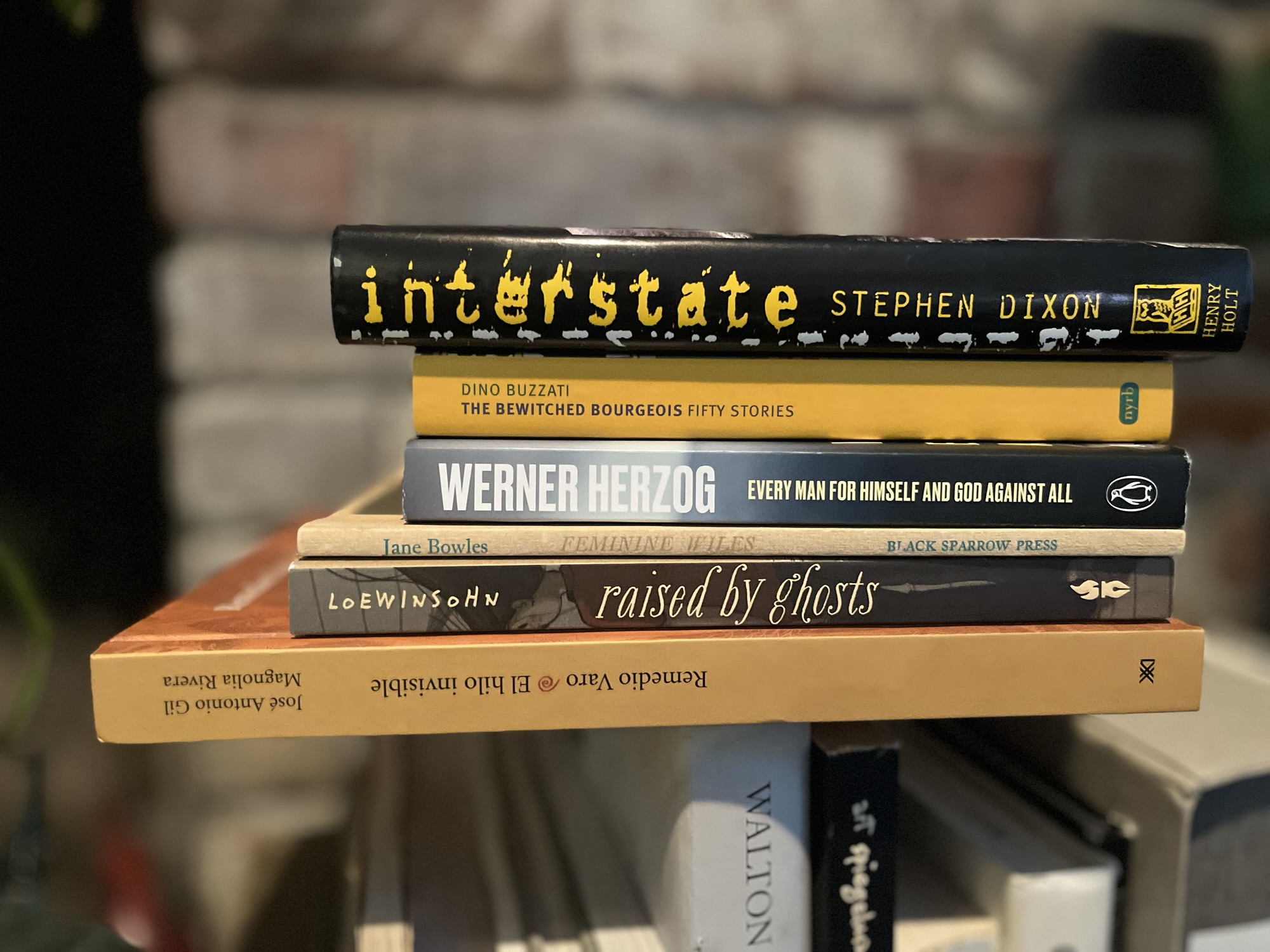
What an interesting few weeks it’s been! Here’s (some of) what I’ve been reading so far this year:

I’m in the middle of Stephen Dixon’s novel Interstate. It is a devastating, ugly, addictive, beautiful novel; I have no idea if it is “good” or not but I love it. I can’t really think of a single person I know (in real life) I could recommend it to. We played cards with some friends and one of them asked about what I was reading, and I said a novel called Interstate by this guy Stephen Dixon, and she asked of course What’s it about? and I said something, Well, this guy’s driving on the interstate with his daughters and two guys in a van pull up along side him and start shooting at them, killing his younger daughter–this happens in like, the first few paragraphs–and then we see how this event destroys his life–but then Dixon repeats the initial scenario like seven more times with different (but all really tragic so far) outcomes–and it’s written in this addictive vocal style that might be really off-putting to many readers, and it also makes really fascinating use of the coordinating conjunction for, which may just be a verbal tic –and it’s also really funny at times? I am not trying to sell this novel to anyone but I love it.

My reading experience of Briana Loewinsohn’s graphic novel Raised by Ghosts was kinda sorta the opposite of Dixon’s Interstate in that after I finished it I immediately pressed it on my wife and then my kids and then texted some of my oldest friends about it (oldest in the previous clause should be understood to modify the friendship, not the actual friend’s years–although we’re all getting older). We’re all getting older, all the time, and Raised by Ghosts provoked an aged nostalgia in me. I’m about half a year older than Loewinsohn and so much of her semi-autobiographical novel resonated with me. She gets everything right about what it was like to be a little bit of a weirdo at school in the nineties. There’s this wonderful passage on how important it was to get a handwritten note from a friend; there’s a page that’s nothing but a notebook page filled with band names; there’s a marvelous scene where our hero loses her shit watching You’re a Good Man, Charlie Brown. I should have a proper review this week or next, but great stuff. (The whole family loved it, by the way.)

I’ve been reading a collection of Dino Buzzati short stories translated by Lawrence Venuti; my technique is to read one of the shorter stories when I feel a bit of dread or anxiety from, like, reading something else. (The collection is called The Bewitched Bourgeois by the way.) I’ve enjoyed reading them, and have especially enjoyed allowing myself to read them at random instead of following the collection’s chronological trajectory. Very Kafka, very Borges, but also very original.

Not in the picture above, but I’ve also been working my way through a digital copy of Vladimir Sorokin’s short story collection Dispatches from the District Committee, in translation by Max Lawton (and illustrated by Gregory Klassen). Great gross stuff.

I picked up a collection of Jane Bowles’ sketches, letters, and other ephemera a few weeks ago–I love her stuff, but really it was that these were contained in the somewhat-rare Black Sparrow Press edition Feminine Wiles. I’m pretty sure all of the stuff here is collected in My Sister’s Hand in Mine, but I’ve enjoyed dipping into this one more. It’s slim, not bulky, but that bulky boy’s around her (My Sister’s) if I need him.

My uncle sent me a copy of Werner Herzog’s 2022 memoir Every Man for Himself and God Against All for Christmas (in translation by Michael Hofmann). I devoured the first few chapters and then a colleague hipped me to the fact that there’s an audiobook of Herzog reading his memoir (available on Spotify and other platforms) — so on my commute I’ve been listening to him read his own memoir, which is just amazing. Like fucking amazing. Hearing him say phrases like “the escapades of Christopher Robin, Winnie-the-Pooh, Piglet, and Eeyore” or that “chipmunks…have something consoling about them” is surreal. There are like fifty insane things that happen in every chapter, and if Dwight Garner of the failing New York Times attested that he didn’t “believe a word” of the memoir, I take the opposite tack. Everything is true, everything is permitted.

Finally, I can’t really say I’ve been “reading” Remedios Varo: El hilo invisible by Jose Antonio Gil and Magnolia Rivera. My grasp of Spanish cannot graspingly grasp too much of the Spanish (although my iPhone’s picture-text-translate thing works fine when I’m really curious), but the book is a lovely visual catalog of not just one of my favorite artist’s works (including many pieces I haven’t seen before), but also documents her visual influences. I picked it up at the Museo de Arte Moderno in Mexico City back in January, still floating on the high of seeing many of Varo’s lovely paintings there that afternoon.

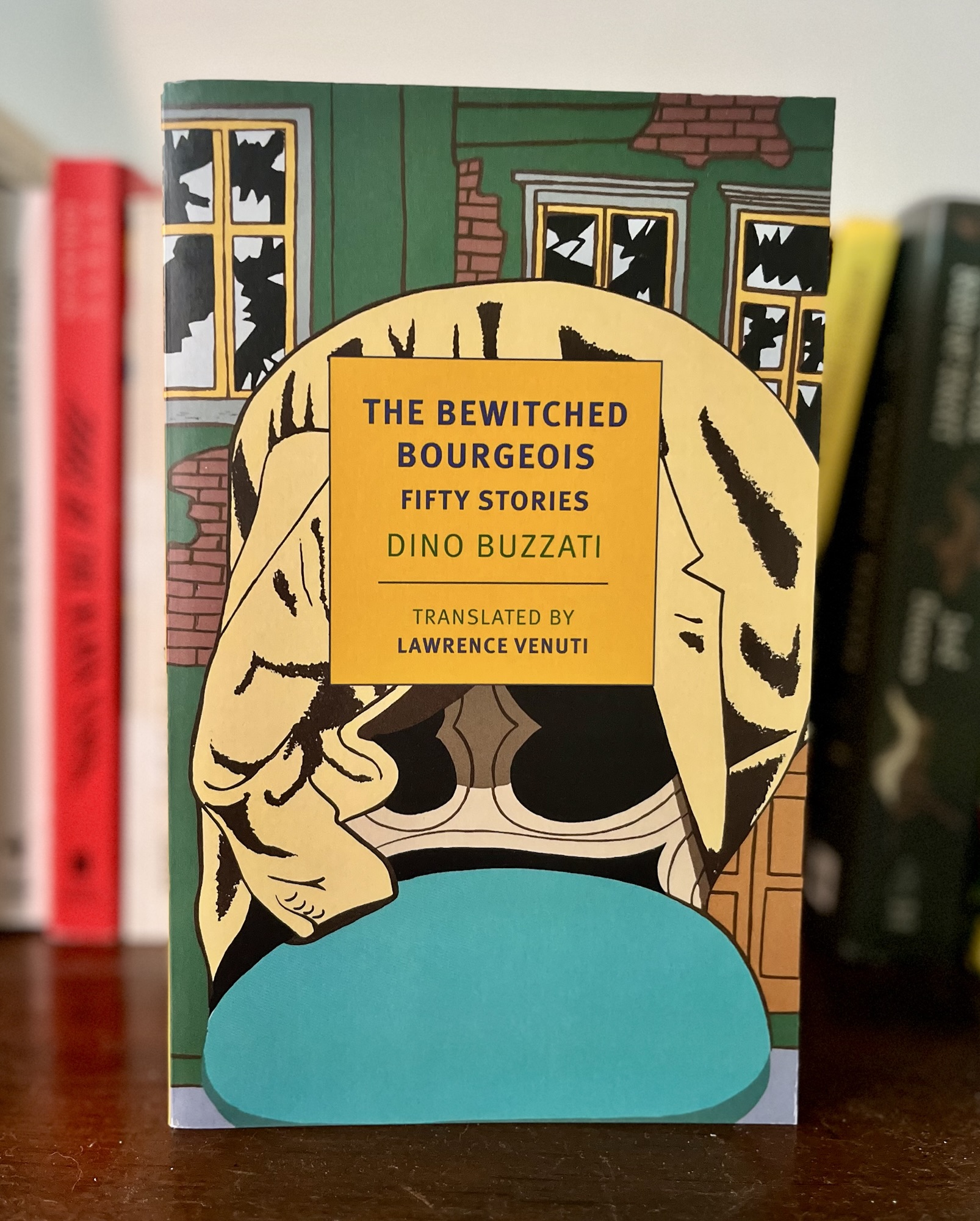
Dino Buzzati’s The Bewitched Bourgeois: Fifty Stories (Book acquired, late Dec. 2024)

I got a review copy of Lawrence Venuti’s selection of Dino Buzzati short stories he’s translated as The Bewitched Bourgeois a few days before we left for a family vacation at the end of last year in Mexico City. I’d meant to take it with me, thinking that the (often very short) short stories would make ideal plane, airport, and I’m-exhausted-but-want-a-quick-brain-snack reading. But I ended up throwing José Donoso’s novel The Obscene Bird of Night into my ancient North Face Recon instead in a weird effort to get its last hundred and fifty pages “finished” before the so-called “next year.” I achieved that goal and am now rereading big chunks of The Obscene Bird of Night. I should have brought the Buzzati. I think it would have been ideal for my needs at the time, based on the handful of tales I’ve read so far.

Here’s NYRB’s blurb:

Dino Buzzati was a prolific writer of stories, publishing several hundred over the course of forty years. Many of them are fantastic—reminiscent of Kafka and Poe in their mixture of horror and absurdity, and at the same time anticipating the alternate realities of The Twilight Zone or Black Mirror in their chilling commentary on the barbarities, catastrophes, and fanaticisms of the twentieth century.

In The Bewitched Bourgeois, Lawrence Venuti has put together an anthology that showcases Buzzati’s short fiction from his earliest stories to the ones he wrote in the last months of his life. Some appear in English for the first time, while others are reappearing in Venuti’s crisp new versions, such as the much-anthologized “Seven Floors,” an absurdist tale of a patient fatally caught in hospital bureaucracy; “Panic at La Scala,” in which the Milanese bourgeoisie, fearing a left-wing revolution, find themselves imprisoned in the opera house; and “Appointment with Einstein,” where the physicist, stopping at a filling station in Princeton, New Jersey, encounters a gas station attendant who turns out to be the Angel of Death.

Man is doomed to constantly fabricate new agonies for himself | On Dino Buzzati’s novella The Singularity

Two years after it was first published in Italy, Dino Buzzati’s 1960 novella Il grande ritratto got its first English translation by Henry Reed under the title Larger Than Life. This year, NRYB issued a new translation of Il grande ritratto by Anne Milano Appel under the title The Singularity. This is the second new English translation of a Buzzati book from NYRB; last year saw the publication of Lawrence Venuti’s translation of Buzzati’s most famous novel, Il deserto dei Tartari, published as The Stronghold (in lieu of the more recognizable title The Tartar Steppe).

It makes sense, from both a cultural and a marketing stance, that Il grande ritratto would find new life as The Singularity, a term that refers to the hypothetical point where artificial intelligence surpasses human intelligence, which in turn triggers a dramatic existential change for humanity. AI slop abounds on the internet; misinformation replicates and mutates; we are told that the chatbots that frustrate us so frequently are an inevitable part of a future that no one seems to want. A sci-fi novel called The Singularity is pretty zeitgeisty.

The scant plot of The Singularity builds to the revelation of an artificial intelligence, part of a military science project perched high in the Italian Alps. I don’t think I’ve necessarily spoiled the grand reveal; both its title and its publisher’s blurb declare The Singularity “a startlingly prescient parable of artificial intelligence.”

Perhaps it’s this prescience that makes the central sci-fi conceit of The Singularity seem a bit dated. There’s a creakiness to Buzzati’s staging of his grand portrait of an artificial intelligence. The novella is more compelling in its initial chapters, which ignite a mood of slow-burning dread, the kind of Kafkaesque foreboding he served up in his superior novel Il deserto dei Tartari.

That slow-burn starts with a certain Professor Ismani, “who had always had an inferiority complex with respect to figures.” He and his much younger wife, the archetypal innocent Elisa (who “had not gone beyond middle school”) agree to undertake a mysterious journey up the mountain to “Experimental Camp of Military Zone 36,” where Ismani will join a scientific project he knows nothing about. As they zig and zag up the mountain, chauffeured by their military liaison, Ismani and Elisa (and the reader) gather crumbs about their destination. “So many mysteries,” a soldier tells them, at a penultimate stop. “If they at least told us what it is we’re guarding. I mean, let’s call it what it is, a kind of prison.”

In response to all this anxious foreboding, we are told that “Ismani felt the return of apprehension and dismay, the feeling of being insignificant in the face of immense, threatening things, a panic that he had once experienced in the war.” None of Ismani’s time in the war comes to bear on the narrative itself. Indeed, Ismani is thrown to the reader as a decoy; initially presented to the audience as the potential big-brain hero of a sci-fi thriller, he ends up a background ghost.

We eventually achieve the summit, where the natural splendor is overrun by the enormous complex that houses the titular singularity:

But the cliffs were no longer visible, nor could any vegetation be seen, or land, or flowing waters. Everything had been invaded and overwhelmed by a tangled succession of buildings similar to silos, towers, mastabas, retaining walls, slender bridges, barbicans, fortifications, blockhouses, and bastions, which plunged in dizzying geometries. As though a city had crashed down the sides of a ravine.

But there was an exceedingly abnormal element that gave those structures an air of enigma. There were no windows. Everything seemed hermetically sealed and blank.

From this moment, more or less, the best bits of The Singularity come not from sci-fi plotting but rather philosophical asides that add weight to the pulp narrative. Most of these are delivered by the handful of scientists who haunt the experimental camp. One of these scientists repeats the mantra, “Language is the worst enemy of mental clarity.” In their attempt to author an artificial consciousness, these scientists decreed that their singularity would have “No language,” for “Every language is a trap for the mind.”

Here in their “little kingdom, hermetically closed off and apart from the rest of the world,” the scientists have created a “machine made in our likeness” which “will read our thoughts, create masterpieces, reveal the most hidden mysteries.” Through hints, intimations, weird noises, and other creaky trappings of pulp horror, we come to learn that the singularity might not be, like, sane. As one of our (maybe not like exactly sane either) scientists declares, “before we knew it we had lost the reins, and all that was left for us to do was to record the machine’s behavior.”

In a move that would surprise no one familiar with the tropes of Gothic romance, we come to learn that the singularity’s consciousness is based on a beautiful dead woman. The whole operation is powered by a mysterious glowing egg. Indeed, The Singularity is perhaps most interesting if approached through a feminist lens. As it rushes to its climax, Elisa the innocent takes over the role of hero. She somehow learns to speak the strange “language” of the pre-lingual singularity, and through conversation, comes to understand that the singularity views herself as a desiring machine. The singularity wants a body; specifically a female body; specifically a body that can be desired by a male body and bear offspring.

Ultimately, The Singularity feels less like a novella than it does a short story stretched a bit too thin. Buzzati adroitly crafts an atmosphere of suspense and foreboding, but the characters are underdeveloped. Like a lot of pulp fiction, Buzzati’s book often reads as if it were written very quickly (and written expressly for money). Still, Buzzati’s intellect gives the book a philosophical heft, even if it sometimes comes through awkwardly in forced dialogue. Anne Milano Appel’s translation is smooth and nimble; it’s a page turner, for sure, and if it seems like I’ve been a bit rough on it in this paragraph in particular, I should be clear: I enjoyed The Singularity.

Like many of the modernist writers of the twentieth century, Buzzati intuited a future in which technology would become increasingly self-propelled, mutating unchecked in the notion of a progress wholly divorced from the needs of the human spirit. In our own era, we see con artists and hucksters banging the drum for “artificial intelligences” to “read our thoughts, create masterpieces, reveal the most hidden mysteries” for us. The results have been utter shit. Buzzati’s mad scientist isn’t so much prescient as he is simply describing the human condition then, when he declares that “man is doomed to torment himself, he doesn’t see the consolations offered to him, right there, within reach, he has to constantly fabricate new agonies for himself.” We can fabricate the agonies, but we can fight them too.

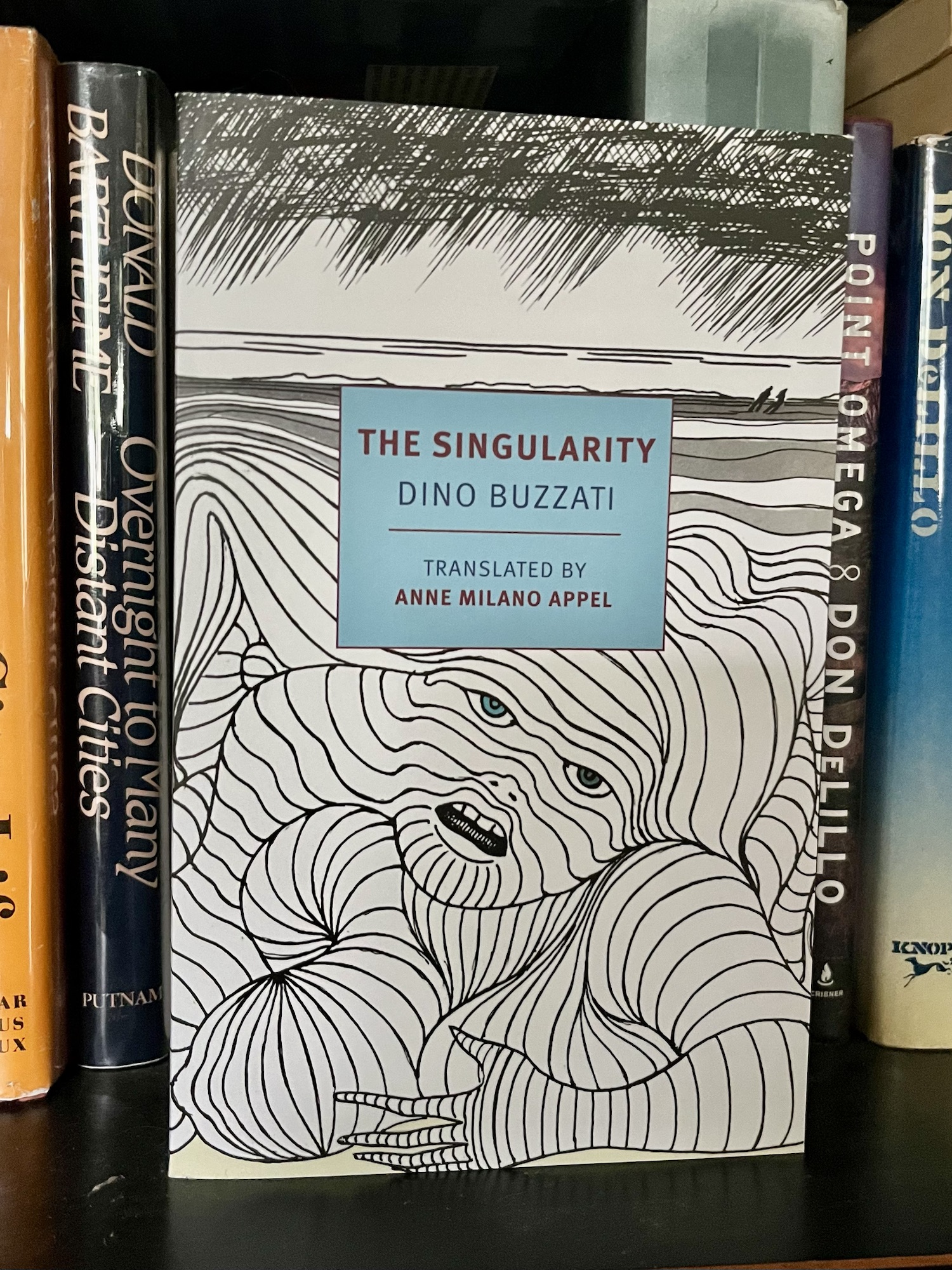
Dino Buzzati’s The Singularity (Book acquired, 23 May 2024)

NYRB has another new translation of an old Dino Buzzati novel on deck—it’s a 1960 sci-fi called The Singularity in translation by Anne Milano Appel. NYRB’s blurb:

At the beginning of Dino Buzzati’s The Singularity, Ermanno Ismani, an unassuming university professor, is summoned by the minister of defense to accept a two-year, top-secret mission at a mysterious research center, isolated from the world among forests, plunging cliffs, and high mountains. What’s he supposed to do there? Not clear. How long will he be there? No saying.

Still, Ismani takes the mystifying job and, accompanied by his no-nonsense wife, Elisa, heads to the so-called Experimental Camp of Military Zone 36, wondering whether, in the midst of the Cold War, it’s some sort of nuclear project he’s been assigned to. But no, the colleagues the couple meets on arrival assure them, it’s nothing like that. It’s much, much more powerful.

At the center of the research complex is strange, shining, at times murmurous, white wall. Behind it, a deep gorge drops away, full of wires and radio towers and mobile sensors and a host of eccentric structures. A question begins to dawn: Could this be the shape of consciousness itself? And if so, whose?

Buzzati’s novella of 1960, a pioneering work of Italian science fiction, is published here in a brisk new translation by Anne Milano Appel. In it, Buzzati explores his favorite themes of love and longing while offering a startlingly prescient parable of artificial intelligence.

A review of The Stronghold, Dino Buzzati’s novel of deferred hope and ecstatic boredom

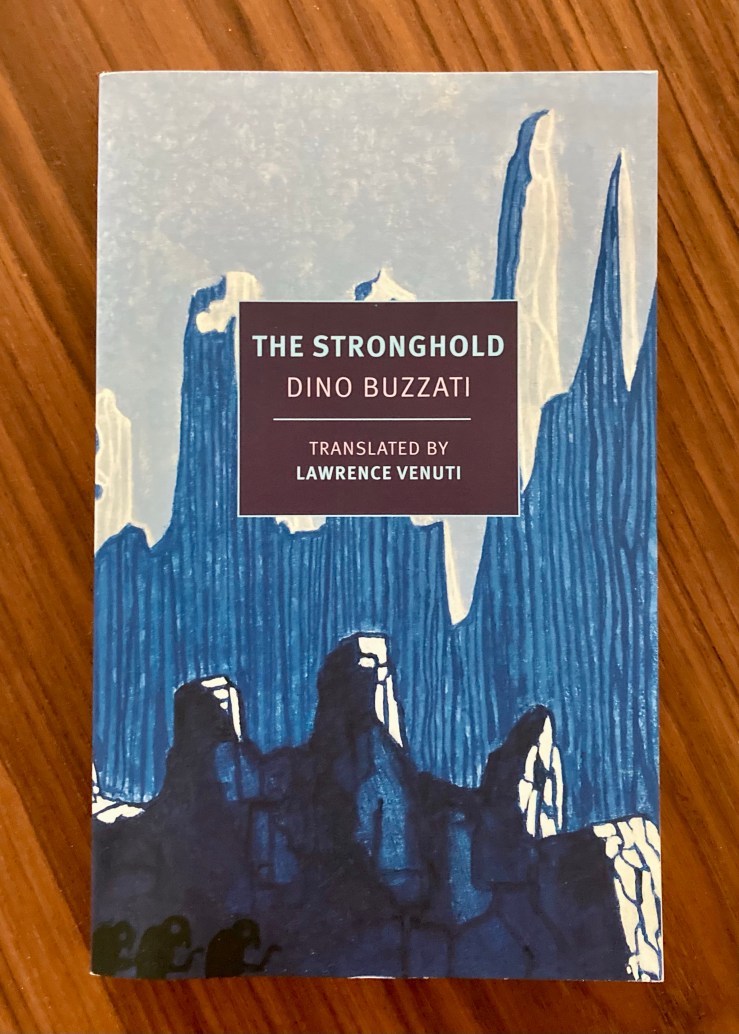
Dino Buzzati’s 1940 novel Il deserto dei Tartari (retitled The Stronghold in Lawrence Venuti’s new English translation) takes place in an unidentified time in an unidentified country. Our protagonist is Giovanni Drogo, freshly graduated from an unspecified military academy and ready for a thrilling life of combat and adventure at his new post, Fortezza Bastiani, a fortress at the border of the Tartar steppe. He and his fellow soldiers wait in the hope of attaining glory.

And they continue to wait.

The nebulous Tartars repeatedly fail to appear, offering only the vaguest hints of their alien existence. The soldiers of Fortezza Bastiani live a life of anxious monotony, their desires and hopes for the heroics of war flattened by the boredom of day to day life. It’s all very existentialist.

From the opening pages of The Stronghold, Buzzati conjures a strange but familiar world, usually telegraphed in brisk, unadorned prose (a style he honed in his career as a journalist). Everything is slightly off, slightly anxious. Initially, a reader might chalk the disquieting style up to our viewpoint-character Drogo’s own hesitancy as he enters into a new life as a military officer, but we soon find ourselves in an uncanny realm.

The world of the fortezza is somehow simultaneously dull and enthralling. Consider Drogo’s first glimpse of the fortress:

Fortezza Bastiani was neither imposing, with its low walls, or beautiful in any  way. Its towers and ramparts weren’t picturesque. Absolutely nothing alleviated its starkness or recalled the sweet things of life. Yet Drogo gazed at it, hypnotized, as on the previous night at the base of the gorge. And an inexplicable ardor penetrated his heart.

This “inexplicable ardor” is nevertheless ambiguous in its penetration; after learning he is nominally free to choose a different, perhaps more invigorating post, Drogo elects to transfer from the fort. However, his commanding officer suggests that he stay for four months to avoid bureaucratic problems with the higher ups. That four-month season of waiting turns into a lifetime of waiting. And then waiting some more.

Drogo and his fellow soldiers hunger for the glory of contesting the Tartars, an enemy they know utterly nothing about. Like almost every sociopolitical, cultural, and even technological detail in The Stronghold, the specific nature of the Tartar enemy is collapsed into something closer to a fairy tale or a rumor. Vague and dreamlike, the Tartars are not a geopolitical entity; they are not even an other, but rather the figment of an other, the kernel of a dream that promises action. And this dim promise keeps the soldiers waiting at the Fortezza:

From the northern desert would arrive their fortune, the occasion of their exploits, the miraculous hour that befalls everyone at least once. Because of this vague eventuality, which grew increasingly uncertain with time, grown men wasted the best part of their lives there.

The narrator, hovering in Drogo’s consciousness, imagines an interlocutor explaining to one of these soldiers that his “entire life will be the same, utterly the same, till the very last moment” — and then imagines the hypothetical soldier’s response: “Something else must come to pass, something truly worthy.” Drogo here believes he has grasped the “transparent secret” of the soldiers of the Fortezza, but also imagines himself an “uncontaminated onlooker.” But it’s too late. Drogo too has committed to waiting for something else to come to pass.

Nothing comes to pass—or nearly nothing. (One might read The Stronghold as an extended riff on Kafka’s wonderful parable “Before the Law.“) However, this is not to say though that Buzzati’s portraiture of tedium is itself tedious. The boredom he conjures is an ecstatic boredom, anxious and writhing, exploding in strange, magical moments of hallucinations and night terrors.

In one of the novel’s most extraordinary sequences, “fragile apparitions, quite like fairies” enter Drogo’s dreams, bearing away to some spectacular land Drogo’s fallen comrade who is now converted to a child dressed in a rich velvet suit. In another episode, a mysterious horse appears from the desert, sending the men into fits of hope and despair culminating in a horrific incident that underscores the absurdities of military rigor. Late in the novel, a much-older Drogo’s desire for action, for something to come to pass, tips into near-comic paranoia, as he and a younger officer fool around with a telescope to no avail.

After all this waiting in hope, The Stronghold concludes with a devastating Kafkaesque punchline which I shall not spoil here.

It will be clear to most seasoned readers that Kafka was an influence on Buzzati even without Venuti’s afterword, which details Buzzati’s admiration for the Bohemian writer. Buzzati does not ape the older master so much as evoke the same state of anxious alterity we find in texts like “The Great Wall of China” and The Castle. Stepping into The Stronghold, one is reminded of other branches of the Kafka tree, like Kazuo Ishiguro’s The Unconsoled, Kobo Abe’s The Woman in the Dunes, Alasdair Gray’s Lanark, and Albert Camus’ The Stranger, among many others.

Like many Kafkaesque works, one might be inclined to fob his own allegorical readings onto The Stronghold. In his afterword, Venuti points out that early English-language readings of Buzzati’s novel tended to interpret Il deserto dei Tartari as an anti-totalitarian tract. Il deserto dei Tartari was first translated as The Tartar Steppe by Stuart Hood in 1952, and many of its contemporary critics read the novel against the backdrop of the Cold War.

While praising the “remarkable accomplishment” of Hood’s translation, Venuti differentiates his own “historically oriented interpretation” of the novel; namely, his attempt to more emphatically underline Il deserto dei Tartari’s “latent critique” of fascism. Venuti points out that “Hood had twice rendered the generic ‘stivali’ (boots) with the politically marked term ‘jackboots,'” adding, “I tripled its use.”

Venuti also discusses at some lengths his choice to change Hood’s title. He writes that Buzzati initially wanted to title the book La fortezza, but this name was rejected by the novel’s publisher who worried it might be misunderstood by the reading public. In his attempt to further historicize his translation (and differentiate it from Hood’s), Venuti elected to remove Steppe from the title fearing it “might be taken as an anachronistic reference to the Soviet Union.” He also avoided The Fort or The Fortress as a possible titles, worried they might underscore Buzzati’s “debt to Kafka’s The Castle.” Venuti eventually settled on The Stronghold, suggesting that this title helps to emphasize the “cult of virility championed during the Fascist period” while also “conveying the sheer tenaciousness of the soldier’s heroic fantasies, as well as their inability to escape their debilitating obsession.”

I haven’t read Hood’s translation of Il deserto dei Tartari, but I appreciated Venuti’s, which, as I pointed out above, takes place in an unidentified time in an unidentified country. The novel’s eerie, fable-like quality—a quality that resists historicity—is what most engages me. Buzzati’s book captures the paradox of a modern life that valorizes the pursuit of glory (or at least happiness) while simultaneously creating a working conditions that crush the human spirit. We can find this paradox in Herman Melville’s Bartleby or Mike Judge’s Office Space; we can find it in Antonio di Benedetto’s Zama or Mike Judge’s Enlightened; we can find if in David Foster Wallace’s The Pale King or Dan Erickson’s recent show Severance. I could go on of course.

Some of these boredom narratives seek to assuage us, or make us laugh or cry—in recognition, spite, pity, despair, or hope. Some of these boredom narratives find resistance in art, or in just plain resistance. Buzzati’s novel offers something more like a warning. It is not possible to be an “uncontaminated onlooker” in one’s own life. It’s not enough to wait forever, even if we wait in hope.

The Stronghold is available now from New York Review Books.

Two from Dino Buzzati (Books acquired, last week of March 2023)

NYRB is issuing a new translation of Italian author Dino Buzzati’s 1940 novel Il deserto dei Tartari next month. In his afterword to this new edition, translator Lawrence Venuti points out that Buzzati’s original intended title, La fortezza, was rejected by the novel’s publisher Rizzoli, who expressed concerns that, with the outbreak of WW2, the title might be misunderstood by the reading public. The novel received an English translation by Stuart Hood twelve years later as The Tartar Steppe. Venuti restores Buzzati’s intended title in his new translation.

I started in on The Stronghold last night, just casually dipping into a few pages, as I try to do with all of these silly “book acquired” posts, and wound up reading the first fifty pages in one go, then picking it up again this morning. It quickly reminded me of Kafka’s The Castle and Ishiguro’s The Unconsoled—the kind of novel of endless deferrals, its alterity heightened by the concrete precision of the prose. Great stuff so far.

NYRB is also releasing an edition of Joseph Green’s translation of Buzzati’s later novel, A Love Affair. Their blurb:

Antonio Dorigi is a successful architect in Milan, nearing fifty, who has always been afraid of women. He has been a regular at an upscale brothel for years, even as he mourns the lack of close female companionship in his life.

One afternoon, the madam at the brothel introduces Tonio to “a new girl,” Laide (short for Adelaide). Tonio sees nothing especially remarkable about Laide, though it intrigues him that she dances at La Scala and also at a strip club, and yet in a very short time he becomes completely obssessed with her.

Laide draws Antonio on, confounds him, uses and humiliates him, treats him tenderly from time to time, lies to him, makes no apologies to him, and he loves her ever more. This helpless and hopeless love is what he is, he feels, even as it prevents him—we see—from ever seeing Laide for who she is. Because Who is she? is the question at the heart of Buzzati’s clear-eyed and often comic tale of infatuation.

Laide is a young woman who has never known the bourgeois prosperity Tonio takes for granted, someone in a pickle looking for a main chance. She is a storyteller and someone, too, who knows how stories tell on people and shape their desires and lives.

Is A Love Affair a love story or is it a story of anything but love? Buzzati’s novel, with its psychological subtleties, its vivid cityscapes, and its compassion, keeps the reader guessing till the end.