For conveying ideas, novels are among the least functional and most decorative of the blunt instruments. (Could this be a universal truth, some starry, operative mathematical principle? Most stars are decorative too, of course, their function merely to peg the universe in place like studs in upholstery, servicing the elegancies, strumming its physics like a man with a blue guitar, fleshing all the centripetals and centrifugals, stringing the planets like beads, some beautiful pump of placement, arranging night, moving the planetary furniture, and fixing the astronomical data, but less useful, finally, in the sense that a handful more here or a dollop less there could make as much of a never mind as corks or rhythm, less useful, finally, than mail or ice cream.) And if, a few times in a way, novels like Richard Henry Dana’s Two Years Before the Mast or Beecher Stowe’s Uncle Tom’s Cabin or Steinbeck’s Grapes of Wrath come along to legislate, or raise a consciousness or two, or rouse a rabble, to make, I mean, what history or the papers call a difference, why that’s decorative, too, I think, a lip service the system, touching the bases like a superstitious braille, pays art—like, oh, the claims made a few years back for the “We Are the World” folks when it was really the Catholic Relief Services already on site during the Ethiopian famine that did the heavy lifting.
Well it’s not the novelist’s fault. Not that they don’t deserve some of the blame, leaking encouragement like someone paying out line to fish, some of your have-cake-and-eat-its like a little miracle of the loaves. And there are still a few big mouths who stake claims for the ameliorative shamanism of—hark! this is interesting: not the book so much as the writer—the practice of fiction—the loyal, Nutso Art Jerk Groupie, like some devoted cultist, the last Deadhead, say, worrying like holy beads the shoelace on his wrist he thinks is a bracelet making confrontation with an Elvis Presley impersonator.
Isn’t it pretty to think so, though? To take oneself as seriously as one’s readers sometimes do? To believe, if only briefly, and if only by the light off the gloss of the brittlest mood swing, in the justice or even the palpability of one’s cause, to Don Quixote principle, any principle, and raise to the level of purpose what in the final analysis is only what given egos, fashionably or not, fashion or no, frozen in mere season’s hipped au courantness, perceive as beauty. Continue reading ““The Rest of the Novel” — Stanley Elkin”→
Untitled (Motel Room with Fluorescents), from The Los Alamos-Portfolio,1965-68 by William Eggleston (b. 1939)
“Motel #1”
by
Charles Portis
From his essay “Motel Life, Lower Reaches,” first published in Oxford American in 2003 and later collected in Escape Velocity.
Back when Roger Miller was King of the Road, in the 1960s, he sang of rooms to let (“no phone, no pool, no pets”) for four bits, or fifty cents. I can’t beat that price, but I did once in those days come across a cabin that went for three dollars. It was in the long, slender highway town of Truth or Consequences, New Mexico.
That cute and unwieldy name, by the way, was taken in 1950 from the name of a quiz/comedy radio show, and has stuck, against long odds. The show was okay, as I recall, a cut or two above the general run of broadcast ephemera, with some funny 1949 moments. But why re-name your town for it? And by now, a half-century later, you would think the townsfolk must surely have repented their whim and gone back to the old name, solid and descriptive, of Hot Springs. But no, and worse, the current New Mexico highway maps no longer offer both names, with the old one in parentheses, as an option, for the comfort of those travelers who wince and hesitate over saying, “Truth or Consequences.” Everyone must now say the whole awkward business.
I was driving across the state at the time, very fast. There were signs along the approaches to town advertising cheaper and cheaper motel rooms. The tone was shrill, desperate, that of an off-season price war. It was a buyer’s market. I began to note the rates and the little extras I could expect for my money. Always in a hurry then, once committed to a road, I stopped only for fuel, snake exhibits, and automobile museums, but I had to pause here, track down the cheapest of these cheap motels, and see it. I would confront the owner and call his bluff.
There were boasts of being AIR COOLED (not quite the same as being air-conditioned) and of PHONE IN EVERY ROOM, KITCHENETTES, LOW WEEKLY RATES, CHILDREN FREE, PETS OK, VIBRO BEDS, PLENTY OF HOT WATER, MINIATURE GOLF, KIDDIE POOL, FREE COFFEE, FREE TV, FREE SOUVNIERS. (Along Arkansas roads there are five or six ways of spelling souvenirs, and every single one of them is wrong. The sign painters in New Mexico do a little better with that tricky word, but not much better.) The signs said SALESMEN WELCOME and SNOWBIRDS WELCOME and TRUCKS WELCOME/BOBTAILS ONLY—meaning just the tractors themselves; their long semi-trailers would not be welcome. And there were the usual claims, often exaggerated, of having CLEAN ROOMS or NEW ROOMS or CLEAN NEW ROOMS or ALL NEW CLEAN MODERN ROOMS.
I decided not to consider the frills. How could you reckon in cash the delight value of a miniature golf course with its little plaster windmills, tiny waterfalls, and bearded elves perched impudently on plaster toadstools? I would go for price alone, the very lowest advertised price, which turned out to be three dollars. It was a come-on, I knew, a low-ball offer. Sorry, I would be told, but the last of those special rooms had just been taken; the only ones left would be the much nicer $6.50 suites. I would let the owner know what I thought of his sharp practice, but not really expecting him to writhe in shame.
The three-dollar place was an old “tourist court,” a horseshoe arrangement of ramshackle cabins, all joined together by narrow carports. The ports were designed to harbor, snugly, small Ford sedans of 1930s Clyde Barrow vintage, each one with a canvas water bag (“SATURATE BEFORE USING”) hanging from the front bumper, for the crossing of the Great American Desert.
But there were no cars here at all, and no one in the office. I gave the desk bell my customary one ding, not a loutish three or four. An old lady, clearly the owner, perhaps a widow, came up through parted curtains from her cluttered female nest in the rear. She was happy to see me. l asked about a three-dollar room, for one person, one night. She said yes, certainly, all her cabins went for three dollars, and there were vacancies. This, without bothering to crane her neck about and peer over my shoulder, by way of giving my car out there the once-over. Desk clerks do that when I ask for a single, to see if I am trying to conceal a family. These clerks are trained in their motel academies to watch for furtive movement in the back seats of cars, for the hairy domes of human heads, those of wives, tykes, and grannies left crouching low in idling Plymouths.
This old lady had come up in a gentler school. She was honest and her signs were honest and her lodgers were presumed to be more or less honest. She had caught me up short and rattled me. Who was bluffing now? I couldn’t just leave, nor, worse, give her three dollars and then leave, compounding the insult to her and her yellowish cabins. I paid up and stayed the night, her only guest.
My cabin had a swamp cooler, an evaporative cooling machine that is usually quite effective in that arid country. A true air conditioner (brutal compressor) uses much more electricity than a swamp cooler (small water pump, small fan). But then the cooler does consume water, and the economy of nature is such—no free lunch—that the thing works well only in a region where the humidity is low—under forty percent, say. Where water is scarce, that is, and thus expensive.
It was dry enough here, but my cooler was defective and did nothing more than stir the hot air a bit.
I looked the room over for redeeming touches. It wasn’t so bad, beaten down with use and everything gone brown with age, but honorably so, not disgusting, shabby but clean, a dry decay.
The bedding may have been original stock. That central crater in the mattress hadn’t been wallowed out overnight, but rather by a long series of jumbo salesmen, snorting and thrashing about in troubled sleep. A feeble guest would have trouble getting out of the mattress. He would cry out, feebly, for a helping hand, and nobody in earshot. The small lamp on the bedside table was good, much better for reading than the lighting systems in expensive motels, with their diffused gloom. Motel decorators, who obviously don’t read in bed, are all too fond of giant lampshades, a prevailing murk, and lamp switches that are hard to find and reach. The bath towels were clean but threadbare, and much too short to use as wraparound sarongs while shaving. The few visible insects were dead or torpid. There were no bathroom accretions of soft green or black matter. The lavatory mirror was freckled and had taken on a soft sepia tint. Mineral deposits clogged the shower head, making for a lopsided spraying pattern, but the H and C knobs had not been playfully reversed, nor did they turn the wrong way. There were sash windows you could actually raise, after giving them a few sharp blows with the heels of your hands, to break loose the ancient paint. Here again the feeble guest, seeking a breath of air, would struggle and whimper.
I had paid more and seen worse—murkier and more oppressive rooms, certainly, with that dense black motel murk hanging about in all the corners, impossible to dispel and conducive to so many suicides along our highways, I had seen worse rooms, if not thinner and shorter towels. There was plenty of hot water. I had the privacy of a cabin, and indeed not a single neighbor. What I had was a cottage, and a steal at three dollars.
Early the next morning the lady came tapping at my door. She had a pot of coffee for me on a tray with some buttered toast and a little china jug of honey. It was that unprecedented gesture, I think, and the grace note of the honey—no sealed packet of “Mixed Fruit” generic jelly—that made the place stick in my head so, and not the price at all. I like to think the old cabins lasted out the good old lady’s widowhood. It must have been a close-run finish. And it comes to me now, late, a faint voice, saying the price was really two dollars.
I hope never to idealize poetry—it has suffered enough from that. Poetry is not a healing lotion, an emotional massage, a kind of linguistic aromatherapy. Neither is it a blueprint, nor an instruction manual, nor a billboard. There is no universal Poetry anyway, only poetries and poetics, and the streaming, intertwining histories to which they belong. There is room, indeed necessity, for both Neruda and César Vallejo, for Pier Paolo Pasolini and Alfonsina Storni, for Audre Lorde and Aimé Césaire, for both Ezra Pound and Nelly Sachs. Poetries are no more pure and simple than human histories are pure and simple. Poetry, like silk or coffee or oil or human flesh, has had its trade routes. And there are colonized poetics and resilient poetics, transmissions across frontiers not easily traced.
From Adrienne Rich’s Plenary Lecture at the Conference on Poetry and Politics, University of Stirling, Scotland, 13 July 2006. Collected in Essential Essays.
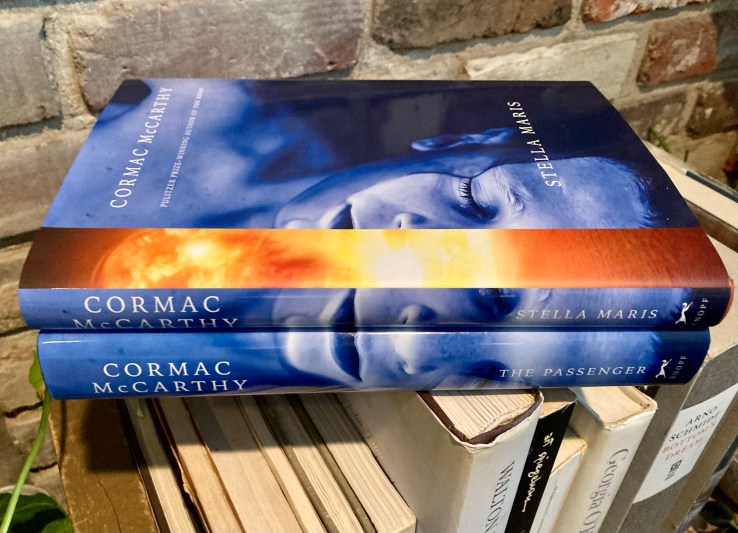
At Harper’s, novelist Joy Williams has a nice long essay on Cormac McCarthy’s novels The Passenger and Stella Maris. Williams begins with a concern that I think is fundamental to reading these novels: How do they talk to each other?
Cormac McCarthy’s latest offering—in that word’s fundamentally spiritual sense—is The Passenger and its coda or addendum, Stella Maris. One is prompted to read The Passenger first (it came out in October) and Stella Maris second (it came out in December). If, however, you dare to test the trickster and begin with Stella Maris—a 189-page conversation between a psychiatrist and his patient—it will seriously trouble your perception of The Passenger. If you read the books in order, you might find Stella Maris (Latin for Star of the Sea, a psychiatric hospital in Black River Falls, Wisconsin) coldly underwhelming despite, or perhaps because of, the erudition of the twenty-one-year-old, debatably schizophrenic, suicidal math genius Alice Western.
Williams focuses heavily on Stella Maris at the outset of her essay, offering a stable timeline for the two novels. If you’ve read The Passenger and Stella Maris, you know that McCarthy withholds a linear, chronological plot. Williams’ plot-making though foregrounds something that’s easy to miss in a first-reading of The Passenger: Bobby is in a coma, officially brain dead after a racing accident. Williams writes that,
The invention of brain death serves the timeline of The Passenger well, and traversing this twisting line, tracing and retracing it, contesting it, surrendering to it, is one of the great and pleasurable challenges of these books. Is there a narrative line? The Kid thinks it’s important to locate one even if, as he says, it doesn’t hold up in court. As for McCarthy, plot has always been irrelevant to his purposes.
What are those purposes?
McCarthy is not interested in the psychology of character. He probably never has been. He’s interested in the horror of every living creature’s situation.
–and–
Cormac McCarthy is interested in . . . the unconscious and in the distaste for language the unconscious harbors and the mystery of the evolution of language, which chose only one species to evolve in. He’s interested in the preposterous acceptance that one thing—a sound that becomes a word—can refer to another thing, mean another thing, replacing the world bit by bit with what can be said about it.
–and–
. . . the overwhelming subject is the soul. Where can it be found? By what means does it travel? Is it frightened when we take leave of it? Can it find rest in the darkness? Animula vagula blandula. The soul. The freed and missing passenger.
I could continue to cherrypick at Williams’ essay, but will instead simply recommend you read it yourself. There’s all kinds of insights there—McCarthy’s weakness in portraying women; the homelessness motif of The Passenger; a brief cataloging of his oeuvre to date.
For me, the most interesting idea in Williams’ essay–which she never directly states–is that Bobby is actually brain dead and that the events in his chapters of The Passenger take place in his unconscious mind.
Williams’ essay was the first (and so far only) review of McCarthy’s latest novels that I’ve read. Thanks to BLCKDGRD for sending a scan of his physical copy my way last week.
By the time of “Bartleby the Scrivener: A Story of Wall-Street” (1853), acedia had lost the last of its religious reverberations and was now an offense against the economy. Right in the heart of robber-baron capitalism, the title character develops what proves to be terminal acedia. It is like one of those western tales where the desperado keeps making choices that only herd him closer to the one disagreeable finale. Bartleby just sits there in an office on Wall Street repeating, “I would prefer not to.” While his options go rapidly narrowing, his employer, a man of affairs and substance, is actually brought to question the assumptions of his own life by this miserable scrivener — this writer! — who, though among the lowest of the low in the bilges of capitalism, nevertheless refuses to go on interacting anymore with the daily order, thus bringing up the interesting question: who is more guilty of Sloth, a person who collaborates with the root of all evil, accepting things-as-they-are in return for a paycheck and a hassle-free life, or one who does nothing, finally, but persist in sorrow? “Bartleby” is the first great epic of modern Sloth, presently to be followed by work from the likes of Kafka, Hemingway, Proust, Sartre, Musil and others — take your own favorite list of writers after Melville and you’re bound sooner or later to run into a character bearing a sorrow recognizable as peculiarly of our own time.
By the time of “Bartleby the Scrivener: A Story of Wall-Street” (1853), acedia had lost the last of its religious reverberations and was now an offense against the economy. Right in the heart of robber-baron capitalism, the title character develops what proves to be terminal acedia. It is like one of those western tales where the desperado keeps making choices that only herd him closer to the one disagreeable finale. Bartleby just sits there in an office on Wall Street repeating, “I would prefer not to.” While his options go rapidly narrowing, his employer, a man of affairs and substance, is actually brought to question the assumptions of his own life by this miserable scrivener — this writer! — who, though among the lowest of the low in the bilges of capitalism, nevertheless refuses to go on interacting anymore with the daily order, thus bringing up the interesting question: who is more guilty of Sloth, a person who collaborates with the root of all evil, accepting things-as-they-are in return for a paycheck and a hassle-free life, or one who does nothing, finally, but persist in sorrow? “Bartleby” is the first great epic of modern Sloth, presently to be followed by work from the likes of Kafka, Hemingway, Proust, Sartre, Musil and others — take your own favorite list of writers after Melville and you’re bound sooner or later to run into a character bearing a sorrow recognizable as peculiarly of our own time.
View’d freely, the English language is the accretion and growth of every dialect, race, and range of time, and is both the free and compacted composition of all. From this point of view, it stands for Language in the largest sense, and is really the greatest of studies. It involves so much; is indeed a sort of universal absorber, combiner, and conqueror. The scope of its etymologies is the scope not only of man and civilization, but the history of Nature in all departments, and of the organic Universe, brought up to date; for all are comprehended in words, and their backgrounds. This is when words become vitaliz’d, and stand for things, as they unerringly and soon come to do, in the mind that enters on their study with fitting spirit, grasp, and appreciation.
Slang, profoundly consider’d, is the lawless germinal element, below all words and sentences, and behind all poetry, and proves a certain perennial rankness and protestantism in speech. As the United States inherit by far their most precious possession—the language they talk and write—from the Old World, under and out of its feudal institutes, I will allow myself to borrow a simile even of those forms farthest removed from American Democracy. Considering Language then as some mighty potentate, into the majestic audience-hall of the monarch ever enters a personage like one of Shakspere’s clowns, and takes position there, and plays a part even in the stateliest ceremonies. Such is Slang, or indirection, an attempt of common humanity to escape from bald literalism, and express itself illimitably, which in highest walks produces poets and poems, and doubtless in pre-historic times gave the start to, and perfected, the whole immense tangle of the old mythologies. For, curious as it may appear, it is strictly the same impulse-source, the same thing. Slang, too, is the wholesome fermentation or eructation of those processes eternally active in language, by which froth and specks are thrown up, mostly to pass away; though occasionally to settle and permanently crystallize.
To make it plainer, it is certain that many of the oldest and solidest words we use, were originally generated from the daring and license of slang. In the processes of word-formation, myriads die, but here and there the attempt attracts superior meanings, becomes valuable and indispensable, and lives forever. Thus the term right means literally only straight. Wrong primarily meant twisted, distorted. Integrity meant oneness. Spirit meant breath, or flame. A supercilious person was one who rais’d his eyebrows. To insult was to leap against. If you influenced a man, you but flow’d into him. The Hebrew word which is translated prophesy meant to bubble up and pour forth as a fountain. The enthusiast bubbles up with the Spirit of God within him, and it pours forth from him like a fountain. The word prophecy is misunderstood. Many suppose that it is limited to mere prediction; that is but the lesser portion of prophecy. The greater work is to reveal God. Every true religious enthusiast is a prophet. Continue reading ““Slang in America,” an essay by Walt Whitman”→
The evolution of language would begin with the names of things. After that would come descriptions of these things and descriptions of what they do. The growth of languages into their present shape and form—their syntax and grammar—has a universality that suggests a common rule. The rule is that languages have followed their own requirements. The rule is that they are charged with describing the world. There is nothing else to describe.
All very quickly. There are no languages whose form is in a state of development. And their forms are all basically the same.
We dont know what the unconscious is or where it is or how it got there—wherever there might be. Recent animal brain studies showing outsized cerebellums in some pretty smart species are suggestive. That facts about the world are in themselves capable of shaping the brain is slowly becoming accepted. Does the unconscious only get these facts from us, or does it have the same access to our sensorium that we have? You can do whatever you like with the us and the our and the we. I did. At some point the mind must grammaticize facts and convert them to narratives. The facts of the world do not for the most part come in narrative form. We have to do that.
By the time of “Bartleby the Scrivener: A Story of Wall-Street” (1853), acedia had lost the last of its religious reverberations and was now an offense against the economy. Right in the heart of robber-baron capitalism, the title character develops what proves to be terminal acedia. It is like one of those western tales where the desperado keeps making choices that only herd him closer to the one disagreeable finale. Bartleby just sits there in an office on Wall Street repeating, “I would prefer not to.” While his options go rapidly narrowing, his employer, a man of affairs and substance, is actually brought to question the assumptions of his own life by this miserable scrivener — this writer! — who, though among the lowest of the low in the bilges of capitalism, nevertheless refuses to go on interacting anymore with the daily order, thus bringing up the interesting question: who is more guilty of Sloth, a person who collaborates with the root of all evil, accepting things-as-they-are in return for a paycheck and a hassle-free life, or one who does nothing, finally, but persist in sorrow? “Bartleby” is the first great epic of modern Sloth, presently to be followed by work from the likes of Kafka, Hemingway, Proust, Sartre, Musil and others — take your own favorite list of writers after Melville and you’re bound sooner or later to run into a character bearing a sorrow recognizable as peculiarly of our own time.
I find it difficult to believe in Father Christmas. If he is the jolly old gentleman he is always said to be, why doesn’t he behave as such? How is it that the presents go so often to the wrong people?
This is no personal complaint; I speak for the world. The rich people get the rich presents, and the poor people get the poor ones. That may not be the fault of Father Christmas; he may be under contract for a billion years to deliver all presents just as they are addressed; but how can he go on smiling? He must long to alter all that. There is Miss Priscilla A—— who gets five guineas worth of the best every year from Mr. Cyril B—— who hopes to be her heir. Mustn’t that make Father Christmas mad? Yet he goes down the chimney with it just the same. When his contract is over, and he has a free hand, he’ll arrange something about THAT, I’m sure. If he is the jolly old gentleman of the pictures his sense of humour must trouble him. He must be itching to have jokes with the parcels. “Only just this once,” he would plead. “Let me give Mrs. Brown the safety-razor, and Mr. Brown the night-dress case; I swear I won’t touch any of the others.” Of course that wouldn’t be a very subtle joke; but jolly old gentlemen with white beards aren’t very subtle in their humour. They lean to the broader effects—the practical joke and the pun. I can imagine Father Christmas making his annual pun on the word “reindeer,” and the eldest reindeer making a feeble attempt to smile. The younger ones wouldn’t so much as try. Yet he would make it so gaily that you would love him even if you couldn’t laugh. Continue reading “I find it difficult to believe in Father Christmas (A.A. Milne)”→
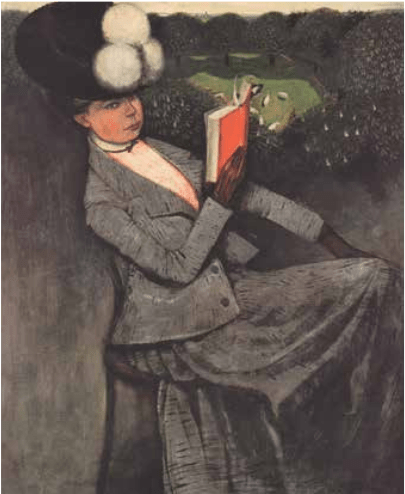
A young lady, a girl of perhaps twenty, is sitting in a chair and reading a book. Or she has just been diligently reading, and now she is reflecting on what she has read. This often happens, that someone who is reading must pause, because all sorts of ideas having to do with the book keenly engage him. The reader is dreaming; perhaps she is comparing the subject matter of the book to her own experiences hitherto; she is thinking about the hero of the book, while she fancies herself almost its heroine.
Read the rest of Robert Walser’s microessay “Portrait of a Lady” (trans. by Lydia Davis) at The Offing. The painting–Portrait of a Lady—is by Karl Walser, Robert’s older brother.
A person who loses heart and hope through a personal bereavement is like a grain of sand on the seashore complaining that the tide has washed a neighboring grain out of reach. He is worse, for the bereaved grain cannot help itself; it has to be a grain of sand and play the game of tide, win or lose; whereas he can quit—by watching his opportunity can “quit a winner.” For sometimes we do beat “the man who keeps the table”—never in the long run, but infrequently and out of small stakes. But this is no time to “cash in” and go, for you can not take your little winning with you. The time to quit is when you have lost a big stake, your fool hope of eventual success, your fortitude and your love of the game. If you stay in the game, which you are not compelled to do, take your losses in good temper and do not whine about them. They are hard to bear, but that is no reason why you should be.
But we are told with tiresome iteration that we are “put here” for some purpose (not disclosed) and have no right to retire until summoned—it may be by small-pox, it may be by the bludgeon of a blackguard, it may be by the kick of a cow; the “summoning” Power (said to be the same as the “putting” Power) has not a nice taste in the choice of messengers. That “argument” is not worth attention, for it is unsupported by either evidence or anything remotely resembling evidence. “Put here.” Indeed! And by the keeper of the table who “runs” the “skin game.” We were put here by our parents—that is all anybody knows about it; and they had no more authority than we, and probably no more intention.
The notion that we have not the right to take our own lives comes of our consciousness that we have not the courage. It is the plea of the coward—his excuse for continuing to live when he has nothing to live for—or his provision against such a time in the future. If he were not egotist as well as coward he would need no excuse. To one who does not regard himself as the center of creation and his sorrow as the throes of the universe, life, if not worth living, is also not worth leaving. The ancient philosopher who was asked why he did not the if, as he taught, life was no better than death, replied: “Because death is no better than life.” We do not know that either proposition is true, but the matter is not worth bothering about, for both states are supportable—life despite its pleasures and death despite its repose.
It was Robert G. Ingersoll’s opinion that there is rather too little than too much suicide in the world—that people are so cowardly as to live on long after endurance has ceased to be a virtue. This view is but a return to the wisdom of the ancients, in whose splendid civilization suicide had as honorable place as any other courageous, reasonable and unselfish act. Antony, Brutus, Cato, Seneca—these were not of the kind of men to do deeds of cowardice and folly. The smug, self-righteous modern way of looking upon the act as that of a craven or a lunatic is the creation of priests, Philistines and women. If courage is manifest in endurance of profitless discomfort it is cowardice to warm oneself when cold, to cure oneself when ill, to drive away mosquitoes, to go in when it rains. The “pursuit of happiness,” then, is not an “inalienable right,” for that implies avoidance of pain. No principle is involved in this matter; suicide is justifiable or not, according to circumstances; each case is to be considered on its merits and he having the act under advisement is sole judge. To his decision, made with whatever light he may chance to have, all honest minds will bow. The appellant has no court to which to take his appeal. Nowhere is a jurisdiction so comprehensive as to embrace the right of condemning the wretched to life.
Suicide is always courageous. We call it courage in a soldier merely to face death—say to lead a forlorn hope—although he has a chance of life and a certainty of “glory.” But the suicide does more than face death; he incurs it, and with a certainty, not of glory, but of reproach. If that is not courage we must reform our vocabulary.
True, there may be a higher courage in living than in dying—a moral courage greater than physical. The courage of the suicide, like that of the pirate, is not incompatible with a selfish disregard of the rights and interests of others—a cruel recreancy to duty and decency. I have been asked: “Do you not think it cowardly when a man leaves his family unprovided for, to end his life, because he is dissatisfied with life in general?” No, I do not; I think it selfish and cruel. Is not that enough to say of it? Must we distort words from their true meaning in order more effectually to damn the act and cover its author with a greater infamy? A word means something; despite the maunderings of the lexicographers, it does not mean whatever you want it to mean. “Cowardice” means the fear of danger, not the shirking of duty. The writer who allows himself as much liberty in the use of words as he is allowed by the dictionary-maker and by popular consent is a bad writer. He can make no impression on his reader, and would do better service at the ribbon-counter.
The ethics of suicide is not a simple matter; one can not lay down laws of universal application, but each case is to be judged, if judged at all, with a full knowledge of all the circumstances, including the mental and moral make-up of the person taking his own life—an impossible qualification for judgment. One’s time, race and religion have much to do with it. Some people, like the ancient Romans and the modern Japanese, have considered suicide in certain circumstances honorable and obligatory; among ourselves it is held in disfavor. A man of sense will not give much attention to considerations of that kind, excepting in so far as they affect others, but in judging weak offenders they are to be taken into the account. Speaking generally, then, I should say that in our time and country the following persons (and some others) are justified in removing themselves, and that to some of them it is a duty:
One afflicted with a painful or loathsome and incurable disease.
One who is a heavy burden to his friends, with no prospect of their relief.
One threatened with permanent insanity.
One irreclaimably addicted to drunkenness or some similarly destructive or offensive habit.
One without friends, property, employment or hope.
One who has disgraced himself.
Why do we honor the valiant soldier, sailor, fireman? For obedience to duty? Not at all; that alone—without the peril—seldom elicits remark, never evokes enthusiasm. It is because he faced without flinching the risk of that supreme disaster—or what we feel to be such—death. But look you: the soldier braves the danger of death; the suicide braves death itself! The leader of the forlorn hope may not be struck. The sailor who voluntarily goes down with his ship may be picked up or cast ashore. It is not certain that the wall will topple until the fireman shall have descended with his precious burden. But the suicide—his is the foeman that never missed a mark, his the sea that gives nothing back; the wall that he mounts bears no man’s weight And his, at the end of it all, is the dishonored grave where the wild ass of public opinion “Stamps o’er his head but can not break his sleep.”
There is magic in the woods on Midsummer Day—so people tell me. Titania conducts her revels. Let others attend her court; for myself I will beg to be excused. I have no heart for revelling on Midsummer Day. On any other festival I will be as jocund as you please, but on the longest day of the year I am overburdened by the thought that from this moment the evenings are beginning to draw in. We are on the way to winter.
It is on Midsummer Day, or thereabouts, that the cuckoo changes his tune, knowing well that the best days are over and that in a little while it will be time for him to fly away. I should like this to be a learned article on “The Habits of the Cuckoo,” and yet, if it were, I doubt if I should love him at the end of it. It is best to know only the one thing of him, that he lays his eggs in another bird’s nest—a friendly idea—and beyond that to take him as we find him. And we find that his only habit which matters is the delightful one of saying “Cuckoo.” Continue reading ““Midsummer Day” — A. A. Milne”→
From Delphic Intimations: Dialogues with Australian Writers and Critics, ed. Pradeep Trikha. 2007: Sarup & Sons, New Delhi.
I have preserved Australian spelling and style.
***
“The Breathing Author” — Gerald Murnane
This essay is the edited version of a talk given at the final session of the Gerald Murnane Research Seminar, held at the University of Newcastle on 20-21 September 2001.
I cannot conceive of myself reading a text and being unmindful that the object before my eyes is a product of human effort.
Much of my engagement with a text consists of my speculating about the methods used by the writer in the putting together of the text, or about the feelings and beliefs that drove the writer to write the text, or even about the life story of the writer.
What I am about to tell you today is the sort of detail that I would have been eager to know if it had been my fate to be a person who was drawn to read these books (points to the stack of his books near by) rather than the person who was drawn to write them.
I have for long believed that a person reveals at least as much when he reports what he cannot do or has never done as when he reports what he has done or wants to do.
I have never been in an aeroplane.
I have been as far north from my birthplace as Murwillumbah in New South Wales and as far south as Kettering in Tasmania; as far east as Bemm River in Victoria and as far west as Streaky Bay in South Australia. The distance between Murwillumbah in the north and Kettering in the south is about 1500 km. It so happens that the distance between Streaky Bay in the west and Orbost in the east is about the same. Until I calculated these distances a few days ago, I was quite unaware that my travels had been confined to an area comprising almost a square, but my learning this was no surprise to me.
I became confused, or even distressed, whenever I find myself among streets or roads that are not arranged in a rectangular grid or are so arranged but not so that the streets or roads run approximately north-south and east-west. Whenever I find myself in such a place, I feel compelled to withdraw from social intercourse and all activities other than what I call finding my bearings. These I try to find by reference to the sun or to roads or streets the alignments of which are known to me. I know I have found my bearings when I can visualise myself and my surroundings as details of a map that includes the northern suburbs of Melbourne and such prominent east-west or north-south thoroughfares of those suburbs as Bell Street or Sydney Road.
My trying to find my bearings takes much mental effort, and I fail more often than I succeed. I often believe I have succeeded but later refer to maps and find that my visualised map was wrong. When I discover this, I feel compelled to attempt a complicated exercise that I have probably never succeeded at. I am compelled first to recall the scene where I tried to find my bearings, then to recall the visualised map that proved to be wrong, and last to try to correct my remembered self, as it were: to relive the earlier experience but with the difference that I get my correct bearings. I sometimes feel this compulsion many years after the original event. While writing these notes, for example, I was compelled to recall the evening in November 1956 when I visited for the first time the suburb or Brighton, on Port Phillip Bay. It was my last day of secondary school, and my class had to meet at the home of the school captain and later to take a train into Melbourne to see a film. I arrived in Brighton by bus, in the company of boys who knew their way around that quarter of Melbourne. Later, when our class arrived on foot at Brighton Beach railway station, I stood with them on the platform where they had gathered, but I was convinced that we were waiting for the train from Melbourne. After the train had arrive and we had boarded, I remained convinced for some time that we were travelling away from Melbourne, and my peace of mind was continually disturbed during the rest of the evening by my wondering how I had so utterly lost my bearings at the railway station. Just now, as I said, I was compelled to relive that experience of more than forty years ago, but I failed yet again to understand how the map of Melbourne in my mind had been stood on its head.
I cannot understand the workings of the International Date Line.





 Biblioklept