Novels Make Lousy Gifts (But We Should Give Them Anyway)

Novels make lousy gifts.

Now, if you have even a passing acquaintance with this little blog, you know that I love novels, that Biblioklept primarily focuses on novels, and that I love books in general. I am not anti-novel or anti-giving-novels-as-gifts. Send me a novel as a gift. I will appreciate it (or trade it toward another book, which is kinda sorta a form of appreciation).

I went to my favorite bookstore today, in fact, to buy some books for Christmas presents. But I restrained myself from picking up novels as gifts.

If you love books like I do, I’m sure that some of your most favorite gifts ever have been novels. Some of my most favorite gifts have been novels. The remaindered copy of The Lord of the Rings (from the South Barwon Library that some friends of the family gave me on Dec. 5th, 1990 when we visited Melbourne (the one in Australia, not Florida)) is probably one of my all-time favorite gifts. I know the exact date because the nice lady who gave it to me wrote a kind note in book and included the date in her note.

I could never bear to get rid of an inscribed book given as a gift, but lots of people do get rid of inscribed books. This is a monstrous practice, one that attests to just how easily people will discard your oh-so-earnest gifts. If you spend a lot of time in used bookstores (I do) you will come across these sad markings. Because it’s close at hand, and I’m aware of its inscription, I’ll share the note that Jean wrote to Helen (no, of course I know neither of them) in my copy of Balthus’s memoir, Vanished Splendors:
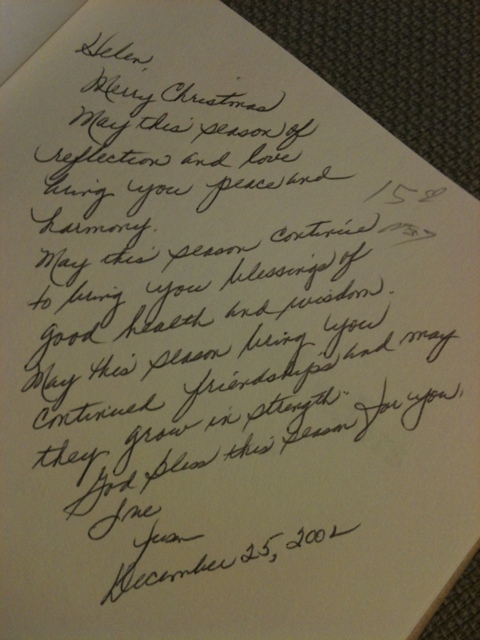
20111220-195619.jpg

I am aware that the memoir of a pervy artist is not the same as a novel, and that, as my first illustrating example, I already seem to be losing my metaphorical balance, but again, it was close at hand, right near the Tolkien in fact (by the bye, Vanished Splendors is pure gold).

In any case, I think Balthus’s memoir “reads” like a novel, which is to say that it’s mostly big chunks of text that require time and energy to decipher, set against the backdrop of TV, internet, movies, etc. It has some pictures, but not many. There’s no gimmick to it. I’m guessing that Helen just wasn’t into Balthus, or, if she had a passing interest in his art, it didn’t translate into wanting to read his memoir. She certainly didn’t read any of it (yes, I have a special sense that tells me when a book has been read. This baby was a virgin). Every time I look over the book, I feel sorta bad for Jean, whose gift seems to have gone unappreciated (by Helen; not by me. I was happy to pick it up used).

To return to an earlier point: yes, some of our favorite gifts ever might be novels. However, most of the life-changing novels I received were rarely given as birthday or Christmas gifts. They weren’t gifts of obligation, if you’ll forgive the ugliness of that term. Most of the great novels that were given to me were handed along free of occasion, given because the giver thought (knew) I should read them.

At Christmas though, we feel obliged to give. Sometimes we get some great novels as gifts. More often though, it seems like that relative who knows you “like to read” gives you a novel by, I dunno, Clive Cussler or Tom Clancy. The worst though are those tiny little hardback books that are designed specifically to be gifts, little faux-tomes of faux-philosophy usually connected to golf or angels or some other bullshit (I was horrified last year when DFW’s “This Is Water” speech got this treatment). Anyway, if you like books, you probably just go trade in this bullshit toward the books you like.

But this post isn’t really about the problem of getting airport novels or gimmick books as gifts. This post is about those of us who insist on giving novels we love to people who we know don’t really love reading novels. Especially really big, somewhat (or very) experimental novels. Important novels. Those novels that we read and decide that everyone needs to read this to become a fully realized human being [gags on that phrase].

I think sometimes we give our friends and relatives novels as gifts because we love them so much and we also love the book so much that we are maybe gunning for an intellectual three-way. We want them to read the novel so that we can share in it together, discuss it, rant about it, argue about it (remember though: that’s what the internet is for).

What often happens though is that these gifted novels (forgive the ambiguous, awkward modifier) tend to lurk about the giftee’s abode, brickishly unread, like dour unwanted houseguests. They skulk at the margins of bookshelves or migrate to the bottom of “to read” stacks; a lucky one might find occasional fingering above a commode. They are ugly reminders to the giftee, signals of how he or she has failed to meet your expectations (your expectations re: 9 or 15 or 25 or 30 hours of her time). (Young people, by which I mean college students in the liberal arts, are the exception here; they probably aren’t going to read the novel, but they are absolutely fine with putting it out for show).

People like books with pictures though, generally.

Even though I think novels tend to make lousy gifts, we should give them to our friends and loved ones anyway, even on those days of obligated giving. We should still offer novels up like they were somehow a part of our own selves in the deluded hope that the giftee will read them and discuss them with us, and that the novel will become an internal, virtual, shared experience. We should give them knowing that it’s likely they’ll go unread, that they may even be a point of shame for the giftee (especially when we ask, “Have you started . . . ?”). We should give them aware that they might point toward our own selfish desires.

Even if a novel may be a gift that implies a certain level of intellectual work, it also implies a  sense of trust and respect toward the giftee, and in this sense, giving a loved novel is a clear way to show love.
RIP Stetson Kennedy, Florida Folklorist, Writer, and Human Rights Activist

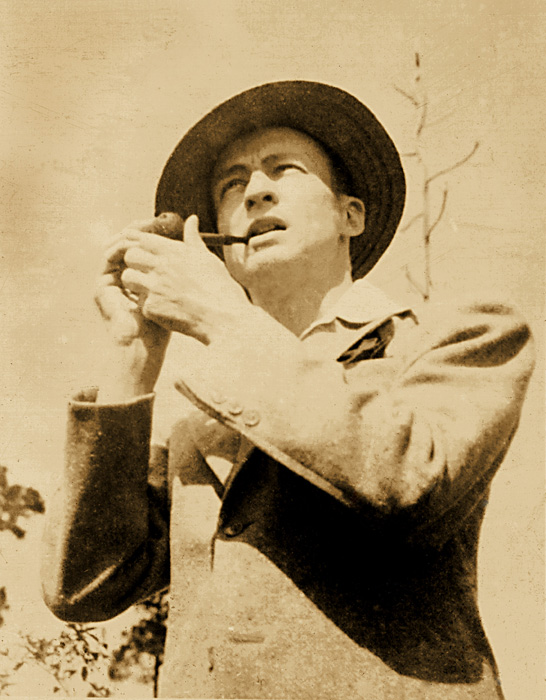
Stetson Kennedy died today at 94 in his native city, Jacksonville, FL.

Kennedy began his career collecting folklore throughout the South in 1937 after leaving the University of Florida. Kennedy worked for the Works Progress Administration’s Florida Writers’ Project, traveling with Zora Neale Hurston to collect oral histories and folk tales from both black and white Floridians alike. In the 1940s, Kennedy worked for the Atlanta office of the CIO. He also infiltrated the Ku Klux Klan in the 1940s and ’50s, exposing many of the racist organization’s secrets and alerting the world to the intrinsic injustice of the Jim Crow system in Southern states.

When Kennedy ran (quite unsuccessfully) for Governor of Florida in 1952, Woody Guthrie wrote the song “Stetson Kennedy” to support his good friend (Wilco and Billy Bragg put the lyrics to music decades later). Kennedy’s anti-Jim Crow, early Civil Rights platform didn’t win him much popularity throughout the state, and when his home in Fruit Cove was firebombed, he moved to France. It was there that the philosopher Jean-Paul Sartre published Kennedy’s The Jim Crow Guide—but the book was too controversial for US publication, despite multiple translations across Europe. Even more incendiary was Kennedy’s expose The Klan Unmasked (1954), which helped to undermine the organization’s secret authority in the South.

Just as Kennedy’s contribution to the Civil Rights movement cannot be underestimated, neither can his work in collecting and preserving Florida folklore (as well as Southern folklore in general). Kennedy helped found the Florida Folklore Society and also served as president, and volumes like Palmetto County and Grits and Grunts: Folkloric Key West will remain staples of Florida folk culture. In 2009, Kennedy bequeathed his papers and personal library to the Civic Media Center in Gainesville, FL, a nonprofit info center and alternative library devoted to human rights, environmental protection, and other causes. Kennedy was closely involved with the CMC since its inception in 1993.

Kennedy was a vibrant fount of cultural and historical force, a man who worked his entire, long life not just to preserve folklore and its history, but also to show the radical place that folk culture occupies throughout time, linking core human values from generation to generation. Stetson Kennedy will live through his legacy.

Kennedy’s website sheds light on his final moments—

He was with his wife and stepdaughter, He was in no pain. And as recently as 4 days ago he was lucid and talking. The doctor, checking his mental faculties asked him questions “where are you from”, Kennedy replied, “The planet Earth”

Stetson’s wishes were for a party and not a funeral. A luncheon at Beluthahatchee will be held October 1st.

Kennedy on This American Life.

Read a 2011 interview with Kennedy in Vice Magazine.

“Florida” — Elizabeth Bishop

“Florida” by Elizabeth Bishop

The state with the prettiest name,
the state that floats in brackish water,
held together by mangrave roots
that bear while living oysters in clusters,
and when dead strew white swamps with skeletons,
dotted as if bombarded, with green hummocks
like ancient cannon-balls sprouting grass.
The state full of long S-shaped birds, blue and white,
and unseen hysterical birds who rush up the scale
every time in a tantrum.
Tanagers embarrassed by their flashiness,
and pelicans whose delight it is to clown;
who coast for fun on the strong tidal currents
in and out among the mangrove islands
and stand on the sand-bars drying their damp gold wings
on sun-lit evenings.
Enormous turtles, helpless and mild,
die and leave their barnacled shells on the beaches,
and their large white skulls with round eye-sockets
twice the size of a man’s.
The palm trees clatter in the stiff breeze
like the bills of the pelicans. The tropical rain comes down
to freshen the tide-looped strings of fading shells:
Job’s Tear, the Chinese Alphabet, the scarce Junonia,
parti-colored pectins and Ladies’ Ears,
arranged as on a gray rag of rotted calico,
the buried Indian Princess’s skirt;
with these the monotonous, endless, sagging coast-line
is delicately ornamented.

Thirty or more buzzards are drifting down, down, down,
over something they have spotted in the swamp,
in circles like stirred-up flakes of sediment
sinking through water.
Smoke from woods-fires filters fine blue solvents.
On stumps and dead trees the charring is like black velvet.
The mosquitoes
go hunting to the tune of their ferocious obbligatos.
After dark, the fireflies map the heavens in the marsh
until the moon rises.
Cold white, not bright, the moonlight is coarse-meshed,
and the careless, corrupt state is all black specks
too far apart, and ugly whites; the poorest
post-card of itself.
After dark, the pools seem to have slipped away.
The alligator, who has five distinct calls:
friendliness, love, mating, war, and a warning–
whimpers and speaks in the throat
of the Indian Princess.

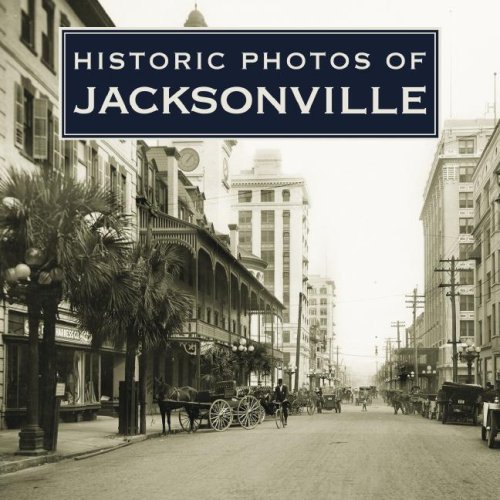
Historic Photos of Jacksonville

hpojacksonville.jpg

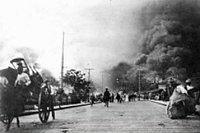
In just over 200 black and white archival photographs, Turner Publishing Company’s Historic Photos of Jacksonville depicts a vision of the Bold New City of the South that might surprise even native Jacksonvillians. The pictorial narrative begins around the same time as the advent of popular photography, before the Civil War (or, the War of Northern Aggression, as some old-school Jacksonvillian’s might say), and continues into the late 1960s. University of North Florida history professor Carolyn Williams’s captions provide insightful but never obtrusive explanations and commentary for the images, and her short essays before each section help to explicate the historical contexts of each of the particular periods of Jacksonville’s history into which the book. Particularly engaging are the smoke-hazed photos of the Great Fire of 1901, a devastating blaze that reduced much of the city to ashes.

200px-jacksonville_fl_fire_1901.jpg

Also fascinating are the post-fire/pre-WWI images of Jacksonville. These detail an overlooked period when the city was a major tourist destination boasting a burgeoning film industry. Northern travelers would flock to luxury resorts like the St. James Hotel, where native Jacksonvillian James Weldon Johnson‘s father worked. When looking at photos of the crowded streets of downtown and the busy industry of the shipyards and train stations, it’s easy to feel a twinge of nostalgia for a time that passed before you ever lived, a time before the strip malls and suburban sprawl, a time before Jacksonville looked more-or-less like Every Other Place in America.

Historic Photos of Jacksonville will look great on your coffee table or on your shelf, preferably next to James Weldon Johnson‘s outstanding autobiography, Along This Way.

Found Folktales

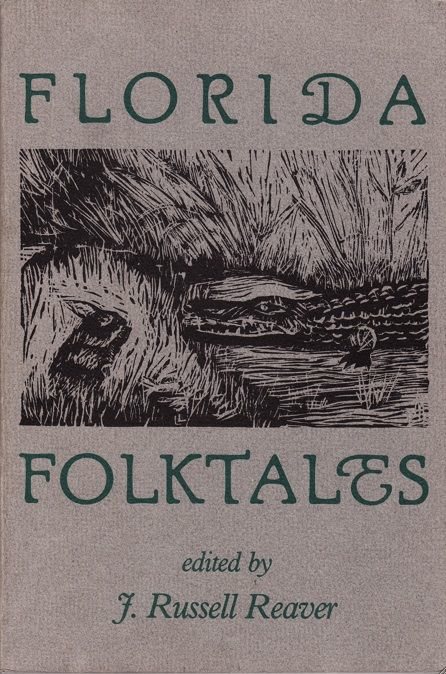
florida-folktales.jpg


I found this little gem at the bottom of a cardboard box in a locked cabinet in an abandoned teacher’s lounge. I had to break the lock: hidden treasure. Florida Folktales collects a range of folklore, ranging from ghost stories and trickster tales, to modern urban legends. I was intrigued by the back cover blurb by my one of my old professors at the University of Florida, Dr. Robert Thomson (he was the instructor for a folklore class I took. My project: I collected stories told by people who claimed to have had supernatural experiences while on drugs. Lots of LSD angels-and-demons stuff. I think I got an A-). Lovely book, University of Florida Presses.


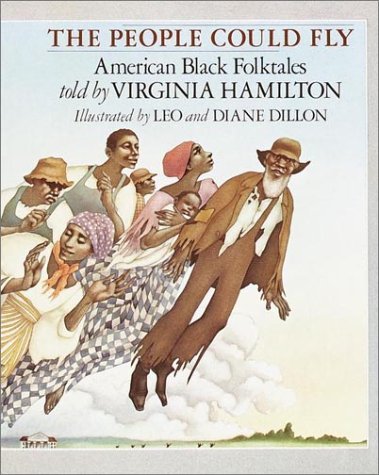
people.jpg

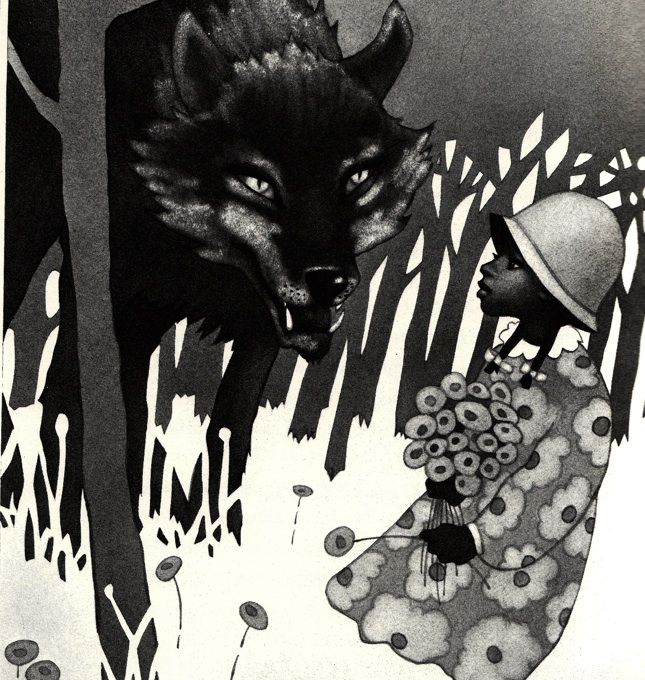
Under Florida Folktales I was pleased as punch (yes, punch: like this guy) to discover Virginia Hamilton’s retelling of traditional American Black folktales, The People Could Fly. I used a few of the tales the same day in class. Beautiful illustrations by Leo and Diane Dillon perfectly capture the axis of waking life and dreamworld these folktales express. Again, a lovely book.


wolfgirl.jpg

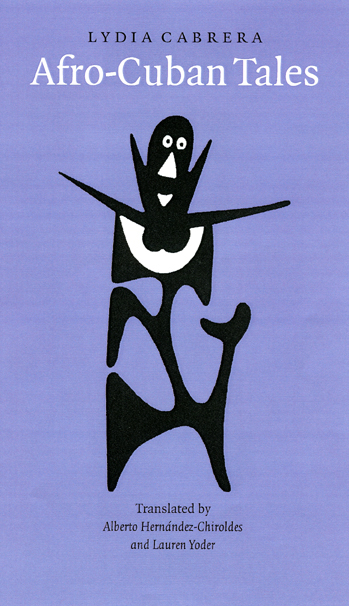
Lydia Cabrera–Afro-Cuban Tales

afro-cuban-tales.jpg

In a sublime synthesis of traditional folklore and imagistic surrealism, Lydia Cabrera’s Afro-Cuban Tales questions the normative spaces occupied by bodies. Deriving from animist tradition, her characters exist in an impossible multiplicity of spaces, being at once animals and plants, humans and gods. Cabrera’s characters endure trials of biological identity and social co-existence, and through these problems they internalize authority, evince taboos, and create a social code. Cabrera’s trickster characters provoke, challenge, or otherwise disrupt the symbolic order of this code. In “Bregantino Bregantín,” a story that recalls Freud’s primal horde theory, as well as the work of more contemporary theorists such as Julia Kristeva and Judith Butler,  narcissist Bull kills all the males of his kingdom and takes all the women for himself.  The sadistic titular turtle of “Papa Turtle and Papa Tiger” uses the power of his dead friend’s antlers to shame, torment, and torture the other animals of his community. And in the magical realism of “Los Compadres,” Capinche seeks to put the horns on his best friend Evaristo by sleeping with his wife–a transgression that ends in necrophilia. This union of sex and death, creation and destruction is the norm in Cabrera’s green and fecund world; the trickster’s displacements of order invariably result in reanimation, transformation, and regeneration—the drawing, stepping-over, and re-drawing of boundaries. A couple of days, Bob hipped me to this really cool Run Wrake short film called Rabbit. While not directly related to Afro-Cuban Tales, this film nonetheless captures the book’s key themes and motifs of death and resurrection, transformation and language, and the trickster’s power to disrupt social and familial codes. Highly recommended.

Danny Rolling: From Hell–Part II

 While I took an afternoon nap, serial killer Danny Rolling was killed by the State of Florida. Sixteen years ago in Gainesville, FL, Rolling went on a killing spree, murdering and mutilating five college students.

I graduated from the University of Florida in 2001. A decade after the murders, you would meet someone–a grad student, a law student, a native–who had a story about that weekend. They made it sound scary as hell.

Anyone who’s lived in Gainesville or even spent some time there will be familiar with the 34th Street mural wall. One panel of the wall is dedicated to the victims of the slaying: Sonja Larson, Christina Powell, Christa Hoyt, Tracy Paules, and Manuel Taboada. The panel seems to be repainted annually; sometimes due to vandalism.

Go here for a detailed chronological account of the murders

These murders were horrific, terrible crimes; random and indeterminate, but premeditated nonetheless. Rolling mutilated the corpses, beheading one of them; he also took body parts from the victims. There is no doubt in my mind that this man was a monster, a killer out of the woods like Grendel. And he got exactly what he wanted: fame and infamy and attention. He channeled hell and brought it to earth; I’m sure that hell still exists for some of his victim’s families to this day. Pragmatically, it is right and proper that Rolling be executed.

I still find myself opposed to the death penalty. I don’t pity Rolling and I don’t aim to add to his fame–but he has bought his fame by personifying abject horror, and this is Halloween horror-time. And as just and right as it seems that Rolling die, I still believe that it is wrong for our state government to kill him. I am not arguing that the death penalty is not a deterrent, or that the appeals process death row inmates go through is just as costly as life imprisonment; my argument is simple: murdering people is wrong. It is wrong and therefore against the law, so we (the “we” of community and society who consent to just government) do not kill. If we kill each other we cannot thrive. Rolling’s crime illustrates the human and social disruption of murder. These killings, these gruesome hyperboles of annihilation, show exactly why it is so important that government discontinue use of the death penalty.

Many, many times I have thought: “That person should be killed. That person should be shot.” I have had these murderous thoughts about awful psychopaths and child molesters and about people I am in strong disagreement with and people who have cut me off in traffic. I have had them in brief passing and I have concentrated on them with intensity, giving them much of my time. However, I know that these feelings are rooted in revenge fantasy and rotten wish-fulfillment. I think that when we buy into the death penalty as a punishment, we validate murder. We endorse a moral paradox: killing is wrong, so we will kill you. This type of social paradox becomes a vicious circle. The revenge cycle is metonymized so perfectly in everything from gang warfare to the Israeli–Palestinian conflict. Confronted with the sheer evidence of such futility and emptiness in violence, I think it only sensical and right that we choose to end capital punishment. Otherwise we only help to maintain the hell that Rolling has channelled, a hell we choose to keep.

Guns and Roses to Play Jacksonville Florida on Halloween Night

Absolutely nothing to do with books, but hey whatever. Guns and Roses have rescheduled their October 20th concert in sweet home Jacksonville FL for Halloween Night. Will Axl show? Will mayhem ensue? Will there be disappointment? Apathy?

And the Gators lost?! And that brawl in Miami?!

Console yourself with this Axl Rose fan art:


James Weldon Johnson — Part II

In 1912, James Weldon Johnson anonymously published The Autobiography of an Ex-Colored Man. It was later republished under Johnson’s name in 1927, at the acme of the Harlem Renaissance.

The Autobiography of an Ex-Colored Man strikes me as a thoroughly postmodern move. This fictional novel is presented as the true life story of a talented man who chooses to “pass” as white so that he might have greater–or at least equal–access to opportunity in America. Autobiography is a fictional novel “passing” as another genre, autobiography. This mirroring wasn’t intended as just a fancy rhetorical device–it was a subversive, incendiary gesture on JWJ’s part, meant to question the mores of white America. In fact, after it’s initial publication, several reviews were written suggesting that the book was a hoax, the premise of these reviews being that a black man could never pass as a white man–let alone marry a white woman and become a landowner of some importance.

Ultimately, the voice in Autobiography problematizes all easy readings. The ex-colored man is a bona fide narcissist with an almost preternatural ability to succeed at everything he attempts–except of course when he is thwarted by racist social norms. The reader seems most encouraged to sympathize with the narrator at these times, when the ex-colored man’s natural and cultivated abilities are confronted or ousted by the dominant system. At other times, the narrator condescends working class blacks he terms “inferior”; he also frequently wishes to sanitize “primitive” forms of black art, such as spirituals and ragtime music, by recasting them in a classical, canonical mode. The ex-colored man clearly feels frustration that the acumen of his genius is constantly delimited by his color, but this frustration sometimes seems aimed at his fellow blacks.

All of this makes for a challenging but brisk and enjoyable read. Paired with JWJ’s real autobiography, Along This Way, a savvy reader can come up with all kinds of ironic, postmodern readings. Or straightforward readings. Or whatever. Read it yourself.

James Weldon Johnson — Part I

Everything in Jacksonville, Florida should be named after native son James Weldon Johnson.


Well, maybe not everything–that could get confusing. But as it stands, the only thing we Jacksonvillians have bearing that great man’s name is a middle school, and an obscure plaque somewhere downtown–which is great. People love plaques.

James Weldon Johnson Middle School feeds Stanton College Preparatory School, an excellent school that JWJ served as principal of from 1894 to 1902. In the interest of full disclosure, I should point out that I’m a proud graduate of the Stanton School (go Blue Devils!). Under JWJ’s plan, Stanton became the first black high school in Florida. In his autobiography, Along This Way, JWJ discloses the genius of his plans for educational reform: he simply asked the eighth grade class to come back again, partitioned off some rooms, and based the new high school program on the curriculum of his alma mater Atlanta University (now known as Clark). The real genius of this is that he didn’t bother to ask the all-white board of education, who undoubtedly would’ve found some way to say “no.” He just did it, and then let the board come see what he had done. Brilliant.

Why isn’t there a single prominent statue of JWJ in Jacksonville? Or a library named after him? Or even a street? It seems to me that the average Jacksonvillian simply isn’t aware of JWJ, or has only a passing knowledge of who he was, not realizing that he was born and raised here.

So:

1. I will continue writing about James Weldon Johnson on this blog.

2. I challenge every Jacksonvillian to read a book by James Weldon Johnson.

 3. Maybe if we read his books, we’ll come to feel his genius, celebrate the fact that he is from our hometown, and honor him appropriately.

The Florida Reader

 go gators!

In The Florida Reader, edited by Lane and O’Sullivan, colonialists from three European countries fight or don’t fight with Indians, Ralph Waldo Emerson is mildly disappointed in the laziness of St. Augustine, Silvia Sunshine defines what a “cracker” person is, Hemmingway and Harry Crews come off as awful macho, and John Lee Williams advises against the consumption of “ardent spirits” in Florida’s hot climate. Also some fantastic Seminole folk tales. Here’s the second half of “Why the Rabbit is Wild”:

Then a horse and dog talked to one of the men. They talked like people. At that time the rabbit stayed with people, and he told lies all the time, but the dog and horse told the truth.One day somebody found out that the rabbit lied. At that time he was always trying to be something he wasn’t. He would go away, and when he came back he would say he had seen things that he had not seen. He would say he had seen snakes, alligators, turkeys, and turtles. The people did not know if they should believe this rabbit. So one of the men said to the rabbit, “If you find a snake, kill him and bring him back to camp. If you find an alligator, kill him and bring him back to camp as well.” The rabbit then left the camp and found a snake. He killed it and started to bring it back to show to the people. When the rabbit was bringing back the snake he saw an alligator. The alligator talked too, at that time. So the rabbit said to the alligator, knowing that the alligator could be a pretty dangerous character, “Somebody wants to see you back at the camp.” The alligator believed this and went along with the rabbit. When they had gone about half way, the rabbit tried to kill the alligator. Rabbit beat at the alligator but could not kill him. Pretty soon the alligator got tired of the battle, and he went back to his cave. Then the rabbit came home with the snake. When the man who had challenged the rabbit saw him, he was impressed. Rabbit had brought a snake, but not an alligator. But at that moment, the man thought he would like a turkey instead. So he said, “If you see a turkey, kill him and bring him home.” So the rabbit started out to get a turkey, but figured it would be better to ask someone else to do the job. So he went to a wildcat and said, “You kill a turkey for me.” Wildcat went and found a turkey and killed him. Rabbit brought the turkey back to the camp and told the man that he had killed it. The man believed the rabbit’s story, and the rabbit continued to live with the people and tell his stories. One day the rabbit wanted to get married. The man thought that because the rabbit had killed the turkey, he could provide for a family, so he married a girl. But, after the rabbit got married, he didn’t bring any food at all. The people found out that the rabbit did not kill the turkey, so they drove the rabbit away from the camp. And that is why the rabbit is wild today.