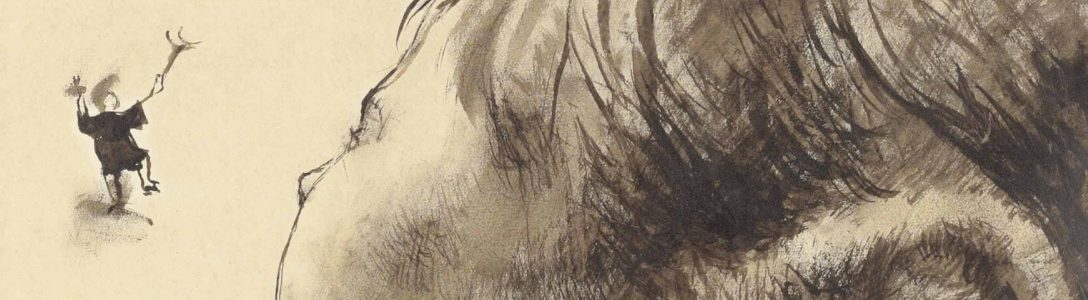
Kafka Rejection (Umberto Eco)

kafka

Jorge Luis Borges Uses Zeno’s Paradox to Describe Kafka’s Literature

I once premeditated making a study of Kafka’s precursors. At first I had considered him to be as singular as the phoenix of rhetorical praise; after frequenting his pages a bit, I came to think I could recognize his voice, or his practices, in texts from diverse literatures and periods. I shall record a few of these here, in chronological order.

The first is Zeno’s paradox against movement. A moving object at A (declares Aristotle) cannot reach point B, because it must first cover half the distance between two points, and before that, half of the half, and before that, half of the half of the half, and so on to infinity; the form of this illustrious problem is, exactly, that of “The Castle”, and the moving object and the arrow and Achilles are the first Kafkian characters in literature.

Read the rest of “Kafka and His Precursors” by Jorge Luis Borges here.

“Unhappiness” — Franz Kafka

“Unhappiness” by Franz Kafka

WHEN it was becoming unbearable – once toward evening in November – and I ran along the narrow strip of carpet in my room as on a racetrack, shrank from the sight of the lit-up street, then turning to the interior of the room found a new goal in the depths of the looking glass and screamed aloud, to hear only my own scream which met no answer nor anything that could draw its force away, so that it rose up without check and could not stop even when it ceased being audible, the door in the wall opened toward me, how swiftly, because swiftness was needed and even the cart horses down below on the paving stones were rising in the air like horses driven wild in a battle, their throats bare to the enemy.

Like a small ghost a child blew in from the pitch-dark corridor, where the lamp was not yet lit, and stood a-tiptoe on a floor board that quivered imperceptibly. At once dazzled by the twilight in my room she made to cover her face quickly with her hands, but contented herself unexpectedly with a glance at the window, where the mounting vapor of the street lighting had at last settled under its cover of darkness behind the crossbars. With her right elbow she supported herself against the wall in the open doorway and let the draught from outside play along her ankles, her throat, and her temples.

I gave her a brief glance, then said ‘Good day,’ and took my jacket from the hood of the stove, since I didn’t want to stand there half-undressed. For a little while I let my mouth hang open, so that my agitation could find a way out. I had a bad taste in my mouth, my eyelashes were fluttering on my cheeks, in short this visit, though I had expected it, was the one thing needful.

The child was still standing by the wall on the same spot, she had pressed her right hand against the plaster and was quite taken up with finding, her cheeks all pink, that the whitewashed walls had a rough surface and chafed her finger tips. I said: ‘Are you really looking for me? Isn’t there some mistake? Nothing easier than to make a mistake in this big building. I’m called So-and-so and I live on the third floor. Am I the person you want to find? Continue reading ““Unhappiness” — Franz Kafka” →
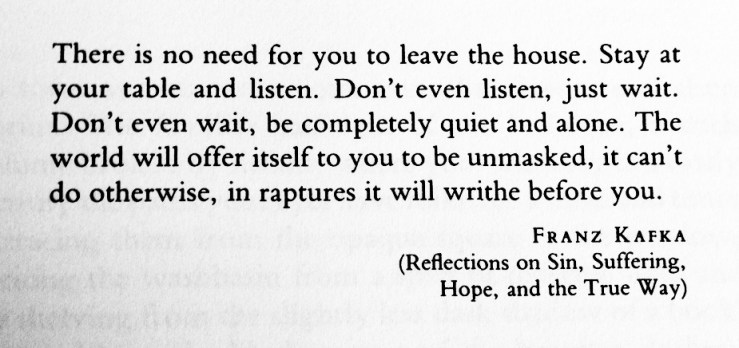
No Need (Kafka)

kafka

Alain Robbe-Grillet on Tolstoy, Dostoevsky, and Kafka

Alain Robbe-Grillet in his 1985 interview with The Paris Review:

ROBBE-GRILLET

When a novelist has “something to say,” they mean a message. It has political connotations, or a religious message, or a moral prescription. It means “commitment,” as used by Sartre and other fellow-travelers. They are saying that the writer has a world view, a sort of truth that he wishes to communicate, and that his writing has an ulterior significance. I am against this. Flaubert described a whole world, but he had nothing to say, in the sense that he had no message to transmit, no remedy to offer for the human condition.

INTERVIEWER

But did Dostoyevsky have nothing to say? Tolstoy?

ROBBE-GRILLET

Tolstoy yes. That is why on the whole he doesn’t interest me.

INTERVIEWER

Not even Anna Karenina?

ROBBE-GRILLET

Especially not Anna Karenina! Among Tolstoy’s books the one that interests me is The Death of Ivan Ilych. Ivan is someone who hurts himself while unhooking a curtain, and one sees his death in that gesture. As for Dostoyevsky, perhaps there is a message in his work but for me it is a kind of parasite. In Crime And Punishment, I am much more interested in the first part which is the preparation for the murder. You remember the scene where Raskolnikov is getting the axe ready? And he is fascinated by the act he has to accomplish? The last part of the book, about guilt and moral responsibility and so on, bores me profoundly.

INTERVIEWER

Because you, or your characters, never feel moral responsibility or guilt?

ROBBE-GRILLET

Never!

INTERVIEWER

Aren’t you lucky!

ROBBE-GRILLET

Perhaps. The book of Dostoyevsky’s that interests me most is The Possessed. It is an enigmatic novel; the main protagonist is an enigma. I read it over and over again and find it tremendous—it has a concept of reality that escapes “significance.” That may be my reading of it; someone else might apprehend it differently. I am sure Camus would have said something quite different about it.

INTERVIEWER

Another writer who has had a great influence on you is Kafka. He is someone who has been interpreted in more than one way. What is his fascination for you?

ROBBE-GRILLET

He has been read as having a metaphysical and religious message—the relationship between the Jew and his God. This is the influence of Max Brod, his friend and first biographer. It doesn’t interest me in the least. I read Kafka as the revelation of a world, which is much more important than yet another meditation on the Talmud. Brod’s reading of Kafka is reductive and restrictive, as if his work could be reduced to metaphysical relations. What I find extraordinary is the actual presence of this opaque world.


“Up in the Gallery” — Franz Kafka

If some frail tubercular lady circus rider were to be driven in circles around and around the arena for months and months without interruption in front of a tireless public on a swaying horse by a merciless whip-wielding master of ceremonies, spinning on the horse, throwing kisses and swaying at the waist, and if this performance, amid the incessant roar of the orchestra and the ventilators, were to continue into the ever-expanding, gray future, accompanied by applause, which died down and then swelled up again, from hands which were really steam hammers, perhaps then a young visitor to the gallery might rush down the long stair case through all the levels, burst into the ring, and cry “Stop!” through the fanfares of the constantly adjusting orchestra.

But since things are not like that—since a beautiful woman, in white and red, flies in through curtains which proud men in livery open in front of her, since the director, devotedly seeking her eyes, breathes in her direction, behaving like an animal, and, as a precaution, lifts her up on the dapple-gray horse, as if she were his grand daughter, the one he loved more than anything else, as she starts a dangerous journey, but he cannot decide to give the signal with his whip and finally, controlling himself, gives it a crack, runs right beside the horse with his mouth open, follows the rider’s leaps with a sharp gaze, hardly capable of comprehending her skill, tries to warn her by calling out in English, furiously castigating the grooms holding hoops, telling them to pay the most scrupulous attention, and begs the orchestra, with upraised arms, to be quiet before the great jump, finally lifts the small woman down from the trembling horse, kisses her on both cheeks, considers no public tribute adequate, while she herself, leaning on him, high on the tips of her toes, with dust swirling around her, arms outstretched and head thrown back, wants to share her luck with the entire circus—since this is how things are, the visitor to the gallery puts his face on the railing and, sinking into the final march as if into a difficult dream, weeps, without realizing it.

“Up in the Gallery” by Franz Kafka

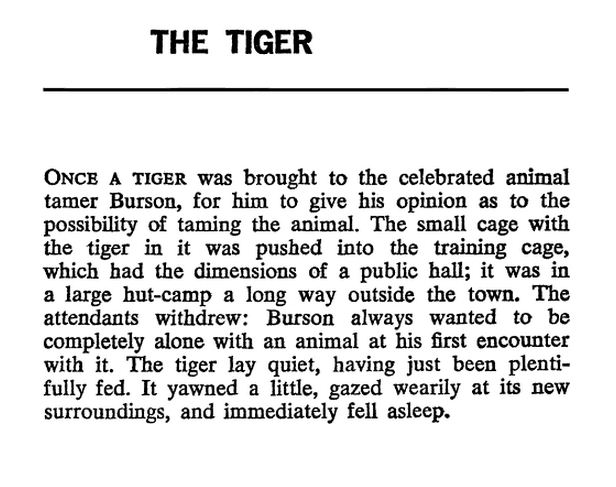
“The Tiger” — Kafka

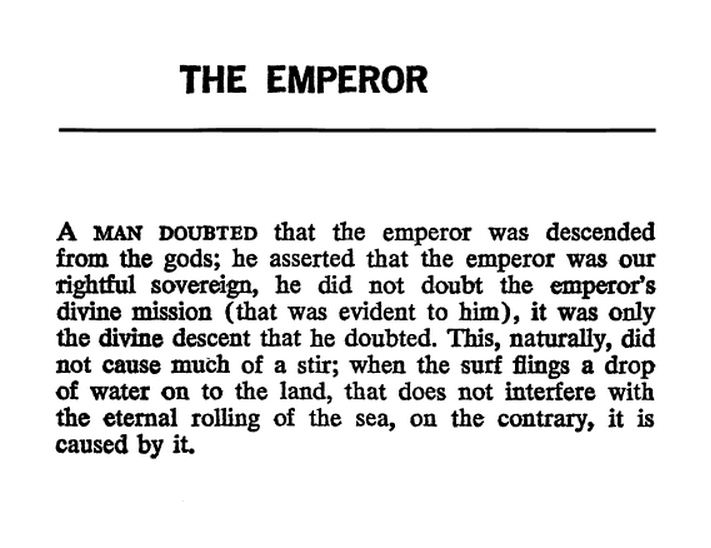
“The Emperor” — Kafka

“Robinson Crusoe” — Kafka

“Robinson Crusoe” by Franz Kafka:

Had Robinson Crusoe never left the highest, or more correctly the most visible point of his island, from desire for comfort, or timidity, or fear, or ignorance, or longing, he would soon have perished; but since without paying any attention to passing ships and their feeble telescopes he started to explore the whole island and take pleasure in it, he managed to keep himself alive and finally was found after all, by a chain of causality that was, of course, logically inevitable.


“Prometheus” — Kafka

“Life in the jungle” (Kafka)

(From Kafka’s Diaries).

“Goethe probably retards the development of the German language by the force of his writing” (Kafka)


Goethe probably retards the development of the German language by the force of his writing.  Even though prose style has often traveled away from him in the interim, still, in the end, as at present, it returns to him with strengthened yearning and even adopts obsolete idioms found in Goethe but otherwise without any particular connection with him, in order to rejoice in the completeness of its unlimited dependence.

From Kafka’s Diaries.


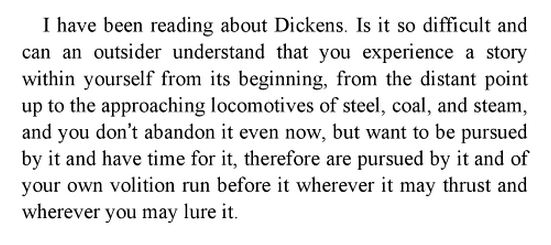
“I have been reading about Dickens” (Kafka)

(From Kafka’s Diaries).

Self-discovery (Kafka)


(From Kafka’s diaries).

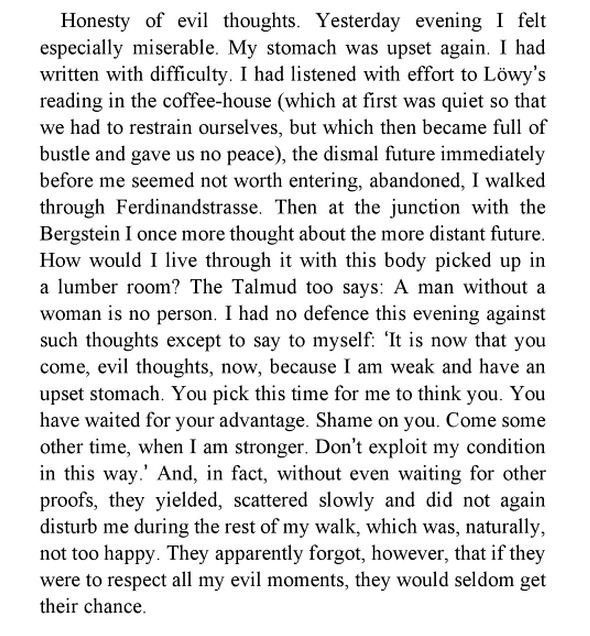
Honesty of Evil Thoughts (Kafka)

From Kafka’s Diaries.

Kafka Doodle

Kafka doodle. From his Diaries (vol.1).

List with No Name #8


  1. Robert Walser
  2. Franz Kafka
  3. Henry Miller
  4. Thomas Bernhard
  5. David Markson
  6. Renata Adler
  7. W.G. Sebald
  8. Lydia Davis
  9. Ben Marcus