
Tag: James Joyce
Books I Am Always (Re-)Reading
Trudging through a very long book the other night–never mind the title, at least now anyway–it occurred to me that I’d rather be reading from 2666; that, at that particular moment, I’d rather re-read from “The Part About the Crimes.” I don’t know if it was the effete dullness of the first volume that made me want to pick up Bolaño’s epic, perhaps trying to zap some life into my waning eyeballs; perhaps it was just the sense that I was wasting my time with the merely good, which, after all, is mediocrity when set against genius (yes, these are subjective terms).
Anyway, I didn’t have to go looking for 2666 — I have a copy (yes, I have two) right there jammed into my nightstand, along with a few other books that I realize that I’m always reading. Furthermore, I’m always reading these books in the most discontinuous, stochastic fashion, often picking them up at random and thumbing through them. I think I use these books to clear my literary palate, to get a bad (or worse, boring) taste out of my brain, to inspire me, to suggest another book. Some of these books, like 2666 are big, fat volumes, volumes that I set close at hand in the hopes of rereading in full. Sometimes I’ve met this goal; in the case of Moby-Dick, I’ve read the book through at least three times now, and yet never tire of it. I’m always picking it up again and again, sometimes to find Elijah’s rant or to dip into Ahab’s mad monologue or perhaps just to hear Stubb comment on the proper preparation of shark steaks. Of a piece with those big novels is David Foster Wallace’s Infinite Jest, which I turn to repeatedly, reading over a riff or two at a time, perhaps still trying to figure out the ending, or some clue of the ending, perhaps trying to figure out why Hal can’t speak (you know, beyond like, a a metaphorical level).
There’s also Blood Meridian.
A book I always keep proximal is D.H. Lawrence’s Studies in Classic American Literature, which, if this were a dictatorship under Biblioklept might replace the Constitution (jaykay, Tea Partiers!). Tellingly, I’ve never managed to finish one of Lawrence’s novels (I even struggle through his much-anthologized piece, “The Rocking Horse Winner”), but I consider his dissertations on Hawthorne, Poe, and Melville indispensable (and creative in their own right). I guess I just like lit crit; Harold Bloom’s too-huge volume The Western Canon is a book I return to again and again. Sometimes I find myself throwing it to the ground, quite literally (if I’ve enjoyed a drink or two, that is), in disgust. Bloom’s battle with “The School of Resentment” can be maddening, especially when he’s so up front about essentially making Shakespeare God. Still, Shakespeare doesn’t seem like a bad God to have.
I should point out that I’ve made no attempt to read The Western Canon the whole way through; in fact, I’ve never made a single attempt to read it systematically. I just sort of pick it up, thumb through it, occasionally plumb the index. There are several books that I am always rereading in this category: Books That I Am Always Reading and Yet Have Never Finished. Foremost among these is Nietzsche’s Human, All Too Human, a book that I probably, at this point, have read in full, but never fully through. Its aphorisms beg to be read discontinuously; I think Nietzsche wet-dreamed about his fragmentary works being literally fragmented and then later found, read piecemeal against some newer, more garish culture. Or perhaps that’s just my metaphorical wet dream.
Other Books That I Am Always Reading and Yet Have Never Finished — The Life and Opinions of Tristram Shandy, Gentleman stands out, as does Finnegans Wake. Sterne’s book is such an oddity: I remember picking it up in a stack of books to be shelved at my college library, thumbing through it, bewildered, thinking that it must be contemporary with John Barth. A bit of research left me even more perplexed. Like Tristram, who can’t seem to finish his story, I can’t seem to actually finish it, but I’m okay with picking it up again and again. Similarly, Finnegans Wake strikes me as an unfinished-unfinishable volume (I do not mean this literally; I know that Joyce “finished” the book as an infinite strange loop, just as I know that the book can be read). I have an audio recording of Finnegans Wake that I like to listen to occasionally (especially while driving), as well as William York Tindall’s guide (which is fun), but I’d rather just sort of grab the thing at random and read a page or two. I know, in an intellectual sense, that is, that I could easily read the book in a calendar year by committing to three pages a day (plus a few pages of Tindall), but I don’t think that I can read books in an intellectual sense. I think, at the risk of sounding unbearably corny, that books have to call to their readers in an emotional and perhaps even spiritual sense. Otherwise, what’s the point?
James Joyce’s Death Mask

Enjoy Thanksgiving with Our Literary Recipes Roundup
Happy Thanksgiving!
Enjoy Turkey Day (sans turkey) with Biblioklept’s menu of literary recipes:
Zora Neale Hurston’s Mulatto Rice
James Joyce’s Burnt Kidney Breakfast
Herman Melville’s Whale Steaks
Ernest Heminway’s Absinthe Cocktail, Death in the Afternoon
Vladimir Nabokov’s Eggs à la Nabocoque
Thomas Pynchon’s Banana Breakfast
Robert Crumb’s Macaroni Casserole
James Joyce’s Burnt Kidney Breakfast
Leopold Bloom, hero of James Joyce’s Ulysses likes kidneys for breakfast. In fact–
Mr Leopold Bloom ate with relish the inner organs of beasts and fowls. He liked thick giblet soup, nutty gizzards, a stuffed roast heart, liverslices fried with crustcrumbs, fried hencods’ roes. Most of all he liked grilled mutton kidneys which gave to his palate a fine tang of faintly scented urine.
Okay, so there’s not much to this recipe. First, you’ve gotta buy the kidney–
A kidney oozed bloodgouts on the willowpatterned dish: the last. He stood by the nextdoor girl at the counter. Would she buy it too, calling the items from a slip in her hand? Chapped: washingsoda. And a pound and a half of Denny’s sausages.
Then you cook it with some butter in a frying pan (don’t forget to share with the cat, and don’t forget the pepper)–
While he unwrapped the kidney the cat mewed hungrily against him. Give her too much meat she won’t mouse. Say they won’t eat pork. Kosher. Here. He let the bloodsmeared paper fall to her and dropped the kidney amid the sizzling butter sauce. Pepper. He sprinkled it through his fingers ringwise from the chipped eggcup.
Then take your lazy adulterous wife her breakfast that you’ve lovingly prepared for her (she’ll need her strength for later). Oh, and don’t forget about the kidney that’s still cooking for you (unless you’re making some kind of subconscious symbolic burnt offering or something)–
—There’s a smell of burn, she said. Did you leave anything on the fire?
—The kidney! he cried suddenly.
He fitted the book roughly into his inner pocket and, stubbing his toes against the broken commode, hurried out towards the smell, stepping hastily down the stairs with a flurried stork’s legs. Pungent smoke shot up in an angry jet from a side of the pan. By prodding a prong of the fork under the kidney he detached it and turned it turtle on its back. Only a little burnt. He tossed it off the pan on to a plate and let the scanty brown gravy trickle over it.
Enjoy with gravy, toast, and a cup of tea–
Cup of tea now. He sat down, cut and buttered a slice of the loaf. He shore away the burnt flesh and flung it to the cat. Then he put a forkful into his mouth, chewing with discernment the toothsome pliant meat. Done to a turn. A mouthful of tea. Then he cut away dies of bread, sopped one in the gravy and put it in his mouth. What was that about some young student and a picnic? He creased out the letter at his side, reading it slowly as he chewed, sopping another die of bread in the gravy and raising it to his mouth.
He sopped other dies of bread in the gravy and ate piece after piece of kidney.
“Riverrun, past Eve and Adam’s” — Stephen Crowe Illustrates Finnegans Wake
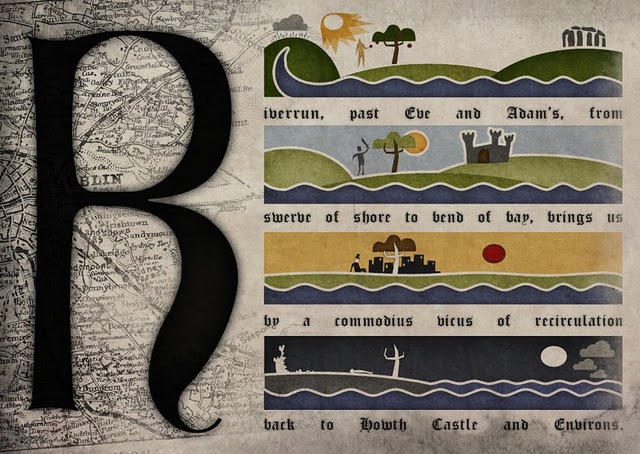
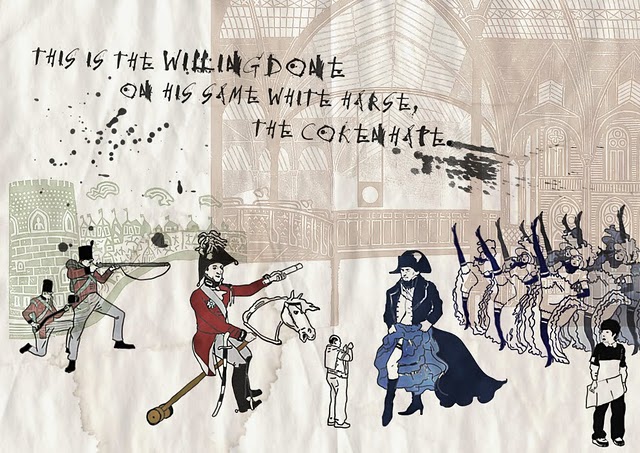
At Wake In Progress, Stephen Crowe has given himself the daunting task of illustrating James Joyce’s novel/linguistic black hole Finnegans Wake. It’s pretty cool stuff, and we love projects like these (see also: Six Versions of Blood Meridian and One Drawing for Every Page of Moby-Dick). Crowe’s site makes an interesting if different companion for the ongoing project at Ulysses “Seen.” Good luck to Stephen–keep them coming! (and thanks to @RhysTranter for sharing). More images–


How to Read James Joyce’s Ulysses (and Why You Should Avoid “How-to” Guides Like This One)

Bloomsday, an annual celebration of James Joyce’s Ulysses, is upon us today with more excitement than ever. Even with the festivities, the book’s reputation for density, erudition, and inscrutability still daunts many readers–leading to a glut of guidebooks, summaries, and annotations. Ironically, rather than inviting first-time readers to the text, the sheer volume of these guides to Ulysses can paradoxically repel. Their very existence seems predicated on an intense need, and although some of the guides out there can be helpful, others can get in the way. This need not be. Ulysses deserves its reputation as one the best books in the English language. It generously overflows with insight into the human experience, and it’s very, very funny. And, most importantly, anyone can read it.
Here are a few thoughts on how to read Ulysses, enumerated–because people like lists:
1. Ignore all guides, lists, maps, annotations, summaries, and lectures. You don’t need them; in fact, they could easily weigh down what should be a fun reading experience. Jump right into the text. Don’t worry about getting all the allusions or unpacking all the motifs.
Pretty soon though, you’ll get to the third chapter, known as “Proteus.” It’s admittedly hard to follow. You might want a guide at this point. Or you might just want to give up. (Of course, you might be a genius and totally get what Stephen is thinking about as he wanders the beach. Good for you). If frustration sets in, I suggest skipping the chapter and getting into the rich, earthy consciousness of the book’s hero, Leopold Bloom in chapter four, “Calypso.” It’s great stuff. You can always go back to chapter three later, of course. The real key, at least in my opinion, to reading (and enjoying) Ulysses is getting into Bloom’s head, matching his rhythm and pacing. Do that and you’re golden.
I’ve already advised you, gentle reader, not to follow any guides, so please, ignore the rest of my advice. Quit reading this post and start reading Ulysses.
For those who wish to continue–
2. Choose a suitable copy of the book. The Gabler edition will keep things neat and tidy and it features wide margins for all those clever game-changing annotations you’ll be taking. Several guides, including Harry Blamire’s The New Bloomsday Book align their annotation to the Gabler edition’s pagination.
3. Make a reading schedule and stick to it. The Gabler edition of Ulysses is nearly 700 pages long. That’s a long, long book–but you can read it in just a few weeks. There are eighteen episodes in Ulysses, some longer and more challenging than others, but reading one episode every two days should be no problem. If you can, try to read one episode in one sitting each day. As the book progresses, you’ll find yourself going back to previous chapters to find the figures, motifs, and traces that dance through the book.
4. So you’ve decided you need a guide. First, try to figure out what you want from the guide. Basic plot summary? Analysis? Explication? There’s plenty out there–too much really–so take the time to try to figure out what you want from a guide and then do some browsing and skimming before committing.
The most famous might be Stuart Gilbert’s James Joyce’s Ulysses, a dour book that manages to suck all the fun out of Joyce’s work. In a lecture on Ulysses, Vladimir Nabokov warned “against seeing in Leopold Bloom’s humdrum wanderings and minor adventures on a summer day in Dublin a close parody of the Odyssey,” noting that “it would be a complete waste of time to look for close parallels in every character and every scene in the book.” Nabokov scathingly continued: “One bore, a man called Stuart Gilbert, misled by a tongue-in-cheek list compiled by Joyce himself, found in every chapter the domination of one particular organ . . . but we shall ignore that dull nonsense too.” It’s perhaps too mean to call Gilbert’s guide “nonsense,” but it’s certainly dull. Harry Blamire’s The New Bloomsday Book is a line-by-line annotation that can be quite helpful when Joyce’s stream of consciousness gets a bit muddy; Blamire’s explications maintain a certain analytical neutrality, working mostly to connect the motifs of the book but letting the reader manage meaning. Don Gifford’s Ulysses Annotated is an encyclopedia of minutiae that will get in the way of any first time reader’s enjoyment of the book. Gifford’s notes are interesting but they can distract the reader from the text, and ultimately seem aimed at scholars and fanatics.
Most of the guidebooks I’ve seen for Ulysses share a common problem: they are obtrusive. I think that many readers who want some guidance or insight to aid their reading of Ulysses, rather than moving between books (what a chore!), should listen to some of the fantastic lectures on Joyce that are available. James Heffernan’s lectures for The Teaching Company provide a great overview of the book with some analysis; they are designed to be listened to in tandem with a reading of the book. Frank Delaney has initiated a new series of podcast lectures called re:Joyce; the first lecture indicates a promising series. The best explication I’ve heard though is a series of lectures by Joseph Campbell called Wings of Art. Fantastic stuff, and probably the only guide you really need. It’s unfortunately out of print, but you can find it easily via extralegal means on the internet. Speaking of the internet–there’s obviously a ton of stuff out there. I’ll withhold comment–if you found this post, you can find others, and have undoubtedly already seen many of the maps, schematics, and charts out there.
5. Keep reading. Reread. Add time to that reading schedule you made if you need to. But most of all, have fun. Skip around. If you’re excited about Molly’s famous monologue at the end of the book, go ahead and read it. Again, the point is to enjoy the experience. If you can trick a friend into reading it with you, so much the better. Have at it.
Radio Bloomsday to Feature Jerry Stiller, Bob Odenkirk, Alec Baldwin and More
 New York’s WBAI will continue their 32 year tradition of celebrating Bloomsday tomorrow with a live broadcast featuring a host of actors reading aloud from James Joyce’s Ulysses. Readings begin at 7pm and continue until 2am. Performers include Paul Muldoon, Alec Baldwin, Jerry Stiller, Charles Busch, T. Ryder Smith, Bob Dishy, Judy Graubart, Aaron Beall, Amy Stiller, Paul Dooley, Bob Odenkirk, John O’Callaghan, Brian O’Doherty, Kate Valk, Mara McEwin, James Kennedy, Jim Fletcher, Richard Maxwell, Anna Goodman-Herrick, Janet Coleman, David Dozer, Emily Mitchell, and Tara Bahna-James. More at their blog.
Biblioklept Interviews Keri Walsh about Her New Book, The Letters of Sylvia Beach
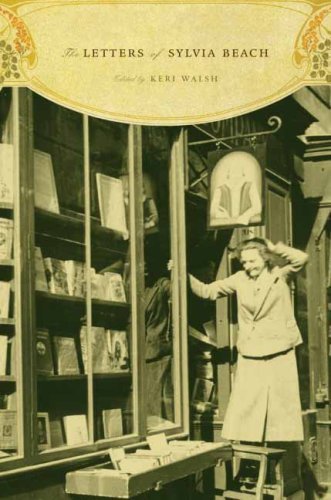
Keri Walsh’s new book The Letters of Sylvia Beach sheds light on one of modern literature’s most fascinating figures. Sylvia Beach was the nexus point for the ex-pat/Lost Generation/Modernist scene in the first half of the twentieth century. Along with her partner Adrienne Monnier, Beach ran the Left Bank bookstore Shakespeare & Company until the Nazi occupation of Paris in 1941. She was the first publisher of Joyce’s Ulysses, she translated Paul Valéry into English, and she was close friends to a good many great writers, including William Carlos Williams, Ezra Pound, H.D., and Ernest Hemingway. Walsh’s book compiles Beach’s letters, revealing a woman who cared deeply about literature and art, who was funny and sincere, and who loved her famous (and not so famous) friends dearly. Over a series of emails, we talked to Dr. Walsh about The Letters of Sylvia Beach, which is out now from Columbia UP. Keri Walsh teachers 20th Century British and Irish Literature at Claremont McKenna College in Los Angeles.
Biblioklept: How did you get interested in Sylvia Beach?
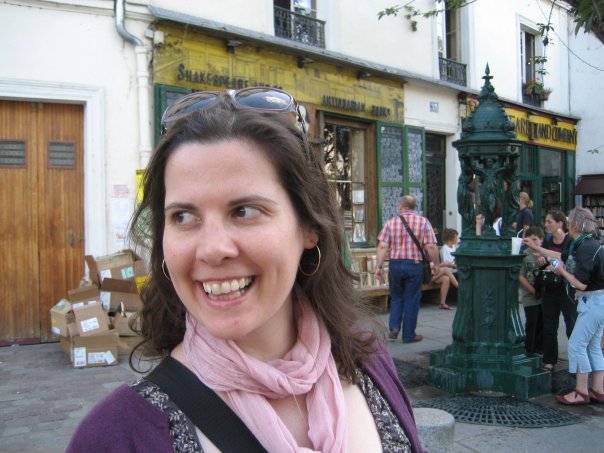
Keri Walsh: I got interested in Sylvia Beach in the same way that many English-speaking visitors to Paris do: when I stumbled upon the Shakespeare and Company bookstore in Paris. Of course, the current bookstore is its own entity: it’s not the direct descendant of Beach’s. It was founded after the Second World War by George Whitman, and it’s been there so long that it’s now legendary in its own right. Today it’s run by Whitman’s daughter, Sylvia Beach Whitman. The shop preserves many of the qualities of Beach’s original: the whimsicality, the friendliness, the sense of being a gathering place for expats. So it was easy to fall in love with it and to want to learn more about its origins.
Sylvia Beach grew up in Princeton, New Jersey. Beach’s father was minister of the Presbyterian Church just up the street from the university campus. I didn’t know that when I began my Ph.D. studies in the English department there. I was delighted to learn that Firestone library, where I worked every day, owned a vast collection of Sylvia Beach’s letters, photographs, books, and belongings. They even had the original “Shakespeare and Company” sign that had hung in front of her store. I started to read through her letters, beginning with the ones she wrote as a teenager. Even then she was always reading. I was charmed by how funny she was, and how resourceful. She could talk her friends into just about anything– including smuggling illegal copies of Ulysses into the United States.
Her correspondents were so illustrious that I was surprised to learn that her letters had never been published. Because she wrote to Gertrude Stein, Ernest Hemingway, H.D. and others, I hoped that this volume might make a contribution to the study of modernist literary culture. But I also wanted to share Beach’s story for its own sake, because she was so fascinating and endearing. I had a hunch that there would be other readers like me who wanted to know more about Beach, and about the sensibility that informed Shakespeare and Company. I thought about all the people who love modernist Paris and independent bookstores. Beach is a kindred spirit for bookworms, expatriates, bohemians, bluestockings, francophiles and salonnieres of all stripes.
B: You mention Sylvia Beach Whitman. I’ve read that she’s an ancestor of Walt Whitman–is that true?
KW: About Sylvia Beach Whitman and the Whitman connection– I don’t know. But I do know that the original Sylvia Beach had a Whitman connection, and she was proud of it. An aunt of hers had visited Whitman and asked permission to dig some manuscripts out of his trash bin. Sylvia had these on display in her shop. She writes in her memoir of “several little manuscripts of Walt Whitman scribbled on the backs of letters. These were the gift of the poet to my Aunt Agnes Orbison. Aunt Agnes, when she was a student at Bryn Mawr, had gone with her friend Alys Smith to Camden to visit Walt Whitman . . ..Manuscripts were strewn all over the floor, and some of them . . . were in the waste-paper basket. She got up the courage to draw out a few of these scribblings, mostly on the backs of letters addressed to Walt Whitman, Esq., and asked if she might keep them. “Certainly, my dear,” he replied. And that’s how our family got its Whitman manuscripts” (20).
B: Can you tell us a bit about Beach’s involvement in smuggling copies of Ulysses into the States?
KW: As for the smuggling of Ulysses, Beach tells us in her memoir Shakespeare and Company that some of Hemingway’s friends in Toronto smuggled copies to the Ulysses subscribers underneath their clothes. The original edition of Ulysses was paid for by subscribers in advance, so when Ulysses was banned in the US, it wasn’t a matter of getting copies into bookstores, it was a matter of getting them to the people who’d already bought them. Beach’s letters show us that she relied on her old friend Marion Peter to do some of the smuggling, receiving the books in non-descript looking parcels and forwarding them on to the subscribers in America. “You were such an angel to take all that trouble bootlegging for me!” she wrote to Marion Peter in 1923, a characteristically Sylvia-esque joke at the height of Prohibition to her eminently respectable friend.
B: In Beach’s letters, she comes across as both a friend and a fan to many of the authors to whom she writes. At times, there seems to be a tension there–there’s a late letter to Ezra Pound (#188), for example, where she seems almost ironically deferential; there’s a letter to Hemingway (#211) where she apologizes ahead of time for early “references to [his] domestic life” in her memoir Shakespeare and Company that “should be deleted.” How important was Beach to these writers, and how important were they to her? What was the response to her memoir?
KW: It must have been hard to know what to say to Pound in the years after the Second World War. His politics during the conflict had been abominable, and his mental health was precarious to say the least. Beach was a tactful person who disliked turning her back on anyone, so I think she struck a compromise, holding Pound at a distance but remaining polite. Beginning in the early 1930s her letters register her discomfort with his attraction to Italian fascism. In 1931 Beach wrote to Hemingway that “Ezra Pound is making us a visit, and an Italian tried to stick a stiletto into him during a soiree given in his honor at the Brasserie de l’Odeon. I think people should control themselves better” (134-5). You’re right to pick up on that ironic deference in the later letters. Perhaps it was her way of “handling” Pound: “Do tell me what the “factual error” was in my piece. Not the color of your shirt, I hope. I could swear it was blue. But I know how inaccurate I am. Adrienne is in despair over it” (214).
Her relationships varied, but as a general pattern her relationships with women like Bryher, H.D., and Adrienne Monnier were deep and mutual. One gets the sense that Joyce was more important to her than she was to him. Beach and Hemingway were genuine kindred spirits in the 1920s, and they retained a fond regard for each other throughout their lives. I think that by the 1950s Beach felt less certain about her friendship with Hemingway, wondering whether this cultural icon and Nobel Prize-winning writer still had time for her. But it was a gesture of thoughtfulness on her part to write to him wondering how much of his private story she could share in her memoir. And he responded with implicit trust in her judgment, telling her that anything she wrote would be OK.
One of my favorite Hemingway moments to come out of the Sylvia Beach archives nicely demonstrates their mutual understanding. Beach recorded on Hemingway’s Shakespeare and Company bill of 1934 that “Hemingway read Wyndham Lewis’s article ‘The Dumb Ox in Life and Letters’ and punched a vase of tulips on the table. Paid SB 1500 fr damages. SB returned 500 fr.” (“The Dumb Ox” was, of course, Lewis’s famously unflattering study of Hemingway’s writing).
B: You mention that “One gets the sense that Joyce was more important to her than she was to him.” There’s a letter published in the volume that Beach never actually sent to Joyce that is extremely angry and shows that, at least to some extent, she felt hurt by Joyce’s treatment of her–that she felt used. The letter also reveals the economic difficulties faced by writers and publishers alike, and perhaps hints that Joyce was more mercenary than he would have liked his public to know. To what extent was Beach merely a bank to Joyce?
KW: That letter is remarkable, isn’t it, because it shows the deep resentment Beach eventually felt toward Joyce. But more characteristically, especially in the early 1920s when they were working together on the publication of Ulysses, Beach was indulgent about the privileges of genius. To an extent that amazes me, she welcomed his incursions on her goodwill. She loved his writing, and she made a conscious decision to serve him and his art. This attitude was probably integral to her success. A less devoted, tenacious, and flexible person would simply not have been able to get Ulysses into print. But their intense and one-sided relationship proved unsustainable as his needs escalated and her resources diminished during the Depression.
Beach wasn’t the only one who put Joyce ahead of her own needs: Harriet Weaver, Paul Léon, Samuel Beckett, and Eugene Jolas were similarly devoted. Now, ideally, Joyce would have repaid these personal debts with magnanimity and grace. Sometimes he did. And sometimes he didn’t. In her recent piece on Beach’s letters in the London Times, Jeanette Winterson expresses the frustration that Beach admirers often feel:
“Joyce’s gigantic ego nearly ruined her. He took her cash, let her take all the risks on his (at the time) unpublishable book, and later reneged on the letter and the spirit of their agreements, simply reselling to Random House when he was famous enough to do so.”
But whatever his weaknesses of character, we have to remember that Beach indulged them. She was moved by Joyce’s work ethic in spite of his wretched health, the fact that he was terribly short of funds, and that he always seemed overmatched by circumstance. Her letters give us a glimpse into the sufferings he endured with his eye surgeries, for instance, and it’s harrowing reading. No, they never patched things up, but Beach remained loyal to Joyce’s family after his death, and she was a careful guardian of his legacy.
B: Beach lived with her partner Adrienne Monnier for years. To what extent were they “out” among Paris society, their literary friends, and their family?
KW: Most people who knew them accepted Beach and Monnier as a couple. Paris in the 1920s was tolerant of alternative lifestyles. As George Orwell put it in “Inside the Whale,” “for a time, the populace had grown so hardened to artists that gruff-voiced lesbians in corduroy breeches and young men in Grecian or medieval costume could walk the streets without attracting a glance.”
Beach was considered a member of the Monnier family and spent weekends and summers at Monnier’s parents’ home in Rocfoin. In Women of the Left Bank, Shari Benstock offers an insightful analysis of their relationship. She notes that Beach and Monnier’s relationship differed from Gertude Stein and Alice Toklas’s in its mutuality, and in its refusal of butch/femme roles or the model of heterosexual marriage. “Perhaps because both partners were strong feminists,” says Benstock, their relationship was characterized by: “an egalitarianism unusual in either homosexual or heterosexual relationships of the period. It was not marked by self-destructive behavior, neither was it given to self-indulgence. Indeed, this union might well serve as an alternative model to the more popular view of Paris lesbian experience… (210-211).”
Of course, then, as now, intolerance could rear its head at any time. I came across one patently homophobic response to Beach and Monnier’s relationship. It came from William Carlos Williams’ Autobiography. He wrote of Monnier: “She enjoyed the thought, she said, of pigs screaming as they were being slaughtered, a contempt for the animal—a woman toward whom it was strange to see the mannishly dressed Sylvia so violently drawn” (93). I think he misunderstood Monnier’s sense of humor, and the fun she had shocking the sensibilities of Americans.
B: Have you ever stolen a book?
KW: Hmm . . . does picking up novels left behind on planes count?
This isn’t a theft, but it did feel like a piece of good luck: while editing Beach’s letters, I wanted a copy of her translation of Henri Michaux’s A Barbarian in Asia. I ordered one though a second-hand bookstore online, and when it arrived, I found that it was inscribed with the name of Sylvia Beach’s Ulysses-bootlegger friend Marion Peter. It was the copy Beach had sent to her as a gift when it came out in 1949.
“Write the Dirty Words Big and Underline Them and Kiss Them and Hold Them for a Moment” — James Joyce’s Dirty Epistles
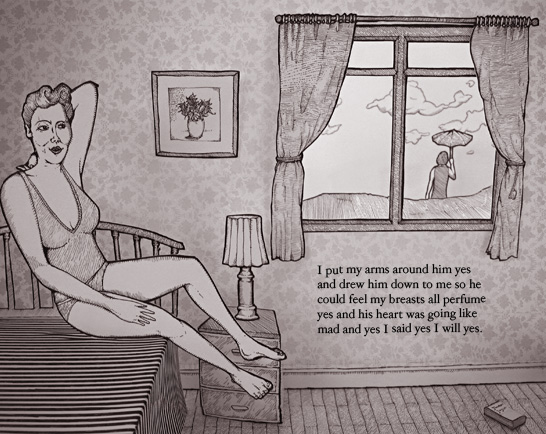
Anyone who’s read the “Circe/Nighttown” chapter of James Joyce’s Ulysses knows that Joyce had more than a passing interest in masochism, gender-role reversals, scatology, and other aspects of “deviant” sexuality (we put the word in quotations in an attempt to remove it from any pejorative or judgmental connotations and at the same time recognize that Joyce aspired to shock or otherwise disrupt his audience in his depictions of sexuality). But if you want to read something really filthy, something purposefully obscene, check out Joyce’s dirty letters to his wife Nora, written over a three month period in 1909 when the couple were separated due to a business trip. Joyce shows a particular fetish for coprophilia, expresses a desire to wear his wife’s underwear, and meticulously describes his wife’s farts. Gross stuff.
Ulysses “Seen” — Robert Berry

Because of its daunting reputation, many readers shy away from James Joyce’s Ulysses, when really the book is not nearly as challenging as some literati would have you believe. It’s funny and poignant and moving, and sure, it’s loaded with so many allusions that you’d have to spend a lifetime sorting them out, but once you get into its rhythm, its voices, it’s actually not that hard to read, and it’s certainly one of the most rewarding books I’ve ever read. One of the key difficulties for readers new to Ulysses is simply penetrating those first few pages, getting a visual for what’s going on with Buck Mulligan and young Stephen. Because Joyce is transposing events, both mythically, religiously, and chronologically, the opening is particularly challenging–especially because Joyce doesn’t explicate these shifts for the reader. There are plenty of aids out there, of course, from Harry Blamires’s The New Bloomsday Book to Joseph Campbell‘s fantastic lectures, and readers new to the book should not feel daunted or put off by the fact that this book might require a good. Led by Robert Berry, the folks at Throwaway Horse have started a new project, a comic book representation of Ulysses that is, to say the least, wildly ambitious. I’ll let them put it in their own words:
“Ulysses ‘SEEN’” is the inaugural project of Throwaway Horse LLC. Throwaway Horse is devoted to fostering understanding of public domain literary masterworks by joining the visual aid of the graphic novel with the explicatory aid of the internet. By creating “Web 2.0” versions of these works, we hope to proliferate and help to not only preserve them, but ensure their continued vitality and relevance. Throwaway Horse projects are meant to be mere companion pieces to the works themselves—by outfitting the reader with the familiar gear of the comic narrative and the progressive gear of web annotations, we hope that a tech-savvy new generation of readers will be able to cut through jungles of unfamiliar references and appreciate the subtlety and artistry of the original books themselves which they otherwise might have neglected.
So far, Berry has illustrated the first chapter (commonly referred to as “Telemachus”). Berry’s work is far more detailed than I initially had imagined was possible, and there are even useful annotations by scholar Mike Barsanti. This is truly a massive project, given the level of detail Berry has committed to the first chapter, and I think it will be an invaluable resource to readers new to Ulysses as well as those who’ve already been through the book before. Here’s hoping that we’ll get all the way to Molly’s final monologue!
(Thanks to Nick for the tip).
Passages From James Joyce’s Finnegans Wake — Mary Ellen Bute
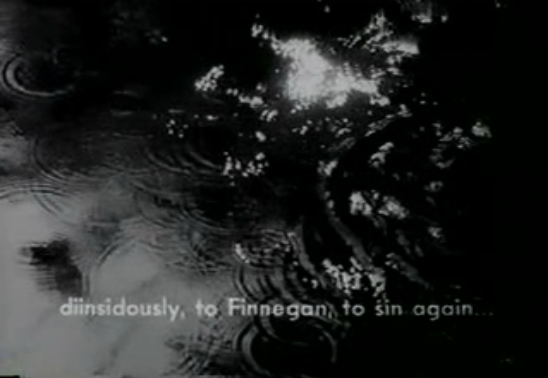
In the mid-sixties, Mary Ellen Bute made a surreal little film that kinda sorta illustrates James Joyce’s most inscrutable novel, Finnegans Wake. Watch the whole thing at UbuWeb Film. And you were going to celebrate St. Patrick’s Day by simply getting stinking drunk…for shame…for shame!
The Sound and the Fury — William Faulkner
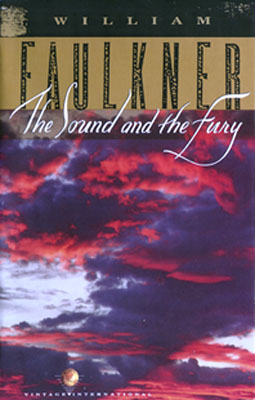
I don’t really know if there’s anything new I can say about Faulkner’s The Sound and the Fury in a blog post, and I’m not in the practice of writing term papers here, and you wouldn’t want to read one anyway. I’ll cop out and be vague but honest: the book was astounding and exhausting. I’ve read a number of Faulkner novels now, and The Sound and the Fury was easily my favorite. I’d attempted it a few times before, only to be thwarted by an inability to commit to the sustained concentration required to comprehend Faulkner’s stream-of-consciousness technique. The first section of the book, told from the perspective of Benjy, the seminal Faulknerian idiot man-child, is particulalry daunting, especially if you have no prior knowledge of the story of the Compson family, and I don’t think I would’ve made it through this reading if I didn’t arleady know the major themes and the trajectory of the plot. I’m actually kinda sorta shocked that the book was published at all, and I really wonder about its earliest audiences–how much context did they have? What guided them through the verbal detritus of the book’s first half?
I suppose that at the time of its publication in 1929, literary audiences were at least somewhat familiar–if not wholly intrigued by–the stream-of-consciousness technique pioneered in books like James Joyce’s Ulysses and Virginia Woolf’s Mrs. Dalloway. I read both of those books years before The Sound and the Fury, and I would make a subjective argument that they are quite a bit easier to enter into in terms of linearity and plot structure. Also, reading TSatF, I couldn’t help but feel the subtle resonance of Ulysses, particular in the constant use of omission. One of the things that makes Ulysses challenging is that Leopold Bloom frequently elides specific referents–we often get a “him” or a “he” or a “she” or an “it” without immediate context. Often, that context comes much, much later in the novel, with the net result that at times Bloom’s stream of consciousness is awfully ambiguous. Other times, Bloom seems unable to even think the words that would name the tragedies of his life (his dead son, his unfaithful wife, his outsider status in Dublin). Similarly, Faulkner’s Compsons are unable to directly name their own tragedies of promiscuity, suicide, alcoholism, madness, and financial decline. The effect is disarming and immediate, and while it can be very engaging, I can see how many readers would be alienated to the point that they can’t finish the book. I think there are a few simple solutions to the intrinsic problems of reading The Sound and the Fury, and at the risk of looking like a didactic asshole, I’ll share:
1) Read a brief plot summary first. I took a graduate seminar on Faulkner from which I gleaned the basic plot points and themes. (Ironically, the seminar assumed that any English major in grad school would have a working knowledge of the book, and instead focused on lesser-read volumes like Intruder in the Dust). Knowing the background of the Compson family did not ruin reading the book for me, nor did it replace an actual reading of Faulkner’s language–it simply gave me enough of a frame of reference not to throw up my hands in despair.
2) Read quickly and in long sittings. This is not a book that you can pick up and read a few pages of each night. Each chapter has a distinctive rhythm, and it takes a few pages to get into the pace and perspective of the chapter. I read the book in about eight sittings. I also found TSatF impossible to read at night before I was about to go to bed.
3) Don’t worry about getting everything in the first reading. Not possible. Enjoy the language, its strangeness. Marvel at Faulkner’s attempts–both successful and unsuccessful–to transcend time, space, and place. If you’re not enjoying it, why bother reading it?
Most of these suggestions could be applied to Ulysses as well. I brought up the possible influence of Joyce on Faulkner and I was interested enough to do a little research. The following text is from pages 208-209 of A William Faulkner Encyclopedia by Robert Hamblin and Charles Peek, and I think it neatly summarizes the issue:
When asked about the influence of Joyce on his own writing during the early years of his fame, following the publication of The Sound and the Fury and As I Lay Dying, Faulkner tended to be understandably evasive. In a 1932 interview with Henry Nash Smith, for example, Faulkner claimed, in fact, that he had never read Ulysses, invoking instead a vague aural source for his knowledge of Joycean methods: ” ‘ You know,’ he smiled, ‘sometimes I think there must be a sort of pollen of ideas floating in the air, which fertilizes similarly minds here and there which have not had direct contact. I had heard of Joyce, of course,’ he went on. ‘Some one told me about what he was doing, and it is possible that I was influenced by what I heard’ ” (LIG 30). In a moment of irony that may not have been lost on the interviewer, Faulkner reached over to his table and handed Smith a 1924 edition of the book. . . By 1947, Faulkner hardly needed to be so coy, telling an English class at the University of Mississippi that Joyce was “the father of modern literature” (1974 FAB 1230). By 1957, Faulkner’s pronouncements on Joyce had become fully classical: “James Joyce was one of the great men of my time. He was electrocuted by the divine fire” (LIG 280).
“Electrocuted by the divine fire” . . . very nice.
James Joyce Reads, You Listen!

Check out these mp3s of James Joyce reading selections from his novels (that word, “novel,” it doesn’t seem right…) Ulysses and Finnegans Wake. Lovely lilting rhythm. Mostly, it’s just cool to hear his voice. From the original liner notes by Sylvia Beach to the 1924 album (courtesy The Modern World):
In 1924 I went to the office of His Master’s Voice in Paris to ask them if they would record a reading by James Joyce from ULYSSES. But they would agree only if it were done at my expense. The record would not have their label on it, nor would it be listed in their catalogue. I accepted the terms: thirty copies of the recording to be paid for on delivery.
Joyce himself was anxious to have this recording made. He had made up his mind, he told me, that this would be his only reading from ULYSSES. Recording was done in a rather primitive manner in those days. All the same, I think the ULYSSES recording is a wonderful performance. I never hear it without being deeply moved.
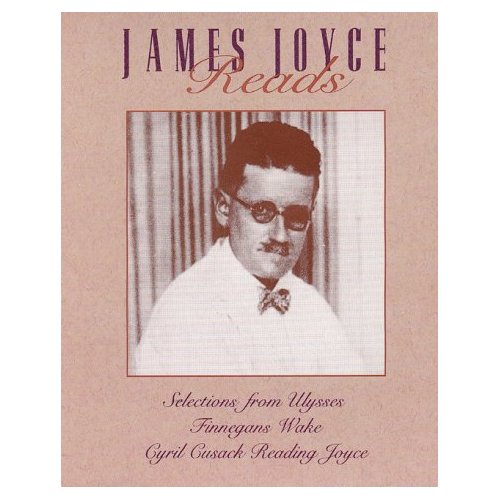
James Joyce reads from Finnegans Wake (part I)
James Joyce reads from Finnegans Wake (part II)
Jams Joyce reads from Ulysses (from the “Aeolus” episode)
Or, if you prefer, check out Jim Norton reading the first few pages of Finnegans Wake (from the audio book version, which who knows if listening to counts as reading the thing–but it’s pretty cool to hear an adult man make these noises and think that such a thing might be Great Literature).
Ulysses, Typography, Potatoes
I was delighted to stumble across the design work of Itamar Lerner whilst looking for Joycean images on the web (I now give myself one demerit for using the execrable phrasal verb “stumble across” to describe a web search, two demerits for using the unforgivably pretentious and archaic conjunction “whilst,” a hundred demerits for not editing the original sentence in the first place, and a thousand demerits for this long-winded excuse).
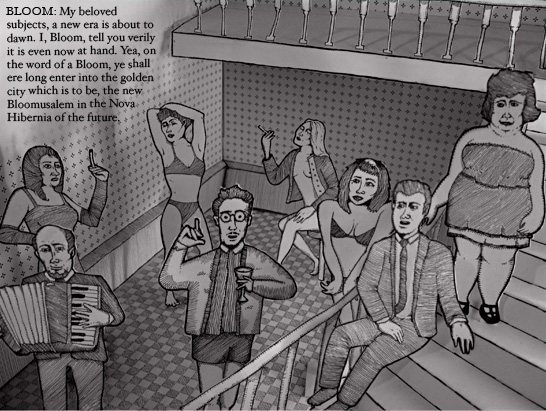
Lerner’s images of Ulysses do justice to both the humor and the pathos of Joyce’s complex episodes. Lerner’s self-described medium of “ink on cut out papers” creates a shaded depth that evokes comic strip art by way of a Punch and Judy show. I like it!
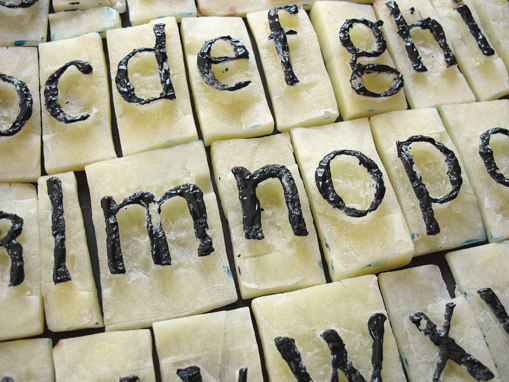
Lerner’s portfolio attests to his masterful fontsciousness: in addition to his original typefaces, he’s designed alphabets in wax, cement, and–my favorite–potatoes:
Some Like it Joyce
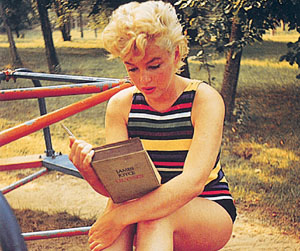
Eve Arnold’s famous photo of Marilyn Monroe reading Ulysses. Supposedly, she’s reading Molly Bloom’s sexy monologue at the end of Joyce’s novel. This pic is good too–

More info here. yes I said yes I will Yes.
Dubliners — James Joyce
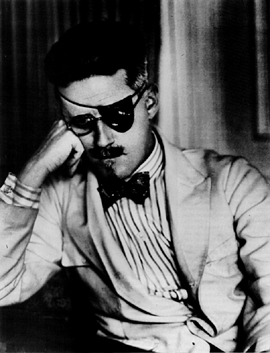
#1 Stunna James Joyce thinkin’ deep thoughts
James Joyce’s Dubliners was one of those books I read in college, shelved under “got it,” and moved on without a second thought. I just re-read (and then re-re-read) the collection again: there’s much, much more to this book than I remembered. Dubliners has always been overshadowed by Joyce’s later works, A Portrait of the Artist as a Young Man, Ulysses, and Finnegans Wake. A closer reading of these fifteen short stories–which effectively unite as a work of complex structure–reveals that many of the themes of the later masterpieces, as well as Joyce’s rhetorical technique, are prefigured in Dubliners. On the surface, the stories seem straightforward–at least in a modernist/realist sense–slice of life urban literature, stripped of romance. Indeed, Dubliners seems to take all of its characters at an ironic distance, treating the protagonists to a series of negative epiphanies. Joyce explores the literally vulgar language of commerce, rife with trite clichés and placeholders, to show how what is not said in customary discourse jars against what custom does permit. The greatest aspect of psychological realism (whatever that means) in Dubliners results from the conflation of voices at play in the stories. The characters imagine their identities in language, a language culled from equal parts Romantic poetry and Bible verses and street signs and post office directories. The intense self-consciousness revealed by the characters calls for a strange mix of empathy and loathing and ironic distancing and even embarrassment on the part of the reader. I think that this style, combined with the anti-epiphanies figured in each story, is something so thoroughly normal, even expected by the contemporary reader, that it becomes easy to overlook just how groundbreaking and prescient these stories were at the beginning of the twentieth century. If you’ve read these, take the time to re-read them. If you haven’t given Joyce a shot, this is the right place to start.
If you don’t have time to read all fifteen in the collection but still want the rhetorical gist, read: “The Sisters,” “Araby,” “An Encounter,” “Eveline,” “Two Gallants,” “A Little Cloud,” “A Painful Case,” and, of course, “The Dead.” Or, if you’re really pressed for time: “The Sisters” and “The Dead.” Have at it.
 Biblioklept
