
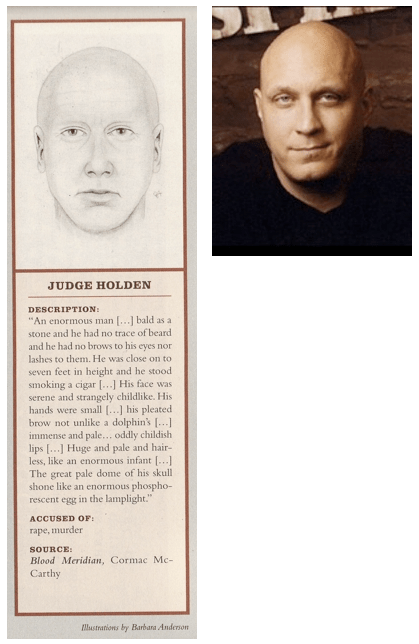
Cormac McCarthy’s Blood Meridian begins as a strange, violent picaresque bildungsroman, detailing the adventures of a teenage runaway known only as “the kid.” When the Kid falls in with John Glanton’s marauders, the narrative lens expands and pulls back; Glanton’s gang essentially envelopes the Kid’s personality. The pronoun “they” dominates the Kid’s own agency, for the most part, and the massive figure of Judge Holden usurps the narrative’s voice. The effect is that the Glanton gang’s killing, raping, and scalping spree becomes essentially de-personalized, and, to a certain extent, amoralized.
The Kid, and perhaps the ex-priest Tobin and the Kid’s erstwhile partner Toadvine, are the only major characters who bear any semblance of conventional morality in the narrative. The Kid exhibits a willingness to help others early on when he agrees to stitch one of Tobin’s wounds; later, he removes an arrowhead from a wounded man when no other member of the company will (Tobin chides him for caring, declaring that the wounded man would have killed the Kid had the Kid’s efforts been unsuccessful). For most of the central narrative though, the Kid’s individual actions are consumed into the gang’s “they.” However, at the beginning of chapter 15 the narrative focuses again on the Kid, who is charged with killing a wounded man named Shelby to “spare” him from the approaching Mexican army (this is a bizarre version of mercy in Blood Meridian). Shelby pleads to live and the Kid allows it, even giving the man some water from his own canteen. After he leaves he catches up with a man named Tate whose horse is wounded. Tate remarks on the boy’s foolishness for helping him, but the Kid does so nonetheless, sharing Tate’s burden as they try to make their way back to the rest of their party. Tate is soon killed by Mexican scouts. In both cases, the outcome of the Kid’s moral actions–the will to help, to save, to preserve life–are negated by the book’s narrative outcomes, but I would argue that his intentions in the face of violence somehow secure his humanity.
His journey alone to rejoin the Glanton gang is figured as a kind of vision quest, a strange echo of Christ in the desert, perhaps. At its core–and perhaps the moral core of the book–is the following strange passage–
It was a lone tree burning on the desert. A herladic tree that the passing storm had left afire. The solitary pilgrim drawn up before it had traveled far to be here and he knelt in the hot sand and held his numbed hands out while all about in that circle attended companies of lesser auxiliaries routed forth into the inordinate day, small owls that crouched silently and stood from foot to foot and tarantulas and solpugas and vinegarroons and the vicious mygale spiders and beaded lizards with mouths black as a chowdog’s, deadly to man, and the little desert basilisks that jet blood from their eyes and the small sandvipers like seemly gods, silent and the same, in Jedda, in Babylon. A constellation of ignited eyes that edged the ring of light all bound in a precarious truce before the torch whose brightness had set back the stars in their sockets.
The burning tree alludes to YHWH’s appearance to Moses as a burning bush, and also the tree of smoke that led the Israelites through the desert. Significantly, all the strange, terrible creatures of the desert come to meet around it in a “precarious truce.” The burning tree inverts the natural, inescapable violence that dominates the novel and turns it into a solitary, singular moment of peace. When the Kid awakes–alone–the tree is merely a “smoldering skeleton of a blackened scrog.” God is not in the permanence of the object but rather in the witnessing of the event–Blood Meridian locates (a version of a) god in the natural violence of burning and consumption. There is a strong contrast here, I believe, with the book’s other version of god, the Judge’s proclamation that “War is god.” The Judge, a cunning, devilish trickster, wants to reduce (or enlarge) war to all contest of wills, to pure violence–to divorce it from any ideological structure. Yet the burning tree episode reveals natural violence divorced from ideology. The animals (and the man, the Kid) suspend their Darwinian animosities in order to witness the sublime. The episode is silent, outside of language, order, ideology. This silence is echoed in the novel’s final confrontation between the Judge and the Kid, who retorts simply “You ain’t nothin'” to the Judge’s barrage of grandiose language. While the rejoinder may not save the Kid, its rejection perhaps saves his soul (if such a thing exists in the novel, which I believe it does). So, while larger-than-life Judge Holden may dominate the novel, Cormac McCarthy has nonetheless given us another moral road to follow, should we choose.
[Ed. note—Biblioklept first published a version of this post in October, 2010.]
 In his
 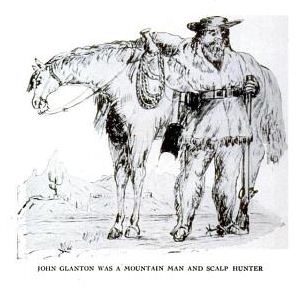 According to Chamberlain, John Glanton was born in South Carolina and migrated to Stephen Austin’s settlement in Texas. There he fell in love with an orphan girl and was prepared to marry her. One day while he was gone, Lipan warriors raided the area scalping the elderly and the children and kidnapping the women- including Glanton’s fiancee. Glanton and the other settlers pursued and slaughtered the natives, but during the battle the women were tomahawked and scalped. Legend has it, Glanton began a series of retaliatory raids which always yielded “fresh scalps.” When Texas fought for its independence from Mexico, Glanton fought with Col. Fannin, and was one of the few to escape the slaughter of that regiment at the hands of the Mexican Gen. Urrea- the man who would eventually employ Glanton as a scalp hunter. During the Range Wars, Glanton took no side but simply assassinated individuals who had crossed him. He was banished, to no avail, by Gen. Sam Houston and fought as a “free Ranger” in the war against Mexico. Following the war he took up the Urrea’s offer of $50 per Apache scalp (with a bonus of $1000 for the scalp of the Chief Santana). Local rumor had it that Glanton always “raised the hair” of the Indians he killed and that he had a “mule load of these barbarous trophies, smoke-dried” in his hut even before he turned professional.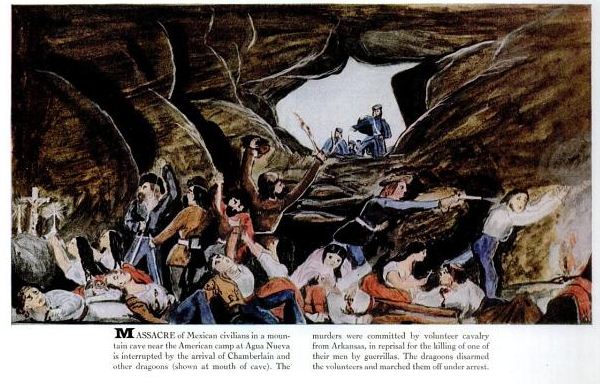
 It’s fascinating to note how much of the Judge is already there–the pedophilia, the marksmanship, the scholarship, and, most interesting of all, the lack of hair. Confession goes on to detail the killing, scalping, raping, and raiding spree that comprises the center of Blood Meridian. Chamberlain even describes the final battle with the Yumas, an event that signals the dissolution of the Glanton gang in McCarthy’s novel.
 Content aside, Chamberlain’s prose also seems to presage McCarthy’s prose. In his book
  You can view many of Chamberlain’s paintings and read an edit of his Confession in three editions of Life magazine from 1956, digitally preserved thanks to Google Books–here’s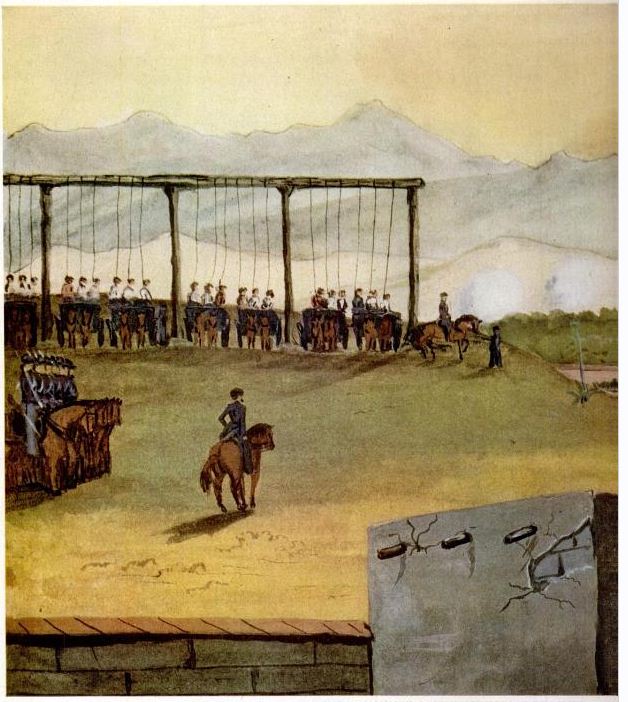




 Biblioklept