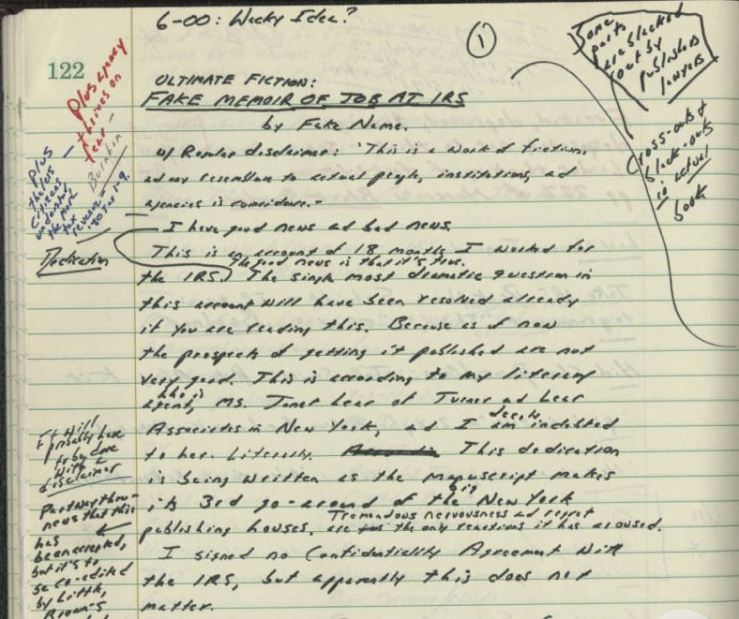
Ultimate Fiction: Fake Memoir of Job at IRS by Fake Name (David Foster Wallace Archive)

dfwThe David Foster Wallace archive at the Harry Ransom Center UT has made some documents from The Pale King accessible online, including a few pages of his workbook, handwritten drafts, and typed edits.

dfw2

(Via).


Letter to Nathaniel Hawthorne, November 1851 — Herman Melville

My Dear Hawthorne, — People think that if a man has undergone any hardship, he should have a reward; but for my part, if I have done the hardest possible day’s work, and then come to sit down in a corner and eat my supper comfortably — why, then I don’t think I deserve any reward for my hard day’s work — for am I not now at peace? Is not my supper good? My peace and my supper are my reward, my dear Hawthorne. So your joy-giving and exultation-breeding letter is not my reward for my ditcher’s work with that book, but is the good goddess’s bonus over and above what was stipulated — for for not one man in five cycles, who is wise, will expect appreciative recognition from his fellows, or any one of them. Appreciation! Recognition! Is love appreciated? Why, ever since Adam, who has got to the meaning of this great allegory — the world? Then we pygmies must be content to have our paper allegories but ill comprehended. I say your appreciation is my glorious gratuity. In my proud, humble way, — a shepherd-king, — I was lord of a little vale in the solitary Crimea; but you have now given me the crown of India. But on trying it on my head, I found it fell down on my ears, notwithstanding their asinine length — for it’s only such ears that sustain such crowns.

Your letter was handed me last night on the road going to Mr. Morewood’s, and I read it there. Had I been at home, I would have sat down at once and answered it. In me divine maganimities are spontaneous and instantaneous — catch them while you can. The world goes round, and the other side comes up. So now I can’t write what I felt. But I felt pantheistic then — your heart beat in my ribs and mine in yours, and both in God’s. A sense of unspeakable security is in me this moment, on account of your having understood the book. I have written a wicked book, and feel spotless as the lamb. Ineffable socialities are in me. I would sit down and dine with you and all the gods in old Rome’s Pantheon. It is a strange feeling — no hopefulness is in it, no despair. Content — that is it; and irresponsibility; but without licentious inclination. I speak now of my profoundest sense of being, not of an incidental feeling.

Whence come you, Hawthorne? By what right do you drink from my flagon of life? And when I put it to my lips — lo, they are yours and not mine. I feel that the Godhead is broken up like the bread at the Supper, and that we are the pieces. Hence this infinite fraternity of feeling. Now, sympathizing with the paper, my angel turns over another page. you did not care a penny for the book. But, now and then as you read, you understood the pervading thought that impelled the book — and that you praised. Was it not so? You were archangel enough to despise the imperfect body, and embrace the soul. Once you hugged the ugly Socrates because you saw the flame in the mouth, and heard the rushing of the demon, — the familiar, — and recognized the sound; for you have heard it in your own solitudes.

My dear Hawthorne, the atmospheric skepticisms steal into me now, and make me doubtful of my sanity in writing you thus. But, believe me, I am not mad, most noble Festus! But truth is ever incoherent, and when the big hearts strike together, the concussion is a little stunning. Farewell. Don’t write a word about the book. That would be robbing me of my miserly delight. I am heartily sorry I ever wrote anything about you — it was paltry. Lord, when shall we be done growing? As long as we have anything more to do, we have done nothing. So,now, let us add Moby Dick to our blessing, and step from that. Leviathan is not the biggest fish; — I have heard if Krakens.

This is a long letter, but you are not at all bound to answer it. Possibly, if you do answer it, and direct it to Herman Melville, you will missend it — for the very fingers that now guide this pen are not precisely the same that just took it up and put it on this paper. Lord, when shall we be done changing? Ah! it’s a long stage, and no inn in sight, and night coming, and the body cold. But with you for a passenger, I am content and can be happy. I shall leave the world, I feel, with more satisfaction for having come to know you. Knowing you persuades me more than the Bible of our immortality.

What a pity, that, for your plain, bluff letter, you should get such gibberish! Mention me to Mrs. Hawthorne and to the children, and so, good-by to you, with my blessing.

Herman.

P.S. I can’t stop yet. If the world was entirely made up of Magians, I’ll tell you what I should do. I should have a paper-mill established at one end of the house, and so have an endless riband of foolscap rolling in upon my desk; and upon that endless riband I should write a thousand — a million — billion thoughts, all under the form of a letter to you. The divine magnet is on you, and my magnet responds. Which is the biggest? A foolish question — they are One.

H.

P.P.S. Don’t think that by writing me a letter, you shall always be bored with an immediate reply to it — and so keep both of us delving over a writing-desk eternally. No such thing! I sh’n’t always answer your letters, and you may do just as you please.

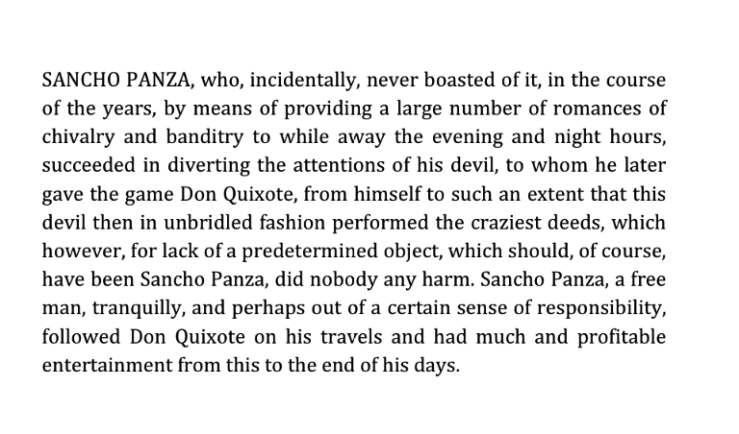
“The Truth about Sancho Panza” — Franz Kafka

IMG_0100

A Conversation about Ben Lerner’s Novel 10:04 (Part 1)

1004

[Context/editorial note: Ben Lerner’s new novel 10:04 wasn’t on my radar until Ryan Chang, who has been contributing reviews, riffs, citations, and other good stuff to this blog for the some time now, brought it up. He digs it, I don’t—but in fairness, I haven’t finished it yet. I was determined to abandon it, but Ryan’s emails kept me interested enough to continue; our conversation of the past five days is presented below. The book frustrates and rewards; at times I’ve laughed out loud and at other moments I’ve sprained my eyeballs by rolling them. More to come, because this is pretty long—but I think Ryan, who offers the bulk of the analysis here, makes a strong case for Lerner’s book. — ET].   

Edwin Turner: Got an e-galley of the Lerner book. I don’t know if it’s that I’m almost exactly the same age as Lerner/the narrator or what, but I really really hate it so far! He’s very smart and the sentences are often great, but I find myself rolling my eyes at a lot of what he’s doing—it’s probably me not him. The narrative voice strikes me as so thoroughly inauthentic that I want to grab the narrator by the lapels and shout, Quit aping Sebald, quit trying to show how clever you are, and just observe and report! Again, it’s probably me not him.

Ryan Chang: I know what you mean; though it won’t bear any difference to your reading, I can attest personally to the diction & syntax of the narrator and Lerner himself (indeed, he does speak like that). I don’t think it’s an affectation, but I think it’s real “poet-y.” It is a criticism I forgive b/c I see that the tension between authenticity (of time) and inauthenticity (of time; especially exemplified in the Whole Foods/Instant coffee scene — which narrative context of time determines the Real, the Market (or its interpretation of Universal time) or our intuition (something like Whitmanic time, where time is experienced not on a linear, progressive plane but a circular, lateral one?)) is a crucial thread that runs throughout 10:04 and in Lerner’s other work. That said, I know  that in reviews to come of the book he’ll get slammed for that (I think the Kirkus review already did this).

A lot of my friends echo your distaste for Lerner for those exact same reasons, and I totally see why, and I’m kind of annoyed by it too. For me, the success of the book lies in the reclamation of fiction as a communal space from fetish book object/commercial futurity (author advances, agents, contracts, etc. — you already get some of this early on but there is more to come in a beautifully scathing scene of the NYC literary scene) And also, a kind of shiv to the Standard American Novelistic Form that reinforces traditional forms of American identity-making that Gass/Gaddis/Markson et al. have been doing for years and, I think, a poisonous strain of American political sentimentality that keeps most of us “depressed.” I think, too, because I’ve read it twice now, that there is an acknowledgment of his complicity in the very machines he participates in, and an inability, at least on his own, to dismantle those systems. Not sure if we should forgive him for criticizing the bourgeois Food Co-Op while being a member, albeit begrudgingly or tolerate his admission. There’s a lot of celebration of Whitmanic politics in that book, a return to a kind of Whitmanic democratic person is a return to a democratic reading is a return to a “real” democracy shared through the space of the book, of the position of the reader looking at an object and knowing that her “I” is shared amongst several. I’m not sure if you’ve gotten here yet, but he keeps intoning this phrase “bad forms of collectivity” as a better solution than nothing, than “modernist difficulty as resistance to the market.”

The Sebald comparison is apt, esp. with the form & diction & syntax, and I agree with you–Sebald is the master. There’s also something to be said, though, that this kind of fiction-making is badly needed in contemporary American letters on the Big 5 Publishing scene. I mean, I can’t read another fucking book about Brooklyn parents or mid-career Manhattan artist crises without wringing my neck. The kind of book Sebald innovated, too, is able to dismantle received ideas of art/history/writing/identity etc.;  I may be being too generous here, but I think it’s a form that will see continued adoption on this side of the pond.

ET: So your response made me return to the book, Ryan. The line that made me quit was something like, “The place was so quiet I could hear the bartender mixing our artisanal cocktails” or something like that—-I’m still not sure how to read that line as anything but a parody, but I think that the narrator, author, and writer are all sincere in trying to capture or document a particular time/feeling with the phrase. And as I continued reading, I was rewarded by the episode of the older poets/mentors, and their “daughter,” whom the narrator obsessed over—a very fine passage—humorous, reflective, a kind of parodic-but-sincere take on wanting to belong to a particular artistic scene. (What continues to unsettle me is the narrator’s assurance of his own achievement, although I could be wrong).

Continue reading “A Conversation about Ben Lerner’s Novel 10:04 (Part 1)”

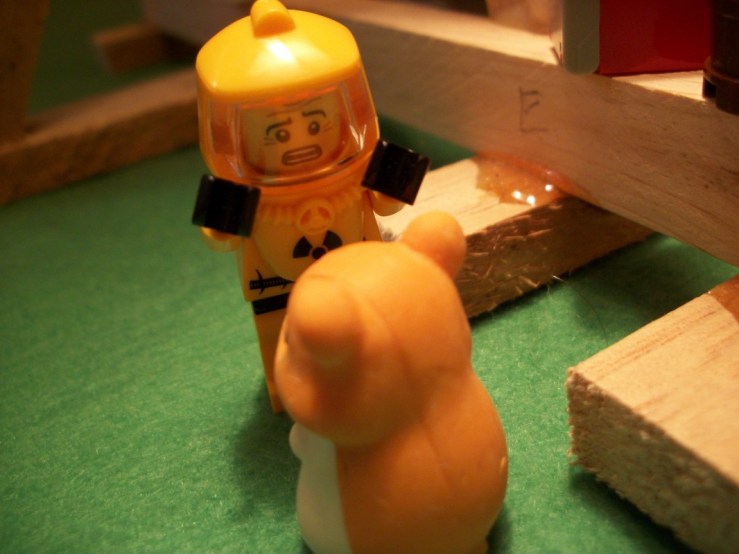
Feral hamsters are not pets. They mean business.

2976326_orig

I had a fantasy of heaven’s being broken into fleecy fragments | Nathaniel Hawthorne’s Notebook Entry for August 27, 1839

August 27th.–I have been stationed all day at the end of Long Wharf, and I rather think that I had the most eligible situation of anybody in Boston. I was aware that it must be intensely hot in the midst of the city; but there was only a short space of uncomfortable heat in my region, half-way towards the centre of the harbor; and almost all the time there was a pure and delightful breeze, fluttering and palpitating, sometimes shyly kissing my brow, then dying away, and then rushing upon me in livelier sport, so that I was fain to settle my straw hat more tightly upon my head. Late in the afternoon, there was a sunny shower, which came down so like a benediction that it seemed ungrateful to take shelter in the cabin or to put up an umbrella. Then there was a rainbow, or a large segment of one, so exceedingly brilliant and of such long endurance that I almost fancied it was stained into the sky, and would continue there permanently. And there were clouds floating all about,–great clouds and small, of all glorious and lovely hues (save that imperial crimson which was revealed to our united gaze),–so glorious, indeed, and so lovely, that I had a fantasy of heaven’s being broken into fleecy fragments and dispersed through space, with its blest inhabitants dwelling blissfully upon those scattered islands.

From Nathaniel Hawthorne’s American Note-Books.

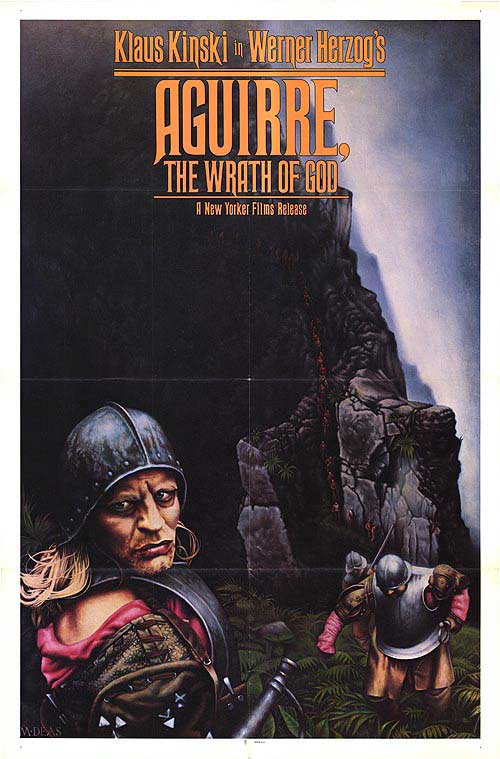
Aguirre, The Wrath of God — Werner Herzog (Full Film)

mpw-32992

“A Famous Dancer” — Thomas Bernhard

20140721-162338-59018084.jpg

“A Short Novel” | Doris Lessing’s The Golden Notebook

*11 A SHORT NOVEL

Two people together, in any kind of relationship—mother, son; father, daughter; lovers; it doesn’t matter. One of them acutely neurotic. The neurotic hands on his or her state to the other, who takes it over, leaving the sick one well, the well one sick.

From Doris Lessing’s novel The Golden Notebook.

“To Whoever Is Reading Me” — Jorge Luis Borges

IMG_3142

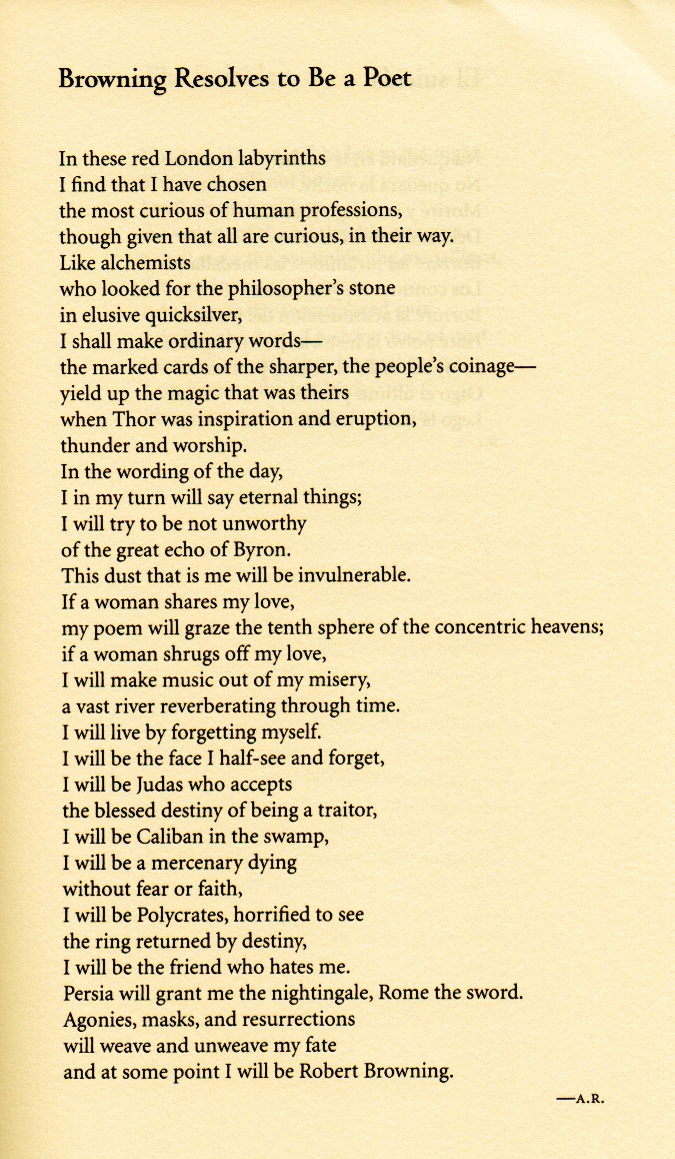
“Browning Resolves to Be a Poet” — Jorge Luis Borges

IMG_3144.JPG

“The Ethnographer” — Jorge Luis Borges

“The Ethnographer”
by
Jorge Luis Borges

I was told about the case in Texas, but it had happened in another state. It has a single protagonist (though in every story there are thousands of protagonists, visible and invisible, alive and dead). The man’s name, I believe, was Fred Murdock. He was tall, as Americans are; his hair was neither blond nor dark, his features were sharp, and he spoke very little. There was nothing singular about him, not even that feigned singularity that young men affect. He was naturally respectful, and he distrusted neither books nor the men and women who write them. He was at that age when a man doesn’t yet know who he is, and so is ready to throw himself into whatever chance puts in his way — Persian mysticism or the unknown origins of Hungarian, the hazards of war or algebra, Puritanism or orgy. At the university, an adviser had interested him in Amerindian languages. Certain esoteric rites still survived in certain tribes out West; one of his professors, an older man, suggested that he go live on a reservation, observe the rites, and discover the secret revealed by the medicine men to the initiates. When he came back, he would have his dissertation, and the university authorities would see that it was published. Murdock leaped at the suggestion. One of his ancestors had died in the frontier wars; that bygone conflict of his race was now a link. He must have foreseen the difficulties that lay ahead for him; he would have to convince the red men to accept him as one of their own. He set out upon the long adventure. He lived for more than two years on the prairie, sometimes sheltered by adobe walls and sometimes in the open. He rose before dawn, went to bed at sundown, and came to dream in a language that was not that of his fathers. He conditioned his palate to harsh flavors, he covered himself with strange clothing, he forgot his friends and the city, he came to think in a fashion that the logic of his mind rejected. During the first few months of his new education he secretly took notes; later, he tore the notes up — perhaps to avoid drawing suspicion upon himself, perhaps because he no longer needed them. After a period of time (determined upon in advance by certain practices, both spiritual and physical), the priest instructed Murdock to start remembering his dreams, and to recount them to him at daybreak each morning. The young man found that on nights of the full moon he dreamed of buffalo. He reported these recurrent dreams to his teacher; the teacher at last revealed to him the tribe’s secret doctrine. One morning, without saying a word to anyone, Murdock left.

In the city, he was homesick for those first evenings on the prairie when, long ago, he had been homesick for the city. He made his way to his professor’s office and told him that he knew the secret, but had resolved not to reveal it.

“Are you bound by your oath?” the professor asked.

“That’s not the reason,” Murdock replied. “I learned something out there that I can’t express.”

“The English language may not be able to communicate it,” the professor suggested.

“That’s not it, sir. Now that I possess the secret, I could tell it in a hundred different and even contradictory ways. I don’t know how to tell you this, but the secret is beautiful, and science, our science, seems mere frivolity to me now.”

After a pause he added: “And anyway, the secret is not as important as the paths that led me to it. Each person has to walk those paths himself.”

The professor spoke coldly: “I will inform the committee of your decision. Are you planning to live among the Indians?”

“No,” Murdock answered. “I may not even go back to the prairie. What the men of the prairie taught me is good anywhere and for any circumstances.”

That was the essence of their conversation.

Fred married, divorced, and is now one of the librarians at Yale.

(Translation by Andrew Hurley).

“The Silence” — Michelangelo Antonioni

20140716-162722-59242226.jpg

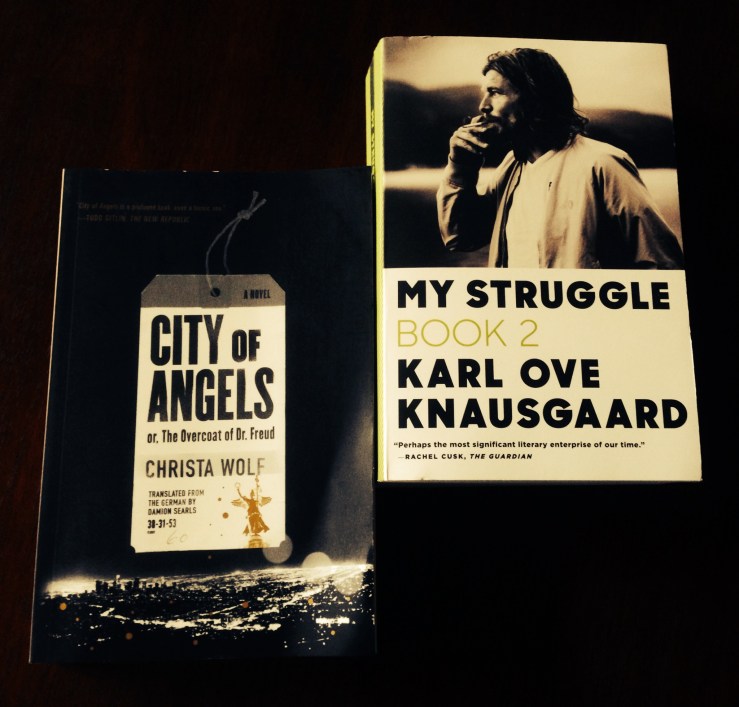
Karl Ove Knaussgard/Christa Wolf (Books Acquired, 8.11.2014)

IMG_3111

Came back to work for the fall semester and these were in my mailbox.

I like the older, zanier, less-austere FS&G paperback covers of the Knausgaard better.

Read Roberto Bolaño’s short story “William Burns”

Untitled (Two Dogs Fighting), Bill Traylor

I could no longer hold out on reading Roberto Bolaño’s collection The Return. I’ve been saving the book for two years now, but reading Chris Andrews’s new study Roberto Bolaño’s Fiction: An Expanding Universe prompted me to dive in the other night. (I also maybe abandoned Michel Houellebecq’s The Possibility of an Island, which nags at me like a duty, a chore, and not a joy). 

I had, of course, read a few of the stories collected in The Return over the years (and shared them on this site); they were published by The New Yorker, including one of my favorites, “William Burns,” (translated, like all the stories in The Return, by Andrews. 

“William Burns” is one of Bolaño’s rare stories set in the U.S. It’s about a “laid-back guy who never lost his cool,” a private investigator hired to protect two women who believe they are being stalked by a killer. The story is suffused with sinister malice that burns into fated violence, made all the more ominous by the Bolaño’s typically atypical moments of banality. (The story reads almost as Bolaño’s riff on Raymond Carver). 

Anyway, a favorite passage; read the whole thing here:

If I were a dog, I thought resentfully, these women would show me a bit more consideration. Later, after I realized that none of us were feeling sleepy, they started talking about children, and their voices made my heart recoil. I have seen terrible, evil things, sights to make a hard man flinch, but, listening to the women that night, my heart recoiled so violently it almost disappeared. I tried to butt in, I tried to find out if they were recalling scenes from childhood or talking about real children in the present, but I couldn’t. My throat felt as if it were packed with bandages and cotton swabs.

Another New Yorker Reading List

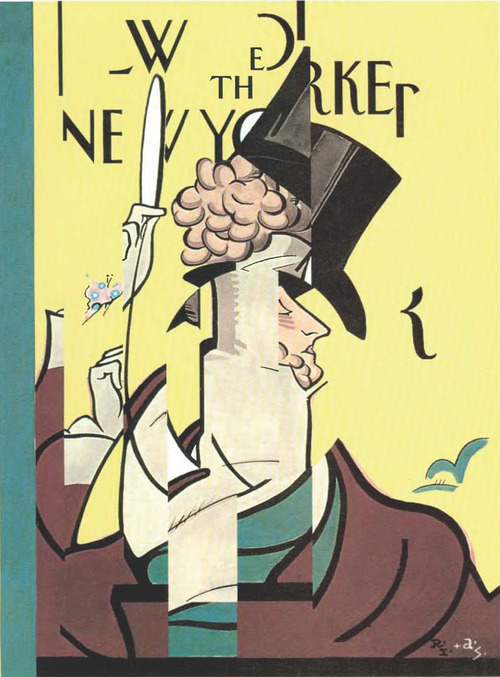
Art Spiegelman's Eustace Tilley
Art Spiegelman’s Eustace Tilley

So, you’re probably aware that The New Yorker has opened up some of its archive for the summer.

I posted a reading list last month of some of my favorite short stories from the magazine (okay, favorite open stories), as well as a few I hadn’t read before, like pieces from Janet Frame and Annie Proulx.

Here’s another list, a baker’s dozen, including some stuff I hadn’t read before the archive opened, as well as suggestions offered by some folks on twitter:

“The Other Place” by Mary Gaitskill

“Escape from Spiderhead” by George Saunders

“Goo Book” by Keith Ridgway

“Black Box” by Jennifer Egan

“The Five-Forty-Eight” by John Cheever”

“Brother on Sunday” by A.M. Homes

“A Beneficiary” by Nadine Gordimer

“A Village After Dark”  by Kazuo Ishiguro

“Still Life” by Don DeLillo

“Other People’s Deaths” by Lore Segal

“Going for Beer” by Robert Coover

“A Silver Dish” by Saul Bellow

“To the Measures Fall” by Richard Powers

For me, the word “writing” is the exact opposite of the word “waiting” (Roberto Bolaño)

The truth is, I don’t believe all that much in writing. Starting with my own. Being a writer is pleasant—no, pleasant isn’t the word—it’s an activity that has its share of amusing moments, but I know of other things that are even more amusing, amusing in the same way that literature is for me. Holding up banks, for example. Or directing movies. Or being a gigolo. Or being a child again and playing on a more or less apocalyptic soccer team. Unfortunately, the child grows up, the bank robber is killed, the director runs out of money, the gigolo gets sick and then there’s no other choice but to write. For me, the word “writing” is the exact opposite of the word “waiting.” Instead of waiting, there is writing. Well, I’m probably wrong—it’s possible that writing is another form of waiting, of delaying things. I’d like to think otherwise. But, as I said, I’m probably wrong.

Roberto Bolaño, in a 2001 email interview with Carmen Boullosa. First published in Bomb and then collected in Melville House’s The Last Interview.