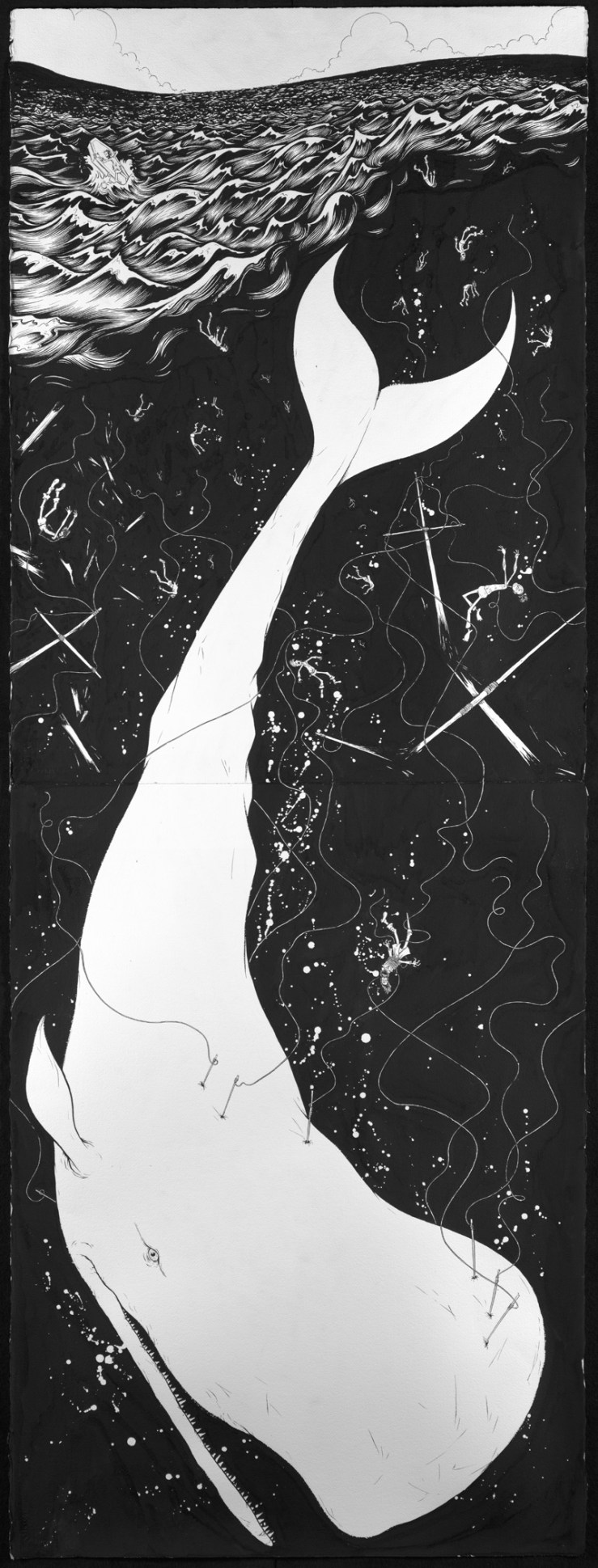
Self-Portrait as Ishmael — Bo Bartlett

Herman Melville’s Whale Steaks

Another entry in our ongoing series of literary recipes to celebrate Thanksgiving.

In Chapter LXIV of Herman Melville’s Moby-Dick, Stubb, second mate of the Pequod, demands whale steaks for dinner. He’s not happy with how the cook has prepared the steaks though, complaining they are too tender and overdone — his taste is closer to the sharks who are making a racket outside the ship–

“Cook,” said Stubb, rapidly lifting a rather reddish morsel to his mouth, ” don’t you think this steak is rather overdone? You’ve been beating this steak too much, cook; it’s too tender. Don’t I always say that to be good, a whalesteak must be tough? There are those sharks now over the side, don’t you see they prefer it tough and rare? What a shindy they are kicking up! Cook, go and talk to ’em; tell ’em they are welcome to help themselves civilly, and in moderation, but they must keep quiet. Blast me, if I can hear my own voice. Away, cook, and deliver my message. Here, take this lantern,” snatching one from his sideboard; ” now, then, go and preach to ’em! “

Stubb then instructs the cook on the best way to prepare whale steaks, a process involving a hot live coal. Oh, and he likes his fins pickled and his flukes soused–

“Well then, cook, you see this whale-steak of yours was so very bad, that I have put it out of sight as soon as possible; you see that, don’t you? Well, for the future, when you cook another whale-steak for my private table here, the capstan, I’ll tell you what to do so as not to spoil it by overdoing. Hold the steak in one hand, and show a live coal to it with the other; that done, dish it; d’ye hear? And now to-morrow, cook, when we are cutting in the fish, be sure you stand by to get the tips of his fins; have them put in pickle. As for the ends of the flukes, have them soused, cook. There, now ye may go.”

Three (Somewhat Literary) Lists for 11 | 11 | 11

Eleven Authors Who Were Also Veterans of War

1. Stendahl (Napoleonic Wars)

2. Ambrose Bierce (Union Army, American Civil War)

3. Erich Maria Remarque (German Army, WWI)

4. George Orwell (Republican Army, Spanish Civil War)

5. Kurt Vonnegut (U.S. Army, WWII)

6. Joseph Heller (U.S. Air Force, WWII)

7. Eveyln Waugh (British Royal Marines, WWII)

8. Norman Mailer (U.S Army, WWII)

9. Gore Vidal (U.S. Army, WWII)

10. Tim O’Brien (U.S. Army, Vietnam War)

11. Anthony Swofford (U.S. Marine Corps, Persian Gulf War)

*          *          *

Eleven Encyclopedic Books, Overstuffed with References, That Compel Compulsive Reading

1. Moby-Dick, Herman Melville

2. Finnegans Wake, James Joyce

3. Expelled from Eden, A WilliamVollmann Reader

4. Species of Spaces and Other Pieces, Georges Perec

5. Wittgenstein’s Mistress, David Markson

6. The Silmarillion, J.R.R. Tolkien

7. Foucault’s Pendulum, Umberto Eco

8. The Rings of Saturn, W.G. Sebald

9. The Recognitions, William Gaddis

10. Between Parentheses, Roberto Bolaño

11.  The Architecture of the Arkansas Ozarks, Donald Harrington

*          *          *

Eleven Excellent Films About Films and Film-making 

1. Hearts of Darkness, Eleanor Coppola, et al

2. Lost in La Mancha, Keith Fulton et al

3. Burden of Dreams, Les Blank

4. Adaptation, Spike Jonze

5. Be Kind Rewind, Michel Gondry

6. The Player, Robert Altman

7. Ed Wood, Tim Burton

8. Stardust Memories, Woody Allen

9. Sullivan’s Travels, Preston Sturges

10. American Movie, Chris Smith

11. Barton Fink, Coen Brothers

“Don’t Kill Whales” — The Animaniacs Confront Captain Ahab

The Origin of “Moby Dick”

Where did Herman Melville get the strange, marvelous name of the leviathan at the center of his strange, marvelous novel Moby-Dick? The name of the great white whale derives from  an 1839 article by Jeremiah Reynolds, “Mocha Dick: or The White Whale of the Pacific” (originally published in Knickerbocker Magazine). As the editors of Melville.org point out though (and thanks be unto them for all their hard, excellent work), how “Mocha Dick” morphed into “Moby Dick” remains “some strange piece of hermetic Melvillean arcana.” From Reynolds’s article

But to return to Mocha Dick — which, it may be observed, few were solicitous to do, who had once escaped from him. This renowned monster, who had come off victorious in a hundred fights with his pursuers, was an old bull whale, of prodigious size and strength. From the effect of age, or more probably from a freak of nature, as exhibited in the case of the Ethiopian Albino, a singular consequence had resulted — he was white as wool! Instead of projecting his spout obliquely forward, and puffing with a short, convulsive effort, accompanied by a snorting noise, as usual with his species, he flung the water from his nose in a lofty, perpendicular, expanded volume, at regular and somewhat distant intervals; its expulsion producing a continuous roar, like that of vapor struggling from the safety-valve of a powerful steam engine. Viewed from a distance, the practised eye of the sailor only could decide, that the moving mass, which constituted this enormous animal, was not a white cloud sailing along the horizon. On the spermaceti whale, barnacles are rarely discovered; but upon the head of this lusus naturae, they had clustered, until it became absolutely rugged with the shells. In short, regard him as you would, he was a most extraordinary fish; or, in the vernacular of Nantucket, “a genuine old sog”, of the first water.

“I am like one of those seeds taken out of the Egyptian Pyramids” — Herman Melville Writes to Nathaniel Hawthorne

From Herman Melville’s June 1851 letter to Nathaniel Hawthorne (read the whole letter here)—

But I was talking about the “Whale” [“Moby-Dick”]. As the fishermen say, “he’s in his flurry” when I left him some three weeks ago. I’m going to take him by his jaw, however, before long, and finish him up in some fashion or other. What’s the use of elaborating what, in its very essence, is so short-lived as a modern book? Though I wrote the Gospels in this century, I should die in the gutter. — I talk all about myself, and this is selfishness and egotism. Granted. But how help it? I am writing to you; I know little about you, but something about myself so I write about myself, — at least, to you. Don’t trouble yourself, though, about writing; and don’t trouble yourself about visiting; and when you do visit, don’t trouble yourself about talking. I will do all the writing and visiting and talking myself — By the way, in the last “Dollar Magazine” I read “The Unpardonable Sin.” He was a sad fellow, that Ethan Brand. I have no doubt you are by this time responsible for many a shake and tremor of the tribe of “general readers.” It is a frightful poetical creed that the cultivation of the brain eats out the heart. But it’s myprose opinion that in most cases, in those men who have fine brains and work them well, the heart extends down to hams. And though you smoke them with the fire of tribulation, yet, like veritable hams, the head only gives the richer and the better flavor. I stand for the heart. To the dogs with the head! I had rather be a fool with a heart, than Jupiter Olympus with his head. The reason the mass of men fear God, and at bottom dislike Him, is because they rather distrust His heart, and fancy Him all brain like a watch. (You perceive I employ a capital initial in the pronoun referring to the Deity; don’t you think there is a slight dash of flunkeyism in that usage?) Another thing. I was in New York for four-and-twenty hours the other day, and saw a portrait of N.H. And I have seen and heard many flattering (in a publisher’s point of view) allusions to the “Seven Gables.” And I have seen “Tales,” and “A New Volume” announced, by N.H. So upon the whole, I say to myself, this N.H. is in the ascendant. My dear Sir, they begin to patronize. All Fame is patronage. Let me be infamous: there is no patronage in that. What “reputation” H.M. has is horrible. Think of it ! To go down to posterity is bad enough, any way; but to go down as a “man who lived among the cannibals”! When I speak of posterity, in reference to myself, I only mean the babies who will probably be born in the moment immediately ensuing upon my giving up the ghost. I shall go down to some of them, in all likelihood. Typee will be given to them, perhaps, with their gingerbread. I have come to regard this matter of Fame as the most transparent of all vanities. I read Solomon more and more, and every time see deeper and deeper and unspeakable meanings in him. I did not think of Fame, a year ago, as I do now. My development has been all within a few years past. I am like one of those seeds taken out of the Egyptian Pyramids, which, after being three thousand years a seed and nothing but a seed, being planted in English soil, it developed itself, grew to greenness, and then fell to mould. So I. Until I was twenty-five, I had no development at all. From my twenty-fifth year I date my life. Three weeks have scarcely passed, at any time between then and now, that I have not unfolded within myself. But I feel that I am now come to the inmost leaf of the bulb, and that shortly the flower must fall to the mould. It seems to be now that Solomon was the truest man who ever spoke, and yet that he a little managed the truth with a view to popular conservatism; or else there have been many corruptions and interpolations of the text. — In reading some of Goethe’s sayings, so worshipped by his votaries, I came across this, “Live in the all.” That is to say, your separate identity is but a wretched one, — good; but get out of yourself, spread and expand yourself, and bring to yourself the tinglings of life that are felt in the flowers and the woods, that are felt in the planets Saturn and Venus, and the Fixed Stars. What nonsense! Here is a fellow with a raging toothache. “My dear boy,” Goethe says to him, “you are sorely afflicted with that tooth; but you must live in the all, and then you will be happy!” As with all great genius, there is an immense deal of flummery in Goethe, and in proportion to my own contact with him, a monstrous deal of it in me.

H. Melville.

P.S. “Amen!” saith Hawthorne.

N.B. This “all” feeling, though, there is some truth in. You must often have felt it, lying on the grass on a warm summer’s day. Your legs seem to send out shoots into the earth. Your hair feels like leaves upon your head. This is the all feeling. But what plays the mischief with the truth is that men will insist upon the universal application of a temporary feeling or opinion.

P.S. You must not fail to admire my discretion in paying the postage on this letter.

Herman Melville’s Lifetime Literary Earnings

The chart below is from The Life and Works of Herman Melville.

Note: This chart does not represent Melville’s entire literary production. It does not list earnings for the magazine articles or for Israel PotterThe Piazza Tales, and The Confidence-Man, for which surviving records are incomplete; nor does it give figures for the volumes of poetry that were published at private expense.

		    UNITED STATES	       UNITED KINGDOM		      TOTALS

		Copies       	            Copies       	        Total       Total
Title		Sold	     Earnings	    Sold	 Earnings (a)   Sales       Earnings
--------------------------------------------------------------------------------------------
Typee		9,598	     1,138.61	    6,722	   708.40	16,320	    1,847.01

Omoo		7,403	     1,719.78	    5,932	   644.00	13,335	    2,363.78

Mardi		2,900	       740.88	    1,000	   970.65	 3,900      1,711.53

Redburn		4,718	       683.57	      750	   484.00	 5,468	    1,167.57

White-Jacket	4,922	       969.44	    1,000	   968.00	 5,922	    1,937.44

Moby-Dick	3,215	       556.37	      500	   703.08	 3,715	    1,259.45

Pierre		1,821	       157.75	      --	      --	 1,821	      157.75
Battle-Pieces	  471	     - 229.71 (b)     --	      --	   471	    - 229.71
	       ------	     --------	   ------	 --------	------	   ---------
TOTALS	       35,048	     5,736.69 	   15,905	 4,478.13       50,953	   10,214.82

“Nobody can be more clownish, more clumsy and sententiously in bad taste, than Herman Melville” — D.H. Lawrence on Moby-Dick

From D.H. Lawrence’s Studies in Classic American Literature, Chapter XI, “Herman Melville’s Moby-Dick“–

A hunt. The last great hunt.

For what ?

For Moby Dick, the huge white sperm whale: who is old, hoary, monstrous, and swims alone; who is unspeakably terrible in his wrath, having so often been attacked; and snow- white.

Of course he is a symbol.

Of what ?

I doubt if even Melville knew exactly. That’s the best of it.

He is warm-blooded, he is lovable. He is lonely Leviathan, not a Hobbes sort. Or is he ?

But he is warm-blooded and lovable. The South Sea Islanders, and Polynesians, and Malays, who worship shark, or crocodile, or weave endless frigate-bird distortions, why did they never worship the whale? So big!

Because the whale is not wicked. He doesn’t bite. And their gods had to bite.

He’s not a dragon. He is Leviathan. He never coils like the Chinese dragon of the sun. He’s not a serpent of the waters. He is warm-blooded, a mammal. And hunted, hunted down.

It is a great book.

At first you are put off by the style. It reads like journalism. It seems spurious. You feel Melville is trying to put something over you. It won’t do.

And Melville really is a bit sententious: aware of himself, self-conscious, putting something over even himself. But then it’s not easy to get into the swing of a piece of deep mysticism when you just set out with a story.

Nobody can be more clownish, more clumsy and sententiously in bad taste, than Herman Melville, even in a great book like Moby Dick. He preaches and holds forth because he’s not sure of himself And he holds forth, often, so amateurishly.

The artist was so much greater than the man. The man is rather a tiresome New Englander of the ethical mystical- transcendentalist sort: Emerson, Longfellow, Hawthorne, etc. So unrelieved, the solemn ass even in humour. So hopelessly au grand serieux, you feel like saying: Good God, what does it matter? If life is a tragedy, or a farce, or a disaster, or any- thing else, what do I care! Let life be what it likes. Give me a drink, that’s what I want just now.

For my part, life is so many things I don’t care what it is. It’s not my affair to sum it up. Just now it’s a cup of tea. This morning it was wormwood and gall. Hand me the sugar.

One wearies of the grand serieux. There’s something false about it. And that’s Melville. Oh dear, when the solemn ass brays! brays! brays!

But he was a deep, great artist, even if he was rather a sententious man. He was a real American in that he always felt his audience in front of him. But when he ceases to be American, when he forgets all audience, and gives us his sheer apprehension of the world, then he is wonderful, his book commands a stillness in the soul, an awe.


Books I Am Always (Re-)Reading

Trudging through a very long book the other night–never mind the title, at least now anyway–it occurred to me that I’d rather be reading from 2666; that, at that particular moment, I’d rather re-read from “The Part About the Crimes.” I don’t know if it was the effete dullness of the first volume that made me want to pick up Bolaño’s epic, perhaps trying to zap some life into my waning eyeballs; perhaps it was just the sense that I was wasting my time with the merely good, which, after all, is mediocrity when set against genius (yes, these are subjective terms).

Anyway, I didn’t have to go looking for 2666 — I have a copy (yes, I have two) right there jammed into my nightstand, along with a few other books that I realize that I’m always reading. Furthermore, I’m always reading these books in the most discontinuous, stochastic fashion, often picking them up at random and thumbing through them. I think I use these books to clear my literary palate, to get a bad (or worse, boring) taste out of my brain, to inspire me, to suggest another book. Some of these books, like 2666 are big, fat volumes, volumes that I set close at hand in the hopes of rereading in full. Sometimes I’ve met this goal; in the case of Moby-Dick, I’ve read the book through at least three times now, and yet never tire of it. I’m always picking it up again and again, sometimes to find Elijah’s rant or to dip into Ahab’s mad monologue or perhaps just to hear Stubb comment on the proper preparation of shark steaks. Of a piece with those big novels is David Foster Wallace’s Infinite Jest, which I turn to repeatedly, reading over a riff or two at a time, perhaps still trying to figure out the ending, or some clue of the ending, perhaps trying to figure out why Hal can’t speak (you know, beyond like, a a metaphorical level).

There’s also Blood Meridian.

A book I always keep proximal is D.H. Lawrence’s Studies in Classic American Literature, which, if this were a dictatorship under Biblioklept might replace the Constitution (jaykay, Tea Partiers!). Tellingly, I’ve never managed to finish one of Lawrence’s novels (I even struggle through his much-anthologized piece, “The Rocking Horse Winner”), but I consider his dissertations on Hawthorne, Poe, and Melville indispensable (and creative in their own right). I guess I just like lit crit; Harold Bloom’s too-huge volume The Western Canon is a book I return to again and again. Sometimes I find myself throwing it to the ground, quite literally (if I’ve enjoyed a drink or two, that is), in disgust. Bloom’s battle with “The School of Resentment” can be maddening, especially when he’s so up front about essentially making Shakespeare God. Still, Shakespeare doesn’t seem like a bad God to have.

I should point out that I’ve made no attempt to read The Western Canon the whole way through; in fact, I’ve never made a single attempt to read it systematically. I just sort of pick it up, thumb through it, occasionally plumb the index. There are several books that I am always rereading in this category: Books That I Am Always Reading and Yet Have Never Finished. Foremost among these is Nietzsche’s Human, All Too Human, a book that I probably, at this point, have read in full, but never fully through. Its aphorisms beg to be read discontinuously; I think Nietzsche wet-dreamed about his fragmentary works being literally fragmented and then later found, read piecemeal against some newer, more garish culture. Or perhaps that’s just my metaphorical wet dream.

Other Books That I Am Always Reading and Yet Have Never Finished — The Life and Opinions of Tristram Shandy, Gentleman stands out, as does Finnegans Wake. Sterne’s book is such an oddity: I remember picking it up in a stack of books to be shelved at my college library, thumbing through it, bewildered, thinking that it must be contemporary with John Barth. A bit of research left me even more perplexed. Like Tristram, who can’t seem to finish his story, I can’t seem to actually finish it, but I’m okay with picking it up again and again. Similarly, Finnegans Wake strikes me as an unfinished-unfinishable volume (I do not mean this literally; I know that Joyce “finished” the book as an infinite strange loop, just as I know that the book can be read). I have an audio recording of Finnegans Wake that I like to listen to occasionally (especially while driving), as well as William York Tindall’s  guide (which is fun), but I’d rather just sort of grab the thing at random and read a page or two. I know, in an intellectual sense, that is, that I could easily read the book in a calendar year by committing to three pages a day (plus a few pages of Tindall), but I don’t think that I can read books in an intellectual sense. I think, at the risk of sounding unbearably corny, that books have to call to their readers in an emotional and perhaps even spiritual sense. Otherwise, what’s the point?
Herman Melville’s Whale Steaks

In Chapter LXIV of Herman Melville’s Moby-Dick, Stubb, second mate of the Pequod, demands whale steaks for dinner. He’s not happy with how the cook has prepared the steaks though, complaining they are too tender and overdone — his taste is closer to the sharks who are making a racket outside the ship–

“Cook,” said Stubb, rapidly lifting a rather reddish morsel to his mouth, ” don’t you think this steak is rather overdone? You’ve been beating this steak too much, cook; it’s too tender. Don’t I always say that to be good, a whalesteak must be tough? There are those sharks now over the side, don’t you see they prefer it tough and rare? What a shindy they are kicking up! Cook, go and talk to ’em; tell ’em they are welcome to help themselves civilly, and in moderation, but they must keep quiet. Blast me, if I can hear my own voice. Away, cook, and deliver my message. Here, take this lantern,” snatching one from his sideboard; ” now, then, go and preach to ’em! “

Stubb then instructs the cook on the best way to prepare whale steaks, a process involving a hot live coal. Oh, and he likes his fins pickled and his flukes soused–

“Well then, cook, you see this whale-steak of yours was so very bad, that I have put it out of sight as soon as possible; you see that, don’t you? Well, for the future, when you cook another whale-steak for my private table here, the capstan, I’ll tell you what to do so as not to spoil it by overdoing. Hold the steak in one hand, and show a live coal to it with the other; that done, dish it; d’ye hear? And now to-morrow, cook, when we are cutting in the fish, be sure you stand by to get the tips of his fins; have them put in pickle. As for the ends of the flukes, have them soused, cook. There, now ye may go.”

“The Authentic American Apocalyptic Novel” — Harold Bloom on Blood Meridian

The Triumph of Death, Pieter Bruegel the Elder, c. 1562

Harold Bloom’s esteem for Blood Meridian may have done much to advance the novel’s reputation over the past decade. His essay on the book, first published in his 2000 collection How to Read and Why and later included as the preface to Random House’s Modern Library editions, makes a strong case for Blood Meridian’s canonical status. Bloom begins, in typical Bloomian fashion–the anxiety of influence is always at work–by situating McCarthy’s book against other heavies–

Blood Meridian (1985) seems to me the authentic American apocalyptic novel, more relevant even in 2000 than it was fifteen years ago. The fulfilled renown of Moby-Dick and of As I Lay Dying is augmented by Blood Meridian, since Cormac McCarthy is the worthy disciple both of Melville and of Faulkner. I venture that no other living American novelist, not even Pynchon, has given us a book as strong and memorable as Blood Meridian . . .

The Garden of Earthly Delights — Hell, Hieronymus Bosch, 1503-1504

Bloom goes  on to rate Blood Meridian over DeLillo’s Underworld, several books by Philip Roth, and even McCarthy’s own All the Pretty Horses. Indeed, Bloom proclaims Blood Meridian “the ultimate Western, not to be surpassed.” This doesn’t mean that Bloom is at home with the book’s violence; he confesses that it took him two attempts to read through its “overwhelming carnage.” Still, he makes a case for reading it in spite of its gore–

Nevertheless, I urge the reader to persevere, because Blood Meridian is a canonical imaginative achievement, both an American and a universal tragedy of blood. Judge Holden is a villain worthy of Shakespeare, Iago-like and demoniac, a theoretician of war everlasting. And the book’s magnificence–its language, landscape, persons, conceptions–at last transcends the violence, and converts goriness into terrifying art, an art comparable to Melville’s and to Faulkner’s.

Bloom repeatedly invokes Melville and Faulkner in his essay, arguing that Blood Meridian’s “high style” is one of its key strengths (unlike fellow aesthetic critic James Wood, who seems to think that McCarthy is a windbag). The trajectory of Bloom’s essay follows Melville and Shakespeare, finding in Judge Holden both a white whale (and not so much an Ahab) and an Iago. He writes–

Since Blood Meridian, like the much longer Moby-Dick, is more prose epic than novel, the Glanton foray can seem a post-Homeric quest, where the various heroes (or thugs) have a disguised god among them, which appears to be the Judge’s Herculean role. The Glanton gang passes into a sinister aesthetic glory at the close of chapter 13, when they progress from murdering and scalping Indians to butchering the Mexicans who have hired them.

I think that Bloom’s great insight here is to read the book as a prose epic as opposed to a linear novel; to see that Blood Meridian foregrounds a deeply tragic and ironic reworking of the great American myth of Manifest Destiny. While hardly a pastiche, the book is somehow a collage; a massive, deafening collage that numbs, stuns, and overwhelms with its layers of thick, bloody prose. The effect is akin to the apocalyptic paintings of Hieronymus Bosch and Pieter Bruegel. Dense and full of allusion, paintings like The Triumph of Death and The Garden of Earthly Delights surge over the senses, destabilizing narrative logic. Like Blood Meridian, these paintings employ a graphic grammar that disorients and then reorients. They are apocalyptic in all senses of the word: both revelatory and portentously conclusive. And like Blood Meridian, they showcase “a sinister aesthetic glory” (to use Bloom’s term), a terrible, awful, awesome ugliness that haunts us with repulsive beauty.

Blood Meridian — The Open Yale Lectures

Dr. Amy Hungerford’s lectures on Cormac McCarthy’s Blood Meridian are part of Yale University’s “Open Yale” series. The lectures were originally presented as part of ENGL 291, The American Novel Since 1945. From the course description–

In this first of two lectures on Blood Meridian, Professor Hungerford walks us through some of the novel’s major sources and influences, showing how McCarthy engages both literary tradition and American history, and indeed questions of origins and originality itself. The Bible, Moby-Dick, Paradise Lost, the poetry of William Wordsworth, and the historical narrative of Sam Chamberlain all contribute to the style and themes of this work that remains, in its own right, a provocative meditation on history, one that explores the very limits of narrative and human potential.

And again–

In this second lecture on Blood Meridian, Professor Hungerford builds a wide-ranging argument about the status of good and evil in the novel from a small detail, the Bible the protagonist carries with him in spite of his illiteracy. This detail is one of many in the text that continually lure us to see the kid in the light of a traditional hero, superior to his surroundings, developing his responses in a familiar narrative structure of growth. McCarthy’s real talent, and his real challenge, Hungerford argues, is in fact to have invoked the moral weight of his sources–biblical, literary, and historical–while emptying them of moral content. Much as the kid holds the Bible an object and not a spiritual guide, McCarthy seizes the material of language–its sound, its cadences–for ambiguous, if ambitious, ends.

“—the bitter lapse into everyday life—the hideous dropping off of the veil” — Or, We Return from Vacation

After five five fun-filled (mostly) sun-soaked days on Florida’s glorious Gulf Coast, Biblioklept returns from July 4th reveries. I found time to finish Adam Langer’s The Thieves of Manhattan–full review forthcoming, but now, I’m still in a lazy-loungy mood: so, links and vids and so forth–

First, I ripped my title from Edgar Allan Poe’s “The Fall of the House of Usher,” which you obviously knew of course, gentle reader, because of course you’ve read it, but maybe you haven’t seen Jan Svankmajer’s 1981 film adaptation. Creepy stop motion that completely dispenses with actors. Ignore the subtitles.

Another great little film I saw this weekend is Oliver Laric’s Versions (2010), an essay that playfully updates Walter Benjamin’s “The Work of Art in the Age of Mechanical Reproduction.” Watch Versions. A choice line–perhaps appropriated?–from Laric’s essay: “There is more work in interpreting interpretations than in interpreting things and more books about books than any other subject.”

Still on film: watched John Huston’s 1956 adaptation of Moby-Dick on a lazy post-July 4th demi-hangover. Melville’s novel is unfilmable, really, but Huston’s effort isn’t half bad, although the tone of “high adventure” and the downright jaunty soundtrack hardly fit the grisly images of whale killing that permeate the work. The climax doesn’t really read as big as it should either. Key scene: Orson Welles delivers Father Mapple’s sermon–

Finally, I listened to a good chunk of the audiobook of David Mitchell’s new novel The Thousand Autumns of Jacob de Zoet. Good stuff so far (great stuff, really), and a full review forthcoming, but for now, here’s Dave Eggers’s review.

The Squid and the Whale

Late last year, we wrote about Matt Kish’s project to illustrate Herman Melville’s Moby-Dick, one page at a time. Kish’s work is still going strong (in fact it looks better than ever) and he’s very close to the half way mark. We love this recent piece, an image to accompany page 273 —

...previous to that connexion, the short-warp goes through sundry mystifications too tedious to detail.

Keep it up!

And I Only Am Escaped Alone to Tell Thee

Illustration of Moby Dick by Tom Neely

Matt Kish Illustrates Moby-Dick, One Page at a Time

So, I’m on my fourth trip through Herman Melville’s masterpiece, Moby-Dick, courtesy of an excellent unabridged audio version read with aplomb, gusto, humor, and great pathos by the late character-actor William Hootkins. I’ll’ go out on a limb and suggest that Hootkins’s reading is so nuanced and attuned to Ishmael’s voice and Melville’s purpose that it would make a great starting point for anyone (unnecessarily) daunted by Melville’s big book.

I’ve been enjoying the book more than ever this time, in part because, knowing its themes, plot, and tone, I can relax a bit more and enjoy its nuance and humor, its weird little nooks and crannies. I’m also really digging Matt Kish’s mixed-media illustrations for the book. Kish is illustrating each page of his 552 page Signet Classics Edition–the same edition I used for a graduate seminar years ago. Kish’s art is fresh, fun, and invigorating; it’s also quite thoughtful in its interpretation of Melville’s text, and never fussy. You can check out an easy-to-use visual index here, or visit his blog here.

Page 046 : "...and from the shuddering cold and blackness of the sea, the whale came breeching up

There Is No Quality in This World that Is Not What It Is Merely by Contrast

I was thinking about this passage when I awoke very cold this morning. Here’s one of our favorite narrators ever, Ishmael, in Herman Melville’s Moby-Dick, explaining why you have to be just a little bit cold to appreciate the snug warmth of a bed on a frozen morning:

We felt very nice and snug, the more so since it was so chilly out of doors; indeed out of bed-clothes too, seeing that there was no fire in the room. The more so, I say, because truly to enjoy bodily warmth, some small part of you must be cold, for there is no quality in this world that is not what it is merely by contrast. Nothing exists in itself. If you flatter yourself that you are all over comfortable, and have been so a long time, then you cannot be said to be comfortable any more. But if, like Queequeg and me in the bed, the tip of your nose or the crown of your head be slightly chilled, why then, indeed, in the general consciousness you feel most delightfully and unmistakably warm. For this reason a sleeping apartment should never be furnished with a fire, which is one of the luxurious discomforts of the rich. For the height of this sort of deliciousness is to have nothing but the blanket between you and your snugness and the cold of the outer air. Then there you lie like the one warm spark in the heart of an arctic crystal.