Every whole person has ambitions, objectives, initiatives, goals. This one particular boy’s goal was to be able to press his lips to every square inch of his own body.
His arms to the shoulders and most of his legs beneath the knee were child’s play. After these areas of his body, however, the difficulty increased with the abruptness of a coastal shelf. The boy came to understand that unimaginable challenges lay ahead of him. He was six.
There is little to say about the original animus or “motive cause” of the boy’s desire to press his lips to every square inch of his own body. He had been housebound one day with asthma, on a rainy and distended morning, apparently looking through some of his father’s promotional materials. Some of these survived the eventual fire. The boy’s asthma was thought to be congenital.
Critic James Wood wrote extensively about Cormac McCarthy’s Blood Meridian in his 2005 essay for The New Yorker, “Red Planet.” Here’s his lede–
To read Cormac McCarthy is to enter a climate of frustration: a good day is so mysteriously followed by a bad one. McCarthy is a colossally gifted writer, certainly one of the greatest observers of landscape. He is also one of the great hams of American prose, who delights in producing a histrionic rhetoric that brilliantly ventriloquizes the King James Bible, Shakespearean and Jacobean tragedy, Melville, Conrad, and Faulkner.
Wood later details McCarthy’s gift as “one of the greatest observers of landscape”–
“Blood Meridian” is a vast and complex sensorium, at times magnificent and at times melodramatic, but nature is almost always precisely caught and weighed: in the desert, the stars “fall all night in bitter arcs,” and the wolves trot “neat of foot” alongside the horsemen, and the lizards, “their leather chins flat to the cooling rocks,” fend off the world “with thin smiles and eyes like cracked stone plates,” and the grains of sand creep past all night “like armies of lice on the move,” and “the blue cordilleras stood footed in their paler image on the sand like reflections in a lake.”
Wood then goes about attempting to explain his problems with McCarthy the “ham” who produces “histrionic rhetoric” —
[McCarthy’s] prose opens its lungs and bellows majestically, in a concatenation of Melville and Faulkner (though McCarthy always sounds more antique, and thus antiquarian, than either of those admired predecessors). . . .
It is a risky way of writing, and there are times when McCarthy, to my ear, at least, sounds merely theatrical. He has a fondness for what could be called analogical similes, in which the linking phrase “like some” introduces not a visual likeness but a hypothetical and often abstract parallel: “And he went forth stained and stinking like some reeking issue of the incarnate dam of war herself.” . . .
The danger is not just melodrama but imprecision and, occasionally, something close to nonsense. . . .
The inflamed rhetoric of “Blood Meridian” is problematic because it reduces the gap between the diction of the murderous judge and the diction of the narration itself: both speak with mythic afflatus. “Blood Meridian” comes to seem like a novel without internal borders.
So, Blood Meridian doesn’t meet the standard of Wood’s cherished “free indirect style,” where an author subtly shifts into a character’s voice. Woodcraves these delicate internal borders. He can’t bear the idea that the towering figure of Judge Holden might come to ventriloquize the novel. It is worth noting here that Wood frequently extols the free indirect styles of Marcel Proust and Henry James–two authors McCarthy dismissed in a 1992 interview with The New York Times, saying “I don’t understand them . . . that’s not literature.” Wood values a mannered precision of realism that McCarthy openly professes little interest in; rather, McCarthy uses a mythic, amplified, and at times grandiose style in Blood Meridian to explore issues of life and death. And Wood is perhaps not wrong here. At times Blood Meridian edges into bombast, although I believe McCarthy controls his language more than Wood allows. In either case, McCarthy’s language is ripe for parody, as exemplified in this clip from Wes Anderson’s 2001 film The Royal Tenenbaums—
I would be happy to leave Wood’s criticism of Blood Meridian and McCarthy alone at this point. Fine, Wood doesn’t like it when McCarthy goes balls-to-the-wall; whatever. But at the end of “Red Planet” Wood turns to attacking McCarthy’s perceived failure to vindicate God’s goodness in the face of evil. Wood here (and elsewhere, always elsewhere) shows his deep conservatism. Wood necessitates that all literature reveal a platonic center, a stable, beating heart that must also be a platonic good. Here he is, griping about McCarthy’s “metaphysical cheapness”–
Like most writers committed to pessimism, McCarthy is never very far from theodicy. Relentless pain, relentlessly displayed, has a way of provoking metaphysical complaint. . . .
But McCarthy stifles the question of theodicy before it can really speak. His myth of eternal violence—his vision of men “invested with a purpose whose origins were antecedent to them”—asserts, in effect, that rebellion is pointless because this is how it will always be. Instead of suffering, there is represented violence; instead of struggle, death; instead of lament, blood.
If Wood finds only a nihilism in Blood Meridian (and the rest of McCarthy’s oeuvre) that he fundamentally disagrees with, he should simply say so. Instead, Wood demands that Blood Meridian be a theodicy and then condemns it for not being one. He shamefully attempts to hold the work to a radically subjective rubric that cannot be answered. Put another way, the failure that Wood finds in Blood Meridian is a failure to answer to a version of God–and God’s judgment–that Wood would like to believe in (or, more accurately, be comforted by).
Wood is a bully (of both authors and readers) whose criticisms rarely enlarge the works they seek to address. We see his program at work in “Red Planet,” where his aim is to deflate Blood Meridian’s giant language and not appraise it on its own terms. That the book survives–and thrives–despite Wood’s criticism is hardly surprising; that a critical conversation of Blood Meridian should include Wood is depressing.
The New Yorker has published a new short story by Biblioklept fave Wells Tower. It’ called “The Landlord”and would have fit fine in Tower’s collection Everything Ravaged, Everything Burned. An excerpt from the story–
My daughter has come from Los Angeles to live with me. Rhoda is thirty-one, and she used to work in advertising, but now she’s a painter and a maker of other art that I’m not sure how to describe. Her field is bummers. Rhoda’s past exhibitions include leukemia-cluster art, floating-yuan art, water-rights art, and mental-health-funding-cuts art, which was piles of clothes painted bronze and rigged up with speakers that yelled. She has also made a lot of hand art and hair art. Eight years ago, shortly into her new career, while getting the hang of a radial-arm saw, Rhoda severed the index, middle, and ring fingers of her left hand. The surgeons reattached them, and Rhoda recovered nearly complete range of motion, but the shock of the injury caused some of her hair to fall out. She keeps her head shaved close now, a style that improves the plainness of face she inherited from me. Bald, she looks about fifteen years older than she is, but also terrifyingly smart and owlish, Lady Malcolm McDowell.
Art Spiegelman’s Maus, released as a graphic novel over twenty years ago, did more to legitimize the comic as an art form than any other work I can think of. It won a Pullitzer Prize Special Award in 1992 (the Pullitzer committee found it hard to classify…perhaps they didn’t want to admit that they were giving a prestigious award to a comic book!), and today Maus is a standard on many college English syllabi.
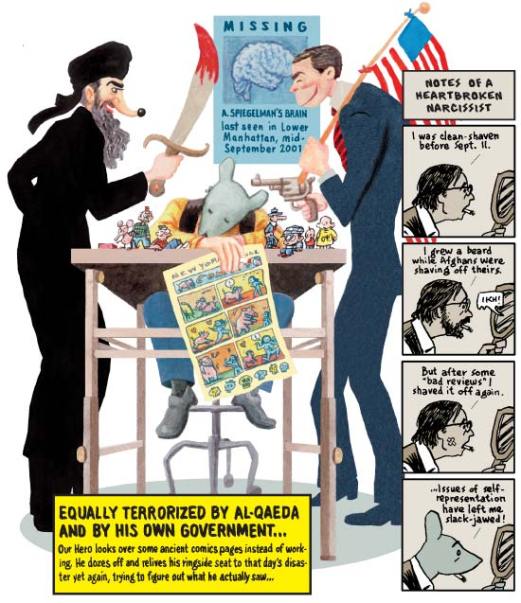
After Maus, Spiegelman worked for The New Yorker for over ten years, quitting in early 2002 after the September 11th attacks to work on a series of broadsheets entitled In the Shadow of No Towers. These broadsheets were collected in 2004 in an unwieldy 15″ x 10″ book.
Spiegelman lived in downtown Manhattan, right by the towers; his daughter attended school a few blocks away. He saw the towers collapse in person, fleeing for his life with his family. Spiegelman attempts to capture this raw, unmediated, and very personal experience in In the Shadow of No Towers (Sonic Youth’s 2002 album Murray Streetworks to the same end–only much more abstractly): the narrative is discontiguous, fluctuating from bitter satire to earnest inquiry. Spiegelman’s choice of the broadsheet as his medium (the broadsheets were published monthly by different newspapers as Spiegelman produced them) is tremendously affective: just like the 9/11 attacks, the broadsheets are larger than life, hard to grasp, hyperbolically resisting easy, singular readings. Spiegelman balances bitter attacks against the conformist mentality spurred by the Bush administration with pathos and humor; In the Shadow of No Towers recalls the good-natured satire of broadsheet comics from a hundred years ago, bittersweetening the content. The 2004 collection wisely contextualizes Spiegelman’s work by reprinting broadsheets of “The Yellow Kid” and “The Katzenjammer Kids.”
Like Maus, In the Shadow of No Towers is a fascinating exploration of how disaster confronts and transforms identity. And reflecting its heinous subject, In the Shadow of No Towers ends without concluding: as the foolish Iraq war begins, Spiegelman can no longer shape any meaning or sense from his work. This isn’t a graphic novel–don’t look for a cohesive narrative structure here; instead, In the Shadow of No Towers explores the loose ends, the detritus, the psychic remnants of disaster.

 Biblioklept