Read “Christmas Eve,” a supernatural tale by Nikolai Gogol

“Christmas Eve”

by

Nikolai Gogol

translated by George Tolstoy

as “The Night of Christmas Eve: A Legend of Little Russia”


The last day before Christmas had just closed. A bright winter night had come on, stars had appeared, and the moon rose majestically in the heavens to shine upon good men and the whole of the world, so that they might gaily sing carols and hymns in praise of the nativity of Christ. The frost had grown more severe than during the day; but, to make up for this, everything had become so still that the crisping of the snow under foot might be heard nearly half a verst round. As yet there was not a single group of young peasants to be seen under the windows of the cottages; the moon alone peeped stealthily in at them, as if inviting the maidens, who were decking themselves, to make haste and have a run on the crisp snow. Suddenly, out of the chimney of one of the cottages, volumes of smoke ascended in clouds towards the heavens, and in the midst of those clouds rose, on a besom, a witch.

If at that time the magistrate of Sorochinsk had happened to pass in his carriage, drawn by three horses, his head covered by a lancer cap with sheepskin trimming, and wrapped in his great cloak, covered with blue cloth and lined with black sheepskin, and with his tightly plaited lash, which he uses for making the driver drive faster—if this worthy gentleman had happened to pass at that time, no doubt he would have seen the witch, because there is no witch who could glide away without his seeing her. He knows to a certainty how many sucking pigs each swine brings forth in each cottage, how much linen lies in each box, and what each one has pawned in the brandy-shop out of his clothes or his household furniture. But the magistrate of Sorochinsk happened not to pass; and then, what has he to do with those out of his jurisdiction? he has his own circuit. And the witch by this time had risen so high that she only looked like a little dark spot up above; but wherever that spot went, one star after another disappeared from heaven. In a short time the witch had got a whole sleeveful of them. Some three or four only remained shining. On a sudden, from the opposite side, appeared another spot, which went on growing, spreading, and soon became no longer a spot. A short-sighted man, had he put, not only spectacles, but even the wheels of a britzka on his nose, would never have been able to make out what it was. In front, it was just like a German; a narrow snout, incessantly turning on every side, and smelling about, ended like those of our pigs, in a small, round, flattened end; its legs were so thin, that had the village elder got no better, he would have broken them to pieces in the first squatting-dance. But, as if to make amends for these deficiencies, it might have been taken, viewed from behind, for the provincial advocate, so much was its long pointed tail like the skirt of our dress-coats. And yet, a look at the goat’s beard under its snout, at the small horns sticking out of its head, and at the whole of its figure, which was no whiter than that of a chimney sweeper, would have sufficed to make any one guess that it was neither a German nor a provincial advocate, but the Devil in person, to whom only one night more was left for walking about the world and tempting good men to sin. On the morrow, at the first stroke of the church bell, he was to run, with his tail between his legs, back to his quarters. The devil then, as the devil it was, stole warily to the moon, and stretched out his hand to get hold of it; but at the very same moment he drew it hastily back again, as if he had burnt it, shook his foot, sucked his fingers, ran round on the other side, sprang at the moon once more, and once more drew his hand away. Still, notwithstanding his being baffled, the cunning devil did not desist from his mischievous designs. Dashing desperately forwards, he grasped the moon with both hands, and, making wry faces and blowing hard, he threw it from one hand to the other, like a peasant who has taken a live coal in his hand to light his pipe. At last, he hastily hid it in his pocket, and went on his way as if nothing had happened. At Dikanka, nobody suspected that the devil had stolen the moon. It is true that the village scribe, coming out of the brandy-shop on all fours, saw how the moon, without any apparent reason, danced in the sky, and took his oath of it before the whole village, but the distrustful villagers shook their heads, and even laughed at him. And now, what was the reason that the devil had decided on such an unlawful step? Simply this: he knew very well that the rich CossackChoop was invited to an evening party at the parish clerk’s, where he was to meet the elder, also a relation of the clerk, who was in the archbishop’s chapel, and who wore a blue coat and had a most sonorous basso profondo, the Cossack Sverbygooze, and some other acquaintances; where there would be for supper, not only the kootia, but also a varenookha, as well as corn-brandy, flavoured with saffron, and divers other dainties. He knew that in the mean time Choop’s daughter, the belle of the village, would remain at home; and he knew, moreover, that to this daughter would come the blacksmith, a lad of athletic strength, whom the devil held in greater aversion than even the sermons of Father Kondrat. When the blacksmith had no work on hand, he used to practise painting, and had acquired the reputation of being the best painter in the whole district. Even the Centurion had expressly sent for him to Poltava, for the purpose of painting the wooden palisade round his house. All the tureens out of which the Cossacks of Dikanka ate their borsch, were adorned with the paintings of the blacksmith. He was a man of great piety, and often painted images of the saints; even now, some of them may be seen in the village church; but his masterpiece was a painting on the right side of the church-door; in it he had represented the Apostle Peter, at the Day of Judgment, with the keys in his hand, driving the evil spirit out of hell; the terrified devil, apprehending his ruin, rushed hither and thither, and the sinners, freed from their imprisonment, pursued and thrashed him with scourges, logs of wood, and anything that came to hand. All the time that the blacksmith was busy with this picture, and was painting it on a great board, the devil used all his endeavours to spoil it; he pushed his hand, raised the ashes out of the forge, and spread them over the painting; but, notwithstanding all this, the work was finished, the board was brought to the church, and fixed in the wall of the porch. From that time the devil vowed vengeance on the blacksmith. He had only one night left to roam about the world, but even in that night he sought to play some evil trick upon the blacksmith. For this reason he, had resolved to steal the moon, for he knew that old Choop was lazy above all things, not quick to stir his feet; that the road to the clerk’s was long, and went across back lanes, next to mills, along the churchyard, and over the top of a precipice; and though the varenookha and the saffron brandy might have got the better of Choop’s laziness on a moonlight night, yet, in such darkness, it would be difficult to suppose that anything could prevail on him to get down from his oven and quit his cottage. And the blacksmith, who had long been at variance with Choop, would not on any account, in spite even of his strength, visit his daughter in his presence. Continue reading “Read “Christmas Eve,” a supernatural tale by Nikolai Gogol”
Read Vladimir Sorokin’s beautiful, abject, horrifying story “Nastya”

You can read the full text of  Vladimir Sorokin’s beautiful, abject, horrifying very long short story “Nastya” at The Baffler. 

The novella-length piece swirls between fairy tale magic and Sadean cruelty. It is probably best if you consume “Nastya” on an empty stomach—like his novel Their Four Hearts, “Nastya” is reminiscent of Pasolini’s horrifying masterpiece Salò, or the 120 Days of Sodom. And like Their Four Hearts, this story is translated by Max Lawton, who vividly conveys the dream-nightmare-reality energy of Sorokin’s prose.

“Nastya” is from the collection Red Pyramid, which will publish in Lawton’s English-language translation early next year. (You can read the title story here.)

Here are the opening paragraphs of “Nastya”

A GRAYISH-BLUE LULL BEFORE DAWN, a slow boat on the heavy mirror of Denezh Lake, emerald caverns in the juniper bushes creeping menacingly toward the white wash of the alpine waters.

Nastya turned the brass knob of the door to the balcony and pushed it open. The thick, reeded glass swam to the right, splintering the landscape with its parallel flutes and mercilessly dividing the little boat into twelve pieces. A damp avalanche of morning air flowed through the open door, embraced her, and shamelessly flew up into her nightgown.

Nastya inhaled greedily through her nose and walked out onto the balcony.

Her warm feet recognized the cool wood, and its boards creaked gratefully. Nastya lay her hands upon the peeling paint of the railing, tears came to her eyes as she took in the motionless world: the left and right wings of the manor, the garden’s milky green, the severity of the linden grove, the sugar-cube church on the hill, the willow branches lying on the ground, the stacks of mown grass.

Nastya rolled her wide, thin shoulders, let down her hair, and stretched out with a moan, listening to her vertebrae crack as her body woke up.

And here is a sentence from later in the story that made me laugh out loud:

“Don’t dare overcook my daughter!”

Great fucked up stuff.

A Summer Reading List

20130527-122151.jpg

Okay:

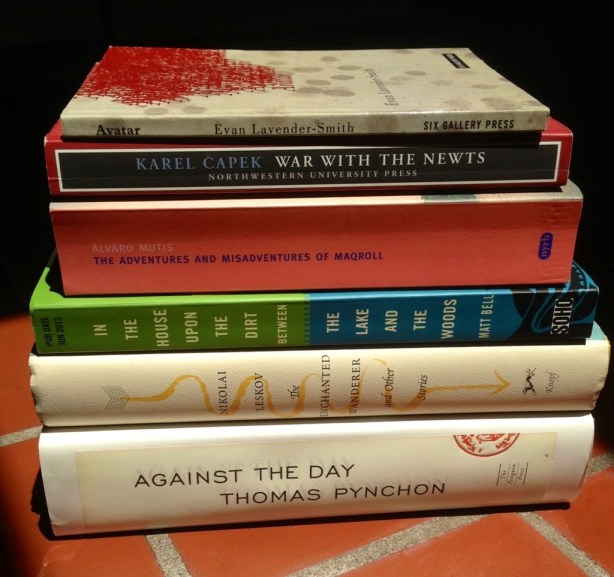
Prospective reading list for the summer.

First, I’ll finish Mikhaíl Bulgakov’s The Master & Margarita, not pictured here because I’m reading it on the Kindle. No new novels until I finish this novel! (Will break this rule).

I just finished another trip through Ulysses, again via audiobook plus tandem-rereading on the Kindle. I like big audiobooks (and I cannot lie), so I’ll get into Against the Day on mp3.

This weekend I read “The Lady Macbeth of Mtsenk,” the first story in a freshly translated collection from Nikolai Leskov. The Enchanted Wanderer is new in translation by Richard Pevear and Larissa ­Volokhonsky. I’ll be reading it in chunks this summer.

Speaking of reading in chunks: I devoured the first three novellas in Álvaro Mutis’s Maqroll series and then took a break to get some other stuff in. Break over.

Also: Matt Bell’s novel In the House Upon the Dirt Between the Lake and the Woods.

And I still haven’t read Karel Čapek’s War with the Newts, so I’ll try to fix that this summer.

I also plan to read Evan Lavender-Smith’s Avatar, but I’d like to do it in one sitting, which means I need to free up a few hours.

Finally: Who knows. Reading lists are kind of ridiculous.

A Lazy Riff on the First Three of Álvaro Mutis’s Maqroll Novellas

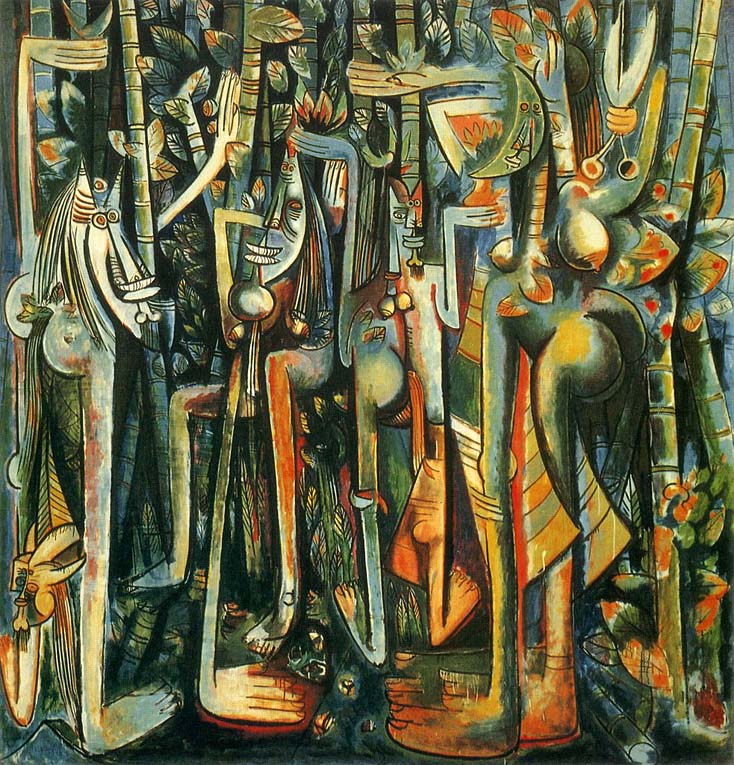
The Jungle by Wilfredo Lam

1. Last year on this blog, my friend Dave Cianci reviewed Álvaro Mutis’s collection of seven novellas, The Adventures and Misadventures of Maqroll. That review got me to eventually pick up the book and start reading. That review is better written and more accomplished than what I’ll likely end up doing here.

2. There are seven Maqroll novellas; I’ve read the first three. They are excellent.

3. Let me steal from Cianci’s review. He describes Maqroll the Gaviero as

a fleshed-out character, as well as the embodiment of an ideal: the knife fighters and Viking poets idolized by Borges, a mixture of Robinson Crusoe, Sam Spade, and Don Quixote. He indulges fantasy but prepares for disappointment. He lives between lawlessness and acceptability.

4. The Gaviero—the lookout—is a picaro, a roguish but poetical sailor. Mutis’s book is picaresque, carnivalesque, a river—or maybe a maze—of storytelling.

5. This is maybe what Maqroll is about: storytelling. Each Maqroll novella is framed as another’s story, or a found document—you know this trick, you’ve read Borges, right? 

6. The book is crammed with stories, stories that lead to other stories, that recall other stories, that tell their own stories—or cover over other stories.

7. A line that might instructively illustrate point 6: In Ilona Comes with the Rain, Mutis unpacks the life of a minor character, a sea captain named Wito. Consider his opening gambit:

His life deserves an entire book. It was so full of adventures, some of which he hurried over as if they were hot coals, that one became lost in their labyrinthine complexity.

The life described here could just as well be the Gaviero’s.

8. Well of course, that’s what Mutis is doing, channeling and conveying and expressing Maqroll’s life, a life of picaresque adventures (and titular misadventures), of loss and gain, of love and despair, drinking, sailing, scheming and plotting—a life full of allusions and hints and digressions. Mutis’s technique is marvelous (literally; he made this reader marvel): he gives us an aging (anti-)hero, a hero whose life is overstuffed with stories and mishaps and feats and enterprises and hazards; he gives us one strand of that life at a time in each novella—but then he points to the other adventures, the other serials of Maqroll that we would love to tune into if only we could.

9. To illustrate point 8: Consider Maqroll in Un Bel Morir, doing some time in prison: His consciousness floats to other prisons, other countries: Afghanistan, British Columbia: And then we get those stories, miniature epics—and nested within them, their own characters tell stories.

10. There’s a wonderful timelessness to Maqroll, a sense that the adventures exist somehow before the postmodern world, that they belong to the pulp fictions of jungle adventure…

11. (Indeed, re: point 10: In Ilona, we find one character who is unstuck in time, taking a Naopleonic lover during a transcontinental voyage…)

12. I’ve already noted the Borgesian quality of Mutis’s tales, brought up their picaresque scope (a la Cervantes), so let me lazily compare Mutis to others: let me note the sprawl of his storytelling, which recalls García Márquez—only more compact, more precise. Let me suggest that there’s something of Kafka in there too—indeed, the first novella, The Snows of the Admiral seems to me a reworking of “Before the Law.” (The tale is also conspicuously quixotic; tilting at windmills and all that). Conrad of course, but also something of Melville—the grand (Moby-Dick) and the sly (The Confidence Man). And hell, also something of Edgar Rice Burroughs’s high adventure, or even, dare I say it, the better parts of the Indiana Jones films.

13. Lazy as I am, I’ve failed to quote Mutis at any length—a shame, because it’s wonderful prose (translated by Edith Grossman, by the way). So here’s a little morsel—one that I think captures why we tell stories—from the appendix to Un Bel Morir, the last of the three novellas I read; before I offer it up I’ll conclude my riff by saying how happy I am that there are four more of these Maqroll novellas to read:

All the stories and lies about his past accumulating until they formed another being, always present and naturally more deeply loved than his own pale, useless existence composed of nausea and dreams.

Book Acquired, Sometime Last Week (I’m Not Exactly Sure, It Showed Up While I Was Doing the Thanksgiving Thing in South Florida)

20111129-161210.jpg

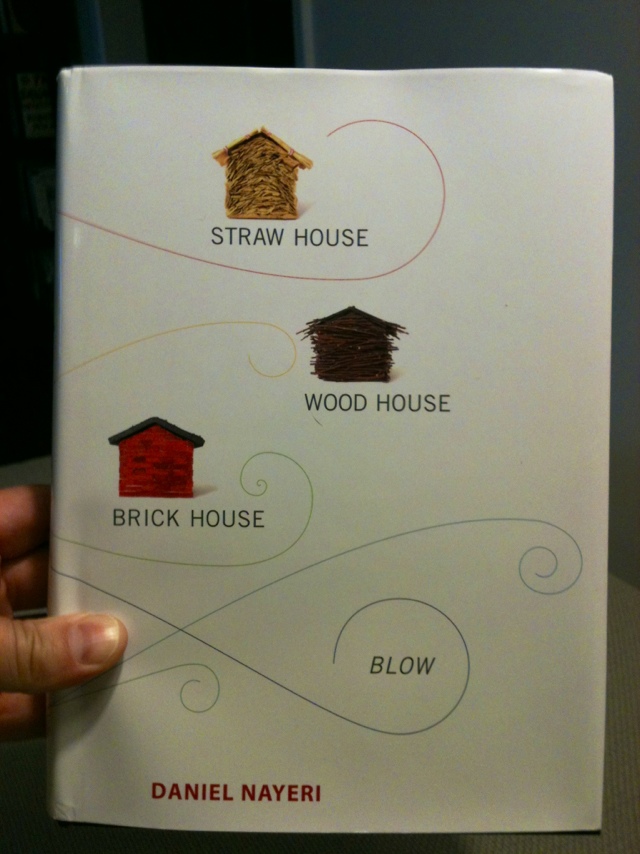
This one looks pretty cool: Daniel Nayeri’s quartet of novels  Straw House, Wood House, Brick House, Blow. Publisher’s description—

Written entirely on an iPhone, this quartet of YA novellas by Another Pan and Another Faust author Daniel Nayeri showcases four different genres.

This bold collection of novellas by Another series author Daniel Nayeri features four riveting tales. These modern riffs on classic genres will introduce young adult readers to a broad range of writing styles that explore universally compelling themes such as identity and belonging, betrayal and friendship, love and mortality.

Straw House: A Western sizzling with suspense, set in a land where a rancher grows soulless humans and a farmer grows living toys.

Wood House: This science-fiction tale plunges the reader into a future where reality and technology blend imperceptibly, and a teenage girl must race to save the world from a nano-revolution that a corporation calls “ReCreation Day.”

Brick House: This detective story set in modern NYC features a squad of “wish police” and a team of unlikely detectives.

Blow: A comedic love story told by none other than Death himself, portrayed here as a handsome and charismatic hero who may steal your heart in more ways than one. With humor, suspense, and relatable prose, this hip and cutting-edge collection dazzles.

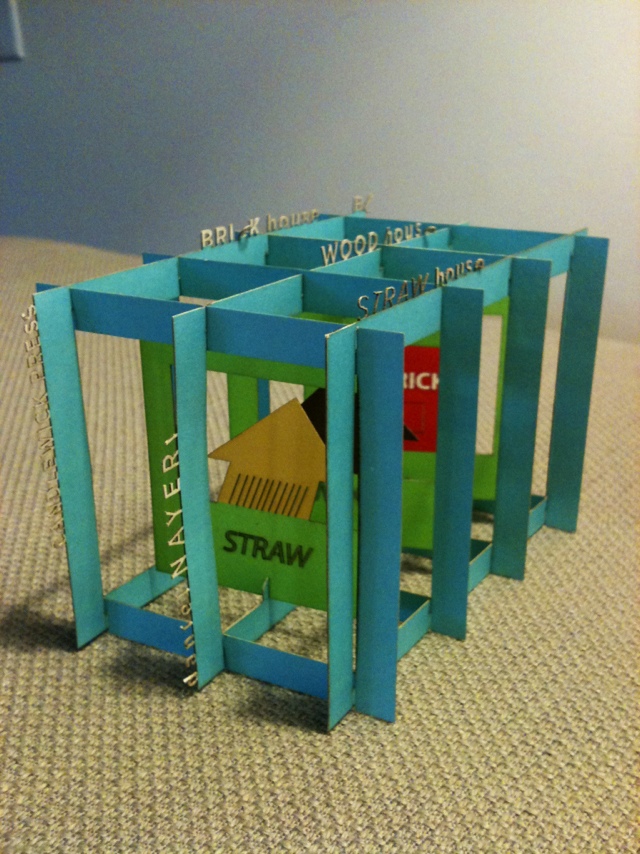
The book also came with this cool, I dunno whatchacallit, bookmark? It’s flat:

20111129-161218.jpg

—and then it pops up, 3-D style. Zing!

20111129-161225.jpg

The Spare Room — Helen Garner

We’ve all had house guests who stay too long. But what happens when a house guest who overstays her welcome is dying? What if you invited her there hoping to prove in yourself some measure of humanity, humility, maybe even heroism, by taking good care of her? What if you found her irritating? Grating? Self-absorbed? What if  she didn’t seem to even notice what a great caretaker you were? What if she didn’t seem to appreciate your prowess as a host? What if she outright ignored the disease that was killing her, just refused to even mention it, denying you any hope of closure? Worst of all would be the shame that compounded all of these feelings about the dying house guest, the sense that you are wrong, inhuman, cowardly, right? Helen Garner’s novella The Spare Room (new in trade paperback from Picador) tackles these questions and the emotional turmoil behind them in measured, spare prose making a compelling and rewarding read.

Little irks me more in journalism than a book review (or any media review, really) that seeks to intertwine the personal dramas of the reviewer. I am about to do just that right now, gentle reader, so you are forewarned. Stop reading now if you wish and know that Biblioklept recommends The Spare Room. It’s a marvelous piece of writing, one that gives proof to the cliché “brutally honest.”

Reading The Spare Room I could not help but identify with its narrator, an Australian woman in her 60s named Helen who takes care of her free-wheeling, slightly daffy, cancer-infested friend Nicola. I am not an Australian woman in my 60s, but, like Helen, I know what it is like to live with and care for a person whom you love who also happens to be dying. From the time I was 12 years old, my maternal grandmother Mama Dot lived with my family. The doctors, prognosticating wise men all, gave Mama Dot just a year or two to live and my folks wanted her to spend that time with us. She was very sick, and, as if to prove the verity of certain stereotypes about Southern women,  she was also very stubborn–mulishly so (the woman could hold a grudge). She went on to live another 10 years with my parents, during which time both my brother and myself of course left the house (but always came back to visit). I loved her very, very much and, perhaps as a result of that love, fought with her constantly and fiercely about any little thing. Unlike the narrator Helen, who bottles up her irritation with Nicola (particularly her fury at her friend’s pursuit of quackish cures), I found it easier to confront my grandmother about her faults in illness–her lapses of memory and judgment, her lack of cooperation, her unbearable slowness. I could even be mean. But like Helen, I always felt bad about it too. What makes The Spare Room such an affecting, gripping read is Garner’s honesty, her ability to capture the negative, selfish feelings that we all must feel when comforting the sick.

Narratives about the dying often disengage the emotional turmoil of the caretaker by applying a veneer of sentimentality, morality, or even whimsy. Garner handles her subject matter with a realism that denies sentimentality and faces the ugliness of death head on. Her narrator is compassionate toward her friend but it’s always clear that the book is not about Nicola–it’s about how Helen reacts to Nicola. It’s about what it means to be selfish at the very moment you are trying to be selfless. It’s about how hard it is to get past your flaws as a human being. Take the book’s humor, for instance: The Spare Room is frequently hilarious, yet the humor never seeks transcendence or escape. When Helen seems to mutter to her audience, “God bless morphine” at the beginning of a chapter, she isn’t drolly avoiding her friend’s pain–she’s thankful that the drug has given both of them a night’s sleep. Similarly, her observation that the “station was a seven-minute walk from my house, twenty if you had cancer,” reveals that Helen’s selfishness is wrapped in minute details, details that compound in the narrative and build tension toward its awful final sentence (a final sentence that I won’t spoil by revealing here, dear reader).

The Spare Room is a tightly-compressed novella that one might read in an afternoon or two, yet the book will undoubtedly stay with most readers for a long time to come. We might not all be like Helen (and, thankfully, not all of our patients are as trying as Nicola) but there is certainly bound to be some measure of her in even the best of us. Garner has captured here some of that rage against the dying of the light that Dylan Thomas encouraged of us, and she’s revealed that that rage, falling impotent against illimitable death, might end up aimed at those we love dearest–as well as ourselves. Highly recommended.