Parody of Manet’s Olympia with Junyer and Picasso — Pablo Picasso

Woman Reading (1920) — Pablo Picasso

Woman Reading (1935) — Pablo Picasso

Great Bather Reading — Pablo Picasso

Woman Reading (1960) — Pablo Picasso

Reading (1932) — Pablo Picasso

Reading (1921) — Pablo Picasso

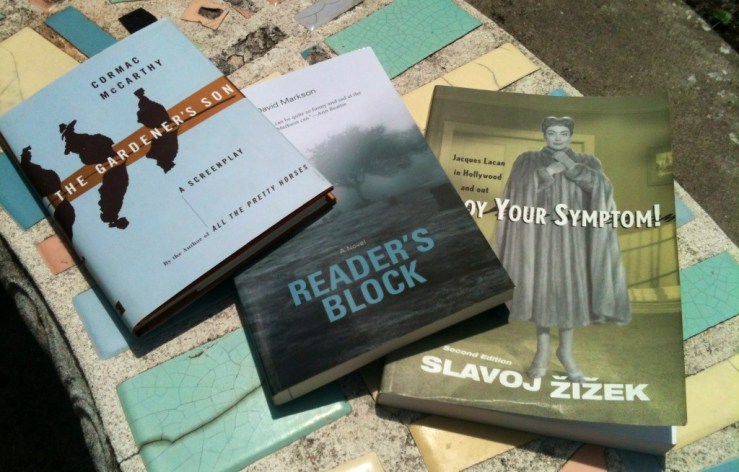
David Markson, Cormac McCarthy, Slavoj Žižek (Books Acquired, 5.19.2012)

20120521-122339.jpg

I ordered David Markson’s Reader’s Block from my local book shop, and intended to get it—and only it—this Saturday. Somehow I took a detour through the film section and picked up the Žižek and didn’t put it back; in the same section I also picked up McCarthy’s screenplay The Gardener’s Son, which is the only thing I haven’t read by him to date, so I picked it up too. So there you go.

21 Citations on Pablo Picasso — David Markson

Pablo Picasso, Les Demoiselles d'Avignon, oil on canvas, 1907 (MoMA)

Painting is not done to decorate apartments –PICASSO

People speak of naturalism in opposition to modern painting.
Where and when has anyone ever seen a natural work of art?
Asked Picasso.

Depressed at the apparent lack of interest in one of his early still lifes, Matisse visited his dealer to retrieve it, only to learn that it had been purchased after all.
By Picasso.

The interrelationship of Picasso and Braque during Cubism:
Like being roped together on a mountain, Braque said.

The oddity that Velazquez and Picasso, surely two of the three greatest Spanish-born painters, each used his mother’s name rather than his father’s.

Among the many paintings in her Paris flat, Gertrude Stein had two exceptional Picassos.
If there were a fire, and I could save only one picture, it would be those two. Unquote.

The Bateau-Lavoir, the legendary former Montmartre piano factory broken up into artists’ studios, where Picasso contrived any number of his early masterpieces — while living with no running water and only one communal toilet.

The so-called anarchist artist who in 1988 smeared a large X in his own blood on a wall in the Museum of Modern Art — and in the process splattered an adjacent Picasso.

Picasso. Cézanne. Matisse. Braque. Bonnard. Renoir.
All of whom painted portraits of Ambroise Vollard.

Cartier-Bresson. Brassaï. Man Ray. Lee Miller. Robert Doisneau. Robert Capa. David Douglas Duncan. Cecil Beaton.
All of whom photographed Picasso.

Picasso’s play, Desire Caught by the Tail — which could be performed for the first time only privately, because of the Nazi occupation of Paris.
But avec Camus, Sartre, Michel Leiris, Raymond Queneau, Dora Maar, Pierre Reverdy, Simone de Beauvoir.

There is no such thing as abstract art, said Picasso.
You always have to start somewhere or other.

Gertrude Stein once delighted Picasso by reporting that a collector had been dumbfounded, years afterward, to hear that Picasso had given her her portrait as a gift, rather than asking payment.
Not understanding that that early in Picasso’s career, the difference had been next to negligible.

You never paint the Parthenon; you never paint a Louis XV armchair. You make pictures out of some little house in the Midi, a packet of tobacco, or an old chair.
Said Picasso.

Future generations will regard Bob Dylan with the awe reserved for Blake, Whitman, Picasso and the like.
Said an otherwise seemingly rational writer named Jonathan Lethem.

Picasso, avec laughter, after being asked if he had used models for Les Demoiselles d’Avignon:
Where would I have found them?

Picasso’s admiration for Charlie Chaplin.
Diego Rivera’s.
Stalin’s.

Kees van Dongen’s admission that there were occasions during his own early Montmartre years when he was forced to filch milk and/or bread from neighborhood doorsteps — with an accomplice named Picasso.

Picasso, in Paris during the Nazi occupation and learning that someone had accused him of having Jewish blood:
I wish I had.

A rejection of all that civilization has done.
Said the London Times of a first Post-Impressionist exhibition, in 1910 — which included Cézanne, van Gogh, Gauguin, Matisse, Picasso, others.

My old paintings no longer interest me. I’m much more curious about those I haven’t done yet.
Said Picasso, at seventy-nine.
From David Markson’s The Last Novel

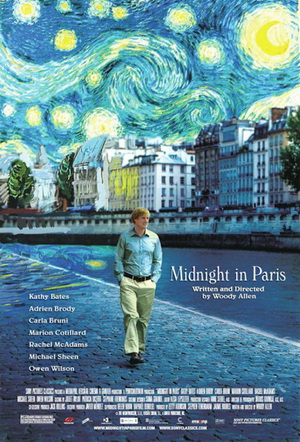
Midnight in Paris — Woody Allen

Woody Allen’s new film Midnight in Paris opens with a sumptuous montage of the City of Light, clearly establishing from the get-go that the movie is Allen’s love letter to Paris. The romantic overture idealizes Paris, just as the film’s protagonist Gil, played pitch perfect by Owen Wilson, idealizes the Lost Generation of writers and artists who populated the cafes and bars of Paris in the ’20s. Gil is on a working vacation with his fiancé and future in-laws; he’s a successful Hollywood screenwriter but dreams of becoming a great novelist. Only he’s struggling with his novel-in-progress, which features a protagonist who runs a nostalgia shop. Nostalgia, or the romance of nostalgia, is the primary idiom of Midnight in Paris, and Owen Wilson transcends the usual parameters of Woody-surrogate in bringing this idiom to life. Wilson’s breezy charisma propels the movie forward at all times; indeed, the entire plot rests on Wilson’s charm, which saves the film from falling into syrupy dreck or boring indie whimsy.

Midnight in Paris works to literally charm its viewers and its protagonist, transporting the narrative back into the ’20s via a magical motorcar, where Wilson’s Gil falls in with a host of notable writers, artists, dancers, and other personalities. There are Cole Porter and Salvador Dali, Man Ray and Luis Bunuel, Pablo Picasso and Josephine Baker—but the standouts are the Fitzgeralds, Gertrude Stein, and Ernest Hemingway. The Hemingway character is a marvelous parody of both Hemingway’s caricature and Hemingway’s prose—although I think the humor in his scenes was lost on more than a few of the audience members I watched the film with. On Hemingway’s advice, Gil submits his manuscript to Gertrude Stein for an honest critique. In the meantime, Gil engages in a romance with Adrianna, Picasso’s muse and mistress, who herself pines for the Belle Époque era. Through another magical transposition, Gil and Adrianna move again through time, heading back to the 1890s to meet Toulouse-Lautrec and Paul Gaugin. As Gil pursues a romance with Adrianna (and the nostalgia of an idealized past), his own fiancé seems to be spending a bit too much time with a windbaggish and pretentious American who is a visiting lecturer at the Sorbonne. The reality of this conflict pulls Gil into making dramatic choices about his own future.

Midnight in Paris falls squarely into Allen’s fantasy films like The Purple Rose of Cairo, A Midsummer Night’s Sex Comedy, Alice, and Shadows and Fog. The film has much to offer those who, like Gil, find themselves fascinated by the romance of the Lost Generation. Allen’s parodies of the Fitzgeralds, Hemingway, and the rest are loving and gentle, and will surely be appreciated by most English majors. At the same time, Midnight in Paris is a slight, ephemeral work, one that relies on beautiful cinematography and the charm of its lead character more than plot, insight, or even jokes. There is no risk or danger in Gil’s fantasy, no sense that his sanity is in jeopardy or that he might not come to realize the theme of the film, which he spells out clearly for the audience if they somehow missed it—the tendency to romanticize the past has more to do with a dissatisfaction with the present than with any objective evidence that the past was somehow better, and dissatisfaction with the present should be viewed positively, for dissatisfaction can be productive and meaningful if we engage it. Recommended.