Mass-market Monday | Philip K. Dick’s Dr. Bloodmoney

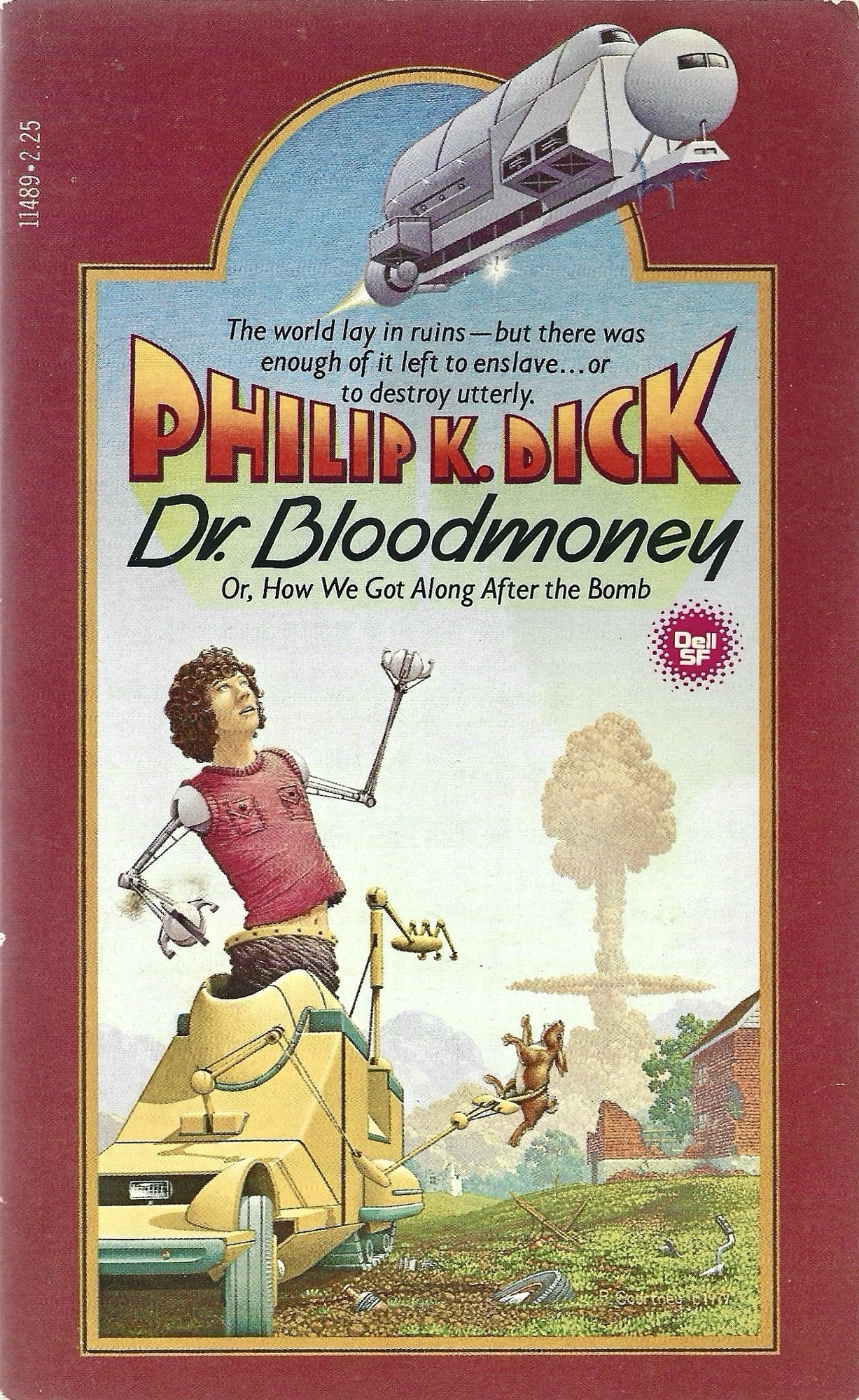
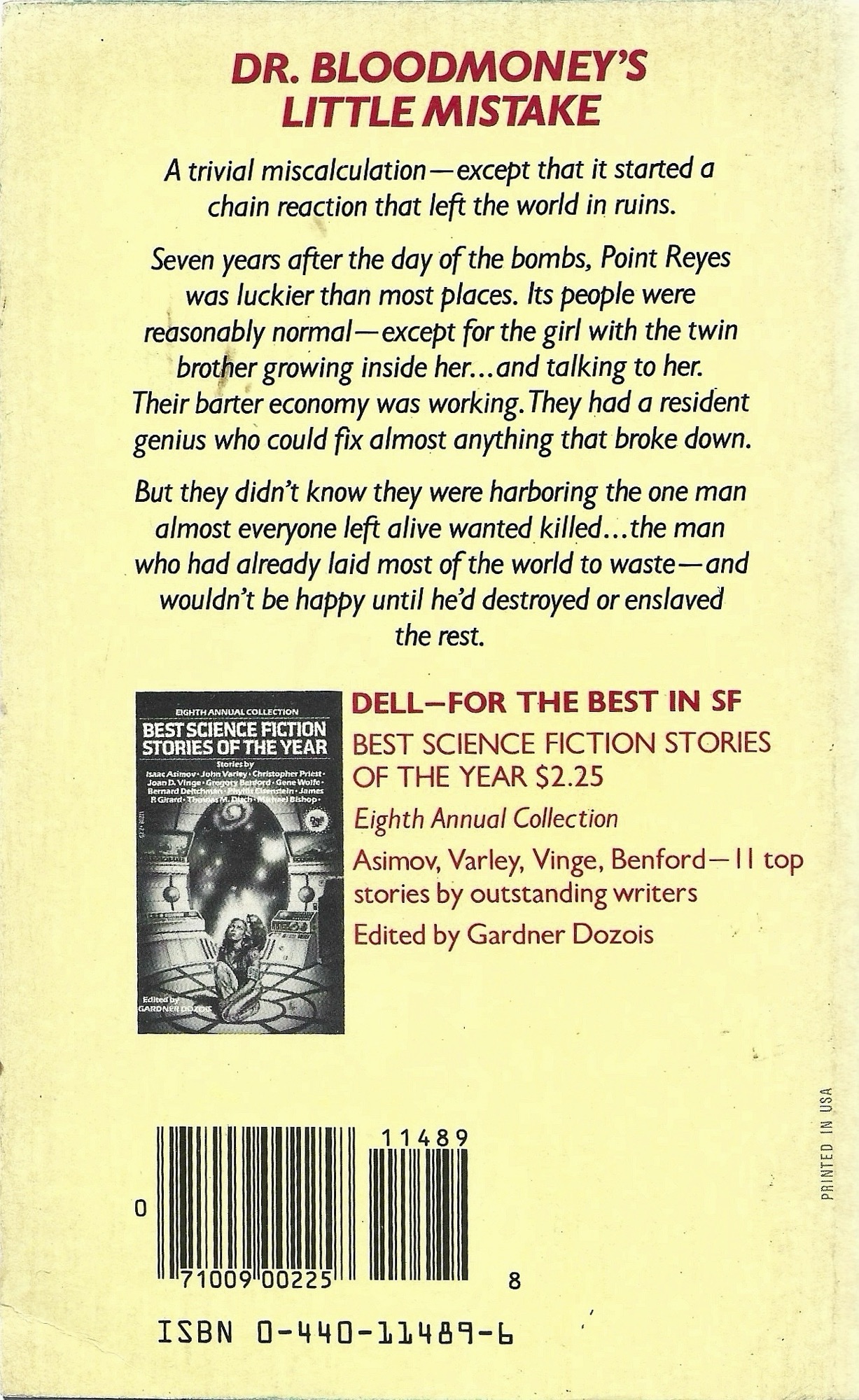
Dr. Bloodmoney, or, How We Got Along After the Bomb, Philip K. Dick, 1965. Dell Books (1980). Cover art by Richard Courtney (not credited; cover signed R. Courtney); no designer credited. 304 pages. Continue reading “Mass-market Monday | Philip K. Dick’s Dr. Bloodmoney”

“The Story to End All Stories” — Philip K. Dick

“The Story to End All Stories”

by

Philip K. Dick


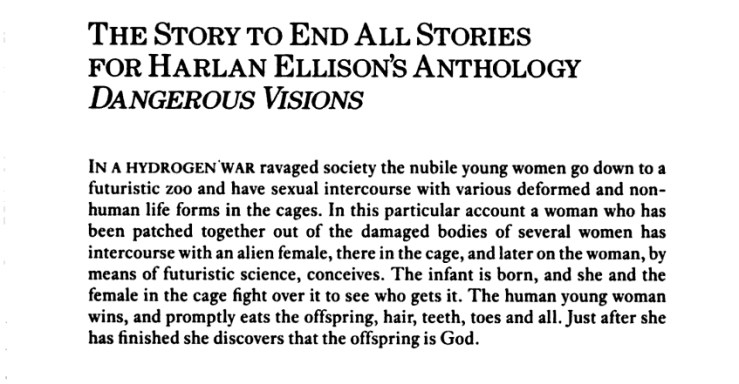
In a hydrogen war ravaged society the nubile young women go down to a futuristic zoo and have sexual intercourse with various deformed and non-human life forms in the cages. In this particular account a woman who has been patched together out of the damaged bodies of several women has intercourse with an alien female, there in the cage, and later on the woman, by means of futuristic science, conceives. The infant is born, and she and the female in the cage fight over it to see who gets it. The human young woman wins, and promptly eats the offspring, hair, teeth, toes and all. Just after she has finished she discovers that the offspring is God.

Mass-market Monday | Philip K. Dick’s Radio Free Albemuth

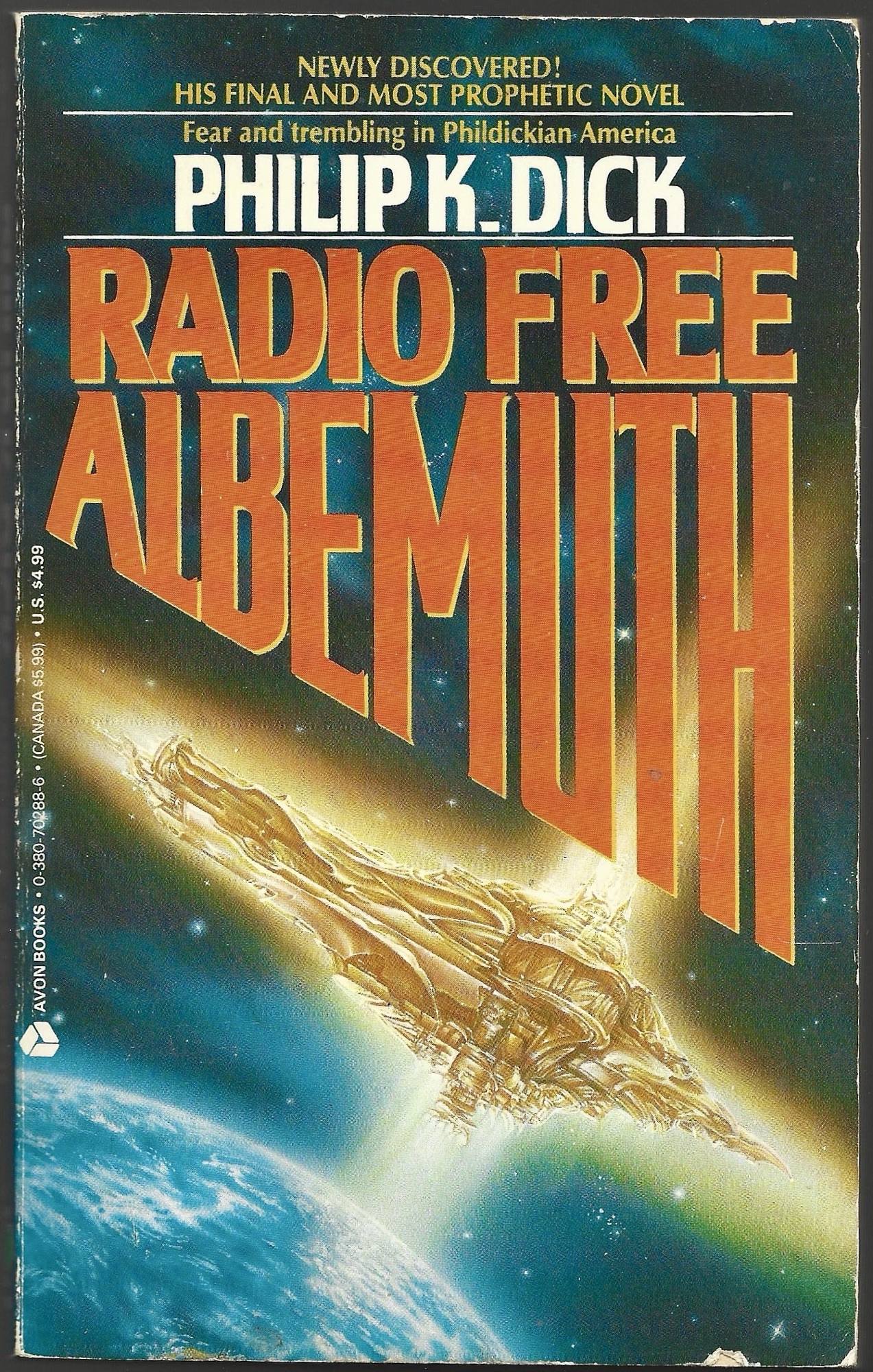
Radio Free Albemuth, 1985, Philip K. Dick. Avon Bard (1987). Cover art by Ron Walotsky. 212 pages.

From Philip K. Dick’s posthumous (and likely never-fully revised) novel Radio Free Albemuth:

The human being has an unfortunate tendency to wish to please.

I was in effect exactly like those captured Americans: a prisoner of war. I had become that in November 1968 when F.F.F. got elected. So had we all; we now dwelt in a very large prison, without walls, bounded by Canada, Mexico, and two oceans. There were the jailers, the turnkeys, the informers, and somewhere in the Midwest the solitary confinement of the special internment camps. Most people did not appear to notice. Since there were no literal bars or barbed wire, since they had committed no crimes, had not been arrested or taken to court, they did not grasp the change, the dread transformation, of their situation. It was the classic case of a man kidnapped while standing still. Since they had been taken nowhere, and since they themselves had voted the new tyranny into power, they could see nothing wrong. Anyhow, a good third of them, had they known, would have thought it w
as a good idea. As F.F.F. told them, now the war in Vietnam could be brought to an honorable conclusion, and, at home, the mysterious organization Aramchek could be annihilated. The Loyal Americans could breathe freely again. Their freedom to do as they were told had been preserved.

I returned to the typewriter and drafted another statement. It was important to do a good job.

Ubik — Bob Pepper

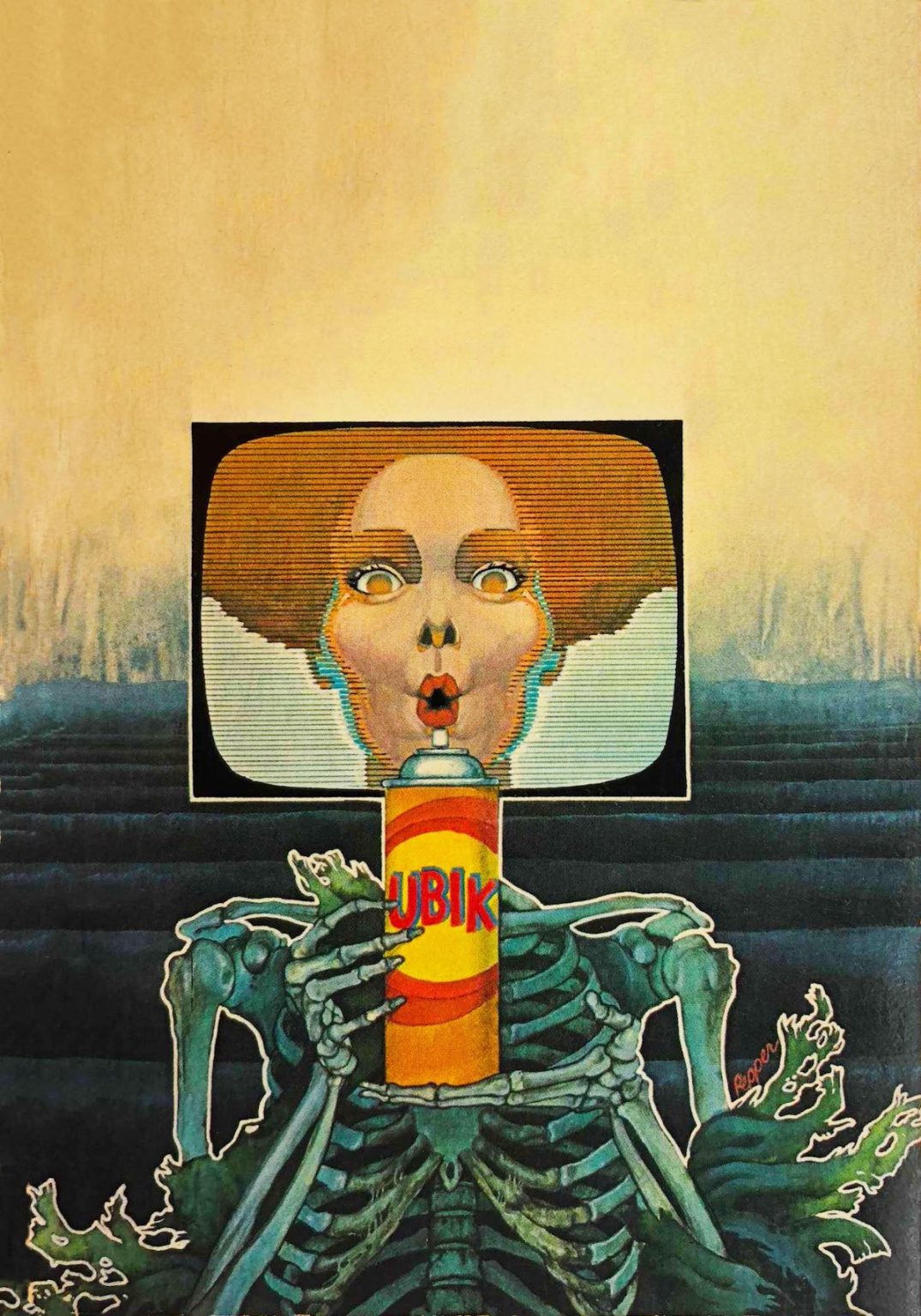
Cover art for Philip K. Dick’s Ubik, 1982 by Bob Pepper (1938-2019). Via/more.

Mass-market Monday | Philip K. Dick’s A Maze of Death

A Maze of Death, Philip K. Dick. Dawn Books, first Daw printing (1983). Cover art by Bob Pepper. 191 pages.

In my review of Philip K. Dick’s 1970 novel, I wrote that A Maze of Death is

…a mishmash of metaphysical mumbo jumbo, filtered through touches of space opera and good old fashioned haunted housery. A Maze of Death is a messy space horror that threatens to leave its readers unsatisfied right up until the final moments wherein it rings its sad coda, a reverberation that nullifies all its previous twists and turns in a soothing wash of emptiness. Not the best starting place for PKD, but I’m very glad I read it.

“Faith of Our Fathers” — Philip K. Dick

“Faith of Our Fathers”

by

Philip K. Dick


On the streets of Hanoi he found himself facing a legless peddler who rode a little wooden cart and called shrilly to every passer-by. Chien slowed, listened, but did not stop; business at the Ministry of Cultural Artifacts cropped into his mind and deflected his attention: it was as if he were alone, and none of those on bicyles and scooters and jet-powered motorcycles remained. And likewise it was as if the legless peddler did not exist.

“Comrade,” the peddler called however, and pursued him on his cart; a helium battery operated the drive and sent the cart scuttling expertly after Chien. “I possess a wide spectrum of time-tested herbal remedies complete with testimonials from thousands of loyal users; advise me of your malady and I can assist.”

Chien, pausing, said, “Yes, but I have no malady.” Except, he thought, for the chronic one of those employed by the Central Committee, that of career opportunism testing constantly the gates of each official position. Including mine.

“I can cure for example radiation sickness,” the peddler chanted, still pursuing him. “Or expand, if necessary, the element of sexual prowess. I can reverse carcinomatous progressions, even the dreaded melanomae, what you would call black cancers.” Lifting a tray of bottles, small aluminum cans and assorted powders in plastic jars, the peddler sang, “If a rival persists in trying to usurp your gainful bureaucratic position, I can purvey an ointment which, appearing as a dermal balm, is in actuality a desperately effective toxin. And my prices, comrade, are low. And as a special favor to one so distinguished in bearing as yourself I will accept the postwar inflationary paper dollars reputedly of international exchange but in reality damn near no better than bathroom tissue.” Continue reading ““Faith of Our Fathers” — Philip K. Dick”

Trey Ellis’s Platitudes (Book acquired, 6 June 2022)

I had a full 90 minutes to browse the second, downtown location of my favorite bookshop today, while my daughter completed onboarding at City Hall for her summer job. I picked up assigned summer reading for both of my kids, and came across a Vintage Contemporaries edition I’d never seen before: Trey Ellis’s debut novel PlatitudesThe blurb on the back by Ishmael Reed sold me on Platitudes:

I was zapped by Trey Ellis’s humongous talent. His book, Platitudes, is delightfully rad. He dares to have the gumption to write comically about American literary politics.

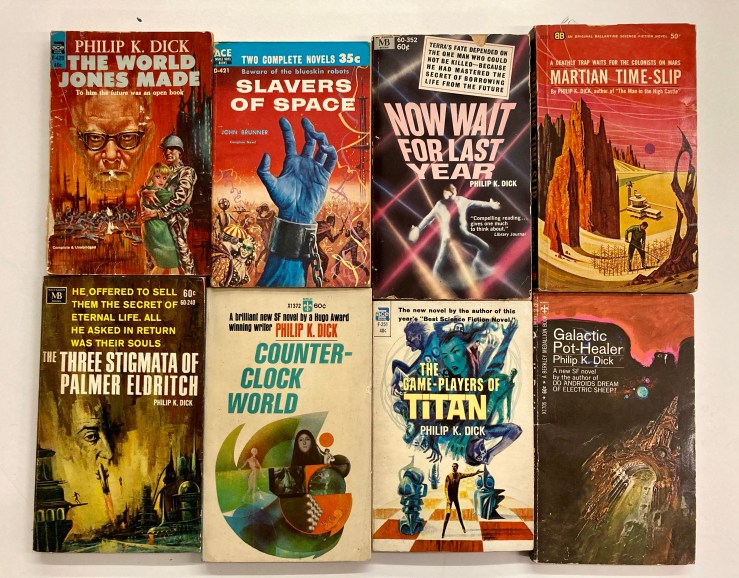
I also managed to avoid leaving with a bunch of massmarket paperbacks by Philip K. Dick—but here’s a pic of all their covers: 

—which I think are so much more interesting than these handsome, respectable, uniform contemporaries:

Read “Piper in the Woods,” Philip K. Dick’s early short story about men turning into plants

“Piper in the Woods”

by

Philip K. Dick

First published in Imagination: Stories of Science and Fantasy, February 1953 and made available via Project Gutenberg.


“Well, Corporal Westerburg,” Doctor Henry Harris said gently, “just why do you think you’re a plant?”

As he spoke, Harris glanced down again at the card on his desk. It was from the Base Commander himself, made out in Cox’s heavy scrawl: Doc, this is the lad I told you about. Talk to him and try to find out how he got this delusion. He’s from the new Garrison, the new check-station on Asteroid Y-3, and we don’t want anything to go wrong there. Especially a silly damn thing like this!

Harris pushed the card aside and stared back up at the youth across the desk from him. The young man seemed ill at ease and appeared to be avoiding answering the question Harris had put to him. Harris frowned. Westerburg was a good-looking chap, actually handsome in his Patrol uniform, a shock of blond hair over one eye. He was tall, almost six feet, a fine healthy lad, just two years out of Training, according to the card. Born in Detroit. Had measles when he was nine. Interested in jet engines, tennis, and girls. Twenty-six years old.

“Well, Corporal Westerburg,” Doctor Harris said again. “Why do you think you’re a plant?”

The Corporal looked up shyly. He cleared his throat. “Sir, I am a plant, I don’t just think so. I’ve been a plant for several days, now.”

“I see.” The Doctor nodded. “You mean that you weren’t always a plant?”

“No, sir. I just became a plant recently.”

“And what were you before you became a plant?”

“Well, sir, I was just like the rest of you.”

There was silence. Doctor Harris took up his pen and scratched a few lines, but nothing of importance came. A plant? And such a healthy-looking lad! Harris removed his steel-rimmed glasses and polished them with his handkerchief. He put them on again and leaned back in his chair. “Care for a cigarette, Corporal?”

“No, sir.”

The Doctor lit one himself, resting his arm on the edge of the chair. “Corporal, you must realize that there are very few men who become plants, especially on such short notice. I have to admit you are the first person who has ever told me such a thing.”

“Yes, sir, I realize it’s quite rare.”

“You can understand why I’m interested, then. When you say you’re a plant, you mean you’re not capable of mobility? Or do you mean you’re a vegetable, as opposed to an animal? Or just what?”

The Corporal looked away. “I can’t tell you any more,” he murmured. “I’m sorry, sir.”

“Well, would you mind telling me how you became a plant?”

Corporal Westerburg hesitated. He stared down at the floor, then out the window at the spaceport, then at a fly on the desk. At last he stood up, getting slowly to his feet. “I can’t even tell you that, sir,” he said.

“You can’t? Why not?”

“Because—because I promised not to.”

Continue reading “Read “Piper in the Woods,” Philip K. Dick’s early short story about men turning into plants”

“The Story to End All Stories” — Philip K. Dick

pkd

PK Dick’s Martian Time-Slip/Kafka regret (Books acquired and not acquired, 12.28.2016)

Two bucks.

Cover art by Darrell Sweet.

Here’s my riff on Philip K. Dick’s Martian Time-Slip.

I regret not picking up this edition of Kafka’s Amerika that same day:

img_4639

I reviewed Schocken’s latest translation of Amerika (not the one above) on Biblioklept like over eight years ago. I still have the black hardback, but I’d maybe exchange it for this beauty.