Tag: Poetry
Behind God’s back | On Thulani Davis’s poetry collection Nothing but the Music

Here are the first lines of Thulani Davis’s 1978 poem “Mecca Flats 1907”:
On this landscape
Like a thin air
Hard to breathe
Behind God’s back
I see the doors
I wanted to underline the line Behind God’s back—such an image! But the book itself is so pretty, lithe, lovely. Better to leave it unmarked?
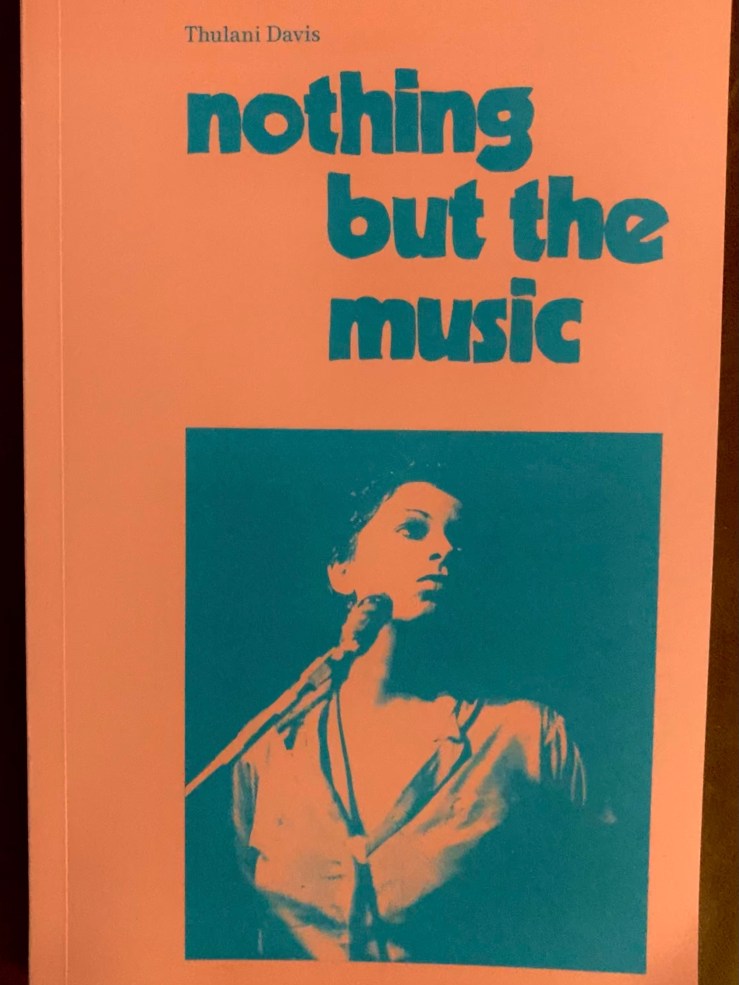
The book is Nothing but the Music, a new collection of Thulani Davis’s poems. Its subtitle Documentaries from Nightclubs, Dance Halls, & a Tailor’s Shop in Dakar: 1974-1992 is a somewhat accurate description of the content here. These are poems about music—about Cecil Taylor and The Commodores and Thelonious Monk and Henry Threadgill and Bad Brains and more. “About” is not really the right word, and of course these poems are their own music; reading them aloud reveals a complexity of rhyme and rhythm that might be lost to the eye on the page.
But where was I—I wanted to underline the line Behind God’s back, but I didn’t. I didn’t even dogear the page. Instead, I went back to read Davis’s acknowledgements, a foreword by Jessica Hagedorn, and an introduction by Tobi Haslett. The material sets the stage and provides context for the poems that follow. Davis’s acknowledgments begin:
I have heard this music in a lot of clubs that no longer exist, opera houses in Italy that will stand another hundred years parks in Manhattan, Brooklyn, L.A., San Francisco, and Washington, DC as well as on Goree Island and in Harare, Zimbabwe. Some of it was in lofts in lower Manhattan now inhabited by millionaires, crowded bistros in Paris that are close, and legendary sites like Mandel Hall and the Apollo, radio studios, recording studios, and my many homes.
Acknowledging the weird times that have persisted (behind God’s back or otherwise), Davis touches on the COVID-19 lockdown that took the joy of live music from her—and then returned it in the strange form of “masked protesters massed in the streets singing ‘Lean on Me'” during the protests following the murder of George Floyd.
Poems in Nothing but the Music resonate with the protests against police violence and injustice we’ve seen this year. The speaker of “Back Stage Drama (For Miami)” (surely Davis herself?) repeats throughout the poem that “I was gonna talk about a race riot,” but the folks around her are absorbed in other, perhaps more minute affairs:
They all like to hang out
Thinking is rather grim to them.
Composed in 1980, the poem documents an attempt to attempt to address the riots in May of the same year in Miami, Florida, after several police officers were acquitted in the murder of Arthur McDuffie, a black man.
The speaker of the poem embeds a poetic plea, a poem-within-a-poem:
I said, ‘they’re mad, they’re on the the bottom going down/
stung by white justice in a white town
and then there’s other colored people
who don’t necessarily think they’re colored people
taking up the middle/leaving them the ground.’
But her would-be audience is weary:
I am still trying to talk about this race riot.
Minnie looked up and said, ‘We don’t have anywhere
to put any more dead.’
Snake put on his coat to leave, ‘We never did,
we never did.’
1992’s “It’s Time for the Rhythm Revue” takes for its erstwhile subject the riots that ensued after the acquittal of the LAPD officers who beat Rodney King. The subject is far more complex though—the speaker of the poem desires joy of course, not violence:
did they acquit somebody in LA?
will we burn it down on Saturday
or dance to the Rhythm Revue
the not too distant past
when we thought we’d live on?
Is God’s back turned—or do the protagonists just live behind it?:
…I clean my house
listening to songs from the past
times when no one asked anyone
if they’d seen a town burn
cause baby everybody had.
In Nothing but the Music, music is part and parcel of the world, entangled in the violence and injustice of it all, not a mere balm or solace but lifeforce itself, a point of resistance against it all. In “Side A (Sir Simpleton/Celebration), the first of two poems on Henry Threadgill’s 1979 album X-75, Vol. I, Davis’s narrator evokes
at the turning of the day
in these winters/in the city’s bottomless streets
it seems sometimes we live behind god’s back
we/the life blood
of forgotten places/unhallowed ground
sometimes in these valleys
turning the corner of canyons now filled with blinding light streams caught between this rock & a known hard place
sometimes in utter solitude
a chorale/a sweetness/makes us whole & never lost
And again there that line, a note from a previous jam—it seems sometimes we live behind god’s back—I’ll dogear it here, digitally, underline it in my little blog scrapbook.
I think seems is the right verb though, above. Does the star of “Lawn Chair on the Sidewalk” not remain in God’s gaze?
there’s a junkie sunning himself
under my front tree
that tree had to fight for life
on this Brooklyn street
disease got to its limbs
while still young
Typing the lines out, I wonder who I meant by star above.
Nothing but the Music is filled with stars. Here’s avant-piano great Cecil Taylor in “C.T. at the Five Spot”:
this is not about romance & dream
it’s about a terrible command performance of the facts
of time & space & air
In a synesthestic moment, the speaker merges her art with its subject:
the player plays/Mr. Taylor plays
delicate separate licks of poems
brushes in tones lighter & tighter/closer in space
In the end it’s one art:
I have heard this music
ever since I can remember/I have heard this music
There are plenty more famous musicians, of course, but more often than not minor players emerge with the greatest force. There’s the unknown hornplayer whose ecstatic playing inspired 1975’s “He Didn’t Give Up/He Was Taken.” In “Leaving Goree” there are the “two Bambara women…gold teeth gleaming” who “sit like mountains” and then explode in song.
Davis crafts here characters with deft economy. Here’s the aforementioned couple of “Back Stage Drama (For Miami)”:
Snake & Minnie
who love each other dearly
drink in different bars,
ride home in separate cars.
They like to kiss goodnight
with unexplored lips.
They go out of town
to see each other open.
Or the hero of 1982’s “Bad Brains, A Band”—
the idea that they think must scare people to death
the only person I ever met from southeast DC
was a genius who stabbed her boyfriend for sneaking up on her in the kitchen
she was tone deaf and had no ear for French
she once burned her partner in bid whist
for making a mistake
At the core of it all is Davis’s strong gliding voice, pure and clean, channeling miracle music and synthesizing it into new sounds. The speaker of “C.T. at the Five Spot” assessed Taylor’s performance as a work of physics, a transcendence beyond “romance & dream,” but the speaker of 1982’s “Zoom (The Commodores)” gets caught up in the aural romance of The Commodore’s pop magic:
zoom I love you
cause you won’t say no/cause you don’t want to go
cause it’s so cruel without love
give me the tacky grandeur of Atlantic City
on the Fourth of July
the corny promises of Motown
give me the romance & the Zoom.
I love those corny promises too. The romance and the zoom are not, at least in my estimation, behind God’s back, but rather, if you believe in that sort of thing, might be God’s special dream. Nothing but the Music cooks raw joy and raw pain into something sublime. I like poems best when they tell stories, and Davis is a storyteller. The poems here capture place and time, but most of all sound, sound, rhythm, and sound. Lovely stuff.
Nothing but the Music is available from Blank Forms Editions.
[Ed. note–Biblioklept first published this review in Nov. 2020.]
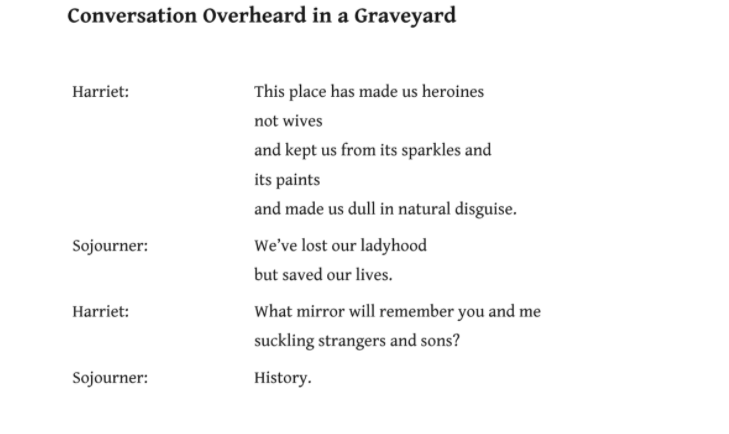
“Conversation Overheard in a Graveyard” — Lucille Clifton

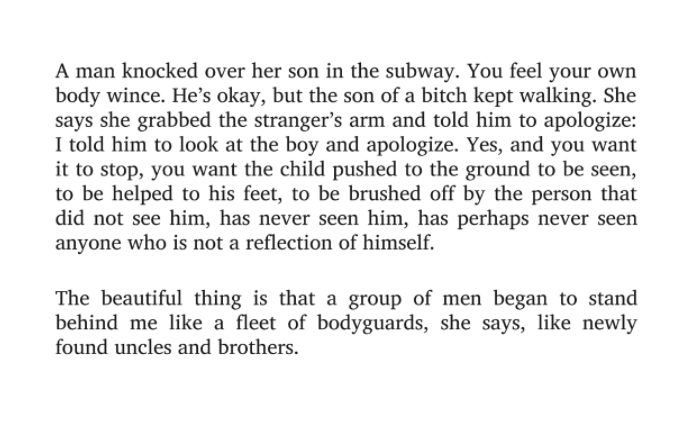
“Being in Plays” — Ed Skoog
“Being in Plays”
by
Ed Skoog
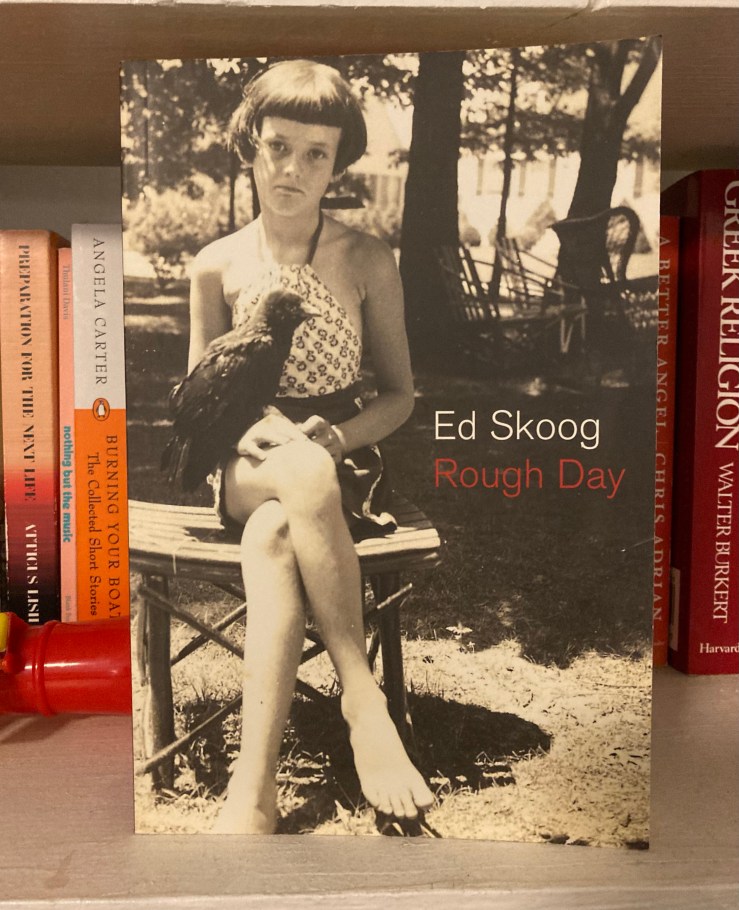
Ed Skoog’s Rough Day (Book acquired, 13 Nov. 2021)
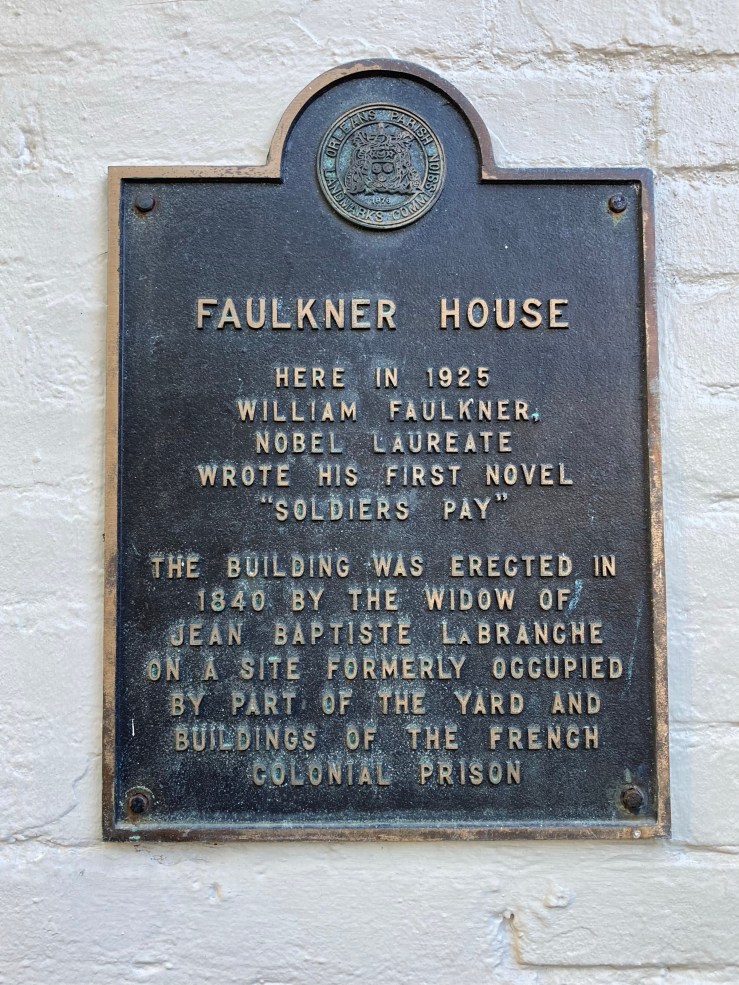
So we had a great long weekend with some friends in New Orleans. We stayed in Marigny—great food, great music, maybe too many drinks—but made it into the quarter for a few hours midday Saturday. I led our little group to Jackson Square where we respectfully finished our Bloody Marys before entering St. Louis Cathedral. My real aim though was Faulkner House Books on Pirate Alley right by the cathedral. Faulkner House imposed a strict four-guests-at-a-time policy, so my friends found a bar while I browsed. The stock in the small store is impeccable. Plenty of NYRB titles, a cadre of hardback Bolaños (including almost all of the poetry available in English), more Anne Carson than I’ve ever seen in a store. (I didn’t make it to Faulkner House when I visited NOLA in late 2016, but in 2012 I got some good stuff.) This time, I picked up a signed copy of Ed Skoog’s Rough Day, which seemed fitting—I’d scheduled a post that day of his poem “Run the Red Lights.”
After I finished up I headed to a bar on the outskirts of the Quarter to meet my friends, but first popped in to Arcadian Books & Prints on Orleans St.—perhaps the most chaotic bookstore I’ve ever been to.
As always, I loved NOLA and look forward to returning sooner rather than later.
“Hell Pig” — Aimee Nezhukumatathil
“Kong Looks Back on His Tryout with the Bears” — William Trowbridge
“Kong Looks Back on His Tryout with the Bears”
by
William Trowbridge
If it had worked out, I’d be on a train to Green Bay,
not crawling up this building with the Air Corps
on my ass. And if it weren’t for love, I’d drop
this shrieking little bimbo sixty stories
and let them take me back to the exhibit,
let them teach me to mambo and do imitations.
They tried me on the offensive line, told me
to take out the right cornerback for Nagurski.
Eager to please, I wadded up the whole secondary,
then stomped the line, then the bench and locker room,
then the east end of town, to the river.
But they were not pleased: they said I had to
learn my position, become a team player.
The great father Bear himself said that,
so I tried hard to know the right numbers
and how the arrows slanted toward the little o’s.
But the o’s and the wet grass and the grunts
drowned out the count, and the tight little cheers
drew my arrow straight into the stands,
and the wives tasted like flowers and raw fish.
So I was put on waivers right after camp,
and here I am, panty-sniffer, about to die a clown,
who once opened a hole you could drive Nebraska through.
“The Difference Between Pepsi and Coke” — David Lehman
“The Maypole” — Robert Herrick

“Seascape” — Elizabeth Bishop
“Seascape”
by
Elizabeth Bishop
This celestial seascape, with white herons got up as angels,
flying high as they want and as far as they want sidewise
in tiers and tiers of immaculate reflections;
the whole region, from the highest heron
down to the weightless mangrove island
with bright green leaves edged neatly with bird-droppings
like illumination in silver,
and down to the suggestively Gothic arches of the mangrove roots
and the beautiful pea-green back-pasture
where occasionally a fish jumps, like a wildflower
in an ornamental spray of spray;
this cartoon by Raphael for a tapestry for a Pope:
it does look like heaven.
But a skeletal lighthouse standing there
in black and white clerical dress,
who lives on his nerves, thinks he knows better.
He thinks that hell rages below his iron feet,
that that is why the shallow water is so warm,
and he knows that heaven is not like this.
Heaven is not like flying or swimming,
but has something to do with blackness and a strong glare
and when it gets dark he will remember something
strongly worded to say on the subject.
“Tell it to the forest fire, tell it to the moon” (Dream Song 44) | John Berryman

Little loving (Langston Hughes)

“Blown Away” — Tom Clark

“Christmasse-Eve, Another Ceremonie” — Robert Herrick

“Christmas Guilt” — Tom Disch

I discover myself on the verge of a usual mistake | Walt Whitman
Enough! enough! enough!Somehow I have been stunn’d. Stand back!Give me a little time beyond my cuff’d head, slumbers, dreams, gaping,I discover myself on the verge of a usual mistake.That I could forget the mockers and insults!That I could forget the trickling tears and the blows of the bludgeons and hammers!That I could look with a separate look on my own crucifixion and bloody crowning.I remember now,I resume the overstaid fraction,The grave of rock multiplies what has been confided to it, or to any graves,Corpses rise, gashes heal, fastenings roll from me.I troop forth replenish’d with supreme power, one of an average unending procession,Inland and sea-coast we go, and pass all boundary lines,Our swift ordinances on their way over the whole earth,The blossoms we wear in our hats the growth of thousands of years.Eleves, I salute you! come forward!Continue your annotations, continue your questionings.
Behind God’s back | On Thulani Davis’s poetry collection Nothing but the Music

Here are the first lines of Thulani Davis’s 1978 poem “Mecca Flats 1907”:
On this landscape
Like a thin air
Hard to breathe
Behind God’s back
I see the doors
I wanted to underline the line Behind God’s back—such an image! But the book itself is so pretty, lithe, lovely. Better to leave it unmarked?
The book is Nothing but the Music, a new collection of Thulani Davis’s poems. Its subtitle Documentaries from Nightclubs, Dance Halls, & a Tailor’s Shop in Dakar: 1974-1992 is a somewhat accurate description of the content here. These are poems about music—about Cecil Taylor and The Commodores and Thelonious Monk and Henry Threadgill and Bad Brains and more. “About” is not really the right word, and of course these poems are their own music; reading them aloud reveals a complexity of rhyme and rhythm that might be lost to the eye on the page.
But where was I—I wanted to underline the line Behind God’s back, but I didn’t. I didn’t even dogear the page. Instead, I went back to read Davis’s acknowledgements, a foreword by Jessica Hagedorn, and an introduction by Tobi Haslett. The material sets the stage and provides context for the poems that follow. Davis’s acknowledgments begin:
I have heard this music in a lot of clubs that no longer exist, opera houses in Italy that will stand another hundred years parks in Manhattan, Brooklyn, L.A., San Francisco, and Washington, DC as well as on Goree Island and in Harare, Zimbabwe. Some of it was in lofts in lower Manhattan now inhabited by millionaires, crowded bistros in Paris that are close, and legendary sites like Mandel Hall and the Apollo, radio studios, recording studios, and my many homes.
Acknowledging the weird times that have persisted (behind God’s back or otherwise), Davis touches on the COVID-19 lockdown that took the joy of live music from her—and then returned it in the strange form of “masked protesters massed in the streets singing ‘Lean on Me'” during the protests following the murder of George Floyd.
Poems in Nothing but the Music resonate with the protests against police violence and injustice we’ve seen this year. The speaker of “Back Stage Drama (For Miami)” (surely Davis herself?) repeats throughout the poem that “I was gonna talk about a race riot,” but the folks around her are absorbed in other, perhaps more minute affairs:
They all like to hang out
Thinking is rather grim to them.
Composed in 1980, the poem documents an attempt to attempt to address the riots in May of the same year in Miami, Florida, after several police officers were acquitted in the murder of Arthur McDuffie, a black man.
The speaker of the poem embeds a poetic plea, a poem-within-a-poem:
I said, ‘they’re mad, they’re on the the bottom going down/
stung by white justice in a white town
and then there’s other colored people
who don’t necessarily think they’re colored people
taking up the middle/leaving them the ground.’
But her would-be audience is weary:
I am still trying to talk about this race riot.
Minnie looked up and said, ‘We don’t have anywhere
to put any more dead.’
Snake put on his coat to leave, ‘We never did,
we never did.’
1992’s “It’s Time for the Rhythm Revue” takes for its erstwhile subject the riots that ensued after the acquittal of the LAPD officers who beat Rodney King. The subject is far more complex though—the speaker of the poem desires joy of course, not violence:
did they acquit somebody in LA?
will we burn it down on Saturday
or dance to the Rhythm Revue
the not too distant past
when we thought we’d live on?
Is God’s back turned—or do the protagonists just live behind it?:
…I clean my house
listening to songs from the past
times when no one asked anyone
if they’d seen a town burn
cause baby everybody had.
In Nothing but the Music, music is part and parcel of the world, entangled in the violence and injustice of it all, not a mere balm or solace but lifeforce itself, a point of resistance against it all. In “Side A (Sir Simpleton/Celebration), the first of two poems on Henry Threadgill’s 1979 album X-75, Vol. I, Davis’s narrator evokes
at the turning of the day
in these winters/in the city’s bottomless streets
it seems sometimes we live behind god’s back
we/the life blood
of forgotten places/unhallowed ground
sometimes in these valleys
turning the corner of canyons now filled with blinding light streams caught between this rock & a known hard place
sometimes in utter solitude
a chorale/a sweetness/makes us whole & never lost
And again there that line, a note from a previous jam—it seems sometimes we live behind god’s back—I’ll dogear it here, digitally, underline it in my little blog scrapbook.
I think seems is the right verb though, above. Does the star of “Lawn Chair on the Sidewalk” not remain in God’s gaze?
there’s a junkie sunning himself
under my front tree
that tree had to fight for life
on this Brooklyn street
disease got to its limbs
while still young
Typing the lines out, I wonder who I meant by star above.
Nothing but the Music is filled with stars. Here’s avant-piano great Cecil Taylor in “C.T. at the Five Spot”:
this is not about romance & dream
it’s about a terrible command performance of the facts
of time & space & air
In a synesthestic moment, the speaker merges her art with its subject:
the player plays/Mr. Taylor plays
delicate separate licks of poems
brushes in tones lighter & tighter/closer in space
In the end it’s one art:
I have heard this music
ever since I can remember/I have heard this music
There are plenty more famous musicians, of course, but more often than not minor players emerge with the greatest force. There’s the unknown hornplayer whose ecstatic playing inspired 1975’s “He Didn’t Give Up/He Was Taken.” In “Leaving Goree” there are the “two Bambara women…gold teeth gleaming” who “sit like mountains” and then explode in song.
Davis crafts here characters with deft economy. Here’s the aforementioned couple of “Back Stage Drama (For Miami)”:
Snake & Minnie
who love each other dearly
drink in different bars,
ride home in separate cars.
They like to kiss goodnight
with unexplored lips.
They go out of town
to see each other open.
Or the hero of 1982’s “Bad Brains, A Band”—
the idea that they think must scare people to death
the only person I ever met from southeast DC
was a genius who stabbed her boyfriend for sneaking up on her in the kitchen
she was tone deaf and had no ear for French
she once burned her partner in bid whist
for making a mistake
At the core of it all is Davis’s strong gliding voice, pure and clean, channeling miracle music and synthesizing it into new sounds. The speaker of “C.T. at the Five Spot” assessed Taylor’s performance as a work of physics, a transcendence beyond “romance & dream,” but the speaker of 1982’s “Zoom (The Commodores)” gets caught up in the aural romance of The Commodore’s pop magic:
zoom I love you
cause you won’t say no/cause you don’t want to go
cause it’s so cruel without love
give me the tacky grandeur of Atlantic City
on the Fourth of July
the corny promises of Motown
give me the romance & the Zoom.
I love those corny promises too. The romance and the zoom are not, at least in my estimation, behind God’s back, but rather, if you believe in that sort of thing, might be God’s special dream. Nothing but the Music cooks raw joy and raw pain into something sublime. I like poems best when they tell stories, and Davis is a storyteller. The poems here capture place and time, but most of all sound, sound, rhythm, and sound. Lovely stuff.
Nothing but the Music is forthcoming from Blank Forms Editions.