Amy Hempel on Gordon Lish and Steve Martin

Amy Hempel talks about studying under Gordon Lish (and how Steve Martin influenced her) in her 2003 interview with The Paris Review

INTERVIEWER

Why Lish?

HEMPEL

At Esquire in the seventies and, later, at Knopf, he was publishing the voices that interested me most. I felt allied with his choices, so he was the one I wanted to work with. Writers like Raymond Carver, Barry Hannah, Mary Robison. These were the three who had the most effect on me when I started.

INTERVIEWER

What about their work interested you?

HEMPEL

They didn’t sound like anyone else I had read. For me, they redefined what a story could be—the thing happening off to the side of the story other writers were telling; they would start where someone else would leave off, or stop where someone else would start. As Hannah said later in Boomerang, a lot of people have their overview, whereas he has his “underview,” scouting “under the bleachers, for what life has dropped.”

INTERVIEWER

Do you remember the first class?

HEMPEL

Vividly. The assignment was to write our worst secret, the thing we would never live down, the thing that, as Gordon put it, “dismantles your own sense of yourself.” And everybody knew instantly what that thing, for them, was. We found out immediately that the stakes were very high, that we were expected to say something no one else had said, and to divulge much harder truths than we had ever told or ever thought to tell. No half-measures. He thought any of us could do it if we wanted it badly enough. And that, when I was starting out, was a great thing to hear from someone who would know.

INTERVIEWER

What was, if you can say, your “worst secret”?

HEMPEL

I failed my best friend when she was dying. It became the subject of the first story I wrote, “In the Cemetery Where Al Jolson Is Buried.”

INTERVIEWER

You stayed on in his workshop as a student for years. You must have been repeatedly humbled.

HEMPEL

I felt humbled by realizing how hard the job was. How hard it is to write a moving, worthwhile, memorable story. But more often I was inspired. It turned out that one of the most helpful things I did without knowing it would be helpful later was hang out with stand-up comics in San Francisco. I went to their shows night after night after night. I watched them performing, working through the same material. I saw some nights it killed and other nights it bombed. All that time I was observing nuance, inflection, timing, how the slightest difference mattered. How the littlest leaning on a word—or leaning away from it—would get the laugh, and this lesson was so valuable. And the improv work—they called it “being human on purpose,” this falling back on the language in your mouth—was hugely important. Just listening to what you’re saying. I learned this when my late friend Morgan Upton, an actor and member of the Committee, took me to a Steve Martin show at the Boarding House in San Francisco. Back in the green room, Steve Martin was sick, but preparing to do his show anyway. I told him I admired that, I said I couldn’t go out there and make people laugh if I were sick. And he said, Don’t be silly—you couldn’t do it if you were well. A brilliant reply on any number of levels. I based an early story, “Three Popes Walk into a Bar,” on that night. Then I ran into him about twenty years later and reminded him of our exchange. He laughed and said, “It sounds mean!” But I thought it was great.


“Your Dog Dies” — Raymond Carver

“Your Dog Dies” by Raymond Carver–

It gets run over by a van.
you find it at the side of the road
and bury it.
you feel bad about it.
you feel bad personally,
but you feel bad for your daughter
because it was her pet,
and she loved it so.
she used to croon to it
and let it sleep in her bed.
you write a poem about it.
you call it a poem for your daughter,
about the dog getting run over by a van
and how you looked after it,
took it out into the woods
and buried it deep, deep,
and that poem turns out so good
you’re almost glad the little dog
was run over, or else you’d never
have written that good poem.
then you sit down to write
a poem about writing a poem
about the death of that dog,
but while you’re writing you
hear a woman scream
your name, your first name,
both syllables,
and your heart stops.
after a minute, you continue writing.
she screams again.
you wonder how long this can go on.


Read Gordon Lish’s Edit of Raymond Carver’s “What We Talk About When We Talk About Love”

Boy oh boy this is great (yes, I am that kind of nerd). A few years ago The New Yorker published an early draft of Raymond Carver’s short story “What We Talk About When We Talk About Love,” which was originally titled “Beginners.” The New Yorker simultaneously published a version of the story showing Gordon Lish’s edits. It’s a fascinating look at the Carver-Lish writing experience. In the sample that follows, strike-throughs are deletions and boldfaced words are Lish’s additions—

My friend Mel Herb McGinnis, a cardiologist, was talking. Mel McGinnis is a cardiologist, and sometimes that gives him the right. The four of us were sitting around his kitchen table drinking gin. It was Saturday afternoon. Sunlight filled the kitchen from the big window behind the sink. There were Mel Herb and me I and his second wife, Teresa—Terri, we called her—and my wife, Laura. We lived in Albuquerque, then. But but we were all from somewhere else. There was an ice bucket on the table. The gin and the tonic water kept going around, and we somehow got on the subject of love. Mel Herb thought real love was nothing less than spiritual love. He said When he was young he’d spent five years in a seminary before quitting to go to medical school. He He’d left the Church at the same time, but he said he still looked back on to those years in the seminary as the most important in his life.

Terri said the man she lived with before she lived with Mel Herb loved her so much he tried to kill her. Herb laughed after she said this. He made a face. Terri looked at him. Then Terri she said, “He beat me up one night, the last night we lived together. He dragged me around the living room by my ankles. He kept saying, , all the while saying, ‘I love you, don’t you see? I love you, you bitch.’ He went on dragging me around the living room. My , my head kept knocking on things.” TerriShe looked around the table at us and then looked at her hands on her glass. “What do you do with love like that?” she said. She was a bone-thin woman with a pretty face, dark eyes, and brown hair that hung down her back. She liked necklaces made of turquoise, and long pendant earrings. She was fifteen years younger than Herb, had suffered periods of anorexia, and during the late sixties, before she’d gone to nursing school, had been a dropout, a “street person” as she put it. Herb sometimes called her, affectionately, his hippie.

“My God, don’t be silly. That’s not love, and you know it,” Mel Herb said. “I don’t know what you’d call it, —madness is what I’d call it—but I sure know you wouldn’t call it it’s sure as hell not love.”

The Collected Fictions of Gordon Lish (as Read by Gordon Lish)

Listening to Gordon Lish read selections from Iambik Audio’s compendium of his Collected Fictions for the fourth time today, it occurred to me that I should just go ahead and review the damn thing. Quit stalling. Get to it. I hope that pointing out that I’ve listened to Lish narrate ten of his odd, funny, gut-wrenching tales four times now (and will surely listen again) is enough to motivate thee, gentle reader, to follow my example—but that’s lazy, wishful thinking, right? There needs to be a proper review. Here goes—

Lish is perhaps more famous as an editor than a writer of short fiction. He worked for years at Vanity Fair and later for Knopf, and the list of writers that he championed reads like a who’s-who of contemporary greats: Don DeLillo, Cynthia Ozick, Amy Hempel, Barry Hannah, David Leavitt, and Harold Brodkey, just to name a few. The writer he is perhaps most associated with though is Raymond Carver. By paring down sentence after sentence, Lish helped Carver develop his spare, minimalist style.

It’s that attention to sentences, to the truth of each sentence, to their individual force, that shines through in the collection. Consider this beauty, from “The Death of Me,” a story about a boy (surely Gordon Lish, hero of all Gordon Lish stories) who peaks too early, winning first place in all five field events at his summer camp one fine day in 1944, and then succumbing to the realization that this apex is, frankly, the end of it all–

I felt like going to sleep and staying asleep until someone came and told me that my parents were dead and that I was all grown up and that there was a new God in heaven and that he liked me better even than the old God had.

This sentence seems to me to be the expression of an emotion that I’ve felt for which I have no name. Lish’s sentences can move through tragedy and pathos to devastating comedy, a kind of comedy that collapses the auditor. Check out a line from “Mr. Goldbaum”–

What if your father was the kind of father who was dying and he called you to him and you were his son and he said for you to come lie down on the bed with him so that he could hold you and so that you could hold him so that you both could be like that hugging with each other like that to say goodbye before you had to actually go leave each other and did it, you did it, you god down on the bed with your father and you got up close to your father and you got your arms around your father and your father was hugging you and you were hugging your father and there was one of you who could not stop it, who could not help it, but who just got a hard-on?

Lish advised, “Don’t have stories — have sentences,” but “The Death of Me” and “Mr. Goldbaum” are more than the sum of their parts, more than just a collection of sculpted, scalpeled syntax. From the 1988 collection Mourner at the Door (the only Lish book I’d read before Collected Fictions), both stories announce Lish’s major theme of death, the absurdity of death, or the absurdity of life against the inevitability of death—but also the heavy truth of death, the ugly truth of death, the powerlessness of language against the finality of death. “Spell Bereavement,” also from Mourner, is essentially a prequel to “Mr. Goldbaum”: Gordon gets the news of his father’s death from his sister and mother. The story takes place over the phone as a sort of switch-hit interrogation, as mom and sis caustically berate the speechless man, who tells us, at the end, “There are not people in my heart of hears. There are just sentences in my heart of hearts.” Why does Gordon the narrator of “Spell Bereavement” fail to respond to the news of his father’s death? He is “too disabled to talk . . . going crazy with pencil and paper so as not to miss one word.”

Lish means to capture the ecstatic truth in death, and truth is at the core of all these stories, even when they are fables of a sort, like “After the Beanstalk,” which features a bewitched princess who has been transmogrified into a dog. The tale is hilarious and cutting and sad. There’s also “Squeak in the Sycamore,” which begins as a child’s list of fears and enumerations of death and longing and nature and ends in a joke and then an insult to the reader for laughing at the joke. (Best line: “Six is: the gardener died from digging up a basilisk”). “How to Write a Poem” is a caustic rant that argues that literary theft is really a matter of stern guts, of facing truth, and “Everything I Know” problematizes the very act of storytelling — it’s a story about how we tell stories, or our versions of stories. By far the most affecting piece that Lish reads though is “Eats with Ozick and Lentricchia,” about which he tells us, before reading it, “there is not a word of it that is not true.” It is a story that hovers around the death, or the dying of, more accurately, Lish’s wife Barbara; its details are almost too cruel, too true to bear.

Lish reads his tales in a bold voice that seems to challenge the auditor at all angles, as if his sentences were prodding you, poking you, pinching you even. He claims, in one of the many asides that precede these tales, to have never really read his work aloud before, and not to have really read the work in years, but his confidence seems to belie this notion; maybe, more accurately, it conveys the intense concentration of his intellect. His tone fascinates, and then he cracks out something like: “It always astonishes me I could have written such a thing” in such a dry honest voice that, while his quip hangs ambiguous, it remains utterly sincere. There’s a wonderful moment in the recording when he moves from reading “Mr. Goldbaum” to “Spell Bereavement” and seems to notice, as if for the first time, their close connection. He then remarks–

It shames me in one kind of way to see that my writing gathers itself into such a rut, but on the other hand it does please me to have spoken again and again and again about that which occurred to me at the time to be of consequence. I haven’t written fiction or anything else really for a great number of years and this occasion, reading these pieces, is an education for me and alien, foreign, in one kind of way, because the sentences are complex, but in another kind of way, I’m reminded of who I am.

Lish’s influence cannot be underestimated, from writers like David Foster Wallace to Denis Johnson to Sam Lipsyte, and all of those who will follow in turn. Readers have a fantastic (and incredibly inexpensive, I must add) starting place in Iambik’s wonderful collection. Do yourself a favor and check this out. Very highly recommended.

Did Alcohol Inspire Raymond Carver? “My God, No!” — Carver on His Days with Cheever at the Iowa Writers’ Workshop

We continue to raid Raymond Carver’s 1983 Paris Review interview

INTERVIEWER

Did you ever feel that alcohol was in any way an inspiration? I’m thinking of your poem “Vodka,” published in Esquire.

CARVER

My God, no! I hope I’ve made that clear. Cheever remarked that he could always recognize “an alcoholic line” in a writer’s work. I’m not exactly sure what he meant by this but I think I know. When we were teaching in the Iowa Writers’ Workshop in the fall semester of 1973, he and I did nothing but drink. I mean we met our classes, in a manner of speaking. But the entire time we were there—we were living in this hotel they have on campus, the Iowa House—I don’t think either of us ever took the covers off our typewriters. We made trips to a liquor store twice a week in my car.

INTERVIEWER

To stock up?

CARVER

Yes, stock up. But the store didn’t open until 10:00 a.m. Once we planned an early morning run, a ten o’clock run, and we were going to meet in the lobby of the hotel. I came down early to get some cigarettes and John was pacing up and down in the lobby. He was wearing loafers, but he didn’t have any socks on. Anyway, we headed out a little early. By the time we got to the liquor store the clerk was just unlocking the front door. On this particular morning, John got out of the car before I could get it properly parked. By the time I got inside the store he was already at the checkout stand with a half gallon of Scotch. He lived on the fourth floor of the hotel and I lived on the second. Our rooms were identical, right down to the same reproduction of the same painting hanging on the wall. But when we drank together, we always drank in his room. He said he was afraid to come down to drink on the second floor. He said there was always a chance of him getting mugged in the hallway! But you know, of course, that fortunately, not too long after Cheever left Iowa City, he went to a treatment center and got sober and stayed sober until he died.

The world of addiction treatment is full of stories of addicts who managed to stay sober using support from other former addicts as they went about the rehabilitation process.

“Let’s just say, on occasion, the police were involved and emergency rooms and courtrooms” — Raymond Carver Talks About Drinking

More from Raymond Carver’s 1983 Paris Review interview

INTERVIEWER

Could you talk a little more about the drinking? So many writers, even if they’re not alcoholics, drink so much.

CARVER

Probably not a whole lot more than any other group of professionals. You’d be surprised. Of course there’s a mythology that goes along with the drinking, but I was never into that. I was into the drinking itself. I suppose I began to drink heavily after I’d realized that the things I’d wanted most in life for myself and my writing, and my wife and children, were simply not going to happen. It’s strange. You never start out in life with the intention of becoming a bankrupt or an alcoholic or a cheat and a thief. Or a liar.

INTERVIEWER

And you were all those things?

CARVER

I was. I’m not any longer. Oh, I lie a little from time to time, like everyone else.

INTERVIEWER

How long since you quit drinking?

CARVER

June second, 1977. If you want the truth, I’m prouder of that, that I’ve quit drinking, than I am of anything in my life. I’m a recovered alcoholic. I’ll always be an alcoholic, but I’m no longer a practicing alcoholic.

INTERVIEWER

How bad did the drinking get?

CARVER

It’s very painful to think about some of the things that happened back then. I made a wasteland out of everything I touched. But I might add that towards the end of the drinking there wasn’t much left anyway. But specific things? Let’s just say, on occasion, the police were involved and emergency rooms and courtrooms.


“None of my stories really happened, of course” — Raymond Carver on Realism (and Drinking) in His Stories

Raymond Carver talks realism, autobiography (and drinking) in his 1983 Paris Review interview. A taste–

INTERVIEWER

Where do your stories come from, then? I’m especially asking about the stories that have something to do with drinking.

CARVER

The fiction I’m most interested in has lines of reference to the real world. None of my stories really happened, of course. But there’s always something, some element, something said to me or that I witnessed, that may be the starting place. Here’s an example: “That’s the last Christmas you’ll ever ruin for us!” I was drunk when I heard that, but I remembered it. And later, much later, when I was sober, using only that one line and other things I imagined, imagined so accurately that they could have happened, I made a story—“A Serious Talk.” But the fiction I’m most interested in, whether it’s Tolstoy’s fiction, Chekhov, Barry Hannah, Richard Ford, Hemingway, Isaac Babel, Ann Beattie, or Anne Tyler, strikes me as autobiographical to some extent. At the very least it’s referential. Stories long or short don’t just come out of thin air. I’m reminded of a conversation involving John Cheever. We were sitting around a table in Iowa City with some people and he happened to remark that after a family fracas at his home one night, he got up the next morning and went into the bathroom to find something his daughter had written in lipstick on the bathroom mirror: “D-e-r-e daddy, don’t leave us.” Someone at the table spoke up and said, “I recognize that from one of your stories.” Cheever said, “Probably so. Everything I write is autobiographical.” Now of course that’s not literally true. But everything we write is, in some way, autobiographical. I’m not in the least bothered by “autobiographical” fiction. To the contrary. On the Road. Céline. Roth. Lawrence Durrell in The Alexandria Quartet. So much of Hemingway in the Nick Adams stories. Updike, too, you bet. Jim McConkey. Clark Blaise is a contemporary writer whose fiction is out-and-out autobiography. Of course, you have to know what you’re doing when you turn your life’s stories into fiction. You have to be immensely daring, very skilled and imaginative and willing to tell everything on yourself. You’re told time and again when you’re young to write about what you know, and what do you know better than your own secrets? But unless you’re a special kind of writer, and a very talented one, it’s dangerous to try and write volume after volume on The Story of My Life. A great danger, or at least a great temptation, for many writers is to become too autobiographical in their approach to their fiction. A little autobiography and a lot of imagination are best.


Raymond Carver: Dreams Are What You Wake Up From

Continue reading “Raymond Carver: Dreams Are What You Wake Up From”

“Drinking While Driving” — Raymond Carver

“Drinking While Driving” by Raymond Carver–

It’s August and I have not
Read a book in six months
except something called The Retreat from Moscow
by Caulaincourt
Nevertheless, I am happy
Riding in a car with my brother
and drinking from a pint of Old Crow.
We do not have any place in mind to go,
we are just driving.
If I closed my eyes for a minute
I would be lost, yet
I could gladly lie down and sleep forever
beside this road
My brother nudges me.
Any minute now, something will happen.

Amy Hempel on Gordon Lish and Barry Hannah

Amy Hempel talks Gordon Lish and Barry Hannah (among other things) in a new interview with Vice. A taste–

Do you think about readers when you’re writing? Do you personify them?
I do. I always have, and it’s always been a handful of other writers. Sometimes it has changed, but yes, I really do think of a few actual people. It makes it a little bit easier since I know them, and I know that, well, if this person will find it funny, then I’ve succeeded, or some such thing. It makes it more like trading confidences. I think it’s daunting to think of writing for one’s readers, whoever they may be, so I bring it down to something manageable—a few people whose standards I know and whose work I very much admire—and that makes it more like, almost, a letter to the person. That helps me set the course.

So do you think like, “I’m going to change this here. I’m sure Gordon Lish would love it”?
[laughs] Well, I often have in mind Barry Hannah, and in fact when you phoned me just now, I was working on some remarks I’m going to make at a sort of memorial tribute to Barry, who died last March. This is something that will be held just outside Boston, two nights from now. A bunch of writers who adored him, just paying tribute to him. Barry Hannah was always on my list of people I knew, writers I admired immensely, and just thinking, you know, Barry Hannah might read this, it seemed to focus me when I was writing.

Writing is an extremely solitary activity, but at the same time it’s also very intense. One analogy that I always think of is swimming—it’s something that you do on your own, and the only standard of success you have is your last lap.
I agree 100 percent. And yet there are writers who hold themselves up and compare themselves to other writers. I think that’s useless. As you say, you’re only trying to beat your own best time. That’s the only relevant competition as far as I’m concerned.

Is your past with Lish something that still has an influence on you?
You know, it was a long time ago. I was a student of his at Columbia and then privately and then his author back in the early 80s. I did two books with him. Working with him was a crucial formative experience, but it was a long time ago. There are other writers who have sort of stepped in. Interestingly, Barry Hannah was one and Mary Robison is another, and they are both his authors, too, and were at the time that I was being published by him. So, yes, [Lish] had a terrific impact on my writing very early on. I don’t think he’s writing any more, but he’s still present among writers who really do care about writing at the sentence level. His impact there has certainly endured.

What about the so-called golden age of American short stories? I don’t really know if it’s accurate, or even intelligent, to define it that way.
Well, I think it was a phenomenon in publishing, with a lot of critics rightly going to Raymond Carver—who was also Gordon’s author—and people like Mary Robison. You know—some of the story writers who really, really opened things up again for stories as a commercially viable kind of writing as well as something that was important to a lot of readers.

Angels — Denis Johnson

Angels, Denis Johnson’s 1983 début novel, begins as a small book about not very much and ends as a small book about pretty much everything. Johnson has a keen eye and keener ear for the kinds of marginal characters many of us would rather overlook all together, people who live and sweat and suffer in the most wretched, unglamorous, and anti-heroic vistas of a decayed America. The great achievement of the novel (beyond Johnson’s artful sentences) is in staging redemption for a few–not all, but a few–of its hopeless anti-heroes.

Take Jamie, for instance. Angels opens on this unfortunate young woman as she’s hauling her two young children onto a Greyhound bus. She’s leaving her cheating husband for relatively unknown prospects, lugging her children around like literal and symbolic baggage. Jamie should be sympathetic, but somehow she’s not. She’s someone we’d probably rather not look at, yelling at her kids while she drags on a Kool. Even she knows it. Of two nuns on the bus: “But Jamie could sense that they found her make-up too thick, her pants too tight. They knew she was leaving her husband, and figured she’d turn for a living to whoring. She wanted to tell them what was what, but you can’t talk to a Catholic.” Jamie finds a closer companion, or at least someone equally bored and equally prone to drinking and substance abuse, in Bill Houston. The ex-con, ex-navy man is soon sharing discreet boilermakers with her on the back of the bus, and she makes the first of many bad decisions in deciding to shack up with him over the next few weeks in a series of grim motels.

The bus, the bus stations, the motels, the bars–Johnson details ugly, urgent gritty second-tier cities and crumbling metropolises at the end of the seventies. The effect is simply horrifying. This is a world that you don’t want to be in. Johnson’s evocation never veers into the grotesque, however; he never risks tipping into humor, hyperbole, or distance. The poetic realism of his Pittsburgh or his Chicago is virulent and awful, and as Jamie drunkenly and druggily lurches toward an early trauma, one finds oneself hoping that even if she has to fall, dear God, just let those kids be okay. It’s tempting to accuse Johnson of using the kids to manipulate his audience’s sympathy, but that’s not really the case. Sure, there’ s a manipulation, but it veers toward horror, not sympathy. (And anyway, all good writing manipulates its audience). Johnson’s milieu here is utterly infanticidal and Jamie is part and parcel of the environment: “Jamie could feel the muscles in her leg jerk, she wanted so badly to kick Miranda’s rear end and send her scooting under the wheels, of, for instance, a truck.”

Jamie is of course hardly cognizant of the fact that her treatment of her children is the psychological equivalent of kicking them under a truck. She’s a bad mother, but all of the people in this novel are bad; only some are worse–much worse–than others. Foolishly looking for Bill Houston on the streets of Chicago, she notices that “None of these people they were among now looked at all legitimate.” Jamie is soon conned, drugged, and gang-raped by a brother and his brother-in-law; the sister/wife part of that equation serves as babysitter during the horrific scene.

And oh, that scene. I put the book down. I put the book away. For two weeks. The scene is a red nightmare, the tipping point of Jamie’s sanity, and the founding trauma that the rest of the novel must answer to–a trauma that Bill Houston, specifically, must somehow pay for, redress, or otherwise atone. The rape and its immediate aftermath are hard to stomach, yet for Johnson it’s no mere prop or tasteless gimmick. Rather, the novel’s narrative thrust works to somehow answer to the rape’s existential cruelty, its base meanness, its utter inhumanity. Not that getting there is easy.

Angels shifts direction after the rape, retreating to sun-blazed Arizona, Bill Houston’s boyhood home and home to his mother and two brothers. There’s a shambling reunion, the book’s closest moment of levity, but it’s punctuated and punctured by Jamie’s creeping insanity, alcoholism, and drug addiction. Johnson’s signature humor is desert-dry and rarely shows up to relieve the narrative tension. Jamie hazily evaporates into the background of the book as the Houston brothers, along with a dude named Dwight Snow, plan a bank robbery. Another name for Angels might be Poor People Making Bad Decisions out of Sheer Desperation. Burris, the youngest Houston, has a heroin habit to feed. James Houston is just bored and nihilistic and seems unable to enjoy his wife and child and home. On hearing about the bank robbery plan, Jamie achieves a rare moment of insight: “Rather unexpectedly it occurred to her that her husband Curt, about whom she scarcely ever thought, had been a nice person. These people were not. She knew that she was in a lot of trouble: that whatever she did would be wrong.” And of course, Jamie’s right.

The bank robbery goes wrong–how could it not?–but to write more would risk spoiling much of the tension and pain at the end of Angels. Those who’ve read Jesus’ Son or Tree of Smoke will see the same concern here for redemption, the same struggle, the same suffering. While Jesusian narratives abound in our culture, Johnson is the rare writer who can make his characters’ sacrifices count. These are people. These are humans. And their ugly little misbegotten world is hardly the sort of thing you want to stumble into, let alone engage in, let alone be affected by, let alone be moved by. But Johnson’s characters earn these myriad affections, just as they earn their redemptions. Angels is clearly not for everyone, but fans of Raymond Carver and Russell Banks should make a spot for it on their reading lists (as well as Johnson fans like myself who haven’t gotten there yet). Highly recommended.

“He’s a good editor. Maybe he’s a great editor.” — Raymond Carver on Gordon Lish

We continue to raid The Paris Review’s vault of interviews. Here’s Raymond Carver on Gordon Lish–

INTERVIEWER: Where does Gordon Lish enter into this? I know he’s your editor at Knopf.

CARVER: Just as he was the editor who began publishing my stories at Esquire back in the early 1970s. But we had a friendship that went back before that time, back to 1967 or 1968, in Palo Alto. He was working for a textbook publishing firm right across the street from the firm where I worked. The one that fired me. He didn’t keep any regular office hours. He did most of his work for the company at home. At least once a week he’d ask me over to his place for lunch. He wouldn’t eat anything himself, he’d just cook something for me and then hover around the table watching me eat. It made me nervous, as you might imagine. I’d always wind up leaving something on my plate, and he’d always wind up eating it. Said it had to do with the way he was brought up. This is not an isolated example. He still does things like that. He’ll take me to lunch now and won’t order anything for himself except a drink and then he’ll eat up whatever I leave in my plate! I saw him do it once in the Russian Tea Room. There were four of us for dinner, and after the food came he watched us eat. When he saw we were going to leave food on our plates, he cleaned it right up. Aside from this craziness, which is more funny than anything, he’s remarkably smart and sensitive to the needs of a manuscript. He’s a good editor. Maybe he’s a great editor. All I know for sure is that he’s my editor and my friend, and I’m glad on both counts.

“Never Give an Inch” — Gerald Howard on Social Class and the American Novel

Tin House #45, out in September, focuses on “Class in America.” You can read Gerald Howard’s essay from that issue, “Never Give an Inch,” in full now. The essay discusses shifting ideas of the social class of the American novelist, with an emphasis on “working class” writers. Howard discusses Raymond Carver and Russell Banks at some length, as well as Richard Price and Dorothy Allison (he also mentions Gilbert Sorrentino, whose work seems to be enjoying a late reappraisal). From the essay–

I don’t suppose anyone has ever done an in-depth study of that interesting form of literary ephemera, the author dust jacket biography. But if they did, I’m sure they would notice a distinct sociological shift over the past decades. Back in the forties and fifties, the bios, for novelists at least, leaned very heavily on the tough and colorful professions and pursuits that the author had had experience in before taking to the typewriter. Popular jobs, as I recall, were circus roustabout, oil field roughneck, engine wiper, short-order cook, fire lookout, railroad brakeman, cowpuncher, gold prospector, crop duster, and long-haul trucker. Military experiences in America’s recent wars, preferably combat-related, were also often mentioned. The message being conveyed was that the guy (and they were, of course, guys) who had written the book in your hand had really been around the block and seen the rougher side of life, so you could look forward to vivid reading that delivered the authentic experiential goods.

It’s been a long time since an author has been identified as a one-time circus roustabout. These days such occupations have become so exotic to the average desk-bound American that they serve as fodder for cable television reality shows—viz., The Deadliest Catch, Dirty Jobs, and Ice Road Truckers. Contemporary dust jacket biographies tend to document the author’s long march through the elite institutions, garnering undergraduate and postgraduate and MFA degrees, with various prizes and publications in prestigious literary magazines all duly noted. Vocational experiences generally get mentioned only when pertinent to the subject of the novel at hand—e.g., assistant DA or clerk for a Federal judge if the book deals with crime or the intricacies of the law. Work—especially the sort of work that gets your hands dirty and that brands you as a member of the working class—no longer seems germane to our novelists’ apprenticeships and, not coincidentally, is no longer easy to find in the fiction they produce. Whether one finds this scarcity something to worry about or simply a fact to be noted probably says a lot about one’s class origins and prejudices.

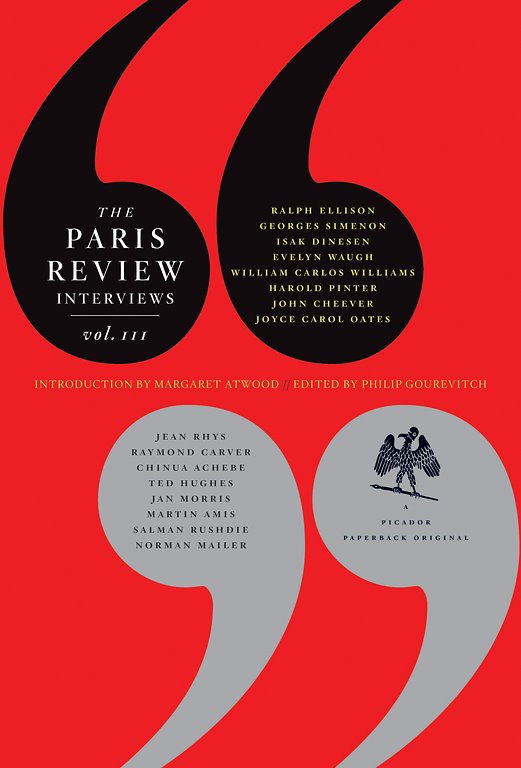
The Paris Review Interviews, Volume III

How much you enjoy the third collection The Paris Review Interviews will depend entirely on how much you enjoy reading intelligent and thoughtful writers discussing intelligent and thoughtful subjects. I happen to love reading author interviews–even interviews with authors I don’t particularly like–and hence, I enjoyed this book quite a bit.

Covering sixteen disparate authors and fifty-two tumultuous years, the interviews here are by turns insightful, hilarious, strange, and at times, infuriating. The first interview (the book is organized chronologically), a 1955 conversation with Ralph Ellison evokes all of these emotions. One can almost feel Ellison’s restraint as he patiently replies to asinine questions like, “Then you consider your novel a purely literary work as opposed to one in the tradition of social protest?” and, “But isn’t it going to be difficult for the Negro writer to escape provincialism when his literature is concerned with a minority?” If anything, these politicized charges prompt Ellison to some of the most salient observations about literature’s universalizing powers that I’ve ever read.

In his 1964 interview, poet William Carlos Williams also sheds quite a bit of light on his art and craft. Interestingly, his wife is also a major part of the interview, discussing at some length her own role in her husband’s writing. Beyond literature, craft, and writing, Williams also sets another early theme that unites the interviews collected here–dissing other writers. He calls T.S. Eliot a “conformist” determined to set poets back twenty years. Evelyn Waugh picks up on this theme in his 1963 interview. Of Faulkner: “I find Faulkner intolerably bad.” And Raymond Chandler: “I’m bored by all those slugs of whiskey. I don’t care for all the violence either.” Zing!

Don’t feel too bad for Chandler, though; he comes off funny and earthy and sad in his 1983 interview, especially when he discusses his alcoholism, and how and why he quit drinking. Apparently, teaching–and drinking–with John Cheever when the two were teaching at the Iowa Writer’s Workshop in 1973 had a major impact on Chandler’s decision to stop drinking.

John Cheever focuses mostly on the writing craft in his 1976 interview–not much talk of drinking here. He does, however, share this insight: “Plot implies narrative and a lot of crap. It is a calculated attempt to hold the reader’s interest at the sacrifice of moral conviction.” I’ve never liked Cheever’s writing, but he’s a great interview. In his 1994 interview, Achebe–an author whose fiction (and essays) I do like comes off as far more insightful and far less pretentious. On why creative writing classes exist: “I think it’s very important for writers who need something else to do, especially in these precarious times. Many writers can’t make a living. So to be able to teach how to write is a valuable to them. But I don’t really know about its value to the student.” Lovely. MFAs beware!

The interviews collected here are funny, smart, and very entertaining–whether its Achebe on general misunderstandings of his famous Conrad essay, Salman Rushdie on New Wave Cinema, or Joyce Carol Oates on Finnegans Wake, The Paris Review Interviews, Volume III is full of smart people talking about smart things–and what’s better than that? Highly recommended.

The Paris Review Interviews, Volume III is available October 28th, 2008 from Picador.