“I Rarely Remember a Book About Which I Have Had Such Violent Arguments” — W.H. Auden Reviews J.R.R. Tolkien

From the Oh, This Exists? Department — W.H. Auden’s 1956 New York Times review of J.R.R. Tolkien’s The Return of the King. It’s a fantastic review that defends Tolkien’s literary authenticity against his many haters, using Erich Auerbach’s groundbreaking work Mimesis as a central arguing point. Here’s Auden’s intro, but again, I recommend reading the whole review—

In “The Return of the King,” Frodo Baggins fulfills his Quest, the realm of Sauron is ended forever, the Third Age is over and J. R. R. Tolkien’s trilogy “The Lord of the Rings” complete. I rarely remember a book about which I have had such violent arguments. Nobody seems to have a moderate opinion: either, like myself, people find it a masterpiece of its genre or they cannot abide it, and among the hostile there are some, I must confess, for whose literary judgment I have great respect. A few of these may have been put off by the first forty pages of the first chapter of the first volume in which the daily life of the hobbits is described; this is light comedy and light comedy is not Mr. Tolkien’s forte. In most cases, however, the objection must go far deeper. I can only suppose that some people object to Heroic Quests and Imaginary Worlds on principle; such, they feel, cannot be anything but light “escapist” reading. That a man like Mr. Tolkien, the English philologist who teaches at Oxford, should lavish such incredible pains upon a genre which is, for them, trifling by definition, is, therefore, very shocking.

Biblioklept Recommends Five Novels, Some of Them New, Not All of Them German

I shouldn’t be reading five novels at once. It’s a terrible idea, a symptom of a bad habit that I thought I’d broken, but after abandoning Levin’s tedious tome The Instructions and wasting my time on Shteyngart’s insipid dystopian novel Super Sad True Love Story, I found myself absorbed by a lovely little cache that had been neatly, patiently stacked for a few weeks now.

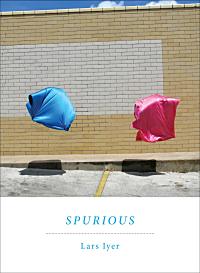
I’m only 60 or so pages into Lars Iyer’s Spurious — about a third of the way through — and at the rate I’m reading, I won’t finish it until the end of this month. It’s not that it’s slow or tedious or hard work: quite the opposite, in fact — it’s funny and lively, even when it’s erudite and depressive. I’ve enjoyed taking it in as a series of vignettes or skits or riffs. Spurious is about, or seems to be about (the term must be placed under suspicion) two would-be intellectuals, W. and his friend the narrator. They bitch and moan and despair: it’s the end of the world, it’s the apocalypse; they find themselves incapable of original thought, of producing any good writing. The shadow of Kafka paralyzes them. They travel about Europe, seeking out knowledge and inspiration — or at least a glimpse of some beautiful first editions. W. is cruel to the narrator, calling him fat and deriding his intellect for sport. But it’s all in good fun. Or maybe not. I’m really enjoying Spurious and have no hesitation recommending it; however, like a strong shot of bourbon, it’s best enjoyed frequently but in small doses. Spurious is brand spanking new from Melville House.

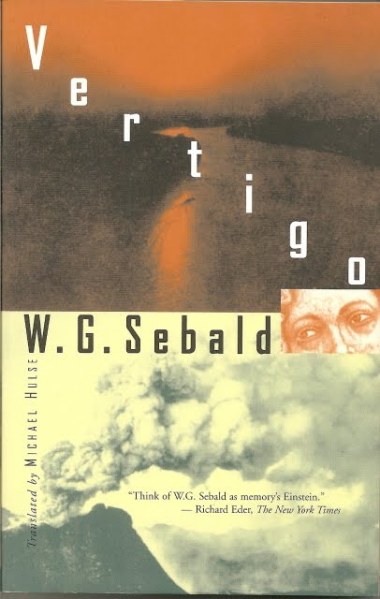
Iyer’s book dovetails nicely with W.G. Sebald’s first novel, Vertigo, which I picked up expressly to get the bad taste of Shteyngart out of my brain. Both books are haunted by Kafka, both  blur the lines between fiction and biography, both are works of and about flânerie, and both are melancholy. The book comprises four sections; the first section tells the story of the romantic novelist Stendhal (or, more to the point, a version of Stendhal); the second section details two trips Sebald made to Italy, one in 1980, and one in 1987; the third section, which I just read last night, describes a trip Kakfa took to Italy near the end of his life. I’m almost certain that I’ve read this section, “Dr. K Takes the Waters at Riva,” before — but I can’t remember where or when. It was strange reading it, almost as if I were experiencing some of the vertigo that permeates the volume. Full review forthcoming.

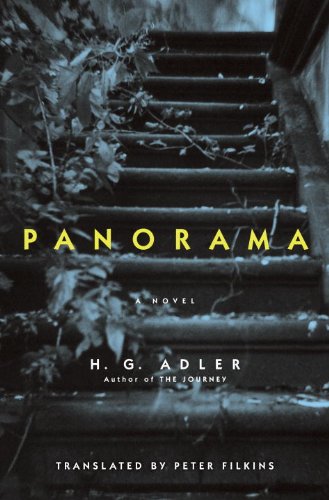
Kafka was a German-speaking Jewish writer from Prague. So was H.G. Adler, author of Panorama, new in English for the first time (hardback; Random House). Another way to transition from the Sebald paragraph above to this write-up of Panorama might be to point out that Sebald references Adler in Austerlitz, a book that tries to measure continental memory of the Holocaust. Adler survived the Holocaust, forced first into Theresienstadt and then Auschwitz, where his wife and mother were murdered in the gas chambers. Panorama is an autobiographical bildungsroman, with its hero young Josef Kramer standing in for Adler, and while it will clearly work its way into grim territory, the beginning — which is to say, the part that I’ve read so far — is bucolic and sweet and strange, as we see young Josef at home with his family. There’s a cinematic scope to Adler’s prose — Panorama is a Modernist work, one where the narrative freely dips into its protagonist’s mind. More to come.

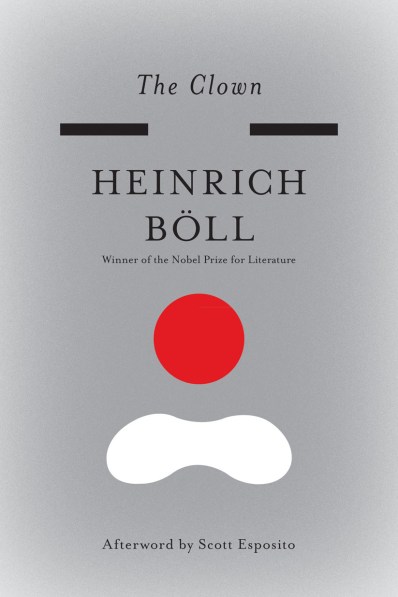
Continuing in this Teutonic vein is Heinrich Böll’s novel The Clown (also Melville House). It’s postwar Germany, and Hans Schnier is a clown who’s crashing and burning. He hurts himself–purposefully–during a performance (at one of the increasingly more provincial venues he finds himself playing for these days) and retreats to Bonn, where he holes up in his small apartment and makes angry desperate phone calls (and tries not to drink too much brandy) and reflects on his past. What’s eating him up? His gal Marie, basically his common-law wife, has reverted back to her Catholic ways and up and left him for some chump named Zupfner. Schnier rants against a complacent and complicit German bourgeoisie, spitting vitriol against Protestants and Catholics alike; some of the best parts of the novel though are his ravings about art and the role of the “artiste” in society. Also: he can smell over the phone. Full review soon.

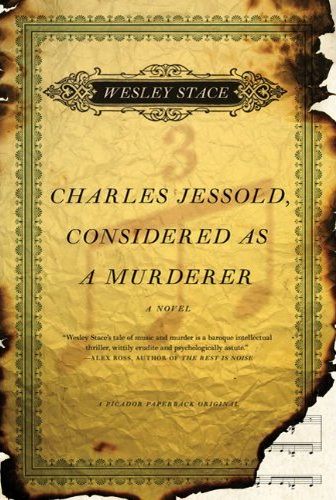
Wesley Stace’s new novel Charles Jessold, Considered as a Murderer (new from Picador) is a musical murder mystery set in the early part of 20th century Britain. Our (seemingly less than reliable) narrator Leslie Shepherd is a music critic with an aristocratic background who likes to spend his weekends collecting folk songs with other rich boys in the towns surrounding their country manors. He’s smitten (platonically, of course) with Charles Jessold, a middle class composer with a spark of avant-garde genius, and wins the younger man’s friendship quickly when he tells the story of Carlo Gesualdo, a fifteenth century composer/lord who kills his wife and her lover. (Notice the etymological connection between their names?) This tale of murder and cuckoldry is doubled in the ballad “Little Musgrave“; when Jessold and Shepherd find a new variation of the ballad, they set out to write the next (only?) great English opera, an adaptation of “Musgrave.” Oh, and that plot? The book opens with a news clipping reporting that Jessold killed his wife and her lover, and then himself, after the première of his opera Little Musgrave. Life imitates art imitates life. Stace has a keen ear for the period he writes about as well as a seemingly encyclopedic knowledge about music, but he also has the good sense to restrain himself and remember that he’s delivering a murder mystery. I’ve been enjoying Jessold quite a bit, and will return to it when I finish writing these lines. (And, for what it’s worth, part of Jessold is set in Germany).

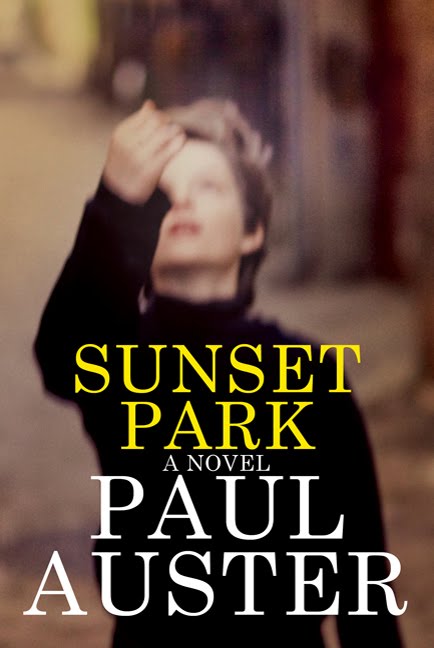
Sunset Park — Paul Auster

At the end of Paul Auster’s new novel Sunset Park, the narrative inhabits the mind of young protagonist Miles Heller. Riding in the back of a cab through Brooklyn, Miles’s thoughts glide through a slippery tangle of ideas. In a long sentence that runs on for almost two pages, Miles’s consciousness shifts from his own physical pain to a character in the movie The Best Years of Our Lives, a soldier named Homer who returns home with hooks for hands. This thought blends into a riff on the poet Homer, which in turn leads Miles, long estranged from his family, to figure himself a Telemachus now reunited with his father. And yet the homecoming cannot be; thoughts of Homer slip into thoughts about homelessness, his own homelessness, his friends’ homelessness, not metaphorical but literal. He then thinks about the homeless and displaced people across the country (Sunset Park is set square in the middle of the recent Great Recession), causing his mind to move back to the beginning of the novel, when he worked “trashing out” foreclosed homes in South Florida. The idea of “home” transmutes finally to “hope” as the cab crosses the Brooklyn Bridge–yet the idea (and the novel) is suspended in a strange, sad limbo.

I begin my review with Auster’s final sentence because it delineates many of Sunset Park’s themes, settings, and motifs. At its core–if such a novel can be said to have a core–Sunset Park asks its readers what “home” might mean. Is home a geographic location, a center that resonates with personal and cultural significance? Is home a place with a person you love? Can home be in your head? Is home where your family is? And, even more problematic, what exactly constitutes a family?

The founding trauma of the book, which is to say Miles’s founding trauma, is a radically ambiguous moment of violence: as a teenager, in a heated fight with his step-brother on a country road, Miles pushes the boy. At the same moment, a car flies down the road and kills him. Did Miles mean to kill his brother? At the moment of his anger, how could he not psychologically, if only temporarily, wish for the young man’s death? Did he know the car was coming? Miles cannot deal with the trauma and soon drops out of college and drops out of life. Unlike the biblical Cain, Miles’s exile is self-imposed. He breaks contact with his parents and thus breaks a family that was already twice broken; first, in his parents’ divorce and his mother’s move across the country to California; and second, in the death of his step-brother. Miles relegates himself to hard and unrewarding manual labor, wandering aimlessly around the country. It’s only after he meets a young girl named Pilar that he is able to reconstitute the idea of a family–of a self who can be in a family.

Pilar is a high school student. She is a minor. Auster does little to justify the social acceptability of Miles’s love for (and sodomy of) Pilar; instead, he repeatedly invokes the idea that other characters see the “truth” of the love by simply watching the pair. This is easily the book’s greatest weakness. Auster wants to communicate the idea that in loving Pilar, Miles is able to love a young version of himself–and thus forgive his young self (significantly, Pilar is the same age that Miles was when he pushed his step-brother)–yet the essential predatory narcissism of this “love” remains largely unremarked upon. Even Pilar’s caretaker, her oldest sister, is amenable to the romance–that is, until Miles refuses to keep bringing her high-end items that he recovers from the foreclosed homes he’s “trashing out.” Miles is again exiled, this time from his makeshift home with Pilar. He returns for the first time in seven years to New York City to stay in a squatter’s house with three other twentysomethings.

There’s a kind of silly Bohemian romanticism to the squat in Sunset Park. The project is helmed by would-be avant-jazzman, Bing Nathan, a notorious ranter who improbably subsists on funds he obtains from running his store, the Hospital for Broken Things, where he repairs typewriters and other antique artifacts. Bing thinks his friend Miles will be a perfect fit in the house–and he’s right: the other squatters love him. There’s Ellen, a skittish realtor (!) who aspires to become a pornographic painter, and Alice, an ABD trying to finish her doctoral thesis (on The Best Years of Our Lives, of course). Both women fall for Miles in different ways, although Auster’s writing never once shows why this might be.

Bing has other reasons for getting Miles back to NYC–he wants to reunite the Heller family. He’s been secretly communicating with Miles’s father Morris for years. Morris, who runs his own literary publishing house, is easily the most achieved character in Sunset Park, or at least its most realistic. Although the plot gets bogged down with his own marital difficulties (and other sundry tragedies that echo the “loss of children” theme), Morris’s narrative is the most focused and convincing section of the novel. His sad tone moves beyond melancholy but halts at bitterness, even as he reflects upon the myriad regrets of his life and the fearful future that yawns ahead (things are going badly with his wife; the publishing industry is in peril). Although Miles’s mother Mary-Lee figures less in the novel, she is also a more convincing and sympathetic character than the young people who squat in Sunset Park. Like Morris, she’s reflective, distanced enough from the young self who abandoned her only son, yet analytical enough to comprehend its traumatic effect. Mary-Lee and Morris, with their regrets and fears and hopes are far more aesthetically concrete and satisfying than the novel’s twentysomethings, who at times seem like caricatures or puppets or placeholders.

In Auster’s hands, the Sunset Park gang reflects an unrealistic idealization of youthful and artistic resistance to a predatory capitalist culture. Still, they provide him occasion for some of Sunset Park’s finest riffs, whether he’s ventriloquizing Bing (rage, rage against the lies of the man) or exploring Ellen’s enchanting perversions. Alice’s thesis on The Best Years of Our Lives (a film that somehow everyone in the book has not just seen but seen repeatedly and even analyzed) gives Auster ample material to explore how different generations face trauma, whether it’s the alienation experienced by WWII soldiers returning to a world that seems to have left them behind, or the crises of young people trying find homes in an America tottering on financial collapse.

With its ironic title, The Best Years pairs nicely with the other narrative that informs Sunset Park, Samuel Beckett’s play Happy Days-a play that Mary-Lee just happens to be performing on Broadway at the time of Miles’s return. Auster–through his erudite characters–riffs frequently and wisely on both the film and the play, and these are some of the finer moments of Sunset Park; one almost wishes that Auster would have abandoned the conceit of a novel completely and just write some kind of essay with his material. Sunset Park repeats the themes of alienation, loneliness, separation, and stasis that we find in Happy Days and The Best Years, yet it veers closer to the film’s melodrama than Beckett’s absurdity. Perhaps this is a fault of form: overloaded with characters, Sunset Park sags at times, asking its reader to care about yet another over-educated, privileged New Yorker whose artistic ambitions have stalled out. A concession to Beckett’s minimalism would have done wonders, and perhaps deflated some of Sunset Park’s murky self-seriousness.

The highlight of the novel is Auster’s syntax. His keen sentences, often unfurling for pages at a time, move from concrete to abstract, to present to past to future, to inside and outside, with a precision and skill that is admirable to say the least. Sure, he hits the occasional clunker–some of the book’s early dialog in Florida is particularly painful, as is a moment late in the book when Morris refers to his wife and friend as “the walking wounded,” a cliché that neither Morris or Auster should let slip–but there’s a smoothness of vision that unites the book from sentence to sentence.

Still, syntax is not content, and Sunset Park left me wanting something–more? Something different? I’m not sure what that something is, which is a precarious criticism at best. Auster’s vision of stasis, of limbo, of the impossibility of a real homecoming runs deeply contrary to the traditions and conventions of Western story-telling: in short, we are trained to desire and look for resolution. Auster’s observations–a continuation of Happy Days and The Best Years, in this sense–are precisely the right kind of psychological dissatisfaction we must experience for this novel to be “true” in an artistic sense. However, the aesthetic dissatisfaction I experienced at the end of the book seems of a separate nature. Chalk it up to too many characters and subplots, perhaps. In any case, Sunset Park made me think and made me feel, which is really the job of art–even if those thoughts and feelings are often negative and unpleasant. Perhaps it’s my own critical failing, but in the end I wanted a light to lead me out of the Auster’s  limbo.

Sunset Park is new in hardback this month from Henry Holt.

Steps — Jerzy Kosinski

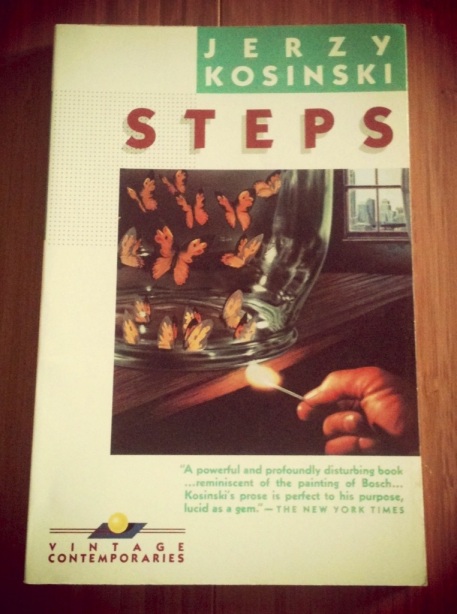
One of the many small vignettes that comprise Jerzy Kosinski’s 1968 book Steps begins with the narrator going to a zoo to see an octopus that is slowly killing itself by consuming its own tentacles. The piece ends with the same narrator discovering that a woman he’s picked up off the street is actually a man. In between, he experiences sexual frustration with a rich married woman. The piece is less than three pages long.

There’s force and vitality and horror in Steps, all compressed into lucid, compact little scenes. In terms of plot, some scenes connect to others, while most don’t. The book is unified by its themes of repression and alienation, its economy of rhythm, and, most especially, the consistent tone of its narrator. In the end, it doesn’t matter if it’s the same man relating all of these strange experiences because the way he relates them links them and enlarges them. At a remove, Steps is probably about a Polish man’s difficulties under the harsh Soviet regime at home played against his experiences as a new immigrant to the United States and its bizarre codes of capitalism. But this summary is pale against the sinister light of Kosinski’s prose. Consider the vignette at the top of the review, which begins with an autophagous octopus and ends with a transvestite. In the world of Steps, these are not wacky or even grotesque details, trotted out for ironic bemusement; no, they’re grim bits of sadness and horror. At the outset of another vignette, a man is pinned down while his girlfriend is gang-raped. In time he begins to resent her, and then to treat her as an object–literally–forcing other objects upon her. The vignette ends at a drunken party with the girlfriend carried away by a half dozen party guests who will likely ravage her. The narrator simply leaves. Another scene illuminates the mind of an architect who designed concentration camps. “Rats have to be removed,” one speaker says to another. “Rats aren’t murdered–we get rid of them; or, to use a better word, they are eliminated; this act of elimination is empty of all meaning. There’s no ritual in it, no symbolism. That’s why in the concentration camps my friend designed, the victim never remained individuals; they became as identical as rats. They existed only to be killed.” In another vignette, a man discovers a woman locked in a metal cage inside a barn. He alerts the authorities, but only after a sinister thought — “It occurred to me that we were alone in the barn and that she was totally defenseless. . . . I thought there was something very tempting in this situation, where one could become completely oneself with another human being.” But the woman in the cage is insane; she can’t acknowledge the absolute identification that the narrator desires. These scenes of violence, control, power, and alienation repeat throughout Steps, all underpinned by the narrator’s extreme wish to connect and communicate with another. Even when he’s asphyxiating butterflies or throwing bottles at an old man, he wishes for some attainment of beauty, some conjunction of human understanding–even if its coded in fear and pain.

In his New York Times review of Steps, Hugh Kenner rightly compared it to Céline and Kafka. It’s not just the isolation and anxiety, but also the concrete prose, the lucidity of narrative, the cohesion of what should be utterly surreal into grim reality. And there’s the humor too–shocking at times, usually mean, proof of humanity, but also at the expense of humanity. David Foster Wallace also compared Steps to Kafka in his semi-famous write-up for Salon, “Five direly underappreciated U.S. novels > 1960.” Here’s Wallace: “Steps gets called a novel but it is really a collection of unbelievably creepy little allegorical tableaux done in a terse elegant voice that’s like nothing else anywhere ever. Only Kafka’s fragments get anywhere close to where Kosinski goes in this book, which is better than everything else he ever did combined.” Where Kosinski goes in this book, of course, is not for everyone. There’s no obvious moral or aesthetic instruction here; no conventional plot; no character arcs to behold–not even character names, for that matter. Even the rewards of Steps are likely to be couched in what we generally regard as negative language: the book is disturbing, upsetting, shocking. But isn’t that why we read? To be moved, to have our patterns disrupted–fried even? Steps goes to places that many will not wish to venture, but that’s their loss. Very highly recommended.

Beatrice and Virgil — Yann Martel

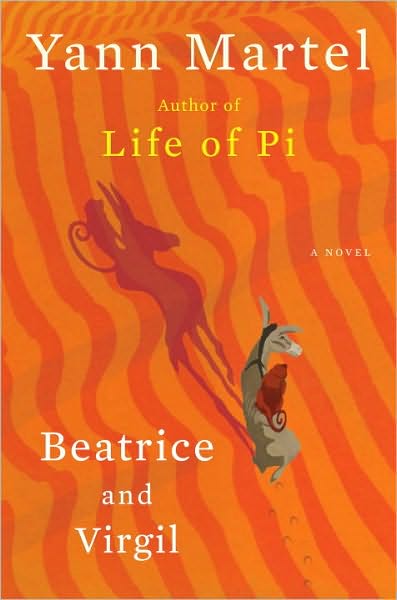
Yann Martel’s Beatrice and Virgil tells the story of a writer named Henry whose follow-up novel to a surprise smash hit is rejected. He moves to a large metropolitan city, gets a dog and a cat, takes clarinet lessons, joins an amateur theater group, and slowly forgets about writing fiction altogether. One day a stranger sends Henry a short story by Gustave Flaubert called St. Julian the Hospitator.” The sender has highlighted passages about Julian’s delight in slaughtering animals and also included a few pages of an original manuscript, a Beckettian play featuring two characters, Beatrice and Virgil. There’s also a note asking for help. Intrigued, or maybe bored, Henry visits the mysterious author, an old, creepy taxidermist (also named Henry). His play features two characters, Virgil, a howler monkey, and Beatrice, a donkey, who are trying to come to terms with a series of events they call The Horrors. The taxidermist’s project reignites Henry’s passion for writing and he’s soon helping the would-be playwright with revisions, blind to the inconsistencies and gaps in the old man’s strange behavior.

Beatrice and Virgil is a page turner, engaging, propulsive, and quite easy to read. It injects the philosophical and artistic concerns of literary fiction into the frame and pacing of a book designed for broader audiences. Martel displays his keenest literary skill in the early part of the novel, flitting through the kinds of subjects that bookish nerds of a certain postmodernist bent tend to obsess over: the possibilities and challenges of writing in a particular language, the complexity of pseudonymous fame, the intellectual allure of the essay versus the power of fiction to narrativize higher truth. To address this latter problem, Henry proposes that his new book comprise two sections–a work of narrative fiction and an essay to explicate that work. Why the need for an essay? Henry proposes to write an artful, fictive account of the Holocaust. The essay, which Henry wants published on the flip side of the fiction, thus eliminating a front/back cover distinction, is meant to explicate the fiction. In many ways the first section of Beatrice and Virgil functions as counterpoint to Henry’s proposed essay, concisely addressing the problems of using anything other than historical facts to represent the Holocaust.

After Henry gets the taxidermist’s package and reads “St. Julian the Hospitator,”Beatrice and Virgil moves into a faster rhythm and continues to accelerate to its end, never sagging. At times, Martel relies on stock phrasing and overt exposition to afford this pacing. I found myself wishing a few times that he would trust his audience a bit more. Is it really necessary to directly explain the titular allusion to Dante’s Divine Comedy? He could also be a bit less free with his narrator’s everyman style of questioning, a device employed often to propel the plot, but one somewhat inconsistent with Henry’s obvious intellectual acumen. Martel’s occasional use of lazy devices of the Dan Brown school directly contrasts the more experimental or postmodern aspects of his book. There’s the book’s initial section, which reads very much like a lyric essay; there’s the exegesis of “St. Julian”; there’s the taxidermist’s play, Beatrice and Virgil; there’s the book’s final section, “Games for Gustav.” This final section comprises thirteen short epigrams written in second-person perspective. “Games for Gustav,” Henry’s Holocaust art, demands audience identification with the victims of the Holocaust. Its brevity and ambiguity correlate to the narrative’s ahistorical engagement with the Holocaust and communicate a sense of apprehension and distance toward the subject. Is that subject Martel’s or Henry’s? In a piece I wrote last month about Beatrice and Virgil and the challenges of an aesthetic response to the Holocaust, I suggested that “Henry, a young French Canadian with no Jewish roots is utterly divorced from any authentic response to the Holocaust. He could write an academic essay on the subject, or a navel-gazing bit of metafiction that dithered over storytelling itself, but he essentially already has an answer to his own question of why there are so few artistic responses to the Holocaust–that to re-imagine or re-interpret or otherwise re-frame the real events of the Holocaust in art is to, at once, open oneself to dramatic possibilities of failure.”

Is Beatrice and Virgil an authentic response to the Holocaust? I won’t accuse Martel of using the Holocaust as a mere prop in his novel; indeed, anticipation of such an accusation is precisely what leads Henry to suffer over an essay to explicate his fiction. Martel’s book is about murder, horror, and how one might witness to or otherwise narrativize murder and horror; Henry’s “Games for Gustav” is just one of those attempts to witness. The novel engenders multiple readings then. We can take Henry’s “Games” as part and parcel of Martel’s program, read them perhaps as Martel’s own attempt at poetry after Auschwitz. This reading would subscribe to a traditional narrative arc–Henry faces a challenge, endures a perilous task, and finds resolution in his art: a valid artistic response to the Holocaust is possible. I think, however, that there is another, more complicated reading available, one far more ambiguous, one that places any aesthetic response to the Holocaust under suspicion. If we scrutinize the elements of traditional narrative fiction at work in the novel, we can see multiple ironies in Henry’s “hero arc,” ironies outside of Henry’s otherwise perspicacious gaze. To write an authentic aesthetic response to the Holocaust, Henry must face some kind of deathly extreme that will license such art. But is such a licensing, a conferring of authority possible? I won’t point to spoilers here but will say that I read the novel’s climax ironically. I believe it complicates Henry’s (and perhaps Martel’s) attempt to engage the Holocaust via metaphor and artifice and calls the novel’s resolution into question.

But these matters are probably better reserved for the detailed dialogues the book will no doubt inspire. Beatrice and Virgil raises essential questions of post-postmodernity, exploring the porous boundaries between autobiography and fiction, history and myth, and the limits of allegory. Its rewards are not in its answers but in its questions.

Beatrice and Virgil is new in hardback from Spiegel & Grau on April 13, 2010.

Venus Drive — Sam Lipsyte

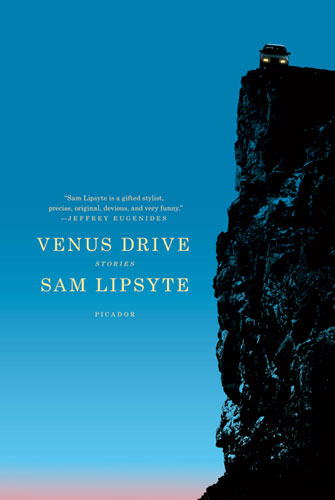
Sam Lipsyte’s forthcoming novel The Ask is already poised to be one of the major critical successes of 2010. In concordance with its publication, Picador will print a new trade paperback edition of his short story collection Venus Drive, the first such publication since its original debut from Open City a decade ago.

The thirteen stories in Venus Drive compose a sort of novel-in-stories. The title of the collection takes its name from a banal suburban street mentioned in a few of the stories, and many of the characters seem like iterations of the same type or voice. There are washed up would-be indie rock stars, small-time coke peddlers, and underemployed and overeducated addicts. There are deviants and perverts and outsiders. There are bullies. There are dead or dying mothers, dead or dying sisters. In short, Venus Drive is its own tightly-drawn, tightly-coiled, and highly-compressed world.

As the plot points double and re-double in these stories, so do the themes. “Our culture is afraid of death, and considers it something we must wage battle against,” says Tessa, a pain specialist, a peripheral character in “Cremains.” She continues: “I say, surrender, submit. Go gentle. Terminal means terminal.” Death informs almost all of these stories in some way, and Tessa’s commentary presents the problem with death, or at least the problem these characters have with dealing with death: it’s not easy to go gentle. It goes against our culture and our nature to surrender. If she’s presented as a voice of wisdom, she’s also an ironic character, one of the many would-be authorities Lipsyte’s weirdos and outsiders can’t help but mock. “The Drury Girl,” part-suburban satire and pure pathos, posits a pre-pubescent narrator obsessed with his teenage babysitter; his dad’s cancer plays second fiddle to his lust. Thus the story neatly ties together the overarching themes of Venus Drive, sex and death. Admittedly, these are probably the only real themes of proper literature, but Lipsyte does it so damn well and lays it all out so bare and does so in such humor and grace that it really sticks. It’s good stuff.

That humor is desert-dry, of course, and succeeds so well because his characters are so endearing in their pathetic pathologies. The antiheroes of “Beautiful Game” and “My Life, for Promotional Use Only,” are also-rans in the sordid history of underground rock, addicts approaching washed-up (Are they the same person? Maybe. They have different names, of course. Doesn’t matter). A scene from “Beautiful Game” shows the ambivalence at the core of many of these characters: “At the bank machine, Gary doesn’t check the balance. Better to leave it to the gods. Someday the bank machine will shun him. Why know when?” Gene, the ex-rocker in “My Life, for Promotional Use Only” now suffers the indignities of working for his ex-girlfriend. Everyone in the story is an ex-something, everyone is growing up and leaving art (or is it “Art”?) behind. In a poignant and funny and cruel scene, familiar to many of us, Gene sees some of himself in a waitress:

Rosalie calls over the waitress and they talk for a while about somebody’s new art gallery. The waitress is famous for a piece where she served the Bloody Marys mixed with her menstrual blood. Word had it she overdid the tabasco.

I wait for the moment when our waitress stops being a notorious transgressor of social mores and becomes a waitress again, look for it in her eyes, that sad blink, and order a beer.

Gene, a former “notorious transgressor of social mores” himself feels both sorrow and hate for the waitress. He sees her job as menial and pathetic — just like his own. He doesn’t seem to think much of her art, either. Lipsyte telegraphs so much there with so few words, his sentences clean, spare, precise, and rarely of the compound variety. There’s a truncated, clipped rhythm that Lipsyte builds over the thirteen-story run that helps propel the immediacy of his tales. The stories are short, too; the longest is sixteen pages and most run to eight or ten. Lipsyte’s rhetorical gift is to shine the grubby and, at times, his sentences can feel almost too perfect, too-fussed over–but this (minor) complaint, it must be noted, comes from someone who admires occasional ambiguity or incoherence. Lipsyte removes his own authorial voice and thus achieves lucidity in his characters’ voices; somehow, though — and paradoxically — these voices bear the ghostly trace of his absence. But that seems like a silly conversation, and certainly not one for this post.

Venus Drive reminds me very much of one of my favorite books, Denis Johnson’s Jesus’ Son, which I would also call a novel-in-stories, also a spare and precise collection, also a study of weirdos and addicts and outsiders. Jesus’ Son is something of a standard in creative writing workshops (or at least it used to be) and a sensible teacher would add Venus Drive to her syllabus as well. Finally, like Jesus’ Son, Lipsyte’s book is seething, funny, and poignant, with characters tipped toward some redemption, awful or otherwise, for all their myriad sins. The book might take its name from a geographic location, but the “Venus drive” is also a spiritual inclination toward love and hope. Highly recommended.

Venus Drive is available March 2nd, 2010 in trade paperback from Picador.

Point Omega — Don DeLillo

Don DeLillo’s latest work Point Omega takes an oblique, subtle, and unnerving tackle at themes of time, perception, family, and, ultimately, personal apocalypse. It’s not a particularly fun book nor does it yield any direct answers, but it’s also a rewarding, engaging, and often challenging read.

Point Omega pretends to be a novel about two subjects: the Iraq War and film. Its narrator Jim Finley is an experimental filmmaker who travels to the Arizona desert in an attempt to convince aging intellectual Richard Elster to participate in a film comprised solely of one long, unedited take of Elster talking about whatever he likes. Although Finley repeatedly claims that Elster can talk about whatever he chooses to in the film, it’s clear that that the younger man wishes for the subject to be Elster’s involvement in the planning of the Iraq War, a sort of mea culpa from the intellectual elite who rolled over to the Bush administration. Elster’s involvement was essentially to provide academic credibility to the invasion:

He was the outsider, a scholar with an approval rating but no experience in government. He sat at a table in a secure conference room with the strategic planners and military analysts. He was there to conceptualize, his words, in quotes, to apply overarching ideas and principles to such matters as troop deployment and counter-insurgency. He was cleared to read classified manuscripts, he said, and he listened to the chatter of the resident experts, the metaphysicians in the intelligence agencies, the fantasists in the Pentagon.

Elster becomes disillusioned with the whole process soon; he comes to realize the hollowness of his role and soon moves to the desert. “He’d exchanged all that for space and time,” writes DeLillo, announcing his theme. Later in the novella, Elster claims that the geologic time of the desert allows him to feel, “Time falling away . . . Time becoming slowly older. Enormously old. Not day by day. This is deep time, epochal time.” He contrasts this “deep time” with the time of cities:

It’s all embedded, the hours and minutes, words and numbers everywhere, he said, train stations, bus routes, taxi meters, surveillance cameras. It’s all about time, dimwit time, inferior time, people checking watches and other devices, other reminders. This is time draining out of our lives. Cities were built to measure time, to remove time from nature. There’s an endless counting down, he said. When you strip away all the surfaces, when you see into it, what’s left is terror. This is the thing that literature is meant to cure. The epic poem, the bedtime story.

Elster appears concerned that humanity is approaching Teilhard’s omega point, the maximum level of complexity of consciousness toward which the universe is evolving. He concedes that this idea might be “a case of language that’s struggling toward some idea our experience.” For Elster, the omega point is inevitable and leads to either “a sublime transformation of mind and soul or some worldly convulsion.” Ultimately, his viewpoint seems nihilistic: he’d rather human beings somehow be transformed into stones, be somehow absorbed into a new time, a geologic time.

The obsession with time and film literally wraps the book in two short chapters called “Anonymity” (a prologue) and “Anonymity 2” (an epilogue (or a prescient epitaph, perhaps?)). Both sections describe a man who spends all of his time at MOMA’s presentation of Douglas Gordon’s videowork 24 Hour Psycho, a silent showing of Hitchcock’s Psycho over 24 hours. Neither section is narrated by Finley, although it later becomes clear that he–along with other principals in the story–is present at the showing. The unnamed man whose consciousness permeates these chapters finds his own omega point in the crawling pace of the film. 24 Hour Psycho divorces itself from the healing powers that stories give us, the power to narrativize all the gaps and crevices of life. It’s no longer the medicine that Elster suggests literature (or film) might be. It now exists outside of narrative cohesion and somehow resonates with the purity or transcendence of geologic time.

Fortunately, DeLillo is gracious enough to his readers to not attempt replicating the pace of geologic time in his book. Point Omega is particularly slim–under 120 pages in hardback–and reads with a the conciseness and clarity which has been a hallmark of DeLillo’s style. As perhaps the signal writer of post-postmodernism (whatever that means), DeLillo continues to engage and anticipate new and emerging forms of alienation, and he does so without gimmicks or trickery, just the purity of considered ideas. Point Omega works best when he allows those ideas some room to breathe; the late-night scotch-soaked dialogues between Elster and Finley are some of the finest passages of the book and it’s a pity there aren’t more of them.

But it seems like we’ve digressed from some of our starting points, doesn’t it? Many critics will call Point Omega DeLillo’s “Iraq War novel,” which is a mistake akin to calling Underworld a book about baseball or White Noise a book about Hitler. The war is merely an entry point to the greater, more personal tragedy that underlies the book, a tragedy that will perhaps make Elster reassess his own value system. We won’t name the trauma at the core of the book–to do so might spoil a twist in a book largely devoid of conventional concrete plotting–but it is worth noting that DeLillo optimizes suspense and tension as the novel builds to its own omega point. While many will feel left cold by the book’s ultimately ambiguous invocation of personal calamity, we found in it a meaningful counterpoint to Elster’s explicit commentary on time and identity. DeLillo’s novel, in the end, requires an intellectual–or perhaps, dare we say spiritual–leap. Point Omega is hardly a satisfying read, but that’s kind of the point, isn’t it? Highly recommended.

Point Omega is available February 2nd, 2010 from Scribner.

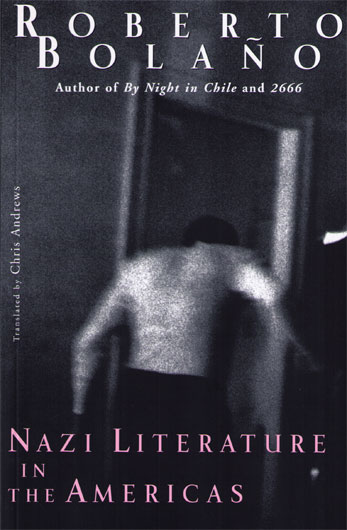
Nazi Literature in the Americas — Roberto Bolaño

I was talking with a friend last weekend about Roberto Bolaño and he remarked that many of the early slim novels from this remarkable writer tend to read like sketches for his masterwork 2666. This is a more than fair assessment and also one that shouldn’t–and doesn’t–detract from enjoying these books. But it’s difficult to read the nightmare-rant of By Night in Chile or the paranoiac dread invested in the tales in Last Evenings on Earth without recalling the layered themes of violence and art that underpin 2666. Bolaño’s fake-encyclopedia, Nazi Literature in the Americas is perhaps, by its very nature, the sketchiest of these sketches, yet that term, “sketch” — well it’s just plain wrong here. While most of the book’s entries are marked by brevity, none are undercooked. Rather–and I hate that I’m about to crib from critic Francisco Goldman’s blurb on the back of the book, but he’s spot on–the book is a “key cosmology to Bolaño’s literary universe.” In short, Nazi Literature in the Americas helps to confirm that, like J.R.R. Tolkien, Bolaño was a writer with a fully-realized universe at his disposal, one with its own heroes and villains, histories and myths, and yes, like Tolkien, its own literature.

Nazi Literature in the Americas is a stunning, ugly, highly-enjoyable, and often hilarious book. It details the exploits, both literary and non-, of over two dozen fictional writers from North, Central, and South America. While few of the writers are actually practicing Nazis, all are right-wingers and most are crazy failures. Big surprise that Bolaño would write about crazy, failed writers, right? And that is the central paradox of the book: while the writers here are anti-Semites and fascists and neo-Nazis who represent the worst in human values and ethics, they also darkly mirror Bolaño himself, or at least his fictional stand-ins. For example, the (anti-)heroes Ignacio Zubieta and Jesús Fernández-Gómez are Colombian writers who side first with the fascists and then the Nazis, yet they come across as doubles for the Mexican lefty poets Ulises Lima and Arturo Belano, the (anti-)heroes of The Savage Detectives. The pair pops up a few times in the course of the book as well, most notably in the section on Daniela de Montecriesto, who was a minor character in 2666.

She’s not the only character to traverse Bolaño books. The final chapter of Nazi Literature, its longest, tells the story of Ramírez Hoffman, the aviator-poet-serial killer whose story is extended in the novella Distant Star. Hoffman’s entry, besides being the longest, is also the only written in the first-person. The narrator is even identified as “Bolaño.”

At times the reader will find himself sympathizing with Bolaño’s monsters. The sci-fi writer Gustavo Border says: “I have been tormented, spat on, and deceived so often–the only way I could go on living and writing was to find spiritual refuge in an ideal place.” Bolaño immediately cuts the pathos with humor; Border ends his sad comment: “In a way, I’m like a woman trapped in a man’s body.” Elsewhere, what’s most shocking is not how much sympathy Bolaño evokes, but how interesting the literature he describes sounds. Take Segundo José Heredia’s Saturnalia, for instance:

Saturnalia, the story of two young friends who in the course of a week-long journey through France are confronted with the most horrendous acts they have ever witnessed, without being able to tell for sure whether or not they are dreaming. The novel includes scenes of rape, sexual and workplace sadism, incest, impaling, and human sacrifice in prisons crowded to the physical limit; there are convoluted murder plots in the tradition of Conan Doyle, colorful and realistic descriptions of every Paris neighborhood, and, incidentally, one of the most vivid and spine-chilling female characters in Venezuelan literature since 1950: Elisenda, the enemy of the two young men.

It sounds horrific but I’d love to read it. It also sounds like a Bolaño novel, with its nightmare violence, prisons, and detective plots.

In one telling aside, one of Bolaño’s writers realizes that “literature . . . is a surreptitious form of violence.” Bolaño’s oeuvre seems to work from this thesis, or perhaps work to enact this thesis. If the writers of of Nazi Literature are villains, they are also sympathetic in their villainy, not for their racist viewpoints, which are subtly but repeatedly mocked and condemned, but rather for the fact that as writers and artists they have no hope; like Oedipus they are fated to violence. Like Bolaño himself, they both channel and engender violence. Their failure, of course, is to seek to regulate or otherwise give meaning to that violence via ideology and dogma. Tellingly, Bolaño investigates–and perhaps corrects–this failure in his opus 2666 which resists easy answers and scapegoats.

And so to return to our point of entry: Nazi Literature in the Americas will probably be enjoyed most by those who’ve trucked through 2666 or some of Bolaño’s other works. It’s a quick, propulsive read, and while quite funny–and at times scary–it’s most fascinating as a document that further fleshes out the Bolañoverse. Highly recommended.

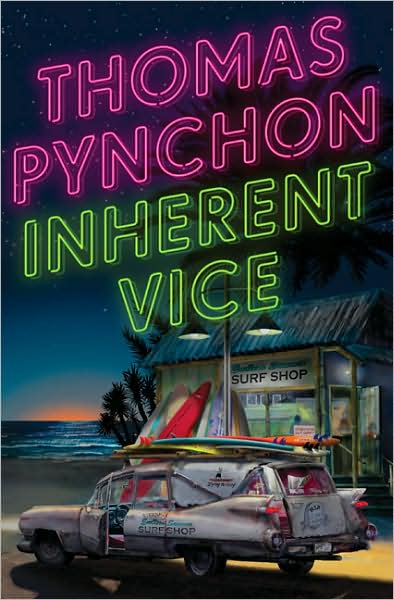
Inherent Vice — Thomas Pynchon

inherent_vice

Thomas Pynchon’s latest novel, Inherent Vice is a detective-fiction genre exercise/parody set in a cartoonish, madcap circa-1970 L.A. redolent with marijuana smoke, patchouli, and paranoia. Navigating this druggy haze is private detective Doc Sportello, who, at the behest of his ex-girlfriend, searches for a missing billionaire in a plot tangled up with surfers, junkies, rock bands, New Age cults, the FBI, and a mysterious syndicate known as the Golden Fang–and that’s not even half of it. At a mere 369 pages, Inherent Vice is considerably shorter than Pynchon’s last novel Against the Day, not to mention his masterpieces Gravity’s Rainbow and Mason & Dixon, and while it might not weigh in with those novels, it does bear plenty of the same Pynchonian trademarks: a strong picaresque bent, a mix of high and low culture, plenty of pop culture references, random sex, scat jokes, characters with silly names (too many to keep track of, of course), original songs, paranoia, paranoia, paranoia, and a central irreverence that borders on disregard for the reader. And like Pynchon’s other works, Inherent Vice is a parody, a take on detective noir, but also a lovely little rip on the sort of novels that populate beaches and airport bookstores all over the world. It’s also a send-up of L.A. stories and drug novels, and really a hate/love letter to the “psychedelic 60s” (to use Sportello’s term), with much in common with Pynchon’s own Vineland (although comparisons to Elmore Leonard, Raymond Chandler, The Big Lebowski and even Chinatown wouldn’t be out of place either).

While most of Inherent Vice reverberates with zany goofiness and cheap thrills, Pynchon also uses the novel as a kind of cultural critique, proposing that modern America begins at the end of the sixties (the specter of the Manson family, the ultimate outsiders, haunts the book). The irony, of course–and undoubtedly it is purposeful irony–is that Pynchon has made similar arguments before: Gravity’s Rainbow locates the end of WWII as the beginning of modern America; the misadventures of the eponymous heroes of Mason & Dixon foreground an emerging American mythology; V. situates American place against the rise of a globally interdependent world. If Inherent Vice works in an idiom of nostalgia, it also works to undermine and puncture that nostalgia. Feeling a little melancholy, Doc remarks on the paradox underlying the sixties that “you lived in a climate of unquestioning hippie belief, pretending to trust everybody while always expecting be sold out.” In one of the novel’s most salient passages–one that has nothing to do with the plot, of course–Doc watches a music store where “in every window . . . appeared a hippie freak or a small party of hippie freaks, each listening on headphones to a different rock ‘n’ roll album and moving around at a different rhythm.” Doc’s reaction to this scene is remarkably prescient:

. . . Doc was used to outdoor concerts where thousands of people congregated to listen to music for free, and where it all got sort of blended together into a single public self, because everybody was having the same experience. But here, each person was listening in solitude, confinement and mutual silence, and some of them later at the register would actually be spending money to hear rock ‘n’ roll. It seemed to Doc like some strange kind of dues or payback. More and more lately he’d been brooding about this great collective dream that everybody was being encouraged to stay tripping around in. Only now and then would you get an unplanned glimpse at the other side.

If Doc’s tone is elegiac, the novel’s discourse works to undercut it, highlighting not so much the “great collective dream” of “a single public self,” but rather pointing out that not only was such a dream inherently false, an inherent vice, but also that this illusion came at a great price–one that people are perhaps paying even today. Doc’s take on the emerging postmodern culture is ironized elsewhere in one of the book’s more interesting subplots involving the earliest version of the internet. When Doc’s tech-savvy former mentor hips him to some info from ARPANET – “I swear it’s like acid,” he claims – Doc responds dubiously that “they outlawed acid as soon as they found out it was a channel to somethin they didn’t want us to see? Why should information be any different?” Doc’s paranoia (and if you smoked a hundred joints a day, you’d be paranoid too) might be a survival trait, but it also sometimes leads to this kind of shortsightedness.

Intrinsic ironies aside, Inherent Vice can be read straightforward as a (not-so-straightforward) detective novel, living up to the promise of its cheesy cover. Honoring the genre, Pynchon writes more economically than ever, and injects plenty of action to keep up the pace in his narrative. It’s a page-turner, whatever that means, and while it’s not exactly Pynchon-lite, it’s hardly a heavy-hitter, nor does it aspire to be. At the same time, Pynchon fans are going to find plenty to dissect in this parody, and should not be disappointed with IV‘s more limited scope (don’t worry, there’s no restraint here folks–and who are we kidding, Pynchon is more or less critic-proof at this point in his career, isn’t he?). Inherent Vice is good dirty fun, a book that can be appreciated on any of several different levels, depending on “where you’re at,” as the hippies in the book like to say. Recommended.

Inherent Vice is available from Penguin August 4th, 2009.