
Book Acquired, 1.18.2011 (Matt Mullins/Chainsaw Short Fiction Edition)

20120120-163945.jpg

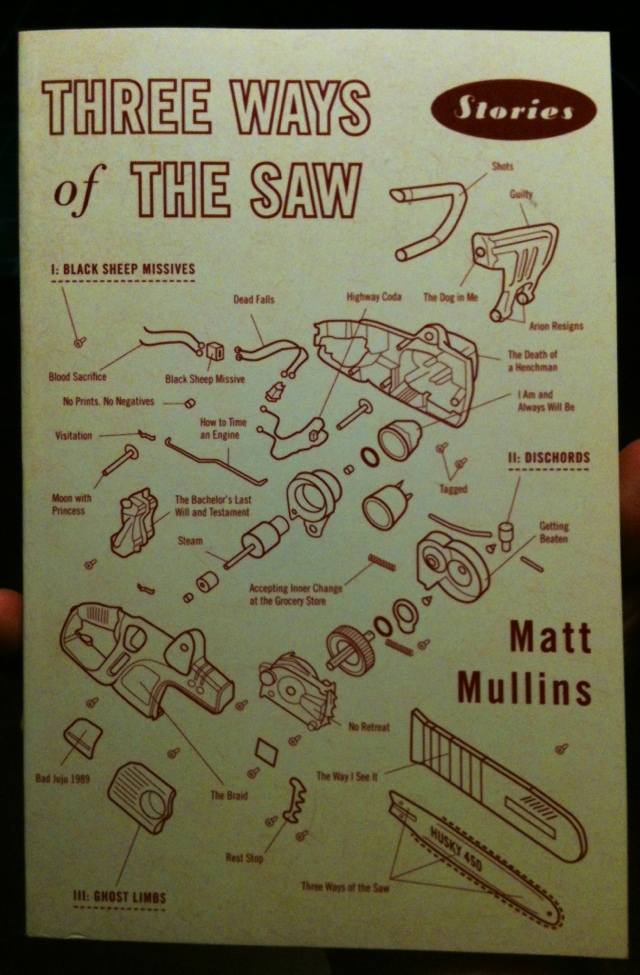
Matt Mullins’s Three Ways of the Saw (new in February from Atticus): Spent a few afternoons sifting through this volume, intrigued by its outstanding cover (I use the word “outstanding” literally; over a dozen titles came into Bblklpt Wrld Hdqrtrs this fine week). Mullins’s volume, stocked with short and short-short (and micro-) stories, bristles with boozy energy, grit, ugly druggy nervy episodes, shenanigans, dirty hi-jinks, breaking families, bad sons, bad people, broken people, desperate people . . . There’s a strong Bukoswkiish vibe to the business, with less ego, more concrete imagery, more Denis Johnson. I like this book.

“The Mice” — Lydia Davis

“The Mice” a very short story by Lydia Davis (read our review of The Collected Stories of Lydia Davis)—

Mice live in our walls but do not trouble our kitchen. We are pleased but cannot understand why they do not come into our kitchen where we have traps set, as they come into the kitchens of our neighbors. Although we are pleased, we are also upset, because the mice behave as though there were something wrong with our kitchen. What makes this even more puzzling is that our house is much less tidy than the houses of our neighbors. There is more food lying about in our kitchen, more crumbs on the counters and filthy scraps of onion kicked against the base of the cabinets. In fact, there is so much loose food in the kitchen I can only think the mice themselves are defeated by it. In a tidy kitchen, it is a challenge for them to find enough food night after night to survive until spring. They patiently hunt and nibble hour after hour until they are satisfied. In our kitchen, however, they are faced with something so out of proportion to their experience that they cannot deal with it. They might venture out a few steps, but soon the overwhelming sights and smells drive them back into their holes, uncomfortable and embarrassed at not being able to scavenge as they should.

Read “Town of Cats,” a Story by Haruki Murakami

Today, The New Yorker shares “Town of Cats,” a short story by Haruki Murakami. First paragraph—

At Koenji Station, Tengo boarded the Chuo Line inbound rapid-service train. The car was empty. He had nothing planned that day. Wherever he went and whatever he did (or didn’t do) was entirely up to him. It was ten o’clock on a windless summer morning, and the sun was beating down. The train passed Shinjuku, Yotsuya, Ochanomizu, and arrived at Tokyo Central Station, the end of the line. Everyone got off, and Tengo followed suit. Then he sat on a bench and gave some thought to where he should go. “I can go anywhere I decide to,” he told himself. “It looks as if it’s going to be a hot day. I could go to the seashore.” He raised his head and studied the platform guide.

At that point, he realized what he had been doing all along.

Fun fact: I used to live in Shin-Koenji, right near Koenji, and I took the Chuou to work every day.

“Home” — George Saunders

From “Home,” a new George Saunders story in The New Yorker—-

Like in the old days, I came out of the dry creek behind the house and did my little tap on the kitchen window.

“Get in here, you,” Ma said.

Inside were piles of newspapers on the stove and piles of magazines on the stairs and a big wad of hangers sticking out of the broken oven. All of that was as usual. New was: a water stain the shape of a cat head on the wall above the fridge and the old orange rug rolled up halfway.

“Still ain’t no beeping cleaning lady,” Ma said.

I looked at her funny.

“Beeping?” I said.

“Beep you,” she said. “They been on my case at work.”

It was true Ma had a pretty good potty mouth. And was working at a church now, so.

We stood there looking at each other.

Then some guy came tromping down the stairs: older than Ma even, in just boxers and hiking boots and a winter cap, long ponytail hanging out the back.

“Who’s this?” he said.

“My son,” Ma said shyly. “Mikey, this is Harris.”

“What’s your worst thing you ever did over there?” Harris said.

“What happened to Alberto?” I said.

“Alberto flew the coop,” Ma said.

“Alberto showed his ass,” Harris said.

“I hold nothing against that beeper,” Ma said.

“I hold a lot against that fucker,” Harris said. “Including he owes me ten bucks.”

“Harris ain’t dealing with his potty mouth,” Ma said.

“She’s only doing it because of work,” Harris explained.

“Harris don’t work,” Ma said.

“Well, if I did work, it wouldn’t be at a place that tells me how I can talk,” Harris said. “It would be at a place that lets me talk how I like. A place that accepts me for who I am. That’s the kind of place I’d be willing to work.”

“There ain’t many of that kind of place,” Ma said.

“Places that let me talk how I want?” Harris said. “Or places that accept me for who I am?”

“Places you’d be willing to work,” Ma said.

“How long’s he staying?” Harris said.

“Long as he wants,” Ma said.

“My house is your house,” Harris said to me.

“It ain’t your house,” Ma said.

“Give the kid some food at least,” Harris said.

“I will but it ain’t your idea,” Ma said, and shooed us out of the kitchen.

“Great lady,” Harris said. “Had my eyes on her for years. Then Alberto split. That I don’t get. You got a great lady in your life, the lady gets sick, you split?”

“Ma’s sick?” I said.

“She didn’t tell you?” he said.

He grimaced, made his hand into a fist, put it upside his head.

“Lump,” he said. “But you didn’t hear it from me.”

Ma was singing now in the kitchen.

“I hope you’re at least making bacon,” Harris called out. “A kid comes home deserves some frigging bacon.”

“Why not stay out of it?” Ma called back. “You just met him.”

“I love him like my own son,” Harris said.

“What a ridiculous statement,” Ma said. “You hate your son.”

“I hate both my sons,” Harris said.

“And you’d hate your daughter if you ever meet her,” Ma said.

Harris beamed, as if touched that Ma knew him well enough to know he would inevitably hate any child he fathered.

Ma came in with some bacon and eggs on a saucer.

“Might be a hair in it,” she said. “Lately it’s like I’m beeping shedding.”

“You are certainly welcome,” Harris said.

“You didn’t beeping do nothing!” Ma said. “Don’t take credit. Go in there and do the dishes. That would help.”

“I can’t do dishes and you know that,” Harris said. “On account of my rash.”

“He gets a rash from water,” Ma said. “Ask him why he can’t dry.”

“On account of my back,” Harris said.

“He’s the King of If,” Ma said. “What he ain’t is King of Actually Do.”

“Soon as he leaves I’ll show you what I’m king of,” Harris said.

“Oh, Harris, that is too much, that is truly disgusting,” Ma said.

Harris raised both hands over his head like: Winner and still champ.

“We’ll put you in your old room,” Ma said.

“What’s the Matter, Don’t You Love Me Anymore?” — Raymond Carver’s Correspondence with Gordon Lish

Today is Raymond Carver’s birthday. Read excerpts of Carver’s letters to his editor Gordon Lish at The New Yorker. A few highlights (the letter from July 8, 1980 is fantastic and should be read in full, by the way)—

July 15, 1970

Hombre, thanks for the superb assist on the stories. No one has done that for me since I was 18, I mean it. High time I think, too. Feel the stories are first class now, but whatever the outcome there, I appreciate the fine eye you turned on them. Hang tough.

February 1, 1979

I’m going to Mardi Gras with Tess; and the Fords are coming down in March for spring break and we’re going into Mexico by train for a week. . . . I’m happy, and I’m sober. It’s aces right now, Gordon. I know better than anyone a fellow is never out of the woods, but right now it’s aces, and I’m enjoying it.

July 8, 1980, 8 a.m.

Dearest Gordon,

I’ve got to pull out of this one. Please hear me. I’ve been up all night thinking on this, and nothing but this, so help me. I’ve looked at it from every side, I’ve compared both versions of the edited mss—the first one is better, I truly believe, if some things are carried over from the second to the first—until my eyes are nearly to fall out of my head. You are a wonder, a genius, and there’s no doubt of that, better than any two of Max Perkins, etc., etc. And I’m not unmindful of the fact of my immense debt to you, a debt I can simply never, never repay. This whole new life I have, so many of the friends I now have, this job up here, everything, I owe to you for “Will You Please.” You’ve given me some degree of immortality already.

January 21, 1983

What’s the matter, don’t you love me anymore? I never hear from you. Have you forgotten me already? Well, I’m going back to the [Paris Review] interview and take out all the good things I said about you.

“The Man Who Shouted Teresa” — Italo Calvino

“The Man Who Shouted Teresa,” a very short story by Italo Calvino. From Numbers in the Dark.

I stepped off the pavement, walked backwards a few paces looking up, and, from the middle of the street, brought my hands to my mouth to make a megaphone, and shouted toward the top stories of the block: “Teresa!”
My shadow took fright at the moon and huddled at my feet.
Someone walked by. Again I shouted: “Teresa!” The man came up to me and said: “If you do not shout louder she will not hear you. Let’s both try. So: count to three, on three we shout together.” And he said: “One, two, three.” And we both yelled, “Tereeeesaaa!”
A small group of friends passing by on their way back from the theater or the café saw us calling out. They said: “Come on, we will give you a shout too.” And they joined us in the middle of the street and the first man said one to three and then everybody together shouted, “Te-reee-saaa!”
Somebody else came by and joined us; a quarter of an hour later there were a whole bunch of us, twenty almost. And every now and then somebody new came along.
Organizing ourselves to give a good shout, all at the same time, was not easy. There was always someone who began before three or who went on too long, but in the end we were managing something fairly efficient. We agreed that the “Te” should be shouted low and long, the “re” high and long, the “sa” low and short. It sounded fine. Just a squabble every now and then when someone was off.
We were beginning to get it right when somebody, who, if his voice was anything to go by, must have had a very freckled face, asked: “But are you sure she is home?”
“No,” I said.
“That is bad,” another said. “Forgotten your key, have you?”
“Actually,” I said, “I have my key.”
“So,” they asked, “why dont you go on up?”
“I don’t live here,” I answered. “I live on the other side of town.”
“Well, then, excuse my curiosity,” the one with the freckled voice asked, “but who lives here?”
“I really wouldn’t know,” I said.
People were a bit upset about this.
“So, could you please explain,” somebody with a very toothy voice asked, “why you are down here calling out Teresa.”
“As far as I am concerned,” I said, “we can call out another name, or try somewhere else if you like.”
The others were a bit annoyed.
“I hope you were not playing a trick on us,” the freckled one asked suspiciously.
“What,” I said, resentfully, and I turned to the others for confirmation of my good faith. The others said nothing.
There was a moment of embarrassment.
“Look,” someone said good-naturedly, “why don’t we call Teresa one more time, then we go home.”
So we did it one more time. “One two three Teresa!” but it did not come out very well. Then people headed off for home, some one way, some another.
I had already turned into the square when I thought I heard a voice still calling: “Tee-reee-sa!”
Someone must have stayed on to shout. Someone stubborn.

First Love and Other Sorrows — Harold Brodkey

One way to measure how great a work of literature is might be to ask how true (or “True,” if one is feeling particularly romantic) the writing is. We can find facts anywhere, but details and data are not the same as art. Great literature happens in the arrangement of that data, by presenting details with the right ear and eye for truth—and also, the good sense to know what to withhold from the audience, who, after all, are a part of the equation. The stories collected in Harold Brodkey’s First Love and Other Sorrows, both inspiriting and crushing, are some of the most psychologically true pieces of fiction I’ve ever read.

First Love collects nine stories, all composed and published in the 1950s; all but one was originally published in The New Yorker. Although discrete entities, the stories function together. First Love is very much a novel-in-stories, with recurring characters, themes, and motifs. Brodkey’s stories document the strange little bubble of time between WWII and the turmoil of the sixties, and his writing, a kind of late modernism, reflects this period, when the ideal of the American Dream began to be redefined in terms of new modes of class and education.

The first few stories in the collection are told from the first-person perspective of an adolescent, likely an iteration of Brodkey himself. Opener “State of Grace” serves as an overture to the collection, introducing a family that will be transposed throughout the tales. There’s the narrator, a sensitive, awkward boy, beginning to feel strains of alienation from his older sister and his mother. Dad is out of the picture, and with him, the family’s fortunes have fallen: big sis is expected to marry the right man for money—and for class.

These themes are explored in greater length in the very-long short story “First Love and Other Sorrows,” a compact little novella, really, that everyone should read at some point. The narrator, likely the same boy from the first story, describes his life at the end of his high school career in St. Louis, as he prepares to move on to college soon. Again, the major explicit conflict of the story revolves around his sister’s romances, as their mother pressures her to marry the right man. The real conflict though is the boy’s emerging realization of his own dramatic detachment from his family; or, more accurately, the young man is coming to realize the underlying instability that adults tend to hide from children. The boy observes his older sister, whom he reveres—

It occurred to me that she didn’t really know what she was doing; she was not really as sure of everything as she seemed. It was a painfully difficult thought to arrive at, and it clung to me. Why hadn’t I realized it before? Also, she sort of hated me, it seemed to me. I had never noticed that before, either. How could I have been so wrong, I wondered. Knowing how wrong I had been about this, I felt that no idea I had ever had was safe. For instance, we were not necessarily a happy family, with the most wonderful destinies for my sister and me. We might make mistakes and choose wrong. Unhappiness was real. It was even likely…

The narrator’s epiphany is articulate and crushing and wholly real: it documents the ugly realization that the fantasies of a middle class childhood — “happily ever after” — are, indeed, mere fantasies. Brodkey twins this moment in another epiphany at the end of the story that I would love to discuss but fear spoiling; suffice to say that the final line of the story, forever etched in my brain, is simply one of the finest and most fitting moments I’ve ever read.

The next story, “The Quarrel,” finds our young hero, a bit more jaded, off to Harvard, where he falls in with a bitter rich kid named Duncan; they quickly make it their business to despise everything, adopting (unearned) world-weary poses and contrarian natures. Against the advice of their families, the two take a semester off college to tour Europe, spending much of their time bicycling across France. The story documents the kind of friendships that many young people emerging from adolescence engage in: fierce, passionate, identity-defining relationships that always buckle under their own weight. Hence—

Duncan enjoyed Pernod. It made me sick. Duncan hated talking to people. I talked to everyone. My French vocabulary was better than Duncan’s. His pronunciation was better than mine. I became terribly adept at not irritating Duncan before breakfast. I couldn’t see that he appreciated any of this, or that he responded with any similar awareness. For the fiftieth time, I thought him unfair. The moment came when I could no longer stand the sound of his voice, or his ideas. After traveling with him day and night, without a break, for fifty-three days, I felt my senses suffocating in an awareness of Duncan.

“The Quarrel” perfectly captures the strange paradoxes of youthful, immature friendships that can’t survive; reading it forced me to remember myself at eighteen, and to recall a friendship similar to that between the narrator and Duncan, an intense friendship that burned out bitterly and quickly, yet nevertheless helped me to define myself.

“The Quarrel” is the last story in the collection written in first-person perspective; indeed, Brodkey’s narrative shift signals a shift in development; as his characters age (as they do through the collection), he allows himself to step outside of them a bit, as if the psychological pain he explores is almost too much to bear. “Sentimental Education” tells the story of an intense first love (the male lead seems like another iteration of the narrator from the first three stories). In a free indirect style, Brodkey glamorizes, valorizes, and satirizes the young lovers, all at once, exploring the passion and shame and confusion of early adulthood. Here, he describes what happens when the pair begin a sexual relationship—

Their first dip in sensual waters left them nonplussed. They didn’t know what to make of it. They tried to persuade themselves that something had really happened, but the minute it was over, they couldn’t believe they had ever done such a thing. They rushed into further experiences; they broke off in the middle of embraces and looked at each other, stunned and delighted. “Is this really happening?” they both asked at different times, and each time the other said, “No,” and they would laugh. They knew that nothing they did was real, was actual. They had received a blow on the head and were prey to erotic imaginings, that was all. But at the same time they half realized it was true, they were doing these things, and then the fact that they, Caroline and Elgin, shared such intimacy dazed and fascinated them; and when they were together, they tried to conceal it, but this indescribable attraction they felt for each other kept making itself known and draining all the strength from their bodies.

“Sentimental Education” retraces the fallout explored in “The Quarrel,” as the young lovers inevitably fall apart.

After this love story, Brodkey shifts his attention to a character named Laura (or, in one version, “Laurie”), who seems to be a version of the narrator’s sister from the first few stories. The five Laura stories are much shorter than the other narratives. These tightly detailed miniature portraits trace the development of Laura as she chooses the man her mother didn’t approve of; this plot is very much in the background of the stories, though, an implicit detail that nevertheless hangs over Laura’s psychological development. The Laura stories seem to trace what it means to grow old but not mature. They recall the narrator in “First Love and Other Stories” epiphany that adulthood might be a murky or unhappy place. “Laura” documents postpartum depression and “Trio for Three Gentle Voices” subtly explores the ways in which parents seek to avoid repeating their own parents’ mistakes. “Piping Down the Valley’s Wild” is a simple, elegant story about Laura’s husband’s college roommate coming over for dinner. Reading it, I experienced an uncanny transposition, as if I were observing a reinterpretation of something I experienced a few weekends ago. The story ends with another sad epiphany—

She just wanted this day to go on forever and ever, unending, with all its joys intact, and no one changing, nothing new happening, just these same things occurring over and over. Because how did you know happiness would come back? Or if it came back, that it would be as good as this? Laura sighed and wiped her eyes surreptitiously. The trouble with being happy was that it made you frightened.

This realization again encodes the paradox of adulthood, pointing toward its radical instability. To grow up, in Brodkey’s terms (terms I again point out strike me as utterly true) is to face irretrievable loss at every single moment, even as you gain new friends, new lovers, or new children. The joys of life are predicated on the necessary loss of these joys: existence costs.

First Love and Other Sorrows is a book that deserves more attention. In its spirit and art, it matches (and perhaps surpasses) other mid-century American narratives like The Catcher in the Rye or The Glass Menagerie, and in its spare, precise, minimal style, it points toward the later fiction of writers like Raymond Carver. This is a beautiful, sad book, the kind that leaves a deep impression. Very highly recommended.

“In the Dry” — Breece D’J Pancake

Read Breece D’J Pancake’s short story “In the Dry.” Excerpt —

He sees the bridge coming, sees the hurt in it, and says aloud his name, says, “Ottie.” It is what he has been called, and he says again, “Ottie.” Passing the abutment, he glances up, and in the side mirror sees his face, battered, dirty; hears Bus’s voice from a far-off time, I’m going to show you something. He breathes long and tired, seems to puff out the years since Bus’s Chevy slammed that bridge, rolled, and Ottie crawled out. But somebody told it that way—he only recalls the hard heat of asphalt where he lay down. And sometimes, Ottie knows. Now and again, his nerves bang one another until he sees a fist, a fist gripping and twisting at once; then hot water runs down the back of his throat, he heaves. After comes the long wait—not a day or night, but both folding on each other until it is all just a time, a wait. Then there is no more memory, only years on the hustle with a semi truck—years roaring with pistons, rattling with roads, waiting to sift out one day. For one day, he comes back.

This hill-country valley is not his place: it belongs to Sheila, to her parents, to her Cousin Buster. Ottie first came from outside the valley, from the welfare house at Pruntytown; and the Gerlocks raised him here a foster child, sent him out when the money-crop of welfare was spent. He sees their droughty valley, cannot understand—the hills to either side can call down rain. Jolting along the pike, he looks at withered fields, corn tassling out at three feet, the high places worse with yellowish leaves. August seems early for the hills to rust with dying trees, early for embankments to show patches of pale clay between milkweed and thistle. All is ripe for fire.

Read “Deniers,” a New Sam Lipsyte Story

The New Yorker has published “Deniers,” a new story by Biblioklept fave Sam Lipsyte. Excerpt—

“Trauma this, atrocity that, people ought to keep their traps shut,” Mandy’s father said. American traps tended to hang open. Pure crap poured out. What he and the others had gone through shouldn’t have a name, he told her friend Tovah, all those years later in the nursing home. People gave names to things so they could tell stories about them, goddam fairy tales about children who got out alive.

Mandy’s father, Jacob, had never said anything like this to Mandy, not in any of his tongues. He’d said other things, or nothing at all. He had worked for thirty-nine years as a printer in Manhattan. The founders of the company had invented the Yellow Pages.

“Think about that,” he’d often said.

Mandy did think about it, the thick directory that used to boost her up on her stool at the kitchen counter.

She’d spent her childhood mornings at that counter, culling raisins from her cereal, surveying the remains of her father’s dawn meal, his toast crusts, the sugared dregs in his coffee mug. Sometimes she’d wondered if he would come home from work that day, but it was a game, because he always came home. He’d eat his dinner and take to his reclining—or, really, collapsing—chair, listen to his belly gurgle, read popular histories of the American West. Maybe he’d watch a rerun of “Hogan’s Heroes,” the only show he could abide.

His gastric arias mostly stood in for conversation, but some evenings he managed a few words, such as the night he spotted Mandy’s library book on the credenza. This teen novel told the story of a suburban boy who befriends an elderly neighbor, a wanted Nazi. Mandy watched her father study the book from across the room. The way he handled it made her think he was scornful of its binding or paper stock, but then he read the dust flap, shuddered. He whispered in his original language, the one he rarely used, so glottal, abyssal.

Venus Drive — Sam Lipsyte

[Editorial note: Biblioklept ran a version of this review last year; we run it again in the spirit of Sam Lipsyte Week].

The thirteen stories in Venus Drive compose a sort of novel-in-stories. The title of the collection takes its name from a banal suburban street mentioned in a few of the stories, and many of the characters seem like iterations of the same type or voice. There are washed up would-be indie rock stars, small-time coke peddlers, and underemployed and overeducated addicts. There are deviants and perverts and outsiders. There are bullies. There are dead or dying mothers, dead or dying sisters. In short, Venus Drive is its own tightly-drawn, tightly-coiled, and highly-compressed world.

As the plot points double and re-double in these stories, so do the themes. “Our culture is afraid of death, and considers it something we must wage battle against,” says Tessa, a pain specialist, a peripheral character in “Cremains.” She continues: “I say, surrender, submit. Go gentle. Terminal means terminal.” Death informs almost all of these stories in some way, and Tessa’s commentary presents the problem with death, or at least the problem these characters have with dealing with death: it’s not easy to go gentle. It goes against our culture and our nature to surrender. If she’s presented as a voice of wisdom, she’s also an ironic character, one of the many would-be authorities Lipsyte’s weirdos and outsiders can’t help but mock. “The Drury Girl,” part-suburban satire and pure pathos, posits a pre-pubescent narrator obsessed with his teenage babysitter; his dad’s cancer plays second fiddle to his lust. Thus the story neatly ties together the overarching themes of Venus Drive, sex and death. Admittedly, these are probably the only real themes of proper literature, but Lipsyte does it so damn well and lays it all out so bare and does so in such humor and grace that it really sticks. It’s good stuff.

That humor is desert-dry, of course, and succeeds so well because his characters are so endearing in their pathetic pathologies. The antiheroes of “Beautiful Game” and “My Life, for Promotional Use Only,” are also-rans in the sordid history of underground rock, addicts approaching washed-up (Are they the same person? Maybe. They have different names, of course. Doesn’t matter). A scene from “Beautiful Game” shows the ambivalence at the core of many of these characters: “At the bank machine, Gary doesn’t check the balance. Better to leave it to the gods. Someday the bank machine will shun him. Why know when?” Gene, the ex-rocker in “My Life, for Promotional Use Only” now suffers the indignities of working for his ex-girlfriend. Everyone in the story is an ex-something, everyone is growing up and leaving art (or is it “Art”?) behind. In a poignant and funny and cruel scene, familiar to many of us, Gene sees some of himself in a waitress:

Rosalie calls over the waitress and they talk for a while about somebody’s new art gallery. The waitress is famous for a piece where she served the Bloody Marys mixed with her menstrual blood. Word had it she overdid the tabasco.

I wait for the moment when our waitress stops being a notorious transgressor of social mores and becomes a waitress again, look for it in her eyes, that sad blink, and order a beer.

Gene, a former “notorious transgressor of social mores” himself feels both sorrow and hate for the waitress. He sees her job as menial and pathetic — just like his own. He doesn’t seem to think much of her art, either. Lipsyte telegraphs so much there with so few words, his sentences clean, spare, precise, and rarely of the compound variety. There’s a truncated, clipped rhythm that Lipsyte builds over the thirteen-story run that helps propel the immediacy of his tales. The stories are short, too; the longest is sixteen pages and most run to eight or ten. Lipsyte’s rhetorical gift is to shine the grubby and, at times, his sentences can feel almost too perfect, too-fussed over–but this (minor) complaint, it must be noted, comes from someone who admires occasional ambiguity or incoherence. Lipsyte removes his own authorial voice and thus achieves lucidity in his characters’ voices; somehow, though — and paradoxically — these voices bear the ghostly trace of his absence. But that seems like a silly conversation, and certainly not one for this post.

Venus Drive reminds me very much of one of my favorite books, Denis Johnson’s Jesus’ Son, which I would also call a novel-in-stories, also a spare and precise collection, also a study of weirdos and addicts and outsiders. Jesus’ Son is something of a standard in creative writing workshops (or at least it used to be) and a sensible teacher would add Venus Drive to her syllabus as well. Finally, like Jesus’ Son, Lipsyte’s book is seething, funny, and poignant, with characters tipped toward some redemption, awful or otherwise, for all their myriad sins. The book might take its name from a geographic location, but the “Venus drive” is also a spiritual inclination toward love and hope. Highly recommended.

Venus Drive is available in trade paperback from Picador.

Airships — Barry Hannah

In his 1978 collection Airships, Barry Hannah sets stories in disparate milieux, from the northern front of the Civil War, to an apocalyptic future, to the Vietnam War, to strange pockets of the late-twentieth century South. Despite the shifts in time and place, Airships is one of those collections of short stories that feels somehow like an elliptical, fragmentary novel. There are the stories that correspond directly to each other — the opener “Water Liars,” for instance, features (presumably, anyway), the same group of old men as “All the Old Harkening Faces at the Rail.” The old men love to crony up, gossip, tell tall tales. An outsider spoils the fun in “Water Liars” by telling a truth more terrible than any lie; in “Harkening,” an old man shows off his new (much younger) bride. These stories are perhaps the simplest in the collection, the homiest, anyway, or at least the most “normal” (whatever that means), yet they are both girded by a strange darkness, both humorous and violent, that informs all of Airships.

We find that humor and violence in an outstanding trio of Civil War stories (or, more accurately, stories set during the Civil War). The narrator of “Dragged Fighting from His Tomb,” a Confederate infantryman relates a tale of heroic slaughter with a hypberbolic, phallic force. Observe—

I knew the blueboys thought they had me down and were about ready to come in. I was in that position at Chancelorsville. There should be about six fools, I thought. I made the repeater, I killed four, and the other two limped off. Some histrionic plumehead was raising his saber up and down on the top of a pyramid of crossties. I shot him just for fun. Then I brought up another repeater and sprayed the yard.

Later, the narrator defects, switches to the Union, and claims he kills Jeb Stuart, a figure that towers over the Civil War tales. The narrator of “Dragged Fighting” hates Stuart; the narrator of “Knowing He Was Not My Kind Yet I Followed” is literally in love with the General. In contrast to the narrator of “Dragged Fighting,” the speaker in “Knowing” — an avowed “sissy” whom the other soldiers openly detest — hates the violence and madness of war—

We’re too far from home. We are not defending our beloved Dixie anymore. We’re just bandits and maniacal. The gleam in the men’s eyes tells this. Everyone is getting crazier on the craziness of being simply too far from home for decent return. It is like Ruth in the alien corn, or a troop of men given wings over the terrain they cherished and taken by the wind to trees they do not know.

He despairs when he learns of Jeb Stuart’s death. In the final Civil War story, “Behold the Husband in His Perfect Agony,” a Union spy is given the task to communicate news of Stuart’s death through enemy lines. Rather than offering further explication, let me instead point you, dear reader, to more of Hannah’s beautiful prose, of which I have not remarked upon nearly enough. From “Behold the Husband” —

Isaacs False Corn, the Indian, the spy, saw Edison, the Negro, the contact, on the column of an inn. His coat was made of stitched newspapers. Near his bare feet, two dogs failed earnestly at mating. Pigeons snatched at the pieces of things in the rushing gutter. The rains had been hard.

The short, descriptive passage rests on my ears like a poem. Hannah, who worked with Gordon Lish, evinces in his writing again and again that great editor’s mantra that writing is putting one sentence after another.

Although set in the Vietnam War, “Midnight and I’m not Famous Yet” seems an extension of the Civil War stories. In it, an officer from a small Southern town goes slowly crazy from all the killing, yet, like the narrator of “Dragged Fighting,” he presents himself as a warrior. Above all though, he laments that the war has robbed him of some key, intermediary phase of his late youth, a phase he can’t even name—

The tears were out of my jaws then. Here we shot each other up. All we had going was the pursuit of horror. It seemed to me my life had gone straight from teen-age giggling to horror. I had never had time to be but two things, a giggler and a killer.

This ironic sense of a “pursuit of horror” pervades Airships, particularly in the collection’s most apocalyptic visions. “Eating Wife and Friends” posits an America where food shortages and material scarcity leads people to eating leaves and grass — and then each other. In “Escape to Newark,” the environment is wildly out of balance—

In August it’s a hundred fifty degrees. In December it’s minus twenty-five and three feet of snow in Mississippi. In April the big trees explode.

A plan is made to “escape” these conditions via a rocket, but of course there’s not enough fuel to get past Newark. In Airships, modes of flight are transcendent but ultimately transient. Gravity’s pull is heavy stuff.

Just as Hannah’s war stories are not really war stories, his apocalypse tales are really about human relationships, which he draws in humor, pathos, and dark cynicism. In “Green Gets It,” an old man repeatedly attempts his suicide, only to fail again and again. His suicide note, written to his daughter, is scathing and shocking and sad and hilarious and wise–

My Beloved Daughter,

Thanks to you for being one of the few who never blamed me for your petty, cheerless and malign personality. But perhaps you were too busy being awful to ever think of the cause. I hear you take self-defense classes now. Don’t you understand nobody could take anything from you without leaving you richer? If I thought rape would change you, I’d hire a randy cad myself. I leave a few dollars to your husband. Bother him about them and suffer the curse of this old pair of eyes spying blind at the minnows in the Hudson.

Your Dad,

Crabfood

Although Hannah explores the darkest gaps of the soul in Airships, he also finds there a shining kernel of love in the face of waste, depravity, violence, and indifference. This love evinces most strongly perhaps in Airships trio of long stories. These tales, which hover around 30 pages, feel positively epic set against the other stories in the collection, which tend to clock in between five and ten pages. The first long story, “Testimony of Pilot,” details the development of a boyhood friendship over a few decades. It captures the strange affections and rivalries and unnameable bonds and distances that connect and disconnect any two close friends. The second of the long tales is “Return to Return,” a tragicomic Southern drama in the Oedipal vein (with plenty of tennis and alcoholism to boot). As in “Testimony of Pilot,” Hannah finds some measure of redemption, or at least solace, for his characters in their loving friendship, yet nothing could be more unsentimental. The final long story, which closes the collection, is “Mother Rooney Unscrolls the Hurt,” a daring work of stream of consciousness that seems to both respond to — and revise — Katherine Anne Porter’s “The Jilting of Granny Weatherall.” The story concludes (and of course concludes the volume) with a vision of love that corresponds to the imagery of The Pietà, a kind of selflessness that ironically confirms the self as an entity that exists in relation to the pain of others.

I could keep writing of course — I’ve barely touched on Hannah’s surrealism, a comic weirdness that I’ve never seen elsewhere; it is Hannahesque, I suppose. Nor have I detailed Hannah’s evocations of regular working class folk, fighting and drinking and divorcing and raising children (not necessarily in that order). Airships is a world too rich and fertile to unpack in just one review, and I’ve already been blathering too long, I fear, when what I really want  to do is just outright implore you, kind reader, to find it and start reading it immediately. Very highly recommended.

“Going for a Beer” — Robert Coover

The New Yorker publishes “Going for a Beer,” a very short story by Robert Coover. From the story–

He finds himself sitting in the neighborhood bar drinking a beer at about the same time that he began to think about going there for one. In fact, he has finished it. Perhaps he’ll have a second one, he thinks, as he downs it and asks for a third. There is a young woman sitting not far from him who is not exactly good-looking but good-looking enough, and probably good in bed, as indeed she is. Did he finish his beer? Can’t remember. What really matters is: Did he enjoy his orgasm? Or even have one?


“The Other Place” — New Fiction from Mary Gaitskill

The New Yorker has published “The Other Place,” a new short story from Mary Gaitskill. A taste–

My son, Douglas, loves to play with toy guns. He is thirteen. He loves video games in which people get killed. He loves violence on TV, especially if it’s funny. How did this happen? The way everything does, of course. One thing follows another, naturally.

Naturally, he looks like me: shorter than average, with a fine build, hazel eyes, and light-brown hair. Like me, he has a speech impediment and a condition called “essential tremor” that causes involuntary hand movements, which make him look more fragile than he is. He hates reading, but he is bright. He is interested in crows because he heard on a nature show that they are one of the only species that are more intelligent than they need to be to survive. He does beautiful, precise drawings of crows.

Mostly, though, he draws pictures of men holding guns. Or men hanging from nooses. Or men cutting up other men with chainsaws—in these pictures there are no faces, just figures holding chainsaws and figures being cut in two, with blood spraying out.

My wife, Marla, says that this is fine, as long as we balance it out with other things—family dinners, discussions of current events, sports, exposure to art and nature. But I don’t know. Douglas and I were sitting together in the living room last week, half watching the TV and checking e-mail, when an advertisement for a movie flashed across the screen: it was called “Captivity” and the ad showed a terrified blond girl in a cage, a tear running down her face. Doug didn’t speak or move. But I could feel his fascination, the suddenly deepening quality of it. And I don’t doubt that he could feel mine. We sat there and felt it together.

And then she was there, the woman in the car. In the room with my son, her black hair, her hard laugh, the wrinkled skin under her hard eyes, the sudden blood filling the white of her blue eye. There was excited music on the TV and then the ad ended. My son’s attention went elsewhere; she lingered.

“Wake for Susan” — Cormac McCarthy

Great find by Reddit user db_usher, who’s unearthed Cormac McCarthy’s early short story, “Wake for Susan” (okay, “unearthed” might be an extreme verb; you can get the story via interlibrary loan from the University of Tennessee, but hey, that takes effort). The piece was published in 1959 in The Phoenix; it’s a bit of juvenilia with its faults, to be sure, but will interest fans of course. Usher’s Reddit post links to a .pdf file; I’ve posted the story after the jump for those who wish to read it on a screen.

Continue reading ““Wake for Susan” — Cormac McCarthy”

“The West” — Carson Mell

Deb Olin Unferth Reads Her Short Story “Deb Olin Unferth”

“55 Miles to the Gas Pump” — Annie Proulx

“55 Miles to the Gas Pump” is a very short story by Annie Proulx.

Rancher Croom in handmade boots and filthy hat, that walleyed cattleman, stray hairs like the curling fiddle string ends, that warm-handed, quick-foot dancer on splintery boards or down the cellar stairs to a rack of bottles of his own strange beer, yeasty, cloudy, bursting out in garlands of foam, Rancher Coom at night galloping drunk over the dark plain, turning off at a place he knows to arrive at a canyon brink where he dismounts and looks down on tumbled rock, waits, then steps out, parting the air with his last roar, sleeves surging up, windmill arms, jeans riding over boot tops, but before he hits he rises again to the top of the cliff like a cork in a bucket of milk.

Mrs. Croom on the roof with a saw cutting a hole into the attic where she has not been for twelve years thanks to old Croom’s padlocks and warnings, whets to her desire, and the sweat flies as she exchanges the saw for a chisel and hammer until a ragged slab peak is free and she can see inside: just as she thought: the corpses of Mr. Croom’s paramours – she recognizes them from their photographs in the paper: MISSING WOMAN – some desiccated as jerky and much the same color, some moldy from lying beneath roof leaks, and, all of them used hard, covered with tarry handprints, the marks of boot heels, some bright blue with remnants of paint used on the shutters years ago, one wrapped in newspaper nipple to knee.

When you live a long way out you make your own fun.