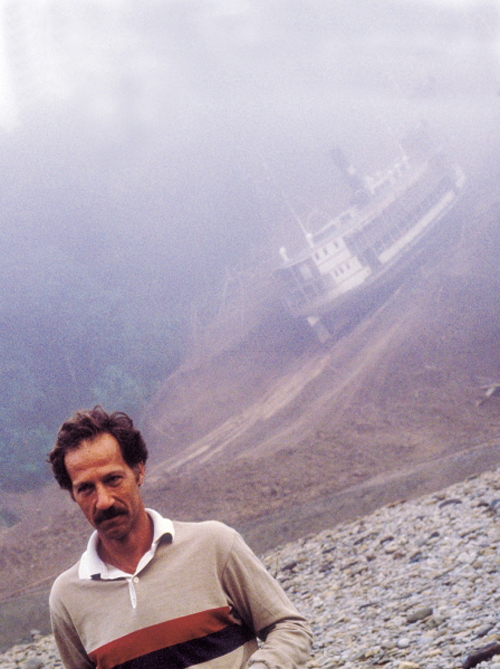
Werner Herzog Explains Why His Films Are Funnier Than Eddie Murphy’s

Werner Herzog on Moral Responsibility

“All These Dreams Are Yours As Well” — Werner Herzog

“We Are Challenging Nature Itself . . . And It Hits Back” — Werner Herzog on Nature’s Violent Obscenity

(More).

Ten Thousand Years Older — Werner Herzog

“I Don’t Usually Have Guests This Deep” — Werner Herzog Visits Stephen Colbert

Vodpod videos no longer available.

Werner Herzog Talks Culture and Caves

The AV Club interviews Werner Herzog. Sample—

AVC: In 20,000 years, could it be our culture that’s discovered in a cave somewhere?

WH: In 20,000 years, there will be significant things in the environment that will be preserved, like certain dams. Like Vajont Dam near Longarone [Italy], where there was this catastrophic event almost 50 years ago now. An incredibly massive landslide came down into the lake. The entire lake, over 50 billion cubic meters, shot up into the air in a tsunami of 700 feet that came down in this gorge and wiped out the town of Longarone. I have studied the place over and over. I do my pilgrimages to the place. At its base, [the dam] is something like a hundred feet thick. The steel-reinforced concrete. The whole thing is about 180 meters at its highest, and it withstood the landslide coming into it. It’s still intact, and most of it will be intact hundreds of thousands of years from now. So in the future, when people are looking for the Neanderthals of the 21st century, they will see our traces standing in open air. They will see the sarcophagus of Chernobyl, which is going to be built over it now. It will be there in 20,000 years. They won’t have to search in a cave.

Werner Herzog on NPR’s Fresh Air

Werner Herzog on NPR’s Fresh Air with Terry Gross. Herzog discusses his new documentary The Cave of Forgotten Dreams. (Thanks to Bblklpt reader Josh for forwarding us the link).

Cormac McCarthy and Werner Herzog on Science Friday (In Case You Missed It (Like We Did))

Cormac McCarthy and Werner Herzog, along with physicist Lawrence Krauss on NPR’s Science Friday with Ira Flatow, in case you missed it. Which I did.

“They’re Very Prone to Hypnosis” — Werner Herzog on Chickens

(See also.)

Werner Herzog on James Cameron’s Avatar

Three Takes on Nosferatu

Here’s F.W. Murnau’s seminal 1922 vampire film, Nosferatu, in full, thanks to public domain laws. Nosferatu is a horrifying and beautiful example of German expressionism at its finest. Max Schreck is terrifying as the vampire Count Orlok (an adaptation of Bram Stoker’s character Dracula). Observe–

Werner Herzog’s 1979 remake is also gorgeous, but employs a more naturalistic style. Klaus Kinski plays Dracula. Two scenes–

In 2000, director E. Elias Merhige gave us the underrated gem Shadow of the Vampire, a fictionalized account of the making Murnau and his crew making the original Nosferatu. Willem Dafoe is amazing as Max Schreck–or really, as Orlok, rather, as he stays in makeup and costume for the entirety of the production. The movie is both hilarious and frightening, and at times even sadistic. It’s also of a piece with the wave of meta-textual films that surged in the last decade,like Being John Malkovich, I Heart Huckabees, and Adaptation.

More Excerpts from Werner Herzog’s Conquest of the Useless

conquest

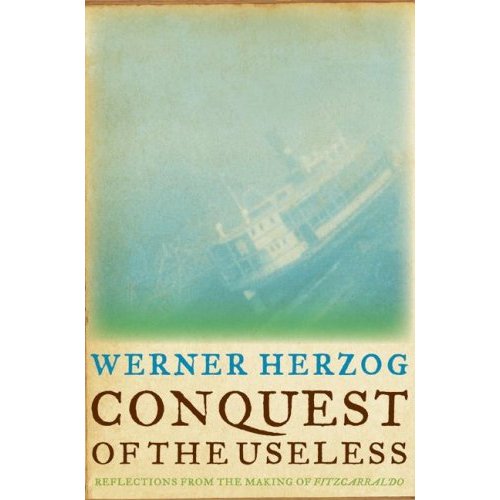
Last month, we were delighted to read some excerpts from Conquest of the Useless, Werner Herzog‘s forthcoming account of the making of his epic Fitzcarraldo (we wrote about it here). The paragons of moral literature at Vice Magazine have henceforth published a few more excerpts, available here. Here’s a morsel to whet the appetite:

I hurried to the first-aid station and saw a native man and a woman, both of whom had been struck with enormous arrows. They had been fishing for the camp three hours upstream by speedboat, and had spent the night on a sandbank. During the night they had been ambushed and shot at close range by Amehuacas. The woman had been hit by three arrows and almost bled to death. The wounds were close together. One arrow had gone all the way through her body just above her kidney, one had bounced off her hip bone, and the most life-threatening one was still sticking in her abdomen, broken off on the inner side of her pelvis. I spent several hours helping out while she was operated on, shining a powerful flashlight into her abdominal cavity and with the other hand spraying insect repellent to try to drive away the clouds of mosquitoes the blood had attracted. The man still had an arrow made of razor-sharp bamboo and almost thirty centimeters long sticking through his throat. He had broken off the two-meter-long shaft himself, and was gripping it in his hand. In his state of shock he refused to let go of it. The arrow’s tip, which looked more like the point of a lance, had spliced open one of his shoulders along the collarbone and was sticking crossways through his neck, with the tip lodged in his shoulder on the other side. He seemed to be in less immediate danger and was operated on only after the woman. Here is what had happened: the man, his wife, and a younger man, all three of them Machiguengas from Shivankoreni, who provide us with yucca, had gone up the Camisea to hunt. They were sleeping on a sandbank, and during the night the woman woke up because the man next to her was gasping strangely. Thinking a jaguar had got him by the throat, she grabbed a still glowing branch from the fire and jumped up. At that moment she was struck by three arrows. The younger man woke up; he had a shotgun with him, and, grasping the situation, fired two shots blindly into the night, since everything was happening in pitch darkness and complete silence. None of the three saw any trace of the attacking Amehuacas; they disappeared, leaving only a few footprints in the sand.

Lovely!

“The Jungle Is Obscene” — Werner Herzog’s Visceral Nature Writing

wernerherzogfitz

This month’s issue of Harper’s features a fantastic collection of diary entries by German film director Werner Herzog. These entries are excerpted from the forthcoming book Conquest of the Useless: Reflections from the Making of Fitzcarraldo. Released in 1982, Fitzcarraldo tells the story of a would-be rubber magnate who attempts to haul a steamship over a small mountain in Peru so that he can access an area rich in rubber trees. The infamous Klaus Kinski plays Fitzcarraldo, a European who pushes his crew to the breaking point in this mad quest; the semi-fictional plot was doubled in the real-life production disasters that plagued the movie. Fitzcarraldo dramatizes one of the oldest narrative conflicts, man vs. nature, in an earnest yet completely unromantic way. Fitzcarraldo, the opera-lover who brings ice to the natives, shatters any romantic illusions one might have about the power and majesty of nature in his mad schemes. This theme repeats throughout Herzog’s work, from the conquistador opus Aguirre, the Wrath of God to his outstanding 2005 documentary Grizzly Man. Again and again, Herzog’s films ironize, disrupt, or otherwise show the folly of romanticizing nature. His diary entries from Conquest of the Useless lay these sentiments bare in ways both bleakly poetic and terribly funny.

Take this entry from December 8, 1980: “The jungle is obscene. Everything about it is sinful, for which reason the sin does not stand out as sin.” Here, Herzog provides a succinct antithesis to Rousseau’s concept of the “noble savage.” Herzog’s view of man—de-politicized, that is—seems more Hobbesian, actually. In an entry from April 6, 1981, he writes:

“This morning I woke up to terror such as I have never experienced before: I was entirely stripped of feeling. Everything was gone; it was as if I had lost something that had been entrusted to me the previous evening, something I was supposed to take special care of overnight. I was in the position of someone who has been assigned to guard an entire sleeping army, but suddenly finds himself mysteriously blinded, deaf, and effaced. Everything was gone. I was completely empty, without pain, without longing, without love, without warmth and friendship, without anger, without hate. Nothing, nothing was there anymore, and I was left like a suit of armor with no knight inside. It took a long time before I even felt alarmed.”

Nature seems to nullify Herzog, to void any essential humanity he might have had. His repetition of “Nothing, nothing was there anymore” reminds me of King Lear’s famous lines “Never, never, never, never, never.” Although Lear is weeping over the body of his kind daughter Cordelia, the psychology of these lines surely reflect his own terrible experiences, his own nullified identity of homelessness on the wild heath.

For Herzog, nature is a war, nature will eat you. “Moss grows on lianas, and in the knobby places where the moss is thicker, a leafy plant like a slender hare’s ear grows out of the moss: a parasite on a parasite on a parasite,” he observes. If Herzog is melancholy or mordant in these grim reckonings, he’s also very, very funny. Take this hilarious June 4th entry concerning a giant albino turkey that’s been terrorizing the set:

“The camp is silent with resignation; only the turkey is making a racket. It attacked me, overestimating its own strength, and I quickly grabbed its neck, which squirmed and tried to swallow, slapped him left-right with the casual elegance of the arrogant cavaliers I had seen in French Three Musketeers films who go on to prettily cross swords, and then let the vain albino go. His feelings hurt, he trotted away, wiggling his rump but with his wings still spread in conceited display.”

And yet one senses that Herzog’s humor is a defense against the absurdity of nature, one that derives from an acute awareness that humanity is at once of and apart from nature, and at that by its own definition, its own choice. In a June 2nd entry featuring his nemesis the albino turkey, Herzog details an incident that highlights the essential ugliness of a Darwinian world:

“Our kitchen crew slaughtered our last four ducks. While they were still alive, Julian plucked their neck feathers, before chopping off their heads on the execution block. The white turkey, that vain creature, the survivor of so many roast chickens and ducks transformed into soup, came over to inspect, gobbling and displaying, and used his ugly feet to push one of the beheaded ducks, as it lay there on the ground bleeding and flapping its wings, into what he thought was a proper position and making gurgling sounds while his bluish-red wattles swelled, he mounted the dying duck and copulated with it.”

There we go. We get it all, all the order of nature. Food, sex, death, the whole deal, laid out keenly and with grim humor, neatly compacted into a single, grotesque episode. If these excerpts are any indication of the rest of the book’s trajectory, Conquest of the Useless promises to transcend standard making-of fare. Indeed, Herzog’s book seems nothing less than a profound meditation on the intersection of man, nature, terror, and mortality.

Conquest of the Useless: Reflections on the Making of Fitzcarraldo is available June 30th from HarperCollins.

Rescue Dawn–Werner Herzog

rescuedawn2.jpg

So my uncle and I went to see Rescue Dawn, the new Werner Herzog film. Rescue Dawn is the true story of Dieter Dengler (not a porn name), an Air Force pilot who crashed his plane during a mission over Laos in 1966. Dengler was captured, held as a POW, and tortured by his captors. Dengler organized and executed a daring escape, leading the other prisoners out of the camp. In 1997 Herzog made a documentary about Dengler’s story called Little Dieter Needs to Fly. I have not seen that film.

My expectations for Rescue Dawn were high–I love Herzog’s films, which mix high adventure with a sense of naturalistic realism and psychological surrealism–and I love Christian Bale, he of American Psycho fame, who plays Dengler. I suppose my expectations were too high, because Rescue Dawn wasn’t nearly as good as I thought it would be. My uncle was also slightly disappointed. It was by no means bad, but it wasn’t nearly as good as its reviews would make it seem; additionally, it’s practically a Hollywood action movie (complete with the big happy ending in front of an assembled audience of cheering extras)–something I wouldn’t have expected from Herzog. Bale is excellent though, as is co-star Steve Zahn, and the setting and pacing of the film make for an exciting afternoon. Then again, so does Missing in Action.

I may be going a little rough on Rescue Dawn–it’s better than 99% of the schlock out there, and in a summer crowded with franchise sequels, I think that moviegoers (i.e. people who go to the movies every week) should go check it out. Chalk my disappointment up to high expectations. Netflix addicted hermits like myself should probably just wait for the DVD.