
William H. Gass on Robert Walser. From Gass’s introduction to Masquerade and Other Stories; also collected in Gass’s Finding a Form.

William H. Gass on Robert Walser. From Gass’s introduction to Masquerade and Other Stories; also collected in Gass’s Finding a Form.
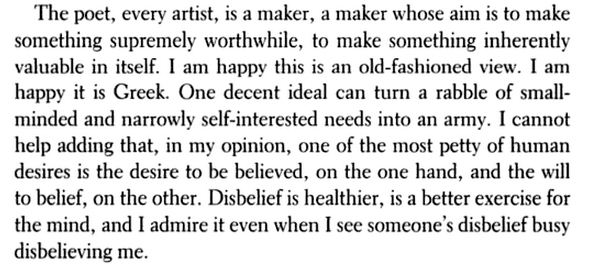
–from William H. Gass’s essay “Finding a Form.”
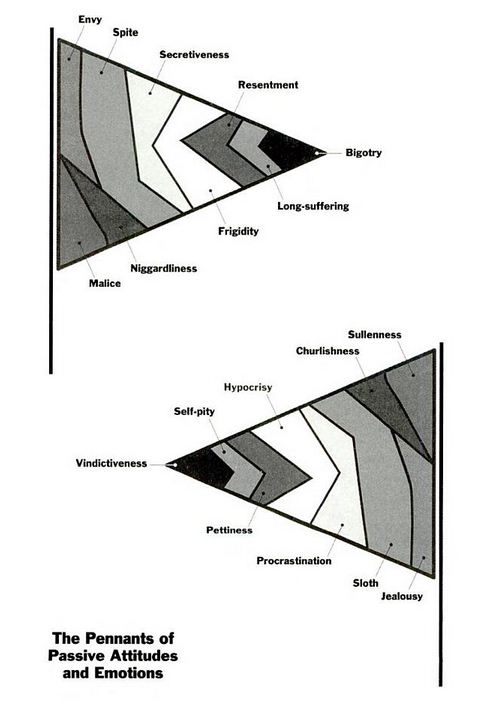
(From William Gass’s 1995 novel The Tunnel; The Quarterly Conversation will lead a Big Read of The Tunnel starting next week).
William Gass, in his 1977 Paris Review interview—
INTERVIEWER
Is the reader an adversary for you?
GASS
No. I don’t think much about the reader. Ways of reading are adversaries—those theoretical ways. As far as writing something is concerned, the reader really doesn’t exist. The writer’s business is somehow to create in the work something which will stand on its own and make its own demands; and if the writer is good, he discovers what those demands are, and he meets them, and creates this thing which readers can then do what they like with. Gertrude Stein said, “I write for myself and strangers,” and then eventually she said that she wrote only for herself. I think she should have taken one further step. You don’t write for anybody. People who send you bills do that. People who want to sell you things so they can send you bills do that. People who want to tell you things so they can sell you things so they can send you bills do that. You are advancing an art—the art. That is what you are trying to do.
In his Paris Review interview from 1977, William Gass riffs on the writers he admires:
INTERVIEWER
Who are some living novelists you respect?
GASS
Well, the question leaves out so many dead ones who are more alive. I think Barth is one of the great writers. I have admired his work since I first encountered it. I think he is incredible. Several of his books, in particular The Sot-Weed Factor, are the works which stand to my generation as Ulysses did to its. His habits of work are wholly unlike mine, and the kind of thing which engages him is quite different too. He is a great narrator, one of the best who ever plied the pen, as they used to say. He has been accused of being cold, purely mental, but I find him full of passion and excitement. And what I like about his work in great part is the unifying squeeze which that great intellectual grasp of his gives to his work, and the combination of enormous knowledge with fine feeling and artistic pride and energy and total control. I really admire a master. He’s one.
A lot of the work of Hawkes is extraordinary, breathtaking. Everybody likes Beckett. Now. It’s silly to mention Bellow, Borges, Nabokov—so obvious. And of course Stanley Elkin’s work I like enormously. Some of Coover’s, too, I find extraordinarily interesting. Control again. Gaddis. Control. Also Barthelme—a poet. A great many South American writers write rings around us. Infante’s Three Trapped Tigers is a great book. I taught Hopscotch once. I’ll never get over it. Márquez, Fuentes, Lima, Llosa . . . it is always an exciting time to be a reader. Lots of European writers are overblown, especially some of the French experimentalists, but Italo Calvino is wonderful. Thomas Bernhard’s The Lime Works is impressive. In general, I would think that at present prose writers are much in advance of the poets. In the old days, I read more poetry than prose, but now it is in prose where you find things being put together well, where there is great ambition, and equal talent. Poets have gotten so careless, it is a disgrace. You can’t pick up a page. All the words slide off.
I have terrible writer’s block. It’s not that I have nothing to say, it’s just that I can’t seem to say it. Or that I write sentences like the previous one and shudder at their awkward clunky artless awfulness. But I’m gonna press through it, write through it, and share a few thoughts on what I’ve read this week–
 First up: Adam Langer’s new novel, The Thieves of Manhattan, a send-up of the publishing industry that sets its targets directly on the current swath of (faked) memoirs that have done gangbusters for publishers in the past few years. Ian Minot is a broke-assed barista one fuck-up away from an overdue firing, who moves from the Midwest to make it as a writer in the big city. Only he’s not doing so well–in contrast to his gorgeous Romanian girlfriend Anya whose literary star is on the rise. For Minot though, this isn’t the worst–that would be the rampant success of über-poseur Blade Markham, a wanna-be gangsta whose memoir Blade on Blade is a blatant fabrication (albeit a fabrication that no one but savvy schlemiel Minot seems to notice (or, at the least, be bothered by)). I read the first fifty-odd pages of the Thieves in one sitting–a good sign to be sure. Langer’s Minot’s voice is familiar territory, the boy who loves to mock the literati he would love to be a part of. In one of the signal moves of his patois, the names of famous authors (and characters) regularly replace common nouns–a bed becomes a proust, a full head of hair is a chabon, sex is chinaski and so on. Minot seems to be headed to running his own grift soon with the help of a man he appropriately calls the Confident Man–should be good stuff. Full review forthcoming. The Thieves of Manhattan is available July 13, 2010 from Spiegel & Grau.
 I’ve also been reading William H. Gass’s first novel, Omensetter’s Luck. It’s weird, wonderful, Faulknerish in its loose (but somehow layered and constructed) stream of consciousness. Omensetter’s Luck comprises three sections, each progressively longer; I finished the second one today, and so far the novel seems to dance around a description or accounting of its namesake, Brackett Omensetter who carts his family into the small sleepy town of Gilean, Ohio, and immediately perplexes the townsfolk with his amazing luck. As Frederic Morton put it in his contemporary 1966 New York Times review, “It quickly becomes apparent that as other people have green thumbs, [Omensetter] has a green soul. The cosmos and he live in mysterious congruity.” There’s much to commend and unpack in Gass’s writing here, but the pleasure of his musical rhythm are enough for me now (in my writer’s block, I retreat to aesthetic criticism [shudders]). Besides, do I really have to recommend this novel when David Foster Wallace already did so in his semi-famous list “Five Direly Underappreciated U.S. Novels > 1960”? No, I don’t, that’s right. Here’s Wallace on Omensetter’s Luck: “Gass’ first novel, and his least avant-gardeish, and his best. Basically a religious book. Very sad. Contains the immortal line ‘The body of Our Saviour shat but Our Saviour shat not.’ Bleak but gorgeous, like light through ice.”
 Speaking of Wallace and début novels, Richard Rayner at The Los Angeles Times has reviewed Wallace’s first book The Broom of the System, which is being republished at the end of this month with a cool new cover by tattoo artist Duke Riley. A considered, well-written review, one which prompted me to dig out (okay, bad verb phrase choice; no unearthing involved, my Wallace volumes are neatly aligned together on a shelf in my living room) my copy of Broom. I remember reading a friend’s copy in the burning humidity of a Gainesville summer, in ’98 or ’99, reading the book in long chunks. I tried to read it again after I finishing Infinite Jest but it seemed kinda sorta goofy (albeit purposely, Pynchonesquely goofy). Anyway, Rayner’s review makes a strong case for a re-reading.
 And, speaking of Wallace (again), or at least using him as a crutch–I’ve almost finished Autobiography of a Recovering Skinhead by Frank Meeink (“as told to” Jody M. Roy; they’ve sort of got the whole Malcolm X/Alex Haley thing going on there). So, yeah, why the Wallace segue? How to justify it? Well, reading Meeink’s story, the true story of an abused, battered Philadelphia kid who falls into the American neo-Nazi movement and its attendant violent crime and terrorism, who goes to prison and finds redemption and human connection and a new purpose for the nihilistic void of his life, who falls into alcoholism and drug addiction only to be redeemed again–reading Meeink’s story, even knowing its veracity (demonstrable to a point that would satisfy even Langer’s Ian Minot)–I couldn’t help but read his strong, immediate, gritty, and utterly real voice as something not unlike one of the creations in David Foster Wallace’s Brief Interviews with Hideous Men. It’s not just Meeink’s hideousness, his violence, or the grace that he works toward–all constituents of DFW’s collection–it’s that voice, the realness of the volume, surely the book’s greatest asset. Recovering Skinhead is an engrossing read, fascinating in the same way that an infected wound prompts our attention, our paradoxical compulsion and repulsion, but most of all it’s an exhilarating and exhausting performance of voice, of Meeink’s unrelenting, authentic telling of a tale, a telling that any novelist would thrill to channel. Only Meeink’s voice isn’t a novel creation: it’s real. Autobiography of a Recovering Skinhead is available now from Hawthorne Books.
About the same time I was finishing up James Wood’s How Fiction Works, I was also beginning William Gaddis‘s massive tome The Recognitions. So far the book is fantastic–I’m about 180 pages in–but it’s (very, very) long and there’s a big stack of upcoming releases here that needs to be digested for review, so who knows if I’ll finish it anytime soon. Anyway, I thought this notation from William H. Gass‘s brilliant introduction does a fantastic job of speaking to both the limits of literary criticisms (like Wood’s) as well as underscoring the value of reading–and rereading:
No great book is explicable, and I shall not attempt to explain this one. An explanation–indeed, any explanation–would defile it, for reduction is precisely what a work of art opposes. Easy answers, convenient summaries, quiz questions, annotations, arrows, highlight lines, lists of its references, the numbers of its sources, echoes, and influences, an outline of its design–useful as sometimes such helps are–nevertheless seriously mislead. Guidebooks are useful, but only to what is past. Interpretation replaces the original with the lamest sort of substitute. It tames, disarms. “Okay, I get it,” we say, dusting our hands, “and that takes care of that.” “At least I understand Kafka” is a foolish and conceited remark.

 Biblioklept