Mass-market Monday | William S. Burroughs’ Nova Express

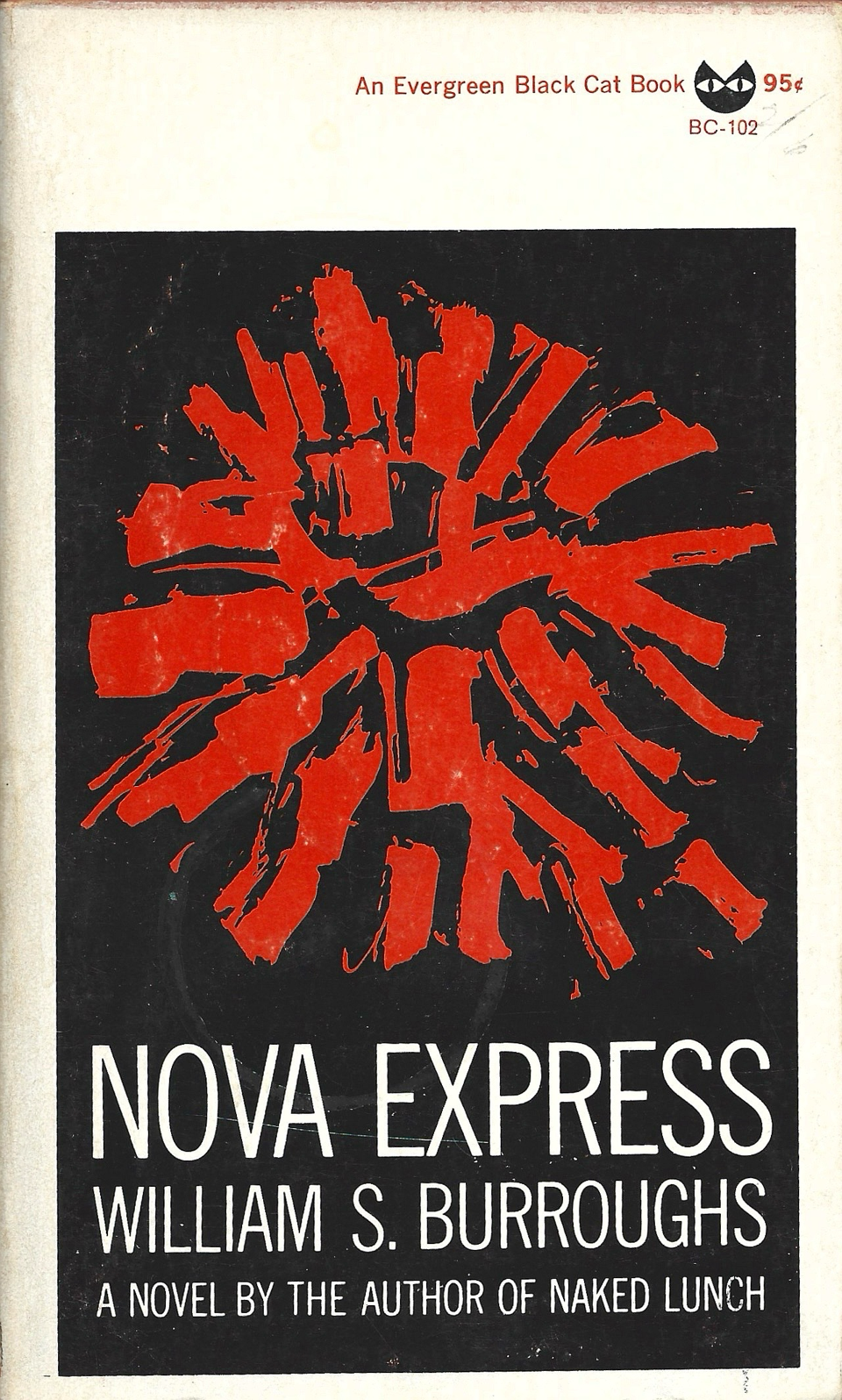
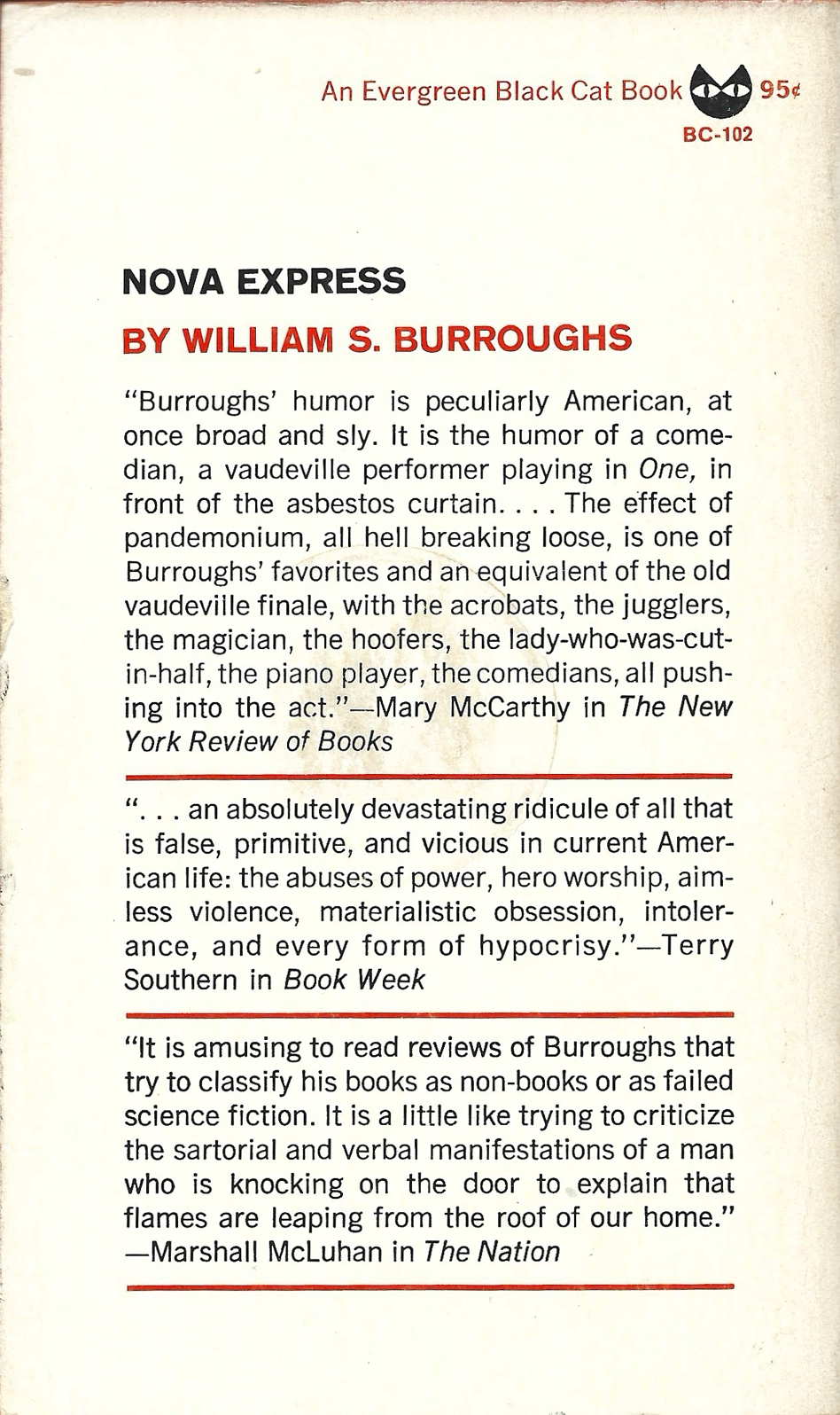
Nova Express, William S. Burroughs, 1964. Evergreen Black Cat Books (1965). 155 pages. The cover by artist Grove Press mainstay Roy Kuhlman is not credited.


I picked up this mass-market Burroughs at A Capella Books in Atlanta this weekend. We drove up on Thursday to see the American indie rock band Big Thief play at the Fox Theatre. The theater is gorgeous, its interior a lavish orientalist fantasy draped in rich reds and golds, royal blues, and warm ambers, all illuminated under a ceiling painted to resemble a twinkling night sky. The sound was pretty bad and the crowd was worse. Several groups around me talked throughout the concert, and the general vibe was soured by the crowd’s inability to pick a lane when it came to standing-or-not-standing. Big Thief started in a moody jammy mood jamming on an extended version of “No Fear” from their new album Double Infinity. They followed it up with three more songs from the new album, and while the playing was polished and strong, with plentiful harmonic textures coming from the guitars, the audience didn’t really respond in a strong way until they played two “hits” back to back — “Vampire Empire” and “Simulation Swarm.” The audience then fell into this weird rhythm of people rising to their feet like reverse dominoes when people closer to the stage decided to stand and sway to more familiar “hits,” only to sit down when Big Thief played a newer song. The jerky rhythm led to hissed arguments and then not-so-hissed arguments throughout the theater — again, the mood was really odd, and the band didn’t seem to really connect with the audience. At one point, guitarist Buck Meek said something like, “You can dance to this new one, too” — but the few people who tried eventually quit. After “Not” and “Masterpiece,” Big Thief decided to workshop a new song, stopping at one point to adjust the rhythm. Again, the reaction to this tinkering was mixed. The highlight of the show for me was a dreamy, hazy, heavy reworking of “Dragon New Warm Mountain I Believe in You” in which the band seemed to tune totally in to their sound. (I had also managed to get the guys behind me to shut the fuck up after a very tense exchange, so I could actually appreciate the sounds without their banal chomping.) The band managed to get the crowd on their feet two more times — once with “Spud Infinity” near the end of their set, and then again when the crowd called for the obligatory encore. (It’s worth noting that much of the crowd headed to the exits right away, determined to beat awful Atlanta traffic.) Big Thief then played exactly one song (“Change”) and left, signalling for the house lights to come on. I have never seen a band play only one song at an encore. Some of the people I was with had a better time than I did. The show mostly reminded me of seeing Wilco in an old theater — this was close to twenty years ago, I guess — and their failure to connect with the audience. There’s not a lot of room to boogie in those old seats. That’s not what a theater is designed for. I saw Yo La Tengo around the same time in the same theater and they absolutely understood the space they were playing in and mapped their show around it. I still have a sour taste in my mouth from the concert, but the rest of the weekend was fun–good food, good times, etc. I even dressed up for Halloween — as Bob Ferguson from One Battle After Another. It’s such an easy costume (jeans, flannel robe, black beanie, oversized sunglasses) that I thought the Beltline would be littered with other lazy dickheads with the same dickhead idea, but it wasn’t. Everyone I interacted with thought I was going for the Dude. In my review of One Battle After Another I made the bathrobe connection writing that PTA’s film plays “as a sinister inversion to The Big Lebowski. I will file the pair away for a future double feature.” Later that night, after perhaps too many okay not perhaps definitely too many libations I rewatched The Beach Bum on my laptop. That’s the triple feature — Battle, LebowskiBum.


So here’s a snippet from Nova Express, just so I won’t be accused of bait n’ switch:

 “Mr. Martin, and you board members, vulgar stupid Americans, you will regret calling in the Mayan Aztec Gods with your synthetic mushrooms. Remember we keep exact junk measure of the pain inflicted and that pain must be paid in full. Is that clear enough Mr. Intolerable Martin, or shall I make it even clearer? Allow me to introduce myself: The Mayan God Of Pain And Fear from the white hot plains of Venus which does not mean a God of vulgarity, cowardice, ugliness and stupidity. There is a cool spot on the surface of Venus three hundred degrees cooler than the surrounding area. I have held that spot against all contestants for five hundred thousand years. Now you expect to use me as your ‘errand boy’ and ‘strikebreaker’ summoned up by an IBM machine and a handful of virus crystals? How long could you hold that spot, you ‘board members’? About thirty seconds I think with all your guard dogs. And you thought to channel my energies for ‘operation total disposal’? Your ‘operations’ there or here this or that come and go and are no more. Give my name back. That name must be paid for. You have not paid. My name is not yours to use. Henceforth I think about thirty seconds is written.”
The object of art is to make the reader or viewer or listener aware of what he knows but doesn’t know that he knows | William S. Burroughs on photography

The object of art is to make the reader or viewer or listener aware of what he knows but doesn’t know that he knows … And this is doubly true of photography, because the photographer is making the viewer aware of what he is actually seeing and yet at the same time not seeing. So many people in urban environments are walking around without seeing what is in front of them, let alone what is at the margin of vision, because what they see seems to have no meaningful relationship to them as observers. It is the art of the photographer to wrest back meaning for the observer from the input of impressions. Cut, shuffle, pick a card, any card… what do we see as we walk the streets of a city? A jumble of fragments. Now, these fragments are meaningful to you because they are what you have chosen to see.

I used to have an exercise that I suggested to my students at New York City College. Walk around the block and try to keep your eyes open for a change. Now sit down and write what you have just seen with particular attention to what you were thinking when someone walked by, when you saw a certain billboard, when a car passed… and so forth.

It soon becomes apparent that these fragments are not meaningless, that they mean something very definite to you, spelling out messages, cryptic messages … Some students think they are going insane. “Everything is talking to me.” Of course it is … it always was… You are just starting to listen and see a little. (One student became convinced that I was the Anti-Christ and that voices were telling him to kill me. At this point I edged into the kitchen and sought the proximity of a potato masher.)

Another exercise I called “color walks.” Walk down a New York street and pick out all the reds-focusing on the red. Now shift to the blues, the yellows, the whites… Blue again and I know the car coming up behind me will be blue… and it is. Or you’re running out of yellow… a yellow cab comes right on cue. Just start looking and you will see. Example-I am thinking about New Mexico. Round a corner and there is a New Mexico license plate. “New Mexico, Land of Enchantment.”

Click, click, click. Catch these intersection points between your inner reality and what you are seeing, between the inner reality and the outer reality. They have a particular relevance to the observer and, if the observer is also a photographer, the intersection points give the photographs their special style. Now take a stack of photographs. We are looking for the point where inner reality and outer reality intersect.

From William S. Burroughs’s introduction to Robert Walker’s New York Inside Out, a 1984 collection of street photography. The introduction was published, along with several of Walker’s photographs, in the August 1984 issue of Popular Photography.

Weed | From William Burroughs’ novel Junky

 Tea heads are not like junkies. A junkie hands you the money, takes his junk and cuts. But tea heads don’t do things that way. They expect the peddler to light them up and sit around talking for half an hour to sell two dollars’ worth of weed. If you come right to the point, they say you are a “bring down.” In fact, a peddler should not come right out and say he is a peddler. No, he just scores for a few good “cats” and “chicks” because he is viperish. Everyone knows that he himself is the connection, but it is bad form to say so. God knows why. To me, tea heads are unfathomable.

There are a lot of trade secrets in the tea business, and tea heads guard these supposed secrets with imbecilic slyness. For example, tea must be cured, or it is green and rasps the throat. But ask a tea head how to cure weed and he will give you a sly, stupid look and come-on with some double-talk. Perhaps weed does affect the brain with constant use, or maybe tea heads are naturally silly.

The tea I had was green so I put it in a double boiler and set the boiler in the oven until the tea got the greenish-brown look it should have. This is the secret of curing tea, or at least one way to do it.

Tea heads are gregarious, they are sensitive, and they are paranoiac. If you get to be known as a “drag” or a “bring down,” you can’t do business with them. I soon found out I couldn’t get along with these characters and I was glad to find someone to take the tea off my hands at cost. I decided right then I would never push any more tea.

In 1937, weed was placed under the Harrison Narcotics Act. Narcotics authorities claim it is a habit-forming drug, that its use is injurious to mind and body, and that it causes the people who use it to commit crimes. Here are the facts: Weed is positively not habit-forming. You can smoke weed for years and you will experience no discomfort if your supply is suddenly cut off. I have seen tea heads in jail and none of them showed withdrawal symptoms. I have smoked weed myself off and on for fifteen years, and never missed it when I ran out. There is less habit to weed than there is to tobacco. Weed does not harm the general health. In fact, most users claim it gives you an appetite and acts as a tonic to the system. I do not know of any other agent that gives as definite a boot
to the appetite. I can smoke a stick of tea and enjoy a glass of California sherry and a hash house meal.

I once kicked a junk habit with weed. The second day off junk I sat down and ate a full meal. Ordinarily, I can’t eat for eight days after kicking a habit.

Weed does not inspire anyone to commit crimes. I have never seen anyone get nasty under the influence of weed. Tea heads are a sociable lot. Too sociable for my liking. I cannot understand why the people who claim weed causes crime do not follow through and demand the outlawing of alcohol. Every day, crimes are committed by drunks who would not have committed the crime sober.

There has been a lot said about the aphrodisiac effect of weed. For some reason, scientists dislike to admit that there is such a thing as an aphrodisiac, so most pharmacologists say there is “no evidence to support the popular idea that weed possesses aphrodisiac properties.” I can say definitely that weed is an aphrodisiac and that sex is more enjoyable under the influence of weed than without it. Anyone who has used good weed will verify this statement.

You hear that people go insane from using weed. There is, in fact, a form of insanity caused by excessive use of weed. The condition is characterized by ideas of reference. The weed available in the U.S. is evidently not strong enough to blow your top on and weed psychosis is rare in the States. In the Near East, it is said to be common. Weed psychosis corresponds more or less to delirium tremens and quickly disappears when the drug is withdrawn. Someone who smokes a few cigarettes a day is no more likely to go insane than a man who takes a few cocktails before dinner is likely to come down with the D.T.’s.

One thing about weed. A man under the influence of weed is completely unfit to drive a car. Weed disturbs your sense of time and consequently your sense of spatial relations. Once, in New Orleans, I had to pull over to the side of a road and wait until the weed wore off. I could not tell how far away anything was or when to turn or put on the brakes for an intersection.

From William S. Burroughs’ novel Junky.

Mid-August riff; some books acquired, etc.

The last two weeks flew by. My kids went back to school this week; they are attending the same school for the first time since elementary school, high school,my own dear mother, that school, and I am relieved, if only temporarily from driving duties. We are making pizzas in an hour or two to celebrate the first Friday of their school year (we make pizzas every Friday as a nifty fridge clearing activity, but let’s not ruin the sparkle). My own semester starts the week after next and I realize that I need to do something more with my summers now that my children are so much older than they were when they were little children, when I was with them all summer, or if I wasn’t exactly right there with them I was hovering in the background.

I am on track to read fewer novels, or books, or whatever, than I read in July of this year. I finished Mauro Javier Cárdenas’s third novel American Abductions and liked it very much, or liked the experience or feeling of reading it, whatever that means, and I owe it a proper review. In July I read Katherine Dunn’s debut novel Attic and loved it. I couldn’t find her 1971 follow-up Truck in any of the used bookstores I frequent, so I ended up listening to it on audiobook. Maybe it was the narrator’s narration but I found it disappointing, but I still appreciate its grime and its abjection and its picaresque energy. I also checked out some Stephen Dixon e-books from my library; I read a handful of fucked up stories (a piece called “The Intruder” was especially weird) before digging into his 1988 novel Garbage. I read the first half of Garbage last night and I don’t even know how to describe it—it’s sort of like wandering upon some forgotten gritty 1970s American exploitation film made by an insane but focused auteur. But it’s also very normal in a way I will not explain. It’s uncanny.

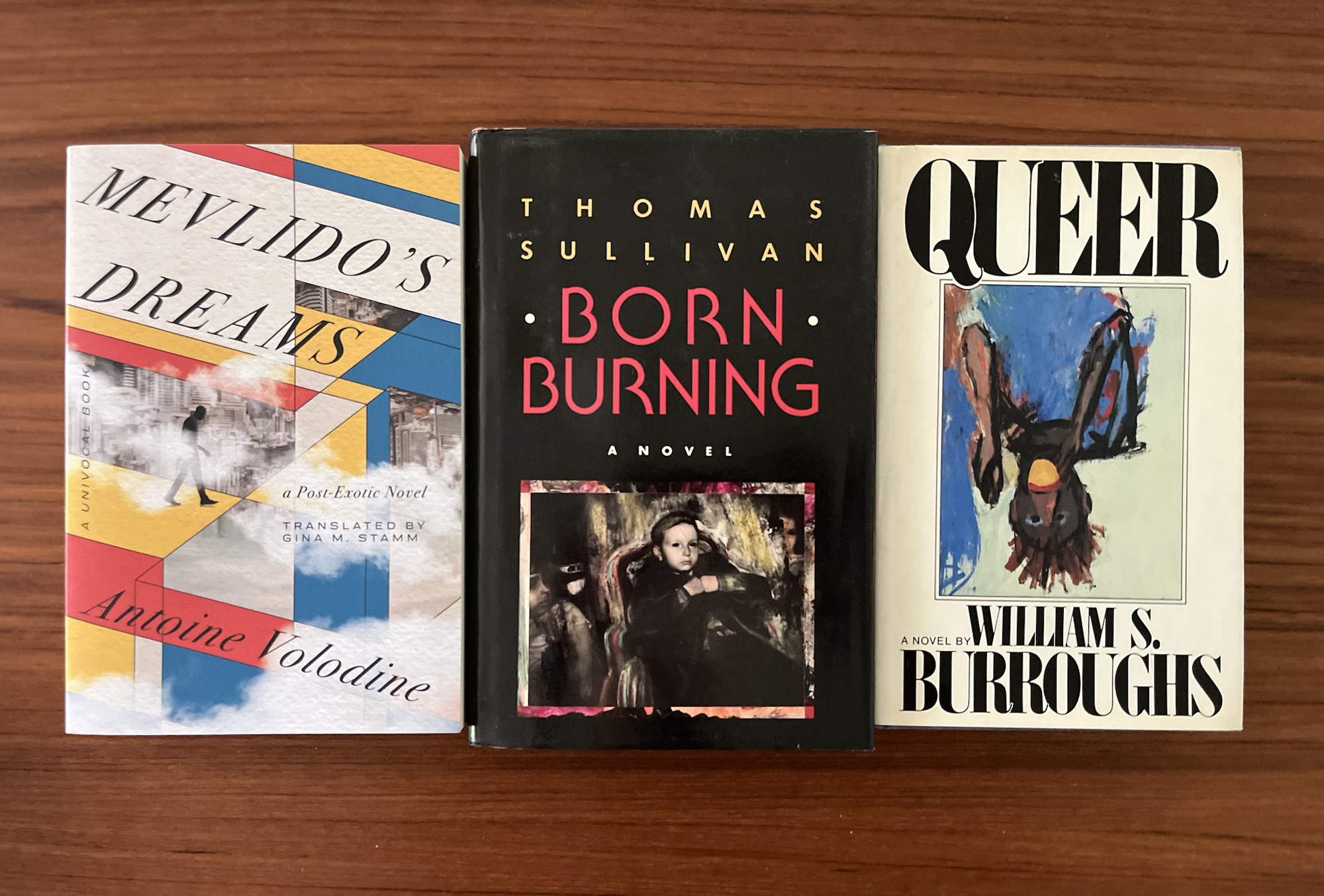
I purged about thirty paperbacks last week at my local used bookstore and ordered a copy of the latest Antoine Volodine novel, Gina M. Stamm’s translation of Mevlido’s Dreams. A recent reading of Volodine’s Radiant Terminus left me hungry for more of that sweet gross post-exotic flavor. I went to pick up the Volodine today and ended up with two hardbacks. I admit that the blurb on the back of Thomas Sullivan’s 1989 novel Born Burning sold me; it compared his previous novel to William Gaddis, John Barth, and Kurt Vonnegut. I also snapped up a first-edition hardback 1985 edition of William S. Burroughs’s novel Queer, which I fear was quite underpriced, although I don’t fear that too much. (All my sweet purged paperback credit is gone!)

I am ready for the summer to end.

Illustration from Ah Pook Is Here — Malcolm McNeill

Illustration from Ah Pook Is Here, Malcolm McNeill’s 1970s collaboration with William S. Burroughs

It takes a brave man to try and trade drug stories toe-to-toe with William Burroughs, and Cronenberg makes only a perfunctory attempt

Photography by Chris Buck and Brian Hamill; art by Nick Van Der Grinten

It’s been half a day and no one has taken a hit of anything stronger than the vodka and Coke Burroughs is nursing. These days, at seventy-seven and post-triple bypass, Burroughs is taking a break from the opiates. The conversation, however, is free to range where Burroughs no longer does.

It takes a brave man to try and trade drug stories toe-to-toe with William Burroughs, and Cronenberg makes only a perfunctory attempt. “I tried opium once, in Turkey, and there I felt like I had a hideous flu, you know? It was like I was sick.”

“You probably were! It can be very nauseating. You had just taken more than you could assimilate.”

“I did take LSD once,” Cronenberg responds. “It was a great trip. It was a very revealing experience to me, because I had intuited that what we consider to be reality is just a construct of our senses. It shows you, in no uncertain terms, that there are any number of realities that you could live, and you could change them and control them. It’s very real, the effects it left.”

Burroughs nods patronizingly, although he was more of an opiate man.

Talk then shifts to over-the-counter drugs one could abuse, which included the availability of codeine in Canada, opium cold-and-flu tablets in France, and “in England,” says Burroughs, “they used to sell Dr. Brown’s Chlorodine. It was morphine, opium, and chloroform. I used to boil out the chloroform.”

“I was chloroformed once,” says Cronenberg, “as a kid, when they took out my tonsils. I still remember what happened when they put this mask over my face. I saw rockets shooting. Streamers of flame, rockets. . . . I can still see it. And that sickly smell.” He makes a face. After discussing insects, gunshot wounds, and snake bites all day, were finally onto something that can gross out Cronenberg.

“I hate general anesthesia,” says Burroughs. “Scares the hell out me. I had to have it when they did the bypass, but I knew where I was. I knew I was in the hospital having an operation, and there was this gas coming into my face like a gray fog. When I cracked my hip, they put a pin in with a local. A spinal. Of course, it ran out and I started screaming.”

“I was in a motorcycle accident where I separated my shoulder,” says Cronenberg. “They took me into the operating room and gave me a shot of Demerol.”

“Demerol,” says Burroughs, brightening a bit. “Did it help?”

“I loved it. It was wonderful.”

“It helps. I had a shot of morphine up here somewhere,” he says, pointing to the top of his shoulder near his neck, “from my bypass operation. She said, ‘This is morphine.’ And I said, ‘Fine!’ ” Burroughs drags out the word in a sigh of bliss. He closes his eyes in an expression of rapt anticipation. “Shoot it in, my dear, shoot it in.” I ask Burroughs if the doctors and nurses at the hospital knew who he was. “Certainly,” he drawls. “The doctor wrote on my chart, ‘Give Mr. Burroughs as much morphine as he wants.’”

From “Which Is the Fly and Which Is the Human?” a 1992 profile in Esquire by Lynn Snowden. The occasion for the article is the release of Cronenberg’s film adaptation of Naked Lunch.

I’ve sat down many times and tried to write a bestseller but something always goes wrong | William S. Burroughs

BOCKRIS: Do you ever get worried that being a writer provides a pretty thin income?

BURROUGHS: It’s gotten very thin. I’ve sat down many times and tried to write a bestseller but something always goes wrong. It isn’t that I can’t bring myself to do it or that I feel I’m commercializing myself or anything like that, but it just doesn’t work. If your purpose is to make a lot of money on a book or film, there are certain rules to observe. You’re aiming for the general public, and there are all sorts of things the general public doesn’t want to see or hear. A good rule is never ask the general public to experience anything they cannot easily experience. You don’t want to scare them to death, knock them out of their seats, and above all, you don’t want to puzzle them.

From With William Burroughs: A Report from the Bunker by Victor Bockris. The selection is from Bockris’s recording of a 1978 dinner with Maurice Girodias, Gerard Malanga, and Glenn O’Brien.


This expedition to see Céline was organized in 1958 by Allen Ginsberg | William S. Burroughs

This expedition to see Céline was organized in 1958 by Allen Ginsberg who had got his address from someone. It is in Meudon, across the river from Paris proper. We finally found a bus that let us off in a shower of French transit directions: “Tout droit, Messieurs …” Walked for half a mile in this rundown suburban neighborhood, shabby villas with flaking stucco—it looked sort of like the outskirts of Los Angeles—and suddenly there’s this great cacophony of barking dogs. Big dogs, you could tell by the bark. “This must be it,” Allen said. Here’s Céline shouting at the dogs, and then he stepped into the driveway and motioned to us to come in. He seemed glad to see us and clearly we were expected. We sat down at a table in a paved courtyard behind a two-story building and his wife, who taught dancing—she had a dancing studio—brought coffee.

Céline looked exactly as you would expect him to look. He had on a dark suit, scarves and shawls wrapped around him, and the dogs, confined in a fenced-in area behind the villa, could be heard from time to time barking and howling. Allen asked if they ever killed anyone and Céline said, “Nooo. I just keep them for the noise.” Allen gave him some books, Howl and some poems by Gregory Corso and my book Junky. Céline glanced at the books without interest and laid them sort of definitively aside. Clearly he had no intention of wasting his time. He was sitting out there in Meudon. Céline thinks of himself as the greatest French writer, and no one’s paying any attention to him. So, you know, there’s somebody who wanted to come and see him. He had no conception of who we were.

Allen asked him what he thought of Beckett, Genet, Sartre, Simone de Beauvoir, Henri Michaux, just everybody he could think of. He waved this thin, blue-veined hand in dismissal: “Every year there is a new fish in the literary pond.

“It is nothing. It is nothing. It is nothing,” he said about all of them.

“Are you a good doctor?” Allen asked.

And he said: “Well … I am reasonable.”

Was he on good terms with the neighbors? Of course not.

“I take my dogs to the village because of the Jeeews. The postmaster destroys my letters. The druggist won’t fill my prescriptions.…” The barking dogs punctuated his words.

We walked right into a Céline novel. And he’s telling us what shits the Danes were. Then a story about being shipped out during the war: the ship was torpedoed and the passengers are hysterical so Céline lines them all up and gives each of them a big shot of morphine, and they all got sick and vomited all over the boat.

He waved goodbye from the driveway and the dogs were raging and jumping against the fence.

From With William Burroughs, by Victor Bockris. The speaker is, of course, Burroughs, prompted by a question from Bockris. It’s from the chapter entitled “Dinner with Nicolas Roeg, Lou Reed, Bockris-Wylie, and Gerard Malanga: New York 1978.” Roeg and Reed come off as total pricks.

Blog about some recent reading

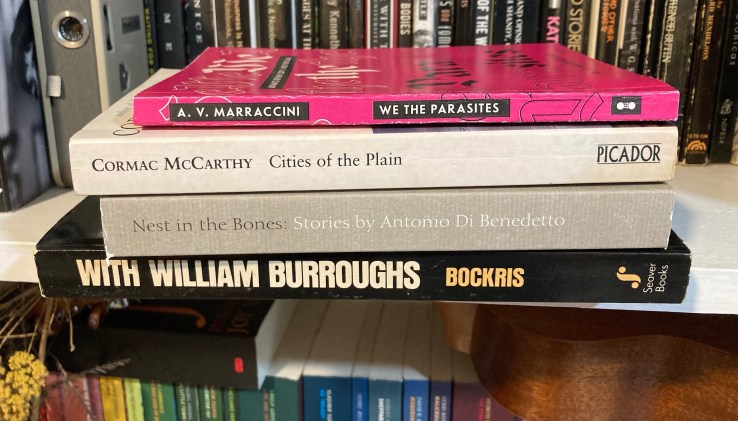
I finished A. V. Marraccini’s We the Parasites very very early Friday morning and then sneaked in two hours of sleep before a nine a.m. alarm. We the Parasites is a discursive  ekphrasis, its finest moments concentrated on Cy Twombly (and his historical painting The Age of Alexander in particular). Marraccini turns her lens also to John Updike’s novel The Centaur, Jean Genet, and pomegranates and wasps. 2020 and Covid-19 hang over the book, inverting its would-be-flânerie: It’s flânerie for silent nights, cybernights, flânerie for necessary introversion.

I’m about 100 pages into Cities of the Plain, the final book of Cormac McCarthy’s Border Trilogy. I read it maybe fifteen years ago and recall almost nothing about it other than McCarthy uniting the two heroes of the first two books, John Grady Cole and Billy Parham. So far, the novel is a far quicker read than the first two Border novels—more direct, more cinematic, less adolescent, its intensities tamped by experience. About thirty pages in, McCarthy devotes two entire pages to a description of changing a tire. It’s beautiful.

Nest in the Bones collects a career-spanning selection of Antonio Di Benedetto short stories (in translation by Martina Broner). I’ve been trying to read one or two a day. Many of the early stories are quite short, and Di Benedetto perhaps shows a bit too much debt to Kafka here, but the oddity of it all is wonderful.

It is true that William S. Burroughs was fond of dinners with famous and interesting people, and was totally fine with having a young, perhaps good looking Victor Bockris serve as a nexus and recorder for such events, events that have nothing to do with big-ell Literature. But my favorite thing here (as was the case with Allen Ginsberg’s nineties jaunt with Burroughs in the same vein, Don’t Hide the Madness), my favorite thing here is how Burroughs undercuts any pretension or redirects conversation to his own strange obsessions.

I don’t see what’s being said here at all | William S. Burroughs

BOCKRIS: William, have you ever written anything out of admiration?

BURROUGHS: I don’t know what this term means. It does seem to me an anemic emotion.

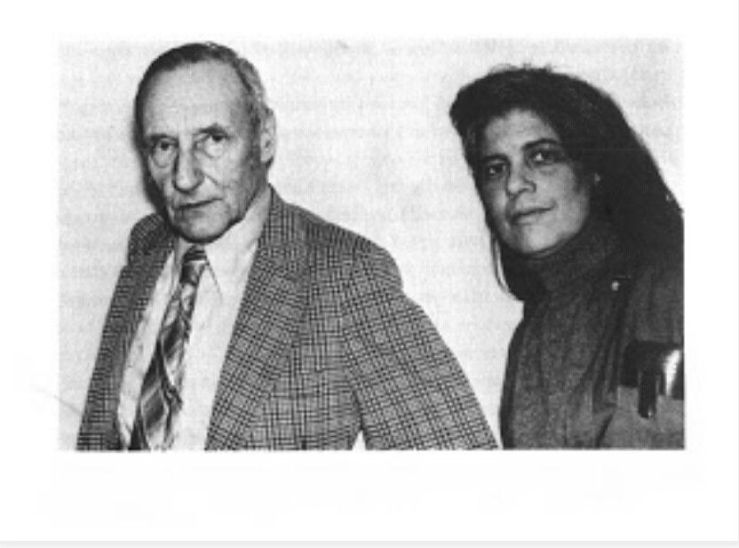
SONTAG: Bill, suppose you agreed, which maybe you couldn’t even conceive of doing, to write about Beckett. Somebody offered you a situation at which you said, yes, I’d like to say what I want to say about Beckett, and my feeling about Beckett is mainly positive. I think that’s harder to get down in a way that’s satisfactory than when you’re attacking something.

BURROUGHS: I don’t see what’s being said here at all.

From With William Burroughs: A Report from the Bunker by Victor Bockris. The selection is from Bockris’s recording of a 1980 dinner with Susan Sontag, Stewart Meyer, and Gerard Malanga.

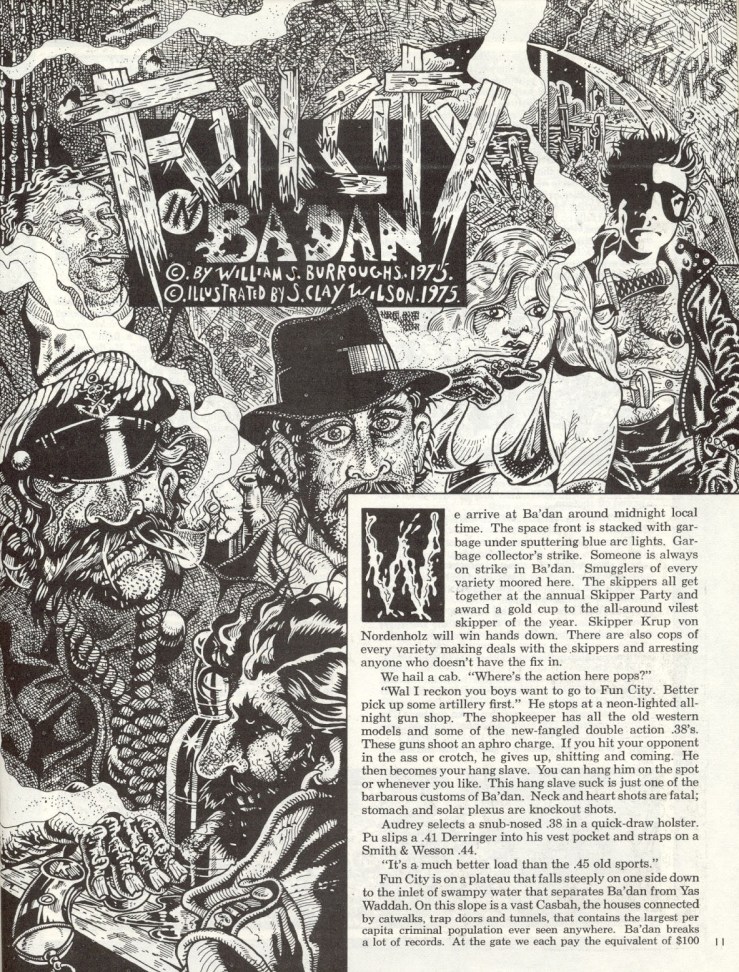
Read “Fun City in Ba’dan” by William S. Burroughs with illustrations by underground comix legend S. Clay Wilson


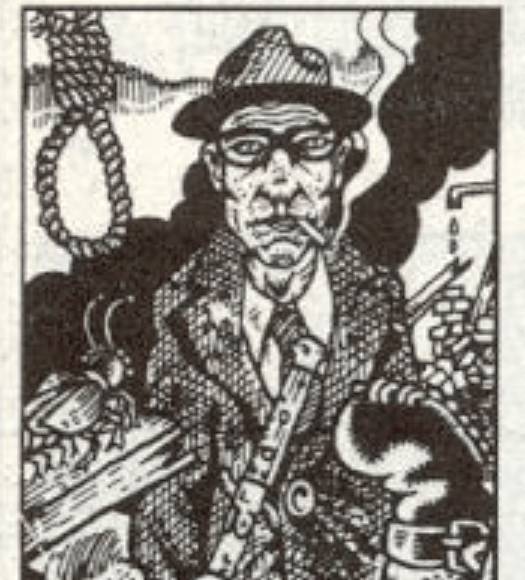
“Fun City in Ba’dan” was published in Arcade, vol. 1, no. 4 in the winter of 1975. The story is an excerpt from William S. Burroughs’ then-novel-in-progress, Cities of the Red Night and is illustrated by underground comix legend S. Clay Wilson. The front matter includes a portrait of Burroughs that doesn’t show up in the story.


The rest of the story (NSFW) is after the jump:

Continue reading “Read “Fun City in Ba’dan” by William S. Burroughs with illustrations by underground comix legend S. Clay Wilson”

Two signed William S. Burroughs novels (Books acquired, 15 Oct. 2022)

Huge huge huge thanks to my twitter friend Prabhakar Ragde for sending me his signed copies of two William S. Burroughs novels: Cities of the Red Night and Naked Lunch. Prabhakar is downsizing his book collection as he moves to Europe, abandoning, I guess, the totally-sane, rational heaven that is the U.S. of A.

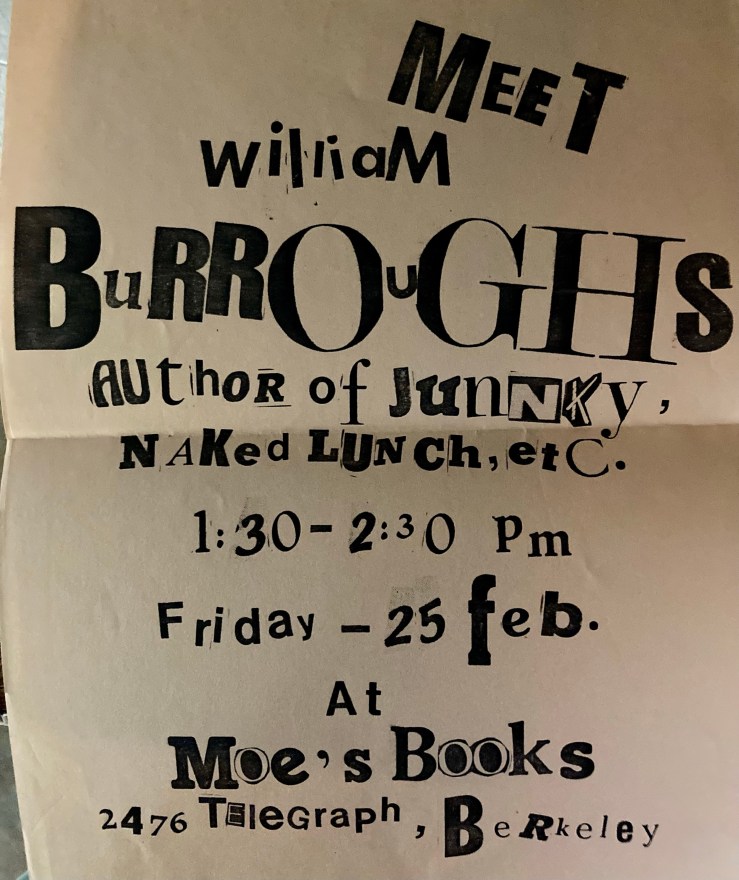
Prabhakar got the volumes signed at a 1984 in-store appearance at Moe’s Books in Berkeley. (“He asked for my name, but I told him it was too hard to spell, so it’s just his signature,” Prabhakar told me.)

Thanks again, Prabhakar!

“The Valley” — William S. Burroughs

“The Valley”

a passage from

The Western Lands

by William S. Burroughs


THE VALLEY

There is no way in or out of the Valley, which is ringed with sheer cliffs with an overhanging ledge. How did the people of the Valley get in there in the first place? No one remembers. They have been there for many years. Children have been born, grown old and died in the Valley, but not many children. Food is scarce. A stream runs through the Valley, and they have dammed up a large pond to raise fish. There is an area along the stream where they grow corn. Sometimes they kill birds, a few lizards and snakes. So most children must be killed at birth. Just an allotted number to continue the line.

Maybe, some say, they will be seen, and people will lower ropes. There is a legend that one man built a flying machine from lizard, snake and fish skins sewn to a frame of light wood. It took him all his life to build it, and he was seventy when the machine was finally finished. It looked like a gigantic dragonfly with sixty-foot wings.
Continue reading ““The Valley” — William S. Burroughs”

Joe the Dead belongs to a select breed of outlaws known as the NOs, natural outlaws dedicated to breaking the so-called natural laws of the universe | William S. Burroughs

  Joe the Dead belongs to a select breed of outlaws known as the NOs, natural outlaws dedicated to breaking the so-called natural laws of the universe foisted upon us by physicists, chemists, mathematicians, biologists and, above all, the monumental fraud of cause and effect, to be replaced by the more pregnant concept of synchronicity.

Ordinary outlaws break man-made laws. Laws against theft and murder are broken every second. You only break a natural law once. To the ordinary criminal, breaking a law is a means to an end: obtaining money, removing a source of danger or annoyance. To the NO, breaking a natural law is an end in itself: the end of that law.

Ordinary outlaws specialize their trades, in accordance with their inclinations and aptitudes—or they did at one time. Many of the old-time criminal types are endangered species now. Consider the Murphy Man. How many even know what a Murphy Man is? Your Murphy Man steers the mark to a nonexistent whore, having located an apartment building without a doorman and with the front door unlocked.

“Looking for some action, friend?”

“Well, uh, yes . . .”

The Murphy Man makes a phone call: it’s all set up. He leads the mark to the apartment building entrance.

“Go up one flight, first door on your left, 1A. Prime grade, friend, and she’s ready and waiting on you. You pay me now, so there won’t be any arguments.”

Only a black man can have the real Murphy Man voice— cool, insinuating, familiar—and the real Murphy Man face— sincere, unflappable, untrustworthy.

And practitioners of the Hype or the Bill, a short-change routine. You start by paying for a two-bit item with a twenty-dollar bill. You get the change on the counter, then you tell the clerk, “I must have been dreaming—I don’t mean to take all your small change. Here, give me ten for this” and count the ones back, minus the five. Or something like that. It’s hard to get a conviction on the Bill, because nobody can explain exactly what happened.

The basic principle can be found in a sketch by Edgar Allan Poe on nineteenth-century hustlers who were known as Diddlers. The diddler walks into a tobacco store and asks for a plug of tobacco. When the plug is on the counter, he changes his mind.

“Give me a cigar instead.” He takes the cigar and starts to walk out.

“Wait a minute. You didn’t pay for the cigar.”

“Of course not. I traded it against the tobacco plug.”

“Don’t recall you paid me for that either.”

“Paid you for it! Why, there it is! None of your tricks on traveling men.”

Unobtrusive and insistent, practitioners of the Bill are often addicts.

I wonder if there are any hype men left? Like Yellow Kid Weil and the Big Store: he would set up a prop brokerage office or bookmaking parlor and fleece his customers for several days before vanishing one night with the boodle. Also noteworthy is the sordid yachting swindle, practiced at one time by a certain well-known cult leader who shall be nameless. They’re going to buy a boat together, sail the South Seas . . . this swindle requires that mark and swindler live in the same trailer, get drunk together every night and lay the same whore. Yellow Kid Weil would have been scandalized. “Never drink with a savage,” was one of his rules.

The old-time bank robbers, the burglars who bought jewelry-store insurance inventories and knew exactly what they were looking for, the pickpockets trained from early childhood—they say the best ones come from Colombia—where are they now? The Murphy Men, the hype artists, the Big Store? Gone, all gone.

From William S. Burroughs’ last novel The Western Lands.

A hiatus of disinterest | Burroughs meets Beckett (again)

I recall a personal visit to Beckett. John Calder, my publisher and Beckett’s, was the intermediary for a short, not more than half an hour audience. This was in Berlin. Beckett was there directing one of his new plays. Allen Ginsberg, Susan Sontag and myself were there for a reading. Also present in the visiting party were Fred Jordan and Professor Hoellerer, a professor of English literature at Berlin University.

Beckett was polite and articulate. It was, however, apparent to me at least that he had not the slightest interest in any of us, nor the slightest desire to ever see any of us again. We had been warned to take our own liquor as he would proffer none. So we had brought along a bottle of whisky. Beckett accepted a small drink which he sipped throughout the visit. Asking the various participants first what Beckett said, and what the whole conversation was about seems to elicit quite different responses. Nobody seems to remember at all clearly. It was as if we had entered a hiatus of disinterest. I recall that we did talk about my son’s recent liver transplant and the rejection syndrome. I reminded Beckett of our last meeting in Maurice Girodias’ restaurant On this occasion we had argued about the cut-ups, and I had no wish to renew the argument. So it was just ‘yes’, ‘Maurice’s restaurant’. Allen, I believe, asked Beckett if he had ever given a reading of his work. Beckett said ‘No’.

There was some small talk about the apartment placed at his disposal by the Academy: a sparsely furnished duplex overlooking the Tiergarten. I said the zoo was very good, one of the best, with nocturnal creatures in dioramas, like their natural habitat. They even have flying foxes. Beckett nodded, as if willing to take my word for this. I think there was some discussion of Susan Sontag’s cancer. I looked at my watch. Some one asked Allen or Fred for the time. We got up to go. Beckett shook hands politely.

From William S. Burroughs’ essay “Beckett and Proust.” Collected in The Adding Machine. 

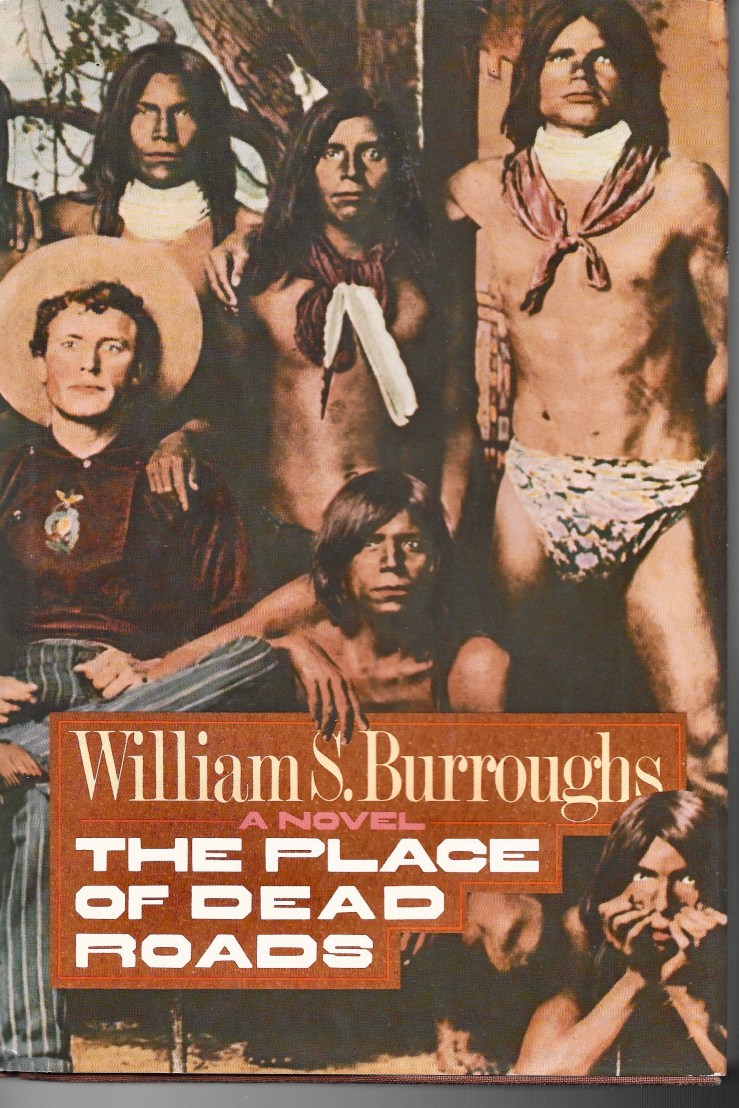
There were a number of these antivaccination cults, a self-limiting phenomenon | William S. Burroughs

Kim remembers his first adolescent experiment with biologic warfare. Smallpox was the instrument, the town of Jehovah across the river, his target. Their horrid church absolutely spoiled his sunsets, with its gilded spire sticking up like an unwanted erection, and Kim vowed he would see it leveled.

It was dead easy. The townspeople were antivaccinationists…”polluting the blood of Christ,” they called it. Around the turn of the century there were a number of these antivaccination cults, a self-limiting phenomenon since all the cultists contracted smallpox sooner or later.

So Kim simply jogged the arm of destiny, you might say, by distributing free illustrated Bibles impregnated with smallpox virus to the townspeople of Jehovah. The survivors moved out. Kim bought the land and used the church to test his homemade flamethrower. He found the plan in Boy’s Life…a weed killer, they called it. Well, rotten weeds, you know…

From The Place of Dead Roads by William S. Burroughs.

Game planet | William S. Burroughs

This is a game planet. All games are hostile and basically there is only one game, and that game is war. Research into altered states of consciousness — which might result in a viewpoint from which the game itself could be called into question — is inexorably drawn into the game. One of the rules of this game is that there cannot be final victory since that would mean the end of the war game. Every player must believe in final victory and endeavor to attain final victory with all his resources. In consequence all existing technologies are directed towards producing total weapons that could end the game by killing all players. Is there any way out of this impasse of national security at the expense of global insecurity? Certainly a prerequisite for any solution would be for all countries to put all their top secrets right on the table.

From “Mind War,” collected in The Adding Machine.