RIP Béla Tarr

RIP Béla Tarr, 1955-2026

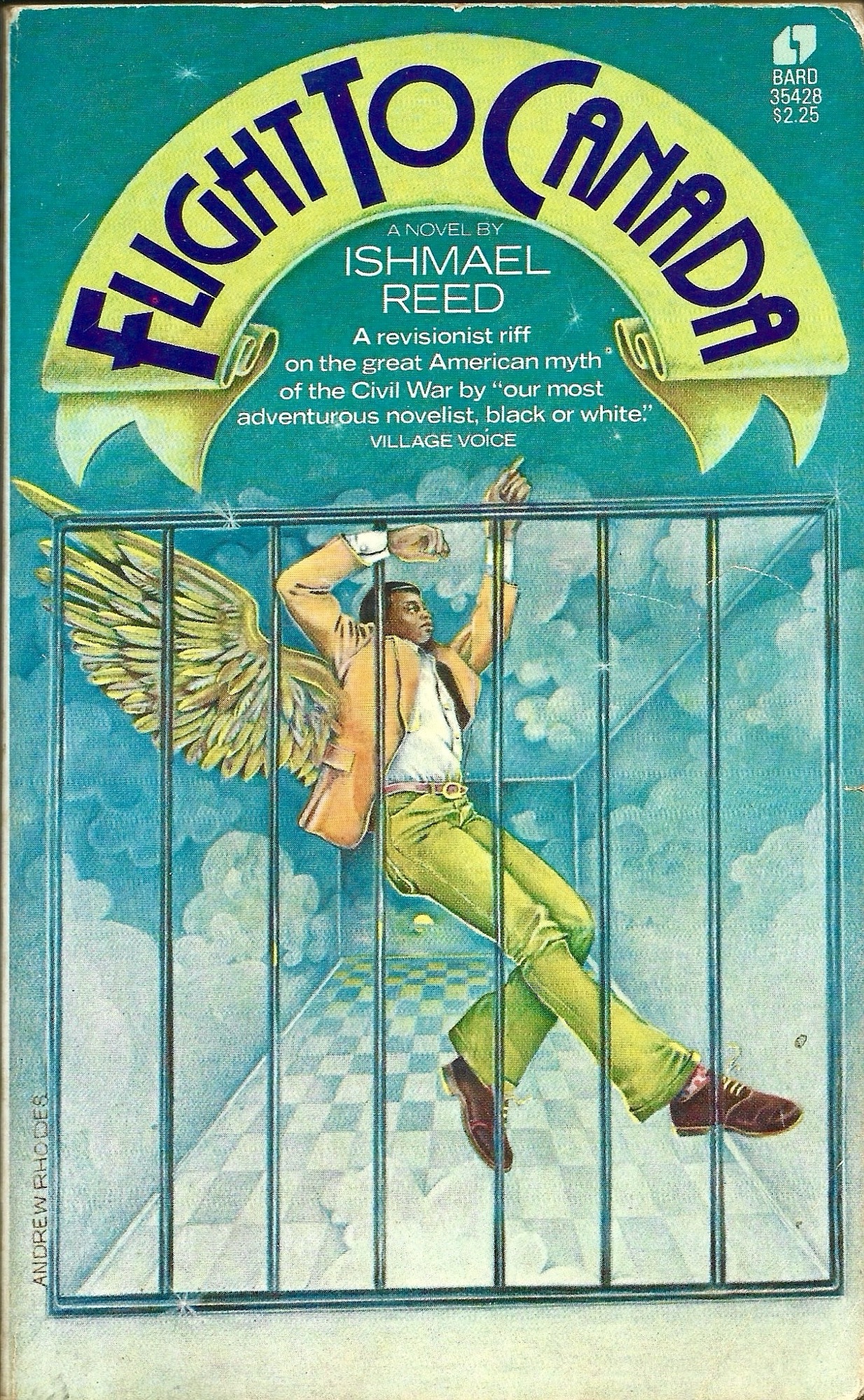
Mass-market Monday | Ishmael Reed’s Flight to Canada

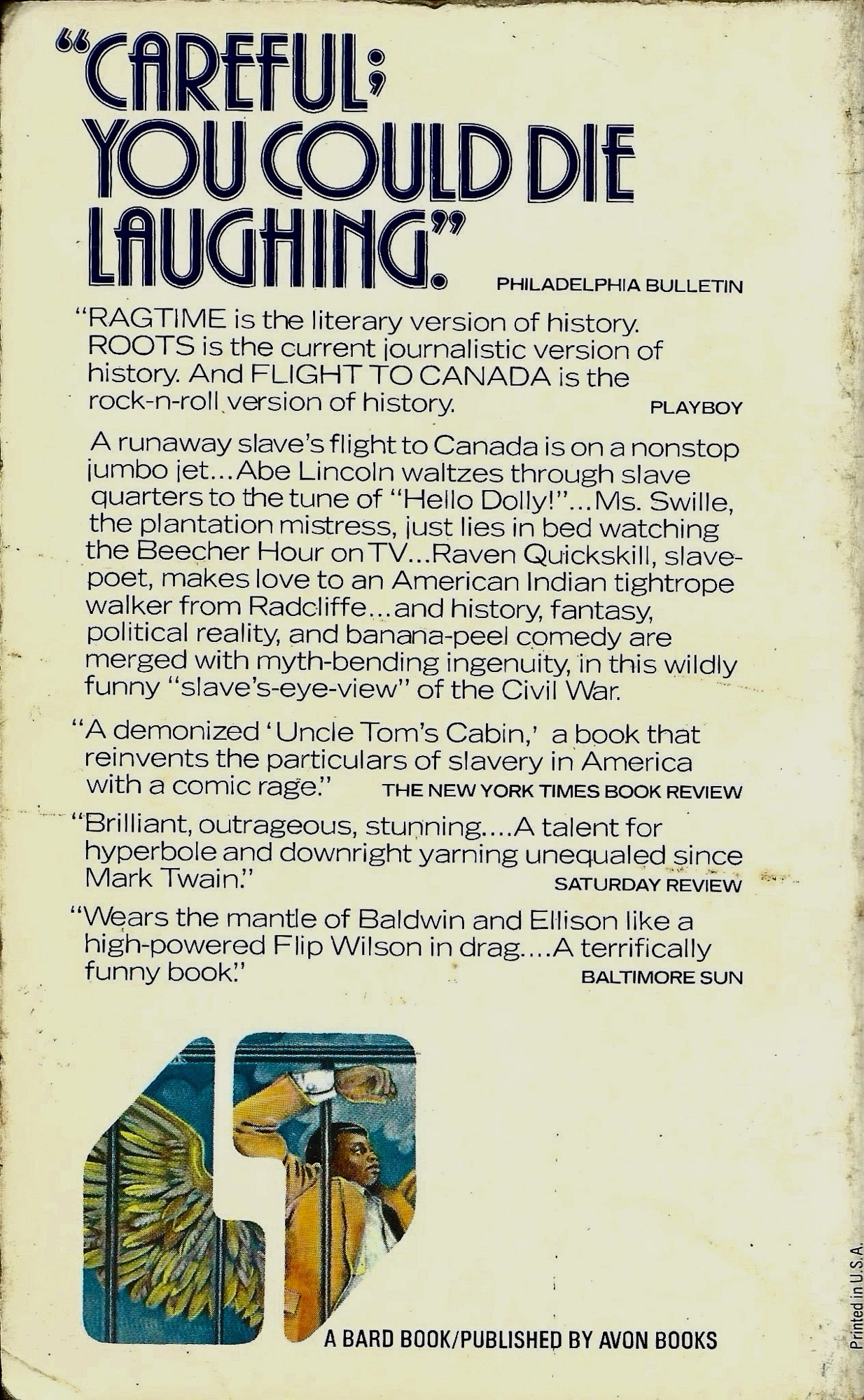
Flight to Canada, Ishmael Reed, 1976. Avon Bard Books (1977). Cover art by Andrew Rhodes; no designer credited. 192 pages.


Reed’s Flight to Canada is one of my Best Books of 1976? round up of books published fifty years ago.

From my 2020 review of the novel:

Flight to Canada features a number of intersecting plots. One of these plots follows the ostensible protagonist of the novel, former slave Raven Quickskill, who escapes the Swille plantation in Virginia. Along with two other former slaves of the Swille plantation, Quickskill makes his way far north to “Emancipation City” where he composes a poem called “Flight to Canada,” which expresses his desire to escape America completely. The aristocratic (and Sadean) Arthur Swille simply cannot let “his property run off with himself,” and sends trackers to find Quickskill and the other escapees, Emancipation Proclamation be damned. On the run from trackers, Quickskill jumps from misadventure to misadventure, eventually reconnecting his old flame, an Indian dancer named Quaw Quaw (as well as her husband, the pirate Yankee Jack). Back at Swille’s plantation Swine’rd, several plots twist around, including a visit by Old Abe Lincoln, a sadistic episode between Lady Swille and her attendant Mammy Barracuda, and the day-to-day rituals of Uncle Robin, a seemingly-compliant “Uncle Tom” figure who turns out to be Reed’s real hero in the end.

ReMass-market Monday | Ishmael Reed’s Mumbo Jumbo

Sunday Comix

From The Portable February by David Berman2009, Drag City.

Celebrate David Berman’s birthday by listening to a bootleg recording of the Silver Jews playing the Green Man Festival in Crickhowell, Wales in 2006.

Read “Orpheus the Dentist,” a very short story by Alberto Savinio

“Orpheus the Dentist”

by

Alberto Savinio

translated by Richard Pevear


I had decided to leave on Tuesday. But starting Saturday, when, in the evening, I had the supreme joy of hearing a broadcast of my radio opera Agenzia Fix on the radio, a dull pain began to occupy, at ever more frequent intervals, the upper right side of my jaw, and to spread itself through my head, like a spider its legs.

I thought: “It’s him.” He was one of my last premolars. He had already made himself felt at other times. The pain would wake up, torment me for several days, doze off again; sometimes for whole seasons, like snakes.

Teeth are cunning. His predecessors had done the same. Until, one by one, they left. Without remorse. Yet teeth are part of us. And, in some men, a very important, very “functional” part. In Woodrow Wilson, for example; in Franklin Delano Roosevelt. Yet, despite the extremely important function that teeth have had in the mouths of these two presidents of the United States, many citizens of those States have their teeth pulled, in full youth and perfect conditions of dental health, and replace them with false teeth.

“Why say false? Better to say painless. At the end of this May, the Piccolo Teatro di Milano will produce a work of mine, The Alcestis of Samuel. The one who will bring Alcestis back from Hades this time is not Hercules but Franklin Delano Roosevelt. By no means an arbitrary substitution. Perfectly justified. As I myself explain in the context, and as the audience will certainly understand, Hercules is not a singular figure, confined to the son of Alcmene. Hercules, that “purgator,” is a figure who periodically renews himself. The penultimate Hercules, in order of time, was Giuseppe Garibaldi; the latest was Franklin Delano Roosevelt. In my version of Alcestis, the part of Hercules, that is, of Roosevelt, will be played by Camillo Piloto. Piloto, at the present time, is studying the physiognomy of the President in minute particulars on photographic documents in the American Library of Rome: the form of the eyeglasses, which did not hook over the ears like mine or yours, but were pinched to the nose; and meanwhile a brave dental technician is fabricating a row of enormous teeth which, in the actor’s mouth, will imitate the famous laugh.

In 1914, in Paris, I got to know a citizen of the United States, of Mexican origin: Marius de Zayas. He had a pair of Nietzschean mustaches which, starting from under his nostrils, fell in a hairy cascade over his sharp and obstinate chin. Marius de Zayas was a theater impresario. In July 1914, he made an agreement with Apollinaire and me for a tour of lectures and concerts the following autumn to several cities of the United States, during which Apollinaire’s Breasts of Tiresias would be staged, accompanied by music written for the occasion by me. A month later the First World War broke out.

The mustaches of Marius de Zayas had not only an ornamental function but also hid his mouth, empty and black as a cave. Zayas, though he was going on thirty then and was immune to cavities, had spent some time in a clinic in New York, and had all thirty-two of his teeth removed one after the other; but, unable to bear dentures, which he abandoned in the water glasses of hotel rooms during his frequent travels, he chewed every sort of food, down to the toughest steak, with his bare gums.

In contrast to Marius de Zayas, toothless and a most robust chewer, we may cite the god Pushan, an Indian colleague of the Greek Hermes and the Latin Mercury, because Pushan, like the son of Zeus and Maia, was also a god of the roads, and not only guided men on their earthly roads, but continued to guide them on the roads of the beyond. Pushan performed his functions as a guide seated on a little cart drawn by goats, and although, unlike Zayas, his gums were armed with leonine teeth, he ate only foods soaked in water.

Two years ago I visited the convent of Saint Francis in Paola. The saint’s relics are kept in a glass case in the church. While Francis was living and working as a saint in Calabria, Louis XI, in France, was casually killing off, by means of other hands, all those who somehow got in his way, and killed so many that in the end, despite a very tough conscience, he began to feel the sting of remorse. How to heal it? The king was told that an Italian monk by the name of Francis, who lived in far-off Calabria, was a good healer of consciences, and Louis ordered that the healer come to France without delay, as today, for the same reason, they call in some famous psychoanalyst: for example, the father of that young American student who, not long ago, married the sister of the Shah of Persia, in a civil ceremony in Civitavecchia, and is now studying the Koran so as to be able to marry her religiously as well. Francis had a sister. Seeing him on the point of departure, she said to him: “You’re going so far, and you’re not leaving me anything to remember you by?” “Yes, I’m leaving you something,” replied Francis, and, so saying, he pulled out a canine tooth with two fingers and left it to his sister to remember him by. Extremely white, this canine tooth now gleams in the glass case of relics, in the church of Saint Francis in Paola. On the relations between Louis XI and Saint Francis of Paola, Casimir Delavigne wrote, as is known, a ridiculous play.

So I thought: “It’s him.” And I thought: “Until he quiets down, it’s not prudent for me to go traveling.” And that morning, instead of making my way to the station, I made my way to my dentist.

My dentist is not only an excellent odontologist; he is also a man of culture and a first-rate musician. Two years ago, at his invitation, I took myself to his house one afternoon, this time to sit not in the articulated mechanical chair in his dental office, but on a more peaceful one in his drawing room, and hear a short but pithy concert: a sonata for cello and piano by Shostakovich, some lyrics by Mahler, and a very tender Ave Maria from the hand of the master of the house, which a Spanish baritone, brown as a young bull from Triana, the school of bullfighters, sang with a velvet voice.

But my dentist is not only an excellent odontologist, and a man of culture, and a musician; he is also a kindly soul. I’ll say more: he is Orpheus. His sure hand had just finished extracting “Him” from his socket, my right cheek was numb and prickly from the effects of Novocain (the strange condition of hemiplegics, who drag half of themselves behind them, reduced to a phantasm), and he invited me to go to the drawing room with him. Sitting on the bench of his Hammond organ, still in his white coat, he pulled out a few stops, pressed on a pedal, placed his right hand on the upper keyboard, which is that of the melody, and his left on the lower one, which is that of the accompaniment, and played a Lullaby of his own composition and of an infinite tenderness; and the hateful memory of “Him” gradually vanished into the harmonious heaven of Euterpe.

Best Books of 1976?

Previously:

Best Books of 1972?

Best Books of 1973?

Best Books of 1974?

Best Books of 1975?

Not-really-the-rules recap:

I will focus primarily on novels here, or books of a novelistic/artistic scope.

I will include books published in English in 1976, including translations published in English for the first time.


The New York Times Best Seller list for fiction in 1976 was dominated by Agatha Christie, Gore Vidal, and Leon Uris. Christie’s 1975 novel Curtain ruled winter and early spring, with her posthumous 1976 novel Sleeping Murder topping the charts in November and December. Vidal’s historical novel 1876 and Uris’s Trinity split the rest of the year. While Alex Haley’s Roots topped the nonfiction Best Seller list for only a few weeks in 1976, it’s the bestseller title of the year with the most cultural staying power. Bob Woodward and Carl Bernstein’s The Final Days, their follow up to 1974’s All the President’s Men was a bestseller in the spring and summer (and one of many, many Watergate books of this era). Gail Sheehy’s “road map to adult life” Passages was popular in the fall.

But sales charts ain’t literature.

Better to regard the New York Times Book Review’s end-of-year round up, “1976: A Selection of Noteworthy Titles.” It begins with a heavy dose of literary biographies, memoirs, autobiographies, and collections of letters. These include Christopher Isherwood’s Christopher and His KindLucille Clifton’s memoir Generations, Patrick McCarthy’s bio Celine, Charles Higham’s The Adventures of Conan Doyle, and Lillian Hellman’s third memoir Scoundrel Time. 

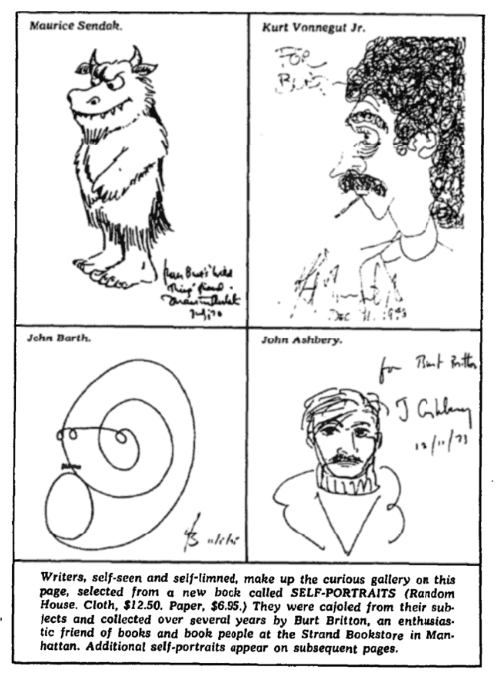
Also of note in the NYT list are Ron Kovic’s Born on the Fourth of JulyMaxine Hong Kingston’s The Woman Warrior, and Britt Britton’s collection of author Self-Portraits (the article is peppered with some of the portraits).

The Book Review piece also notes collections of letters by Sylvia Plath, E.B. White, and Virginia Woolf, as well as more diaries of Anaïs Nin. There are multiple memoirs of Hemingway (one by his son and one by his last wife) and David Heyman’s Ezra Pound biography. The list of literary bios and memoirs conveys the beginnings of a strange autopsy of the Modernist past giving way to something new.

Here are some of the fiction titles the New York Times Book Review includes in its “Selection of Noteworthy Titles” that I thought more noteworthy than other titles included:

The Acts of King Arthur and His Noble Knights, John Steinbeck

The Autumn of the Patriarch Gabriel García Márquez (trans. Gregory Rabassa)

The Easter Parade, Richard Yates

Flight to Canada, Ishmael Reed

The Franchiser, Stanley Elkin

Lady Oracle, Margaret Atwood

Lucinella, Lore Segal

Meridian, Alice Walker

Ratner’s Star, Don DeLillo

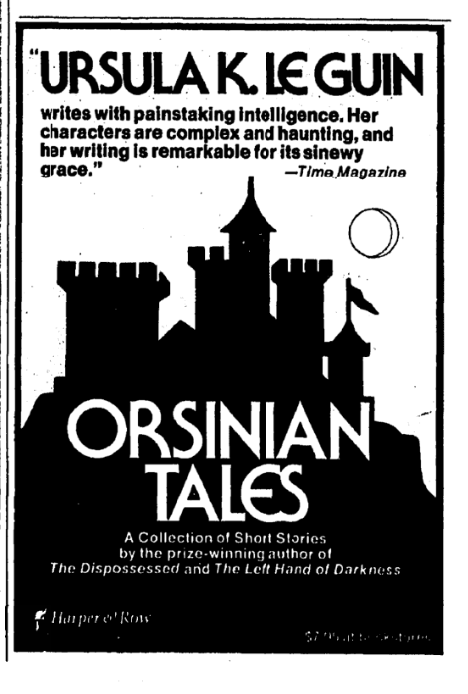
Orsinian Tales, Ursula K. Le Guin

Slapstick, Kurt Vonnegut

Speedboat, Renata Adler

The Takeover, Muriel Spark

Travesty, John Hawkes

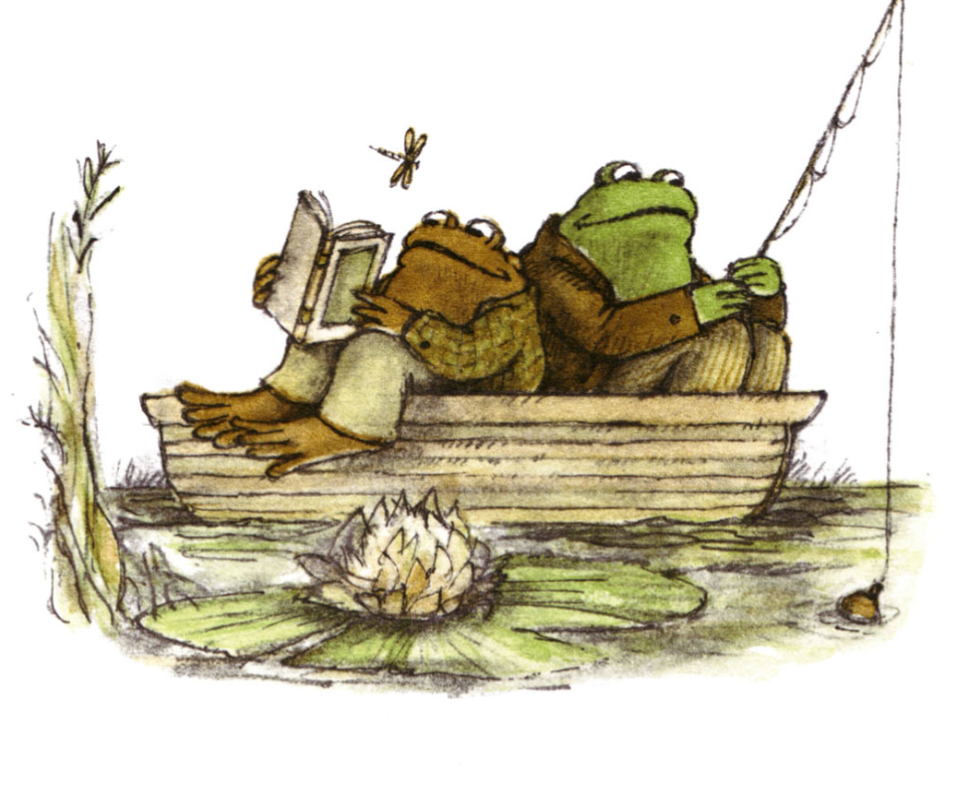
Frog and Toad All Year, Arnold Lobel

Children of Dune, Frank Herbert

The Fifth Head of Cerberus, Gene Wolfe

Triton, Samuel R. Delany

I’ll do some more with that list in a second. But for now–

One of the best sections of the NYT Book Review’s year-end recap is “Author’s Authors,” in which they ask various writers to pick their three favorite reads of 1976. John Cheever picks John Updike’s Picked Up Pieces (1975). Bernard Malamud picks García Márquez’s The Autumn of the Patriarch. Vladimir Nabokov, always humble selects his own manuscript for The Original of Laura (it remained unpublished until 2009).

William H. Gass selects buddies William Gaddis (J R, 1975) and Stanley Elkin (The Franchiser); I’ll pick up Craig Nova’s 1975 novel The Geek on his recommendation. I’ll also be on the look out for one of Ishmael Reed’s recommendations: Dangerous Music (1975) by Jessica Tarahata Hagedorn. He also recommends one of the many, many Watergate books of the era, Blind Ambition by John Dean and Shouting! by Joyce Carol ThomasAs far as I can tell, Shouting! wasn’t published until 2007.

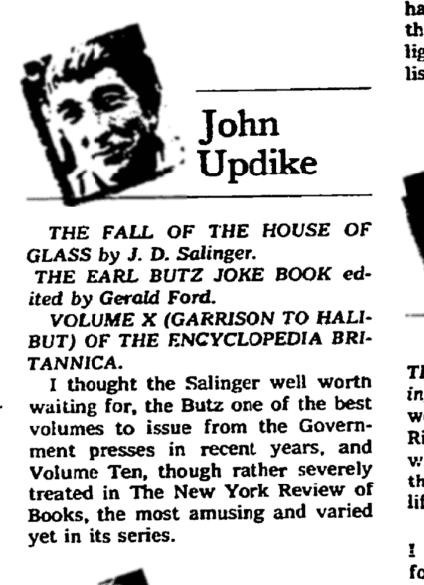
By far the best entry belongs to John Updike though:

John Updike THE FALL OF THE HOUSE OF GLASS by J.D. Salinger THE EARL BUTZ JOKE BOOK edited by Gerald Ford VOLUME X (GARRISON TO HALIBUT) OF THE ENCYCLOPEDIA BRITTANICA. I thought the Salinger well worth waiting for, the Butz one of the best volumes to issue from the Government presses in recent years, and Volume Ten, though rather severely treated in the New York Review of Books, the most amusing and varied yet in its series.

Shitposting in the Times in the late seventies. Gotta love it.

In her “Author’s Authors” write up, the novelist Lois Gold makes the only mention of Anne Rice’s Interview with the Vampire in the NYTBR piece. Rice’s seminal postmodernist vampire romance currently sits at #1 on Goodreads list of most popular books published in 1976, a testament to its populist staying power. Other notable books on the Goodreads list that were absent from the lofty NTYBR’s contemporary coverage include Tom Robbins’ Even Cowgirls Get the BluesMarge Piercy’s Woman on the Edge of TimeMichael Crichton’s Eaters of the DeadDavid Seltzer’s The OmenRaymond Carver’s Will You Please Be Quiet, Please?, Marian Engel’s BearOctavia Butler’s PatternmasterHarry Crews’ A Feast of SnakesHubert Selby Jr.’s The Demon, Richard Brautigan’s Sombrero FalloutKingsley Amis’s The Alteration, and many, many more. I’ll do more with that list momentarily, but next —

–prizes!

Saul Bellow won both the 1976 Nobel Prize in Literature (“for the human understanding and subtle analysis of contemporary culture that are combined in his work”) and the 1976 Pulitzer Prize for Fiction, specifically for his 1975 novel Humboldt’s Gift.

David Saville’s novel Saville was awarded the 1976 Booker Prize. The shortlist consisted of An Instant in the Wind by André Brink, Rising by R. C. Hutchinson, The Doctor’s Wife by Brian Moore, King Fisher Lives by Julian Rathbone, and The Children of Dynmouth by William Trevor. 

The 1977 National Book Award winner for fiction was Wallace Stegner’s The Spectator Bird. Runners-up were Will You Please Be Quiet, Please? by Raymond Carver, Orsinian Tales by Ursula K. Le Guin, The Balloonist by MacDonald Harris, and A Fine Romance by Cynthia Propper Seton. 

The 1976 National Book Critics Circle award for best fiction went to John Gardner’s October LightFinalists were Renata Adler’s Speedboat, Valdimir Nabokov’s Details of a Sunset and Other Stories, Cynthia Ozick’s Bloodshed and Three Novellas, and The Easter Parade by Richard Yates. Haley’s Roots was runner up to Maxine Hong Kingston’s The Woman Warrior. 

The Nebula Awards for fiction published in 1976 gave first place to Inferno by Larry Niven and Jerry Pournelle. Notable finalists included Marta Randall’s Islands, Delany’s Triton and Where Late the Sweet Birds Sang by Kate Wilhelm.

I have read many but hardly all the books mentioned in this post. But this is my blog, so here are my picks for the best books of 1976:

The Autumn of the Patriarch, Gabriel García Márquez (trans. Gregory Rabassa)

Bear, Marian Engel 

A Feast of Snakes, Harry Crews

Flight to Canada, Ishmael Reed

The Franchiser, Stanley Elkin

Orsinian Tales, Ursula K. Le Guin

Lucinella, Lore Segal

Ratner’s Star, Don DeLillo

Slapstick, Kurt Vonnegut

Speedboat, Renata Adler

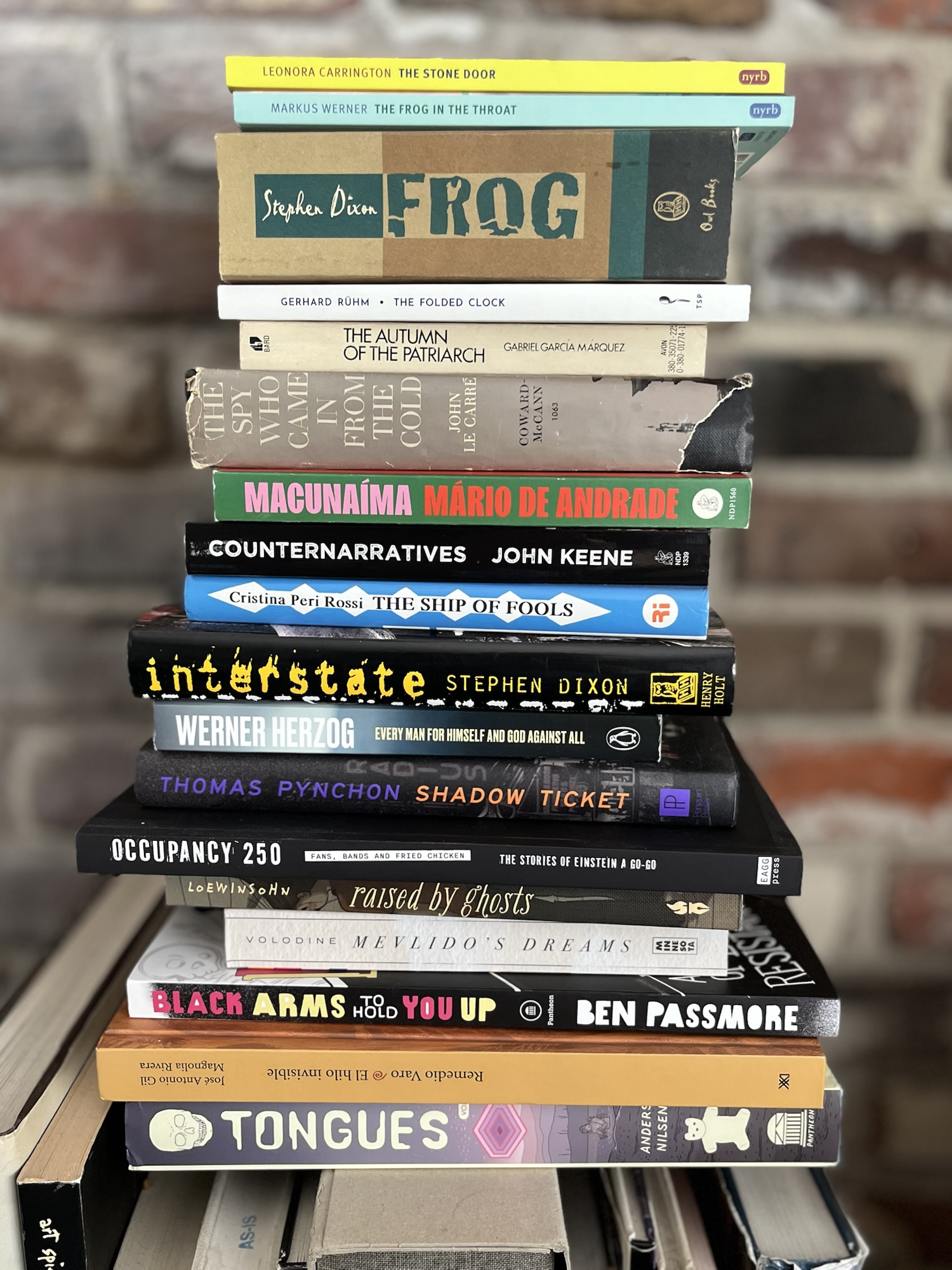
A few sentences on every book I read or reread in 2025

☉ indicates a reread.

☆ indicates an outstanding read.

In some cases, I’ve self-plagiarized some descriptions and evaluations from my social media and blog posts.

I have not included books that I did not finish or abandoned.


Every Man for Himself and God Against All, Werner Herzog☆

I got a paperback copy of Herzog’s memoir for Christmas last year but ended up listening to him read the audiobook on my commute for a week or two. Every Man for Himself was one of four memoirs as-read-by-the-author I listened to this year. The other three: The Friedkin Connection by William Friedkin; The Harder I Fight the More I Love You by Neko Case; Rumors of My Demise by Evan Dando. I enjoyed all four memoirs and maybe as I go through this post I’ll pull a few common threads. Herzog’s memoir is bonkers, better than fiction. It really is one of those deals where a paragraph starts one way and a few sentences later you’re in a totally different place.

Dispatches from the District Committee, Vladimir Sorokov (translation by Max Lawton; illustrations by Gregory Klassen)

An absolutely vile book. I loved it.

Raised by Ghosts, Briana Loewinsohn

Loewinsohn’s love letter to the latchkey nineties hit me hard. I reviewed it here.

Nazi Literature in the Americas, Roberto Bolaño (translation by Chris Andrews)☉

I think I was trying to get through the beginning of a novel by an “alt” midlist author when I realized I’d rather read something I loved. Or maybe there was something else in the air in late January. The notes on the draft for this post are cryptic.

Feminine Wiles, Jane Bowles

A slim lil guy, a nice reprieve from current events in January, a reminder that sanity is precarious.

Interstate, Stephen Dixon☆

From my review: “It upset me deeply, reading Stephen Dixon’s 1995 novel Interstate. It fucked me up a little bit, and then a little bit more, addicted to reading it as I was over two weeks in a new year.”

Remedios Varo: El hilo invisible, Jose Antonio Gil and Magnolia Rivera

A lot of Varo’s pictures, but also a lot of Spanish. I was trying hard at the time (to read Spanish). I used my iPhone to translate a lot.

Borgia, Alejandro Jodorowsky and Milo Manara 

Indian Summer, Milo Manara and Hugo Platt

CaravaggioMilo Manara

A nice little run there, I seem to recall. Borgia was the best.

Occupancy 250: The Stories of Einstein A Go-Go

The Einstein A Go-Go was an all-ages music club at Jacksonville Beach that was a massive part of my teenage years. I saw so many amazing bands there over four or five years (including Luna, Thinking Fellers Union Local 282, Man or Astroman, Sebadoh, Polvo, Superchunk, Archers of Loaf, and so many more), met so many cool people, and even played there with my band a time or two or five. And if I was too late (that is, too young) to see acts like Nirvana, The Replacements, 10,000 Maniacs, The Cranberries, and Soundgarden there at the the end of the eighties and beginning of the nineties, it feels pretty swell to see my band’s name on the back of Occupancy 250 right there in the mix, as well as flyers and photos. Occupancy 250 is like the yearbook we never got when the club had to shut its doors in ’97 in the name of beachfront development. What a gift it was. A few months ago we went to a reunion event, featuring bands like The Cadets and Emperor X. I’ve never been to a high school reunion, but I know that this was better.

Autumn of the Patriarch, Gabriel García Márquez (translation by Gregory Rabassa)☆

Loved it. A discussion with a colleague after, a Spanish instructor, led to my reading Cela, Peri Rossi, and Rulfo.

The Hive, Camilo José Cela (translation by Anthony Kerrigan)

Pascual Duarte, Camilo José Cela (translation by Anthony Kerrigan)

I liked them both but liked Pascal Duarte more than La colmena. I would love to read Cela’s 1988 novel Cristo versus Arizona if I could get my pink little hands on an English-language copy.

The Friedkin Connection, William Friedkin☆

I think that Spotfiy suggested that I listen to Friedkin’s memoir after I finished the Herzog memory; in any case, there was a lot of overlap. Like Herzog, Friedkin had no idea how to make a film and never really developed a baseline beyond, Doing the thing for real and filming it, whatever the thing was. Going to make a film where a criminal is going to counterfeit US currency? Better teach Willem Dafoe how to, I don’t know, counterfeit money and just film that instead of, like, getting a props department involved. (Weird overlap: both Friedkin and Herzog laud Michael Shannon as the greatest actor of his generation.)

I loved this memoir. It starts, if I recall correctly, with Friedkin admitting that he threw away a sketch by Basquiat and an offer from Prince. It ends with Friedkin telling his wife, legendary producer Sherry Lansing, to pass on Forrest Gump. Amazing stuff.

The Ship of Fools, Cristina Peri Rossi (translation by Psiche Hughes)☆ 

I loved it.

Monsieur Teste, Paul Valéry (translation by Charlotte Mandell) 

I hated it.

Pedro Páramo, Juan Rulfo (translation by Douglas J. Weatherford

I liked it!

Blood Meridian, Cormac McCarthy☉ 

I guess I fall into rereading this all the time.

Tongues, Anders Nilsen☆ 

screenshot-2018-08-31-at-4-34-20-pm

Amazing stuff.

Day of the Triffids, John Wyndham

I probably would’ve read Day of the Triffids a dozen times as a kid instead of, like, Joan D. Vinge’s novelization of Mad Max Beyond Thunderdome, if there had been a copy in the lending library in Tabubil. Anyway, I’m glad I got to it when I did.

Frog, Stephen Dixon☆ 

Above, I wrote I have not included books that I did not finish or abandoned; look, I didn’t finish Frog, but in some ways it’s the most important book — or rather, most important, reading experience — for me this year.

An old great friend mailed me his copy back in March. I read and loved a hefty chunk of Frog, a long book, but abandoned it when another great old friend died unexpectedly in early May. I was deep into it but there was no comfort in it, in Frog.

And so then well I just read or reread a bunch of John le Carré novels.

Call for the Dead, John le Carré

A Murder of Quality, John le Carré☆ 

The Spy Who Came in from the Cold, John le Carré

The Looking Glass War, John le Carré

Tinker Tailor Soldier Spy, John le Carré☉☆ 

Was a blur, thank you to Mr. Le Carré’s ghost. A Murder of Quality was my favorite (I think). (I was a fucking mess and these books really helped me.)

The Woman with Fifty Faces: Maria Lani and the Greatest Art Heist That Never Was, by Jon Lackman and Zack Pinson.☆ 

I read it all in one sitting. Loved it.

The Bus 3, Paul Kirchner

I reviewed it here.

Portalmania, Debbie Urbanski

In my review, I wrote that, “Debbie Urbanski’s new collection Portalmania is a metatextual tangle of science fiction, fantasy, and horror where portals don’t offer escape so much as expose the fractures beneath family, love, and identity.”

Dreamsnake, Voya McIntrye

I liked it!

The Stone Door, Leonore Carrington

Wrestled with this dude a lot and it beat me. I thought it would twist one way and it did another thing. Ended up reading it twice in the summer and I guess I’ll read it again.

The Great Mortality, John Kelly

Kelly’s Black Death chronicle was a comfort read this summer.

Figures Crossing the Field Towards the Group, Rebecca Grandsen

Skip my review of Grandsen’ poetic post-apocalyptic miniature epic and just buy it and read it.

Macunaíma, Mário de Andrade (translation by Katrina Dodson)☆ 

I am so glad my guy at the bookstore sold me on this one. A synthesis of Brazilian folklore with high and low modernism (eh, Modernism?).

The Sense of an Ending, Julian Barnes

A corny book a colleague recommended. I’m happy that someone I know IRL wants me to read a book and talk about it with them.

Unkempt Thoughts, translation by Jacek Galazka (translation by Jacek Galazka)

More Unkempt Thoughts Stanislaw J. Lec (translation by Jacek Galazka)

Aphorisms.

The Frog in the Throat, Markus Werner (translation by Michael Hofmann)☆ 

I gave the guy who gave me the Julian Barnes this novel; he didn’t like it!

I loved it. In my review of The Frog in the Throat. I noted that “you could throw a small dart in this short book and find a nice line” its protagonist. I included a lot of those pithy gems in the review if you want a sample.

Counternarratives, John Keene☆ 

Amazing stuff. I was halfway through when I realized that Keene wrote the intro to my edition of Mário de Andrade’s Macunaíma. My favorite piece in the collection reads like a riff on Melville’s Benito Cereno with strong Gothic undertones.

Mevlido’s Dreams, Antoine Volodine (translation by Gina M. Stamm)☆ 

A bleak, dystopian noir novel set several centuries in a ruined city-state wherein Mevlido’s fragmented consciousness becomes a vessel for Volodine’s haunting post-exotic vision of history, language, and apocalypse. Loved it! My review.

Shadow Ticket, Thomas Pynchon☆ 

The highlight of 2025 in reading was a new late Pynchon novel. It might not have been the best novel I read this year, but it was my favorite reading experience. I ended up reading it twice, running a series of posts I called Notes on Thomas Pynchon’s novel Shadow Ticket. At the end of those notes, I wrote:

“I should probably distill my thoughts on Shadow Ticket into a compact, “proper” review, but I’ve sat with the novel now for two months, reading it twice, and really, really enjoying it. I never expected to get another Pynchon novel; it’s a gift. I loved its goofy Gothicism; I loved its noir-as-red-herring-genre-swap conceit; I loved even its worst puns (even “sofa so good”). I loved that Pynchon loves these characters, even the ones he might not have had the time or energy to fully flesh out — this is a book that, breezy as it reads, feels like a denser, thicker affair. And even if he gives us doom on the horizon in the impending horrors of genocide and atomic death, Pynchon ends with the hopeful image of two kids chasing sunsets. Great stuff.”

Black Arms to Hold You Up, Ben Passmore

Sports Is Hell, Ben Passmore

Subtitled A History of Black Resistance, Passmore’s comic is more fun than you would think a book about fighting a racist state should be. I still owe it a proper review. It made me go back and read Passmore’s Sports Is Hell, which is kinda like the NFL x Walter Hill’s The Warriors x George Herriman’s Krazy Kat.

The Harder I Fight the More I Love You, Neko Case

Of the four memoirs I listened to this year, musician Neko Case’s is the most artfully written, packing in bursts of sensory images that pivot cannily to evoke very specific memories that connect the reader to the storyteller. The memoir is heavy on Case’s childhood and adolescence and purposefully avoids a direct accounting of her musical career. That’s not to say there isn’t a lot about music in here — there is (life on the road, songwriting, a nice section on her tenor guitar) — but Case seems to avoid going into too much detail about interpersonal relationships with other musicians. She also seems to want to apologize for some past behaviors, but the apologetic language is indirect and even cagey (Evan Dando’s memoir is a massive contrast here — the dude dishes deep, but is also frank and clear and specific about all the bad mean shit he did to people when he was younger).

Neko Case’s magnificent singing voice translates well to reading her memoir. She’s really good at reading it — expressive without being hammy, subtle, artful. I would love to hear her read other audiobooks, but I’m also happy for her to keep her focus on making music and playing live.

The King in Yellow, Robert Chambers☉

I played this silly fun indie game called The Baby in Yellow which led me to reread The King in the Yellow for the first time since I went nuts over True Detective (the first season). The first two stories were much stronger than I remembered — much weirder.

Acid Temple Ball, Mary Sativa

A Satyr’s Romance, Barry N. Malzberg

Flesh and BloodAnna Winter

I spent some of the year browsing through a copy of the Maurice Girodias edited volume The Olympia Reader. That edition offers excerpts from Olympia Press’s more “respectable” authors, like William Burroughs, Chester Himes, Henry Miller, Jean Genet etc. I downloaded a bunch of trashier Olympia titles and ended up reading these three. They were all pretty bad but also fun. Acid Temple Ball is like a sex-positive Go Ask Alice; both A Satyr’s Romance and Flesh and Blood are well-beyond “problematic” in their depictions of sexual relationships.

The Pisstown Chaos, David Ohle☆ 

In my golden-hued review, I called The Pisstown Chaos “a foul, abject, hilarious, zany vaudeville act, a satire of post-apocalyptic literature, an extended riff on American hucksterism. It’s very funny and will make most readers queasy.”

The Changeling, Joy Williams

Joy Williams is one of my favorite writers, but I’ll admit I was disappointed in her second novel, 1978’s The Changeling. I loved how dark and weird and oppressive it was, but soon tired of spending time in the rattled consciousness of its alcoholic hero, Pearl. When Williams explores beyond Pearl, the novel hints at weird Gothic cult island shit that is super-intriguing — but we always have to retreat back to our depressed, insane hero.

The Folded Clock, Gerhard Rühm (translation by Alexander Booth)

A collection of “number poems, comprising typewriter ideograms, typed concrete poetry, collages of everyday paper ephemera and scraps, and a wide variety of literary forms where the visual pattern created on the page underpins the thematic meaning,” as publisher Twisted Spoon puts it. A fascinating and frustrating read that hearkens back to the good ole days of the avant garde.

Rumors of My Demise, Evan Dando

In a review at the Guardian of Evan Dando’s memoir Rumors of My Demise, Alexis Petridis writes that the Lemonheads leader “sounds insufferable, but weirdly, he doesn’t come across that way.” Dando doesn’t try to deny, deflect, or otherwise shade his life. He’s upfront about his privileged background, his good looks, and his love of the rock star lifestyle. He’s also, as he always was, very upfront about the drugs. I was in eighth grade when It’s a Shame about Ray came out. I loved it. I loved the follow up album, Come on Feel the Lemonheads even more. I am, I suppose, the target audience for this book, and I found it very satisfying. I also think listening to Dando read it is really remarkable. He’s charming and affable, but he doesn’t seem comfortable reading out loud (you can hear it, for example, in an awkward pause when he has to change the page during the middle of a sentence). It’s also remarkably honest, and culminates in a series of apologies to many of the people he’d hurt when he was younger (“If I could go back in time and give a bit of advice to myself, I’d say ‘Evan, don’t be such a dick.’”)

My best friend Nick, who died this May, was a bigger Lemonheads fan than I was. I think he would have loved Rumors of My Demise and I thought about him all the time while I was listening to it, wanting to text him, Hey, you’re gonna love this story about Dando drinking Fanta Orange and Absolut with Keith Richards or, Man, Dando really has a score to settle with Courtney Love, or Dando’s some kind of disaster magnet — he lived right by the Twin Towers and was home on 9/11, he was in L.A. during the King riots, in Paris when Diana died, on Martha’s Vineyard when JFK Jr. crashed…or, Man, Dando seems to have finally quit heroin, good for him. I didn’t get to text those things so I’m writing them here.

Happy New Year to you and yours.
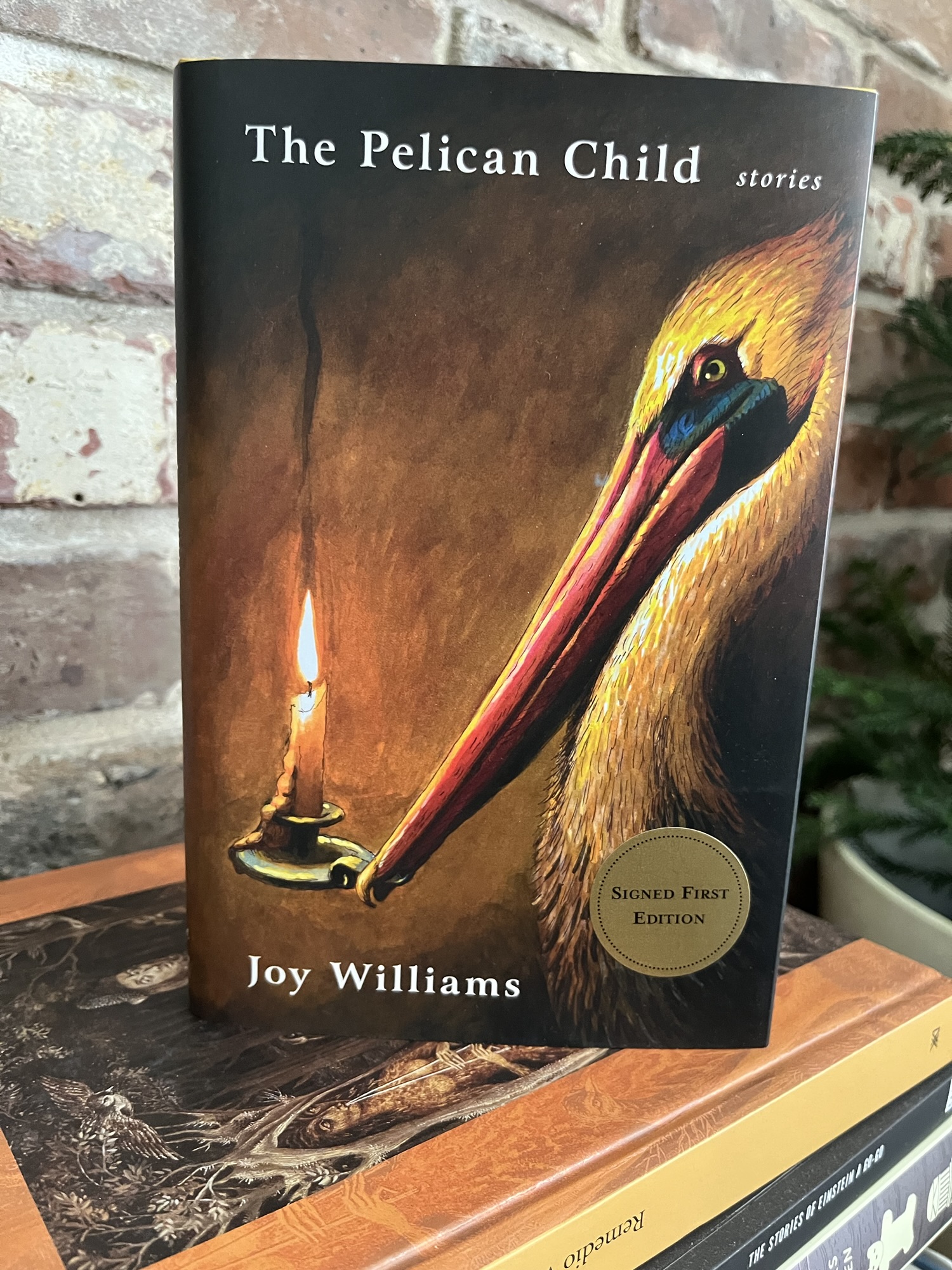
Joy Williams’ The Pelican Child (Book acquired, 27 Dec. 2025)

I finally made it to The Lynx bookstore this weekend while visiting some old friends in Gainesville, FL. The Lynx was opened by novelist Lauren Groff and her husband Clay Kallman last year; its inventory emphasizes challenged and banned books, BIPOC and LGBTQ authors, and Florida writers. There was a nice selection of graphic novels, children’s books, and even some zines. A fair bit of the store’s inventory seemed to be given over to the kind of YAified fiction that sells well, along with a lot of books on contemporary social issues. A lot of those titles tended to skew towards what I think of as “in this house” politics — this ain’t your local anarchist bookstore — but it’s pretty well stocked.

I picked up Joy Williams’ latest collection, The Pelican Child, as well as copy of Williams’ history/guidebook The Florida Keys to give to my hosts, who spend six weeks in the Keys every summer. My wife also got the newest Alison Roman cookbook.

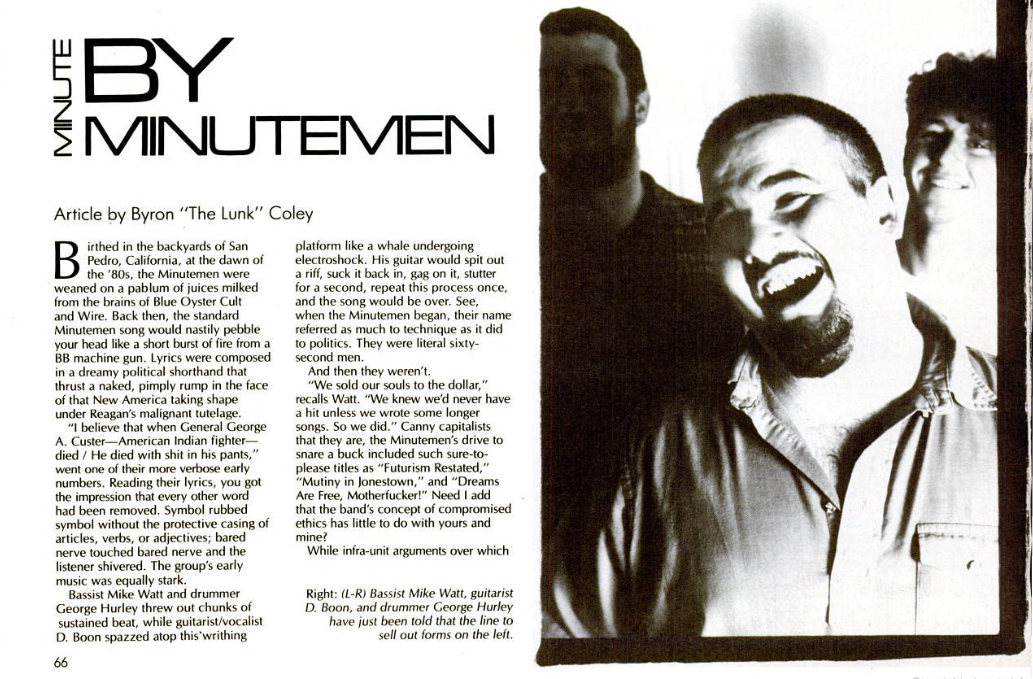
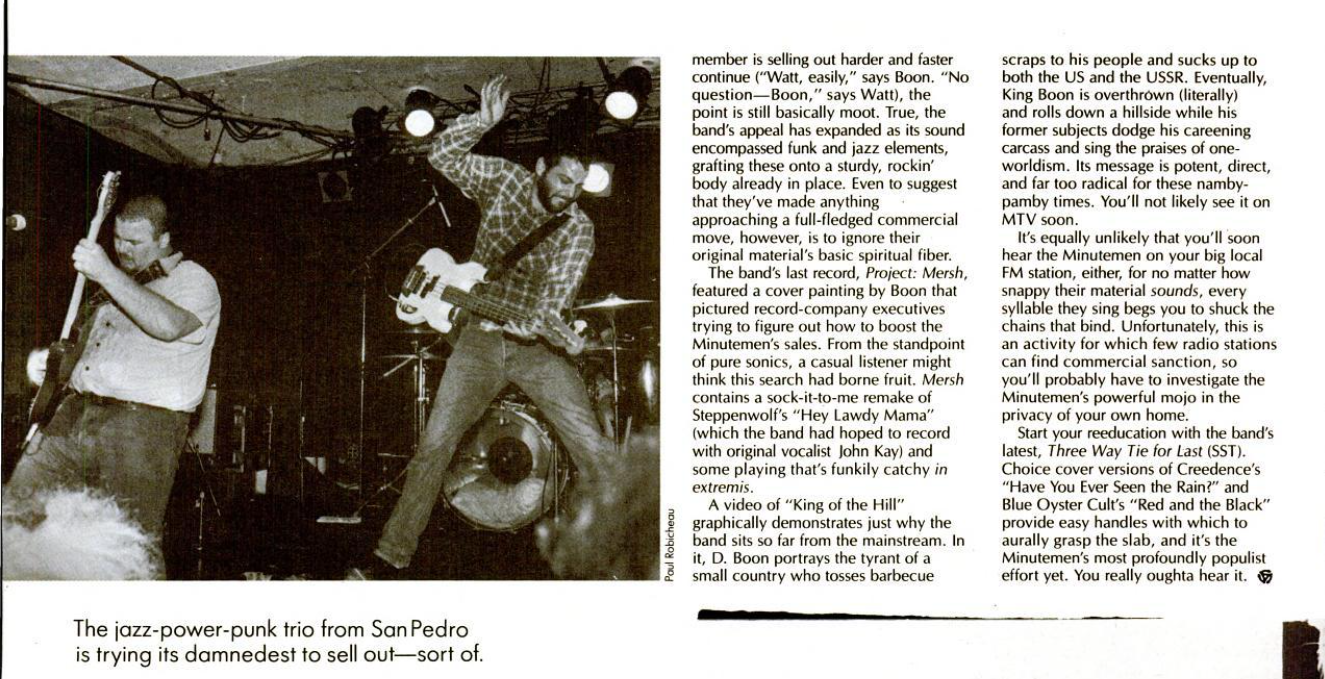
Read a December 1985 interview with the Minutemen

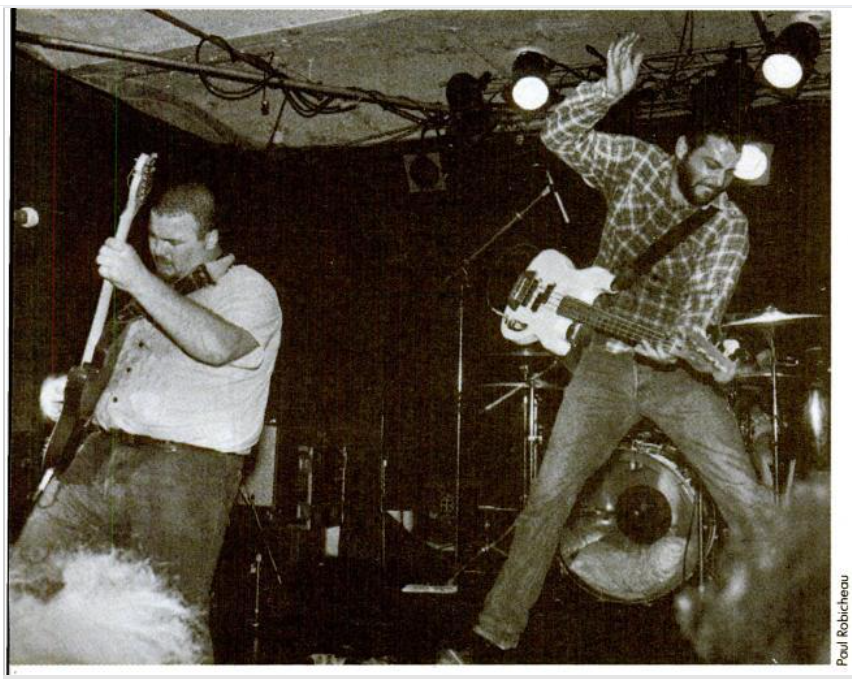
I was looking for something else when I found this brief profile of the Minutemen in the December 1985 issue of SPIN (I didn’t find the thing I was looking for). The article, by Forced Exposure stalwart Byron Coley, focuses on the Minutemen’s attempt to “sell out” with their record 3-Way Tie (For Last). The record, like the issue of SPIN, was released in December 1985.

3-Way Tie ended up being the last studio album by the Minutemen. Singer/guitarist D. Boon died tragically right after its release. From Michael Azerrad’s Our Band Could Be Your Life:

[Mike] Watt’s phone rang early the following morning: December 23, 1985. It was D. Boon’s dad. Boon’s girlfriend had been driving the band’s tour van, her sister in the passenger seat and a feverish Boon sleeping in the back. At around four in the morning, Boon’s girlfriend fell asleep at the wheel. The van crashed and flipped; Boon was thrown out the back door and broke his neck. He died instantly.

I looked through the next two issues of SPIN to see if there was any mention of Boon’s passing but didn’t find anything (there was a feature on Mötley Crüe in the Jan. 1986 issue tastelessly titled “Asleep at the Wheel” and a long profile on crack (the drug) in the Feb. ’86 issue).

Here is the article (followed by a transcription):


“Minute by Minutemen”

Article by Byron “The Lunk” Coley

Born in the backyards of San Pedro, California, at the dawn of the ’80s, the Minutemen were weaned on a pabulum of juices milked from the brains of Blue Öyster Cult and Wire. Back then, the standard Minutemen song would nastily pebble your head like a short burst of fire from a BB machine gun. Lyrics were composed in a dreamy political shorthand that thrust a naked, pimply rump in the face of that New America taking shape under Reagan’s malignant tutelage.

“I believe that when General George A. Custer—American Indian fighter—died / He died with shit in his pants,” went one of their most verbose early numbers. Reading their lyrics, you got the impression that every other word had been removed. Symbol rubbed symbol without the protective casing of articles, verbs, or adjectives; bared nerve touched bared nerve and the listener shivered. The group’s early music was equally stark.

Bassist Mike Watt and drummer George Hurley threw out chunks of sustained beat, while guitarist/vocalist D. Boon spazzed atop this writhing platform like a whale undergoing electroshock. His guitar would spit out a riff, suck it back in, gag on it, stutter for a second, repeat this process once, and the song would be over. See, when the Minutemen began, their name referred as much to technique as it did to politics. They were literal sixty-second men.

And then they weren’t.

“We sold our souls to the dollar,” recalls Watt. “We knew we’d never have a hit unless we wrote some longer songs. So we did.” Canny capitalists that they are, the Minutemen’s drive to snare a buck included such sure-to-please titles as “Futurism Restated,” “Mutiny in Jonestown,” and “Dreams Are Free, Motherfucker.” Need I add that the band’s concept of compromised ethics has little to do with yours and mine?

While infra-unit arguments over which member is selling out harder and faster continue (“Watt, easily,” says Boon. “No question—Boon,” says Watt), the point is still basically moot. True, the band’s appeal has expanded as its sound encompassed funk and jazz elements, grafting these onto a sturdy, rockin’ body already in place. Even to suggest that they’ve made anything approaching a full-fledged commercial move, however, is to ignore their original material’s basic spiritual fiber.

The band’s last record, Project: Mersh, featured a cover painting by Boon that pictured record-company executives trying to figure out how to boost the Minutemen’s sales. From the standpoint of pure sonics, a casual listener might think this search had borne fruit. Mersh contains a sock-it-to-me remake of Steppenwolf’s “Hey Lawdy Mama” (which the band had hoped to record with original vocalist John Kay) and some playing that’s funkily catchy in extremis.

A video of “King of the Hill” graphically demonstrates just why the band sits so far from the mainstream. In it, D. Boon portrays the tyrant of a small country who tosses barbecue scraps to his people and sucks up to both the US and the USSR. Eventually, King Boon is overthrown (literally) and rolls down a hillside while his former subjects dodge his careening carcass and sing the praises of one-worldism. Its message is potent, direct, and far too radical for these namby-pamby times. You’ll not likely see it on MTV soon.

It’s equally unlikely that you’ll soon hear the Minutemen on your big local FM station, either, for no matter how snappy their material sounds, every syllable they sing begs you to shuck the chains that bind. Unfortunately, this is an activity for which few radio stations can find commercial sanction, so you’ll probably have to investigate the Minutemen’s powerful mojo in the privacy of your own home.

Start your reeducation with the band’s latest, Three Way Tie for Last (SST). Choice cover versions of Creedence’s “Have You Ever Seen the Rain?” and Blue Öyster Cult’s “Red and the Black” provide easy handles with which to aurally grasp the slab, and it’s the Minutemen’s most profoundly populist effort yet. You really oughta hear it.


“A Wish for Unconsciousness” — Thomas Hardy

“A Wish for Unconsciousness”

by

Thomas Hardy


If I could but abide
As a tablet on a wall,
Or a hillock daisy-pied,
Or a picture in a hall,
And as nothing else at all,
I should feel no doleful achings,
I should hear no judgment-call,
Have no evil dreams or wakings,
No uncouth or grisly care;
In a word, no cross to bear.

Sunday Comix

From Neat Stuff #1 by Peter Bagge, July, 1985, Fantagraphics Books.

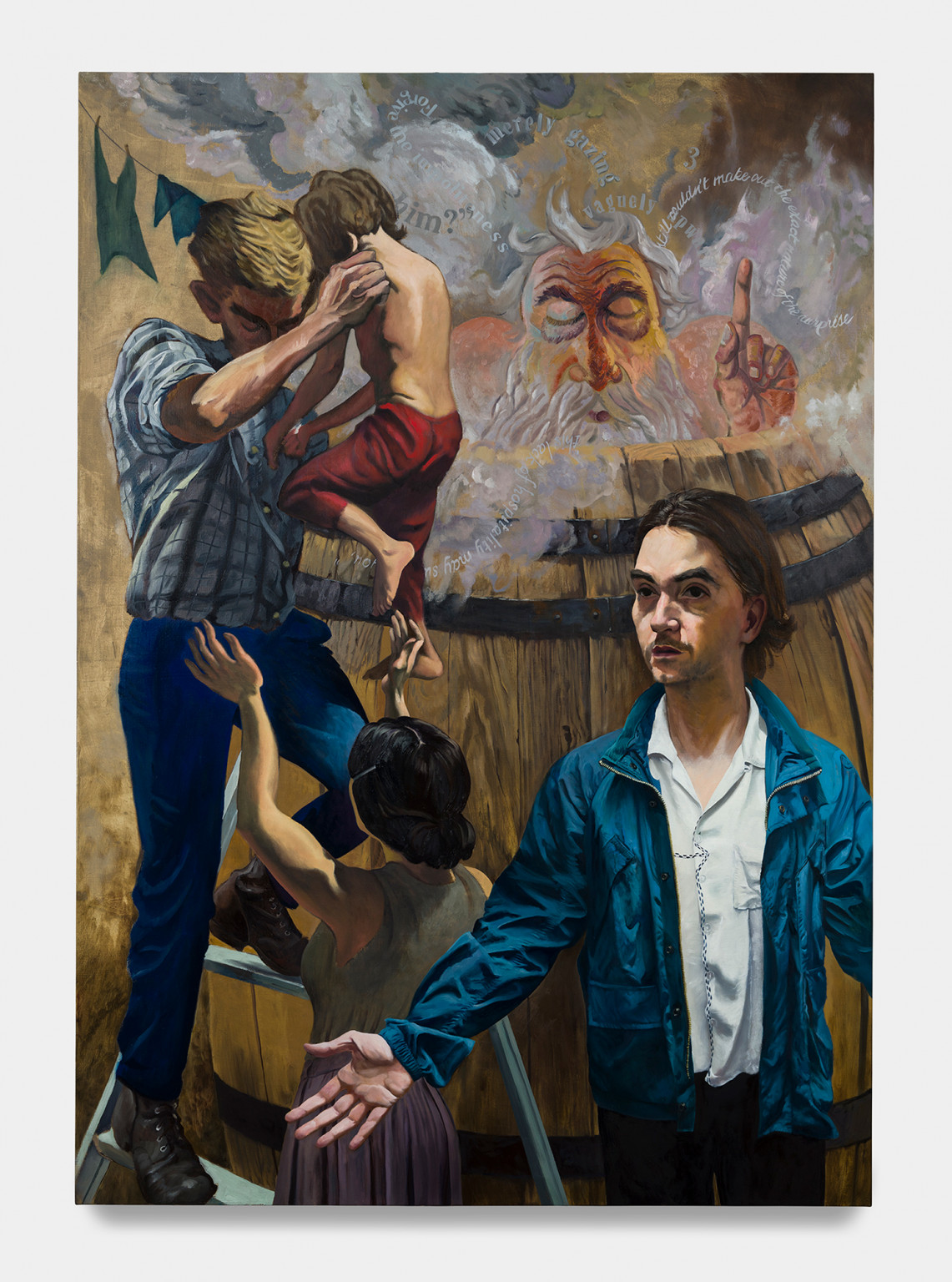
Peasants Washday — Justin John Greene

Peasants Washday, 2023 by Justin John Greene (b. 1984)

“After a Journey” — Thomas Hardy

“After a Journey”

by

Thomas Hardy


Hereto I come to view a voiceless ghost;
Whither, O whither will its whim now draw me?
Up the cliff, down, till I’m lonely, lost,
And the unseen waters’ ejaculations awe me.
Where you will next be there’s no knowing,
Facing round about me everywhere,
With your nut-coloured hair,
And gray eyes, and rose-flush coming and going.

Yes: I have re-entered your olden haunts at last;
Through the years, through the dead scenes I have tracked you;
What have you now found to say of our past—
Scanned across the dark space wherein I have lacked you?
Summer gave us sweets, but autumn wrought division?
Things were not lastly as firstly well
With us twain, you tell?
But all’s closed now, despite Time’s derision.

I see what you are doing: you are leading me on
To the spots we knew when we haunted here together,
The waterfall, above which the mist-bow shone
At the then fair hour in the then fair weather,
And the cave just under, with a voice still so hollow
That it seems to call out to me from forty years ago,
When you were all aglow,
And not the thin ghost that I now frailly follow!

Ignorant of what there is flitting here to see,
The waked birds preen and the seals flop lazily;
Soon you will have, Dear, to vanish from me,
For the stars close their shutters and the dawn whitens hazily.
Trust me, I mind not, though Life lours,
The bringing me here; nay, bring me here again!
I am just the same as when
Our days were a joy, and our paths through flowers.

Pentargan Bay.

The Adoration of the Shepherds — James Ensor

The Adoration of the Shepherds, 1888 by James Ensor (1860-1949)

Read “Christmas Eve,” a supernatural tale by Nikolai Gogol

“Christmas Eve”

by

Nikolai Gogol

translated by George Tolstoy

as “The Night of Christmas Eve: A Legend of Little Russia”


The last day before Christmas had just closed. A bright winter night had come on, stars had appeared, and the moon rose majestically in the heavens to shine upon good men and the whole of the world, so that they might gaily sing carols and hymns in praise of the nativity of Christ. The frost had grown more severe than during the day; but, to make up for this, everything had become so still that the crisping of the snow under foot might be heard nearly half a verst round. As yet there was not a single group of young peasants to be seen under the windows of the cottages; the moon alone peeped stealthily in at them, as if inviting the maidens, who were decking themselves, to make haste and have a run on the crisp snow. Suddenly, out of the chimney of one of the cottages, volumes of smoke ascended in clouds towards the heavens, and in the midst of those clouds rose, on a besom, a witch.

If at that time the magistrate of Sorochinsk had happened to pass in his carriage, drawn by three horses, his head covered by a lancer cap with sheepskin trimming, and wrapped in his great cloak, covered with blue cloth and lined with black sheepskin, and with his tightly plaited lash, which he uses for making the driver drive faster—if this worthy gentleman had happened to pass at that time, no doubt he would have seen the witch, because there is no witch who could glide away without his seeing her. He knows to a certainty how many sucking pigs each swine brings forth in each cottage, how much linen lies in each box, and what each one has pawned in the brandy-shop out of his clothes or his household furniture. But the magistrate of Sorochinsk happened not to pass; and then, what has he to do with those out of his jurisdiction? he has his own circuit. And the witch by this time had risen so high that she only looked like a little dark spot up above; but wherever that spot went, one star after another disappeared from heaven. In a short time the witch had got a whole sleeveful of them. Some three or four only remained shining. On a sudden, from the opposite side, appeared another spot, which went on growing, spreading, and soon became no longer a spot. A short-sighted man, had he put, not only spectacles, but even the wheels of a britzka on his nose, would never have been able to make out what it was. In front, it was just like a German; a narrow snout, incessantly turning on every side, and smelling about, ended like those of our pigs, in a small, round, flattened end; its legs were so thin, that had the village elder got no better, he would have broken them to pieces in the first squatting-dance. But, as if to make amends for these deficiencies, it might have been taken, viewed from behind, for the provincial advocate, so much was its long pointed tail like the skirt of our dress-coats. And yet, a look at the goat’s beard under its snout, at the small horns sticking out of its head, and at the whole of its figure, which was no whiter than that of a chimney sweeper, would have sufficed to make any one guess that it was neither a German nor a provincial advocate, but the Devil in person, to whom only one night more was left for walking about the world and tempting good men to sin. On the morrow, at the first stroke of the church bell, he was to run, with his tail between his legs, back to his quarters. The devil then, as the devil it was, stole warily to the moon, and stretched out his hand to get hold of it; but at the very same moment he drew it hastily back again, as if he had burnt it, shook his foot, sucked his fingers, ran round on the other side, sprang at the moon once more, and once more drew his hand away. Still, notwithstanding his being baffled, the cunning devil did not desist from his mischievous designs. Dashing desperately forwards, he grasped the moon with both hands, and, making wry faces and blowing hard, he threw it from one hand to the other, like a peasant who has taken a live coal in his hand to light his pipe. At last, he hastily hid it in his pocket, and went on his way as if nothing had happened. At Dikanka, nobody suspected that the devil had stolen the moon. It is true that the village scribe, coming out of the brandy-shop on all fours, saw how the moon, without any apparent reason, danced in the sky, and took his oath of it before the whole village, but the distrustful villagers shook their heads, and even laughed at him. And now, what was the reason that the devil had decided on such an unlawful step? Simply this: he knew very well that the rich CossackChoop was invited to an evening party at the parish clerk’s, where he was to meet the elder, also a relation of the clerk, who was in the archbishop’s chapel, and who wore a blue coat and had a most sonorous basso profondo, the Cossack Sverbygooze, and some other acquaintances; where there would be for supper, not only the kootia, but also a varenookha, as well as corn-brandy, flavoured with saffron, and divers other dainties. He knew that in the mean time Choop’s daughter, the belle of the village, would remain at home; and he knew, moreover, that to this daughter would come the blacksmith, a lad of athletic strength, whom the devil held in greater aversion than even the sermons of Father Kondrat. When the blacksmith had no work on hand, he used to practise painting, and had acquired the reputation of being the best painter in the whole district. Even the Centurion had expressly sent for him to Poltava, for the purpose of painting the wooden palisade round his house. All the tureens out of which the Cossacks of Dikanka ate their borsch, were adorned with the paintings of the blacksmith. He was a man of great piety, and often painted images of the saints; even now, some of them may be seen in the village church; but his masterpiece was a painting on the right side of the church-door; in it he had represented the Apostle Peter, at the Day of Judgment, with the keys in his hand, driving the evil spirit out of hell; the terrified devil, apprehending his ruin, rushed hither and thither, and the sinners, freed from their imprisonment, pursued and thrashed him with scourges, logs of wood, and anything that came to hand. All the time that the blacksmith was busy with this picture, and was painting it on a great board, the devil used all his endeavours to spoil it; he pushed his hand, raised the ashes out of the forge, and spread them over the painting; but, notwithstanding all this, the work was finished, the board was brought to the church, and fixed in the wall of the porch. From that time the devil vowed vengeance on the blacksmith. He had only one night left to roam about the world, but even in that night he sought to play some evil trick upon the blacksmith. For this reason he, had resolved to steal the moon, for he knew that old Choop was lazy above all things, not quick to stir his feet; that the road to the clerk’s was long, and went across back lanes, next to mills, along the churchyard, and over the top of a precipice; and though the varenookha and the saffron brandy might have got the better of Choop’s laziness on a moonlight night, yet, in such darkness, it would be difficult to suppose that anything could prevail on him to get down from his oven and quit his cottage. And the blacksmith, who had long been at variance with Choop, would not on any account, in spite even of his strength, visit his daughter in his presence. Continue reading “Read “Christmas Eve,” a supernatural tale by Nikolai Gogol”

A partial glossary for Thomas Pynchon’s Gravity’s Rainbow

The October 1980 issue of Esquire ran a piece titled “What to Think about Gravity’s Rainbow” by the poet Terrill Shepard Soules. It’s not really a what to think piece, though (the title seems an editorial intervention), but rather a witty glossary.

“WHAT TO THINK ABOUT GRAVITY’S RAINBOW

by Terrill Shepard Soules


VERY CLEVER.

THOMAS PYNCHON, AUTHOR, KEEPS A LOW PROFILE.

MAIN CHARACTER: TYRONE SLOTHROP.

FIRST LINE: “A SCREAMING COMES ACROSS THE SKY.” NICE FIRST LINE.

LONG — 760 PAGES IN HARD-COVER.

BUZZWORDS: PIGS, PARANOIA, B MOVIES, SEX, NAZIS.

PUBLISHED 1973; EVERYONE WENT CRAZY.

NATIONAL BOOK AWARD, OF COURSE. PULITZER JUDGES LOVED IT, PULITZER TRUSTEES THOUGHT OBSCENE. ALSO INCOMPREHENSIBLE. NO PULITZER PRIZE. SOMETHING LIKE ULYSSES THAT WAY. A FREQUENT COMPARISON.

INSIDERS CALL IT RAINBOW. INSIDERS ARE INSIDERS BECAUSE THEY LOVE THE IDEA THAT
SOME RECLUSE (A CORNELL GRAD?) WROTE A 760-PAGE BOOK ABOUT PIGS AND PARANOIA. ALSO BECAUSE THEY KNOW SOME VERY EXTRAORDINARY WORDS FROM RAINBOW, LIKE THE ONES IN THE GLOSSARY BELOW (FROM THE HARD-COVER EDITION).


BOOK 1
Beyond the Zero

NARODNIK [p. 11]
From Russian narod, “people.” Intellectual trying to metamorphose peasant into revolutionaries. The Narodniki flourished in the late 1860s. In the late 1960s Student Nonviolent Coordinating Committee activists were referred to as narodoniks. By show-offs.

PRETERITION, PRETERITE
[p. 15 and throughout]
A passing over. Preterition is the Fluke Cosmic, the doctrine that God in John Calvin’s breast (cf. the Jampere-phrenia in Alien) decreed that you and you and you are heavenbound no questions asked but We’re going to have to think about the rest of you — don’t get your hopes up.

MAFFICK [p. 17]
The founder of the Boy Scouts defended the garrison at Mafeking against the Boers for two hundred seventeen days. When the siege was raised, on May 17, 1900, London went crazy, and the jubilant celebratory maffick — it’s a verb! — was born. Here, part of Lieutenant Oliver “Tantivy” Mucker-Maffick’s moniker.

TANTIVY [p. 17]
Mucker-Maffick’s nickname. Means to gallop along, or a blast on a horn, or that headlong gallop itself.

LOVE-IN-IDLENESS [p. 22]
The perfect word for violet. Pynchon’s choice is dazzling. First, on a map of London there’s a star for each of Slothrop’s women, Slothrop “having evidently the time, in his travels among places of death, to devote to girl-chasing.” Second, the many stars are of many colors. Third, Slothrop gets the idea that the stars look like flowers. Now Viola tricolor, the flower in question, turns out to be a violet with yellow, white, and purple petals and several country names. The name our author finally selects enables him to pull off a genuine rampage-prose triple play: “and all over the place, purple and yellow as hickeys, a prevalence of love-in-idleness.” Continue reading “A partial glossary for Thomas Pynchon’s Gravity’s Rainbow”

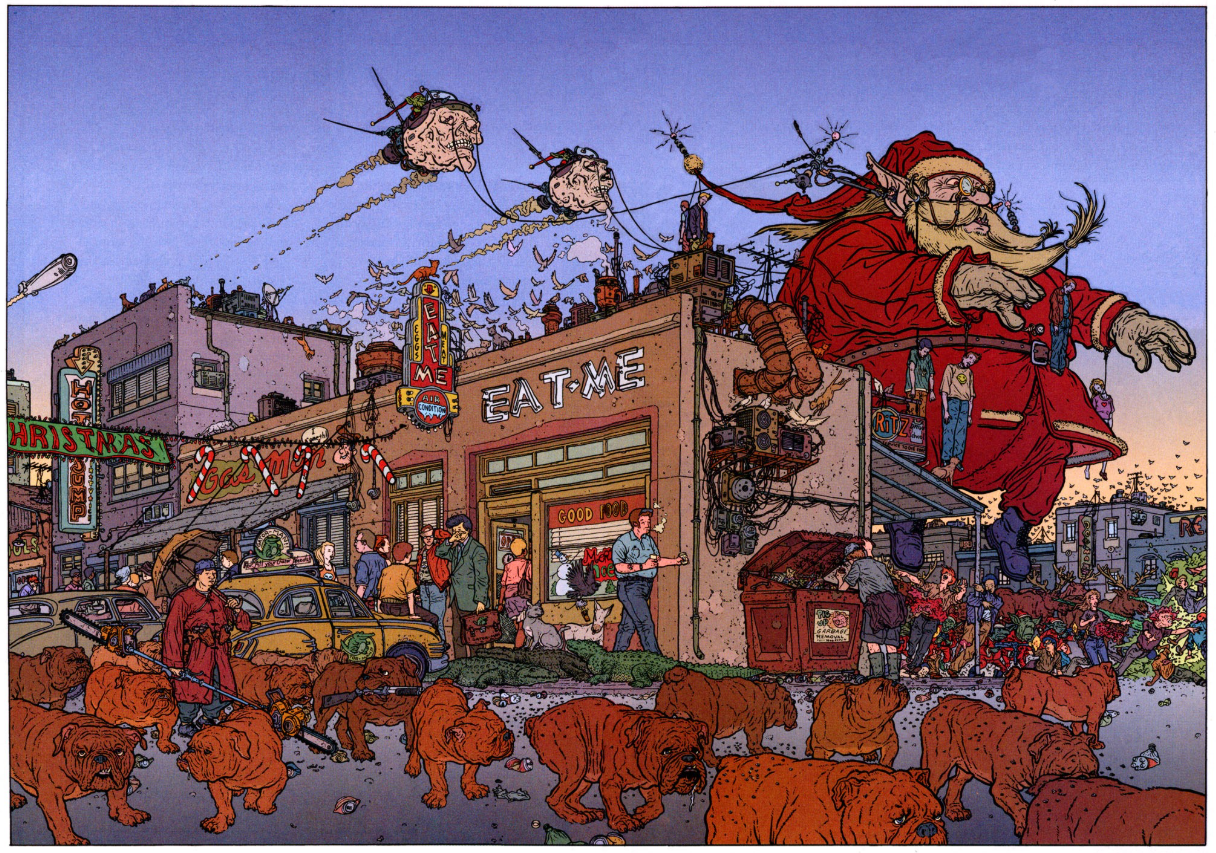
Sunday Comix

“Christmas” by Geof Darrow; colors by Dave Stewart. From the one-shot anthology Hellboy Christmas Special, 1997, Dark Horse Comics.

Read “Markheim,” a dark Christmas tale by Robert Louis Stevenson

“Markheim”

by

Robert Louis Stevenson


“Yes,” said the dealer, “our windfalls are of various kinds. Some customers are ignorant, and then I touch a dividend on my superior knowledge. Some are dishonest,” and here he held up the candle, so that the light fell strongly on his visitor, “and in that case,” he continued, “I profit by my virtue.”

Markheim had but just entered from the daylight streets, and his eyes had not yet grown familiar with the mingled shine and darkness in the shop. At these pointed words, and before the near presence of the flame, he blinked painfully and looked aside.

The dealer chuckled. “You come to me on Christmas Day,” he resumed, “when you know that I am alone in my house, put up my shutters, and make a point of refusing business. Well, you will have to pay for that; you will have to pay for my loss of time, when I should be balancing my books; you will have to pay, besides, for a kind of manner that I remark in you to-day very strongly. I am the essence of discretion, and ask no awkward questions; but when a customer cannot look me in the eye, he has to pay for it.” The dealer once more chuckled; and then, changing to his usual business voice, though still with a note of irony, “You can give, as usual, a clear account of how you came into the possession of the object?” he continued. “Still your uncle’s cabinet? A remarkable collector, sir!”

And the little pale, round-shouldered dealer stood almost on tip- toe, looking over the top of his gold spectacles, and nodding his head with every mark of disbelief. Markheim returned his gaze with one of infinite pity, and a touch of horror.

Continue reading “Read “Markheim,” a dark Christmas tale by Robert Louis Stevenson”