Smaug Flies Round the Mountain — An Illustration by J.R.R. Tolkien

(More).

Werner Herzog Talks About Making Nosferatu

Freud’s Perverse Polymorph — Salvador Dali

Cosby Nightmarez

“The Rules” — William T. Vollmann’s Prescription to Heal Diseased Writing

William T. Vollmann’s essay “American Writing Today” was published over 20 years ago in Conjunctions, but it’s still relevant today (I read it in the indispensable Vollmann reader Expelled from Eden, but you can read the entire essay online). Concerned with the solipsism and insularity of contemporary American writing, Vollmann tells us:  “I now propose to set forth our responsibility, and some rules for reform. This first requires that I set right all the woes of the world.” The second sentence’s naked irony punctures the seriousness of the project proposed by the first sentence; this is classic Vollmann—earnest, ironic, and self-effacing at all times. Here are Vollmann’s rules, which are somehow both tongue-in-cheek and totally sincere at the same time:

1. We should never write without feeling.

2. Unless we are much more interesting than we imagine we are, we should strive to feel not only about Self, but also about Other. Not the vacuum so often between Self and Other. Not the unworthiness of Other. Not the Other as a negation or eclipse of Self. Not even about the Other exclusive of Self, because that is but a trickster-egoist’s way of worshiping Self secretly. We must treat Self and Other as equal partners. (Of course I am suggesting nothing new. I do not mean to suggest anything new. Health is. more important than novelty.)

3. We should portray important human problems.

4. We should seek for solutions to those problems. Whether or not we find them, the seeking will deepen the portrait.

5. We should know our subject, treating it with the respect with which Self must treat Other. We should know it in all senses, until our eyes are bleary from seeing it, our ears ring from listening to it, our muscles ache from embracing it, our gonads are raw from making love to it. (If this sounds pompous, it is perhaps because I wear thick spectacles.)

6. We should believe that truth exists.

7. We should aim to benefit others in addition to ourselves.

“Love Can Be Terribly Obscene” — D.H. Lawrence on Edgar Allan Poe

D.H. Lawrence on Edgar Allan Poe. From Studies in American Literature

Poe had experienced the ecstasies of extreme spiritual love. And he wanted those ecstasies and nothing but those ecstasies. He wanted that great gratification, the sense of flowing, the sense of unison, the sense of heightening of life. He had experienced this gratification. He was told on every hand that this ecstasy of spiritual, nervous love was the greatest thing in life, was life itself. And he had tried it for himself, he knew that for him it was life itself. So he wanted it. And he would have it. He set up his will against the whole of the limitations of nature.

This is a brave man, acting on his own belief, and his own experience. But it is also an arrogant man, and a fool.

Poe was going to get the ecstasy and the heightening, cost what it might. He went on in a frenzy, as characteristic American women nowadays go on in a frenzy, after the very same thing: the heightening, the flow, the ecstasy. Poe tried alcohol, and any drug he could lay his hand on. He also tried any human being he could lay his hands on.

His grand attempt and achievement was with his wife; his cousin, a girl with a singing voice. With her he went in for the intensest flow, the heightening, the prismayic shades of ecstasy. It was the intensest nervous vibration of unison, pressed higher and higher in pitch, till the blood-vessels of the girl broke, and the blood began to flow out loose. It was love. If you call it love.

Love can be terribly obscene.

It is love that causes the neuroticism of the day. It is love that is the prime cause of tuberculosis.

The nerves that vibrate most intensely in spiritual unisons are the sympathetic ganglia of the breast, of the throat, and the hind brain. Drive this vibration over-intensely, and you weaken the sympathetic tissues of the chest – the lungs – or of the throat, or of the lower brain, and the tubercles are given a ripe held.

But Poe drove the vibrations beyond any human pitch of endurance.

Being his cousin, she was more easily keyed to him.

Killer Lampshade

(See also).

Bertrand Russell Explains How Smoking Saved His Life

Ray — Barry Hannah

ray

Barry Hannah’s slim 1980 novel Ray is a strange wonder, a poem rocket assured to offend any unsuspecting customer who wanders in unaware. I use the term “offend” here loosely: some may be offended by Hannah’s subject matter (booze, drugs, sex, violence), others may be offended by his refusal to submit to any of the conventions we expect from a “novel.” Sure, there are defined characters, conflicts, hints of a plot even, but don’t expect arc, easily recognizable growth, or even linearity. Hannah breaks almost every convention, right down to a first-person narration that shifts occasionally into a kind of second-person meditation and then into a faux-objective third-person voice and then into the third-person free indirect style that marks modernism. The subject Ray careens not just through perspectives but also through time. Here he is in Chapter V (this is the chapter in its entirety)—

I live in so many centuries. Everybody is still alive.

And if Ray is busy stumbling through his own psychic quagmire, shooting down planes in ‘Nam or killing Yankees under Jeb Stuart’s command, he’s also a very real, concrete personality, a doctor, a family man, an alcoholic, a suffering soul trying to navigate children and lovers and patients and neighbors in the swelter of Tuscaloosa, Alabama at the end of Carter’s presidency.

None of this should work, of course, but Hannah’s writing assimilates the reader, inculcates the reader, infects the reader. Ray is a dramatically unstable figure of the old school—misogynist, casually racist, the kind of doctor who finds himself “drinking five bottles of wine a day just to stay cool” — but Hannah’s syntactic powers (which he awards to his narrator Ray) become the core of a novel that by rights should run off the tracks, what with its sharp velocity and manic force and hairpin turns. But Ray doesn’t run off the tracks; it explodes them.

It’s hard to summarize the plot of this fragmentary novel, but I’ll give it a try (and at least share some of Hannah’s remarkable prose). Ray is a country doctor of some note and education, a former pilot who fought and killed in Vietnam, a man with literary ambitions who tries his hand at poetry and occasionally lectures at the local college. Here’s a taste of one of those lectures, showcasing Hannah’s wit, the radically ambivalent place of history in his work, and the core paradoxes of his lead character—

So now, class, I say:

“Americans have never been consistent. They represent gentleness and rage together. Franklin was the inventor of the stove, bifocals, and so on. Yet he abused his neglected family. Jefferson, with his great theories, could not actually release the slaves even though he regularly fornicated with one of them. One lesson we as Americans must learn is to get used to the conrarieties in our hearts and live with them.” Etc.

Lazy Blakean. In addition to his history lectures, Ray has even written a number of papers with unlikely titles about women and depressives and medicine; it is wholly ironic that Ray should lay claims to understanding women and depressed people, let alone understanding how to treat them. During the course of the novel he marries again, to a woman named Westy, and they combine their children into a post-nuclear family that recalls The Brady Bunch on Dexedrine and bourbon and weed (that description sounds far more negative than I intend; I’m trying to telegraph the spirit or tone of the novel, which is difficult, impossible). Ray’s lusty marriage to Westy doesn’t prevent his shambolic philandering. Not all of Ray’s infidelities are born of human weakness though. His love for a young woman named Sister from a white trash family called the Hooches deeply informs the novel; it also allows me another chance to quote from the novel—

Sister is always in love with somebody, sometimes me. There is a capricious wisdom she has about attaching herself to anybody for very long, although her loyalties are fast. She plays the guitar well and has a nice voice that she keeps to herself. Life has been such for her that she has no attitude at all. She expects no sympathy. Two of her teenage lovers died in an accident at the railroad tracks. That’s when I met Sister. I rode down to the tracks, and she was standing there in a long sleeping gown, two weeks after the accident.

“What’s wrong, girl?”

“I growed up.”

Along with Sister, a man named Charlie DeSoto plays a large role in Ray; indeed, at times the novel comes to inhabit his consciousness, as if he was some alter-ego of Ray. That consciousness also becomes unstuck in time. In a passage that recalls (and predates) Blood Meridian, DeSoto (via Ray?) migrates back to the mid 1500s, into the mind of one of Hernando DeSoto’s companions in arms. In a bizarre first-person sequence, this ancient Christian describes slaughtering 4,000 Indians under the command of the war chief Tuscaloosa. History is a nightmare that Ray cannot wake up from.

Ray is a strange fever dream, buzzing with tumult, beauty, filth, and ugly vitality. Our clumsy (anti?)hero cannot seem to reconcile his violent past (both as a fighter pilot in Vietnam and as an American with “contrarieties” in his heart) with his duty as a healer, a doctor. He tells us—

I am infected with every disease I ever tried to cure. I am a vicious nightmare of illnesses. God cured me with a memory that holds everything in my brain. There is no forgetting with me. Every name, every foot, every disease, every piece of jewelry hanging from an ear. Nothing is hazy.

If “Nothing is hazy” then everything is brought into vibrant foreground, all details afforded a prominent place, none pushed to a defining background. If “Nothing is hazy” then everything is hazy; contrariety rules.

Perhaps Ray might be summed up by one of its chapters, LII (again, in its entirety)—

To live and delight in healing, flying, fucking. Here are the men and women.

Hannah might have been heir to Faulkner, with his grotesque characters and bizarre syntax and challenging tropes (not to mention the sweaty ickiness of both writers’ prose). Ray also hearkens back to Henry Miller’s rants, although I’d suggest a larger, or at least more loving spirit in Hannah. There are even tinges of Bukoswki here. Ray also recalls Renata Adler’s strange novel Speedboat, another discursive, vaulting piece from the late ’70s. But comparing Ray to other works risks belying its radical originality, which is surely one of its great pleasures. Ray is not a novel for everyone, and those interested in Hannah might do better to begin with his equally strange compilation Airships, but those seeking a challenging, funny novel will appreciate Ray, a novel that explodes literary convention even as it reaffirms the affective power of literature. Highly recommended.


Derrida Talks About Stupidity

Books Acquired, 10.22.2011

20111023-103958.jpg

I was too busy on Saturday to document the books that arrived at Biblioklept World Headquarters, but here they are of a Sunday, both sporting impeccable design and, uh, burgundy.

Richard Locke’s Critical Children (Columbia UP) examines childhood in a number of novels, including Dickens, Twain, Peter Pan,Lolita, Catcher in the Rye, and The Turn of the Screw. Here’s Locke, synthesizing these figures in Holden Caulfield—

Salinger’s most famous character, sixteen-year-old Holden, is a holy rebel who combines elements of Oliver Twist and the Artful Dodger, Huckleberry Finn and Peter Pan. Like Oliver, Holden can be said to represent “the principle of Good surviving through every adverse circumstance, and triumphing at last.” Like the Artful Dodger, he is a quick-tongued urban trickster. Like Peter Pan, he mocks his own conventional (and comfortably affluent) society and wants to never grow up. But his most celebrated ancestor is Huckleberry Finn. Salinger transforms Huck the frontier fugitive into Holden the prep-school dropout: both boys’ famously provocative colloquial voices embody their quests for American freedom and authenticity.


20111023-104321.jpg

I can’t overstate the aesthetic pleasure I take in Def Jam Recordings:  The First 25 Years of the Last Great Record Label by Bill Adler and Dan Charnas. It’s huge—thick and big and crammed with photos and interviews and memories—all kinds of great stuff. It makes sense of course that Def Jam, a label as much about style as it was about music, would produce such a beautiful book, but this beast surpasses the expectations most of us might have for a coffee table book: it also functions as an oral history of the people, music, fashion, politics, money, and culture of Def Jam—the influence of which on popular culture simply cannot be underestimated. Full review forthcoming, but two random pics for now—


20111023-104019.jpg

20111023-104026.jpg


William S. Burroughs Talks About Allen Ginsberg

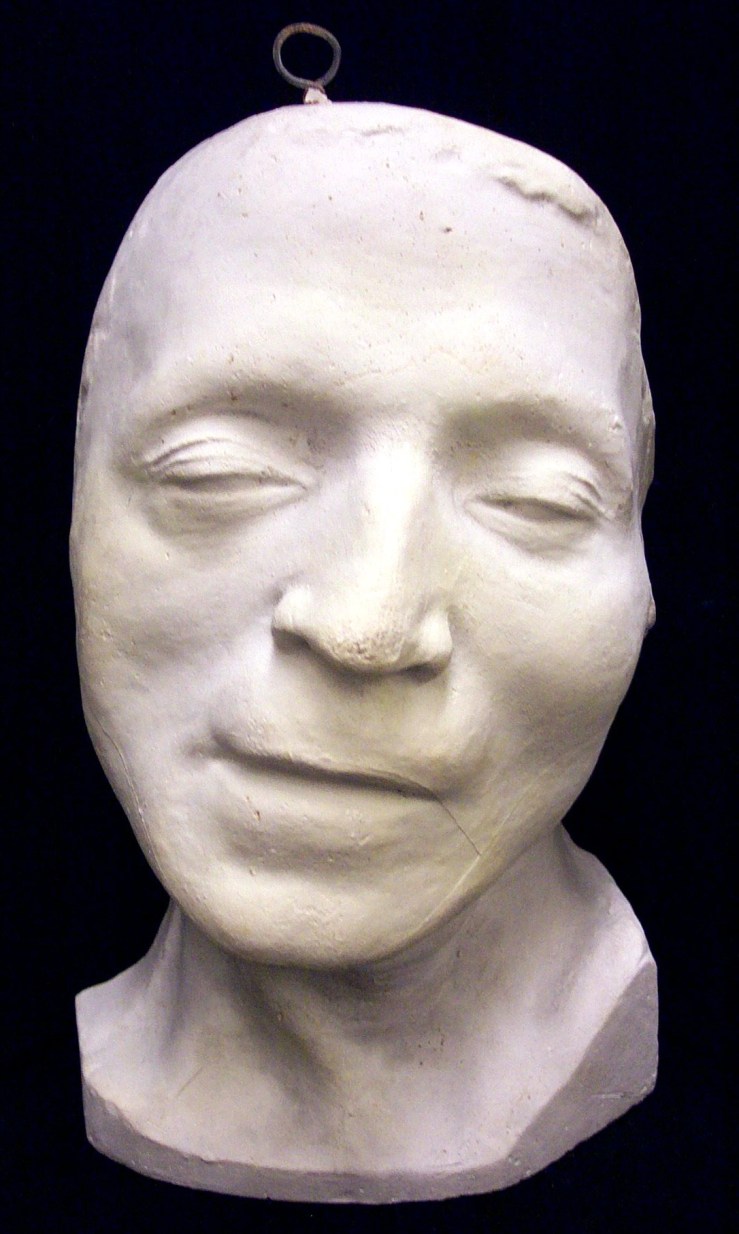
Jean-Paul Marat’s Death Mask

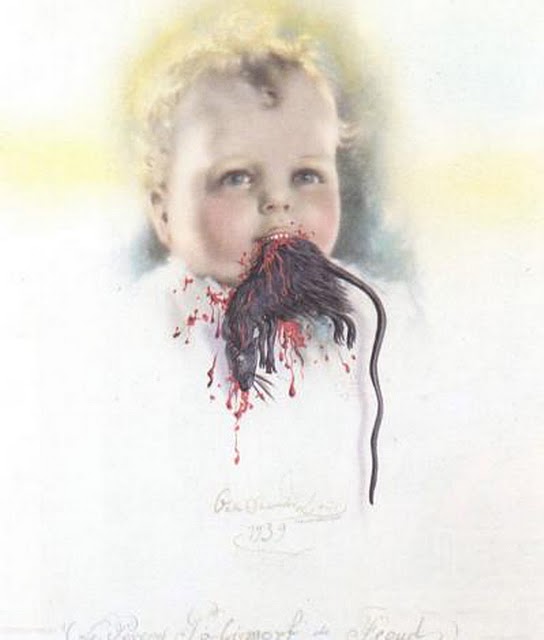
Sometimes I Spit with Pleasure on the Portrait of My Mother (Sacred Heart) — Salvador Dali

HST and Terry Gilliam Riff About Words and Images

Books Acquired, 10.20.2011

20111020-190929.jpg

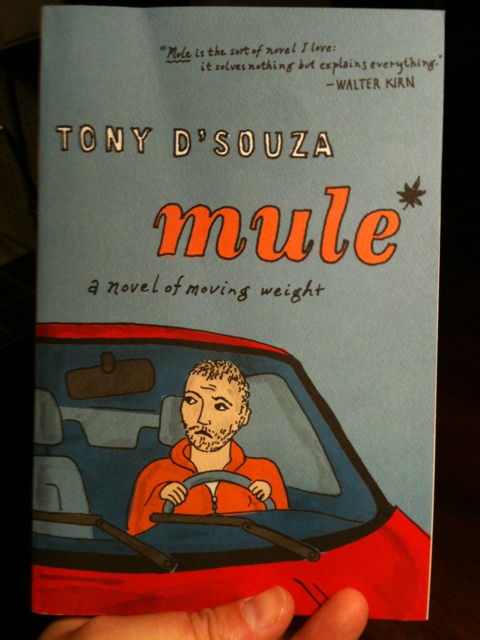
A good lookin’ pair this eve. First up, Tony D’Souza’s novel Mule, which looks rather promising (the cover and premise alone earn it an advanced spot in the stack). From K. Reed Petty’s review at Electric Literature—

Mule is Scarface for readers of The New Yorker: It plots all the emotional points on a man’s rise and downfall, while explaining everything you need to know to avoid getting caught while driving $50,000 worth of marijuana from California to Tennessee.

D’Souza’s book is the most satisfying in answering the details that cable skims over. Our hero, James, is an out-of-work freelance journalist with a new family and no safety net. When he gets an opportunity to make some quick cash, he researches the business of driving drugs like a long-form journalist: How do you convince a bank teller to hand over your $7,000 savings account in hundreds? What are your rights if a cop pulls you over in Texas versus Nevada? And, as James asks of a buyer he meets on his first run: “How much does an ounce weigh?”

20111020-190939.jpg

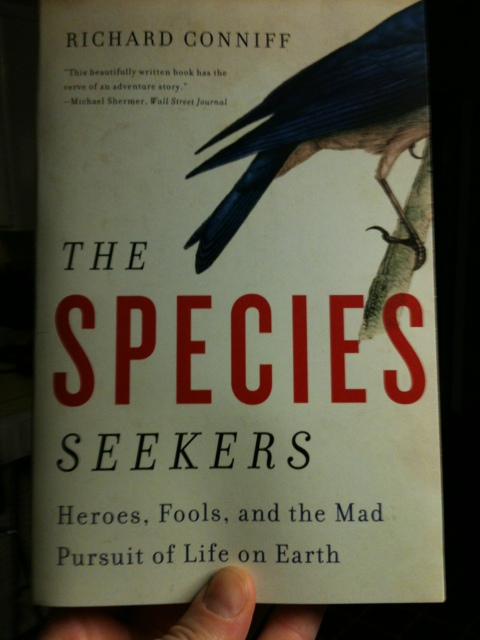
The Species Seekers by Richard Conniff also seems really cool. The book explores the strange intersections of science and adventure. Press release—

Conniff takes us back in time—before the words “scientist” or “biologist” even existed—to when a popular fever for the natural world swept through humanity. Beginning in the mid-eighteenth century, amateur naturalists made it their mission to go to the most perilous corners of the planet and bring back astonishing new species. Linnaeus, Darwin, and Wallace dominate most histories of the great age of discovery.  But they owed their success to this network of enthusiasts, who worked mainly for the pleasure of adding “to the power and grace and beauty of the Infinite.”  Among them:  A grave-robbing anatomist who became the model for Dr. Jekyll and Mr. Hyde, a Catholic missionary who held off bandits at gunpoint, and a British ornithologist who lost his left arm by jamming it down the throat of a charging leopard—but happily lived on to play a good game of tennis.

Discovering new species wasn’t a rarefied pastime; it was a pandemic, a social disease that struck every corner of society, claiming such notables as Thomas Jefferson, who laid out mastodon bones on the floor of the White House, and Mark Twain, who set out to become an Amazonian explorer, but went bust in New Orleans and had to make do with the river at hand.

Amid its tales of adventure and intrigue, The Species Seekers offers unmatched insight into one of the great revolutions in the history of human thought. At the start, God was in heaven, Man was the center of the universe, and everyone accepted that the Earth had been born yesterday for our benefit. But we weren’t sure where vegetable ended and animal began. We didn’t know what species were, or that they could be joined by common origin. We had no way to identify the causes of the pestilential diseases that made death a constant companion.

All that suddenly changed, as the species seekers introduced us to the pantheon of life on Earth—and our place within it.

The Royal Menagerie at the Tower of London — Walton Ford