“Ideology Is a Wall Between Communication and People” — Alfonso Cuarón

Alfred Hitchcock Distinguishes Mystery from Suspense

“Americans Are in a Way Crazy” — David Foster Wallace

Chapter 19 David Foster Wallace’s The Pale King (or, §19, if you prefer the book’s conceit) begins with this paragraph—

‘There’s something very interesting about civics and selfishness, and we get to ride the crest of it. Here in the US, we expect government and law to be our conscience. Our superego, you could say. It has something to do with liberal individualism, and something to do with capitalism, but I don’t understand much of the theoretical aspect—what I see is what I live in. Americans are in a way crazy. We infantilize ourselves. We don’t think of ourselves as citizens—parts of something larger to which we have profound responsibilities. We think of ourselves as citizens when it comes to our rights and privileges, but not our responsibilities. We abdicate our civic responsibilities to the government and expect the government, in effect, to legislate morality. I’m talking mostly about economics and business, because that’s my area.’

‘What do we do to stop the decline?’

I plan to write more about this later — Tea Party, Real America, all that slang — but I’m tapped out right now. Back to school, syllabi to stick in the toaster oven, too much red tonight, all that jazz.

Kakutani, Limn Addict

There’s a piece today in Salon about Michiko Kakutani taking up her favorite verb “limn” again. Thrilling stuff, I know, but it recalled to me this list compiled in Harper’s eight years ago by Christian Lorentzen of Kakutani’s use of “limn” (the Harper’s bit is not mentioned in the Salon article) —

Limn an entire life in a couple of pages

Limn the trajectory of an entire life in a handful of pages

Limn the suffocating atmosphere of small-town life and the alienation experienced by those who defy its provincial mores

Limn the last days of an alcoholic frontierswoman living in a small western town

Limn a man’s sudden apprehension of vulnerability and loss–all brought on by his discovery of a dead rat on his kitchen floor

Limn his inner life or probe the sources of his equipoise

Limn the inner life of people, surprised by the deceptions of time

Limn, with tenderness, wisdom, and humor, a vast array of human relationships, both straight and gay

Limn the rituals of hunting, trapping, planting, and canning with a wry mixture of amusement and respect

Limn the daily minutiae of life

Limn the human condition

Limn the complicated emotional geometry

Limn the delicate geometry of emotions

Limn a marriage of enduring passion and shared ideals

Limn Willy’s fears of losing Biff’s love and his own longings for immortality

Limn the brutal, perilous, and harrowing art of killing a forty-ton creature with a hand-thrown weapon

Limn some of its burgeoning manifestations

Limn the social and geopolitical fallout

Limn the surrealness of contemporary life

Limn the rhythms of the universe and an artist’s inner state of mind

Limn a future in which Pop Art gives way to Poll Art

Limn the nervous, almost flirtatious banter

Limn a hero’s efforts to achieve self-understanding

Limn girls’ secret struggle for womanhood in the post-sexual-revolution world

Limn the dangers posed by emerging diseases

Limn the spiritual yearnings and dislocations of an entire nation as it lurched from the certainties of the World War II years toward the confusions of the 1970s

Limn the irrationalities of history

Limn the impermanence–and emotional chaos–that threatens to overwhelm ordinary people

Limn the fabulous

Limn the ordinary with seeming nonchalance

Limn this deeply felt, if somewhat limited, theme with clarity and moral vigor

Alice Coltrane Harp Solo

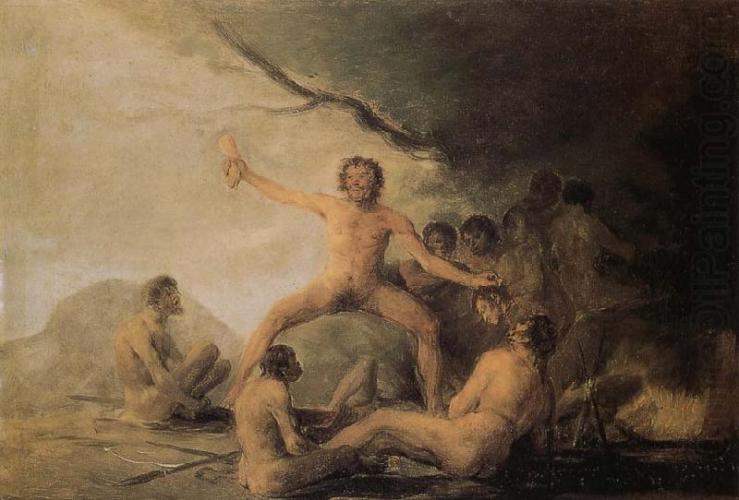
Cannibals Gazing at Their Victims — Goya

John Hodgman Riffs on Bookstores on The Daily Show

Vodpod videos no longer available.

Parc Monceau — Alfonso Cuarón

http://vimeo.com/4469267

Parc Monceau, another rich, beautiful, continuous shot from Alfonso Cuarón, from the compilation film Paris Je T’Aime.


“No Bookkeeper Is as False and Fraudulent as Collective Memory” — Jerzy Kosinski

Jerzy Kosinski talks to The Paris Review (1972). Read our review of his weird novel Steps. From the interview—

INTERVIEWER

You say that literature demands more involvement and more effort from the reader than the visual media. Is this why your last two novels have been so spare?

KOSINSKI

Yes. I do trust the reader. I think he is perfectly capable of filling in the blank spaces, of supplying what I purposefully withdrew. Steps attempts to involve the reader through nonuse of the clear and discernible plot. From the first sentence of the book, “I was traveling further south,” when the reader starts traveling down the page, he is promised nothing, since there is no obvious plot to seduce him. He has to make the same decisions my protagonist is making: Will he continue? Is he interested in the next incident?

INTERVIEWER

Your intent, then, is subversive. You want to involve, to implicate the reader via his own imagination.

KOSINSKI

I guess I do. Once he is implicated he is an accomplice, he is provoked, he is involved, he is purged. That’s why my novels don’t provide easy moral guidelines. Does life? The reader must ask himself questions about what is good or what is evil about my characters. Was it his curiosity that dragged him into the midst of my story? Was it recognition of his complicity? For me this is the ultimate purpose of literature.

INTERVIEWER

Do you want to be remembered as . . .

KOSINSKI

No bookkeeper is as false and fraudulent as collective memory. It’s best to be forgotten.

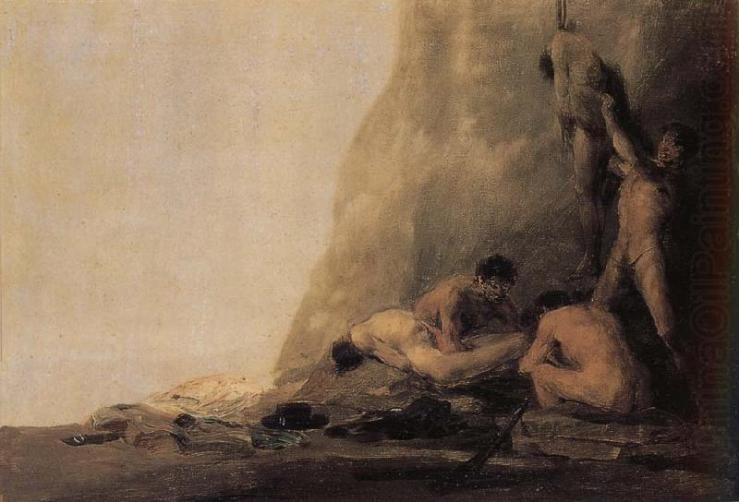
Cannibals Preparing Their Victims — Goya

Guillermo Del Toro Talks About Alfonso Cuarón’s New Film Gravity

Vodpod videos no longer available.

“Florida” — Elizabeth Bishop

“Florida” by Elizabeth Bishop

The state with the prettiest name,
the state that floats in brackish water,
held together by mangrave roots
that bear while living oysters in clusters,
and when dead strew white swamps with skeletons,
dotted as if bombarded, with green hummocks
like ancient cannon-balls sprouting grass.
The state full of long S-shaped birds, blue and white,
and unseen hysterical birds who rush up the scale
every time in a tantrum.
Tanagers embarrassed by their flashiness,
and pelicans whose delight it is to clown;
who coast for fun on the strong tidal currents
in and out among the mangrove islands
and stand on the sand-bars drying their damp gold wings
on sun-lit evenings.
Enormous turtles, helpless and mild,
die and leave their barnacled shells on the beaches,
and their large white skulls with round eye-sockets
twice the size of a man’s.
The palm trees clatter in the stiff breeze
like the bills of the pelicans. The tropical rain comes down
to freshen the tide-looped strings of fading shells:
Job’s Tear, the Chinese Alphabet, the scarce Junonia,
parti-colored pectins and Ladies’ Ears,
arranged as on a gray rag of rotted calico,
the buried Indian Princess’s skirt;
with these the monotonous, endless, sagging coast-line
is delicately ornamented.

Thirty or more buzzards are drifting down, down, down,
over something they have spotted in the swamp,
in circles like stirred-up flakes of sediment
sinking through water.
Smoke from woods-fires filters fine blue solvents.
On stumps and dead trees the charring is like black velvet.
The mosquitoes
go hunting to the tune of their ferocious obbligatos.
After dark, the fireflies map the heavens in the marsh
until the moon rises.
Cold white, not bright, the moonlight is coarse-meshed,
and the careless, corrupt state is all black specks
too far apart, and ugly whites; the poorest
post-card of itself.
After dark, the pools seem to have slipped away.
The alligator, who has five distinct calls:
friendliness, love, mating, war, and a warning–
whimpers and speaks in the throat
of the Indian Princess.

Francis Ford Coppola, Artist, Thief

“He’s One of My Favorite American Writers” — F. Scott Fitzgerald

Another fragment from F. Scott Fitzgerald’s Notebooks. The piece was left out of Tender Is the Night. Phillips Oppenheim was British.

“Did you ever read the books of Phillips Oppenheim?”
“I think I’ve read one.”
“He’s one of my favorite American writers,” Tommy said simply. “He writes about the Riviera, you know. I don’t know whether the things he writes about are true but this place is like that.”
Standing before the gate they were suddenly bathed in a small floodlight, quick as a flashlight, that left them blinded for a moment. Then a voice from behind the gate.
“Who’s this, please?”
“Tell Monsieur Irv that it’s Monsieur Tommy. Tell him we can’t come in the house, but can he come out in the garden a minute.”
A section of the gate rumbled open like a safe and they were in a park, following a young Italo-American dandy toward a lighted house. They waited just out of range of the porch light, and presently the door opened and a dark thin man of forty came out and gazed blindly.
“Where you, Tommy?”
“Down here. Don’t come. I have a lady with me who wants to remain anonymous.”
“How?”
“I’ve got a lady with me who doesn’t want to be seen— like you.”
“Oh, I unestand, I unestand.”
“We want to swim. Anybody on the beach?”
“Nobody, nobody. Go ahead, Tommy. You want suits, towels?”
“All right, some towels. Nodoby’s going to come down, are they?”
“No, no, nobody. Say, did you see Du Pont de Nemours went up—”
“No stock market in the presence of ladies.”
“All right, excuse me, lady. You wait now—Salve will take you down—don’t want you to get in trouble.”
As Irv re-entered the house Tommy said, “Probably he’s phoning the machine gunner to pass us. He was a fellow townsman of yours in Chicago—now he has the best beach on the Riviera.”
Curiously Nicole followed down an intricate path, then through a sliding steel door that operated like a guillotine, out into a roofless cavern of white moonlight, formed by pale boulders about a cup of phosphorescent waters. It faced Monaco and the blur of Mentone beyond. She likes his taste in bringing her here—from the high­handed storming of Mr. Irv’s fortress.
Then, starting back the lane by which they had come Tommy tripped over a wire and a faint buzzer sounded far away.
“My God!” he excalimed, “that a man should have to live like this!”
“Is he afraid of burglars?”
“He’s afraid of your lovely city and came here with a bodyguard of a dozen monkeys—is that the right slang? Maybe Al Capone is after him. Anyhow he has one period between being drunk and being sober when he is very nice.”
He broke off as again they were momentarily bathed in the ubiquitous spotlight. Then amber lamps glowed on the porch of the castellated villa and Mr. Irv, this time supported by the very neat young man, came out unsteadily.
“I kept them off the beach, Tommy,” he announced.
“Thank you, very much.”
“Won’t you both change your minds and come in? In greatest confidence. I have some other ladies here.” He raised his voice as if to address Nicole. “As you are a lady of background you will like ’em.”
“It’s four o’clock,” said Tommy. “We have to get to our background. Good night.”
Irv’s voice followed them.
“You never make a mistake having to do with a lady.”

Jonathan Franzen Talks About The Mekons

I don’t really care for Franzen either as writer or public figure (but as an object of derision, sure), but I do  Mekons.

Spurious — Lars Iyer

Lars Iyer’s début novel Spurious is about two would-be intellectuals, W., the book’s comic hero, and his closest friend, our narrator Lars. They bitch and moan and despair: it’s the end of the world, it’s the apocalypse; they find themselves incapable of original thought, of producing any good writing. The shadow of Kafka paralyzes them. They travel about Europe, seeking out knowledge and inspiration — or at least a glimpse of some beautiful first editions of Rosenzweig. They attend dreadful academic conferences; they write letters. They flounder and fail. In the meantime, a fungus of seemingly metaphysical proportions infects Lars’s apartment, soaking it through, compounding his desperation, as no one can figure out how to get rid of it—

No one understands the damp. It’s Talmudic. The damp is the enigma at the heart of everything. It draws into it the light of all explanation, all hope. The damp says: I exist, and that is all. I am that I am: so the damp. I will outlast you and outlast everything: so the damp.

The passage is a lovely example of Iyer’s humor, which pervades the book just as the damp creeps through his narrator’s home, absurd and bewildering. Iyer is willing to play with tropes of theology and philosophy in ways that are simultaneously absurd, hyperbolic, and deadly serious. “These are the End Times, but who knows it but us?” his hapless heroes wonder. W. is not without solutions though—-

Every conversation must be driven through the apocalyptic towards the messianic, that’s W.’s principle; the shared sense that it’s all at an end, it’s all finished. He loves nothing better than conversations of this kind, W. says, when everything’s at stake, when everything that could be said is said.

That’s when messianism begins, W. says, You have to wear out speech, to run it down. And then? And then, W. says, inanity begins, reckless inanity. The whole night opens up. You have to drink a great deal to get there. It’s an art.

The dialogue (or monologue pretending to be dialogue, more accurately) highlights the verbal slapstick of Spurious, its willingness to shift direction while retaining tone. “Both characters are mesmerised by a real disaster,” Iyer told me in a recent interview (the interview, by the way, makes a better case for reading Spurious than I can hope to here) . “And both — particularly W. — are mesmerised by their partial responsibility for this disaster. The ‘strained and unreasoning’ laughter of Spurious is a response to the grimness of the world that is of our making.”

W.’s response to our grim, apocalyptic world is a mix of absurd humor and real cruelty toward his friend Lars. And if W. is willing to mock and laugh at his friend, he also mocks and laughs at the world, and himself—only his laughter never absolves or forgives or otherwise deflects the cruelty and grimness of the world (or his own cruelty, in turn). When W. calls Lars fat or chastises his laziness or derides his intellect, there’s a recursive angle to his jabs, a sense that they will return to rest on his own brow. It’s all in good fun except when it’s not.

W. and Lars face the same trial that all thinking people face during the End Times, the inescapable, all-devouring nightmare of history, art, philosophy. Perhaps a passage will explicate better than I—

Kafka was always our model, we agree. How is it possible that a human being could write like that?, W. says, again and again. It’s always at the end of the night when he says this, after we’ve drunk a great deal and the sky opens above us, and it is possible to think of what is most important.

At the same time, we have Kafka to blame for everything. Our lives each took a wrong turn when we opened The Castle. It was quite fatal: there was literature itself! We were finished. What could we do, simple apes, but exhaust ourselves in imitation? We had been struck by something we could not understand. It was above us, beyond us, and we were not of its order.

If our heroes are disciples of literature (or the purity of “literature itself”), they are also its prisoners, its slaves, the tormented. W. attempts to find ways out through mathematics and Talmudic theology, but these disciplines entail their own weight and chains—and ultimately, W.’s own shortcomings in these areas only point back to his own reliance on literature (and, in turn, his own shortcomings there again). Still, W. (or Lars, or Iyer, I guess), is willing to share his citations with us, quoting or paraphrasing from a rich intellectual diet.

Although in some ways Spurious is fragmentary and elliptical, a series of riffs, vignettes, and skits, it is also in many ways a traditional novel, with emotionally drawn characters in Lars and W., whose friendship resounds with a deep reality and psychological honesty with which most readers will identify. W. suggests that companionship and friendship are reasons enough to continue existence in the face of despair and absurdity; he then turns around and accuses Lars of being a terrible friend. Iyer offers the kind of truth that has become a cliché, offers it perhaps without cynicism or irony, and then immediately punctures it, even as he reinforces its original truth. Spurious is full of such vacillations, reeling like its often-drunk heroes at times, but always unified by a consistent tone and tight prose. Funny and lively, even when it’s erudite and depressive, Spurious is a lovely little book for drinking and thinking. Read it and pass it on to a dear friend.

Spurious is available now from Melville House; I encourage you again, dear reader, to read my interview with Lars Iyer.
“Very Few of the Things That I Start I Finish” — David Foster Wallace