
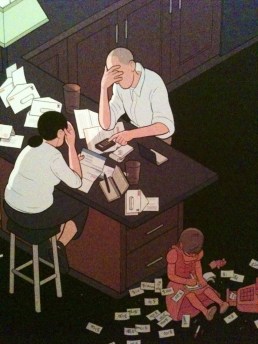
“Disconnect,” one of the longer episodes in Chris Ware’s novel Building Stories, serves as a reminder of Ware’s strength as a prose writer. Wordiness tends to kill illustrated storytelling, at least in my estimation. Sure, there are exceptions—Joe Sacco and Harvey Pekar come to mind—but in general, I think comics are at their best when thought and word bubbles are uncluttered (or nonexistent). Ware clearly understands the economy of his medium, and some of Building Stories’ finest moments have been wordless ones where Ware constructs the story in pure imagery. We can see so much of the plot and themes of “Disconnect” in this full page, for instance:
But Ware also packs plenty of storytelling into his prose in “Disconnect,” where he continues the story of Lonely Girl, who it’s probably better to now call Married Mom—I still think of her as Lonely Girl though, after first really meeting her in “September 23rd, 2000,” an episode ostensibly narrated by her diary. “Disconnect” is a second diary of sorts, her internal narration guiding us subtly through episodes in her life over a series of years. “Disconnect” focuses on LG/MM raising her young daughter against the backdrop of a strained marriage.
Lonely Girl/Married Mom’s observations ring particularly true. She points out that “When your children aren’t around, you miss them with every fiber of your being—but when they are, you just want to get them to bed so you can go read the news or something,” an observation simultaneously profound, disturbing, and banal. When our heroine recalls how her relationship to her pet cat changed after her child was born, I also saw shades of myself: “The day we brought Lucy home, almost to the minute, all applied personality to Miss Kitty evaporated, and we saw her for what she was—an animal—and an animal who we were beholden to feed and house, with, suddenly it seemed, little to offer in return.”
Through Lonely Girl/Married Mom, Ware paints a portrait of modern disconnection and alienation, and, even as we sympathize with the heroine, Ware also allows us to see through her—or rather, to see what she can’t see, or to see what she refuses to see. The effect is an irony that tips into small, banal tragedy.
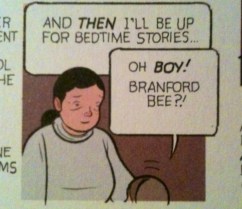
Ware’s prose is usually overshadowed by his gifts as a draftsman, an architect—he’s the builder of Building Stories, a fact that this chapter alludes to, both internally, intertextually, and metatextually. We learn, for example, that Branford the Bee is a story within a story:
This nesting of stories emerges in the final part of “Disconnect,” wherein our aged narrator—addressing her grown daughter—relates a dream:
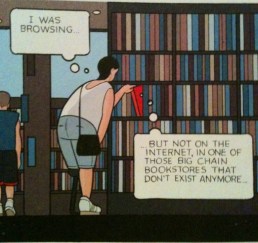
The scene culminates so beautifully that it brought a little tear to my eye. Most postmodern novels contain (often more than once) their own descriptions, and Building Stories is no exception:
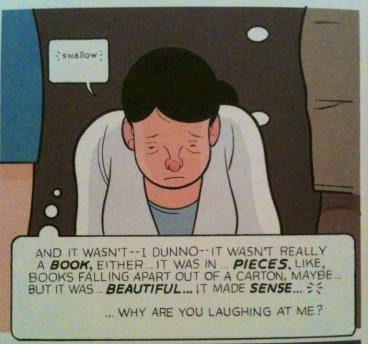
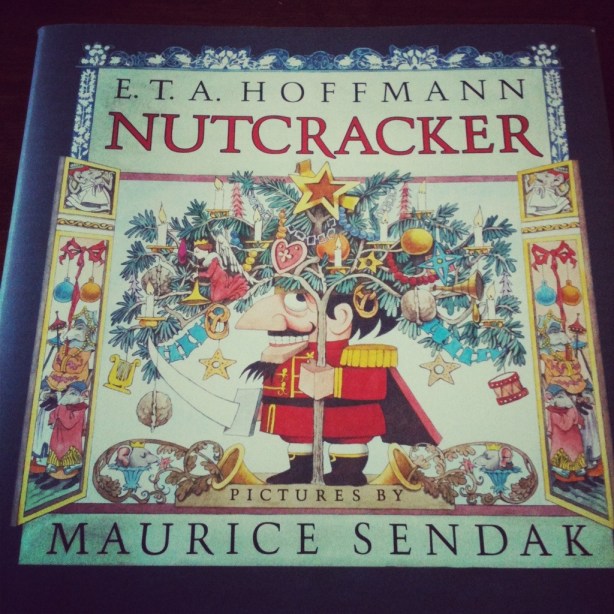
And yet what we see here isn’t postmodern cleverness or empty gimmickry, but the evocation of dream and imagination and desire and creation—the spirit of the book, of what it means to build stories. Reading the final panels of “Disconnect,” I immediately recalled the epigraph to Building Stories (it’s on the interior of the box lid, by the colophon and dedication):




 Biblioklept