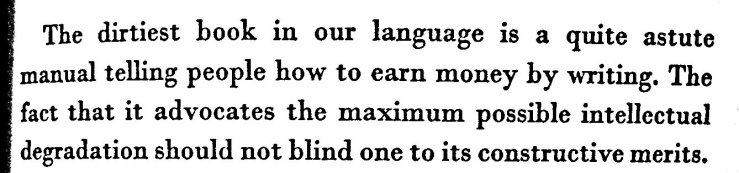
The dirtiest book (Ezra Pound)

20130506-200713

Iggy Pop Talks About Repo Man (And Kinda Sorta Wears a Shirt)

My Aunt Asleep Dreaming of Monsters — James Ensor

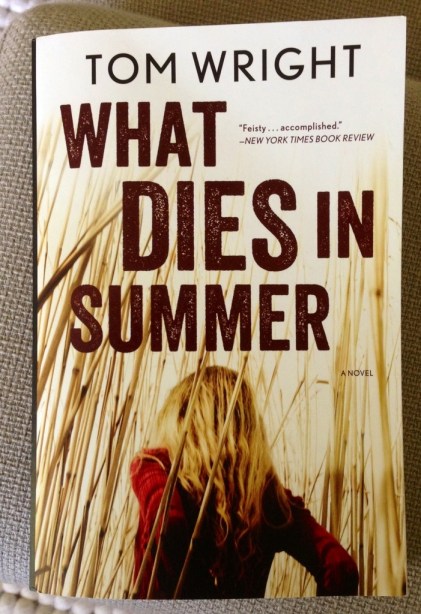
What Dies in Summer (Book Acquired, 5.02.2013)

20130505-185201.jpg

Tom Wright’s What Dies in Summer is new in trade paperback. Pub’s blurb:

A riveting Southern Gothic coming-of-age debut by major new talent.

“I did what I did, and that’s on me.” From that tantalizing first sentence, Tom Wright sweeps us up in a tale of lost innocence. Jim has a touch of the Sight. It’s nothing too spooky and generally useless, at least until the summer his cousin L.A. moves in with him and their grandmother. When Jim and L.A. discover the body of a girl, brutally raped and murdered in a field, an investigation begins that will put both their lives in danger. In the spirit of The Lovely Bones and The Little FriendWhat Dies in Summer is a novel that casts its spell on the very first page and leaves an indelible mark.

And the lede from Julie Myerson’s review last year in the NYT:

Why do teenagers make such ideal protagonists? Maybe it’s because they’re doing just what novels do: struggling to make sense of a troubling and imperfect world. And at first, Jim, called Biscuit, and L. A. (Lee Ann), the teenage cousins at the heart of Tom Wright’s feisty first novel, are ­exactly what you hope they’ll be: funny, frank, mouthy and more than a touch off kilter. Both are forced to live with their grandmother because their mothers aren’t up to the task of child rearing. Their homes are haunted by alcoholism and violence, but Gram takes a simple, affectionate, responsibility for them — though it’s almost inevitable that certain questions, if not the answers, will push their ugly way to the surface sooner or later.

Plagiarism

You pray to the gods? Let me grant your prayers.

It is the honourable characteristic of Poetry that its materials are to be found in every subject which can interest the human mind.

The evidence of this fact is to be sought, not in the writings of Critics, but in those of Poets themselves.

Criticism is a genre of literature or it does not exist.

To imagine is to misinterpret, which makes all poems antithetical to their precursors.

Who are your parents? Do you know?

The strength of any poem is the poems that it has managed to exclude.

The death of Patroclus, Iliad XVI:

Even as he spoke, the shadow of death came over him. His soul fled from his limbs and went down to the house of Hades, bemoaning its fate, leaving manhood and youth.

Every poem is a misinterpretation of a parent poem.

There is a voice inside of you
That whispers all day long.

New poems originate mainly from old poems.

Ivan Goncharov was essentially deranged in the last thirty years of his life.

And insisted that every word Turganev published had been stolen from him.

All unknowing you are the scourge of your own flesh and blood, the dead below the earth and the living here above, and the double lash of your mother and your father’s curse will whip you from this land one day, their footfall treading you down in terror, darkness shrouding your eyes that now can see the light!

The primary struggle of the young poet is against the old masters.

The father is perceived as an obstacle.

They fuck you up, your mum and dad.

The death of Hector, Iliad XXII:

Even as he spoke, the shadow of death came over him. His soul fled from his limbs and went down to the house of Hades, bemoaning its fate, leaving manhood and youth.

The ephebe must clear imaginative space for himself through a creative misreading of the strong poets of the past.

The old God, the Father, took second place; Christ, the Son, stood in His stead, just as in those dark times every son had longed to do.

Only strong poets can overcome this anxiety of influence.

Picasso: He was my one and only master. Cézanne! It was the same with all of us—he was like our father.

Lesser lights become derivative flatterers and never achieve poetic immortality for themselves.

No poem, not even Shakespeare or Milton or Chaucer, is ever strong enough to totally exclude every crucial precursor text or poem.

To you, your father should be as a god;
One that compos’d your beauties, yea, and one
To whom you are but as a form in wax
By him imprinted, and within his power
To leave the figure or disfigure it.

Mom and pop, they will fuck you up.

Under the wide and starry sky,

Dig the grave and let me lie.

Glad did I live and gladly die,

And I laid me down with a will.

Poetic misreading or misprison proper.

A corrective movement in his own poem. A swerve.

A breaking device, a movement towards discontinuity with the precursor.

But they were fucked up in their turn.

Sublime.

Counter-sublime.

How sharper than a serpent’s tooth it is
To have a thankless child.

The return of the dead.

As though the later poet himself had written the precursor’s characteristic work.

To imagine after a poet is to learn his own metaphors for his acts of reading.

A poem is not an overcoming of anxiety, but is that anxiety.

This be the verse you grave for me:

Here he lies where he longed to be.

Man hands on misery to man.

There are no interpretations but only misinterpretations.

“Spring Spleen” — Lydia Davis

IMG_5712

The Same — Goya

“On Dress and Deportment” — Jerome K. Jerome

“ON DRESS AND DEPORTMENT” by Jerome K. Jerome

They say—people who ought to be ashamed of themselves do—that the consciousness of being well dressed imparts a blissfulness to the human heart that religion is powerless to bestow. I am afraid these cynical persons are sometimes correct. I know that when I was a very young man (many, many years ago, as the story-books say) and wanted cheering up, I used to go and dress myself in all my best clothes. If I had been annoyed in any manner—if my washerwoman had discharged me, for instance; or my blank-verse poem had been returned for the tenth time, with the editor’s compliments “and regrets that owing to want of space he is unable to avail himself of kind offer;” or I had been snubbed by the woman I loved as man never loved before—by the way, it’s really extraordinary what a variety of ways of loving there must be. We all do it as it was never done before. I don’t know how our great-grandchildren will manage. They will have to do it on their heads by their time if they persist in not clashing with any previous method.

Well, as I was saying, when these unpleasant sort of things happened and I felt crushed, I put on all my best clothes and went out. It brought back my vanishing self-esteem. In a glossy new hat and a pair of trousers with a fold down the front (carefully preserved by keeping them under the bed—I don’t mean on the floor, you know, but between the bed and the mattress), I felt I was somebody and that there were other washerwomen: ay, and even other girls to love, and who would perhaps appreciate a clever, good-looking young fellow. I didn’t care; that was my reckless way. I would make love to other maidens. I felt that in those clothes I could do it.

They have a wonderful deal to do with courting, clothes have. It is half the battle. At all events, the young man thinks so, and it generally takes him a couple of hours to get himself up for the occasion. His first half-hour is occupied in trying to decide whether to wear his light suit with a cane and drab billycock, or his black tails with a chimney-pot hat and his new umbrella. He is sure to be unfortunate in either decision. If he wears his light suit and takes the stick it comes on to rain, and he reaches the house in a damp and muddy condition and spends the evening trying to hide his boots. If, on the other hand, he decides in favor of the top hat and umbrella—nobody would ever dream of going out in a top hat without an umbrella; it would be like letting baby (bless it!) toddle out without its nurse. How I do hate a top hat! One lasts me a very long while, I can tell you. I only wear it when—well, never mind when I wear it. It lasts me a very long while. I’ve had my present one five years. It was rather old-fashioned last summer, but the shape has come round again now and I look quite stylish.

But to return to our young man and his courting. If he starts off with the top hat and umbrella the afternoon turns out fearfully hot, and the perspiration takes all the soap out of his mustache and converts the beautifully arranged curl over his forehead into a limp wisp resembling a lump of seaweed. The Fates are never favorable to the poor wretch. If he does by any chance reach the door in proper condition, she has gone out with her cousin and won’t be back till late. Continue reading ““On Dress and Deportment” — Jerome K. Jerome”

Musical Allegory — Rembrandt