Reclining River Nymph at the Fountain — Lucas Cranach the Elder

July 13, 1838 (Nathaniel Hawthorne)

July 13th.–A show of wax-figures, consisting almost wholly of murderers and their victims,–Gibbs and Hansley, the pirates, and the Dutch girl whom Gibbs murdered. Gibbs and Hansley were admirably done, as natural as life; and many people who had known Gibbs would not, according to the showman, be convinced that this wax-figure was not his skin stuffed. The two pirates were represented with halters round their necks, just ready to be turned off; and the sheriff stood behind them, with his watch, waiting for the moment. The clothes, halter, and Gibbs’s hair were authentic. E. K. Avery and Cornell,–the former a figure in black, leaning on the back of a chair, in the attitude of a clergyman about to pray; an ugly devil, said to be a good likeness. Ellen Jewett and R. P. Robinson, she dressed richly, in extreme fashion, and very pretty; he awkward and stiff, it being difficult to stuff a figure to look like a gentleman. The showman seemed very proud of Ellen Jewett, and spoke of her somewhat as if this wax-figure were a real creation. Strong and Mrs. Whipple, who together murdered the husband of the latter. Lastly the Siamese twins. The showman is careful to call his exhibition the “Statuary.” He walks to and fro before the figures, talking of the history of the persons, the moral lessons to be drawn therefrom, and especially of the excellence of the wax-work. He has for sale printed histories of the personages. He is a friendly, easy-mannered sort of a half-genteel character, whose talk has been moulded by the persons who most frequent such a show; an air of superiority of information, a moral instructor, with a great deal of real knowledge of the world. He invites his departing guests to call again and bring their friends, desiring to know whether they are pleased; telling that he had a thousand people on the 4th of July, and that they were all perfectly satisfied. He talks with the female visitors, remarking on Ellen Jewett’s person and dress to them, he having “spared no expense in dressing her; and all the ladies say that a dress never set better, and he thinks he never knew a handsomer female.” He goes to and fro, snuffing the candles, and now and then holding one to the face of a favorite figure. Ever and anon, hearing steps upon the staircase, he goes to admit a new visitor. The visitors,–a half-bumpkin, half country-squire-like man, who has something of a knowing air, and yet looks and listens with a good deal of simplicity and faith, smiling between whiles; a mechanic of the town; several decent-looking girls and women, who eye Ellen herself with more interest than the other figures,–women having much curiosity about such ladies; a gentlemanly sort of person, who looks somewhat ashamed of himself for being there, and glances at me knowingly, as if to intimate that he was conscious of being out of place; a boy or two, and myself, who examine wax faces and faces of flesh with equal interest. A political or other satire might be made by describing a show of wax-figures of the prominent public men; and by the remarks of the showman and the spectators, their characters and public standing might be expressed. And the incident of Judge Tyler as related by E—- might be introduced

From Nathaniel Hawthorne’s American Note-Books.

The Library of the Palais Lanckoronski, Vienna — Rudolf von Alt

Ascot Finery — Laura Knight

Heavy Rain — Utagawa Kuniyoshi

“Rain” — Alice Meynell

“Rain”

by

Alice Meynell

Not excepting the falling stars—for they are far less sudden—there is nothing in nature that so outstrips our unready eyes as the familiar rain.  The rods that thinly stripe our landscape, long shafts from the clouds, if we had but agility to make the arrowy downward journey with them by the glancing of our eyes, would be infinitely separate, units, an innumerable flight of single things, and the simple movement of intricate points.

The long stroke of the raindrop, which is the drop and its path at once, being our impression of a shower, shows us how certainly our impression is the effect of the lagging, and not of the haste, of our senses.  What we are apt to call our quick impression is rather our sensibly tardy, unprepared, surprised, outrun, lightly bewildered sense of things that flash and fall, wink, and are overpast and renewed, while the gentle eyes of man hesitate and mingle the beginning with the close.  These inexpert eyes, delicately baffled, detain for an instant the image that puzzles them, and so dally with the bright progress of a meteor, and part slowly from the slender course of the already fallen raindrop, whose moments are not theirs.  There seems to be such a difference of instants as invests all swift movement with mystery in man’s eyes, and causes the past, a moment old, to be written, vanishing, upon the skies.

The visible world is etched and engraved with the signs and records of our halting apprehension; and the pause between the distant woodman’s stroke with the axe and its sound upon our ears is repeated in the impressions of our clinging sight.  The round wheel dazzles it, and the stroke of the bird’s wing shakes it off like a captivity evaded.  Everywhere the natural haste is impatient of these timid senses; and their perception, outrun by the shower, shaken by the light, denied by the shadow, eluded by the distance, makes the lingering picture that is all our art.  One of the most constant causes of all the mystery and beauty of that art is surely not that we see by flashes, but that nature flashes on our meditative eyes.  There is no need for the impressionist to make haste, nor would haste avail him, for mobile nature doubles upon him, and plays with his delays the exquisite game of visibility.

Momently visible in a shower, invisible within the earth, the ministration of water is so manifest in the coming rain-cloud that the husbandman is allowed to see the rain of his own land, yet unclaimed in the arms of the rainy wind.  It is an eager lien that he binds the shower withal, and the grasp of his anxiety is on the coming cloud.  His sense of property takes aim and reckons distance and speed, and even as he shoots a little ahead of the equally uncertain ground-game, he knows approximately how to hit the cloud of his possession.  So much is the rain bound to the earth that, unable to compel it, man has yet found a way, by lying in wait, to put his price upon it.  The exhaustible cloud “outweeps its rain,” and only the inexhaustible sun seems to repeat and to enforce his cumulative fires upon every span of ground, innumerable.  The rain is wasted upon the sea, but only by a fantasy can the sun’s waste be made a reproach to the ocean, the desert, or the sealed-up street.  Rossetti’s “vain virtues” are the virtues of the rain, falling unfruitfully.

Baby of the cloud, rain is carried long enough within that troubled breast to make all the multitude of days unlike each other.  Rain, as the end of the cloud, divides light and withholds it; in its flight warning away the sun, and in its final fall dismissing shadow.  It is a threat and a reconciliation; it removes mountains compared with which the Alps are hillocks, and makes a childlike peace between opposed heights and battlements of heaven.

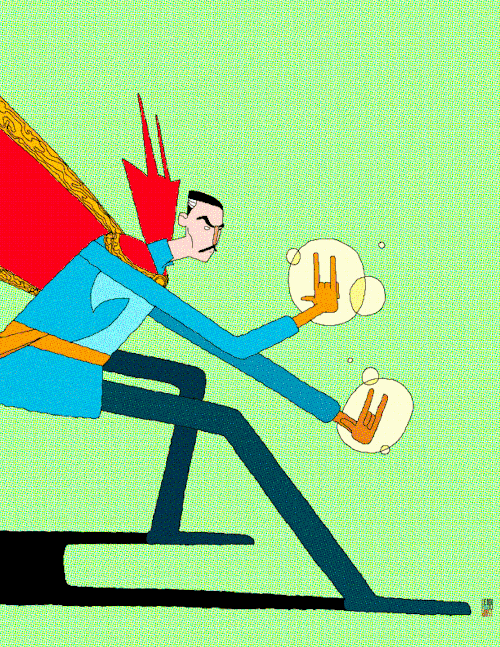
Dr. Strange — Henry Bonsu

strange

RIP Tommy Ramone

ramone

RIP Tommy Ramone, 1952-2014

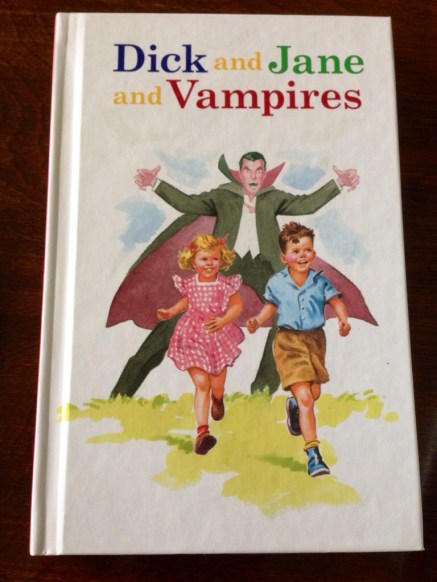
Dick and Jane and Vampires (Book Acquired, 6.30.2014)

20140707-150319-54199418.jpg

Look, I usually hate novelty books, but a few weeks ago I took my kids to the book store and I saw this there in the children’s section and it’s just so on-the-nose in its Dick and Jane style that I had to pick it up. My daughter read it to my son. It scared him.

20140707-150317-54197704.jpg

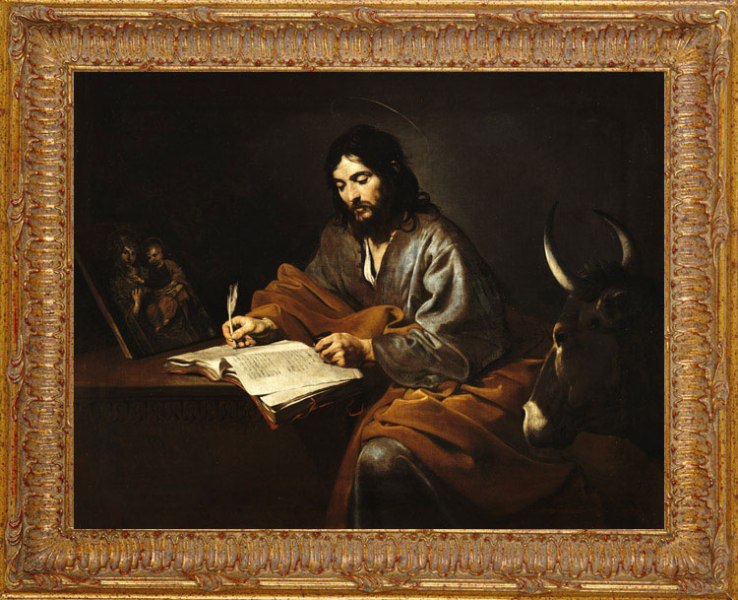
Saint Luke the Evangelist — Valentin de Boulogne

TG-69BX

Shower — Kitagawa Utamaro

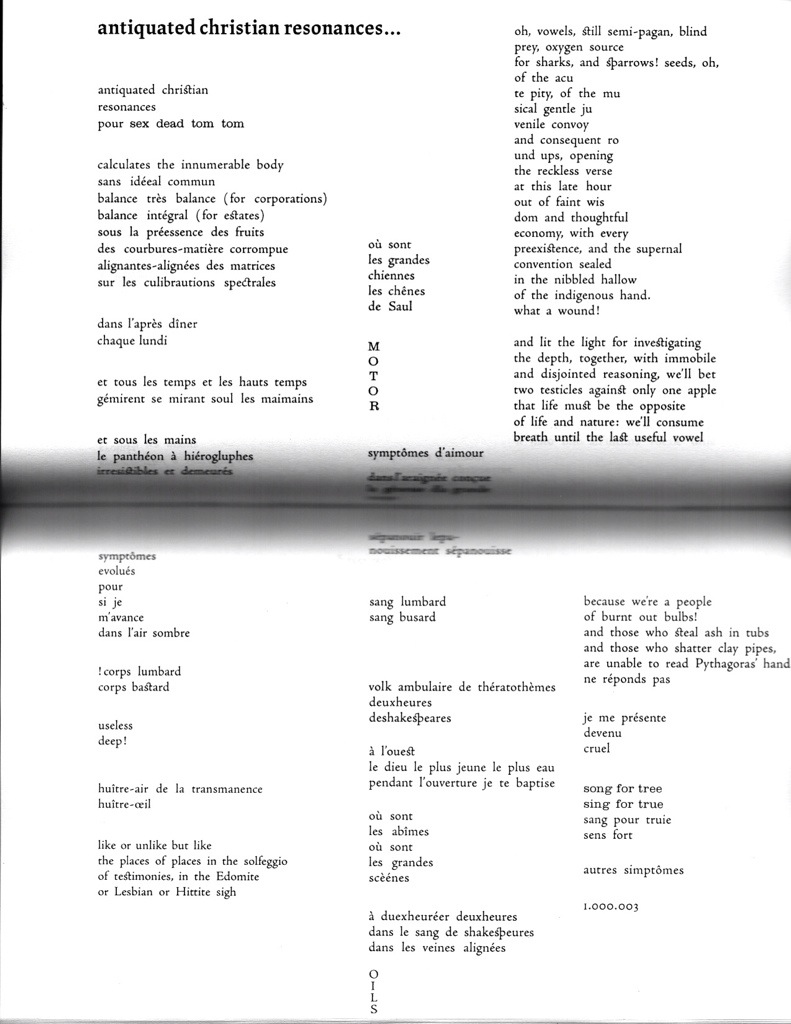
“antiquated christian resonances…” — Emilio Villa

20140711-164712-60432826.jpg

Sancho Regrets Having Traded the Care of His Donkey for the Role of Governor — Gustave Doré

My other blog, Gustave Doré’s Don Quixote, is winding down to its end.

“How autobiographical is this portrait?” (Margot at the Wedding)

Couple in Love — Giacomo Manzù

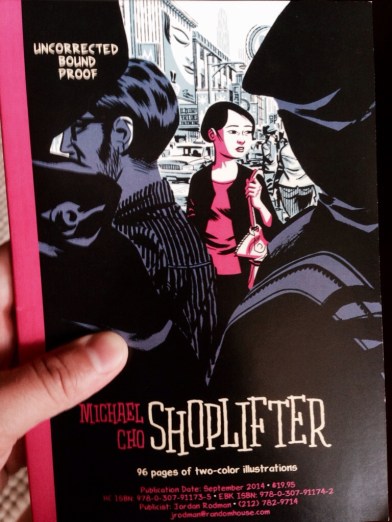
Michael Cho’s Shoplifter (Book Acquired, 6.06.2014)

20140707-150424-54264125.jpg

The nice people at Pantheon sent along a bound galley of Michael Cho’s graphic novel Shoplifter when they sent me a copy of Charles Burns’s Sugar Skull. Both titles are out this fall.

I read Shoplifter in one short sitting—it’s a pleasant read, and Cho’s talent shows in the small panels and big splashes alike.
20140707-150425-54265789.jpg

His blurb:

Corinna Park used to have big plans. Studying English literature in college, she imagined writing a successful novel and leading the idealized life of an author. After graduation, she moved to a big city and took a job at an advertising agency—just to pay off her student loans. Now she’s worked in the same office for five years and the only thing she’s written is . . . copy. She longs for companionship (other than her cat),gets no satisfaction from her job, and feels numbed by the monotony of a life experienced through a series of screens. But whenever she shoplifts a magazine from the corner store near her apartment, she feels a little, what? A little more alive. Yet Corinna knows there must be something more to life, and she faces the same question as does everyone of her generation: how to find it?

Is the story a bit familiar? Sure. But Cho updates it to the post-social media world, where advertisers have convinced almost everyone (especially themselves) that what they are doing is Important Art. There’s a smallness to Shoplifter—the book shouldn’t be an epic, of course, but 96 pages feels slim here. I guess I would’ve liked to see Corinna the biblioklept, you know, steal more. Still, her ultimate resistance to a mundane life feels like a victory in the end.