Wherefore Now Ariseth the Illusion of a Third Dimension — Ivan Albright

The headless corpse. Love kills penguin. Pig got rheumatism. Nagged Bible reader slays wife. (William Gaddis)


After the injection, he picked up his newspaper. The Sunday edition, still in the rack beside him, required fifty acres of timber for its “magic transformation of nature into progress, benefits of modern strides in transportation, communication, and freedom of the press: public information. (True, as he got into the paper, the average page was made up of a half-column of news, and four-and-one-half columns of advertising.) A train wreck in India, 27 killed, he read; a bus gone down a ravine in Chile, 1 American and 11 natives; avalanche in Switzerland, death toll mounts . . . This evening edition required only a few acres of natural grandeur to accomplish its mission (for it carried less advertising). Mr. Pivner read carefully. Kills father with meat-ax. Sentenced for slaying of three. Christ died of asphyxiation, doctor believes. Woman dead two days, invalid daughter unable to summon help. Nothing escaped Mr. Pivner’s eye, nor penetrated to his mind; nothing evaded his attention, as nothing reached his heart. The headless corpse. Love kills penguin. Pig got rheumatism. Nagged Bible reader slays wife. “Man makes own death chair, 25,000 volts. “Ashamed of world,” kills self. Fearful of missing anything, he read on, filled with this anticipation which was half terror, of coming upon something which would touch him, not simply touch him but lift him and carry him away.Every instant of this sense of waiting which he had known all of his life, this waiting for something to happen (uncertain quite what, and the Second Advent intruded) he brought to his newspaper reading, spellbound and ravenous. Man fights lion in zoo, barefisted. Cow kills woman. Rooster kills woman. Dogs eat Eskimo. As he turned the pages, folding them smartly back over the bulk of the newspaper, he relaxed a little at his comparative safety away from the news, drew comfort from the train wreck (he was not in it), the bus accident in Chile (nor in that), the meat-ax slaying (he had not done it), the headless corpse (not his), and so the newspaper served him, externalizing in the agony of others the terrors and temptations inadmissible in himself. Even though the evening paper repeated the news of the morning paper, he read attentively again, reworded, of the hunt for the unknown person who was releasing birds from an uptown zoo, of the discovery of two priceless art treasures, original paintings of Dierick Bouts, in a pawnshop in Hell’s Kitchen, of the murder trial in Mouth, Mississippi, where just that morning the husband’s heart had been exhibited in court. All of these civilized wonders were brought together, he was made to feel, expressly for him, by the newspaper. True, they kept him in such a state that he often bought late editions of the same newspaper, seeing different headlines than those tucked under his arm, only to read the story from column six suddenly elevated to a banner across columns one to four. True, often the only way he could know whether he had read a newspaper was to turn to the comic strips, where life flowed in continuum; and recognizing them, he knew that he must have read everything else closely and avidly, that nothing had evaded his eye, nor penetrated to his heart round which he had built that wall called objectivity without which he might have gone mad. As the tales of violence seemed daily to increase it hardly occurred to him that he was living in such unnatural density of population that it daily supported disasters sufficient for a continent. Added to this came the blood of the world, piped in on wires, and wireless, teletype, undersea cables, and splashed without a drop lost in transit upon Mr. Pivner, who sat, hard, patient, unbending, wiped it from his eyes, and waited for more.

An inhumanity museum from William Gaddis’s The Recognitions. I’m citing part of the passage for a bigger thing I’m working on now—it’s a bit too long for that thing, but too good not to share in full.

“What Have You Done?” — Ben Marcus

When Paul’s flight landed in Cleveland, they were waiting for him. They’d probably arrived early, set up camp right where passengers float off the escalator scanning for family. They must have huddled there watching the arrivals board, hoping in the backs of their minds, and the mushy front parts of their minds, too, yearning with their entire minds, that Paul would do what he usually did—or didn’t—and just not come home.

But this time he’d come, and he’d hoped to arrive alone, to be totally alone until the very last second. The plan was to wash up, to be one of those fat guys at the wall of sinks in the airport bathroom, soaping their underarms, changing shirts. Then he’d get a Starbucks, grab his bag, take a taxi out to the house. That way he could delay the face time with these people. Delay the body time, the time itself, the time, while he built up his nerve, or whatever strategy it was that you employed when bracing yourself for Cleveland. For the people of Cleveland. His people.

They had texted him, though, and now here they were in a lump, pressed so tightly together you could almost have buckshot the three of them down with a single pull. Not that he was a hunter. Dad, Alicia, and Rick. The whole sad gang, minus one. Paul considered walking up to them and holding out his wrists, as if they were going to cuff him and lead him away. You have been sentenced to a week with your family! But they wouldn’t get it, and then, forever more, he’d be the one who had started it, after so many years away, the one who had triggered all the difficulty yet again with his bullshit and games, and why did he need to queer the thing before the thing had even begun, unless, gasp, he wanted to set fire to his whole life

Read the rest of Ben Marcus’s story “What Have You Done?” at The New Yorker.

Painter and His Model — Balthus

Field Guide — Fred Tomaselli

Fred

“All art constantly aspires towards the condition of music”

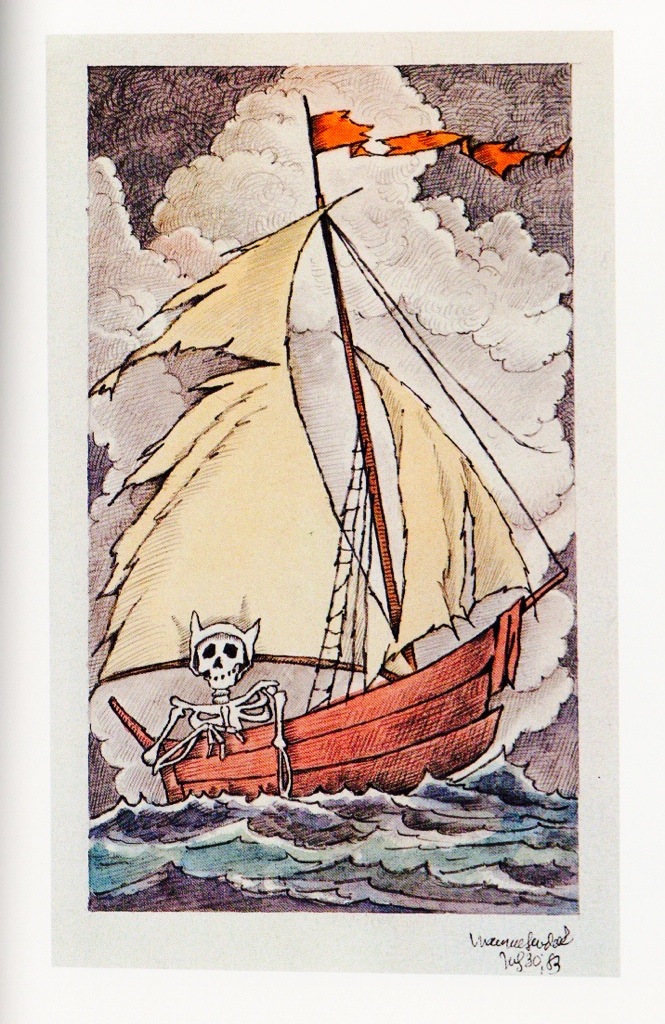
Skeleton Max — Maurice Sendak

20140630-154101-56461596.jpg

Read “Jumping the Line,” A Very Short Story by Mikhail Bulgakov

“Jumping the Line”

by

Mikhail Bulgakov

There was a line outside the Moscow Criminal Investigations Department.
“Oh. . . Geez . . . all this waiting and waiting!”
“Even here there’s a line!”
“What can you do? Do you happen to be a bookkeeper, if you don’t mind my asking?”
“Nope, I’m a cashier.”
“Did you come to get arrested?”
“Yeah, what else!”
“That’s good. So how much were you caught with, if you don’t mind my asking?”
“Three thousand smackers.”
“That’s nothing, young man. You’ll just get a year. But if you take your heartfelt repentance into consideration . . . and the fact that the Bolshevik Anniversary is coming up . . . so, all in all, you’ll do three months, and then, the sweet bird of freedom!”
“You sure? You’re comforting me no end. I was already real desperate. Yesterday I went to see a lawyer, and he scared the living daylights out of me–the article, he tells me, is such that you won’t get away with less than two years’ hard labor.
“Pure twaddle, young man! Trust my experience. Hey, you there! Where do you think you’re going? Get back in line!”
“Citizens! Let me pass! I filched some official money! My con- science is biting me!”
“Everyone’s conscience is biting them! You’re not the only one!”
“I squandered the entire holdings of the Moscow Agrarian Industry Store in drink!” a low voice kept mumbling.
“Quite a fellow, aren’t you! You’ll pay for it now! You’ll never see the light of day again!”
“That’s not true! What if I’m ignorant? And not educated? And there are hereditary social conditions, huh? And my previous con- viction? And being an alcoholic?”
“How come they put you, an alcoholic, in charge of the wine store?”
“I did warn them!”
“Hey you! Where do you think you’re going?”
“Citizen Officer! I am tortured by remorse!”
“Hey, stop pushing! I’m tortured too!”
“Excuse me! I’ve been waiting here since ten in the morning to get arrested!”
“Just give me your last name, place of employment, amount!”
“Fioletov, Misha, tortured by remorseful conscience!”
“How much?”
“In Makrettrest–two hundred smackers.”
“Sidorchuk! Process this Fioletov!”
“May I take my toothbrush with me?”
“You may! And you, what was the amount?”
“Seven people.”
“A family?”
“Exactly.”
“And how much was it you took?”
“Two hundted in cash, a robe, a watch and some candlesticks.”
“I don’t get it. An official’s robe?”
“What do you mean? Us guys don’t deal with officials. It was a private family. Shtippelman.”
“You’re Shtippelman?”
“Me? No!”
“Then what’s Shtippelman got to do with it?”
“What he’s got to do with it is we knifed him. I’m reporting seven people: his wife, five children and their granny.”
“Sidorchuk! Kakhrushin! Take preventive measures! Now!”
“Excuse me, Citizen Officer! Why is this man getting preferential treatment?”
“Please, citizens! Be conscientious! this man is a murderer!”
“Big deal! You’re telling us he’s a big shot or something? For all you know I might have blown up a state institution!”
“This is an outrage! Bureaucracy! We will complain!”

Translated from Russian by Anneta Greenlee and published in the Fall ’98 issue of Conjunctions—read more Bulgakov stories there.

anxOxna (Excerpt) — AUJIK

(More) / (About).


The Model — Jacek Malczewski

Hesiod and the Muse — Gustave Moreau

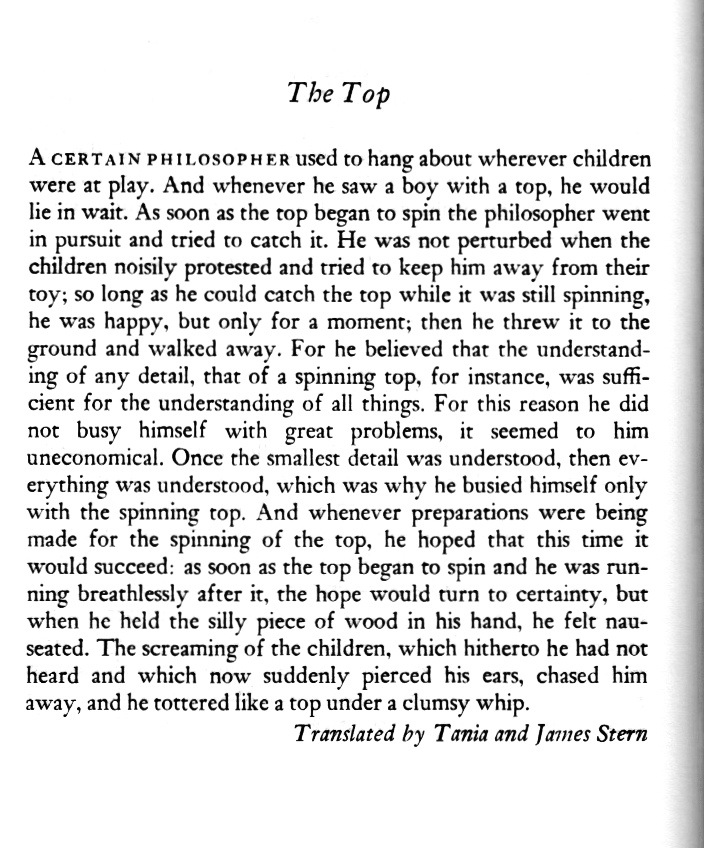
“The Top” — Franz Kafka

20140721-162337-59017474.jpg

Not bad, but (The Far Side)

20140801-165913-61153383.jpg

Some content on this page was disabled on May 26, 2021 as a result of a DMCA takedown notice from Gary Larson. You can learn more about the DMCA here:

https://wordpress.com/support/copyright-and-the-dmca/

Painter’s Inspiration — Jacek Malczewski

What Kant meant when he said that the aesthetic experience is not mediated by concepts (William H. Gass)

My photographs, I used a lot, but I used them as a teaching tool, and they really worked wonderfully,in a sense. Let’s suppose you’re trying to get the students to understand what [Immanuel] Kant meant when he said that the aesthetic experience is not mediated by concepts. Okay, show them a photograph of a floor of an abandoned building—I used to go into all of these abandoned buildings—that’s been sitting abandoned for years, and there are all these pigeons flying around, and they’ve layered the floor with guano, pigeon shit. Huge warehouses, light coming in shining off this, and it’s gorgeous. So you take a picture, which looks like—you know how with aluminum foil, when you crumple it up and then smooth it out again you have all these little lines and it shines and stuff? That’s what it looks like. So you show them a slide. “Oh, boy,” they say. Then you say, “It’s pigeon shit.” Concept. Bing! And I used to take pictures of dog deposits and bird shit, especially during the season when there was lots of huckleberries, some berries that would stain it, and sometimes it would be quite nice, and I’d use things like this, so they’d see it right away, they’d understand that there are names for things, forbidden them to see, and to get them used to seeing, because they’ll never have an aesthetic experience until they can do that. So I used a lot of it, and some of it would have been okay to put in along with an essay as an illustration, but not as “Look at this as a photograph.”

William H. Gass, in a 2013 interview with Rain Taxi.

Reading on the Rocks — John George Brown

e01921decb6d91ddb8f81e76e9804d26

The Drinkers (After Daumier) — Vincent van Gogh