
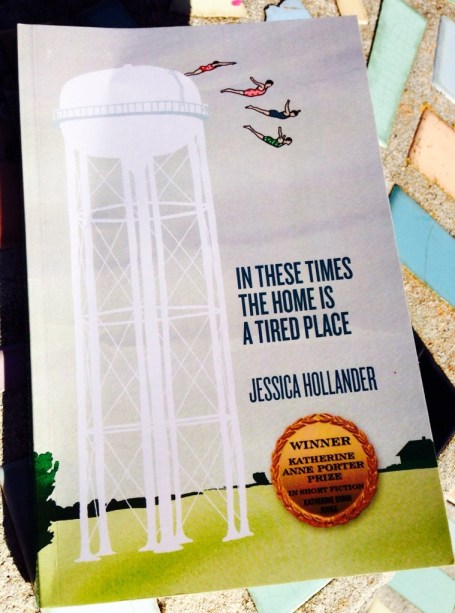
Every story in Jessica Hollander’s début collection In These Times the Home Is a Tired Place feels thoroughly real, deeply authentic, and if we already know the contours of these plots—perhaps having lived some of them ourselves—Hollander makes us experience them anew with her bristling, strange sentences. Hollander writes here of families on the brink and families broken, families fragmenting and families forgetting. She conjures domestic spaces limned with ghosts and memories, children and parents who aren’t quite sure how to be a family, but who nevertheless try—even if trying is really just imagining.
In the strong opener “You Are a Good Girl I Love You,” our narrator Gertrude, about to graduate high school, imagines her future as a kind of do-over, one without interference from her overprotective father, inert mother, and wild child sister:
Of course Pete and I would attend the same school, live in the same dorm, plan classes to start and end together so we would be only briefly apart. We had a dependable timeline mapped out behind the child’s armoire in his room involving dates: graduations, wedding, first jobs, first house, babies raised by smiling parents. Some evenings we practiced smiling thinking the more one does it the more natural it feels.
Many of the stories that follow respond to—and complicate—Gertrude’s dream of an ideal happy family. There’s “girlfriend,” the otherwise-unnamed hero of “This Kind of Happiness,” who imagines alternate titles she might assume: “Single Mother. Pregnant Bride. Gun-toting Madwoman.” In “The Good Luck Doll,” Claudia feigns a pregnancy to keep her boyfriend deluded but happy (if only for a time). She’s happy to imagine the pregnancy along with him. “March On,” like several of the stories here, follows the aftermath of a failed marriage. What happens when a family ceases to take the same form? Are the old appendages, the in-laws now essentially dead to their ex-family members? Waiting outside her father’s mother’s door after having knocked and yelled for Grandma to open, narrator Raimy reflects on these changes:
Then, briefly, I decided she was dead. I imagined her pale on the floor and me making all this noise, and I felt even more disruptive. I stared at the quiet street, thinking about us all dead in some ways: the distance between people and the everyday separation, and maybe we constantly grieved each other and our old lives. The only comfort we had was thinking maybe it was like this for everyone, maybe there was a connection in that.
The connection that Raimy imagines and takes solace in runs through In These Times the Home Is a Tired Place. We find it in one of the strongest stories in the collection, “What Became of What She Had Made,” as mother Lynette grieves her estrangement from her adult daughter Christine. She enlists her other daughter Olivia, “a lush,” to come along on the mission. They head from Michigan to Ohio by taxi, fortifying themselves with morning doses of schnapps. By the time we finally meet Christine, we see why she might want her family to simply pretend she’s dead. Hollander’s restraint pays off, her precise sentences revealing just enough detail for us to fill in the dark gaps.
Sometimes Hollander achieves a near archetypal mode, but one tempered in specificity. Consider how much she packs in to just one paragraph form “I Now Pronounce You”:
In the husband and wife’s third year of marriage, a woman—not the wife—pushed the no-longer-new husband from a third-story window after she’d slightly burnt some chicken and he’d refused to eat it. And also he had refused to leave hi no-longer-new wife for the other woman because he’d realized the other woman was crazy. Besides, it was nice with the wife, who didn’t complain when he watched sports in the morning and who stayed home and became a better cook and took care of their small son, whom he didn’t much like but planned to increasingly as the son came to resemble more a small man than a wild animal.
Hollander’s rhetorical force is perhaps most evident in the title story, which undertakes to describe a divorce from several perspectives. Written as three lists, each one perhaps a year removed from the next, “In These Times the Home Is a Tired Place” merges form and content, its broken, discontinuous structure mirroring the broken, discontinuous family at its non-center. That breaking up also figures in the daughter’s favorite pastime:
The girl spent a Saturday morning cutting snowflakes from a pile of paper she’d found on her mother’s desk. The snowflakes were peppered with sliced negotiations, diamond-pierced words like child and property and alimony, and when the girl finished she strung the flakes together and hung them from her window so they trailed to the berry bush and flapped in the stirred summer wind.
Attempting to mediate (if not ameliorate) the daughter’s trauma is the babysitter:
“A sad situation,” the babysitter told friends lounging at night on her parents’ screened-in porch. She planned years from now to marry the boy holding her hand, though he’d quit his job and all summer hung around his mother’s pool smoking cigarettes with his mother. Dark ahead; behind them bright inside with television and bills, an electric piano and screwed-together projects. The babysitter said, “Stay together for the child,” and one friend said, “Yes,” and another said, “No,” and another said, “Life is life,” and the boyfriend said nothing.
The babysitter might have stepped out of one of the other stories in this collection. Maybe she’s older in one of those stories. Maybe she’s Gertrude or Olivia or Raimy or girlfriend or wife. She dreams, she imagines, and we know enough—Hollander shows us enough—to see that her imagining the future is not enough.
Tolstoy gave us that famous opener: “Happy families are all alike; every unhappy family is unhappy in its own way.” The unhappy families of Hollander’s collection are unhappy in their own, personal, distinct and distinctly unhappy ways—but our author, by focusing on the capacities of her characters to imagine ways of being happy, also shows us that in many ways unhappy families are all alike. Recommended.
In These Times the Home Is a Tired Place is newish from University of North Texas Press.







 Biblioklept