“Titles for Unwritten Articles, Essays, and Stories” — Samuel Butler

“Titles for Unwritten Articles, Essays, and Stories”

from Samuel Butler’s Note-Books

  1. The Art of Quarrelling.
  2. Christian Death-beds.
  3. The Book of Babes and Sucklings.
  4. Literary Struldbrugs.
  5. The Life of the World to Come.
  6. The Limits of Good Faith.
  7. Art, Money and Religion.
  8. The Third Class Excursion Train, or Steam-boat, as the Church of the Future.
  9. The Utter Speculation involved in much of the good advice that is commonly given—as never to sell a reversion, etc.
  10. Tracts for Children, warning them against the virtues of their elders.
  11. Making Ready for Death as a Means of Prolonging Life.  An Essay concerning Human Misunderstanding.  So McCulloch [a fellow art-student at Heatherley’s, a very fine draughtsman] used to say that he drew a great many lines and saved the best of them.  Illusion, mistake, action taken in the dark—these are among the main sources of our progress.
  12. The Elements of Immorality for the Use of Earnest Schoolmasters.
  13. Family Prayers: A series of perfectly plain and sensible ones asking for what people really do want without any kind of humbug.
  14. A Penitential Psalm as David would have written it if he had been reading Herbert Spencer.
  15. A Few Little Crows which I have to pick with various people.
  16. The Scylla of Atheism and the Charybdis of Christianity.
  17. The Battle of the Prigs and Blackguards.
  18. That Good may Come.
  19. The Marriage of Inconvenience.
  20. The Judicious Separation.
  21. Fooling Around.
  22. Higgledy-Piggledy.
  23. The Diseases and Ordinary Causes of Mortality among Friendships.
  24. The finding a lot of old photographs at Herculaneum or Thebes; and they should turn out to be of no interest.
  25. On the points of resemblance and difference between the dropping off of leaves from a tree and the dropping off of guests from a dinner or a concert.
  26. The Sense of Touch: An essay showing that all the senses resolve themselves ultimately into a sense of touch, and that eating is touch carried to the bitter end.  So there is but one sense—touch—and the amœba has it.  When I look upon the foraminifera I look upon myself.
  27. The China Shepherdess with Lamb on public-house chimney-pieces in England as against the Virgin with Child in Italy.
  28. For a Medical pamphlet: Cant as a means of Prolonging Life.
  29. For an Art book: The Complete Pot-boiler; or what to paint and how to paint it, with illustrations reproduced from contemporary exhibitions and explanatory notes.
  30. For a Picture: St. Francis preaching to Silenus.  Fra Angelico and Rubens might collaborate to produce this picture.
  31. The Happy Mistress.  Fifteen mistresses apply for three cooks and the mistress who thought herself nobody is chosen by the beautiful and accomplished cook.
  32. The Complete Drunkard.  He would not give money to sober people, he said they would only eat it and send their children to school with it.
  33. The Contented Porpoise.  It knew it was to be stuffed and set up in a glass case after death, and looked forward to this as to a life of endless happiness.
  34. The Flying Balance.  The ghost of an old cashier haunts a ledger, so that the books always refuse to balance by the sum of, say, £1.15.11.  No matter how many accountants are called in, year after year the same error always turns up; sometimes they think they have it right and it turns out there was a mistake, so the old error reappears.  At last a son and heir is born, and at some festivities the old cashier’s name is mentioned with honour.  This lays his ghost.  Next morning the books are found correct and remain so.
  35. A Dialogue between Isaac and Ishmael on the night that Isaac came down from the mountain with his father.  The rebellious Ishmael tries to stir up Isaac, and that good young man explains the righteousness of the transaction—without much effect.
  36. Bad Habits: on the dropping them gradually, as one leaves off requiring them, on the evolution principle.
  37. A Story about a Freethinking Father who has an illegitimate son which he considers the proper thing; he finds this son taking to immoral ways, e.g. he turns Christian, becomes a clergyman and insists on marrying.
  38. For a Ballad: Two sets of rooms in some alms-houses at Cobham near Gravesend have an inscription stating that they belong to “the Hundred of Hoo in the Isle of Grain.”  These words would make a lovely refrain for a ballad.
  39. A story about a man who suffered from atrophy of the purse, or atrophy of the opinions; but whatever the disease some plausible Latin, or imitation-Latin name must be found for it and also some cure.
  40. A Fairy Story modelled on the Ugly Duckling of Hans Andersen about a bumptious boy whom all the nice boys hated.  He finds out that he was really at last caressed by the Huxleys and Tyndalls as one of themselves.
  41. A Collection of the letters of people who have committed suicide; and also of people who only threaten to do so.  The first may be got abundantly from reports of coroners’ inquests, the second would be harder to come by.
  42. The Structure and Comparative Anatomy of Fads, Fancies and Theories; showing, moreover, that men and women exist only as the organs and tools of the ideas that dominate them; it is the fad that is alone living.
  43. An Astronomical Speculation: Each fixed star has a separate god whose body is his own particular solar system, and these gods know each other, move about among each other as we do, laugh at each other and criticise one another’s work.  Write some of their discourses with and about one another.

Continue reading ““Titles for Unwritten Articles, Essays, and Stories” — Samuel Butler”

Lost in Dreams — Friedrich von Amerling

2aFriedrich von Amerling (Austrian-born artist, 1803-1887) In Traumen Versunken, 1835.

Meanwhile.

20140719-140243-50563063.jpg

“Good God, What a Night That Was” — Petronius

Capture(Translation by Kenneth Rexroth)

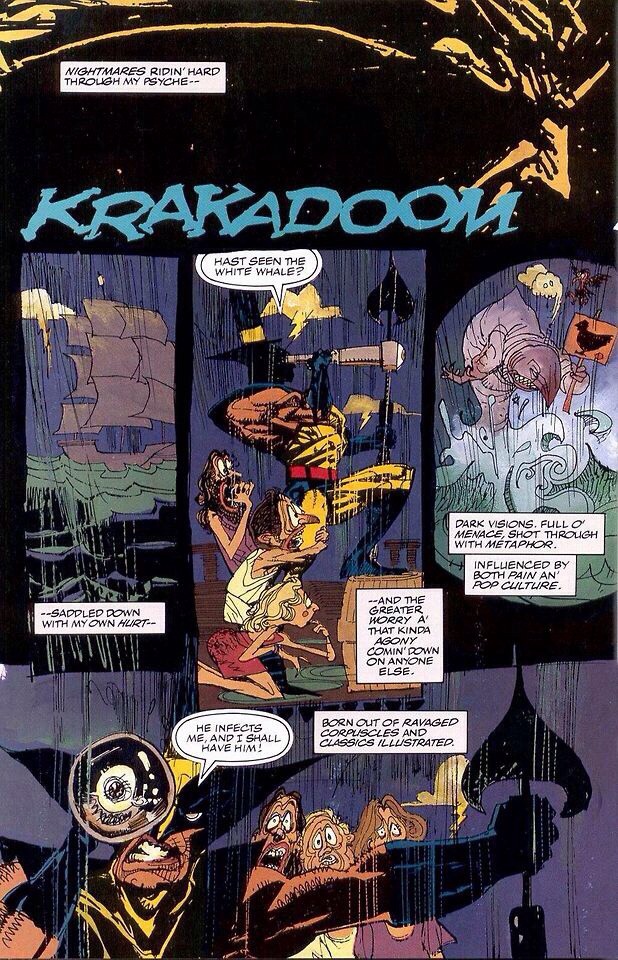
Wolverine/Moby-Dick (Bill Sienkiewicz)

IMG_0085.JPG

Meeting of Thirty-Five Heads of Expression — Louis Léopold Boilly

“The Undertaker’s Chat” — Mark Twain

“Now that corpse,” said the undertaker, patting the folded hands of deceased approvingly, “was a brick—every way you took him he was a brick. He was so real accommodating, and so modest-like and simple in his last moments. Friends wanted metallic burial-case—nothing else would do. I couldn’t get it. There warn’t going to be time—anybody could see that.

“Corpse said never mind, shake him up some kind of a box he could stretch out in comfortable, he warn’t particular ’bout the general style of it. Said he went more on room than style, anyway in a last final container.

“Friends wanted a silver door-plate on the coffin, signifying who he was and wher’ he was from. Now you know a fellow couldn’t roust out such a gaily thing as that in a little country-town like this. What did corpse say?

“Corpse said, whitewash his old canoe and dob his address and general destination onto it with a blacking-brush and a stencil-plate, ‘long with a verse from some likely hymn or other, and p’int him for the tomb, and mark him C. O. D., and just let him flicker. He warn’t distressed any more than you be—on the contrary, just as ca’m and collected as a hearse-horse; said he judged that wher’ he was going to a body would find it considerable better to attract attention by a picturesque moral character than a natty burial-case with a swell door-plate on it.

“Splendid man, he was. I’d druther do for a corpse like that ‘n any I’ve tackled in seven year. There’s some satisfaction in buryin’ a man like that. You feel that what you’re doing is appreciated. Lord bless you, so’s he got planted before he sp’iled, he was perfectly satisfied; said his relations meant well, perfectly well, but all them preparations was bound to delay the thing more or less, and he didn’t wish to be kept layin’ around. You never see such a clear head as what he had—and so ca’m and so cool. Jist a hunk of brains—that is what he was. Perfectly awful. It was a ripping distance from one end of that man’s head to t’other. Often and over again he’s had brain-fever a-raging in one place, and the rest of the pile didn’t know anything about it—didn’t affect it any more than an Injun Insurrection in Arizona affects the Atlantic States. Well, the relations they wanted a big funeral, but corpse said he was down on flummery—didn’t want any procession—fill the hearse full of mourners, and get out a stern line and tow him behind. He was the most down on style of any remains I ever struck. A beautiful, simpleminded creature—it was what he was, you can depend on that. He was just set on having things the way he wanted them, and he took a solid comfort in laying his little plans. He had me measure him and take a whole raft of directions; then he had the minister stand up behind a long box with a table-cloth over it, to represent the coffin, and read his funeral sermon, saying ‘Angcore, angcore!’ at the good places, and making him scratch out every bit of brag about him, and all the hifalutin; and then he made them trot out the choir, so’s he could help them pick out the tunes for the occasion, and he got them to sing ‘Pop Goes the Weasel,’ because he’d always liked that tune when he was downhearted, and solemn music made him sad; and when they sung that with tears in their eyes (because they all loved him), and his relations grieving around, he just laid there as happy as a bug, and trying to beat time and showing all over how much he enjoyed it; and presently he got worked up and excited, and tried to join in, for, mind you, he was pretty proud of his abilities in the singing line; but the first time he opened his mouth and was just going to spread himself his breath took a walk.

“I never see a man snuffed out so sudden. Ah, it was a great loss—a powerful loss to this poor little one-horse town. Well, well, well, I hain’t got time to be palavering along here—got to nail on the lid and mosey along with him; and if you’ll just give me a lift we’ll skeet him into the hearse and meander along. Relations bound to have it so—don’t pay no attention to dying injunctions, minute a corpse’s gone; but, if I had my way, if I didn’t respect his last wishes and tow him behind the hearse I’ll be cuss’d. I consider that whatever a corpse wants done for his comfort is little enough matter, and a man hain’t got no right to deceive him or take advantage of him; and whatever a corpse trusts me to do I’m a-going to do, you know, even if it’s to stuff him and paint him yaller and keep him for a keepsake—you hear me!”

He cracked his whip and went lumbering away with his ancient ruin of a hearse, and I continued my walk with a valuable lesson learned—that a healthy and wholesome cheerfulness is not necessarily impossible to any occupation. The lesson is likely to be lasting, for it will take many months to obliterate the memory of the remarks and circumstances that impressed it.

By Mark Twain. From Sketches New and Old.

The Reader — Harold Knight

(c) John Croft; Supplied by The Public Catalogue Foundation

The story of the Fisher King

Mickey Mouse — Jack Kirby

IMG_0084.JPG

Hemingway’s regard for T. S. Eliot, as a poet, a critic, and a man (David Markson)

IMG_0087.PNG

Untitled — Zdislav Beksinski

“James Joyce” — James Huneker

“James Joyce,” a chapter from James Huneker’s collection of criticism, Unicorns (1917).

Who is James Joyce? is a question that was answered by John Quinn, who told us that the new writer was from Dublin and at present residing in Switzerland; that he is not in good health—his eyes trouble him—and that he was once a student in theology, but soon gave up the idea of becoming a priest. He is evidently a member of the new group of young Irish writers who see their country and countrymen in anything but a flattering light. Ireland, surely the most beautiful and most melancholy island on the globe, is not the Isle of Saints for those iconoclasts. George Moore is a poet who happens to write English, though he often thinks in French; Bernard Shaw, notwithstanding his native wit, is of London and the Londoners; while Yeats and Synge are essentially Celtic, and both poets. Yes, and there is the delightful James Stephen, who mingles angels’ pin-feathers with rainbow gold; a magic decoction of which we never weary. But James Joyce, potentially a poet, and a realist of the De Maupassant breed, envisages Dublin and the Dubliners with a cruel scrutinising gaze. He is as truthful as Tchekov, and as grey—that Tchekov compared with whose the “realism” of De Maupassant is romantic bric-à-brac, gilded with a fine style. Joyce is as implacably naturalistic as the Russian in his vision of the sombre, mean, petty, dusty commonplaces of middle-class life, and he sometimes suggests the Frenchman in his clear, concise, technical methods. The man is indubitably a fresh talent.

Emerson, after his experiences in Europe, became an armchair traveller. He positively despised the idea of voyaging across the water to see what is just as good at home. He calls Europe a tapeworm in the brain of his countrymen. “The stuff of all countries is just the same.” So Ralph Waldo sat in his chair and enjoyed thinking about Europe, thus evading the worries of going there too often. It has its merit, this Emersonian way, particularly for souls easily disillusioned. To anticipate too much of a foreign city may result in disappointment. We have all had this experience. Paris resembles Chicago, or Vienna is a second Philadelphia at times; it depends on the colour of your mood. Few countries have been so persistently misrepresented as Ireland. It is lauded to the eleventh heaven of the Burmese or it is a place full of fighting devils in a hell of crazy politics. Of course, it is neither, nor is it the land of Lover and Lever; Handy Andy and Harry Lorrequer are there, but you never encounter them in Dublin. John Synge got nearer to the heart of the peasantry, and Yeats and Lady Gregory brought back from the hidden spaces fairies and heroes.

Is Father Ralph by Gerald O’Donovan a veracious picture of Irish priesthood and college life? Is the fiction of Mr. Joyce representative of the middle class and of the Jesuits? A cloud of contradictory witnesses passes across the sky. What is the Celtic character? Dion Boucicault’s The Shaughraun? Or isn’t the pessimistic dreamer with the soul of a “wild goose,” depicted in George Moore’s story, the real man? Celtic magic, cried Matthew Arnold. He should have said, Irish magic, for while the Irishman is a Celt, he is unlike his brethren across the Channel. Perhaps he is nearer to the Sarmatian than the continental Celt. Ireland and Poland! The Irish and the Polish! Dissatisfied no matter under which king! Not Playboys of the Western World, but martyrs to their unhappy temperaments. Continue reading ““James Joyce” — James Huneker”

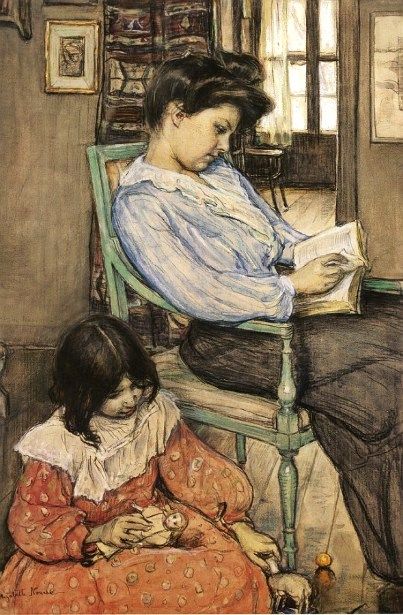
An Hour of Leisure — Elisabeth Nourse

woman reading

Countryside With Saint George Fighting the Dragon — Albrecht Altdorfer

Out of Focus

Sancho Finds Trees full of Hanged Men — Gustave Doré