David Foster Wallace’s “Order and Flux in Northampton” was published in the Fall 1991 issue of Conjunctions: Part I, Part II, Part III, Part IV.
First few paragraphs:
BARRY DINGLE, CROSS-EYED PURVEYOR of bean sprouts, harbors for Myrnaloy Trask, operator of Xerox and regent of downtown Northampton’s most influential bulletin board at Collective Copy, an immoderate love.
Myrnaloy Trask, trained Reproduction Technician, unmarried woman, vegetarian, flower-child tinged faintly with wither, overseer and editor of Announcement and Response at the ten-foot-by-ten-foot communicative hub of a dizzying wheel of leftist low-sodium aesthetes, a woman politically correct, active in relevant causes, slatternly but not unerotic, all-weather wearer of frayed denim skirts and wool knee-socks, sexually troubled, ambiguous sexual past, owner of one spectacularly incontinent Setter/Retriever bitch, Nixon, so named by friend Don Megala because of the dog’s infrangible habit of shitting where it eats: Myrnaloy has eyes only for Don Megala: Don Megala, middle-aged liberal, would-be drifter, maker of antique dulcimers by vocation, by calling a professional student, a haunter of graduate hallways, adrift, holding fractions of Ph.D.’s in everything from Celtic phonetics to the sociobiology of fluids from the University of Massachusetts at Amherst, presently at work on his seventh and potentially finest unfinished dissertation, an exhaustive study of Stephen Dedalus’s sublimated oedipal necrophilia vis à vis Mrs. D. in Ulysses, an essay tentatively titled “The Ineluctable Modality of the Ineluctably Modal.”
Add to the above Trask-data the fact that, though Barry Dingle’s spotlessly managed franchise, The Whole Thing Health Food Emporium, is located directly next to Collective Copy on Northampton’s arterial Great Awakening Avenue, Myrnaloy has her nutritional needs addressed at The Whole Thing’s out-of-the-way, sawdust-floored competition, Good Things to Eat, Ltd., the proprietor of which, one Adam Baum, is a crony of Megala, and add also that The Whole Thing is in possession of its own Xerox copier, and the following situation comes into narrative focus: Myrnaloy Trask has only the sketchiest intuition that Barry Dingle even exists, next door.
For Barry Dingle, though, the love of Myrnaloy Trask has become the dominant emotional noisemaker in his quiet life, the flux-ridden state of his heart, a thing as intimately close to Dingle as Myrnaloy is forever optically distant or unreal.
My attraction to film as a medium—i.e., a dead medium, as opposed to what they pompously called at the time a living spectacle—had undoubtedly been the first sign in me of a disinterest in, even a disgust for, the general public—and probably for mankind in general. I was working at that time on my sketches with a small video camera, fixed on a tripod and linked to a monitor on which I could control in real time my intonations, funny expressions, and gestures. I had always had a simple principle: if I burst out laughing at a given moment, it was this moment that had a good chance of making the audience laugh as well. Little by little, as I watched the cassettes, I became aware that I was suffering from a deeper and deeper malaise, sometimes bordering on nausea. Two weeks before the premiere, the reason for this malaise became clear to me: what I found more and more unbearable wasn’t even my face, nor was it the repetitive and predictable nature of certain standard impersonations that I was obliged to do: what I could no longer stand was laughter, laughter in itself, that sudden and violent distortion of the features that deforms the human face and strips it instantly of all dignity. If man laughs, if he is the only one, in the animal kingdom, to exhibit this atrocious facial deformation, it is also the case that he is the only one, if you disregard the natural self-centeredness of animals, to have attained the supreme and infernal stage of cruelty.
The three-week run was a permanent calvary; for the first time, I truly experienced those notorious, atrocious tears of the clown; for the first time, I truly understood mankind. I had dismantled the cogs in the machine, and I knew how to make it work, whenever I wanted. Every evening, before going on stage, I swallowed an entire sheet of Xanax. Every time the audience laughed (and I could predict it, I knew how to dose my effects, I was a consummate professional), I was obliged to turn away so as not to see those hideous faces those, hundreds of faces moved by convulsions, agitated by hate.
From Michel Houellebecq’s novel The Possibility of an Island.
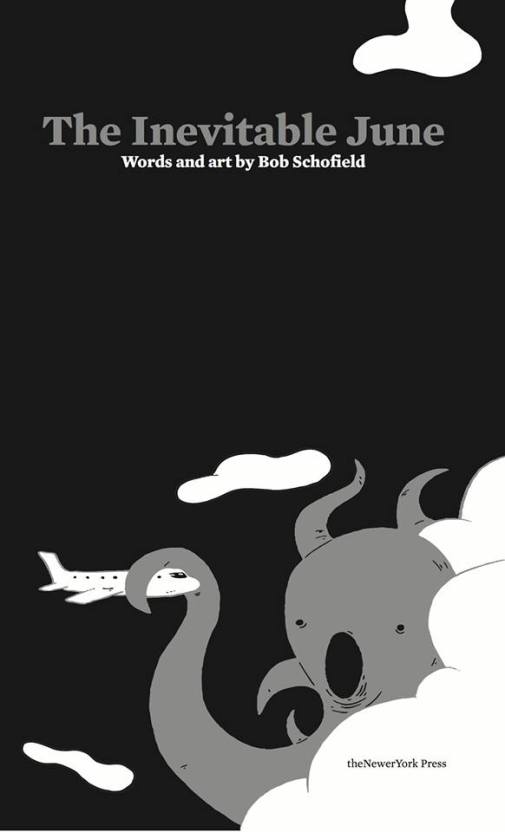
Bob Schofield is a writer and artist. He first showed up on my radar when theNewerYork sent me a digital file of his book The Inevitable June, which I described as “the kind of thing that we need more of; not a gimmick or a hybrid, but something new.” I’m still not sure what the book is, but I dig it. Bob was kind enough to talk to me over a series of emails about his work. Read some of Bob’s work at his website. Read my review of The Inevitable June here. Read our discussion below.
Biblioklept: What is The Inevitable June?
Bob Schofield: The Inevitable June is a collection of 30 surreal short prose pieces, one for every day in June, intercut with black and white illustrations. The drawings don’t always correspond to the text, and there isn’t really much of a coherent “story” per se, but there is certainly momentum and direction. The book definitely goes somewhere, though I’m not sure where exactly that “somewhere” is.
I kind of just wanted to build a little world that mirrored my imagination. A kind of scale-model. So I wanted it to be a little cold and sad and spooky and, hopefully, also fun. Like some kind of weird, floppy theme park made of bound paper squares.
Biblioklept: How did you compose that “scale-model”? Did you have an outline from the outset?
Schofield: There were a few structural “rules” I came up with, and the rest I sort of made up as I went. Like I knew I’d have thirty pieces total, and they’d all be titled for successive days in June. It’s funny, a lot of the momentum in the book just comes from that progression of calendar days. I guess we’re just culturally wired to feel like we’re going somewhere when we see those days slide by. But in the book it’s all relatively arbitrary, and if you were to take the days away as titles, things would feel a lot more meandering.
My other big structural decision was to start every piece with “This morning,” which would become a kind of refrain throughout the book. I kind of thought of it a bit like a dinner bell, indicating one course of the meal was over, and we were moving on to the next.
Then as I was writing all the individual pieces, I’d cherry pick certain images and phrases I liked, and then be sure to repeat them later on. That way the reader’s brain would kind of light up as they recognized parts of a pattern, even though the pattern wasn’t really saying anything specific. I think that kind of thing is important when you don’t have a more familiar storytelling structure to rely on. You need to give the reader something to hold on to.
And for myself as writer, all these patterns and rules gave me just as much of an anchor. It meant I wasn’t just spinning off into some sort of insane, incomprehensible word soup. I’d always be aware that I’d have to wrap things up at some point, and move on to the next “day.”
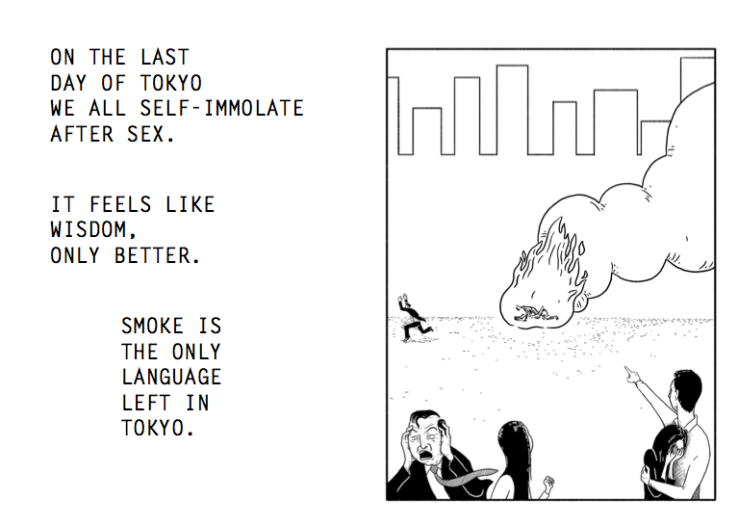
Biblioklept: Your book The Last Days of Tokyo shares some of the anchoring features you mention—beginning each page with the phrase “On the last day of Tokyo,” for example, and the image of a salaryman fleeing in horror, his face an echo of Munch’s The Scream.
The first two minutes of this film are particularly captivating. (Select cc and then translate for a language other than Portuguese—the Portuguese to English translation is remarkably lucid).
I was a slow reader. That is, I was slow getting to be fast. I remember having a hell of a lot of trouble reading in the third grade. I learned how to read in the fifth grade, I think it was. But that’s puzzling, because, although I remember having a lot of trouble when I was in school because I couldn’t read, I also remember that I was reading Malory’s Morte d’Arthur with love and astonishment then. It was the first book I read that I remember with absolute clarity. Yet that was before I officially “learned to read.” By the time I was in the seventh grade I was a speed-reader. I became a member of a speed-reading team. Speed-reading teams were at that time fairly common. Our high school had a team of readers, and you went out and read against other schools, and then did these comprehension tests. One year I was the speed-reading champ of the state of Ohio. I read slowly now. I learned to slow down, and read properly, when I started reading philosophy seriously, and, as a consequence, finally learned to read poetry properly too. Now I’m practically a lip reader again, although I can still go like hell if I have to.







 Biblioklept