Destroy corporate rock! (SST Records TV Commercial)

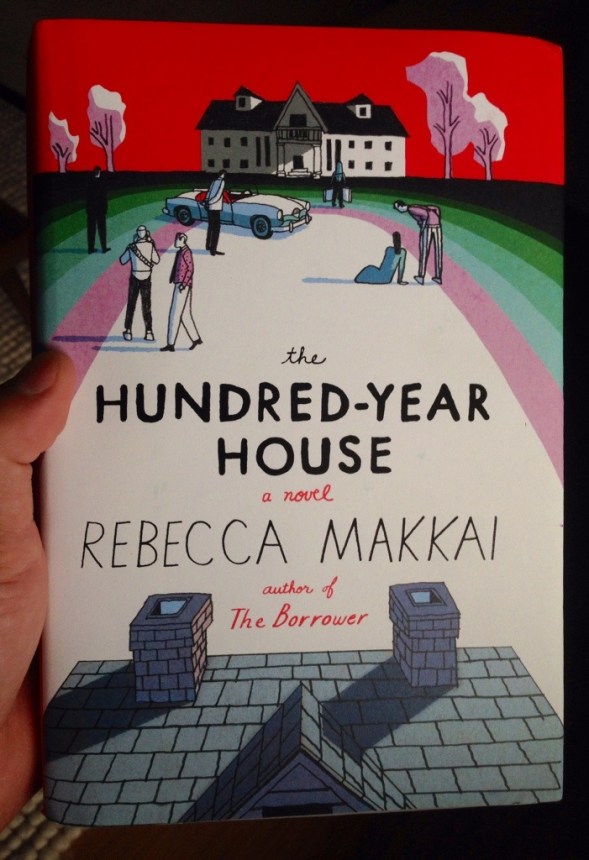
The Hundred-Year House (Book Acquired, 6.19.2014)

20140621-192942-70182350.jpg

Wonderful cover on Rebecca Makkai’s The Hundred-Year House, new in hardback from Penguin this summer. Blurb from the author’s site:

When Doug’s mother-in-law offers up the coach house at Laurelfield, her hundred-year-old estate north of Chicago, Doug and his wife Zee accept. Doug is fascinated by the house’s previous life as an artists’ colony, and hopes to find something archival there about the poet Edwin Parfitt, who was in residence at Laurelfield in the twenties (and whose work happens to be Doug’s area of scholarship). When he learns that there are file cabinets full of colony materials in the attic, Doug is anxious to get to work and save his career—but his mother-in-law refuses him access. With help from friends, Doug finally does access the Parfitt file—only to find far stranger and more disturbing material than he bargained for.

Doug may never learn all the house’s secrets, but the reader does, as the narrative zips back in time from 1999 to 1955 and 1929. We see the autumn right after the colony’s demise, when its newlywed owners are more at the mercy of the place’s lingering staff than they could imagine; and we see it as a bustling artists’ community fighting for survival in the last, heady days of the 1920s.

Through it all, the residents of Laurelfield are both plagued and blessed by the strange legacy of Laurelfield’s original owners: extraordinary luck, whether good or bad.


My Eyes in the Time of Apparition — August Natterer

My first meeting with Oscar Wilde was an astonishment (W.B. Yeats)

My first meeting with Oscar Wilde was an astonishment. I never before heard a man talking with perfect sentences, as if he had written them all over night with labour and yet all spontaneous. There was present that night at Henley’s, by right of propinquity or of accident, a man full of the secret spite of dulness, who interrupted from time to time, and always to check or disorder thought; and I noticed with what mastery he was foiled and thrown. I noticed, too, that the impression of artificiality that I think all Wilde’s listeners have recorded came from the perfect rounding of the sentences and from the deliberation that made it possible. That very impression helped him, as the effect of metre, or of the antithetical prose of the seventeenth century, which is itself a true metre, helped its writers, for he could pass without incongruity from some unforeseen, swift stroke of wit to elaborate reverie. I heard him say a few nights later: “Give me The Winter’s Tale, ‘Daffodils that come before the swallow dare’ but not King Lear. What is King Lear but poor life staggering in the fog?” and the slow, carefully modulated cadence sounded natural to my ears. That first night he praised Walter Pater’s Studies in the History of the Renaissance: “It is my golden book; I never travel anywhere without it; but it is the very flower of decadence: the last trumpet should have sounded the moment it was written.” “But,” said the dull man, “would you not have given us time to read it?” “Oh no,” was the retort, “there would have been plenty of time afterwards—in either world.” I think he seemed to us, baffled as we were by youth, or by infirmity, a triumphant figure, and to some of us a figure from another age, an audacious Italian fifteenth century figure. A few weeks before I had heard one of my father’s friends, an official in a publishing firm that had employed both Wilde and Henley as editors, blaming Henley who was “no use except under control” and praising Wilde, “so indolent but such a genius”; and now the firm became the topic of our talk. “How often do you go to the office?” said Henley. “I used to go three times a week,” said Wilde, “for an hour a day but I have since struck off one of the days.” “My God,” said Henley, “I went five times a week for five hours a day and when I wanted to strike off a day they had a special committee meeting.” “Furthermore,” was Wilde’s answer, “I never answered their letters. I have known men come to London full of bright prospects and seen themcomplete wrecks in a few months through a habit of answering letters.” He too knew how to keep our elders in their place, and his method was plainly the more successful, for Henley had been dismissed. “No he is not an aesthete,” Henley commented later, being somewhat embarrassed by Wilde’s Pre-Raphaelite entanglement; “one soon finds that he is a scholar and a gentleman.” And when I dined with Wilde a few days afterwards he began at once, “I had to strain every nerve to equal that man at all”; and I was too loyal to speak my thought: “You and not he said all the brilliant things.” He like the rest of us had felt the strain of an intensity that seemed to hold life at the point of drama. He had said on that first meeting “The basis of literary friendship is mixing the poisoned bowl”; and for a few weeks Henley and he became close friends till, the astonishment of their meeting over, diversity of character and ambition pushed them apart, and, with half the cavern helping, Henley began mixing the poisoned bowl for Wilde. Yet Henley never wholly lost that first admiration, for after Wilde’s downfall he said to me: “Why did he do it? I told my lads to attack him and yet we might have fought under his banner.”

From W.B. Yeats’s autobiography, The Trembling of the Veil.

Girl Reading (Thinking of Edward Hopper) — Kiko Esperilla

kiko esperilla

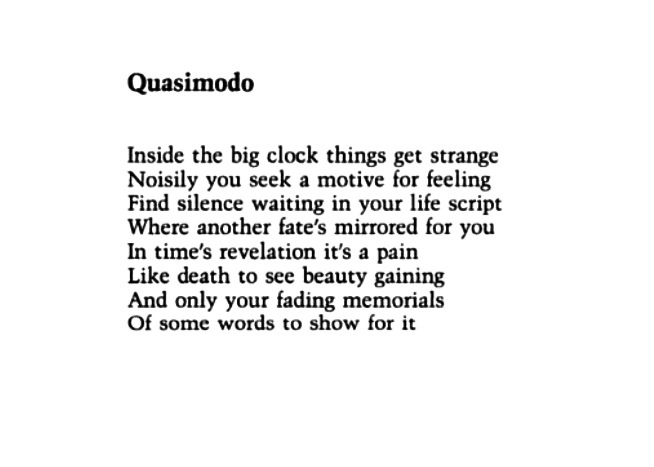
“Quasimodo” — Tom Clark

20140623-182727-66447266.jpg

Film Poster for Wong Kar Wai’s The Grandmaster — Vania Zouravliov

filmz.ru

Books Acquired (Second Week of June, 2014)

20140621-192932-70172308.jpg

Two historicalish fictions.

First, Merivel: A Man of His Time by Rose Tremain, which is new in trade paperback; the hardback received good reviews last year. Pub’s blurb:

The wonderful new historical novel set in seventeenth-century England from Rose Tremain, author of Restoration (shortlisted for the Booker Prize), The Road Home (winner of the Orange Prize) and Trespass (a Richard & Judy pick). Merivel has been called ‘wonderfully entertaining’ (Guardian Books of the Year) and ‘an unadulterated delight’ (Independent) and has been shortlisted for the Walter Scott Prize for Historical Fiction.

The gaudy years of the Restoration are long gone and Robert Merivel, physician and courtier to King Charles II, sets off for the French court in search of a fresh start. But royal life at the Palace of Versailles – all glitter in front and squalor behind – leaves him in despair, until a chance encounter with the seductive Madame de Flamanville, allows him to dream of a different future.
But will that future ever be his? Summoned home urgently to attend to the ailing King, Merivel finds his loyalty and skill tested to their limits.

20140621-192930-70170223.jpg

Also: Peter Tremayne’s The Seventh Trumpet:

When a murdered corpse of an unknown young noble is discovered, Fidelma of Cashel is brought in to investigate, in Peter Tremayne’s The Seventh Trumpet

Ireland, AD 670. When the body of a murdered young noble is discovered not far from Cashel, the King calls upon his sister, Fidelma, and her companion Eadulf to investigate. Fidelma, in addition to being the sister of the king, is a dailaigh—an advocate of the Brehon Law Courts—and has a particular talent for resolving the thorniest of mysteries.

But this time, Fidelma and Eadulf have very little to work with—the only clue to the noble’s identity is an emblem originating from the nearby kingdom of Laign. Could the murder be somehow related to the wave of violence erupting in the western lands of the kingdom? The turmoil there is being stirred up by an unknown fanatical figure who claims to have been summoned by “the seventh angel” to remove the “impure of faith.” Fidelma and Eadulf, once again grappling with a tangled skein of murder and intrigue, must somehow learn what connects the dead noble, a murdered alcoholic priest, and an abbot who has turned his monastery into a military fortress. When it appears that things cannot get more complex, Fidelma herself is abducted, and Eadulf must rescue her before the mystery can be solved.

Automat (I) — Michaël Borremans

“A Seventeenth-Century Story” — A. A. Milne

“A Seventeenth-Century Story”

by

A. A. Milne 

There is a story in every name in that first column of The Times- -Births, Marriages, and Deaths—down which we glance each morning, but, unless the name is known to us, we do not bother about the stories of other people. They are those not very interesting people, our contemporaries. But in a country churchyard a name on an old tombstone will set us wondering a little. What sort of life came to an end there a hundred years ago?

In the parish register we shall find the whole history of them; when they were born, when they were married, how many children they had, when they died—a skeleton of their lives which we can clothe with our fancies and make living again. Simple lives, we make them, in that pleasant countryside; “Man comes and tills the field and lies beneath”; that is all. Simple work, simple pleasures, and a simple death.

Of course we are wrong. There were passions and pains in those lives; tragedies perhaps. The tombstones and the registers say nothing of them; or, if they say it, it is in a cypher to which we have not the key. Yet sometimes the key is almost in our hands. Here is a story from the register of a village church— four entries only, but they hide a tragedy which with a little imagination we can almost piece together for ourselves. Continue reading ““A Seventeenth-Century Story” — A. A. Milne”

Self Portrait with Charlie Brown — Chris Ware

ware brown

Peter and the Wolf — Ben Shahn

peter wolf shahn

The Melancholy — Lucas Cranach the Elder

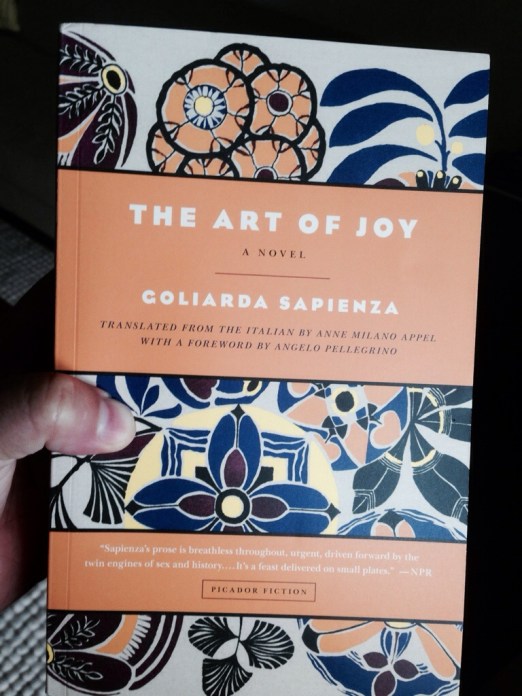
The Art of Joy (Book Acquired, 6.16.2014)

20140621-192944-70184406.jpg

This is pretty cool: Goliarda Sapienza’s huge novel The Art of Joy, in English translation for the first time by Anne Milano Appel and published by Picador.

Their blurb:

Rejected by a series of publishers, abandoned in a chest for twenty years, Goliarda Sapienza’s masterpiece, The Art of Joy, survived a turbulent path to publication. It wasn’t until 2005, when it was released in France, that this novel received the recognition it deserves. At last, Sapienza’s remarkable book is available in English.

The Art of Joy centers on Modesta, a Sicilian woman born in 1900 whose strength and character are an affront to conventional morality. Impoverished as a child, Modesta believes she is destined for a better life. She is able, through grace and intelligence, to secure marriage to an aristocrat without compromising her own deeply felt values, and revels in upsetting the rules of her fascist, patriarchal society. This is the history of the twentieth century seen through the perspective of one extraordinary woman.

Got into a bit of it this weekend and it looks like good stuff; if your interest is piqued, you might want to check out Emily Cooke’s New Yorker piece for more. From Cooke’s essay:

What exactly the art of joy consists of isn’t immediately evident. At the outset, the novel reads less like a handbook on happiness than like a sadomasochistic Italian novelization of “The Joy of Sex.” It opens with a girl, called Modesta, who is born in 1900, in Sicily, to modest circumstances and immodest predilections, masturbating to the screams of a resented disabled sister, whom Modesta fantasizes is deliberately rending her own flesh. Masturbation gives way to cunnilingus by a tall neighbor boy, which gives way to intercourse, with Modesta’s deflowering, at the age of nine, by a stranger who claims to be her father. Perhaps the “joy” part hasn’t begun yet. But, wait, she rather likes it, at least until he sticks “something hard … into the hole where the pee-pee came out.” Immediately after the rape, the family’s hut goes up in flames, the casualty of a fire that Modesta has lit accidentally/on purpose. The worst casualties are Modesta’s sister and mother, locked in a bedroom by the prodigal father. Modesta has a chance to unlock them; she does not take it. The father is gone for good. Dispatched to a convent, this “poor tormented child,” as the nuns gullibly call her, fakes seizures in order to secure the comforting bosom of the Mother Superior, Leonora, who likes to titillate herself and her charge with stories of the persecuted Saint Agatha. Her bosom, St. Agatha’s was torn from her chest with “red-hot forceps” and “arranged … warm and tremulous, on a silver tray.” The lurid description gives Modesta “a thrill of pleasure” “so intense and protracted” that she has to grit her teeth to avoid a cry. When she discovers that the nun won’t put out—Leonora ventures only a “few timid caresses” and punishes Modesta for having witnessed her masturbating—infatuation turns to anger. “I hate her, I hate her,” she shrieks, alone in her cell, then brings herself to orgasm. All this before Modesta has reached the age of eighteen, and the book a tenth of its length.

 

“All art constantly aspires towards the condition of music”

Letter with Sketch for The Sower — Vincent van Gogh