The Milkmaid — Johannes Vermeer

Jim O’Rourke Live in Tokyo in June of 2014

Della — James Jean

della-revised-cropped-36x48-medres

“Language” — Ezra Pound

“Language”

by

Ezra Pound

from A Retrospect

Use no superfluous word, no adjective which does not reveal something.

Don’t use such an expression as “dim lands of peace.” It dulls the image. It mixes an abstraction with the concrete. It comes from the writer’s not realizing that the natural object is always the adequate symbol.

Go in fear of abstractions. Do not retell in mediocre verse what has already been done in good prose. Do’t think any intelligent person is going to be decieved when you try to shirk all the difficulties of the unspeakably difficult art of good prose by chopping your composition into line lengths.

What the expert is tired of today the public will be tired of tomorrow.

Don’t imagine that the art of poetry is any simpler than the art of music, or that you can please the expert before you have spent at least as much effort on the art of verse as an average piano teacher spends on the art of music.

Be influenced by as many great artists as you can, but have the decency either to acknowledge the debt outright, or to try to conceal it.

Don’t allow “influence” to mean merely that you mop up the particular decorative vocabulary of some one or two poets whom you happen to admire. A Turkish war correspondent was recently caught red-handed babbling in his despatches of “dove-grey” hills, or else it was “pearl-pale,” I can not remember.

Use either no ornament or good ornament.

Pool Side — Tomer Hanuka

poolSide_650

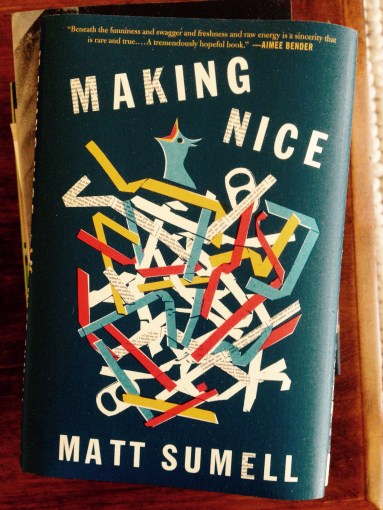
Matt Sumell’s Making Nice (Book acquired some time in January)

IMG_4953

I was hoping to save up a little energy to write a bit about the stories I’ve read in Matt Sumell’s debut collection Making Nice…but I don’t seem to have it. There’s a macho swagger here that will repel a lot of folks but hell I’m a barbarian and I dig what he’s doing, even if it’s been done by a few (many) other folks before (there’s that Carver/Johnson/Lipsyte axis, yes)—it’s funny and savage stuff. Continue reading “Matt Sumell’s Making Nice (Book acquired some time in January)”

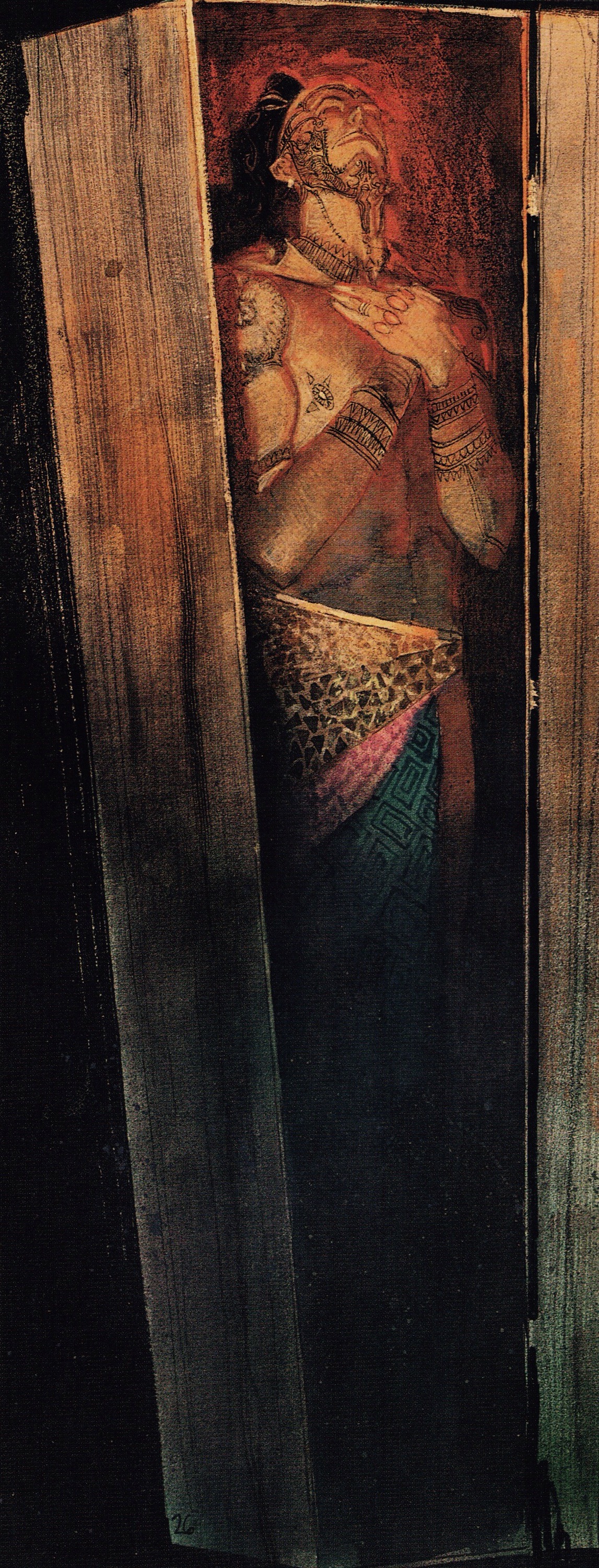
Queequeg in His Coffin — Bill Sienkiewicz

IMG_5094

Happy Breece D’J Pancake Day

bdjp

Today is Shrove Tuesday or Fat Tuesday or Mardi Gras—or Pancake Day if you like. Besides his unusual last name, there is basically no connection between this pre-Lenten day and the West Virginian writer Breece D’J Pancake. But whatever. Pancake remains woefully under-read—so any occasion for notice, yes?

Breece Pancake’s stories are compact, sad, and beautiful. Haunting is a fair word—these tales stick with you. Pancake’s evocation of place and mood are so strong that it’s often a relief to leave the little world he’s painted for the reader. (Does that sound like a negative criticism? ‘Twas not meant to be).

There’s not much Pancake to read—just one collection of short stories, posthumously published. Pancake shot himself in the head a few months before his 27th birthday. In his afterword to The Stories of Breece D’J Pancake, John Casey points out that Pancake had not yet achieved his full vision of his writing (he also explains the unusual punctuation in the author’s name):

When he sold his first story to The Atlantic he scarcely took a breath. (He did do one thing by way of celebration. The galley proofs came back with the middle initials of his name set up oddly: Breece D’J Pancake. He said fine, let it stay that way. It made him laugh, and, I think, it eased his sense of strain—the strain of trying to get things perfect—to adopt an oddity committed by a fancy magazine.) He was glad, but the rhythm of his work didn’t let him glory or even bask. He had expected a great deal from his work, and I think he began to feel its power, but he also felt he was still far from what he wanted.

Obviously, we can lament that we don’t get to read what Pancake might have written—or we can read what he gave us and be grateful. There’s “Hollow”“The Honored Dead,” and “In the Dry”—go ahead, those links are for full-text stories. Don’t be afraid to click.

Pancake’s most well-known story might be “Trilobites” — here are the first few paragraphs:

I open the truck’s door, step onto the brick side street. I look at Company Hill again, all sort of worn down and round. A long time ago it was real craggy, and stood like an island in the Teays River. It took over a million years to make that smooth little hill, and I’ve looked all over it for trilobites. I think how it has always been there and always will be, least for as long as it matters. The air is smoky with summertime. A bunch of starlings swim over me. I was born in this country and I have never very much wanted to leave. I remember Pop’s dead eyes looking at me. They were real dry, and that took something out of me. I shut the door, head for the café.


I see a concrete patch in the street. It’s shaped like Florida, and I recollect what I wrote in Ginny’s yearbook: “We will live on mangoes and love.” And she up and left without me—two years she’s been down there without me. She sends me postcards with alligator wrestlers and flamingos on the front. She never asks me any questions. I feel like a real fool for what I wrote, and go into the café.


The place is empty, and I rest in the cooled air. Tinker Reilly’s little sister pours my coffee. She has good hips. They are kind of like Ginny’s and they slope nice curves to her legs. Hips and legs like that climb steps into airplanes. She goes to the counter end and scoffs down the rest of her sundae. I smile at her, but she’s jailbait. Jailbait and black snakes are two things “Won’t touch with a window pole. One time I used an old black snake for a bullwhip, snapped the sucker’s head off, and Pop beat hell out of me with it. I think how Pop could make me pretty mad sometimes. I grin.

Why isn’t the story in my Norton Anthology of American Literature?

Do you want more than those paragraphs? Here’s Joyce Carol Oates on Pancake, from her 1983 NYT review of the collection:

The most powerful of the stories – ”Trilobites,” ”Hollow,” ”Fox Hunters,” ”The Scrapper,” ”In the Dry” – are as compactly and tightly written as prose poems and should be read (and reread) with extreme care. The author’s method is to create an atmosphere of extreme tension in his readers as well as in his protagonists. The stories’ opening paragraphs often announce in embryo what will follow, so that the narrative is thematically complete before, in a sense, it begins, and one feels the inexorable bars of circumstance closing about the characters. And the writing, lean, taut, pared back, near-flawless in its uninflected cadences, is perfectly suited to its content.

Over three decades after that review, there’s still a sense that Pancake hasn’t quite gotten his due. Here’s Jon Michaud, writing almost exactly a year ago in The New Yorker:

…Pancake deserves to be more than a writer’s writer. In his stories, objects are constantly being unearthed: fossils and coal from the earth, skeletons and arrowheads from Indian burial grounds. “The Stories of Breece D’J Pancake” is a sharp, flinty object, an arrowhead left behind by a talented and tragic young author. It would be easy to allow his one collection of stories to be buried under the landslide of books published every year. But it’s worth doing a little excavating to dig it up. The past few years have seen late-in-the-day and posthumous revivals of interest in writers such as Renata Adler, Elena Ferrante, and John Williams. Get out your pickaxes. It’s high time for a Pancake revival.

I agree.

The Pancake Woman — Rembrandt

“Hinges” — Shel Silverstein

IMG_5093

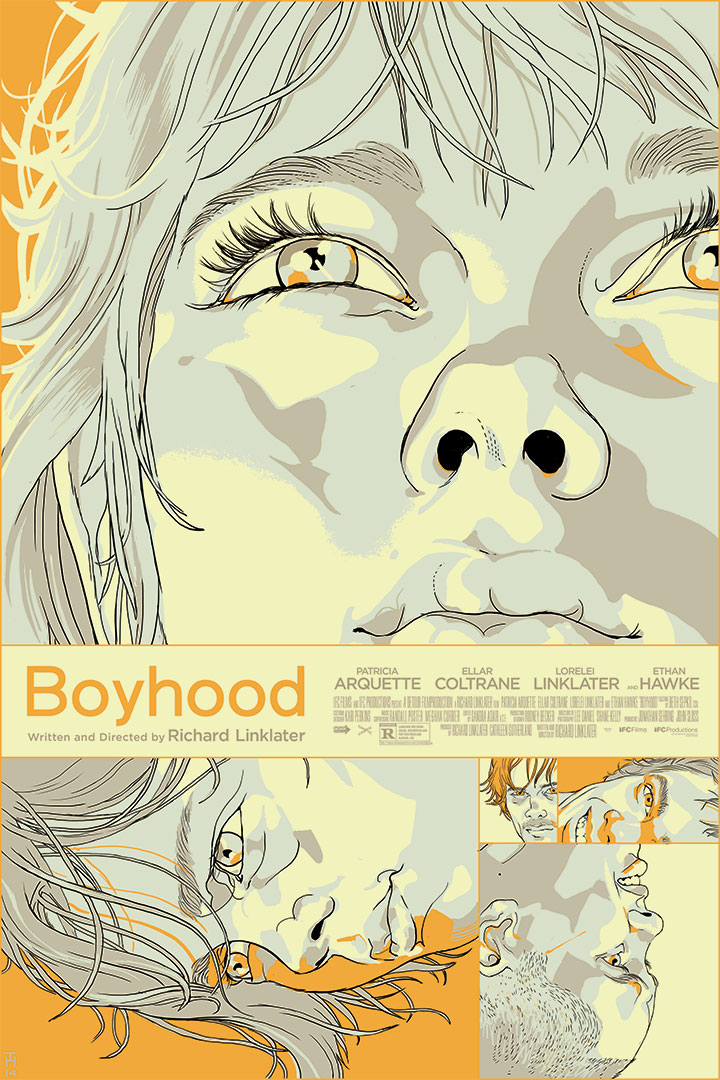
A short riff on a favorite scene from Richard Linklater’s film Boyhood

boyhood_color10

I absolutely loved Richard Linklater’s film Boyhood, which is nominated for a few Oscars this year, including Best Picture. (Boyhood is too good to win best picture; I’m fine with that prize going to Iñárritu’s faux-art film Birdman). A rich and sentimental evocation of “reality,” Boyhood synthesizes the best elements of Linklater’s previous films, and like many of those films—Slacker, the Before trilogy, Waking LifeDazed and ConfusedBoyhood isn’t really about anything. Of course it’s also kinda sorta about everything: family, love, growth, education, life. Etc.

The central formal device of Boyhood—namely, that Linklater shot the film over twelve years using the same actors—has been remarked upon at great length by others, so I won’t touch on it, other than to say that I found watching Ellar Coltrane’s Mason grow up profoundly moving. The aesthetic experience of Boyhood is its greatest pleasure, much like its sister film The Tree of Life. And although Boyhood’s aesthetic power relies in large part on our witnessing its characters grow and age, its emotional tenor, its vibe, inheres from scene to scene.

Capture

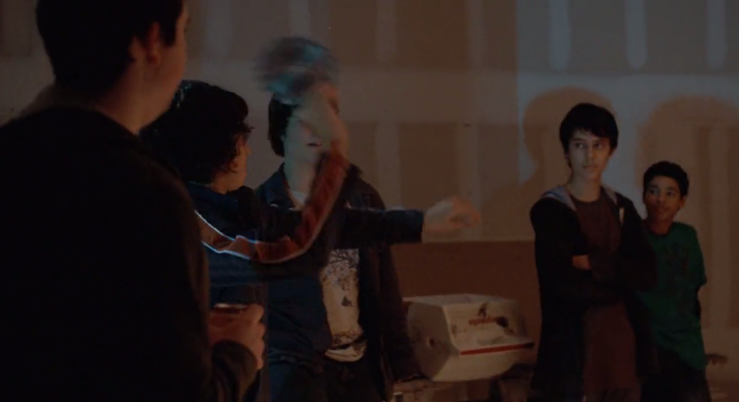
There are many wonderful moments in the film, some more memorable than others, but a favorite of mine takes place at an overnight “camping trip” in a house that’s still under construction. Mason is maybe, what, thirteen here?—I’m not quite sure, but he tells his mother the truth about where he’s going, if not entirely the truth about what he’ll be doing there…which is, what? Not much really—the younger kids hang out with the older kids, drink a beer or two, lie about sex—stuff kids do. The scene captures the same not-quite-boring hangout vibe that permeates Dazed and Confused and Waking Life—a kind of familiar realness.

Linklater is a master at evoking a sense of place. And this place, this house—it’s simultaneously boring, calming, and horrifying. On one hand, we’ve been there before—the abandoned house, the empty parking lot, the little switch of trees that aren’t quite woods, not really—the free space where we can play at being adults. On the other hand, Boyhood has allowed us—or maybe I should not extend my pronoun to the plural? No?—Okay: Boyhood has allowed me, this viewer, a kind of paternalistic view of Mason (“my-son”) who is, after all, growing up before our very eyes (sorry for slipping back into the first-person plural there). And here Linklater has young Mason—whom we trust to do the right thing and all but still—here Linklater has staged Mason & co. in an abandoned house full of scrap wood and power tools and circular saw blades which the young men are of course throwing into the sheet rock with gleeful abandon.

I flinched as the blades flew forcefully past Mason and his friend; in any other film they would have to cut into flesh and bone, be tools for forces tragic or comic. Plot devices. But in Boyhood they are the toys of boys playing at growing up. Nothing happens. No grievous injury or terrible death—the sort of thing that usually licenses, I don’t know, the central character’s maturation. Not even a comic wound. Nothing. The blade-throwing is just normal bored stupid teenage amusement. It’s the sort of thing that Mason’s mom—and a paternalistic viewer like me—might find horrifying—You could get very badly hurt, Mason!—but he doesn’t. He’s fine. He’s alive.

For me, this particular scene—not the strongest or the strangest or the most memorable or moving—is nevertheless a key moment in Boyhood, not just because it disrupts audience expectations (the film is full of such gentle disruptions), but because it engenders and then discharges my own parental anxieties. That’s a form of catharsis, I guess, but not a catharsis of tragedy. It’s catharsis for reality.

Vanitas Vanitatum — Agostino Arrivabene

aa

Commuter Doodle (Reader) — Roman Muradov

tumblr_njofbupdxB1qzxelgo1_500

Peter Jackson’s Dead Alive (Full Film)

Sweat of the Brow — Hans-Georg Rauch

sweat of the brow rauch

Read “Uncle Sam Carrington,” a short story by Leonora Carrington

“Uncle Sam Carrington”

by

Leonora Carrington

When Uncle Sam Carrington saw the full moon he was never able to stop laughing. A sunset had the same effect on Aunt Edgeworth. These two events created much suffering for my mother who took pleasure in a certain social prestige.

At the age of eight I was considered the most serious person in the family. My mother confided in me. She said that it was shameful that nobody would invite her out, that Lady Cholmendley-Bottame did not say Good Afternoon to her in the street. I was deeply upset.

Uncle Sam Carrington and Aunt Edgeworth lived in the house. They occupied the first floor. Thus, nothing could be done to hide this lamentable state of affairs. During the daytime I asked myself how I could free the family of this shame. Finally, it was impossible for me to bear the tension and my mother’s tears, things that made me suffer greatly. I decided to search for the solution. One afternoon when the sun had become very red and Aunt Edgeworth rejoiced in an especially repugnant manner, I took a jar of sweets, a loaf of bread and took to the road. In order to frighten the bats, I sang “O come into the garden, Maude, and hear the blackbirds sing!” (O, van al jardín, Maude, y escucha el canto de los miñes!)

My father sang this song when he wasn’t going to church, and another that began so: “It cost me seven shillings and sixpence.” (Esto me costo siete chelines y seis peniques.) I sang both songs with the same emotion.

“Good—” I thought, the trip has begun. Night certainly will bring me a solution. If I count the trees up to the place where I am going, I will not lose my way. Upon returning I will remember the number of trees.” But I forgot that I only knew how to count up to ten, and even then I made mistakes. So, in a little while I counted up to 10 several times until I became completely lost. Trees surrounded me everywhere.

“I am in the forest,” I said to myself. I was right.

The full moon diffused its clarity among the trees which permitted me to see some meters in front of me and the reason for a disquieting noise. Two cabbages that were fighting terribly made the disturbance. They tore off each other’s leaves with such ferocity that soon there were only a few sad leaves everywhere, and nothing of the cabbages.

“It doesn’t matter,” I said to myself. “It’s nothing more than a nightmare.” But suddenly I remembered that that night I had not gone to bed and, therefore, I could not treat it as a nightmare.

“It’s horrible,” I thought.

After that, I picked up the cadavers and continued my walk. In a little while, I came across a friend: the horse that, years later, would play an important part in my life.

“Hello!” he said to me. “Are you looking for something?” I explained to him the object of my excursion at such an advanced hour in the evening.

“Evidently,” he said, “from the social point of view it’s most complicated. Around here live two ladies who are occupied with similar questions. Your pursued goal consists in the eradication of your family shame. They are two very wise ladies. If you want, I will take you to them.”

The Señoritas Cunningham-Jones had a house surrounded discretely by uncultivated weeds and moss of another era. They were found in the garden about to play a game of checkers. The horse stuck out his head between the legs of some 1890 knickers and directed the word to the señoritas Cunningham-Jones.

“Let your little friend enter,” said the señorita who was seated at the right in a very distinct accent. “We are always ready to help in the matter of respectability.”

The other señorita bent her head benevolently. She was wearing a huge hat adorned with all kinds of horticultural specimens.

“Your family, señorita,” she said to me, offering me a Louis XV style chair, “does it continue the line of our beloved and lamented Duke of Wellington or that of Sir Walter Scott, that noble aristocrat of fine literature?”

I was a bit confused. There were no aristocrats in my family.

Taking notice of my fright, she said to me with the most enchanting smile: “Dear girl, you must realize that here we only arrange matters of the oldest and most noble families of England.”

A sudden inspiration illuminated my face. “In the dining room, at home…” I said.

The horse gave me a strong kick in the backseat.

“Don’t ever speak of anything so vulgar as food,” he said to me in a low voice.

Luckily, the señoritas were a little deaf. Correcting myself, I continued, perplexed. ln the living room there is a table upon which, it is said, a duchess left her glasses in 1700.”

“In that case,” the señorita answered, “Perhaps we can come to an agreement, but naturally, señorita, we will see ourselves obliged to ask for a somewhat steep reward.”

We easily understood each other. The señoritas got up saying: “Wait here some minutes; we will give you what you need. Meanwhile you can look at the illustrations in this book. It’s instructive and interesting. No library is complete without this volume. My sister and I always have lived by that admirable example.”

The book was titled: The Secrets of the Flowers of Distinction and the Coarseness of Food. When the two women had left, the horse asked: “Do you know how to walk without making a sound?”

“Certainly,” I answered.

“Then let’s see the señoritas devoted to their work,” he said. “But if your life matters to you, don’t make a sound.”

The señoritas were in their orchard which extended behind the house, surrounded by a wide wall. I mounted the horse and a surprising scene offered itself to my eyes: the señoritas Cunningham-Jones, each armed with an immense whip, were striking the vegetables, and shouting: “It’s necessary to suffer in order to go to heaven. Those who do not wear corsets will never arrive.”

The vegetables, on their part, fought among themselves, and the older ones threw the smaller ones at the señoritas with angry screams.

“Each time it happens so,” murmured the horse. “They are the vegetables that suffer on behalf of humanity. Soon you will see how they pick one for you, one that will die for the cause.”

The vegetables did not have an enthusiastic air over dying an honorable death. But the señoritas were stronger. Soon two carrots and a little cabbage fell between their hands.

“Quickly!” exclaimed the horse. “Back.”

Scarcely had we again sat down in front of THE COARSENESS OF FOOD, when the señoritas entered with the exact appearance as before. They gave me a little package that contained the vegetables, and in exchange for this I paid them with the jar of sweets and the little fritters.

I’ve Had Enough of the Futility of Your Struggle! — Yongbo Zhao

_FLH5018ab_tmb