Easter Chimes Awaken Nature — Alphonse Mucha

“There Sat Down, Once, a Thing on Henry’s Heart” — John Berryman

“Easter Eve” — Anton Chekhov

“Easter Eve”

by

Anton Chekhov

I was standing on the bank of the River Goltva, waiting for the ferry-boat from the other side. At ordinary times the Goltva is a humble stream of moderate size, silent and pensive, gently glimmering from behind thick reeds; but now a regular lake lay stretched out before me. The waters of spring, running riot, had overflowed both banks and flooded both sides of the river for a long distance, submerging vegetable gardens, hayfields and marshes, so that it was no unusual thing to meet poplars and bushes sticking out above the surface of the water and looking in the darkness like grim solitary crags.

The weather seemed to me magnificent. It was dark, yet I could see the trees, the water and the people. . . . The world was lighted by the stars, which were scattered thickly all over the sky. I don’t remember ever seeing so many stars. Literally one could not have put a finger in between them. There were some as big as a goose’s egg, others tiny as hempseed. . . . They had come out for the festival procession, every one of them, little and big, washed, renewed and joyful, and everyone of them was softly twinkling its beams. The sky was reflected in the water; the stars were bathing in its dark depths and trembling with the quivering eddies. The air was warm and still. . . . Here and there, far away on the further bank in the impenetrable darkness, several bright red lights were gleaming. . . .

A couple of paces from me I saw the dark silhouette of a peasant in a high hat, with a thick knotted stick in his hand.

“How long the ferry-boat is in coming!” I said.

“It is time it was here,” the silhouette answered.

“You are waiting for the ferry-boat, too?”

“No I am not,” yawned the peasant—”I am waiting for the illumination. I should have gone, but to tell you the truth, I haven’t the five kopecks for the ferry.”

“I’ll give you the five kopecks.”

“No; I humbly thank you. . . . With that five kopecks put up a candle for me over there in the monastery. . . . That will be more interesting, and I will stand here. What can it mean, no ferry-boat, as though it had sunk in the water!”

The peasant went up to the water’s edge, took the rope in his hands, and shouted; “Ieronim! Ieron—im!” Continue reading ““Easter Eve” — Anton Chekhov”

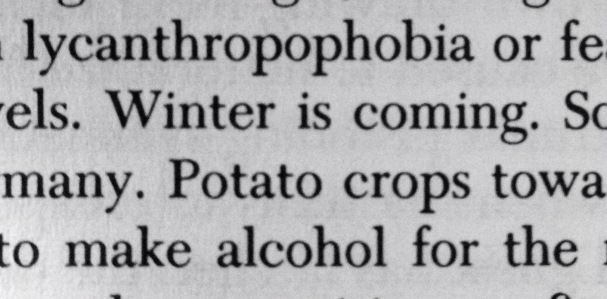
Winter is coming (Thomas Pynchon)

IMG_5728

Sorry sorry sorry couldn’t help myself. From page 640 of Thomas Pynchon’s Gravity’s Rainbow.

Woodland Prayer — Egon Schiele

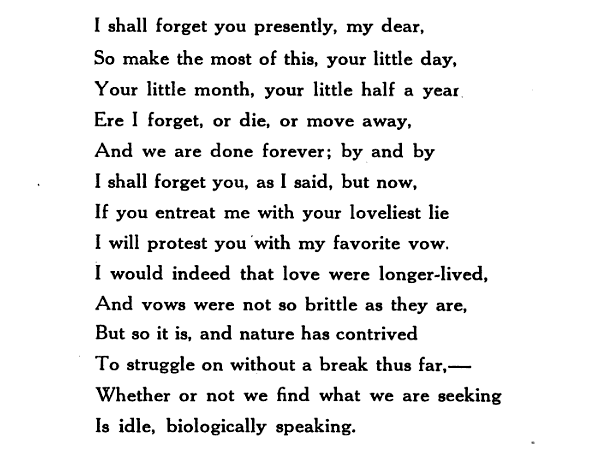
“[I shall forget you presently, my dear]” — Edna St. Vincent Millay

Screenshot 2015-04-03 at 1.46.38 PM

List with No Name #52

Continue reading “List with No Name #52”

“Thus do authors beget authors” — Washington Irving on Plagiarism and Creation

0126m

Now and then one of these personages would write something on a small slip of paper, and ring a bell, whereupon a familiar would appear, take the paper in profound silence, glide out of the room, and return shortly loaded with ponderous tomes, upon which the other would fall, tooth and nail, with famished voracity. I had no longer a doubt that I had happened upon a body of magi, deeply engaged in the study of occult sciences. The scene reminded me of an old Arabian tale, of a philosopher shut up in an enchanted library, in the bosom of a mountain, which opened only once a year; where he made the spirits of the place bring him books of all kinds of dark knowledge, so that at the end of the year, when the magic portal once more swung open on its hinges, he issued forth so versed in forbidden lore, as to be able to soar above the heads of the multitude, and to control the powers of Nature.

My curiosity being now fully aroused, I whispered to one of the familiars, as he was about to leave the room, and begged an interpretation of the strange scene before me. A few words were sufficient for the purpose. I found that these mysterious personages, whom I had mistaken for magi, were principally authors, and were in the very act of manufacturing books. I was, in fact, in the reading-room of the great British Library, an immense collection of volumes of all ages and languages, many of which are now forgotten, and most of which are seldom read: one of these sequestered pools of obsolete literature to which modern authors repair, and draw buckets full of classic lore, or “pure English, undefiled,” wherewith to swell their own scanty rills of thought.

Being now in possession of the secret, I sat down in a corner, and watched the process of this book manufactory. I noticed one lean, bilious-looking wight, who sought none but the most worm-eaten volumes, printed in black letter. He was evidently constructing some work of profound erudition, that would be purchased by every man who wished to be thought learned, placed upon a conspicuous shelf of his library, or laid open upon his table—but never read. I observed him, now and then, draw a large fragment of biscuit out of his pocket, and gnaw; whether it was his dinner, or whether he was endeavoring to keep off that exhaustion of the stomach, produced by much pondering over dry works, I leave to harder students than myself to determine.

There was one dapper little gentleman in bright-colored clothes, with a chirping gossiping expression of countenance, who had all the appearance of an author on good terms with his bookseller. After considering him attentively, I recognized in him a diligent getter-up of miscellaneous works, which bustled off well with the trade. I was curious to see how he manufactured his wares. He made more stir and show of business than any of the others; dipping into various books, fluttering over the leaves of manuscripts, taking a morsel out of one, a morsel out of another, “line upon line, precept upon precept, here a little and there a little.” The contents of his book seemed to be as heterogeneous as those of the witches’ cauldron in Macbeth. It was here a finger and there a thumb, toe of frog and blind worm’s sting, with his own gossip poured in like “baboon’s blood,” to make the medley “slab and good.”

After all, thought I, may not this pilfering disposition be implanted in authors for wise purposes? may it not be the way in which Providence has taken care that the seeds of knowledge and wisdom shall be preserved from age to age, in spite of the inevitable decay of the works in which they were first produced? We see that Nature has wisely, though whimsically provided for the conveyance of seeds from clime to clime, in the maws of certain birds; so that animals, which, in themselves, are little better than carrion, and apparently the lawless plunderers of the orchard and the corn-field, are, in fact, Nature’s carriers to disperse and perpetuate her blessings. In like manner, the beauties and fine thoughts of ancient and obsolete authors are caught up by these flights of predatory writers, and cast forth, again to flourish and bear fruit in a remote and distant tract of time. Many of their works, also, undergo a kind of metempsychosis, and spring up under new forms. What was formerly a ponderous history, revives in the shape of a romance—an old legend changes into a modern play—and a sober philosophical treatise furnishes the body for a whole series of bouncing and sparkling essays. Thus it is in the clearing of our American woodlands; where we burn down a forest of stately pines, a progeny of dwarf oaks start up in their place; and we never see the prostrate trunk of a tree mouldering into soil, but it gives birth to a whole tribe of fungi.

Let us not then, lament over the decay and oblivion into which ancient writers descend; they do but submit to the great law of Nature, which declares that all sublunary shapes of matter shall be limited in their duration, but which decrees, also, that their element shall never perish. Generation after generation, both in animal and vegetable life, passes away, but the vital principle is transmitted to posterity, and the species continue to flourish. Thus, also, do authors beget authors, and having produced a numerous progeny, in a good old age they sleep with their fathers, that is to say, with the authors who preceded them—and from whom they had stolen.
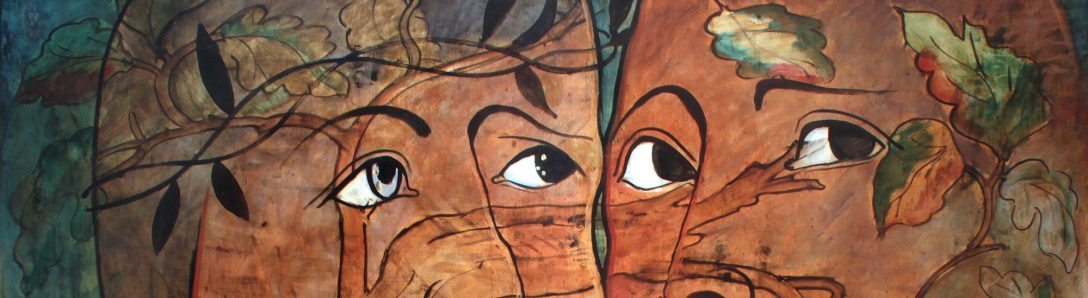
 

From Washington Irving’s story-essay “The Art of Book-Making.”

Dissolving — Odd Nerdrum

on

There is a theory going around that the U.S.A. was and still is a gigantic Masonic plot under the ultimate control of the group known as the Illuminati (Gravity’s Rainbow)

There is a theory going around that the U.S.A. was and still is a gigantic Masonic plot under the ultimate control of the group known as the Illuminati. It is difficult to look for long at the strange single eye crowning the pyramid which is found on every dollar bill and not begin to believe the story, a little. Too many anarchists in 19th-century Europe—Bakunin, Proudhon, Salverio Friscia—were Masons for it to be pure chance. Lovers of global conspiracy, not all of them Catholic, can count on the Masons for a few good shivers and voids when all else fails. One of the best of the classic Weird Mason Stories has Doctor Livingstone (living stone? oh, yes) come wandering into a native village in, not even the heart, but the subconscious of Darkest Africa, a place, a tribe he’s never seen before: fires in the silence, unfathomable stares, Livingstone ambles up to the village chief and flashes him a Masonic high sign—the chief recognizes it, returns it, all smiles, and orders every fraternal hospitality laid on for the white stranger. But recall that Dr. Livingstone, like Wernher von Braun, was born close to the Spring Equinox, and so had to confront the world from that most singular of the Zodiac’s singular points… . Well, and keep in mind where those Masonic Mysteries came from in the first place. (Check out Ishmael Reed. He knows more about it than you’ll ever find here.)

We must also never forget famous Missouri Mason Harry Truman: sitting by virtue of death in office, this very August 1945, with his control-finger poised right on Miss Enola Gay’s atomic clit, making ready to tickle 100,000 little yellow folks into what will come down as a fine vapor-deposit of fat-cracklings wrinkled into the fused rubble of their city on the Inland Sea… .


From Thomas Pynchon’s Gravity’s Rainbow.

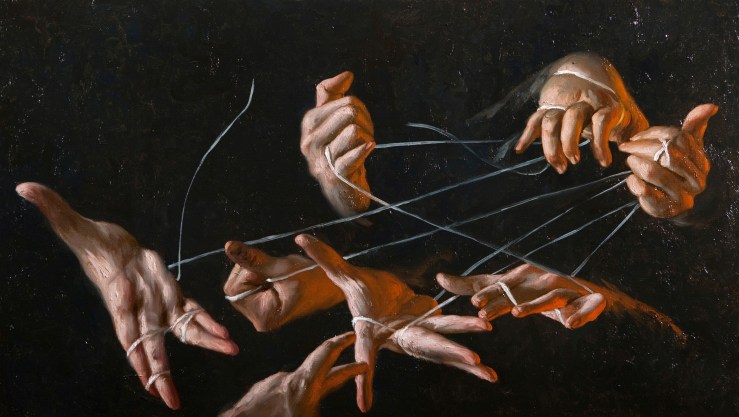
The Right Hand Knows What the Left — Giovanni Gasparro

61_La_mano_destra_ch

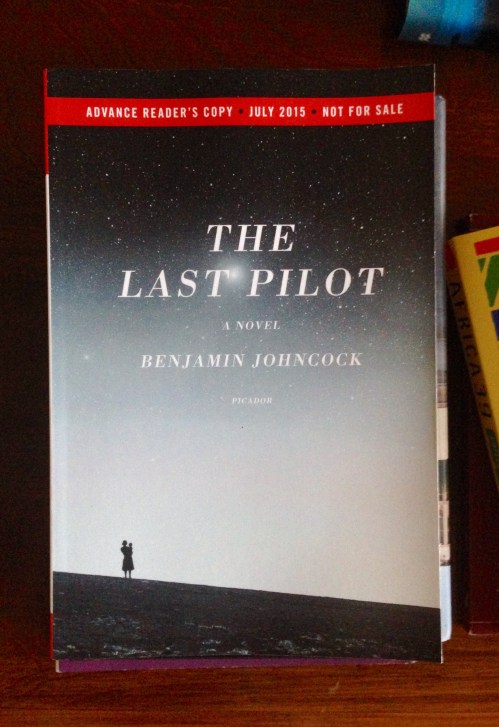
The Last Pilot (Book acquired 3.27.2015)

IMG_5683

Benjamin Johncock’s novel The Last Pilot is forthcoming this summer from Picador. Their blurb:

Jim Harrison is a test pilot in the United States Air Force, one of the exalted few. He spends his days in a precarious dance with death above the Mojave Desert and his nights at his friend Pancho’s bar, often with his wife, Grace. Both are secretly desperate for a child-and are delighted when, against all odds, Grace learns that she is pregnant.

But Sputnik has put the country in a panic, and NASA, newly formed, has been tasked with manning space before the Russians. Harrison turns down the chance to participate in Project Mercury and becomes a father to Florence, his baby girl. Yet his life, as a father and as a pilot, grinds to a halt when she becomes seriously ill and dies at the age of two. Devastated, Harrison loses himself in his work-and, sometimes, in distressing thoughts of Florence-and this time, when he gets a ticket to the moon, he takes it, but without consulting Grace.

As Harrison trains to become an astronaut, the toll that his daughter’s death has taken upon his marriage becomes more palpable, even as his ability to reckon with the reality of it diminishes. Set against the backdrop of one of the most emotionally charged periods in American history, Benjamin Johncock’s The Last Pilot is a mesmerizing story of loss and finding courage in the face of it, from an extraordinary new talent.

Categories are bad news (Barry Hannah)

 WT: Do you read magazines?

BH: If someone would rave about a story in the New Yorker, I’ll read it. But you get a lot of that Woody Allen–New Yorker–Hamptons fiction. My [students] have to send off to the little magazines. I get the sense that only grad students read those.

WT: Writer’s writers?

BH: I don’t like that term, because I wouldn’t buy somebody’s album on a dare if they called him a musician’s musician. I don’t write to be a writer’s writer. I don’t want to be like the little-magazine writer. I don’t want to be that.

Categories are bad news. Being Southern will just kill you sometimes. It’s not always a graceful adjective. Sometimes it means, don’t bother because it’s gonna be [sings a lick from dueling banjos]. It’s gonna be: porch, banjo, Negroes. There’s a canned dream of the South that a lot of people get into, and I’ve resisted that stuff my entire so-called career. Ready-made Southernism just disgusts me, just makes me nauseated. I mean, you can’t see a movie without hearing that goddamned slide guitar. Shit, I’m just so tired of it.


From Barry Hannah’s interview with Wells Tower in The Believer.

“Holy Thursday” (Experience) — William Blake

“Holy Thursday” (Innocence) — William Blake

Metamorphosis — Agostino Arrivabene

resize