Selections from One-Star Amazon Reviews of Cormac McCarthy’s Blood Meridian

[Editorial note: The following citations come from one-star Amazon reviews Cormac McCarthy’s novel Blood MeridianI’ve preserved the reviewers’ original punctuation and spelling. More one-star Amazon reviews.].


It may be art.

Damn McCarthy.

I find him boring.

unrelenting nihilism

The story is thin at best.

Are we supposed to enjoy it?

I felt abused by Blood Meridian

not a traditionally enjoyable book

this book is simply just not “all that”

wordy, over the top speechy dialogue

endless streams of dependent clauses

I am a devout fan of Cormac McCarthy.

The characters are not really sympathetic

He is obviously a sick man psychologically.

all about violence and no plot what so ever.

if I was a trained geologist I might like it better.

too many words that are not in standard dictionary

I guess people think he is cool because he writes so violent.

This one guy peed on some clay stuff to create a bomb like thing

murder, slaughter, killing, massacre, beating, stabbing, shooting, scalping

It consists of a series of almost unconnected scenes of unspeakable violence.

Esoteric words, eccentric expressions, pedantic philosophizing, arcane symbolism

I have to believe that he must be embarrassed to have this book back on the market.

A bunch of guys ride around Mexico killing everyone they come across for no particular reason

If you’re a fan of babies, quotation marks, and native americans, then avoid this book like the plague.

The reception he has had shows how tone deaf America has become to moral values, any moral values.

This book was written long before McCarthy had mastered the style that has brought him so much fame and credit.

the unrelenting amount of violence and cruelty in Blood Meridian strikes me as having crossed the line to pornography

It seemed like Cormac McCarthy wrote this with a dictionary in his lap trying to find words that he had never used before

Many of the words have to have been made up or are contractions of words and/or non-words, including much Spanish dialogue

Eliminate five words from the English language (“They rode on” and “He spat”)and this book would have been about 25 pages long

In this book, one sees him trying hard to hone his now-extraordinary powers of observation and description, and failing badly.

The standards for writing have clearly fallen far if all the praise heaped upon this inchoate, pompous mess of a novel is to be taken seriously.

Everything died: mules, horses, chickens, plants, rivers, snakes, babies, toddlers, boys, girls, women, men, ranchhands, bartenders, cowboys, good guys, bad guys…

I dont think the writer knows very much about AMERICAN history, the way he makes all the scalping get done by the AMERICANS and never by the indians, nor do I think he a PATRIOT

Wherein a company of men wander northern Mexico and the West killing, maiming, raping, and/or torturing everyone they meet, all described in gory, endless detail, led by the symbolic characters Glanton and his advisor, ‘the judge’, and supposedly illustrating that war and bloodletting are the only things that count, and the rest of life is just a meaningless dance.

Some kid with a few guys and a spattering of mans rambling through some part of the US or Mexico or a post-apocalyptic Australian desert seeing scores of gruesome, pointless scenes of violence, inhumanity, and death.

Holden is the sort of overt child defiling character who in real life wouldn’t last a month in a state penitentiary, because someone would rightly dispatch him as soon as possible.

Self-consciously faux-baroque linguistic stylings make this fetus-hurtin’ Treatise a feast for weakest link readers fascinated by the mark of the beast.

This book has some wonderful flowery language, and some beautiful descriptions of the southwest countryside.

They say that this book contains BIBLICAL themes, but I’ve read it and I don’t see how that could be so.

The author seems as if he is somehow trying to make some kind of “statement” about AMERICA

In a well ordered society McCarthy would be serving a life term or he would not exist at all.

there are times when it even seems as though English were not McCarthy’s first language

this book cannot be called a novel because it does not have character development

Would you let Cormac McCarthy look after your child for the night?

McCarthy is the most evil person because he is a talented writer

the author likes to use pronouns without establishing a subject

Who are the good guys and the bad guys, everyone is bad.

read Lonesome Dove instead, it’s a hundred times better

rampant nonstop mindless violence and depravity

I can’t dislike a book more than I dislike this one

This is a great writer being lazy and skating

good if you enjoy violence and nonsense

Theres lots of scalping of indians

Was there a quota on similes?

this booked scarred me

sociopath killers

It’s pure bunk.

a moral blight

utter trash

Ugh
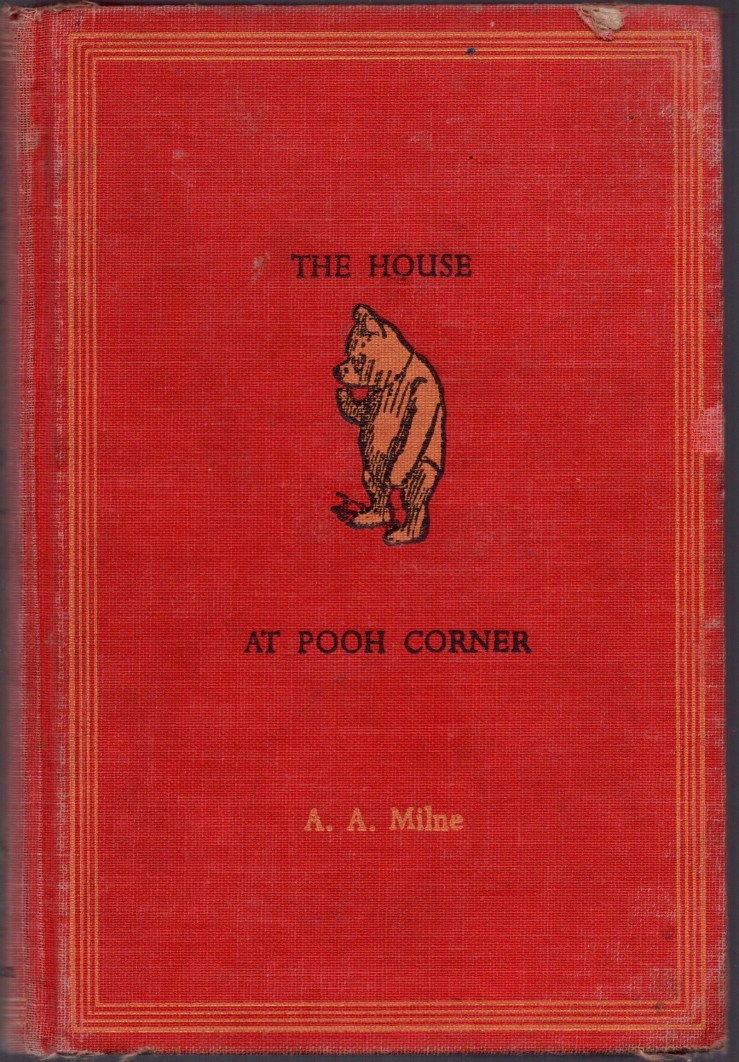
Three Books

IMG_8503

The House at Pooh Corner by A.A. Milne. A 1961 hardback by E.P. Dutton & Co. “Decorations” by Ernest H. Shepard; design credited to Warren Chappell. All three books this week come from a box my mother-in-law dropped off, containing maybe two dozen of her old books.

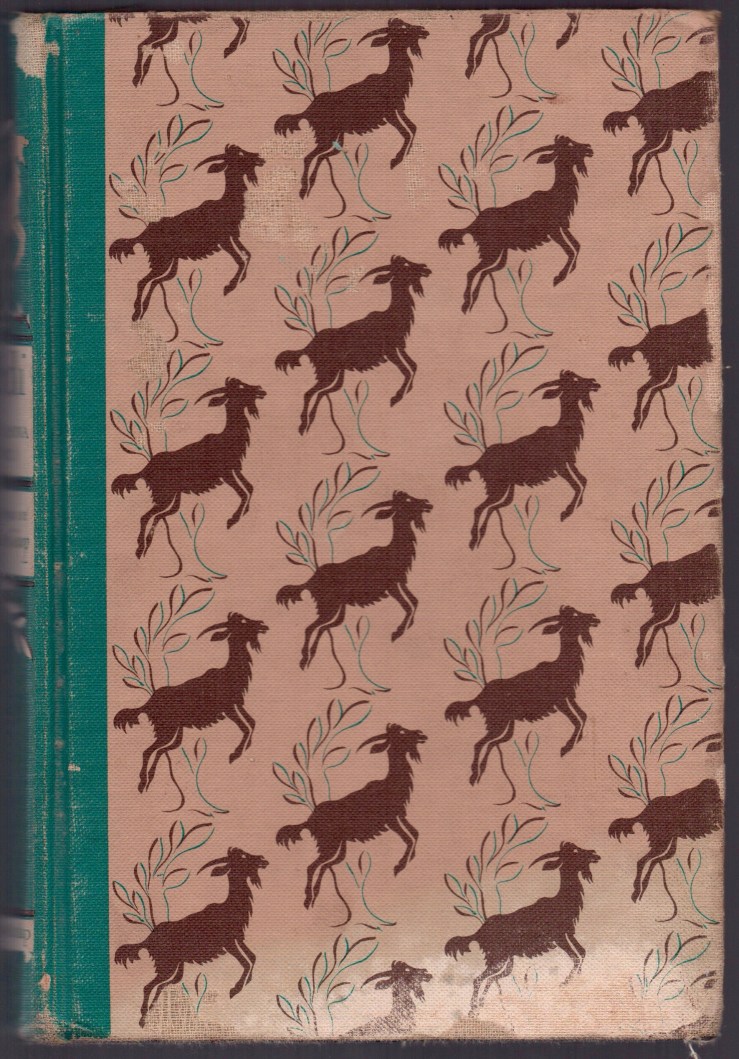
IMG_8504Heidi by Johanna Spyri. A 1945 Grosset & Dunlap Illustrated Junior Library hardback edition. Illustrations are by William Sharp, but no designer is credited for the hardback cover. My guess is that there was a dust jacket for this book at one point.
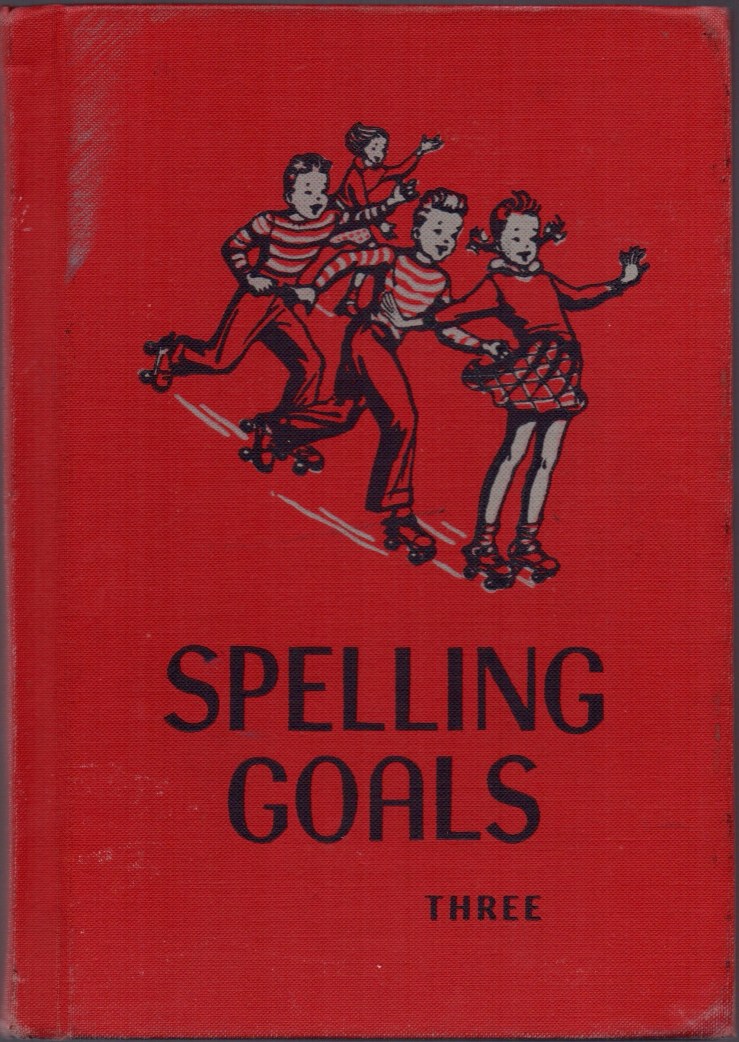
IMG_8505

Spelling Goals (Three) by May Lambader, William Kottmeyer, and Rose Wickey. 1951, hardback, Webster. Illustrations by Edward Miller and cover by Christine Chisolm.

My First Sermon/My Second Sermon — John Everett Millais

Nude — Stanley Spencer

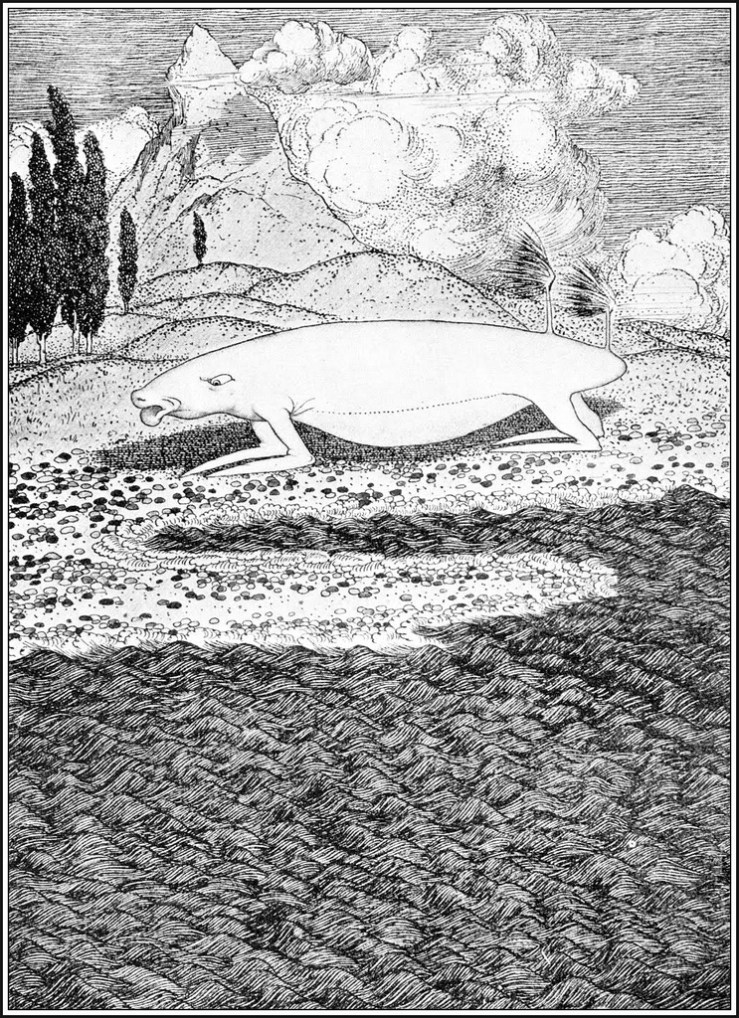
The Two-Tailed Sogg — Sidney Sime

5807538696_c8f8042fa3_b

A video essay on the music of Nic Roeg’s film The Man Who Fell to Earth

(Via).

The Eye of Lorca — Martin Springett

image

Nathaniel Hawthorne’s journal entry for September 26th, 1841

Brook Farm, September 26th.–A walk this morning along the Needham road. A clear, breezy morning, after nearly a week of cloudy and showery weather. The grass is much more fresh and vivid than it was last month, and trees still retain much of their verdure, though here and there is a shrub or a bough arrayed in scarlet and gold. Along the road, in the midst of a beaten track, I saw mushrooms or toad-stools which had sprung up probably during the night.

The houses in this vicinity are, many of them, quite antique, with long, sloping roofs, commencing at a few feet from the ground, and ending in a lofty peak. Some of them have huge old elms overshadowing the yard. One may see the family sleigh near the door, it having stood there all through the summer sunshine, and perhaps with weeds sprouting through the crevices of its bottom, the growth of the months since snow departed. Old barns, patched and supportedby timbers leaning against the sides, and stained with the excrement of past ages.

In the forenoon I walked along the edge of the meadow towards Cow Island. Large trees, almost a wood, principally of pine with the green pasture-glades intermixed, and cattle feeding. They cease grazing when an intruder appears, and look at him with long and wary observation, then bend their heads to the pasture again. Where the firm ground of the pasture ceases, the meadow begins,–loose, spongy, yielding to the tread, sometimes permitting the foot to sink into black mud, or perhaps over ankles in water. Cattle-paths, somewhat firmer than the general surface, traverse the dense shrubbery which has overgrown the meadow. This shrubbery consists of small birch, elders, maples, and other trees, with here and there white-pines of larger growth. The whole is tangled and wild and thick-set, so that it is necessary to part the nestling stems and branches, and go crashing through. There are creeping plants of various sorts which clamber up the trees; and some of them have changed color in the slight frosts which already have befallen these low grounds, so that one sees a spiral wreath of scarlet leaves twining up to the top of a green tree, intermingling its bright hues with their verdure, as if all were of one piece. Sometimes, instead of scarlet, the spiral wreath is of a golden yellow.

Within the verge of the meadow, mostly near the firm shore of pasture ground, I found several grapevines, hung with an abundance of large purple grapes. The vines had caught hold of maples and alders, and climbed to the summit, curling round about and interwreathing their twisted folds in so intimate amanner that it was not easy to tell the parasite from the supporting tree or shrub. Sometimes the same vine had enveloped several shrubs, and caused a strange, tangled confusion, converting all these poor plants to the purpose of its own support, and hindering their growing to their own benefit and convenience. The broad vine-leaves, some of them yellow or yellowish-tinged, were seen apparently growing on the same stems with the silver-mapled leaves, and those of the other shrubs, thus married against their will by the conjugal twine; and the purple clusters of grapes hung down from above and in the midst, so that one might “gather grapes,” if not “of thorns,” yet of as alien bushes.

One vine had ascended almost to the tip of a large white-pine, spreading its leaves and hanging its purple clusters among all its boughs,–still climbing and clambering, as if it would not be content till it had crowned the very summit with a wreath of its own foliage and bunches of grapes. I mounted high into the tree, and ate the fruit there, while the vine wreathed still higher into the depths above my head. The grapes were sour, being not yet fully ripe. Some of them, however, were sweet and pleasant.

Nathaniel Hawthorne’s journal entry for September 26th, 1841. From Passages from the American Note-Books.

Mythological Story with Red Figures — David Burliuk

Merlin Lured by Vivien — Arthur Rackham

Inversions without end (Blood Meridian)

As they rode that night upon the mesa they saw come toward them much like their own image a party of riders pieced out of the darkness by the intermittent flare of the dry lightning to the north. Glanton halted and sat his horse and the company halted behind him. The silent riders hove on. When they were a hundred yards out they too halted and all sat in silent speculation at this encounter.

Who are you? called Glanton.

Amigos, somos amigos.

They were counting each the other’s number.

De donde viene? called the strangers.

A donde va? called the judge.

They were ciboleros down from the north, their packhorses laden with dried meat. They were dressed in skins sewn with the ligaments of beasts and they sat their animals in the way of men seldom off them. They carried lances with which they hunted the wild buffalo on the plains and these weapons were dressed with tassels of feathers and colored cloth and some carried bows and some carried old fusils with tasseled stoppers in their bores. The dried meat was packed in hides and other than the few arms among them they were innocent of civilized device as the rawest savage of that land.

They parleyed without dismounting and the ciboleros lighted their small cigarillos and told that they were bound for the markets at Mesilla. The Americans might have traded for some of the meat but they carried no tantamount goods and the disposition to exchange was foreign to them. And so these parties divided upon that midnight plain, each passing back the way the other had come, pursuing as all travelers must inversions without end upon other men’s journeys.

The last few paragraphs of Ch. IX of Cormac McCarthy’s novel Blood Meridian. The inversion here points towards the novel’s palindromic structure (I would link that phrase “palindromic structure” to Christopher Forbis’s essay “Of Judge Holden’s Hats; Or, the Palindrome in Cormac McCarthy’s Blood Meridian“—only I can’t seem to find it online anymore).

Voyage d’Hermès — Moebius

Moebius-VoyageHermes-6

“The Human Abstract” — William Blake

“The Human Abstract”

by William Blake


Pity would be no more,
If we did not make somebody Poor:
And Mercy no more could be,
If all were as happy as we;

And mutual fear brings peace;
Till the selfish loves increase.
Then Cruelty knits a snare,
And spreads his baits with care.

He sits down with holy fears,
And waters the ground with tears:
Then Humility takes its root
Underneath his foot.

Soon spreads the dismal shade
Of Mystery over his head;
And the Catterpillar and Fly,
Feed on the Mystery.

And it bears the fruit of Deceit,
Ruddy and sweet to eat;
And the Raven his nest has made
In its thickest shade.

The Gods of the earth and sea
Sought thro’ Nature to find this Tree
But their search was all in vain:
There grows one in the Human Brain

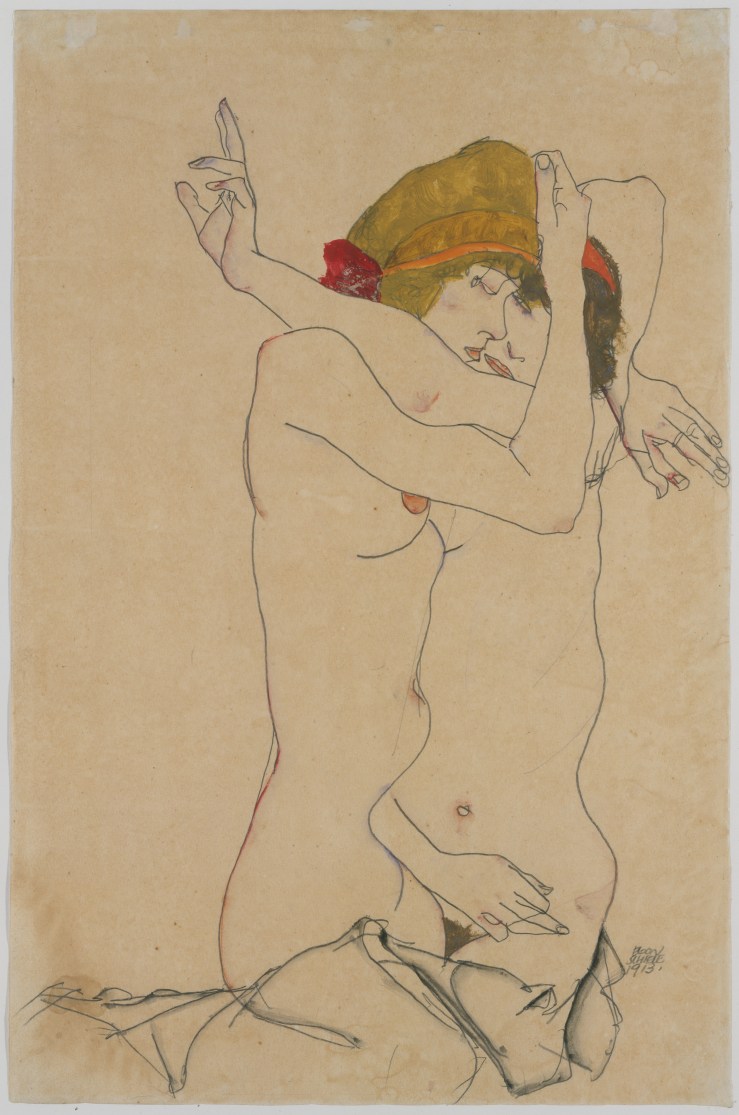
Two Women Embracing — Egon Schiele

DT6691

“On my volcano grows the grass” — Emily Dickinson

volc

Autumn II — Hugo Simberg

Portrait of a Girl Reading — Thomas Sully