More Plant-like: Riffing on Han Kang’s The Vegetarian

We tend to pathologize the ultimate no—suicide—as a shameful failure, the worst kind of failure. The shame of not having assimilated into normative culture, of not bootstrapping the self into a legible narrative of success. Of being merely unable. Melville’s Bartleby teaches us this lesson all too well. Those around Bartleby can’t read his preference to merely not be as such. They want to know why he doesn’t want to be a good bureaucrat. And they string him up for it. But saying no can be an assertion of power, freedom and will, as Bartelby teaches us. The choice to merely not be is simply that. It frustrates everyone around it because it defies the most naturalized assumption in existence: that consciousness is a gift, a privilege, a precious unit of time not to be squandered or frivolously wasted. We are urged to make good with life.

But this attitude comes with the privilege of choices. One who can say that things can be different, that one only need to work a bit harder, shift her perception, to “be the change she wishes to see in the world” doesn’t wake up on Skid Row every morning, is not black in Baltimore or Ferguson, does not live in a body policed by the law and popular culture. Moreover, this attitude assumes that whatever prevents this different life, where one doesn’t have to say no, is conquerable, fixable. Often, the sensation that things cannot be different appears insurmountable. Whatever is assaulting you cannot be removed with a simple shift in perception and attitude.

Such is the dilemma of Yeong-hye in Han Kang’s The Vegetarian. The flap copy describes Yeong-hye’s turn towards vegetarianism as a decision, as does her tyrannical husband and everyone around her, but Yeong-hye’s plant-like turn is only a decision in the most technical sense. Yes, she does decide to become a vegetarian, but not because of preference, or political/ethical commitment. Yeong-hye’s vegetarianism is vital; for her, vegetarianism is her only out from the violent misogyny that she has been born into. But to also say that she wants death and, in turn, that Kang’s novel is a reconfiguration of the normative narrative of suicide would be a double injustice. I know nothing of South Korean culture, and I can only speak confidently of the misogyny that frames The Vegetarian because it is terrifyingly normal in the mouths of its narrators; the first injustice is that I only know this misogyny through western narratives. The second, to assert that Yeong-hye wants death, falls into the trap of romanticizing suicide. None of Yeong-hye’s life is decision, or choice, or freedom, except her desire to become more plant-like—even that is a stretch to say it is a desire. For Yeong-hye, a plant-like existence approaches a state of supreme serenity and disaffection from her world – a position where she cannot be read as a sexual being and, in turn, under the hands of a violent culture. Vegetarianism hangs the human body and self between what we understand and project onto the outside world as life and death. Vegetarianism asymptotically kisses death.

Continue reading “More Plant-like: Riffing on Han Kang’s The Vegetarian”

Allegory of Happiness — Agnolo Bronzino

Read “The Ones Who Walk Away from Omelas” by Ursula K. LeGuin

“The Ones Who Walk Away from Omelas”

by

Ursula K. LeGuin

With a clamor of bells that set the swallows soaring, the Festival of Summer came to the city Omelas, bright-towered by the sea. The rigging of the boats in harbor sparkled with flags. In the streets between houses with red roofs and painted walls, between old moss-grown gardens and under avenues of trees, past great parks and public buildings, processions moved. Some were decorous: old people in long stiff robes of mauve and grey, grave master workmen, quiet, merry women carrying their babies and chatting as they walked. In other streets the music beat faster, a shimmering of gong and tambourine, and the people went dancing, the procession was a dance. Children dodged in and out, their high calls rising like the swallows’ crossing flights over the music and the singing. All the processions wound towards the north side of the city, where on the great water-meadow called the Green Fields boys and girls, naked in the bright air, with mud-stained feet and ankles and long, lithe arms, exercised their restive horses before the race. The horses wore no gear at all but a halter without bit. Their manes were braided with streamers of silver, gold, and green. They flared their nostrils and pranced and boasted to one another; they were vastly excited, the horse being the only animal who has adopted our ceremonies as his own. Far off to the north and west the mountains stood up half encircling Omelas on her bay. The air of morning was so clear that the snow still crowning the Eighteen Peaks burned with white-gold fire across the miles of sunlit air, under the dark blue of the sky. There was just enough wind to make the banners that marked the racecourse snap and flutter now and then. In the silence of the broad green meadows one could hear the music winding through the city streets, farther and nearer and ever approaching, a cheerful faint sweetness of the air that from time to time trembled and gathered together and broke out into the great joyous clanging of the bells.

Joyous! How is one to tell about joy? How describe the citizens of Omelas?

Continue reading “Read “The Ones Who Walk Away from Omelas” by Ursula K. LeGuin”

Guitarra Minhota — Eduardo Viana

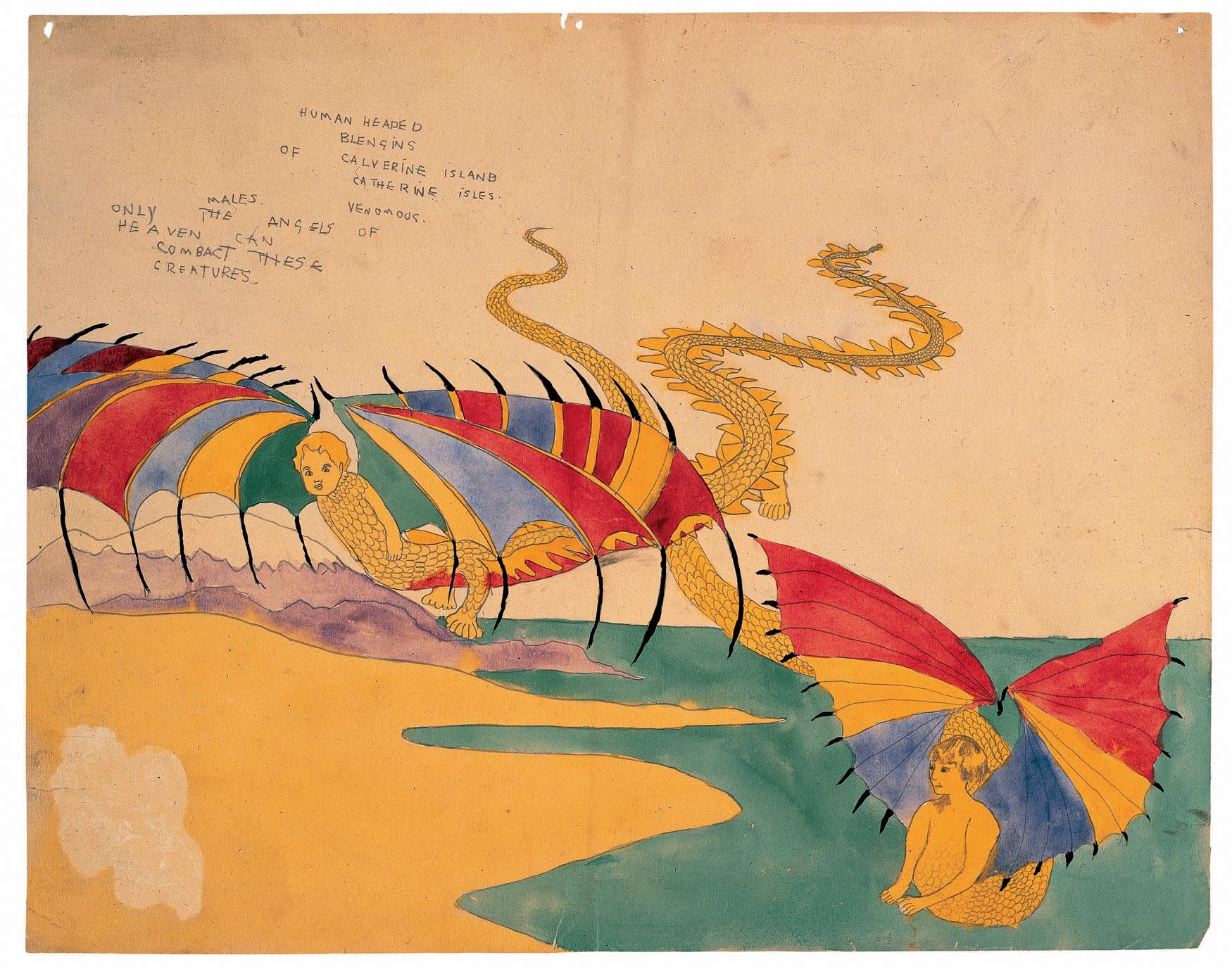
Human headed Blengins of Calverine Island Catherine Isles. — Henry Darger

2001.16.5

Robert Coover reads “The Fallguy’s Faith”

Read along here.

Falling from favor, or grace, some high artifice, down he dropped like a discredited predicate through what he called space (sometimes he called it time) and with an earsplitting crack splattered the base earth with his vital attributes. Oh, I’ve had a great fall, he thought as he lay there, numb with terror, trying desperately to pull himself together again. This time (or space) I’ve really done it! He had fallen before of course: short of expectations, into bad habits, out with his friends, upon evil days, foul of the law, in and out of love, down in the dumps—indeed, as though egged on by some malevolent metaphor generated by his own condition, he had always been falling, had he not?—but this was the most terrible fall of all. It was like the very fall of pride, of stars, of Babylon, of cradles and curtains and angels and rain, like the dread fall of silence, of sparrows, like the fall of doom.

Disks of Newton, Study for Fugue in Two Colors — Frantisek Kupka

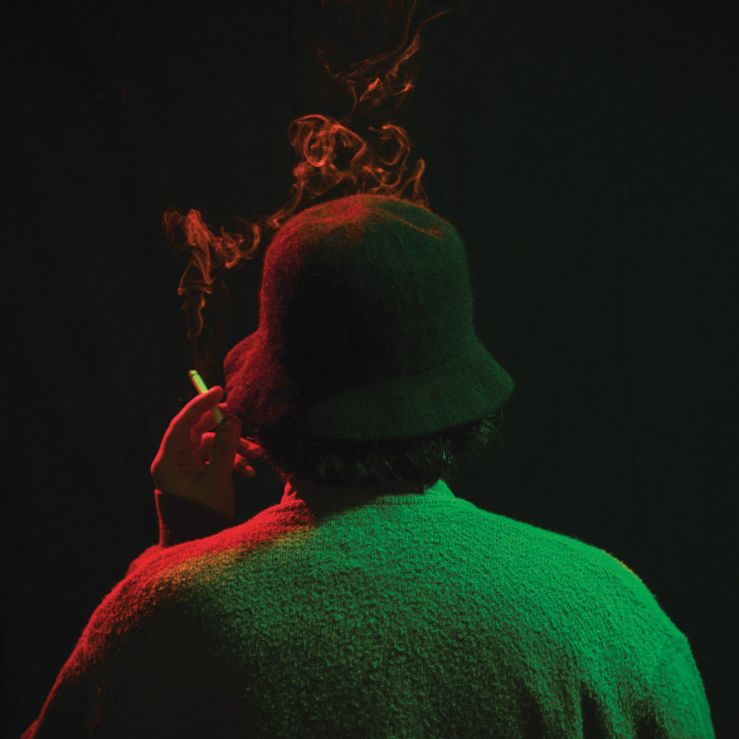
Jim O’Rourke’s Simple Songs

jim-orourke-simple-songs

In the last minute of “Hotel Blue,” the fourth track on his new LP Simple Songs, Jim O’Rourke belts out his lines with an emotional directness we haven’t heard in his work before. He sings, and sings with a sincere presence and confidence perhaps previously absent from his fine work. The song builds from a few strums of acoustic guitar into a crescendo worthy of Harry Nilsson.

Like Nilsson (or Nilsson’s hero Randy Newman), O’Rourke’s work is saturated in a dark humor that’s perhaps easy to ignore because his music sounds so  pretty. Simple Song’s first track “Friends with Benefits” reveals that welcoming-repulsing impetus in its opening lines: “Nice to see you once again / Been a long time, my friend / since you’ve crossed my mind at all.”

The initial moments of “Friends with Benefits” feel like an overture, unfurling in little episodes that recall O’Rourke’s 2009 suite The Visitor. The track eventually coalesces and climaxes in Terry Riley violin strokes, reverberating, decisive guitar lines, and stomping drums.

These musical elements continue throughout the album, which is often driven by piano riffs cribbed from all your favorite ’70s groups. Standout track “Half Life Crisis” bounces along in a Steely Dan strut, punctuated by Brian May guitar squiggles. Dissonant orchestral touches creep into the song’s final moments, recalling some of O’Rourke’s more “experimental” work—but also calling back to The Beatles.

Simple Songs feels like the culmination 0f some of O’Rourke’s projects over the past decade, and it made me revisit them. The Visitor sounds almost like a sketchbook for this record,and All Kinds of People, the record of Burt Bacharach songs O’Rourke recorded with various vocalists, feels in retrospect like a practice run at a personal pop record. Simple Songs builds on O’Rourke’s previous two “pop” records (Eureka and Insignificance), and even though it’s not named after a Nic Roeg film, it completes a trilogy of sorts. (But I hope this is more than a trilogy, to be clear).

The emotional intensity promised in “Hotel Blue” returns in the album’s closing tracks. “End of the Road” sees O’Rourke singing—not just talk-singing, but really singing—over McCartney piano and strings. “If you were at sea / They’d throw you overboard,” our misanthrope suggests. And in the final rousing track “All Your Love,” O’Rourke sings, “I’m so happy now / And I blame you,” before promising that “All your love / Will never change me.”

I’m not very good at writing about music, and really, writing is no substitute for listening. You can stream the album now at NPR—just do it over a real sound system or at least with some proper headphones. It sounds too good for your laptop’s tinny little noise holes.

Simple Songs is out on vinyl, etc., from Drag City next week.

Scupstoel — Rogier van der Weyden

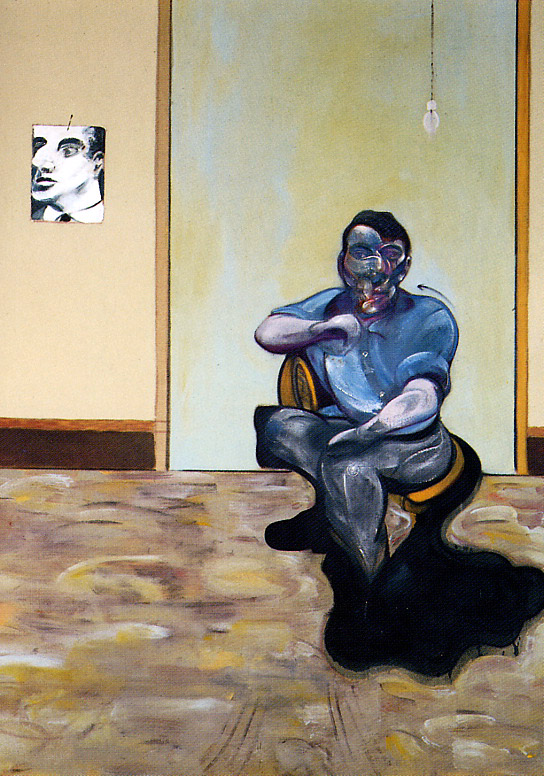
Portrait of Lucian Freud — Francis Bacon

freud bacon

Glossary of Hobo Terms

GLOSSARY OF HOBO TERMS
(from Nels Anderson’s The Milk and Honey Route)

This list of words and phrases is in no sense complete. Nor is it solely hobo slang. Many terms began in Hobohemia and were taken up in time by other groups. Other terms are found among both hobo and other groups, but in each case with a different meaning. Indeed, you will find a hobo term with one meaning on the Pacific and another on the Atlantic Seaboard, and still another in the Southland. In this book I have made no strained effort to use much of this freightyard folklore. This is opposite to the practice of many contemporary hobo writers. They think by the use of slang to add a bona fide touch to the fiction they weave. I am including this glossary largely for the information of those of you who may be interested, and for reference if you want to test some of the “authorities” in this field.

Accommodation – A local freight train. It may carry passengers.
Adam and Eve on a raft – Two fried eggs on toast. “Wreck ’em” if they are scrambled. “With their eyes open,” if not.
Alligator bait – Fried or stewed liver. Too costly now for hobos.
Anchor – A pick. Companion tool of the shovel or banjo.
Angel – A person who gives more than you expect. One who takes an interest without trying to reform you.
Angel food – Mission preaching about the Bread of Life.
AngelinaPunk or road kid acting as a hobo’s companion.
A-No-1 – A famous tramp who writes his name “on everything like J. B. King.” He writes books about his alleged adventures. Many young hobos write this monicker on water tanks, and chalk it on box cars.
AuntieAngelina grown older.
Axle grease – Butter. Sometimes called plaster.
Baldy – Generally an old man “with a high forehead”.
Balloon – A roll of bedding carried on the back; a bindle.
Barnacle – A fellow who sticks to one job a year or more.
Banjo – A short-handled shovel. Continue reading “Glossary of Hobo Terms”

A deleted scene from Inherent Vice

The Mérode Altarpiece — Robert Campin

A Coffee Chronology

A COFFEE CHRONOLOGY

Giving dates and events of historical interest in legend, travel, literature, cultivation, plantation treatment, trading, and in the preparation and use of coffee from the earliest time to the present

(From William H. Ukers’s All About Coffee, 1922)

900[L]—Rhazes, famous Arabian physician, is first writer to mention coffee under the name bunca or bunchum.[M]

1000[L]—Avicenna, Mahommedan physician and philosopher, is the first writer to explain the medicinal properties of the coffee bean, which he also calls bunchum.[M]

1258[L]—Sheik Omar, disciple of Sheik Schadheli, patron saint and legendary founder of Mocha, by chance discovers coffee as a beverage at Ousab in Arabia.[M]

1300[L]—The coffee drink is a decoction made from roasted berries, crushed in a mortar and pestle, the powder being placed in boiling water, and the drink taken down, grounds and all.

1350[L]—Persian, Egyptian, and Turkish ewers made of pottery are first used for serving coffee.

1400–1500—Earthenware or metal coffee-roasting plates with small holes, rounded and shaped like a skimmer, come into use in Turkey and Persia over braziers. Also about this time appears the familiar Turkish cylinder coffee mill, and the original Turkish coffee boiler of metal.

1428–48—Spice grinder to stand on four legs first invented; subsequently used to grind coffee.

1454[L]—Sheik Gemaleddin, mufti of Aden, having discovered the virtues of the berry on a journey to Abyssinia, sanctions the use of coffee in Arabia Felix.

1470–1500—The use of coffee spreads to Mecca and Medina.

1500–1600—Shallow iron dippers with long handles and small foot-rests come into use in Bagdad and in Mesopotamia for roasting coffee.

1505[L]—The Arabs introduce the coffee plant into Ceylon.

1510—The coffee drink is introduced into Cairo.

1511—Kair Bey, governor of Mecca, after consultation with a council of lawyers, physicians, and leading citizens, issues a condemnation of coffee, and prohibits the use of the drink. Prohibition subsequently ordered revoked by the sultan of Cairo.

1517—Sultan Selim I, after conquering Egypt, brings coffee to Constantinople.

1524—The kadi of Mecca closes the public coffee houses because of disorders, but permits coffee drinking at home and in private. His successor allows them to re-open under license.

1530[L]—Coffee drinking introduced into Damascus.

1532[L]—Coffee drinking introduced into Aleppo.

1534—A religious fanatic denounces coffee in Cairo and leads a mob against the coffee houses, many of which are wrecked. The city is divided into two parties, for and against coffee; but the chief judge, after consultation with the doctors, causes coffee to be served to the meeting, drinks some himself, and thus settles the controversy.

Continue reading “A Coffee Chronology”

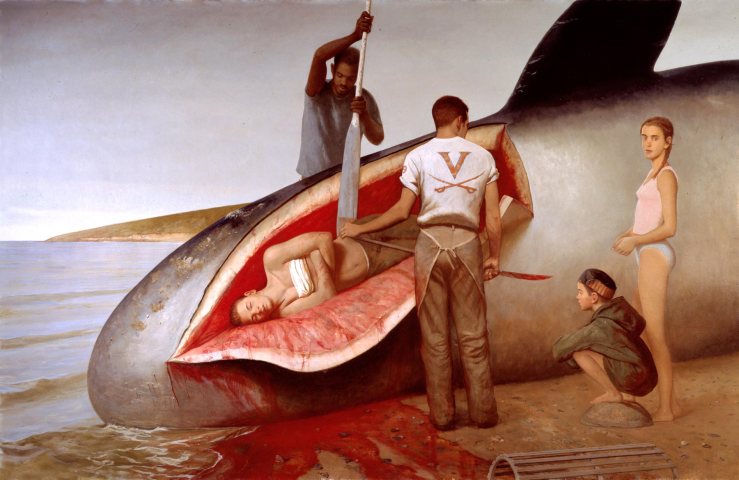
Leviathan — Bo Bartlett

2000-leviathan-lg

“All Things Decay and Die” — Robert Herrick

Screenshot 2015-05-11 at 8