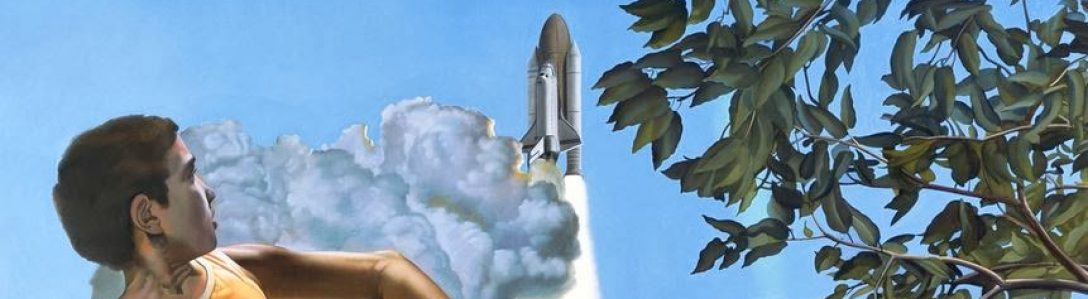
A Spool of Blue Thread (Book acquired some time in January, 2015)

IMG_4954Anne Tyler’s novel A Spool of Blue Thread is new in hardback from publisher Random House. Their blurb:
“It was a beautiful, breezy, yellow-and-green afternoon. . .” This is how Abby Whitshank always begins the story of how she fell in love with Red that day in July 1959. The Whitshanks are one of those families that radiate togetherness: an indefinable, enviable kind of specialness. But they are also like all families, in that the stories they tell themselves reveal only part of the picture. Abby and Red and their four grown children have accumulated not only tender moments, laughter, and celebrations, but also jealousies, disappointments, and carefully guarded secrets. From Red’s father and mother, newly arrived in Baltimore in the 1920s, to Abby and Red’s grandchildren carrying the family legacy boisterously into the twenty-first century, here are four generations of Whitshanks, their lives unfolding in and around the sprawling, lovingly worn Baltimore house that has always been their anchor.

Brimming with all the insight, humor, and generosity of spirit that are the hallmarks of Anne Tyler’s work, A Spool of Blue Thread tells a poignant yet unsentimental story in praise of family in all its emotional complexity. It is a novel to cherish.

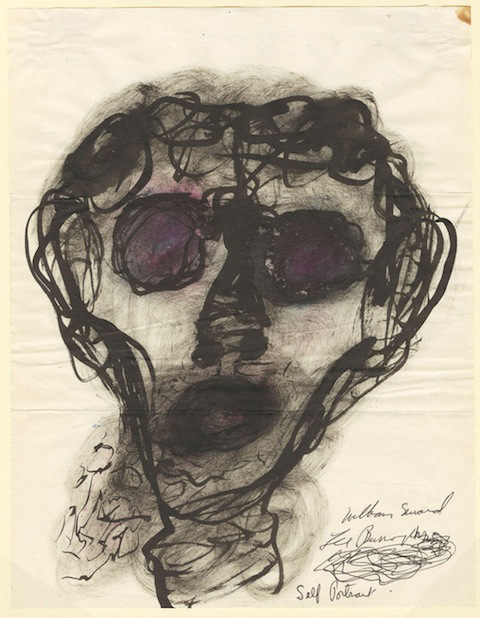
Self-Portrait — William Burroughs

wsb

The Lady on the Horse — Alfred Kubin

The Temptation of St. Anthony — Bernardo Parentino

temptations-of-st-anthony

On the Special Expressions of Cats — Charles Darwin

fig9

Cats.—I have already described the actions of a cat, when feeling savage and not terrified (fig.9). She assumes a crouching attitude and occasionally protrudes her fore-feet, with the claws exserted ready for striking. The tail is extended, being curled or lashed from side to side. The hair is not erected—at least it was not so in the few cases observed by me. The ears are drawn closely backwards and the teeth are shown. Low savage growls are uttered. We can understand why the attitude assumed by a cat when preparing to fight with another cat, or in any way greatly irritated, is so widely different from that of a dog approaching another dog with hostile intentions; for the cat uses her fore-feet for striking, and this renders a crouching position convenient or necessary. She is also much more accustomed than a dog to lie concealed and suddenly spring on her prey. No cause can be assigned with certainty for the tail being lashed or curled from side to side. This habit is common to many other animals—for instance, to the puma, when prepared to spring; but it is not common to dogs, or to foxes, as I infer from Mr. St. John’s account of a fox lying in wait and seizing a hare. We have already seen that some kinds of lizards and various snakes, when excited, rapidly vibrate the tips of their tails. It would appear as if, under strong excitement, there existed an uncontrollable desire for movement of some kind, owing to nerve-force being freely liberated from the excited sensorium; and that as the tail is left free, and as its movement does not disturb the general position of the body, it is curled or lashed about. Continue reading “On the Special Expressions of Cats — Charles Darwin”

Ticket of Admission to a Lecture by Walt Whitman on Abraham Lincoln

Ticket of admission to a lecture by Walt Whitman on Abraham Lincoln,"  initialed by Whitman at lower right. Lecture "to be delivered on Thursday, April 14th [1887], at 4 o'clock P. M., in the Madison Square Theatre, New-York."

(Via/about).

“I would really like to try to do some good in the world” (William T. Vollmann)

I don’t know why it was so strange to hear William T. Vollmann’s voice on NPR as I drove into work this morning. Maybe because I have Vollmann on the brain (I’ve been in the middle of a long email interview with the editors of the recent volume William T. Vollmann: A Critical Companion). Or maybe it’s just that it seems so rare these days to hear the opinions of a novelist given a platform on popular media. Still weird though (even though I heard Vollmann on the radio last year too). Anyway, he was on NPR this morning, speaking to David Greene about his forthcoming article on the aftermath of the Fukushima meltdown in next month’s Harper’s. From their disucssion:

David Greene: William Vollmann, I’m just curious. The last time we spoke we talked about how the FBI thought you might be the Unabomber. You’ve traveled with mujahideen, you’ve smoked crack with prostitutes in California. I mean you have a certain style your reporting where you want to be in the middle of something so to speak and here you’re exposing yourself to radiation. What drives you?


William Vollmann: Well, one time read an E.O. Wilson book about the ants—


DG: E.O. Wilson—you’re talking about the famous Harvard naturalist and professor right?


WV: That’s right, yeah. He says that it’s common in ant colonies for the older female ants to take more and more risks. They’ve already reproduced, and if they don’t come back it’s no real loss to the ant colony. And I’m an older person, I’m 55, I’ve reproduced, I’m going to die in any event, so I have less to fear. And I would really like to try to do some good in the world before I die, and you know, if I get cancer as a result it’s no real loss. The more I see of the disasters that nuclear power can cause, the more I think, I would really like to describe this and help people share my alarm.

Sirin and Alkonost, The Birds of Joy and Sorrow — Viktor Vasnetsov

Conversation (Tom Clark fragment)

Tom Clark

(From “Bugs Ate This Lake Clean,” collected in Light & Shade).

Dr. Doom vs. The Silver Surfer — Jack Kirby

02

The Little Cigarette — Theodor Pallady

That’s that! (Punch Drunk Love)

St. Francis Appears on a Chariot of Fire — José Benlliure y Gil

“When the Devil Was Well” — Gertrude Atherton

“When the Devil Was Well”

by

Gertrude Atherton

The Devil locked the copper gates of Hell one night, and sauntered down a Spacian pathway. The later arrivals from the planet Earth had been of a distressingly commonplace character to his Majesty–a gentleman of originality and attainments, whatever his disagreements with the conventions. He was become seriously disturbed about the moral condition of the sensational little twinkler.

“What are my own about?” he thought, as he drifted past planets which yielded up their tributes with monotonous regularity. “What a squeezed old orange would Earth become did I forsake it! I must not neglect it so long again; my debt of gratitude is too great. Let me see. Where shall I begin? It is some years since I have visited America in person, and unquestionably she has most need of my attention; Europe is in magnificent running order. This is a section of her, if my geography does not fail me; but what? I do not recall it.”

He poised above a country that looked as if it still hung upon the edge of chaos: wild, fertile, massive, barren, luxuriant, crouching on the ragged line of the Pacific. From his point of vantage he saw long ranges of stupendous mountains, some but masses of scowling crags, some green with forests of mammoth trees projecting their gaunt rigid arms above a carpet of violets; indolent valleys and swirling rivers; snow on the black peaks of the North; the riotous colour of eternal summer in the South. Suddenly he uttered a sharp exclamation and swept downward, halting but a mile above the ground. He frowned heavily, then smiled–a long, placid, sardonic smile. There appeared to be but few inhabitants in this country, and those few seemed to live either in great white irregular buildings, surmounted by crosses, in little brown huts near by, in the caves, or in hollowed trees on the mountains. The large buildings were situated about sixty miles apart, in chosen valleys; they were imposing and rambling, built about a plaza. They boasted pillared corridors and bright red tiles on their roofs. Within the belfries were massive silver bells, and the crosses could be seen to the furthermost end of the valley and from the tops of the loftiest mountain.

“California!” exclaimed the Devil. “I know of her. Her scant history is outlined in the Scarlet Book. I remember the points: Climate, the finest, theoretically, in the world; satanically, simply magnificent. I have waited impatiently for the stream of humanity to deflect thitherward, but priests will answer my present purpose exactly–unless they are all too tough. To continue, gold under that grass in chunks–aha! I shall have to throw out an extra wing in Hell! Parched deserts where men will die cursing; fruitful valleys, more gratifying to my genius; about as much of one as of the other, but the latter will get all the advertising, and the former be carefully kept out of sight. Everything in the way of animal life, from grizzly bears to fleas. A very remarkable State! Well, I will begin on the priests.” Continue reading ““When the Devil Was Well” — Gertrude Atherton”

Ghost Story 1 — Emma Bennett

11-GhostStory1-600x763

See the trailer for Peter Greenaway’s new film, Eisenstein in Guanajuato

“Wake” — Langston Hughes

wake