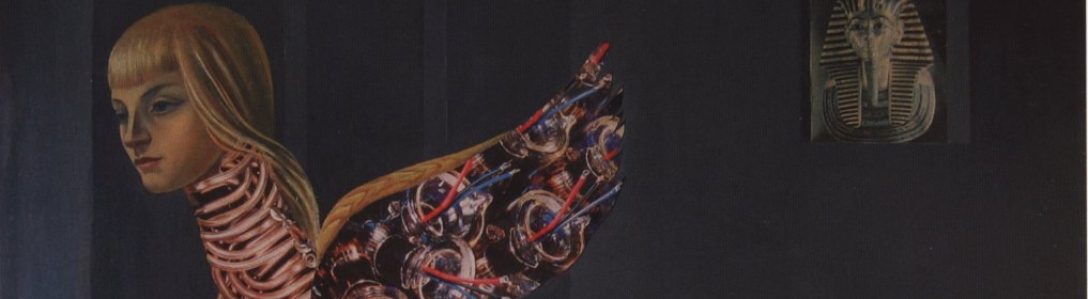
The Moment of Birth — Alfred Kubin

Doc Sportello’s Interstellar Trip (Pynchon’s Inherent Vice)

It had all begun, apparently, some 3 billion years ago, on a planet in a binary star system quite a good distance from Earth. Doc’s name then was something like Xqq, and because of the two suns and the way they rose and set, he worked some very complicated shifts, cleaning up after a labful of scientist-priests who invented things in a gigantic facility which had formerly been a mountain of pure osmium. One day he heard some commotion down a semiforbidden corridor and went to have a look. Ordinarily sedate and studious personnel were running around in uncontrolled glee. “We did it!” they kept screaming. One of them grabbed Doc, or actually Xqq. “Here he is! The perfect subject!” Before he knew it he was signing releases, and being costumed in what he would soon learn was a classic hippie outfit of the planet Earth, and led over to a peculiarly shimmering chamber in which a mosaic of Looney Tunes motifs was repeating obsessively away in several dimensions at once in vividly audible yet unnamable spectral frequencies. . . . The lab people were explaining to him meanwhile that they’d just invented intergalactic time travel and that he was about to be sent across the universe and maybe 3 billion years into the future. “Oh, and one other thing,” just before throwing the final switch, “the universe? it’s been, like, expanding? So when you get there, everything else will be the same weight, but bigger? with all the molecules further apart? except for you—you’ll be the same size and density. Meaning you’ll be about a foot shorter than everybody else, but much more compact. Like, solid?”


“Can I walk through walls?” Xqq wanted to know, but by then space and time as he knew it, not to mention sound, light, and brain waves, were all undergoing these unprecedented changes, and next thing he knew he was standing on the corner of Dunecrest and Gordita Beach Boulevard, and watching what seemed to be an endless procession of young women in bikinis, some of whom were smiling at him and offering thin cylindrical objects whose oxidation products were apparently meant to be inhaled. . . .


As it turned out, he was able to go through drywall construction with little discomfort, although, not having X-ray vision, he did run into some disagreeable moments with wall studs and eventually curtailed the practice. His new hyperdensity also allowed him sometimes to deflect simple weapons directed at him with hostile intent, though bullets were another story, and he also learned to avoid those when possible. Slowly the Gordita Beach of his trip merged with the everyday version, and he began to assume that things were back to normal, except for when, now and then, he’d forget and lean against a wall and suddenly find himself halfway through it and trying to apologize to somebody on the other side.

From Thomas Pynchon’s novel Inherent Vice.

Sinovenator Changii — John Conway

sinovenator-changii

Utopia — Saul Steinberg

“An Inhabitant of Carcosa” by Ambrose Bierce

“An Inhabitant of Carcosa”

by

Ambrose Bierce

For there be divers sorts of death — some wherein the body remaineth; and in some it vanisheth quite away with the spirit. This commonly occurreth only in solitude (such is God’s will) and, none seeing the end, we say the man is lost, or gone on a long journey — which indeed he hath; but sometimes it hath happened in sight of many, as abundant testimony showeth. In one kind of death the spirit also dieth, and this it hath been known to do while yet the body was in vigor for many years. Sometimes, as is veritably attested, it dieth with the body, but after a season is raised up again in that place where the body did decay.

Pondering these words of Hali (whom God rest) and questioning their full meaning, as one who, having an intimation, yet doubts if there be not something behind, other than that which he has discerned, I noted not whither I had strayed until a sudden chill wind striking my face revived in me a sense of my surroundings. I observed with astonishment that everything seemed unfamiliar. On every side of me stretched a bleak and desolate expanse of plain, covered with a tall overgrowth of sere grass, which rustled and whistled in the autumn wind with heaven knows what mysterious and disquieting suggestion. Protruded at long intervals above it, stood strangely shaped and somber- colored rocks, which seemed to have an understanding with one another and to exchange looks of uncomfortable significance, as if they had reared their heads to watch the issue of some foreseen event. A few blasted trees here and there appeared as leaders in this malevolent conspiracy of silent expectation. Continue reading ““An Inhabitant of Carcosa” by Ambrose Bierce”

Charles Burns’s Shadows of Carcosa Cover

productimage-picture-shadows-of-carcosa-456

Nude Reading on the Seashore — William Orpen

Saint Jerome Reading with the Lion — Andrea Mantegna

Evan Dara (Books acquired 1.28/29/2015)

IMG_4990

“All art constantly something something something”

The Wedding Dance — Pieter Bruegel the Elder

There is nothing sacred about literature, it is damned from one end to the other (William Carlos Williams)

There is nothing sacred about literature, it is damned from one end to the other. There is nothing in literature but change and change is mockery. I’ll write whatever I damn please, whenever I damn please and as I damn please and it’ll be good if the authentic spirit of change is on it.

From Kora in Hell: Improvisations by William Carlos Williams.

Ernest Hemingway vs. Wallace Stevens (David Markson)

Capture

Girl Reading — Georges Valmier

Read Donald Barthelme’s short story “At the End of the Mechanical Age”

“At the End of the Mechanical Age”

by

Donald Barthelme

I went to the grocery store to buy some soap. I stood for a long time before the soaps in their attractive boxes, RUB and FAB and TUB and suchlike, I couldn’t decide so I closed my eyes and reached out blindly and when I opened my eyes I found her hand in mine.

Her name was Mrs. Davis, she said, and TUB was best for important cleaning experiences, in her opinion. So we went to lunch at a Mexican restaurant which as it happened she owned, she took me into the kitchen and showed me her stacks of handsome beige tortillas and the steam tables which were shiny-brite. I told her I wasn’t very good with women and she said it didn’t matter, few men were, and that nothing mattered, now that Jake was gone, but I would do as an interim project and sit down and have a Carta Blanca. So I sat down and had a cool Carta Blanca, God was standing in the basement reading the meters to see how much grace had been used up in the month of June. Grace is electricity, science has found, it is not like electricity, it is electricity and God was down in the basement reading the meters in His blue jump suit with the flashlight stuck in the back pocket.

“The mechanical age is drawing to a close,” I said to her.

“Or has already done so,” she replied.

“It was a good age,” I said. “I was comfortable in it, relatively. Probably I will not enjoy the age to come quite so much. I don’t like its look.”

“One must be fair. We don’t know yet what kind of an age the next one will be. Although I feel in my bones that it will be an age inimical to personal well-being and comfort, and that is what I like, personal well-being and comfort.”

“Do you suppose there is something to be done?” I asked her.

“Huddle and cling,” said Mrs. Davis. “We can huddle and cling. It will pall, of course, everything palls, in time…”

Then we went back to my house to huddle and cling, most women are two different colors when they remove their clothes especially in summer but Mrs. Davis was all one color, an ocher. She seemed to like huddling and clinging, she stayed for many days. From time to time she checked the restaurant keeping everything shiny-brite and distributing sums of money to the staff, returning with tortillas in sacks, cases of Carta Blanca, buckets of guacamole, but I paid her for it because I didn’t want to feel obligated.

There was a song I sang her, a song of great expectations.

Ralph is coming,” I sang, “Ralph is striding in his suit of lights over moons and mountains, over parking lots and fountains, toward your silky side. Ralph is coming, he has a coat of many colors and all major credit cards and he is striding to meet you and culminate your foggy dreams in an explosion of blood and soil, at the end of the mechanical age. Ralph is coming preceded by fifty running men with spears and fifty dancing ladies who are throwing leaf spinach out of little baskets, in his path. Ralph is perfect,” I sang, “but he is also full of interesting tragic flaws, and he can drink fifty running men under the table without breaking his stride, and he can have congress with fifty dancing ladies without breaking his stride, even his socks are ironed, so natty is Ralph, but he is also right down in the mud with the rest of us, he markets the mud at high prices for specialized industrial uses and he is striding, striding, striding, toward your waiting heart. Of course you may not like him, some people are awfully picky… Ralph is coming,” I sang to her, “he is striding over dappled plains and crazy rivers and he will change your life for the better, probably you will be fainting with glee at the simple touch of his grave gentle grizzled hand although I am aware that some people can’t stand prosperity, Ralph is coming, I hear his hoofsteps on the drumhead of history, he is striding as he has been all his life toward you, you, you.”

“Yes,” Mrs. Davis said, when I had finished singing, “that is what I deserve, all right. But probably I will not get it. And in the meantime, there is you.”

God then rained for forty days and forty nights, when the water tore away the front of the house we got into the boat. Mrs. Davis liked the way I maneuvered the boat off the trailer and out of the garage, she was provoked into a memoir of Jake.

Continue reading “Read Donald Barthelme’s short story “At the End of the Mechanical Age””

Come Unto these Yellow Sands — Richard Dadd

Can live in Germany in 1970

Set list:

  1. Intro
  2. Sense All of Mine
  3. Oh Yeah
  4. I Feel Allright
  5. Mother Sky
  6. Deadlock
  7. Bring Me Coffee or Tea
  8. Don’t Turn the Light On, Leave Me Alone
  9. Paperhouse