Blog about Claire-Louise Bennett’s short story “Stir-fry”

stir fry

  1. I listened to an audiobook of Claire-Louise Bennett’s 2016 book Pond a few weeks ago, and then wound up getting a digital copy so that I could reread the stories in it.
  2. Pond did something electric to me.
  3. I audited most of it over the course of a weekend. This particular weekend was the first weekend of March. We had an unusually cold February in North Florida, and I’d more or less let my lawn and gardens go to hell. I audited most of Pond while gardening—cutting back dead branches, pulling thorny vines, clipping bushes, etc. I even dug a hole or two.
  4. I had not read a review of Pond before auditing and then reading it; I’d just heard (probably on Twitter) that it was good and odd. I point out that I did not know anything about Pond before getting in to it because I mistakenly thought that Pond was a novel for most of the auditing experience. I realized only toward the end that it was not, properly speaking, a novel—or at least not a novel in the sense that we think of novels as “novels.” Pond is more like a series of related vignettes about a young woman’s life in a remote village in Ireland. And I’m not even sure what I mean by “young woman’s life” in that previous sentence. Let it stand that the book won me over very quickly with “Morning, Noon & Night,” an episode that begins with the aesthetics of breakfast, includes an ill-advised gardening adventure, a hostile academic conference, some sexy emails, and culminates in chopping. It’s wonderful.
  5. Pond does so many things that I always want a book to do, by which I mean that Pond does things that I didn’t know I wanted a book to do until the book has done them.
  6. Pond is unique (are we allowed to use that word?) and thus reminds me of other innovative prose I love: William Carlos Williams’ poetry, Lydia Davis’s stuff, the fictions Jason Schwartz and Gary Lutz, David Markson’s Wittgenstein’s Mistress.
  7. But the title of this post is “Blog about Claire-Louise Bennett’s short story ‘Stir-fry,'” and I have produced a few hundred words thus far, none about Claire-Louise Bennett’s short story “Stir-fry.”
  8. (I chose to blog about “Stir-fry” not because it is my favorite in the collection or because it is an especially representative sample of Bennett’s prose, but because it is short. The longer piece “Morning, Noon & Night” offers a richer sample of Bennett’s powers and you can click on that link and read it for free and see for yourself).
  9. Okay, “Stir-fry.”
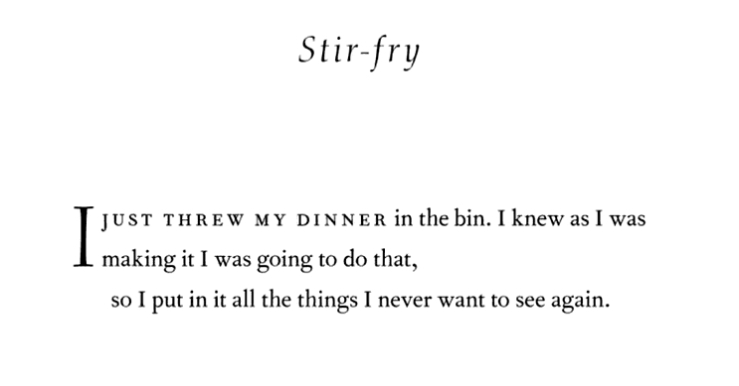
  10. The story is a title and two sentences.
  11. The title specifies the ostensible subject of the story, dinner.
  12. But the story is not about dinner; the story is about throwing dinner away.
  13. But is the story even about throwing dinner away?  I suppose that’s the central action that takes place in “Stir-fry” — tossing food away — but the story is also about consciousness in the creative process.
  14. Our narrator creates something that she knows she intends to throw away immediately after its creation.
  15. Hence, the key line to the story is the one that begins with the coordinating conjunction soBennett emphasizes the line by typographically isolating it; the effect on the page approximates poetry rather than traditional prose.
  16. “so I put in it all the things I never want to see again”: A stir-fry is usually made at least in part from leftovers or food that must be eaten soon or tossed. If we read the story literally (which we should of course), we can fill in the details with our sympathetic imaginations: A bit of rice from three days ago. That last onion. A solitary carrot going to rubber. A stub of ginger. Two small peppers, their skin now papery. The last bit of Sunday’s roast chicken. Etc.
  17. There is something deeply satisfying for some of us in using all the food in our refrigerator.
  18. But I think our sympathetic imagination could extend that phrase “things I never want to see again” even farther than the last few stray vegetables or half of a leftover pork loin or an egg clearly reaching its expiration: What else might have our narrator mixed into her stir-fry? The last little bits of blackberry jam that cling to a jar? Pickles she made two years ago? A questionable yogurt? Pine nuts past their prime? Those turnips? Why did we buy those turnips?
  19. And we can push the phrase even farther if we want: If we are creating something that we know that we will immediately discard and not use for its ostensible purpose (in this case, sustenance, life force), what else might we stir in there? What are all the things we “never want to see again”? All our feeble faults and deficiencies? Our terrible creeping anxieties? Even the bad ambitions we so often trip over? Could we throw war, prejudice, avarice into our stir-fry, and then throw those away too?
  20. Maybe I have pushed an interpretation of “Stir-fry” far too far. But I do read the vignette as a fantasy of sorts. Our narrator consciously creates something she intends to uncreate. This creative uncreation allows her to eliminate all the things she never wants to see again. The fantasy here is about opening up a new way of seeing, one unencumbered by the stale, the musty, the rancid. The desire I see is to see and taste with a fresh spirit.
  21. Or maybe “Stir-fry” is just about throwing away dinner.

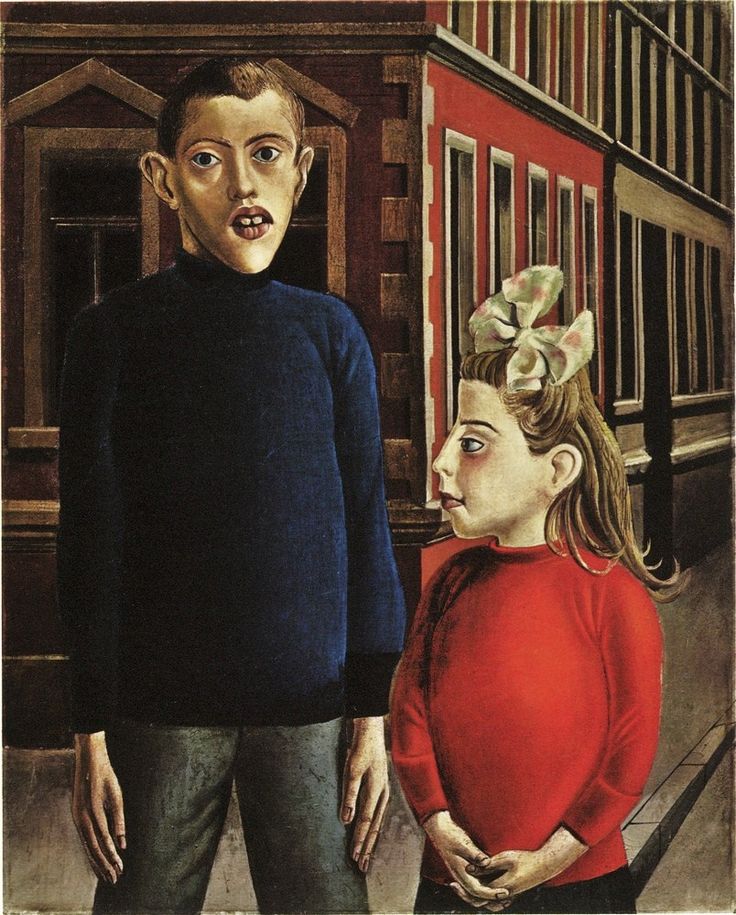
Two Children — Otto Dix

7005ed009ffc9fac39c9652186847386-george-grosz-otto-dix-paintings

Two Children, 1921 by Otto Dix (1891-1969)

Blog about like just the sheer damn orality of Robert Coover’s short story “The Brother”

This weekend I picked up a new audiobook collection of Robert Coover short stories which has been titled Going for a Beer (presumably because “Going for a Beer” is a perfect short story).  The audiobook contains 30 stories and is read by Charlie Thurston, a more than capable as an orator.

The opening story is one of Coover’s earliest published stories. “The Brother” (1962) retells the Noah narrative from the book of Genesis. I just wrote “retells,” but that’s not really the right term. Instead of retelling the story of Noah and the ark and YHWH’s flood, Coover imagines the apocalyptic affair from the perspective of Noah’s younger brother, who narrates this tale.

Noah’s unnamed brother is an earthy, sensual fellow who loves his wife and loves his wine. His wife—a sympathetic and endearing figure—is pregnant with their first child. They’re already picking out names (“Nathaniel or Anna”). Brother Noah keeps taking the narrator from his own familial duties to help build a boat though:

right there right there in the middle of the damn field he says he wants to put that thing together him and his buggy ideas and so me I says “how the hell you gonna get it down to the water?” but he just focuses me out sweepin the blue his eyes rollin like they do when he gets het on some new lunatic notion and he says not to worry none about that just would I help him for God’s sake and because he don’t know how he can get it done in time otherwise and though you’d have to be loonier than him to say yes I says I will of course I always would crazy as my brother is I’ve done little else since I was born and my wife she says “I can’t figure it out I can’t sec why you always have to be babyin that old fool he ain’t never done nothin for you God knows and you got enough to do here fields need plowin it’s a bad enough year already my God and now that red-eyed brother of yours wingin around like a damn cloud and not knowin what in the world he’s doin buildin a damn boat in the country my God what next? you’re a damn fool I tell you” but packs me some sandwiches just the same and some sandwiches for my brother

That’s kinda-sorta the opening paragraph—although no it’s not, because the whole story is just one big paragraph, a big oral fragment really, which begins with a lower-case and keeps going in a verbal rush whose only concessions to punctuation are question marks and quotation marks. No periods or commas here folks. On the page, “The Brother” perhaps approximates the blockish brickish look of a Gutenberg Bible or even the Torah, neither of which give the reader a nice period to rest on, let alone a friendly pause between paragraphs.

“The Brother” might be typographically daunting, but the apparent thickness of verbal force on the page belies its oral charms. The story is meant to be read out loud. Hell, it’s biblical, after all—a witnessing. Read aloud, “The Brother” shows us a deeply sympathetic pair of characters, a husband and wife whose small pleasures, telegraphed in naturalistic speech, might remind the auditor of real persons living today. And yet there’s an apocalyptic backdrop here. Noah’s brother and Noah’s brother’s wife—and their unborn child, and all the unborn children—will not survive YHWH’s flood.

Coover does not paint Noah as anything but a shrugging reluctant weirdo. He’s no prophet who warns and helps his brother, but rather a defeated man:

and it ain’t no goddamn fishin boat he wants to put up neither in fact it’s the biggest damn thing I ever heard of and for weeks wee\s I’m tellin you we ain’t doin nothin but cuttin down pine trees and haulin them out to his field which is really pretty high up a hill and my God that’s work lemme tell you and my wife she sighs and says I am really crazy r-e-a-l-l-y crazy and her four months with a child and tryin to do my work and hers too and still when I come home from haulin timbers around all day she’s got enough left to rub my shoulders and the small of my back and fix a hot meal her long black hair pulled to a knot behind her head and hangin marvelously down her back her eyes gentle but very tired my God and I says to my brother I says “look I got a lotta work to do buddy you’ll have to finish this idiot thing yourself I wanna help you all I can you know that but” and he looks off and he says “it don’t matter none your work” and I says “the hell it don’t how you think me and my wife we’re gonna eat I mean where do you think this food comes from you been puttin away man? you can’t eat this goddamn boat out here ready to rot in that bastard sun” and he just sighs long and says “no it just don’t matter” and he sits him down on a rock kinda tired like and stares off and looks like he might even for God’s sake cry

Noah’s dismissing his brother’s work strikes me as utterly cruel—he makes no attempt to explain why his brother’s efforts at creating a better world are in vain. I shared the passage at length again in part because I hope you’ll read it aloud gentle reader, but also that you’ll note that maybe you didn’t note all its blasphemies—Coover’s story is larded with “my Gods” and “damns” and “goddamns,” no different than the speech of 1962, no different than the speech of 2018.

Coover gives us a narrator like us, human, earthly, driven by simple pleasures and a basic sense of love. Noah comes off like a prick. The Bible loves its heroes, but the ordinary folks don’t even get to live in the margins. There’s more morality in orality though—in conversation and communication and talk.

You don’t have to buy the audiobook though to hear “The Brother.” Here is Coover reading it himself:

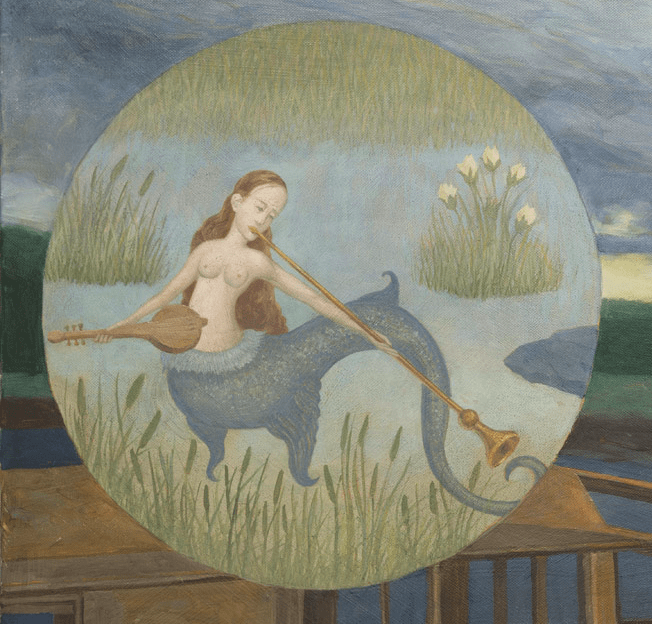
The Little Murderess — Paula Rego

little murderess

The Little Murderess, 1987 by Paula Rego (b. 1935)

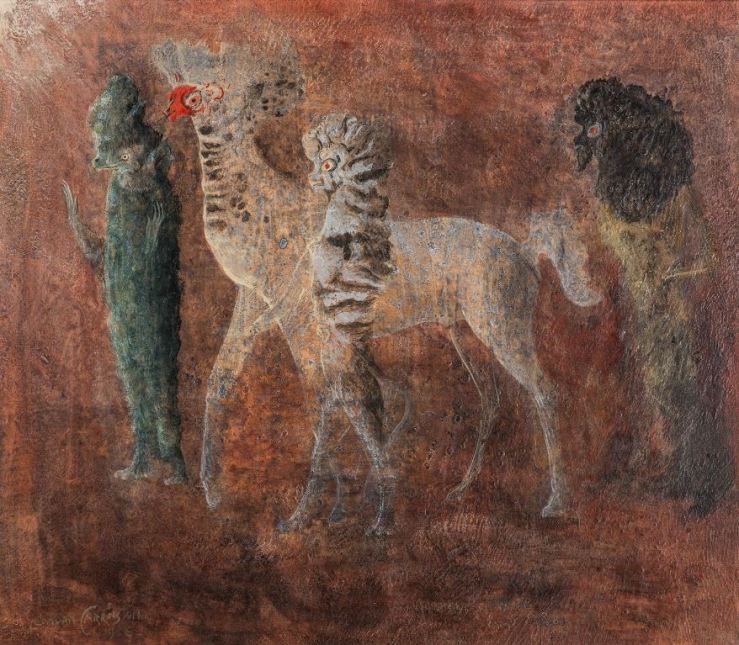
Untitled — Leonora Carrington

lc

Untitled, 1956 by Leonora Carrington (1917–2011)

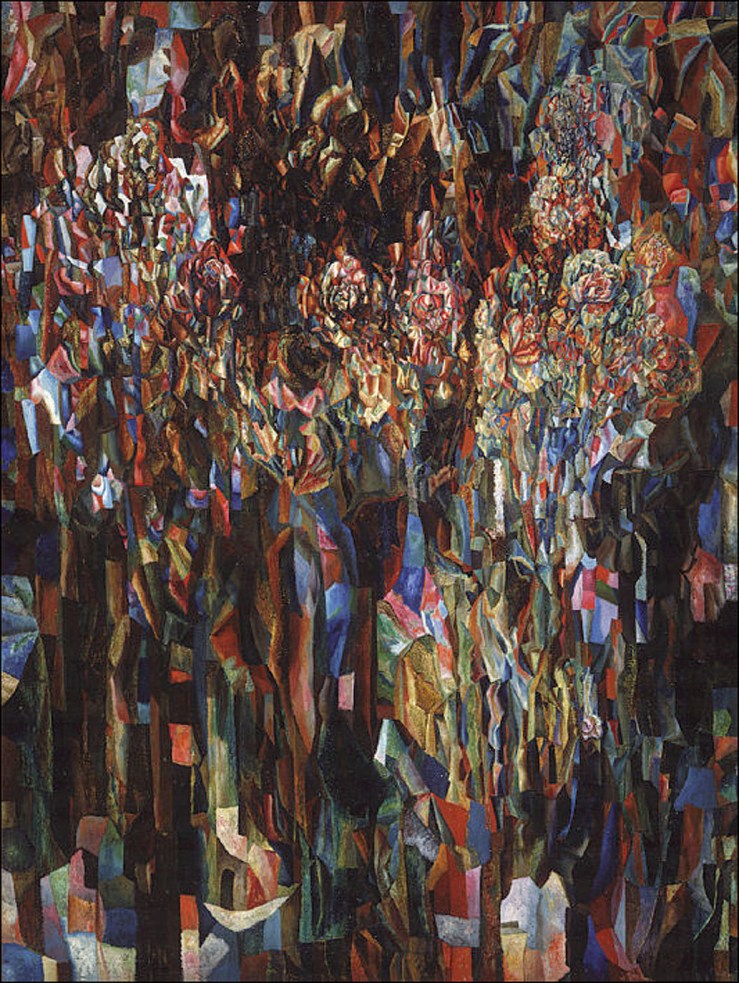
Flowers of the Universal Flowering — Pavel Filonov

universal-flowering-1916

Flowers of the Universal Flowering, 1916 by Pavel Filonov (1883-1941)

Blog about making a sherry cobbler, a cocktail I read about in a Nathaniel Hawthorne novel

In the final third of Nathaniel Hawthorne’s 1852 novel The Blithedale Romance, the narrator, having departed the titular would-be utopian farm, enjoys some city time in a hotel. He takes a voyeuristic pleasure in watching people from his window, and elects to deepen the pleasure by ordering a drink: “Just about this time a waiter entered my room. The truth was, I had rung the bell and ordered a sherry-cobbler.” The explanatory end note for my Penguin Classics copy of Blithedale gives the following recipe: “A drink made with sherry, lemon juice, sugar, and cracked ice.” I decided to make a few.

A brief internet search resulted in dozens and dozens of recipes, all more or less the same iteration: long glass, crushed ice, sherry, simple syrup, citrus (oranges cited most frequently), fresh berries if you have ’em, and a straw. The straw is the kicker here. Here is a passage from Charles Dickens’ 1844 novel Life and Adventures of Martin Chuzzlewit that shows the titular hero’s delight with his first sherry cobbler (note Chuzzlewit’s ecstasy when he gets “the reed” to his lips):

‘I wish you would pull off my boots for me,’ said Martin, dropping into one of the chairs ‘I am quite knocked up—dead beat, Mark.’

‘You won’t say that to-morrow morning, sir,’ returned Mr Tapley; ‘nor even to-night, sir, when you’ve made a trial of this.’ With which he produced a very large tumbler, piled up to the brim with little blocks of clear transparent ice, through which one or two thin slices of lemon, and a golden liquid of delicious appearance, appealed from the still depths below, to the loving eye of the spectator.

‘What do you call this?’ said Martin.

But Mr Tapley made no answer; merely plunging a reed into the mixture—which caused a pleasant commotion among the pieces of ice—and signifying by an expressive gesture that it was to be pumped up through that agency by the enraptured drinker.

Martin took the glass with an astonished look; applied his lips to the reed; and cast up his eyes once in ecstasy. He paused no more until the goblet was drained to the last drop.

‘There, sir!’ said Mark, taking it from him with a triumphant face; ‘if ever you should happen to be dead beat again, when I ain’t in the way, all you’ve got to do is to ask the nearest man to go and fetch a cobbler.’

‘To go and fetch a cobbler?’ repeated Martin.

‘This wonderful invention, sir,’ said Mark, tenderly patting the empty glass, ‘is called a cobbler. Sherry cobbler when you name it long; cobbler, when you name it short. Now you’re equal to having your boots took off, and are, in every particular worth mentioning, another man.’

Anyway. Where was I? Oh, yeah—so I looked around for recipes. David Wondrich’s 2007 cocktail history Imbibe! gives a helpful baseline recipe by citing Jerry Thomas’s 1862 classic, How to Mix Drinks. From Thomas’s book:

cobbler-1

Thomas doesn’t mention muddling the oranges, although pretty much every online recipe I read called for muddling.

So reader, I muddled.

Here is my variation on the sherry cobbler (or Sherry Cobbler, or sherry-cobbler). In the loose spirit of the cocktail, I made ours entirely of ingredients I already had at the house. These were for each cocktail:

–4 oz of sherry

–1/2 oz of simple syrup

–1/2 oz of maraschino syrup

–1 oz of sparkling water

–1 clementine (muddled)

–sprigs of mint

–blueberries

–crushed ice

img_9558

The maraschino syrup was an afterthought after I’d mixed the cocktail and was about to pour it over ice—I wanted to get a pop of color at the bottom of the glass. The mint and blueberries were from our garden. The pic above is lousy; sorry—not sure why I didn’t move the dishcloth and maybe photograph the cocktails like, uh, not in front of my wife’s kombucha hotels.

So how was it? Pretty refreshing. My wife enjoyed it more than I did, although I’m not a huge cocktail guy. (I think it’s pretty hard, for example, to improve upon neat scotch , although I do like bourbon straight up in the hotter months).

I’ve always been fascinated by literary recipes, so I’m a bit surprised the sherry cobbler has evaded my attention until now, despite its having shown up in various novels I’ve read (including Nicholson Baker’s House of Holesas Troy Patterson pointed out in a remarkably thorough literary history of the cocktail at Slate years ago). I’m not sure I’d go out of my way to make a sherry cobbler again (not that I went out of my way to make these ones), but the basic cobbler recipe’s spirit is very close to my approach to making cocktails at home anyway—use what you have. In fact, the major difference between the sherry cobblers I made yesterday and the kind of cocktail I’d normally cobble together for my wife on a Saturday afternoon is the sherry—I’d usually use rum or maybe vodka. Anyway, the whole thing was fun, which is like, the point of cocktails.

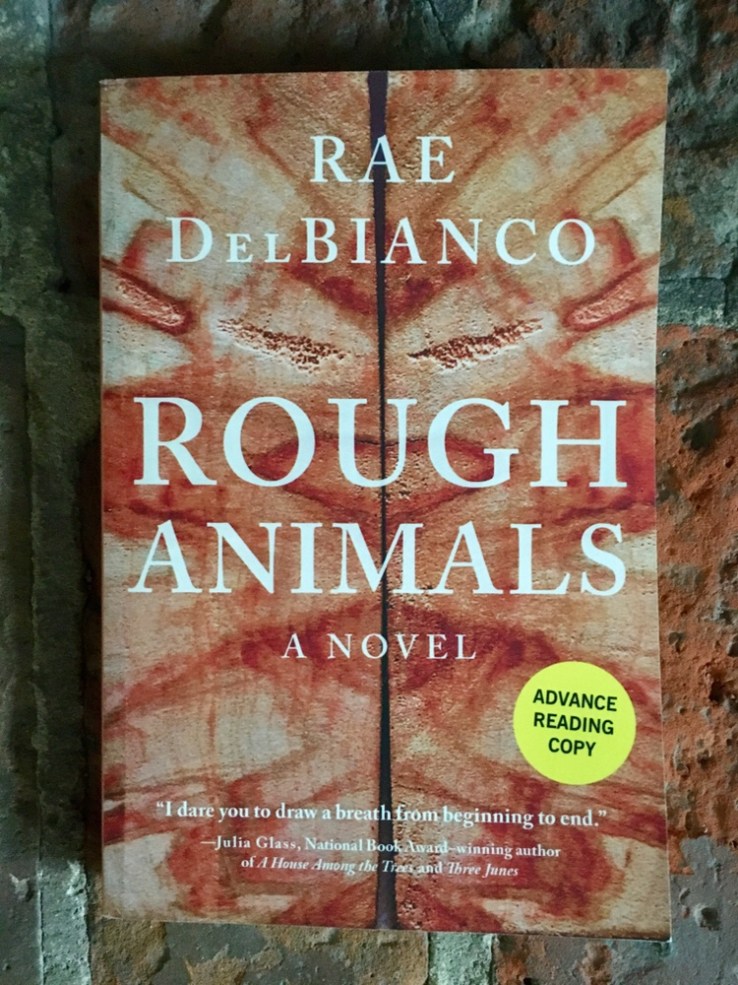
Rough Animals (Book acquired, 21 April 2018)

img_9554

A copy of Rae DelBianco’s novel, Rough Animals, arrived at Biblioklept World Headquarters yesterday. I read the first chapter, which has the protagonist getting shot on like, the second page. This is a fast-paced book so far, its plot propelled by prose clearly influenced by Cormac McCarthy and Denis Johnson.

Here is the blurb:

​Ever since their father’s untimely death five years before, Wyatt Smith and his inseparably close twin sister, Lucy, have scraped by alone on their family’s isolated ranch in Box Elder County, Utah. That is until one morning when, just after spotting one of their bulls lying dead in the field, Wyatt is hit in the arm by a hail of gunfire that takes four more cattle with it. The shooter: a fever-eyed, fearsome girl-child with a TEC-9 in her left hand and a worn shotgun in her right. They hold the girl captive, but she breaks loose overnight and heads south into the desert. With the dawning realization that the loss of cattle will mean the certain loss of the ranch, Wyatt feels he has no choice but to go after her and somehow find restitution for what’s been lost.

Wyatt’s decision sets him on an epic twelve-day odyssey through a nightmarish underworld he only half understands; a world that pitches him not only against the primordial ways of men and the beautiful yet brutally unforgiving landscape, but also against himself. As he winds his way down from the mountains of Box Elder to the mesas of Monument Valley and back, Wyatt is forced to look for the first time at who he is and what he’s capable of, and how those hard truths set him irrevocably apart from the one person he’s ever really known and loved. Steeped in a mythic, wildly alive language of its own, and gripping from the first gunshot to the last, Rough Animals is a tour de force from a powerful new voice.

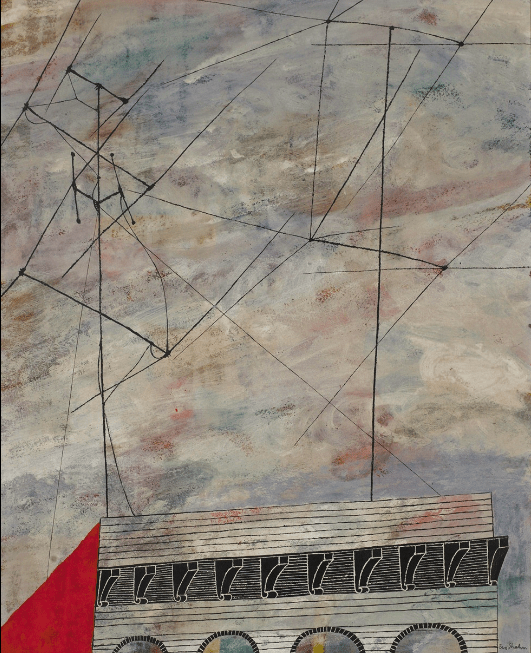
Television #2 — Ben Shahn

Screenshot 2018-04-22 at 10.28.13 AM

Television #2, 1949 by Ben Shahn (1898–1969)

Blog about the correct ranking of all Electric Light Orchestra songs with the word “blue” in the title

There are, to date, seven songs by the British rock group Electric Light Orchestra that contain the word “blue” in the title. A few of these are among ELO’s finest songs. I have put a lot of thought into this matter (by which I mean maybe five minutes), and decided that these are the correct rankings of ELO’s “blue” songs, from the not-best to the very-best:

#7. “Midnight Blue,” from Discovery (1979)

“Midnight Blue” isn’t a bad song, but it feels like a rehash of ELO’s better down-tempo ballad, “Can’t Get It Out of My Head” (from Eldorado, a much better album than Discovery). Lynne’s synthesized background vocals near the beginning point to a weirder, more-interesting tune than the standard pop song that emerges.

#6. “Birmingham Blues,” from Out of the Blue (1977)

“Birmingham Blues” is the first of two tracks from the album Out of the Blue on this list of songs with the word “blue” in the title. Out of the Blue is the only ELO album to date with the word “blue” in the title. Again, “Birmingham Blues” isn’t a bad song, but it feels like filler on an album that features songs like “Turn to Stone,” “Sweet Talkin’ Woman,” and “Mr. Blue Sky.”

#5. “Blue,” from Alone in the Universe (2015)

Technically, “Blue” is by Jeff Lynne’s ELO, but c’mon. It’s basically Jeff Lynne’s show after 1974 anyway. Alone in the Universe is a surprisingly good album—most of the songs clock in around three minutes, showing a restraint and focus not always present in the seventies stuff. “Blue” is actually a bonus track. It’s a sweet little ditty, beholden to the Beatles in the best possible way. (Lynne’s best Beatlesesque numbers synthesize the signature traits of McCartney, Lennon, Harrison—and hell, even Ringo—into something new and different).

#4. “Bluebird Is Dead,” from On the Third Day (1973)

On the Third Day is kind of the album where ELO starts to become, like ELO. “Bluebird Is Dead” is probably the loosest and rawest song on this list, and I think it’s Lynne’s vocal that puts it so high up here for me.

#3. “Mr. Blue Sky,” from Out of the Blue (1977)

“Mr. Blue Sky” is basically a perfect song. It closes out the “Concerto for a Rainy Day” side of Out of the Blue perfectly, bouncing along in a Beatles-beholden bop that unloads in not one but two—and arguably three endings.

#2. “Bluebird,” from Secret Messages (1983)

Secret Messages is a bit underrated—Jeff Lynne has some great ideas on the record (a lot of them showcased in “Bluebird”), but the ideas often fail to cohere. (For example, “Loser Gone Wild” offers a pastiche of the best and worst aspects of this era of ELO—a big contrast to the pastiche of “Mr. Blue Sky,” where everything works). “Bluebird” is a gorgeous song that has to grow on any listener. It’s corny as hell—hell, most of ELO is extremely corny, which is something I love about the band. They are Not Cool, a topic for another post. Anyway, “Bluebird” is a sweet, sad, wonderfully-overproduced song about loss. At about a minute into the jam, Lynne includes an infectious sample of himself simply repeating “work work work” —  and one senses that “Bluebird” isn’t just about a human relationship, but Lynne’s own relationship to his songwriting and production.

#1. “Boy Blue,” from Eldorado (1974)

Eldorado is my favorite ELO album and “Boy Blue” is my favorite song on Eldorado. The song is another pastiche, Beatlesesque pop mixed up with orchestral flourishes, but edged around with an almost-menacing motortik drive. (In another life, ELO could have been the Great English Krautrock band). Lyrically, the song is one ELO’s most focused. Boy Blue is our hometown hero, lately at war with some heathen or another, returns: “Hey, Boy Blue is back,” the town/chorus exclaims. They make a lot of noise for their boy, and ask where he’s been for so many years in the first verse. The second verse is Boy Blue’s reply, wherein he describes the hell of war, where he saw “bold knights, dropping down like flies, “kings, rolling in the mire,” and even God pointing “the finger of doom to our foes.” Lynne’s greatest couplet is surely in this song: “I have fought in the holiest wars/ I have smashed, some of the holiest jaws.” The violence Boy Blue has experienced (he’s been jailed and impaled, among other ordeals) has made him reflect that “no man should be stricken with fear.” He ends his verse by declaring, “no man, shall cause me to take up arms again.” Lynne’s delivery of these lyrics is what really makes the song soar though—his Boy Blue persona becomes more intense even as he builds to his promise of peace.

And here is a Spotify playlist of the songs; the sequencing has nothing to do with the rankings above:

Young Woman Fanning a Fire with a Bird’s Wing — Martin Schongauer

young_woman_fanning_a_fire_with_a_bird27s_wing

Young Woman Fanning a Fire with a Bird’s Wing, 1469 by Martin Schongauer (c. 1448-1491)

Blog about John Berryman’s Dream Song 265 (“I don’t know one damned butterfly from another”)

Hey.

Hey look. Look, hey.

This is a bait and switch. The bait was a promise in the title of the post for a Blog about John Berryman’s Dream Song 265, “I don’t know one damned butterfly from another.” Hey, I’m sorry, but the switch is that I have nothing to add here—I mean what could I add here?—-like what hey I want to say, is, just read Berryman’s poem—-

I don’t know one damned butterfly from another
my ignorance of the stars is formidable,
also of dogs & ferns
except that around my house one destroys the other
When I reckon up my real ignorance, pal,
I mumble “many returns”—

next time it will be nature & Thoreau
this time is Baudelaire if one had the skill
and even those problems O
At the mysterious urging of the body or Poe
reeled I with chance, insubordinate & a killer
O formal & elaborate I choose you

but I love too the spare, the hit-or-miss,
the mad, I sometimes can’t    always tell them apart
As we fall apart, will you let me hear?
That would be good, that would be halfway to bliss
You said will you answer back? I cross my heart
& hope to die but not this year.

Hey, okay. I encourage you to quit now, or better yet, reread our boy Berryman. But I’ll add a little, even though I said I wouldn’t.

I don’t know one damned butterfly from another

—but I think you know about beautiful fragile transmuting things

my ignorance of the stars is formidable,

—same

also of dogs & ferns

–I know a bit about dogs; less about ferns

except that around my house one destroys the other

–I hope it’s the dogs destroying the ferns if I have to pick a side, although I’m not unsympathetic to ferns.

When I reckon up my real ignorance, pal,
I mumble “many returns”—

–This is a great rhyme. I feel like I’m the speaker’s pal here too—maybe it’s all the wine I’ve put down my fat throat, but I feel like I get what he’s doing here. I have some fat real ignorance my ownself.

next time it will be nature & Thoreau

–Oh give us a Transcendentalist vamp Johnny! (Or is it Henry?)

this time is Baudelaire if one had the skill

–Oh if one had the skill oh (I think you have the skill Johnny Henry)

and even those problems O

–Oh Oh O Ho oH O hO

At the mysterious urging of the body or Poe

–I’m reminded here of Dream Song 384 where Henry digs up his dead suicide father’s corpse from the grave: “I’d like to scrabble till I got right down / away down under the grass / and ax the casket open ha to see / just how he’s taking it, which he sought so hard / we’ll tear apart the mouldering grave clothes ha.” The manic ha is more indebted to Poe though than any grave openings or casket axings.

reeled I with chance, insubordinate & a killer
O formal & elaborate I choose you

–Hey but this is about Berryman’s art, his poetry, always his fucking poetry. Formal and elaborate? Out here choosing?

but I love too the spare, the hit-or-miss,

–Oh hey me too. I mean that’s my jam too Henry John.

the mad, I sometimes can’t always tell them apart

–I can’t either.

As we fall apart, will you let me hear?
That would be good, that would be halfway to bliss

–I think we’d all like to be let to hear.

You said will you answer back? I cross my heart
& hope to die but not this year.

-Not this year


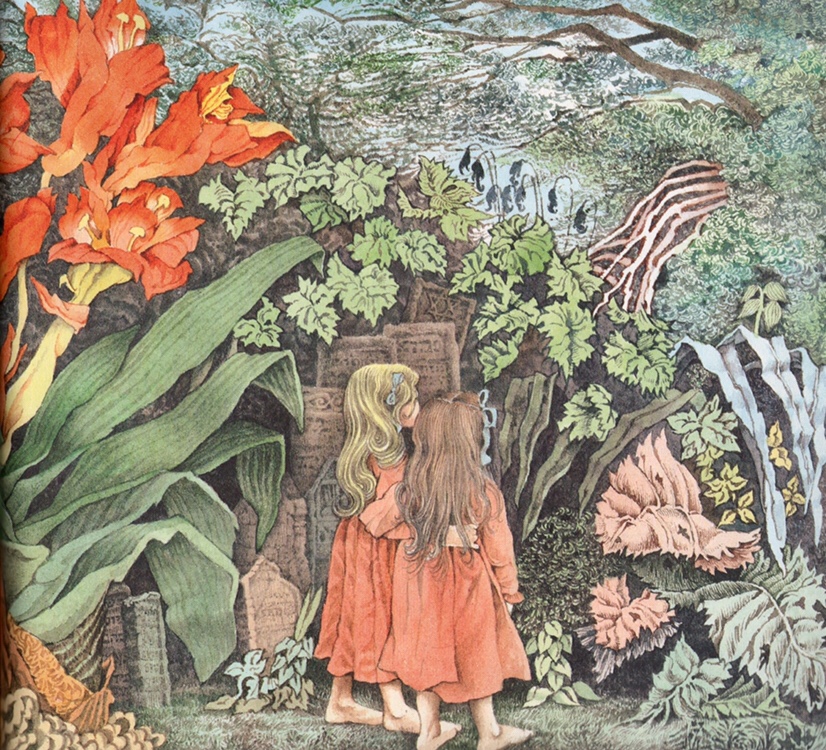
Another Little Girl Was Standing Beside Her — Maurice Sendak

img_9540

From Maurice Sendak’s retelling of Wilhelm Grimm’s Dear Mili.

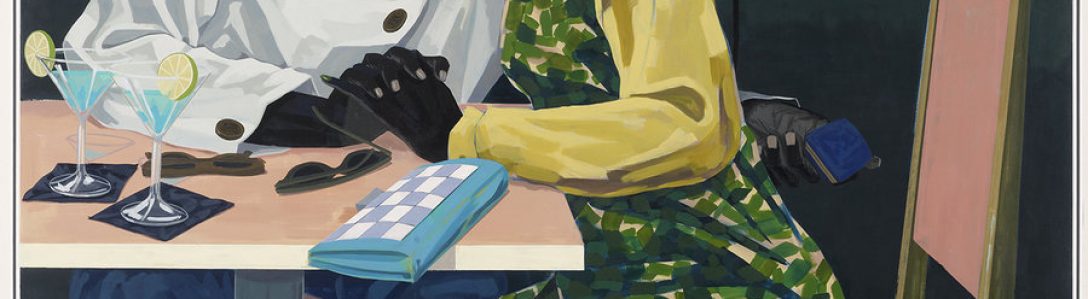
Spa — Axel Krause

krause-kurbad2c-20152c-70x100cm2c-occ88l-auf-leinwand

Screenshot 2018-04-19 at 3.47.37 PM

Screenshot 2018-04-19 at 3.47.10 PM

Spa, 2015 by Axel Krause (b. 1958)

Blog about the American Arcadia (or Arcadian America?) scene in Nathaniel Hawthorne’s novel The Blithedale Romance

img_9535

I am glad I reread Nathaniel Hawthorne’s 1852 novel for many reasons. One of those reasons is because I had completely forgotten to remember a marvelous scene near the end of the novel, in Ch. XXV — “The Masqueraders.” This episode happens near the end of the chapter. Hawthorne’s stand-in Miles Coverdale has decided to return to Blithedale after spending some time out in, like, the world.

Coverdale’s return to the utopian project he half-heartedly abandoned is thoroughly coded in Hawthorne’s signature ambivalence: He notes “a sickness of the spirits kept alternating with my flights of causeless buoyancy” as he walks through the wood. Approaching the Blithedale farm, and feels an “invincible reluctance” in his return, which causes him to linger in the forest. By and by, as the lovely transitional phrase goes, Coverdale winds his way back to his “hermitage, in the heart of the white-pine tree.” (The white-pine reference strikes me as an oblique reference here to Hawthorne himself—or rather, a nod to a distinction between white pine and black hawthorn trees, alter egos).

Here in his hermitage he rests among grapes dangling in “abundant clusters of the deepest purple, deliciously sweet to the taste.” Coverdale’s hermitage is an idealized, natural—transcendental—version of Blithedale, the grapevines (a prefiguration of communication in the American parlance) a kind of perfectly polygamous knot of communal existence.

Taken up in solo-bacchanalia, Coverdale begins devouring the grapes. Always the loner, always the voyeur, he checks out the house from his arboreal perch and notes its emptiness. He decides, drunken on sweet grapes, to skulk through the woods, where he hears “Voices, male and feminine; laughter, not only of fresh young throats, but the bass of grown people.” He continues—

The wood, in this portion of it, seemed as full of jollity as if Comus and his crew were holding their revels in one of its usually lonesome glades. Stealing onward as far as I durst, without hazard of discovery, I saw a concourse of strange figures beneath the overshadowing branches. They appeared, and vanished, and came again, confusedly with the streaks of sunlight glimmering down upon them.

“Comus and his crew” — what a lovely evocation! Comus, cup-bearer and heir of Bacchus, is a figuration of erotic chaos. Hawthorne ushers his hero into a scene of pastoral American anarchy, a strange Arcadia that Walt Whitman would try to replicate in Leaves of Grass a few years later. Note the admixture of cultures here in Hawthorne’s transcendentalist Halloween:

Among them was an Indian chief, with blanket, feathers, and war-paint, and uplifted tomahawk; and near him, looking fit to be his woodland bride, the goddess Diana, with the crescent on her head, and attended by our big lazy dog, in lack of any fleeter hound. Drawing an arrow from her quiver, she let it fly at a venture, and hit the very tree behind which I happened to be lurking. Another group consisted of a Bavarian broom-girl, a negro of the Jim Crow order, one or two foresters of the Middle Ages, a Kentucky woodsman in his trimmed hunting-shirt and deerskin leggings, and a Shaker elder, quaint, demure, broad-brimmed, and square-skirted. Shepherds of Arcadia, and allegoric figures from the “Faerie Queen,” were oddly mixed up with these. Arm in arm, or otherwise huddled together in strange discrepancy, stood grim Puritans, gay Cavaliers, and Revolutionary officers with three-cornered cocked hats, and queues longer than their swords. A bright-complexioned, dark-haired, vivacious little gypsy, with a red shawl over her head, went from one group to another, telling fortunes by palmistry; and Moll Pitcher, the renowned old witch of Lynn, broomstick in hand, showed herself prominently in the midst, as if announcing all these apparitions to be the offspring of her necromantic art.

Again though, in classic Hawthorne fashion, our author hedges all bets, tempering his mythical romantic flight in skepticism, here embodied by Silas Foster, the only real farmer (real earthworker) of Blithedale:

But Silas Foster, who leaned against a tree near by, in his customary blue frock and smoking a short pipe, did more to disenchant the scene, with his look of shrewd, acrid, Yankee observation, than twenty witches and necromancers could have done in the way of rendering it weird and fantastic.

Our narrator Coverdale also spies some men “with portentously red noses…spreading a banquet on the leaf-strewn earth; while a horned and long-tailed gentleman” tuning up a fiddle. The end result:

So they joined hands in a circle, whirling round so swiftly, so madly, and so merrily, in time and tune with the Satanic music, that their separate incongruities were blended all together, and they became a kind of entanglement that went nigh to turn one’s brain with merely looking at it.

The entanglement here—which eventually explodes in riotous communal laughter—recalls the polygamous knot of grapevines that shrouded Coverdale’s hermitage.

The great laughter prompts Coverdale to explode in his own laughter, whereupon the Bacchic party sets out after him with comic-murderous intent:

“Some profane intruder!” said the goddess Diana. “I shall send an arrow through his heart, or change him into a stag, as I did Actaeon, if he peeps from behind the trees!”

Coverdale flees.

He eventually happens upon an old rotting woodpile covered in moss, where he daydreams about “the long-dead woodman, and his long-dead wife and children, coming out of their chill graves, and essaying to make a fire with this heap of mossy fuel!” — this before finally giving himself up to the Blithedale crew.

The episode strikes me very much as a sequel or reboot of Hawthorne’s 1835 story “Young Goodman Brown,” in which a Puritan naif wonders into the woods dark and deep and witnesses all the horrors of his young country made real—he sees the dark heart of his community beating naked and bloody and raw and Satanic—and it changes him forever, essentially dulling his soul unto a living death. The American Arcadia episode of Blithedale though is a bit richer in its mythos, its paganism more complex and inclusive, its perspective character more attuned to the vibrant possibilities of a transcendental community, even as he stands on its outside—and what is an outsider but the most vital secret ingredient of any community?
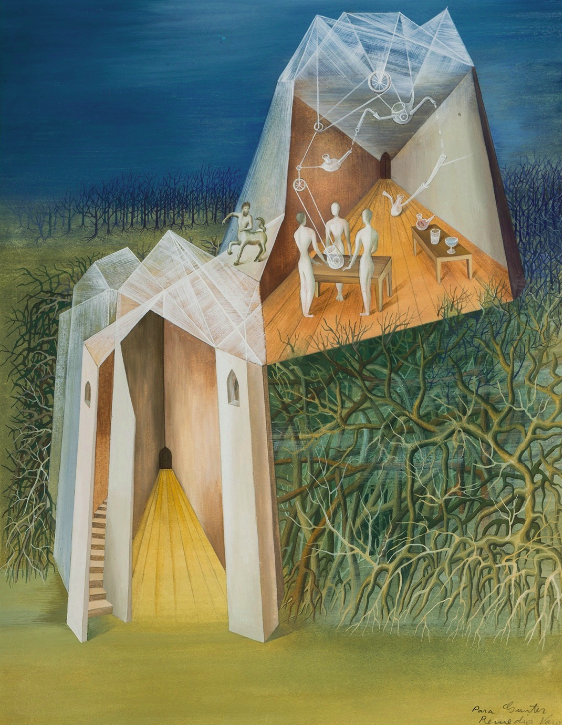
Landscape, Tower, Centaur — Remedios Varo

Screenshot 2018-04-18 at 8.12.25 PM

Landscape, Tower, Centaur, 1943 by Remedios Varo (1908-1963)

Celestina’s House — Paula Rego

9f605cea344c133c21e4350266e0d493

Celestina’s House, 2001 by Paula Rego (b. 1935)

Few virgins (I thank God for it) have you seen in this city that I have not helped sell their wares. As soon as the girl is born, I write her down in my register and keep a catalogue of all their names to the intent that I might know how many escaped my net. Why, what did you think of me, Sempronio? Can I live by the air? Can I feed myself with wind? Do I inherit any other land? Have I any other house or vineyard? Know you of any other substance of mine besides this office? By what do I eat and drink? By what do I put clothes on my back and shoes on my feet? In this city  was I born; in it was I bred; and in it I live (though I say it) in good credit and estimation, as all the world knows. You may rest assured that he who knows not both my name and my house is a stranger in this town.

From José María Ruano de la Haza’s adaptation of Celestina. Based on the English translation by James Mabbe (1631) of the Comedia de Calisto y Melibea by Fernando de Rojas (1499).